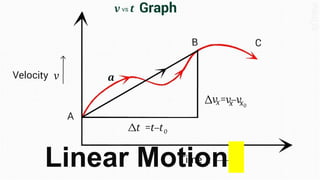
Linear Motion
Define the terms: distance, displacement, speed, velocity, acceleration;
Apply displacement-time and velocity-time graphs
Finding the gradient for straight lines only
discuss Aristotle's arguments in support of his "law of motionā€, that is, v
āObjectives:
Distance, s
Distance is a scalar quantity which refers to how far an object travels or how much ground an
object has covered during its motion.
Unit: m
Displacement, s
Displacement is a vector quantity which refers to how far an object travels in a particular direction.
This is usually the shortest distance between two points
Unit: m
Some terms to understand
ā˜…Speed , v
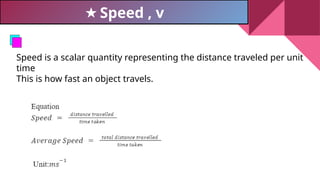
Speed is a scalar quantity representing the distance traveled per unit
time
This is how fast an object travels.
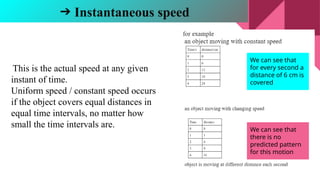
āž” Instantaneous speed
This is the actual speed at any given
instant of time.
Uniform speed / constant speed occurs
if the object covers equal distances in
equal time intervals, no matter how
small the time intervals are.
We can see that
for every second a
distance of 6 cm is
covered
We can see that
there is no
predicted pattern
for this motion
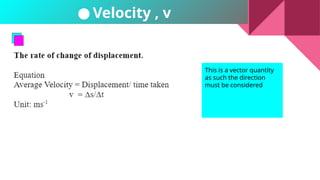
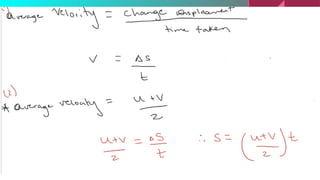
ā— Velocity , v
This is a vector quantity
as such the direction
must be considered
ā— Velocity , v
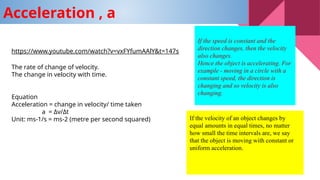
Acceleration , a
https://www.youtube.com/watch?v=vxFYfumAAlY&t=147s
The rate of change of velocity.
The change in velocity with time.
Equation
Acceleration = change in velocity/ time taken
a = Δv/Δt
Unit: ms-1/s = ms-2 (metre per second squared)
If the speed is constant and the
direction changes, then the velocity
also changes.
Hence the object is accelerating. For
example - moving in a circle with a
constant speed, the direction is
changing and so velocity is also
changing.
If the velocity of an object changes by
equal amounts in equal times, no matter
how small the time intervals are, we say
that the object is moving with constant or
uniform acceleration.
Motion Graphs
Displacement time graphs
The displacement-time graph of a moving object tells the distance covered
by a moving object with a change in time. The displacement is a vector
quantity. The slope or the gradient of this graph indicates the object's
velocity. The displacement-time graph is also known as the position-time
graph, which represents the motion of an object. Here, in the graph, the
moving object’s displacement is shown on the y-axis and is a dependent
variable, whereas the time is shown on the x-axis and is an independent
variable.
The correlation between the displacement and the velocity of the object gives
rise to different types of slope shapes in the displacement-time graph. For
example, if the displacement of the moving object increases with time, the graph
shows a constant positive velocity. On the other hand, if the displacement of the
moving object decreases with the duration of time, the graph shows a constant
negative velocity.
Displacement time graphs
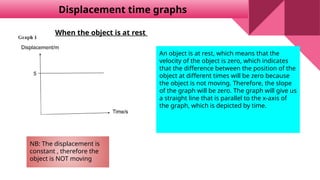
NB: The displacement is
constant , therefore the
object is NOT moving
An object is at rest, which means that the
velocity of the object is zero, which indicates
that the difference between the position of the
object at different times will be zero because
the object is not moving. Therefore, the slope
of the graph will be zero. The graph will give us
a straight line that is parallel to the x-axis of
the graph, which is depicted by time.
When the object is at rest
Displacement time graphs
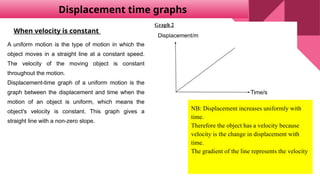
NB: Displacement increases uniformly with
time.
Therefore the object has a velocity because
velocity is the change in displacement with
time.
The gradient of the line represents the velocity
A uniform motion is the type of motion in which the
object moves in a straight line at a constant speed.
The velocity of the moving object is constant
throughout the motion.
Displacement-time graph of a uniform motion is the
graph between the displacement and time when the
motion of an object is uniform, which means the
object's velocity is constant. This graph gives a
straight line with a non-zero slope.
When velocity is constant
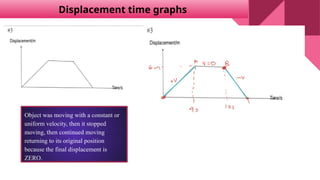
Object was moving with a constant or
uniform velocity, then it stopped
moving, then continued moving
returning to its original position
because the final displacement is
ZERO.
Displacement time graphs
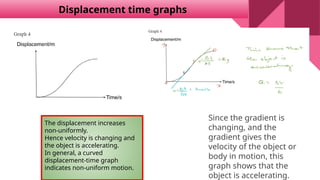
The displacement increases
non-uniformly.
Hence velocity is changing and
the object is accelerating.
In general, a curved
displacement-time graph
indicates non-uniform motion.
Displacement time graphs
Since the gradient is
changing, and the
gradient gives the
velocity of the object or
body in motion, this
graph shows that the
object is accelerating.
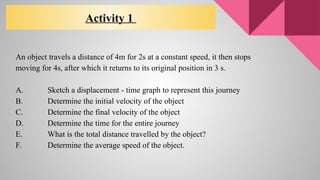
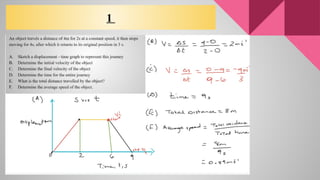
An object travels a distance of 4m for 2s at a constant speed, it then stops
moving for 4s, after which it returns to its original position in 3 s.
A. Sketch a displacement - time graph to represent this journey
B. Determine the initial velocity of the object
C. Determine the final velocity of the object
D. Determine the time for the entire journey
E. What is the total distance travelled by the object?
F. Determine the average speed of the object.
Activity 1
1
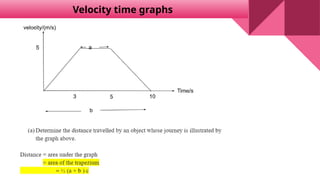
Velocity time graphs
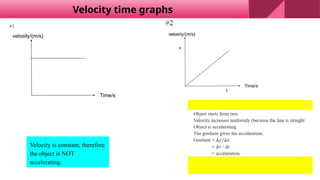
Velocity is constant, therefore
the object is NOT
accelerating.
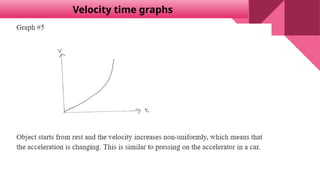
Velocity time graphs
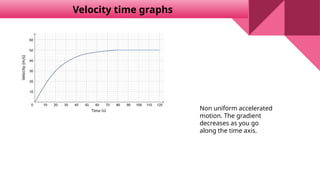
Non uniform accelerated
motion. The gradient
decreases as you go
along the time axis.
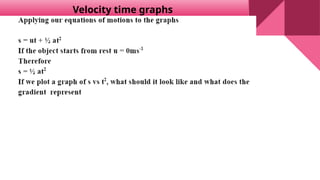
Velocity time graphs
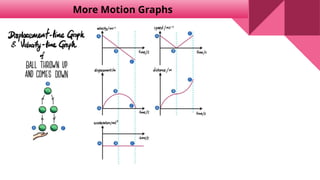
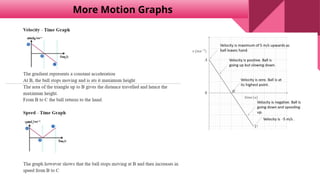
More Motion Graphs
More Motion Graphs
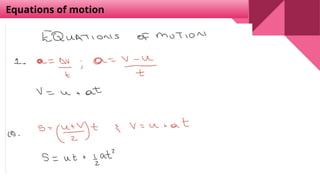
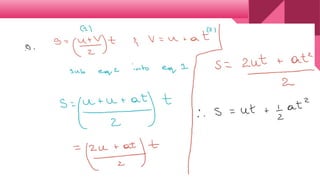
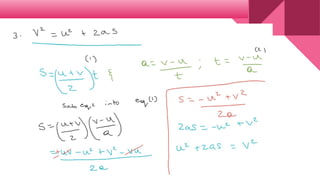
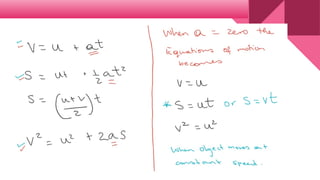
Equation of
Motions
Equations of motion
Laws of Motions
ā˜… 1st law of motion
First Law- The law of inertia
A body will continue in a uniform motion unless acted upon by an
unbalanced external force.
Inertia is the natural tendency of a body to resist change in its state.
Explanation
An object at rest will remain at rest or an object in motion will remain in
motion until a force comes along to change it.
Examples:
1. A sprinter beyond the finish line of a race
2. A ball rolling on the ground
3. Can you think of any more examples??
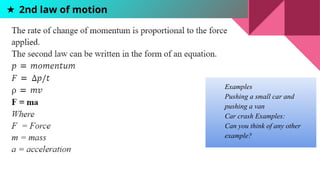
ā˜… 2nd law of motion
Examples
Pushing a small car and
pushing a van
Car crash Examples:
Can you think of any other
example?
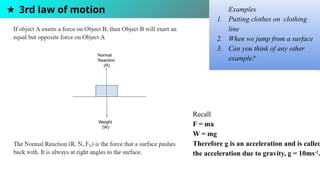
ā˜… 3rd law of motion Examples
1. Putting clothes on clothing
line
2. When we jump from a surface
3. Can you think of any other
example?
Recall
F = ma
W = mg
Therefore g is an acceleration and is called
the acceleration due to gravity, g = 10ms-2
.

4th form Linear Motion -Kinematics(1).pptx

  • 1.
  • 2.
    Define the terms:distance, displacement, speed, velocity, acceleration; Apply displacement-time and velocity-time graphs Finding the gradient for straight lines only discuss Aristotle's arguments in support of his "law of motionā€, that is, v āObjectives:
  • 3.
    Distance, s Distance isa scalar quantity which refers to how far an object travels or how much ground an object has covered during its motion. Unit: m Displacement, s Displacement is a vector quantity which refers to how far an object travels in a particular direction. This is usually the shortest distance between two points Unit: m Some terms to understand
  • 4.
    ā˜…Speed , v Speedis a scalar quantity representing the distance traveled per unit time This is how fast an object travels.
  • 5.
    āž” Instantaneous speed Thisis the actual speed at any given instant of time. Uniform speed / constant speed occurs if the object covers equal distances in equal time intervals, no matter how small the time intervals are. We can see that for every second a distance of 6 cm is covered We can see that there is no predicted pattern for this motion
  • 6.
    ā— Velocity ,v This is a vector quantity as such the direction must be considered
  • 7.
  • 8.
    Acceleration , a https://www.youtube.com/watch?v=vxFYfumAAlY&t=147s Therate of change of velocity. The change in velocity with time. Equation Acceleration = change in velocity/ time taken a = Δv/Δt Unit: ms-1/s = ms-2 (metre per second squared) If the speed is constant and the direction changes, then the velocity also changes. Hence the object is accelerating. For example - moving in a circle with a constant speed, the direction is changing and so velocity is also changing. If the velocity of an object changes by equal amounts in equal times, no matter how small the time intervals are, we say that the object is moving with constant or uniform acceleration.
  • 9.
  • 10.
    Displacement time graphs Thedisplacement-time graph of a moving object tells the distance covered by a moving object with a change in time. The displacement is a vector quantity. The slope or the gradient of this graph indicates the object's velocity. The displacement-time graph is also known as the position-time graph, which represents the motion of an object. Here, in the graph, the moving object’s displacement is shown on the y-axis and is a dependent variable, whereas the time is shown on the x-axis and is an independent variable. The correlation between the displacement and the velocity of the object gives rise to different types of slope shapes in the displacement-time graph. For example, if the displacement of the moving object increases with time, the graph shows a constant positive velocity. On the other hand, if the displacement of the moving object decreases with the duration of time, the graph shows a constant negative velocity.
  • 11.
    Displacement time graphs NB:The displacement is constant , therefore the object is NOT moving An object is at rest, which means that the velocity of the object is zero, which indicates that the difference between the position of the object at different times will be zero because the object is not moving. Therefore, the slope of the graph will be zero. The graph will give us a straight line that is parallel to the x-axis of the graph, which is depicted by time. When the object is at rest
  • 12.
    Displacement time graphs NB:Displacement increases uniformly with time. Therefore the object has a velocity because velocity is the change in displacement with time. The gradient of the line represents the velocity A uniform motion is the type of motion in which the object moves in a straight line at a constant speed. The velocity of the moving object is constant throughout the motion. Displacement-time graph of a uniform motion is the graph between the displacement and time when the motion of an object is uniform, which means the object's velocity is constant. This graph gives a straight line with a non-zero slope. When velocity is constant
  • 13.
    Object was movingwith a constant or uniform velocity, then it stopped moving, then continued moving returning to its original position because the final displacement is ZERO. Displacement time graphs
  • 14.
    The displacement increases non-uniformly. Hencevelocity is changing and the object is accelerating. In general, a curved displacement-time graph indicates non-uniform motion. Displacement time graphs Since the gradient is changing, and the gradient gives the velocity of the object or body in motion, this graph shows that the object is accelerating.
  • 15.
    An object travelsa distance of 4m for 2s at a constant speed, it then stops moving for 4s, after which it returns to its original position in 3 s. A. Sketch a displacement - time graph to represent this journey B. Determine the initial velocity of the object C. Determine the final velocity of the object D. Determine the time for the entire journey E. What is the total distance travelled by the object? F. Determine the average speed of the object. Activity 1
  • 16.
  • 17.
    Velocity time graphs Velocityis constant, therefore the object is NOT accelerating.
  • 18.
  • 19.
  • 20.
  • 21.
  • 22.
  • 23.
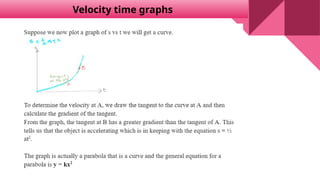
    Velocity time graphs Nonuniform accelerated motion. The gradient decreases as you go along the time axis.
  • 24.
  • 25.
  • 26.
  • 27.
  • 28.
  • 29.
  • 33.
  • 34.
    ā˜… 1st lawof motion First Law- The law of inertia A body will continue in a uniform motion unless acted upon by an unbalanced external force. Inertia is the natural tendency of a body to resist change in its state. Explanation An object at rest will remain at rest or an object in motion will remain in motion until a force comes along to change it. Examples: 1. A sprinter beyond the finish line of a race 2. A ball rolling on the ground 3. Can you think of any more examples??
  • 35.
    ā˜… 2nd lawof motion Examples Pushing a small car and pushing a van Car crash Examples: Can you think of any other example?
  • 36.
    ā˜… 3rd lawof motion Examples 1. Putting clothes on clothing line 2. When we jump from a surface 3. Can you think of any other example? Recall F = ma W = mg Therefore g is an acceleration and is called the acceleration due to gravity, g = 10ms-2 .