Exploring Force Direction and Magnitude
Forces and
Changes in
Motion
Today, you will:
Represent forces using force diagrams
Differentiate balanced and unbalanced forces
Describe how the size and direction of the resultant
force affect the motion of an object
What can forces do?
1 2 3
Forces are pushes or pulls that stem from the interaction between objects.
A force exerted on an object can cause changes in an object’s motion.
It can make an object:
Start or stop
moving
Speed up or
slow down
Change its
direction
The longer the arrow, the
larger the force
An arrow pointing to the
left means the force is
acting to the left.
How do we represent forces?
We use force diagrams to represent forces acting on objects.
Arrows are used in force diagrams to show:
SIZE OF THE FORCE DIRECTION OF FORCE
How do we represent forces?
Remember to always label the forces the arrows represent and their sizes in newtons.
The newton (N) is the standard unit for force, named after the English physicist and
mathematician Isaac Newton.
A person pushing a trolley A crate on a surface
Pushing force
(500 N)
Reaction force
of the surface
(100 N)
Weight of
the crate
(100 N)
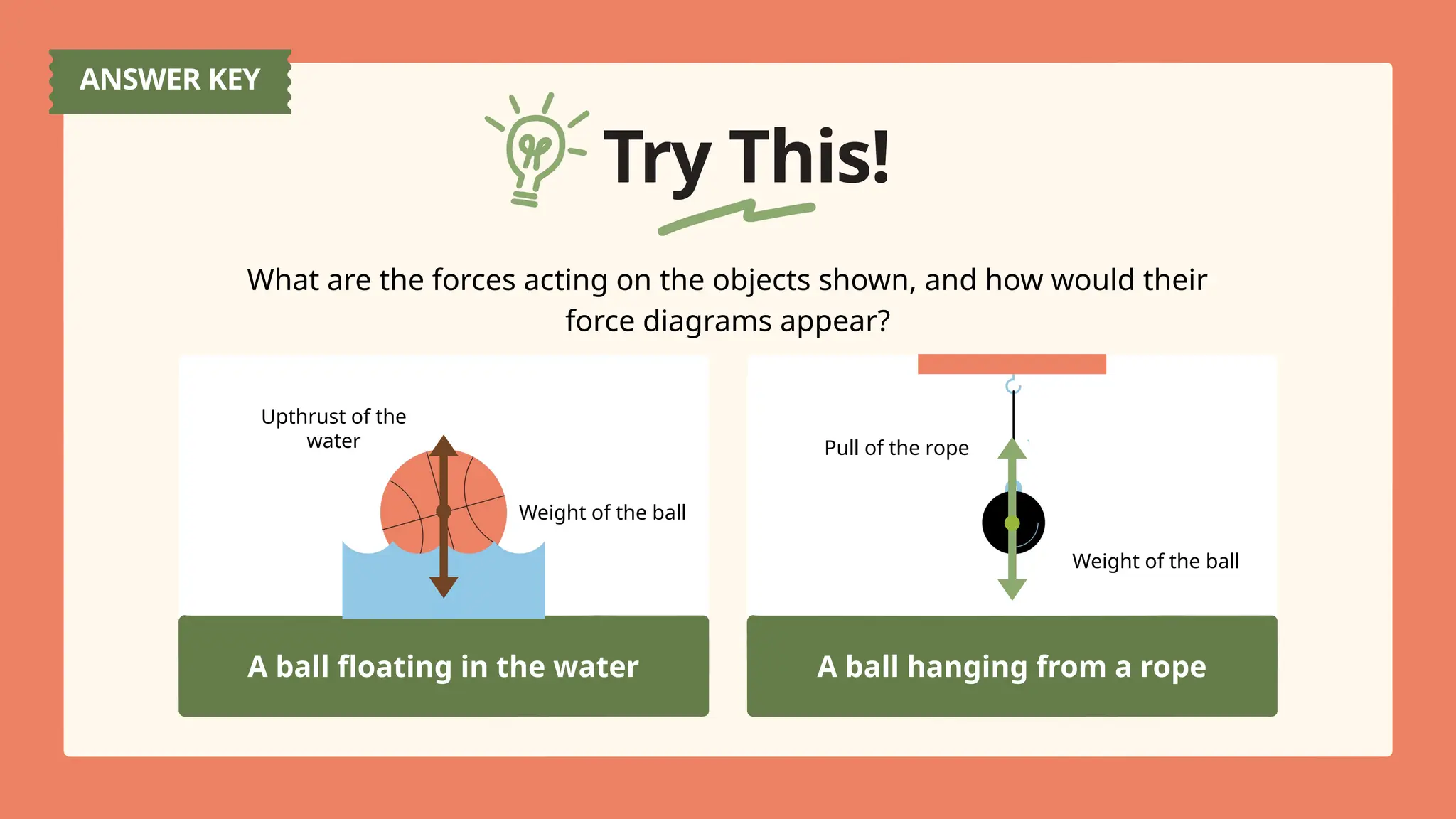
Try This!
What are the forces acting on the objects shown, and how would their
force diagrams appear?
A ball floating in the water A ball hanging from a rope
Try This!
What are the forces acting on the objects shown, and how would their
force diagrams appear?
A ball floating in the water A ball hanging from a rope
Upthrust of the
water
Weight of the ball
Pull of the rope
Weight of the ball
ANSWER KEY
Balanced
Forces
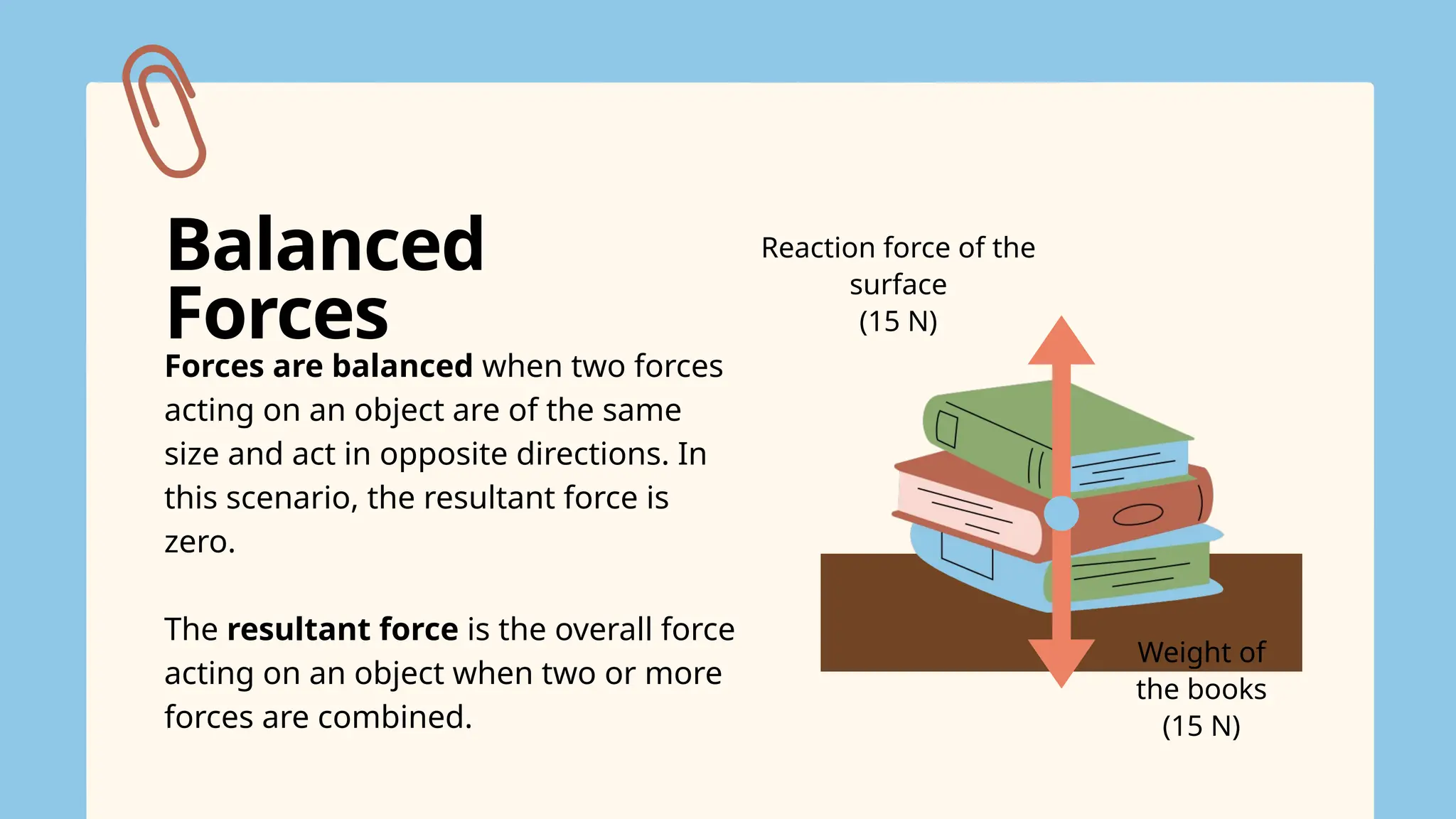
Forces are balanced when two forces
acting on an object are of the same
size and act in opposite directions. In
this scenario, the resultant force is
zero.
The resultant force is the overall force
acting on an object when two or more
forces are combined.
Weight of
the books
(15 N)
Reaction force of the
surface
(15 N)
Balanced Forces
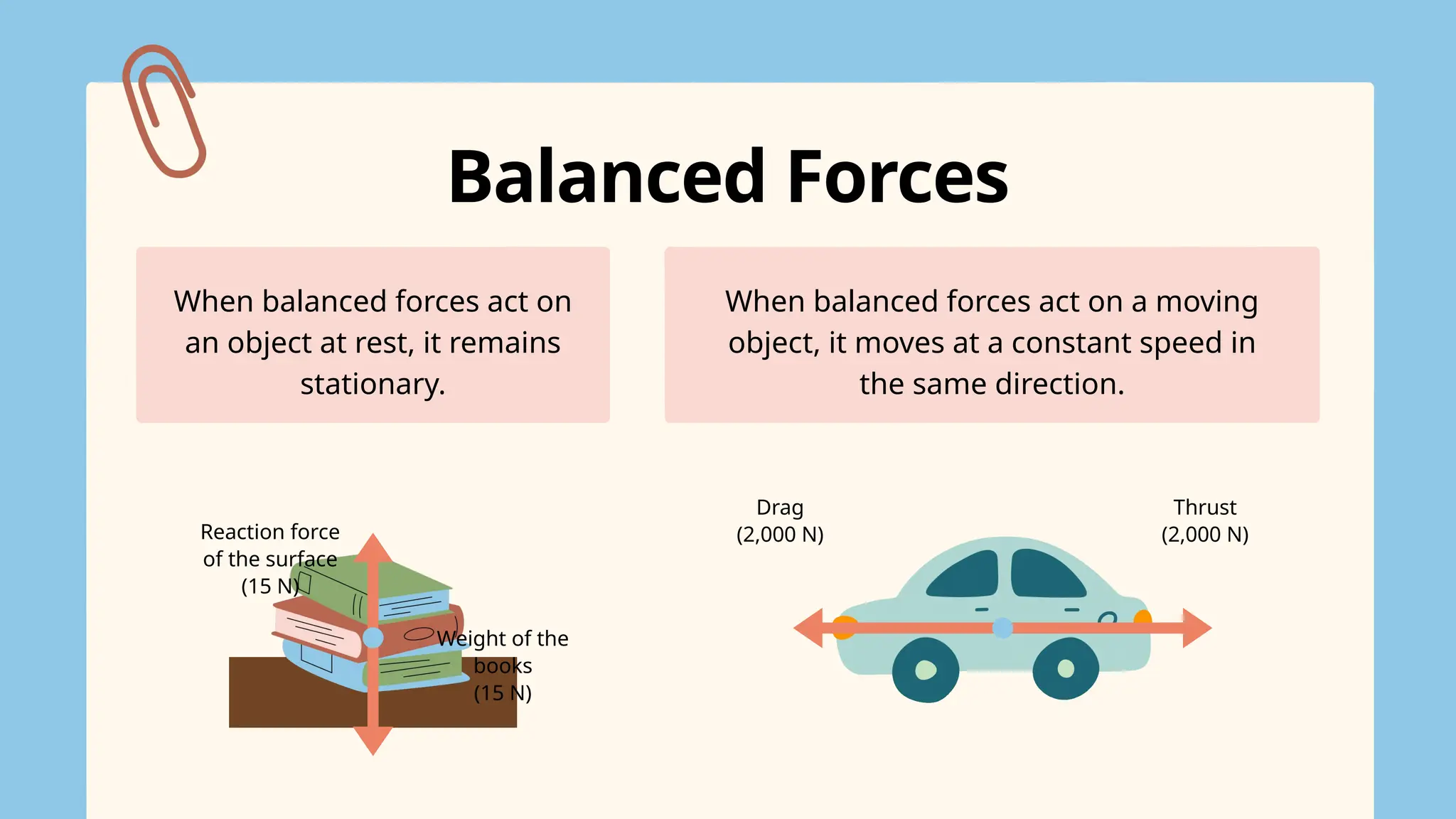
When balanced forces act on
an object at rest, it remains
stationary.
When balanced forces act on a moving
object, it moves at a constant speed in
the same direction.
Weight of the
books
(15 N)
Reaction force
of the surface
(15 N)
Thrust
(2,000 N)
Drag
(2,000 N)
Learning Check
Determine whether each statement is TRUE or FALSE. If false, suggest
an alternative statement to make it correct.
If an object is stationary, no
forces are pushing or pulling
it.
If an object is moving, a
force must be acting on it.
1 2
Learning Check
If an object is stationary, no
forces are pushing or pulling
it.
An object at rest usually has many
forces acting on it, including gravity
and air resistance (or drag) and the
upward force of the surface the
object is sitting on.
If an object is moving, no
force is necessary to keep it moving,
but a force is needed to
make it stop or change direction.
If an object is moving, a
force must be acting on it.
1 2
ANSWER KEY
FALSE FALSE
Unbalanced Forces
We can say that forces are
unbalanced when two (or more)
forces acting on an object are not
equal in size. This means that the
resultant force is no longer zero.
Unbalanced forces cause changes in
the motion of an object. Pushing force
(200 N)
Box starts moving to
the right
Friction
(100 N)
Unbalanced Forces
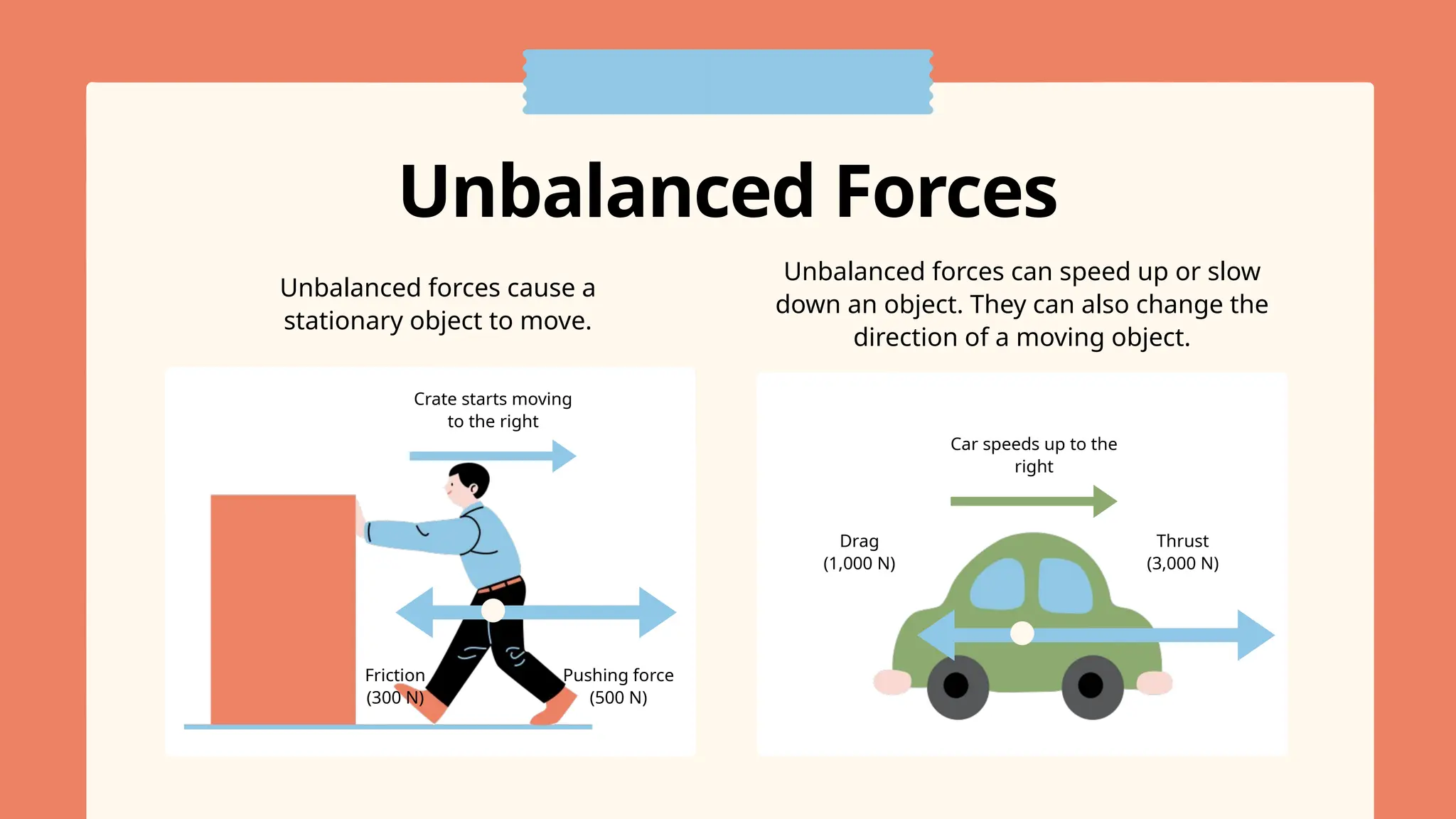
Unbalanced forces cause a
stationary object to move.
Unbalanced forces can speed up or slow
down an object. They can also change the
direction of a moving object.
Pushing force
(500 N)
Crate starts moving
to the right
Car speeds up to the
right
Friction
(300 N)
Thrust
(3,000 N)
Drag
(1,000 N)
Unbalanced Forces
The change in motion of a moving object depends on the direction
of the resultant force.
Resultant force = 3,000 N + (-1,000 N)
= 2,000 N
Resultant force = 1,000 N + (-2,000 N)
= -1,000 N
1,000 N 2,000 N
3,000 N 1,000 N
The truck speeds up to the left The truck slows down
TUG OF WAR RIDING THE SKATEBOARD
Forces Around Us
Winning the tug of war requires an
unbalanced force. The team that exerts
the larger force wins.
To initiate movement or increase speed on
a skateboard, an unbalanced force is
generated by pushing against the ground
with your foot.
Learning
Check
You kick a stationary soccer ball,
and it starts rolling forward.
Then, it hits a muddy area and
slows down until it stops. Why did
the ball stop when it hit the mud?
Learning
Check
The ball stops because the mud
creates friction—a force that acts
opposite to the direction the ball is
moving.
The forces on the ball are unbalanced,
causing the motion of the object to
change.
ANSWER KEY
When forces acting on an
object are not the same
size, it indicates that the
forces are unbalanced,
potentially leading to
changes in the object's
motion.
A force is a push or a pull
resulting from the
interaction between forces.
Force diagrams can
represent these forces.
Summary
Forces are considered
balanced when they are
the same size and act in
opposite directions.

Forces and Changes in Motion-Exploring Force Direction and Magnitude (3).pptx

  • 1.
    Exploring Force Directionand Magnitude Forces and Changes in Motion
  • 2.
    Today, you will: Representforces using force diagrams Differentiate balanced and unbalanced forces Describe how the size and direction of the resultant force affect the motion of an object
  • 3.
    What can forcesdo? 1 2 3 Forces are pushes or pulls that stem from the interaction between objects. A force exerted on an object can cause changes in an object’s motion. It can make an object: Start or stop moving Speed up or slow down Change its direction
  • 4.
    The longer thearrow, the larger the force An arrow pointing to the left means the force is acting to the left. How do we represent forces? We use force diagrams to represent forces acting on objects. Arrows are used in force diagrams to show: SIZE OF THE FORCE DIRECTION OF FORCE
  • 5.
    How do werepresent forces? Remember to always label the forces the arrows represent and their sizes in newtons. The newton (N) is the standard unit for force, named after the English physicist and mathematician Isaac Newton. A person pushing a trolley A crate on a surface Pushing force (500 N) Reaction force of the surface (100 N) Weight of the crate (100 N)
  • 6.
    Try This! What arethe forces acting on the objects shown, and how would their force diagrams appear? A ball floating in the water A ball hanging from a rope
  • 7.
    Try This! What arethe forces acting on the objects shown, and how would their force diagrams appear? A ball floating in the water A ball hanging from a rope Upthrust of the water Weight of the ball Pull of the rope Weight of the ball ANSWER KEY
  • 8.
    Balanced Forces Forces are balancedwhen two forces acting on an object are of the same size and act in opposite directions. In this scenario, the resultant force is zero. The resultant force is the overall force acting on an object when two or more forces are combined. Weight of the books (15 N) Reaction force of the surface (15 N)
  • 9.
    Balanced Forces When balancedforces act on an object at rest, it remains stationary. When balanced forces act on a moving object, it moves at a constant speed in the same direction. Weight of the books (15 N) Reaction force of the surface (15 N) Thrust (2,000 N) Drag (2,000 N)
  • 10.
    Learning Check Determine whethereach statement is TRUE or FALSE. If false, suggest an alternative statement to make it correct. If an object is stationary, no forces are pushing or pulling it. If an object is moving, a force must be acting on it. 1 2
  • 11.
    Learning Check If anobject is stationary, no forces are pushing or pulling it. An object at rest usually has many forces acting on it, including gravity and air resistance (or drag) and the upward force of the surface the object is sitting on. If an object is moving, no force is necessary to keep it moving, but a force is needed to make it stop or change direction. If an object is moving, a force must be acting on it. 1 2 ANSWER KEY FALSE FALSE
  • 12.
    Unbalanced Forces We cansay that forces are unbalanced when two (or more) forces acting on an object are not equal in size. This means that the resultant force is no longer zero. Unbalanced forces cause changes in the motion of an object. Pushing force (200 N) Box starts moving to the right Friction (100 N)
  • 13.
    Unbalanced Forces Unbalanced forcescause a stationary object to move. Unbalanced forces can speed up or slow down an object. They can also change the direction of a moving object. Pushing force (500 N) Crate starts moving to the right Car speeds up to the right Friction (300 N) Thrust (3,000 N) Drag (1,000 N)
  • 14.
    Unbalanced Forces The changein motion of a moving object depends on the direction of the resultant force. Resultant force = 3,000 N + (-1,000 N) = 2,000 N Resultant force = 1,000 N + (-2,000 N) = -1,000 N 1,000 N 2,000 N 3,000 N 1,000 N The truck speeds up to the left The truck slows down
  • 15.
    TUG OF WARRIDING THE SKATEBOARD Forces Around Us Winning the tug of war requires an unbalanced force. The team that exerts the larger force wins. To initiate movement or increase speed on a skateboard, an unbalanced force is generated by pushing against the ground with your foot.
  • 16.
    Learning Check You kick astationary soccer ball, and it starts rolling forward. Then, it hits a muddy area and slows down until it stops. Why did the ball stop when it hit the mud?
  • 17.
    Learning Check The ball stopsbecause the mud creates friction—a force that acts opposite to the direction the ball is moving. The forces on the ball are unbalanced, causing the motion of the object to change. ANSWER KEY
  • 18.
    When forces actingon an object are not the same size, it indicates that the forces are unbalanced, potentially leading to changes in the object's motion. A force is a push or a pull resulting from the interaction between forces. Force diagrams can represent these forces. Summary Forces are considered balanced when they are the same size and act in opposite directions.