RESEARCH Open Access
Three week dietary intervention using
apricots, pomegranate juice or/and
fermented sour sobya and impact on
biomarkers of antioxidative activity,
oxidative stress and erythrocytic glutathione
transferase activity among adults
Mostafa Gouda1
, Amr Moustafa2
, Laila Hussein1*
and Mohamed Hamza3
Abstract
Background: The beneficial effects of the polyphenol (PP) rich fruits and Lactic acid bacteria fermented foods had
been reported as cost-effective strategies for health promotion. Randomized controlled trial was designed to test
the hypothesis that daily intake of polyphenol rich pomegranate juice (PGJ) or/ and lactic acid bacteria fermented
sobya (FS) improved selected biomarkers of relevance to heath status.
Methods: The design of the human trial consisted of 35 healthy adults, who were distributed to 5 equal groups;
The first group served as control and received no supplements; the second group received fresh apricot fruits
(200 g); the third (PGJ) (250 g), the fourth a mixture of PGJ (150 g) and FS (140 g) and the fifth group received (FS)
(170 g). The supplements were served daily between 5 – 6 pm for 21 days. Blood and urine samples were collected
at days zero and 22 of the dietary intervention. The supplements were analyzed chemically for (PP) contents and
total antioxidative activities and microbiologically for selected bacteria and yeast counts. The blood samples were
assayed for plasma antioxidative activities and for erythrocytic glutathione transferase activity (E-GST). Urine samples
were analyzed for the excretions of total PP, antioxidative activity and thiobarbituric acid reactive substances
(TBARS). Statistical analysis: Two way analysis of variance (ANOVA) was conducted and included the main effects of
treatment, time and treatment x time interaction.
Results: Daily intake of (PGJ) for 3 weeks significantly increased the plasma and urinary anti-oxidative activities and
reduced the urinary excretion of (TBARS). Daily intake of (FS) for 3 weeks increased only (E-GST) activity. Daily intake
of a mixture of PGJ and (FS) was also effective.
Conclusions: The daily intakes of PGJ and/ or (FS) affected positively selected biomarkers of relevance to health
status. These functional foods have potential implication for use as bio-therapeutic foods.
(Continued on next page)
* Correspondence: dr.lailahussein@yahoo.com
1
Department of Nutrition & Food Sc, National Research Center, Giza, Dokki,
Egypt
Full list of author information is available at the end of the article
© 2016 Gouda et al. Open Access This article is distributed under the terms of the Creative Commons Attribution 4.0
International License (http://creativecommons.org/licenses/by/4.0/), which permits unrestricted use, distribution, and
reproduction in any medium, provided you give appropriate credit to the original author(s) and the source, provide a link to
the Creative Commons license, and indicate if changes were made. The Creative Commons Public Domain Dedication waiver
(http://creativecommons.org/publicdomain/zero/1.0/) applies to the data made available in this article, unless otherwise stated.
Gouda et al. Nutrition Journal (2016) 15:52
DOI 10.1186/s12937-016-0173-x
(Continued from previous page)
Trial registration: The study was approved by the research ethical committee of the Ministry of Health &
population, Egypt. The trial registration - the unique identifying number. (REC) decision No 12-2013-9, which
complied with the Declaration of Helsinki guidelines (2004). The protocol was fully explained to all subjects and
written informed consent was obtained before their participation in the trial.
Keywords: Pomegranate juice, Sobya, Human trial, Antioxidative activity, Oxidative stress, Erythrocytic glutathione-
S-transferase
Introduction
Under normal physiological conditions, all cells in the
body are exposed chronically to oxidants from both en-
dogenous and exogenous sources; yet the intracellular
“redox buffer” mechanism provides significant protec-
tion mainly by the antioxidant network [1]. Disturbance
in the prooxidant- antioxidant balance in favor of the
former leads to what is known as oxidative stress [2].
This oxidative stress and reactive oxygen species (ROS)
can cause damage to DNA, proteins and lipids an d end
up with an epidemic of non communicable chronic hu-
man diseases [3–5]. The prevalence of NCD are at escal-
ating in Egypt due to activation of 64 genes involved in
inflammation [6, 7] and other modifiable risk factors [8].
Medical and pharmacologic chemotherapeutic agents
were reported to reduce cardio vascular mortality among
individuals at risk, but they may induce oxidative stress,
which increases to an invasive stage with disease pro-
gression [9]. Plant polyphenols possess the ideal chem-
ical structure for free radical scavenging activity and
their in vitro antioxidative activities are more effective
than tocopherols and ascorbate [10]. Designing effective
preventive strategies using naturally occurring phytonu-
trients aiming at reducing oxidative stress is one of the
cost-effective strategies to move people’s lifestyle toward
healthier behaviors [11].
Pomegranate is a popular fruit grown in Egypt with
annual production of approximately 130000 tons [12].
Natural unprocessed pomegranate juice (PGJ) is superior
to commercial juices in their polyphenol (PP) contents
with mean levels of 421 and 382 mg per 100 ml, respect-
ively. Another investigation reported respective (PP)
concentrations of 139 mg gallic acid equivalent (GAE)
per 100 ml juice and may reach over 200 mg GAE/
100 ml, when the other phenolic compounds; anthocya-
min, ellagitannins, and tannin punicalagin were included
[13]. Dietary pomegranate intake in human trials ele-
vated urinary excretion of the above mentioned phenolic
metabolites, which are the bioactive constituents respon-
sible for more than >50 % of the antioxidative capacity
activity of the juice [14, 15] and are the biomarkers
linked to health promotion [16]. Measurement of GST
activity had been recommended for the evaluation of
protective treatment in trials considering antioxidant
strategies. The expression of the phase II hepatic glu-
tathione S-transferase was activated in the liver cells of
animals following feeding pomegranate anthocyanins fla-
vonoids. The molecular mechanism was related to acti-
vation of antioxidant response element (ARE) upstream
of genes that regulate the expression of GST [17].
Specific strains of lactic acid bacteria (LAB) possess also
antioxidative ability, scavenge reactive oxygen species and
chelate metal ions, which provide protection against oxi-
dative stress and lipid peroxidation [18, 19]. The regular
intake of LAB fermented foods such as sourdough [20],
water kefir [21, 22] and sour sobya [23] containing specific
strains of (LAB) with antioxidative capacity activity, con-
tribute to their health effects. Furthermore, the oral
administration of some strains of LAB (L plantarum) to
humans was capable to break down phenolic acids and
hydrolysable tannins into phenolic metabolites that are
more easily absorbed in the body and enhancing the gut
antioxidative effects [24].
In vivo and ex vivo functional biomarkers such as thio-
barbituric acid reactive substances (TBARS) are devel-
oped for assessing exposure to antioxidant and to lipid
oxidation and oxidative stress status [25].
The objective of the present study is to assess the effect-
iveness of dietary intervention with apricots (AP), pom-
egranate juice (PGJ), LAB fermented sour sobya (FS) or
mixtures of PGJ and FS by healthy adults on biomarkers
of antioxidative capacity activity (AEAC), oxidative stress
(TBARS) and phase II glutathione-S-transferase enzyme
activity [E- GST].
Subjects and methods
A Randomized controlled trial (RCT) was conducted on
35 healthy Egyptian adults (25 men and 10 women) be-
tween the ages of 21– 35 years (mean age 27.8 ±
0.96 years). The study received the approval from the re-
search ethical committee (REC) decision No 12-2013-9,
Ministry of Health & population, Egypt, which complied
with the Declaration of Helsinki guidelines (2004). The
protocol was fully explained to all subjects and written
informed consent was obtained before their participation
in the trial.
Inclusion criteria were healthy adults aging 21 –
35 years. Exclusion criteria at the time of the screening
Gouda et al. Nutrition Journal (2016) 15:52 Page 2 of 10
were: History of diabetes, hypertension, heart disease,
endocrine disorders, abnormal blood chemistry profile,
fasting LDL-cholesterol concentration > 3.37 mmol/L, fast-
ing triacylglycerol concentration > 3.39 mmol/L, smoking,
use of antioxidant, vitamin supplements or having taken
part in any dietary intervention trials. Female subjects
were neither pregnant nor lactating. The volunteers were
instructed to continue to eat their normal diet and not to
alter their usual dietary or fluid intake with the exception
of the foods and beverages that are high in dietary flavo-
noids, such as purple grapes, cocoa and chocolate during
the entire three week dietary intervention trial. Also As a
Muslim country red wine drinking is unknown to almost
all of the youths, because its drinking is prohibited by
religion. Also Egypt is not a coffee drinking country.
Volunteers who met the initial inclusion/exclusion criteria
took part in the study and there were no withdrawals.
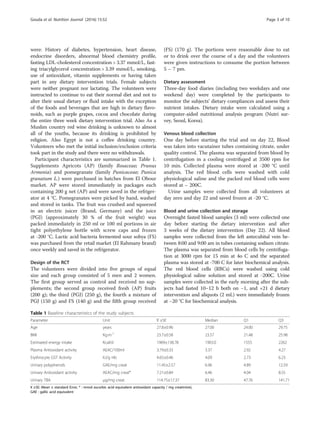
Participant characteristics are summarized in Table 1.
Supplements Apricots (AP) (family Rosaceae; Prunus
Armenia) and pomegranate (family Punicaceae; Punica
granatum L.) were purchased in batches from El Obour
market. AP were stored immediately in packages each
containing 200 g net (AP) and were saved in the refriger-
ator at 4 °C. Pomegranates were picked by hand, washed
and stored in tanks. The fruit was crushed and squeezed
in an electric juicer (Brand, Germany) and the juice
(PGJ) (approximately 30 % of the fruit weight) was
packed immediately in 250 ml or 100 ml portions in air
tight polyethylene bottle with screw caps and frozen
at -200 °C. Lactic acid bacteria fermented sour sobya (FS)
was purchased from the retail market (El Rahmany brand)
once weekly and saved in the refrigerator.
Design of the RCT
The volunteers were divided into five groups of equal
size and each group consisted of 5 men and 2 women.
The first group served as control and received no sup-
plements; the second group received fresh (AP) fruits
(200 g); the third (PGJ) (250 g), the fourth a mixture of
PGJ (150 g) and FS (140 g) and the fifth group received
(FS) (170 g). The portions were reasonable dose to eat
or to drink over the course of a day and the volunteers
were given instructions to consume the portion between
5 – 7 pm.
Dietary assessment
Three-day food diaries (including two weekdays and one
weekend day) were completed by the participants to
monitor the subjects’ dietary compliances and assess their
nutrient intakes. Dietary intake were calculated using a
computer-aided nutritional analysis program (Nutri sur-
vey, Seoul, Korea).
Venous blood collection
One day before starting the trial and on day 22, Blood
was taken into vacutainer tubes containing citrate, under
quality control. The plasma was separated from blood by
centrifugation in a cooling centrifuged at 3500 rpm for
10 min. Collected plasma were stored at -200 °C until
analysis. The red blood cells were washed with cold
physiological saline and the packed red blood cells were
stored at – 200C.
Urine samples were collected from all volunteers at
day zero and day 22 and saved frozen at -20 °C.
Blood and urine collection and storage
Overnight fasted blood samples (3 ml) were collected one
day before starting the dietary intervention and after
3 weeks of the dietary intervention (Day 22). All blood
samples were collected from the left antecubital vein be-
tween 8:00 and 9:00 am in tubes containing sodium citrate.
The plasma was separated from blood cells by centrifuga-
tion at 3000 rpm for 15 min at 4o C and the separated
plasma was stored at -700 C for later biochemical analysis.
The red blood cells (RBCs) were washed using cold
physiological saline solution and stored at -200C. Urine
samples were collected in the early morning after the sub-
jects had fasted 10–12 h both on −1, and +21 d dietary
intervention and aliquots (2 mL) were immediately frozen
at −20 °C for biochemical analysis.
Table 1 Baseline characteristics of the study subjects
Parameter Unit x̄ ±SE Median Q1 Q3
Age years 27.8±0.96 27.00 24.00 29.75
BMI Kg.m-1
23.7±0.58 23.57 21.48 25.98
Estimated energy intake Kcal/d 1969±138.78 1903.0 1555 2262
Plasma Antioxidant activity AEAC/100ml 3.79±0.33 3.37 2.92 4.27
Erythrocyte GST Activity IU/g Hb 4.65±0.46 4.09 2.73 6.23
Urinary polyphenols GAE/mg creat 11.45±2.57 6.96 4.89 12.59
Urinary Antioxidant activity AEAC/mg creat* 7.21±0.84 6.46 4.04 8.55
Urinary TBA μg/mg creat 114.75±17.37 83.30 47.76 141.71
x̄ ±SE: Mean ± standard Error, * : mmol ascorbic acid equivalent antioxidant capacity / mg creatinine),
GAE : gallic acid equivalent
Gouda et al. Nutrition Journal (2016) 15:52 Page 3 of 10
Laboratory investigations
Determination of total polyphenols
The solid-phase extraction (SPE) Cartridge (60 mg) Strata-
C18 (Phenomenex,Torrance,CA, USA); Folin Ciocalteu re-
agent (Catalog No47641; Sigma, USA). MilliQ ultrapure
water (Millipore Iberica, Madrid, Spain). All of the analyt-
ical steps were carried out in dim light. The PPs of AP and
PGJ were extracted vigorously from 4 g AP or 10 g PGJ
with 5 ml distilled water then with 20 ml absolute MetOH.
After centrifugation in the cold, the supernatant was aspi-
rated and concentrated in vaccuo to 4 ml [26]. Clean up
step on Waters 3 ml HLB (60 mg) cartridges were equili-
brated with the successive addition of absolute methanol
(1 ml) and H2O (1 ml). Aliquots of the methanolic fruit ex-
tracts (2 ml) were loaded on the activated SPE; washing
with the successive addition of H2O (10 ml) and 5 % aque-
ous MetOH (1 ml). The PP containing fraction was eluted
after the addition of 5 ml absolute MetOH. The elute was
concentrated under a stream of nitrogen to 2 ml. Aliquots
(20 μl (were taken for the analysis of PP using the Folin
Ciocalteau colorimetric method [27] and the results were
expressed as gallic acid equivalent (GAE) per g apricot or
g PGJ.
Measurement of total polyphenolic compounds in urine
Total polyphenols in the urine samples were assayed
after the clean up step by the solid-phase extraction
(SPE) as described earlier [28, 29]. Aliquots of the cen-
trifuged urine samples (1 ml) were acidified with normal
hydrochloric acid (17 μl) and were loaded onto an acti-
vated Waters Cartridge, preconditioned with 1 ml
methanol and equilibrated with 1 ml of 1.5 mol/l aque-
ous formic acid. The SPE cartridge was washed twice
with 2 ml of the same formic acid and 2 ml of water-
methanol (95:5 by volume) to elute the impurities.
Elution of the (PP) was completed with a mixture con-
taining 1 ml of methanol containing 1 ml/l of formic
acid (2 %)- methanol- H2O (2/60/38 v/v/v). Aliquots of
the elute (500 μl) were pipetted into Eppendorf vials for
the colorimetric determination of the (PP). Successive
addition of Folin_Ciocalteu reagent (50 μl), followed by
20 % sodium carbonate (600 μl). The tubes were left in
the dark for 60 min and then the absorbance of the de-
veloped color was measured at 765 nm against a blank.
A blank and standard working solutions of gallic acid
(0.215 mg/ml) were run in parallel. Urinary (PP) excre-
tion was expressed as mg GAE per g of creatinine.
Plasma antioxidative activity ascorbic acid equivalents (AEAC)
The assay is based on the measurement of the scaven-
ging ability of antioxidants towards the stable DPPH
(1,1-diphenyl-2-picrylhydrazyl) radical compound [30].
Aliquots of plasma samples (100 μl) were mixed with
400 μl methanol and after vortexing the tubes were
centrifuged at 10,000 x g for 10 min at 4 °C. Aliquots of
the clear protein free supernatant (20 μl) was added to
350 μl DPPH reagent (0.127 mol/L methanol) under vig-
orous shaking for 30 sec. The tubes were then incubated
in the dark at room temperature for 30 min. The control
was prepared as above without any extract, and MeOH
was used for the baseline correction. Standard solutions of
ascorbic acid at increasing concentrations (1- 5 μmol/ l )
were freshly prepared and treated as described above. Re-
duction of the absorbance at 515 nm was measured using
a UV-Vis spectrophotometer (Shimadzu-Germany). A
standard curve was plotted for the relation between ascor-
bic acid concentrations and the absorbance at 515 nm. All
experiments were carried out in triplicate. The radical
scavenging activity (RSA) was expressed as the inhibition
percentage using the following formula:
% RSA ¼ Abs control ‐Abs sampleð Þ Â 100ð Þ= Abs control
The plasma antioxidative capacity activity was
expressed as mmol antioxidative activity ascorbic acid
equivalents (AEAC) per 100 ml plasma.
Urinary antioxidative activity ascorbic acid equivalents
(AEAC)
This was assessed using the DPPH equivalent, according
to an adapted colorimetric procedure [31]. Aliquots of
filtered urine samples (100 μl) were mixed thoroughly
using a vortex mixer with 3 mL DPPH solution in
methanol (0.05 g/L) and the tubes were kept in a water
bath at 25 °C in dim light for 30 min for the complete
development of the reaction. The absorbance of the yel-
low color was measured spectrophotometrically against
a blank at 517 nm.
Three measurements were conducted for each extract.
The control solution contained 100 μl of DI water and
3 mL of DPPH solution in methanol. Standard ascorbic
acid of increasing concentrations (2-10 μM/L) was
treated in a similar manner and run in parallel. The in-
hibition of free radical in percent (I %) was calculated
according to the formula: [( A0 - A1) / A 0] x 100,
whereby A0 is the absorbance of the control reaction
(containing all reagents except the urine), and A1 is the
absorbance of the urine sample. All measurements were
carried out in triplicates. Urinary antioxidant activity
was expressed as as mmol antioxidative activity ascorbic
acid equivalents (AEAC) per mmol creatinine).
Urinary thiobarbituric acid-reacting species (TBARS)
Lipid peroxidation (LP) was measured in the urine sam-
ples as malondialdehyde (MDA), which was assayed by
the thiobarbituric acid reactive species (TBARS) as de-
scribed earlier [32]. Briefly, aliquots (200 μl) of urine
samples were mixed with 10 μl of 5 % butylated hydroxyl
Gouda et al. Nutrition Journal (2016) 15:52 Page 4 of 10
toluene in glacial acetic acid, followed by the addition of
300 μl of 0.5 % aqueous TBA solution. After vortexing,
the tubes were incubated at 100ο C for 30 min and the
absorbance of the developed pink color was recorded
spectrophotometrically at 532 nm. Samples were blanked
against reference cuvettes containing reagent without
urine. The concentration of TBARS was calculated from
the absorbance at 532 nm using the molar extinction coef-
ficient of 156000. To control for urine concentration the
data were normalized to urine creatinine concentration.
Determination of urinary creatinine
Aliquots of the urine samples (3 μl) were pipetted into a
96-well plate for the determination of creatinine by the
alkaline picrat method [33]. Aliquots (60 μl) of aqueous
picric acid solution (10 g/l) and a 60 μl aliquot of so-
dium hydroxide (100 g/l) were added in sequence. After
15 min the intensity of the color was read at 500 nm in
the ASYS Expert Plus multi-channel microplate reader
(Biochrom Lt, Cambridge, UK). The concentration was
calculated using a standard creatinine solution.
Assay of erythrocytic glutathione-S-transferase activity (E-GST).
The principle of the assay is based on the conjugation of
1-chloro-2,4dinitro benzene (CDNB) with glutathione
(GSH)
CDNB þ GSH → CDNB – S – glutathione
Aliquots (20 μl) of the washed erythrocytes were lyzed
by mixing with 180 μl stabilizing reagent [34] and the
tubes were kept in a thermo flask at -18 °C for 10 mi-
nutes. After thawing, 50 μL of the hemolysate was added
to enzyme assay mixture containing 0.68 ml of distilled
water and 200 μL phosphate buffer (100 mM phosphate
buffer, K2HPO4/KH2PO4; pH = 6.5) and 20 μL CDNB
(0.5 mM) pre- incubated at 25oC for 10 minutes. The
enzymatic GST assay started immediately at 25 °C by
adding 50 μL GSH (1.0 mM). And monitoring the rate
of increase in absorbance at 340 nm for 10 minutes at
25 °C against a blank solution containing the reaction
mixture, in which; the haemolysate was substituted with
distilled water [35]. The specific E-GST activity is μmol
glutathione transferred /min at 37 °C/g Hb, which is
synonymous to IU/g Hb.
Hemoglobin concentration was determined in the hemo-
lysate by the cyan- methaemoglobin reaction using Drab-
kin reagent [34] and the results were expressed in g/dL.
Statistical analysis
Values are presented as means and SEM and differences
with values <0.05 are considered significant. Two way
ANOVA were conducted using the general linear model
procedure to assess the differences in the effect of the
four dietary supplements (Apricots, pomegranate, mix-
ture of pomegranate – sour sobya or sour sobya) and
control on outcome measures. The models included the
main effects of treatment, two time points and treatment
x time interaction. Fisher's least significant differences
were used to account for multiple testing [36]. Pearson
correlation was used in the correlation evaluations. All
evaluations were performed with excel software (release
16) and MSTAT-C computer package [37].
Results
Table 1 presents the baseline characteristics of the vol-
unteers. At base line all participants excreted urinary
total polyphenols, but the inter individual variation was
quite high (4.89-12.59 mg GAE / 100 ml urine).
Composition of the four supplements served to the
volunteers are presented in Table 2. Dietary supplements
1,2,3,4,5 provided daily 0, 1.52, 24.71, 9.89 and 0 mg
Table 2 Composition of the supplements
Parameter Unit Dietary supplements
Control AP*
PGJ*
PGJ*
+ FS*
FS*
Portion served Portion served Portion served Portion served Portion served
Portion Size g – 200 250 100 +150 170
Total solids g – 27.47 17.75 48 40.01
Carbohydrate g – 22 32.75 59 51.1
Dietary Fiber g – 4 0.25 48.6 54
Energy Kcal – 100 135 290 263
Lactobacillus, diverse cfu / serving size – – – 4.5 × 10⁹
5.1 × 10⁹
Yeast cfu /serving size – – – 2.44×10¹⁰
2.77×10¹⁰
Total Polyphenols mg* / portion g – 32±0.24 519.1±8.75 207.65±3.5 –
Antioxidant activity (AEAC)** – 5.70±0.74 11.35±2.2 11.37±2.05 7.74±1.33
*: mg gallic acid equivalent (GAE) , Ap: Apricot, PGJ: Pomegranate juice, FS: Fermented sobya;
**: mmol ascorbic acid equivalent antioxidant capacity
Gouda et al. Nutrition Journal (2016) 15:52 Page 5 of 10
total polyphenol per portion. Respective antioxidative
activity ascorbic acid equivalents (AEAC) were 0, 5.70 ±
0.74, 11.35 ± 2.2, 11.37 ± 2.05 and 7.74 ± 1.33 as showed
in Table 2. The 170 g portion of FS provided 5.1 ×
109
cfu total Lactobaccilli and 2.77 × 10¹⁰
cfu yeasts,
while the respective counts were 4.5 × 10⁹
cfu total
Lactobaccilli and 2.44 × 10¹⁰
cfu yeasts in the daily por-
tion of the mixture of PGJ & FS supplement.
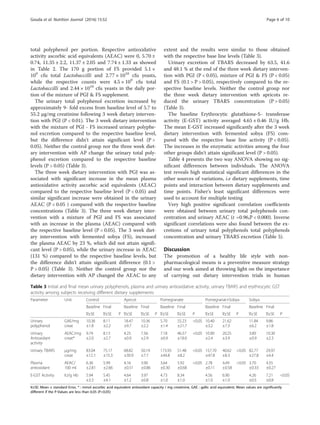
The urinary total polyphenol excretion increased by
approximately 9- fold excess from baseline level of 5.7 to
55.2 μg/mg creatinine following 3 week dietary interven-
tion with PGJ (P < 0.01). The 3 week dietary intervention
with the mixture of PGJ - FS increased urinary polyphe-
nol excretion compared to the respective baseline level,
but the difference didn't attain significant level (P >
0.05). Neither the control group nor the three week diet-
ary intervention with AP change the urinary total poly-
phenol excretion compared to the respective baseline
levels (P > 0.05) (Table 3).
The three week dietary intervention with PGJ was as-
sociated with significant increase in the mean plasma
antioxidative activity ascorbic acid equivalents (AEAC)
compared to the respective baseline level (P < 0.05) and
similar significant increase were obtained in the urinary
AEAC (P < 0.05 ) compared with the respective baseline
concentrations (Table 3). The three week dietary inter-
vention with a mixture of PGJ and FS was associated
with an increase in the plasma (AEAC) compared with
the respective baseline level (P < 0.05). The 3 week diet-
ary intervention with fermented sobya (FS), increased
the plasma AEAC by 23 %, which did not attain signifi-
cant level (P > 0.05), while the urinary increase in AEAC
(131 %) compared to the respective baseline levels, but
the difference didn't attain significant difference (0.1 >
P > 0.05) (Table 3). Neither the control group nor the
dietary intervention with AP changed the AEAC to any
extent and the results were similar to those obtained
with the respective base line levels (Table 3).
Urinary excretion of TBARS decreased by 63.5, 41.6
and 48.1 % at the end of the three week dietary interven-
tion with PGJ (P < 0.05), mixture of PGJ & FS (P < 0.05)
and FS (0.1 > P > 0.05), respectively compared to the re-
spective baseline levels. Neither the control group nor
the three week dietary intervention with apricots re-
duced the urinary TBARS concentration (P > 0.05)
(Table 3).
The baseline Erythrocytic glutathione-S- transferase
activity (E-GST) activity averaged 4.65 ± 0.46 IU/g Hb.
The mean E-GST increased significantly after the 3 week
dietary intervention with fermented sobya (FS) com-
pared with the respective base line activity (P < 0.05).
The increases in the enzymatic activities among the four
other groups didn't attain significant level (P > 0.05).
Table 4 presents the two way ANOVA showing no sig-
nificant differences between individuals. The ANOVA
test reveals high stastistical significant differences in the
other sources of variations, i.e dietary supplements, time
points and interaction between dietary supplements and
time points. Fisher's least significant differences were
used to account for multiple testing
Very high positive significant correlation coefficients
were obtained between urinary total polyphenols con-
centration and urinary AEAC (r =0.96,P < 0.000). Inverse
significant correlations were also found between the ex-
cretions of urinary total polyphenols total polyphenols
concentration and urinary TBARS excretion (Table 5).
Discussion
The promotion of a healthy life style with non-
pharmacological means is a preventive measure strategy
and our work aimed at throwing light on the importance
of carrying out dietary intervention trials in human
Table 3 Initial and final mean urinary polyphenols, plasma and urinary antioxidative activity, urinary TBARS and erythrocytic GST
activity among subjects receiving different dietary supplements
Parameter Unit Control Apricot Pomegranate Pomegranat+Sobya Sobya
Baseline Final Baseline Final Baseline Final Baseline Final Baseline Final
x̄±SE x̄±SE P x̄±SE x̄±SE P x̄±SE x̄±SE P x̄±SE x̄±SE P x̄±SE x̄±SE P
Urinary
polyphenol
GAE/mg
creat
10.36
±1.8
8.11
±2.2
18.47
±9.7
10.36
±2.2
5.70
±1.4
55.23
±21.7
<0.05 10.40
±3.2
21.62
±7.3
11.84
±6.2
9.86
±1.8
Urinary
Antioxidant
activity
AEAC/mg
creat*
9.74
±2.0
8.13
±2.7
4.25
±0.9
7.56
±2.9
7.18
±0.9
46.57
±18.0
<0.05 10.90
±2.4
20.25
±3.9
3.89
±0.9
10.30
±2.3
Urinary TBARS μg/mg
creat
83.04
±12.1
75.17
±15.3
68.82
±30.9
50.19
±7.7
173.93
±44.8
51.48
±8.2
<0.05 157.70
±47.8
40.62
±8.3
<0.05 82.77
±27.8
29.97
±4.4
Plasma
antioxidant
AEAC/
100 ml
6.36
±2.81
5.99
±2.66
4.16
±0.51
3.90
±0.86
3.64
±0.30
5.92
±0.68
<0.05 2.78
±0.11
4.49
±0.58
<0.05 3.70
±0.33
4.55
±0.27
E-GST Activity IU/g Hb 5.94
±3.3
5.45
±4.1
4.64
±1.2
3.97
±0.8
4.73
±1.0
8.34
±1.0
4.56
±1.0
6.90
±1.0
4.26
±0.5
7.21
±0.8
<0.05
x̄±SE: Mean ± standard Error, * : mmol ascorbic acid equivalent antioxidant capacity / mg creatinine, GAE : gallic acid equivalent; Mean values are significantly
different if the P-Values are less than 0.05 (P<0.05)
Gouda et al. Nutrition Journal (2016) 15:52 Page 6 of 10
beings with the PGJ and probiotic LAB fermented food
products. The relationship between the polyphenol rich
fruits and LAB fermented supplements and prevention
of diseases in man is the topic of numerous investiga-
tions during recent years [38].
Antioxidant potency of commonly consumed PGJ was
evaluated through several in vitro methodologies. Hun-
dreds of Norwegian dietary plants were screened for an-
tioxidative activity by automated FRAP assay, and
pomegranate was the fruit with the highest antioxidative
activity ascorbic acid equivalents (AEAC) with mean
level of 11.3 mmol /100 g, while the respective value for
apricot was 0.52 mmol /100 g [39]. Slightly higher anti-
oxidative activities were reported for fresh PGJ with
mean level of 15 AEAC / L, compared to the respective
value of 12 – 13 AEAC for frozen PGJ [40].
The antioxidant capacity of PGJs obtained from eight
Iranian cultivars were determined by the scavenging ac-
tivity against (DPPH) showed that the cultivar Izmir 8
was with the highest scores with efficient concentration
(EC 50) of 29.8 ± 2.9 ml PJ/ g of DPPH [41]. The above
mentioned reported levels are higher than the respective
mean level of 4.5 AEAC per Liter PGJ obtained in the
present study.
The bioavailability of pomegranate flavonoid is influ-
enced by “LADME” [42]. The concept LADME stands
for liberation from the food matrix (bioaccessibility), ab-
sorption, distribution, metabolism and excretion [43].
The dietary polyphenols escape absorption in the small
intestine and are degraded in the colon under the cata-
lytic action of the enormous number of colonic micro-
biota amount to 1014 colony forming units.
The first step in polyphenol degradation involves the
release of aglycones by microbial glycosidases, which en-
hances their absorption. Plasma ellagic acid (EA) peaked
after one hour of oral ingestion of 180 mL PGJ with mean
concentration of 31.9 ng / mL plasma [14]. Identical re-
sults were obtained following the daily consumption of
capsules (800 mg) containing 330.4 mg pomegranate
punicalagins and 21.6 mg EA [44]. According to the au-
thors, the (EA) peak reached 33.8 ± 12.7 ng/mL plasma.
This finding presents evidence that pome granate ellagic
acid (EA) was absorbed in humans. The increase in pom-
egranate ellagic acid (EA) was associated with significant
increases in plasma AEAC averaging 31.8, 1.62 and
1.43 %, after 0.5, one and two hours post ingestion, re-
spectively [44]. Furthermore, urinary urolithin metabolites
persisted for 48 hours after PGJ ingestion [45].
In the present study, the three week dietary intervention
with PGJ was quite appropriate to raise and maintain the
body pools of phenols. The high AEAC of plasma and
urine of our subjects is in good agreement with other
studies reporting high plasma antioxidant capacity in hu-
man volunteers after PGJ consumption [44].
It is suggested that the gastrointestinal tract plays an im-
portant role in the first-pass metabolism of dietary flavo-
noids [46], whereby, during phase I metabolism, intestinal
bacteria reductases convert pomegranate flavonoids into
the urolithins and enabling reuptake [47]. Urolithin A and
urolithin B are the PGJ metabolites detected in the plasma
of volunteers following 5 day intakes of one liter of PGJ
daily containing 4.37 g/L punicalagins and 0.49 g/L antho-
cyanins [48]. Their persistence in plasma and tissues sug-
gest that they account for some of the health benefits of
PGJ [14]. Specific strains of L. plantarum possess enzyme
tannase (tannin acyl -hydrolase) and are able to degrade
hydrolyzable tannins and tannic acid, to the monomeric
antioxidant derivatives gallic acid and pyrogallol [49].
Eubacterium ramulus is one of the key colonic bacteria
implicated in the biotransformation of the polyphewnolic
Table 4 Mean squares analysis of variance for E-GST activity, plasma anti-oxidative activity, urinary anti-oxidative activity, urinary TBA
and urinary polyphenol excretions under five dietary supplements
Source of variation df E-GST Plasma Antioxidant Urinary Antioxidant Urinary TBA Urinary polyphenol
Replicates 6 19.00 0.36 123.16 7508.8 642.51
Dietary Supplement (DS) 4 9.04** 13.96** 1052.62** 8423.2* 993.17
Time point (T) 1 41.84** 11.87** 2261.58** 71153.3** 1640.05*
Interaction (T × DS) 4 13.92** 4.64** 916.08** 10122.7* 1911.84**
* and ** denote significance at 5% and 1% probability level, respectively
Table 5 Correlation coefficients between Percentage change(%) of biochemical plasma antioxidative, urinary polyphenol, urinary
antioxidant and urinary thiobarbituric acid
Biochemical parameter Unit Urinary polyphenol Urinary antioxidant activity Urinary TBARS
Urinary polyphenol GAE/mg creat 1 0.93***
-0.31*
Urinary antioxidant activity AEAC/mg creat* 0.93***
1 -0.28*
Urinary TBARS μg/mg creat -0.31*
-0.28*
1
*:P<0.05;**:P<0.01;***:P<0.001; (AEAC) *: mmol ascorbic acid equivalent antioxidant capacity/creatinine
Gouda et al. Nutrition Journal (2016) 15:52 Page 7 of 10
compounds quercetin, apigenin and naringenin [50]. In
phase II metabolism, polyphenols and their reductive me-
tabolites are then conjugated with glucuronic acid and sul-
fate. by intestinal microsomes [47].
Erythrocytic glutathione-S-transferase (E-GST) desig-
nated GST3 or GSTı belongs to phase II metabolizing
enzyme superfamily involved in the cellular detoxifica-
tion of both xenobiotic and endobiotic compounds [51].
This enzyme serves to scavenge free radicals that are
produced from oxidative stress by actively transporting
GSH- xenobiotic conjugates. Induction of E-GST by ex-
pression had been implicated in protection of blood
stream and other target cells from genotoxic insults [52].
One study reported no changes in the activities of E-
GST following treatment with pomegranate polyphenols,
although the concentrations of the lipid peroxidation
marker malondialdehyde was reduced [53]. Our results
are in agreement with this report, since the increase in
E-GSH activity was not significant following the 3 week
dietary intervention with PGJ, yet the reduction in lipid
peroxidation marker malondialdehde was tremendous.
Significant increase in the E –GST activity was found
only after the three week dietary intervention with fer-
mented sobya (t = 2.27, P < 0.05). This finding suggests
that the sobya micro-organisms (LAB and/ or yeast) po-
tentially modulated the expression of GST genes related
to biotransformation. This finding supports the import-
ant role of fermented products in primary chemo- pre-
vention. Reinforcing the activity of GST protects target
cells [54]. Similar finding was reported with the complex
fermentation of inulin-type fructans which favourably
modulate the expression of genes related to biotrans-
formation in carcinoma cells [55].
Urinary excretion of either free aglycones or conjugated
polyphenols in humans are the valid biological markers of
exposure and are more affordable approach in epidemio-
logical studies and in metabolic studies [56, 57]. Repeated
consumption of PP rich food sources resulted in the urin-
ary excretion of 111 metabolites and about 160 aglycone
metabolites originating from various classes of dietary
polyphenols and maximum excretion rates occurred 3-4
days after juice ingestion [58, 59]. More than 80 urinary
polyphenol metabolites could be identified nowadays with
high predicting ability of food intake (food metabolome)
within the population of 4 European countries [57]. The
development of novel analytic methods is now essential to
measure large sets of polyphenols biomarkers and evaluate
the role of these metabolites in disease prevention. The
biomarkers are indicator of responses to dietary interven-
tion that can aid in understanding the prediction of treat-
ment [60]. In the present study, daily intake of 250 ml PGJ
totaling 5.25 liters per 21 days increased the mean urinary
polyphenol excretion (P < 0.05) from 6 GAE at day 0 to 55
GAE/mg creatinine at day 22. All other supplements failed
to increase urinary PP excretion to a significant level (P >
0.05). In both laboratory and clinical studies, the pom-
egranate combats numerous pathological changes associ-
ated with cardiovascular disease [61, 62]. Pomegranate
fights cardiovascular disease by reducing oxidative stress,
inhibiting the oxidation of potentially harmful LDL [63],
quenching free radicals and supporting the synthesis and
activity of nitric oxide [64, 65]. Oxidation protection ac-
tions of dietary polyphenols include reactive species scav-
enging, enzyme modulation to interference with cell
signaling and oxidative stability [66]. The chemo prevent-
ive action of PGJ was attributed to the modulation of cel-
lular signaling processes including nuclear factor-kappa-B
(NF-кB) and activator protein-1(AP-1) DNA binding [67].
Separation of individual polyphenols from the crude PGJ
were interpreted on the basis that pretreatment of PGJ
inhibited NFκB activation, AKT activity and expression of
COX-2 in HT-29 cells [67].
It is not clear, if the antioxidants in dietary plants poly-
phenol can explain all of the protective effect against
oxidative stress-related chronic diseases. Synergistic ef-
fect between the supplements PGJ & LAB - fermented
sobya biopeptides may be acting in coordination to pro-
tect against oxidative stress events. In agreement with
our finding, apricot cultivars grown in Spain showed low
contents of bioactive compounds with mean polyphenol
concentration of 179.8 mg GAE/100 g [68]. Interestingly,
heat-processed apricots have excellent antioxidative
properties due to the high melanoidins content. Derived
melanoidin is responsible for the significant elevation of
antioxidant capacity and protecting endothelial cells
from hydrogen peroxide - induced oxidative mitochon-
drial damage and cell death [69]. Evidence obtained from
the present trial is based on a healthy adult population
group, may not be generalizable to individuals with a
disease or specific risk factors. Inability to apply molecu-
lar markers or food-specific signatures such as metabo-
lomic analysis is a further limitation due to protocol
limitation.
Conclusion
The nutrition intervention with mixtures of PGJ and
probiotic fermented sobya had synergistic positive ef-
fects. PGJ enhances the antioxidant status in humans by
decreasing the oxidative damage in lipids by decreasing
urinary TBARS and improving the antioxidant mecha-
nisms; while probiotic fermented sobya stimulates eryth-
rocytes GST activity. The present study demonstrated
that designing effective preventive strategies aiming at
reducing the risk of chronic diseases is a cost effective
safe initiative in contrast to the action of drugs devel-
oped by the pharmaceutical industry. Quantification
among individuals of biologically effective pomegranate
dose, interacting with critical cellular targets for curing
Gouda et al. Nutrition Journal (2016) 15:52 Page 8 of 10
or preventing various illnesses warrants further investiga-
tions. Research concerning increased knowledge on the
depth of the role of nutrients in the health promotion and.
Competing interests
The authors declare that they have no competing interests.
Authors’ contribution
MG conceived the study and was responsible for the human trial and the
collection of the biological fluids. He also did the laboratory investigation
and performed the statistical analysis. AM participated in the design of the
study and coordination. LH participated in the design of the study, the
statistical analysis and wrote the manuscript. MH was responsible for the
ANOVA test. All authors read and approved the final manuscript.
Acknowledgment
The authors are grateful to the volunteers participating in the trial for their
patience and compliance.
Author details
1
Department of Nutrition & Food Sc, National Research Center, Giza, Dokki,
Egypt. 2
Department of Biochemistry, Faculty of Agriculture, Cairo University,
Giza, Egypt. 3
Department of Agronomy, Faculty of Agric, Cairo University,
Giza, Egypt.
Received: 25 January 2016 Accepted: 4 May 2016
References
1. Circu ML, Aw TY. Glutathione and modulation of cell apoptosis. Biochim
Biophys Acta. 1823;2012:1767–77.
2. Sies H. Oxidative stress. Introductory remarks. In: Oxidative Stress (Sies, H., ed.),
1985;pp. 1–8. Academic Press, London, U.K.
3. Caillet P, Canoui-Poitrine F, Vouriot J, et al. Comprehensive geriatric
assessment in the decision-making process in elderly patients with cancer:
ELCAPA study. J Clin Oncol. 2011;29(27):3636–42.
4. Itoh Y, Shinya K, Kiso M, Watanabe T, Sakoda Y, Hatta M, Muramoto Y, Tamura
D, Sakai-Tagawa Y, Noda T, et al. In vitro and in vivo characterization of new
swine-origin H1N1 influenza viruses. Nature. 2009;460(7258):1021–5.
5. Paz-Elizur T, Sevilya Z, Leitner-Dagan Y, Elinger D, Roisman LC, Livneh Z. DNA
repair of oxidative DNA damage in human carcinogenesis: potential application
for cancer risk assessment and prevention. Cancer Lett. 2008;18;266(1):60-72.
6. Egypt Demographic and Health Survey. 2014;Pp 52. http://dhsprogram.
com/pubs/pdf/PR54/PR54.pdf.
7. Bengmark, Lansky EP, Newman RA. Punica granatum (pomegranate) and its
potential for prevention and treatment of inflammation and cancer.
J Ethnopharmacol. 2007;109:177–206.
8. WHO. 2008-2013 action plan for the global strategy for the prevention and
control of noncommunicable diseases. 2008. Pp 1-42. http://www.who.int/
nmh/publications/ncd_action_plan_en.pdf.
9. Alomar MJ. Factors affecting the development of adverse drug reactions.
Saudi Pharmac J. 2014;22:83–94.
10. Vertuani S, Angusti A, Manfredini A. The Antioxidants and Pro-Antioxidants
Network: An Overview. Current Pharmaceutical Design. 2004;10:1677–94.
11. Fleg JL, Forman DE, Berra K. Secondary prevention of atherosclerotic
cardiovascular disease in older adults. Circulation. 2013;128:2422–46.
12. Ministry of agriculture Egypt. Annual report- statistical data. 2014; Pp1-10.
http://egypt.opendataforafrica.org/kddlloe/egypt-agriculture-sheet.
13. Kesarwani A, Chiang P, Chen S. Distribution of Phenolic compounds and
antioxidative activities of rice kernel and their relationships with agronomic
practice. Sci W J. 2014;14:1–6.
14. Seeram NP, Aviram M, Zhang Y, Henning SM, Feng L, Dreher M, Heber D.
Comparison of antioxidant potency of commonly consumed polyphenol-
rich beverages in the United States. J Agric Food Chem. 2008;56:1415–22.
15. Borges et al., 2010, Viuda-Martos M, Fernández-López J, Pérez-Álvarez JA.
Pomegranate and its many functional components as related to human
health: a review. Compr Rev Food Sci Food Saf. 2010; 9: 635–54.
16. Guo X, Tresserra-Rimbau A, Estruch R, Miguel A, Martínez-González M,
Medina-Remón A. Effects of Polyphenol, measured by a biomarker of total
polyphenols in urine, on cardiovascular risk factors after a long-term
follow-up in the PREDIMED study. Oxidative Medicine and Cellular
Longevity. 2016;16:1–11.
17. Shih A. Anthocyanins induce the activation of phase II enzymes through
the antioxidant response element pathway against oxidative stress-induced
apoptosis. J Agric Food Chem. 2007;55:9427–35.
18. Kullisaar T, Zilmer M, Mikelsaar T, Vihalemm H, Annuk C, et al. Two
antioxidative lactobacilli strains as promising probiotics. Int J Food
Microbiol. 2002;72:215–24.
19. Songisepp E, Kals J, Kullisaar T, Mända r R, Hütt P, Zilmer M, Mikelsaar M.
Evaluation of the functional efficacy of an antioxidative probiotic in healthy
volunteers. Nutr J. 2005;4:22.
20. Cagno R, Coda R, Angelis M, Gobbetti M. Exploitation of vegetables and
fruits through lactic acid fermentation. Food Microbiology. 2013;33(1):1–10.
21. Alsayadi M et al. Evaluation of anti-Hyperglycemic and anti-hyperlipidemic
activities of water kefir as probiotic on Streptozotocin- induced diabetic
Wistar rats. J Diabetes Mellitus. 2014;4:85–95.
22. Zhang S, Liu L, Su Y, Li H, Sun Q, Liang X, et al. Antioxidative activity of
lactic acid bacteria in yogurt. Afr J Microbiol Res. 2011;5:5194–201.
23. Fouad M, Moustafa A, Hussein L, Romeilah R, Gouda M. In-vitro antioxidant
and antimicrobial activities of selected fruit and vegetable juices and fermented
dairy products commonly consumed in Egypt. RJPBCS. 2015;6(2):541–50.
24. Melgarejo P, Calín-Sánchez A, Carbonell-Barrachina AA, Martínez-Nicolás JJ,
Legua P, Martínez R, Hernández F. Antioxidant activity, volatile composition
and sensory profile of four new very-early AP (Prunus armeniaca L.). J Sci
Food Agric. 2013;30:20–8. doi:10.1002/jsfa.6201 [Epub ahead of print].
25. Martel F, Monteiro R, Calhau C. Effect of polyphenols on the intestinal and
placental transport of some bioactive compounds. Nutr Res Revs. 2010;23:
47–64.
26. Hertog MGL, Sweetnam PM, Fehily AM, Elwood PC, Kromhout D.
Antioxidant flavonols and ischaemic heart disease in a Welsh population of
men. The Caerphilly study. Am J Clin Nutr. 1997;65:1489–94.
27. Singleton VL, Rossi JA. Colorimetry of total phenolics with phosphomolybdic-
phosphotungstic acid reagents. Am J Enol Vitic. 1965;16:144–58.
28. Roura E, Lacueva CA, Estruch R, Lamuela-Ravento RM. Total polyphenol
intake estimated by a modified Folin_Ciocalteu assay of urine. Clin Chem.
2006;52:749–52.
29. Hussein L, Medina A, Barrionnevo A, Lammuela-Raventos RM, Andres-
Lacueva C. Normal distribution of urinary polyphenol excretion among
Egyptian males 7_14 years old and changes following nutritional
intervention with tomato juice (Lycopersicon esculentum). Intern J Food Sc
Nutr. 2009;6:15–23.
30. Brand-Williams W, Cuvelier ME, Berset C. Use of free radical method to
evaluate antioxidant activity. Lebensm Wiss Technology. 1995;28:25–30.
31. Shimada K, Fujikawa K, Yahara K, Nakamura T. Antioxidative properties of
xanthone on the auto oxidation of soybean in cylcodextrin emulsion. J Agr
Food Chem. 1992;40:945–8.
32. Ohkawa H, Ohishi N, Yagi K. Assay for lipid peroxides in animal tissues by
thiobarbituric acid reaction. Anal Biochem. 1979;95:351–8.
33. Jaffe M. Uber den niederschlag, welchen pikrinsaure in normalen hrn erzeugt
und uber eine neue reaction des kreatinins. Z Physiol Chem. 1886;10:391–400.
34. Beutler E, Duron M, Kelly BM O. Improved method for the determination of
blood. Glutathione. J Lab Clin Med. 1963;61:882–8.
35. Habig WJ, Pabst MJ, Jacoby WB. Glutathione S-transferase, the first
enzymatic step in mercapturic acid formation. J Biol Chem. 1974;249:7130–9.
36. Steel RD, Torri JH and Dickey DA. Principles and Procedures of Statistics: A
Biometrical Approach, 3rd ed,. Mc Graw-Hill, New York. 1997;666p.
37. Freed RP, Einensmith S, Gutez D, Reicosky VW, Smail, Wolberg P. MSTAT-C
analysis of agronomic research experiments. East Lansing, USA: Michigan
Univ; 1989.
38. Jakesevic M, Aaby K, Borge GI, Jeppsson B, Ahrné S, Molin G. Antioxidative
protection of dietary bilberry, chokeberry and Lactobacillus plantarum
HEAL19 in mice subjected to intestinal oxidative stress by ischemia-
reperfusion. BMC Complement Altern Med. 2011;11:8–15.
39. Halvorsen BL, Holte K, Myhrstad MCW, Barikmo I, Hvattum E, Remberg SF,
Wold AB, et al. A systematic screening of total anti oxidants in dietary
plants. J Nutr. 2002;132:461–71.
40. Gil MI, Tomás-Barberán FA, Hess-Pierce B, Holcroft DM, Kader AA.
Antioxidant activity of pomegranate juice and its relationship with phenolic
composition and processing. J Agric Food Chem. 2013;48:4581–9.
41. Cam M, Hisil Y, Durmaz G. Classification of 8 pgjs based on antioxidant
capacity measured by four methods. Food Chemistry. 2009;112:721–6.
Gouda et al. Nutrition Journal (2016) 15:52 Page 9 of 10
42. Holst B, Williamson G. A critical review of the bioavailability of
glucosinolates and related compounds. Nat Prod Rep. 2004;21(3):425–47.
43. Lhoste EF, Ouriet V, Bruel S, Flinois JP, Bre’ zillon C, Magdalou J, Che’ ze, C,
et al. The human colonic microflora influences the alterations of xenobiotic-
metabolizing enzymes by catechins in male F344 rats. Food Chem Toxicol.
2003;41(5):695–702.
44. Mertens-Talcott SU, Jilma-Stohlawetz P, Rios J, Hingorani L, Derendorf H.
Absorption, metabolism, and antioxidant effects of pomegranate (Punica
granatum L.) Polyphenols after ingestion of a standardized extract in
healthy human volunteers. J Agric Food Chem. 2006;54:8956–61.
45. Seeram NP, Lee R, Heber D. Bioavailability of ellagic acid in human plasma
after consumption of ellagitannins from pomegranate (Punica granatum
juice). Clin Chim Acta. 2004;348:63–8.
46. Pfeiffer P, Papp N, Abrankó L, Blázovics A, Pedryc A, Stefanovits-Bányai É.
Accumulation of antioxidants in apricot fruit through ripening:
Characterization of a genotype with enhanced functional properties. Biol
Res. 2011;44:339–44.
47. Kemperman RA, Bolca S, Roger LC, Vaughan EE. Novel approaches for
analysing gut microbes and dietary polyphenols: challenges and
opportunities. Microbiology. 2010;156(11):3224–31.
48. Cerda B, Espin JC, Parra S, et al. The potent in vitro antioxidant ellagitannins
from pomegranate juice are metabolised into bioavailable but poor
antioxidant hydroxy-6H-dibenzopyran-6-one derivatives by the colonic
microflora of healthy humans. Eur J Nutr. 2004;43:205–20.
49. Osawa R, Kuroiso K, Goto S, Shimizu A. Isolation of Tannin-Degrading
Lactobacilli from Humans and Fermented Foods. Appl Environ Microbiol.
2000;66(7):3093–7.
50. Simmering R, Pforte H, Jacobasch G, Blaut M. The growth of the flavonoid-
degrading intestinal bacterium, Eubacterium ramulus, is stimulated by
dietary flavonoids in vivo. FEMS Microbiol Ecol. 2002;40:243–8.
51. Salinas AE, Wong MG. Glutathione S-Transferases – a review. Curr Med
Chem. 1999;6:279–309.
52. Pool-Zobel BL, Selvaraju V, Sauer J, Kautenburger T, Kiefer J, Richter KK,
Soom M, Wolfl S. Butyrate may enhance toxicological defence in primary,
adenoma and tumor human colon cells by favourably modulating
expression of glutathione- S-transferases genes, an approach in
nutrigenomics. Carcinogenesis. 2005;26:1064–76.
53. Durgaprasad S, Ganesh PC, Vasanthkumar, Jose FA. A pilot study of the
antioxidant effect of curcumin in tropical pancreatitis S. Indian J Med Res.
2005;122:315–8.
54. Boateng J, Verghese M, Shackelford L, Walker LT, Khatiwada J, Ogutu S,
Williams DS, Jones J, Guyton M, Asiamah D, et al. Selected fruits reduce
azoxymethane (AOM)-induced aberrant crypt foci (ACF) in Fisher 344 male
rats. Food Chem Toxicol. 2007;45:725–32.
55. Munjal U, Scharlau D, Glei M. Gut fermentation products of inulin-type
fructans modulate the expression of xenobiotic-metabolising enzymes in
human colonic tumour cells. Anticancer Res. 2012;32(12):5379–86.
56. Ito H, Gonthier M-P, Manach C, Morand C, Mennen L, Remesy C, Scalbert A.
Polyphenol levels in human urine after intake of six different polyphenol-
rich beverages. Br J Nutr. 2006;94:500–9.
57. Edmands WM, Ferrari P, Rothwell JA, Rinaldi S, Slimani N, Barupal DK, Biessy
C, Jenab M. Polyphenol metabolome in human urine and its association
with intake of polyphenol-rich foods across European countries. Am J Clin
Nutr. 2015;102:905–13.
58. Pe’rez-Jime’nez J, Hubert J, Hooper L, Cassidy A, Manach C, Williamson G,
Scalbert A. Urinary metabolites as biomarkers of polyphenol intake in
humans: a systematic review. Am J Clin Nutr. 2010;92:801–9.
59. Scalbert A, Zamora-Ros R. Bridging evidence from observational and
intervention studies to identify flavonoids most protective for human
health. Am J Clin Nutr. 2015;101(5):897–8. doi:10.3945/ajcn.115.110205.
60. Naylor S. Biomarkers: current perspectives and future prospects. Expert Rev
Mol Diagn. 2003;3:525–9.
61. Jurenka JS. Therapeutic applications of pomegranate (Punica granatum L.):
a review. Altern Med Rev. 2008;13:128–44.
62. Kris-Etherton PM, Lefevre M, Beecher GR, Gross MD, Keen CL, Etherton T.
Bioactive compounds in ntrition and health-researchmethodologies for
establishing biological function:the antioxidant and anti-inflammatory
effects. Of flavonoids on atherosclerosis. Annu. Rev. Nutr. 2004;24:511–38.
63. Hussein L, Abdel-Rahim E, Afify A, Ezz El-Arab A, Labib E. Effectiveness of
Apricots (Prunus armeniaca), Pomegranate (Punica granatum) Juice and
Lactic Acid Fermented Sobya on Plasma Levels of Lipid Profile Parameters
and Total Homocysteine among Egyptian dults. Food and Nutrition
Sciences. 2014;5:2225–36.
64. Umner MD, Elliott-Eller M, Weidner G, Daubenmier JJ, Chew MH, Marlin R,
et al. Effects of pomegranate juice consumption on myocardial perfusion in
patients with coronary heart disease. Am J Cardiol 2005; 96: 810–14.
Pubmed Abstract | Publisher Full Text
65. Basu A, Penugonda K. Pomegranate juice: a heart-healthy fruit juice. Nutr
Reviews. 2009;67:49–56.
66. Kumar R, Goswami S, Singh K, Gyanendra K, Raj D. Modulation of redox signal
transduction in plant system through induction of free radical / ROS scavenging
redox - sensitive enzymes and metabolites. AJCS. 2013;7(11):1744–51.
67. Surh YJ. NF-kappa B, and Nrf2 as potential chemopreventive targets of
some anti-inflammatory and antioxidative phytonutrients with anti-
inflammatory and antioxidative activities. Asia Pac J Clin Nutr. 2008;1:269–72.
68. Brat P, George S, Annick B, Chaffaut L, Scalbert A, Mennen L, Arnault N,
Amiot MJ. Daily polyphenol intake in France from fruit and vegetables.
J Nutr. 2006;136:2368–73.
69. Cossu A, Posadino AM, Giordo R, Emanueli C, Sanguinetti AM, et al. Apricot
melanoidins prevent oxidative endothelial cell death by counteracting
mitochondrial oxidation and membrane depolarization. Plos one. 2012;7(11),
e48817. doi:10.1371/journal.pone.0048817.
• We accept pre-submission inquiries
• Our selector tool helps you to find the most relevant journal
• We provide round the clock customer support
• Convenient online submission
• Thorough peer review
• Inclusion in PubMed and all major indexing services
• Maximum visibility for your research
Submit your manuscript at
www.biomedcentral.com/submit
Submit your next manuscript to BioMed Central
and we will help you at every step:
Gouda et al. Nutrition Journal (2016) 15:52 Page 10 of 10

Mostafa Gouda-Nutrition journal article

  • 1.
    RESEARCH Open Access Threeweek dietary intervention using apricots, pomegranate juice or/and fermented sour sobya and impact on biomarkers of antioxidative activity, oxidative stress and erythrocytic glutathione transferase activity among adults Mostafa Gouda1 , Amr Moustafa2 , Laila Hussein1* and Mohamed Hamza3 Abstract Background: The beneficial effects of the polyphenol (PP) rich fruits and Lactic acid bacteria fermented foods had been reported as cost-effective strategies for health promotion. Randomized controlled trial was designed to test the hypothesis that daily intake of polyphenol rich pomegranate juice (PGJ) or/ and lactic acid bacteria fermented sobya (FS) improved selected biomarkers of relevance to heath status. Methods: The design of the human trial consisted of 35 healthy adults, who were distributed to 5 equal groups; The first group served as control and received no supplements; the second group received fresh apricot fruits (200 g); the third (PGJ) (250 g), the fourth a mixture of PGJ (150 g) and FS (140 g) and the fifth group received (FS) (170 g). The supplements were served daily between 5 – 6 pm for 21 days. Blood and urine samples were collected at days zero and 22 of the dietary intervention. The supplements were analyzed chemically for (PP) contents and total antioxidative activities and microbiologically for selected bacteria and yeast counts. The blood samples were assayed for plasma antioxidative activities and for erythrocytic glutathione transferase activity (E-GST). Urine samples were analyzed for the excretions of total PP, antioxidative activity and thiobarbituric acid reactive substances (TBARS). Statistical analysis: Two way analysis of variance (ANOVA) was conducted and included the main effects of treatment, time and treatment x time interaction. Results: Daily intake of (PGJ) for 3 weeks significantly increased the plasma and urinary anti-oxidative activities and reduced the urinary excretion of (TBARS). Daily intake of (FS) for 3 weeks increased only (E-GST) activity. Daily intake of a mixture of PGJ and (FS) was also effective. Conclusions: The daily intakes of PGJ and/ or (FS) affected positively selected biomarkers of relevance to health status. These functional foods have potential implication for use as bio-therapeutic foods. (Continued on next page) * Correspondence: dr.lailahussein@yahoo.com 1 Department of Nutrition & Food Sc, National Research Center, Giza, Dokki, Egypt Full list of author information is available at the end of the article © 2016 Gouda et al. Open Access This article is distributed under the terms of the Creative Commons Attribution 4.0 International License (http://creativecommons.org/licenses/by/4.0/), which permits unrestricted use, distribution, and reproduction in any medium, provided you give appropriate credit to the original author(s) and the source, provide a link to the Creative Commons license, and indicate if changes were made. The Creative Commons Public Domain Dedication waiver (http://creativecommons.org/publicdomain/zero/1.0/) applies to the data made available in this article, unless otherwise stated. Gouda et al. Nutrition Journal (2016) 15:52 DOI 10.1186/s12937-016-0173-x
  • 2.
    (Continued from previouspage) Trial registration: The study was approved by the research ethical committee of the Ministry of Health & population, Egypt. The trial registration - the unique identifying number. (REC) decision No 12-2013-9, which complied with the Declaration of Helsinki guidelines (2004). The protocol was fully explained to all subjects and written informed consent was obtained before their participation in the trial. Keywords: Pomegranate juice, Sobya, Human trial, Antioxidative activity, Oxidative stress, Erythrocytic glutathione- S-transferase Introduction Under normal physiological conditions, all cells in the body are exposed chronically to oxidants from both en- dogenous and exogenous sources; yet the intracellular “redox buffer” mechanism provides significant protec- tion mainly by the antioxidant network [1]. Disturbance in the prooxidant- antioxidant balance in favor of the former leads to what is known as oxidative stress [2]. This oxidative stress and reactive oxygen species (ROS) can cause damage to DNA, proteins and lipids an d end up with an epidemic of non communicable chronic hu- man diseases [3–5]. The prevalence of NCD are at escal- ating in Egypt due to activation of 64 genes involved in inflammation [6, 7] and other modifiable risk factors [8]. Medical and pharmacologic chemotherapeutic agents were reported to reduce cardio vascular mortality among individuals at risk, but they may induce oxidative stress, which increases to an invasive stage with disease pro- gression [9]. Plant polyphenols possess the ideal chem- ical structure for free radical scavenging activity and their in vitro antioxidative activities are more effective than tocopherols and ascorbate [10]. Designing effective preventive strategies using naturally occurring phytonu- trients aiming at reducing oxidative stress is one of the cost-effective strategies to move people’s lifestyle toward healthier behaviors [11]. Pomegranate is a popular fruit grown in Egypt with annual production of approximately 130000 tons [12]. Natural unprocessed pomegranate juice (PGJ) is superior to commercial juices in their polyphenol (PP) contents with mean levels of 421 and 382 mg per 100 ml, respect- ively. Another investigation reported respective (PP) concentrations of 139 mg gallic acid equivalent (GAE) per 100 ml juice and may reach over 200 mg GAE/ 100 ml, when the other phenolic compounds; anthocya- min, ellagitannins, and tannin punicalagin were included [13]. Dietary pomegranate intake in human trials ele- vated urinary excretion of the above mentioned phenolic metabolites, which are the bioactive constituents respon- sible for more than >50 % of the antioxidative capacity activity of the juice [14, 15] and are the biomarkers linked to health promotion [16]. Measurement of GST activity had been recommended for the evaluation of protective treatment in trials considering antioxidant strategies. The expression of the phase II hepatic glu- tathione S-transferase was activated in the liver cells of animals following feeding pomegranate anthocyanins fla- vonoids. The molecular mechanism was related to acti- vation of antioxidant response element (ARE) upstream of genes that regulate the expression of GST [17]. Specific strains of lactic acid bacteria (LAB) possess also antioxidative ability, scavenge reactive oxygen species and chelate metal ions, which provide protection against oxi- dative stress and lipid peroxidation [18, 19]. The regular intake of LAB fermented foods such as sourdough [20], water kefir [21, 22] and sour sobya [23] containing specific strains of (LAB) with antioxidative capacity activity, con- tribute to their health effects. Furthermore, the oral administration of some strains of LAB (L plantarum) to humans was capable to break down phenolic acids and hydrolysable tannins into phenolic metabolites that are more easily absorbed in the body and enhancing the gut antioxidative effects [24]. In vivo and ex vivo functional biomarkers such as thio- barbituric acid reactive substances (TBARS) are devel- oped for assessing exposure to antioxidant and to lipid oxidation and oxidative stress status [25]. The objective of the present study is to assess the effect- iveness of dietary intervention with apricots (AP), pom- egranate juice (PGJ), LAB fermented sour sobya (FS) or mixtures of PGJ and FS by healthy adults on biomarkers of antioxidative capacity activity (AEAC), oxidative stress (TBARS) and phase II glutathione-S-transferase enzyme activity [E- GST]. Subjects and methods A Randomized controlled trial (RCT) was conducted on 35 healthy Egyptian adults (25 men and 10 women) be- tween the ages of 21– 35 years (mean age 27.8 ± 0.96 years). The study received the approval from the re- search ethical committee (REC) decision No 12-2013-9, Ministry of Health & population, Egypt, which complied with the Declaration of Helsinki guidelines (2004). The protocol was fully explained to all subjects and written informed consent was obtained before their participation in the trial. Inclusion criteria were healthy adults aging 21 – 35 years. Exclusion criteria at the time of the screening Gouda et al. Nutrition Journal (2016) 15:52 Page 2 of 10
  • 3.
    were: History ofdiabetes, hypertension, heart disease, endocrine disorders, abnormal blood chemistry profile, fasting LDL-cholesterol concentration > 3.37 mmol/L, fast- ing triacylglycerol concentration > 3.39 mmol/L, smoking, use of antioxidant, vitamin supplements or having taken part in any dietary intervention trials. Female subjects were neither pregnant nor lactating. The volunteers were instructed to continue to eat their normal diet and not to alter their usual dietary or fluid intake with the exception of the foods and beverages that are high in dietary flavo- noids, such as purple grapes, cocoa and chocolate during the entire three week dietary intervention trial. Also As a Muslim country red wine drinking is unknown to almost all of the youths, because its drinking is prohibited by religion. Also Egypt is not a coffee drinking country. Volunteers who met the initial inclusion/exclusion criteria took part in the study and there were no withdrawals. Participant characteristics are summarized in Table 1. Supplements Apricots (AP) (family Rosaceae; Prunus Armenia) and pomegranate (family Punicaceae; Punica granatum L.) were purchased in batches from El Obour market. AP were stored immediately in packages each containing 200 g net (AP) and were saved in the refriger- ator at 4 °C. Pomegranates were picked by hand, washed and stored in tanks. The fruit was crushed and squeezed in an electric juicer (Brand, Germany) and the juice (PGJ) (approximately 30 % of the fruit weight) was packed immediately in 250 ml or 100 ml portions in air tight polyethylene bottle with screw caps and frozen at -200 °C. Lactic acid bacteria fermented sour sobya (FS) was purchased from the retail market (El Rahmany brand) once weekly and saved in the refrigerator. Design of the RCT The volunteers were divided into five groups of equal size and each group consisted of 5 men and 2 women. The first group served as control and received no sup- plements; the second group received fresh (AP) fruits (200 g); the third (PGJ) (250 g), the fourth a mixture of PGJ (150 g) and FS (140 g) and the fifth group received (FS) (170 g). The portions were reasonable dose to eat or to drink over the course of a day and the volunteers were given instructions to consume the portion between 5 – 7 pm. Dietary assessment Three-day food diaries (including two weekdays and one weekend day) were completed by the participants to monitor the subjects’ dietary compliances and assess their nutrient intakes. Dietary intake were calculated using a computer-aided nutritional analysis program (Nutri sur- vey, Seoul, Korea). Venous blood collection One day before starting the trial and on day 22, Blood was taken into vacutainer tubes containing citrate, under quality control. The plasma was separated from blood by centrifugation in a cooling centrifuged at 3500 rpm for 10 min. Collected plasma were stored at -200 °C until analysis. The red blood cells were washed with cold physiological saline and the packed red blood cells were stored at – 200C. Urine samples were collected from all volunteers at day zero and day 22 and saved frozen at -20 °C. Blood and urine collection and storage Overnight fasted blood samples (3 ml) were collected one day before starting the dietary intervention and after 3 weeks of the dietary intervention (Day 22). All blood samples were collected from the left antecubital vein be- tween 8:00 and 9:00 am in tubes containing sodium citrate. The plasma was separated from blood cells by centrifuga- tion at 3000 rpm for 15 min at 4o C and the separated plasma was stored at -700 C for later biochemical analysis. The red blood cells (RBCs) were washed using cold physiological saline solution and stored at -200C. Urine samples were collected in the early morning after the sub- jects had fasted 10–12 h both on −1, and +21 d dietary intervention and aliquots (2 mL) were immediately frozen at −20 °C for biochemical analysis. Table 1 Baseline characteristics of the study subjects Parameter Unit x̄ ±SE Median Q1 Q3 Age years 27.8±0.96 27.00 24.00 29.75 BMI Kg.m-1 23.7±0.58 23.57 21.48 25.98 Estimated energy intake Kcal/d 1969±138.78 1903.0 1555 2262 Plasma Antioxidant activity AEAC/100ml 3.79±0.33 3.37 2.92 4.27 Erythrocyte GST Activity IU/g Hb 4.65±0.46 4.09 2.73 6.23 Urinary polyphenols GAE/mg creat 11.45±2.57 6.96 4.89 12.59 Urinary Antioxidant activity AEAC/mg creat* 7.21±0.84 6.46 4.04 8.55 Urinary TBA μg/mg creat 114.75±17.37 83.30 47.76 141.71 x̄ ±SE: Mean ± standard Error, * : mmol ascorbic acid equivalent antioxidant capacity / mg creatinine), GAE : gallic acid equivalent Gouda et al. Nutrition Journal (2016) 15:52 Page 3 of 10
  • 4.
    Laboratory investigations Determination oftotal polyphenols The solid-phase extraction (SPE) Cartridge (60 mg) Strata- C18 (Phenomenex,Torrance,CA, USA); Folin Ciocalteu re- agent (Catalog No47641; Sigma, USA). MilliQ ultrapure water (Millipore Iberica, Madrid, Spain). All of the analyt- ical steps were carried out in dim light. The PPs of AP and PGJ were extracted vigorously from 4 g AP or 10 g PGJ with 5 ml distilled water then with 20 ml absolute MetOH. After centrifugation in the cold, the supernatant was aspi- rated and concentrated in vaccuo to 4 ml [26]. Clean up step on Waters 3 ml HLB (60 mg) cartridges were equili- brated with the successive addition of absolute methanol (1 ml) and H2O (1 ml). Aliquots of the methanolic fruit ex- tracts (2 ml) were loaded on the activated SPE; washing with the successive addition of H2O (10 ml) and 5 % aque- ous MetOH (1 ml). The PP containing fraction was eluted after the addition of 5 ml absolute MetOH. The elute was concentrated under a stream of nitrogen to 2 ml. Aliquots (20 μl (were taken for the analysis of PP using the Folin Ciocalteau colorimetric method [27] and the results were expressed as gallic acid equivalent (GAE) per g apricot or g PGJ. Measurement of total polyphenolic compounds in urine Total polyphenols in the urine samples were assayed after the clean up step by the solid-phase extraction (SPE) as described earlier [28, 29]. Aliquots of the cen- trifuged urine samples (1 ml) were acidified with normal hydrochloric acid (17 μl) and were loaded onto an acti- vated Waters Cartridge, preconditioned with 1 ml methanol and equilibrated with 1 ml of 1.5 mol/l aque- ous formic acid. The SPE cartridge was washed twice with 2 ml of the same formic acid and 2 ml of water- methanol (95:5 by volume) to elute the impurities. Elution of the (PP) was completed with a mixture con- taining 1 ml of methanol containing 1 ml/l of formic acid (2 %)- methanol- H2O (2/60/38 v/v/v). Aliquots of the elute (500 μl) were pipetted into Eppendorf vials for the colorimetric determination of the (PP). Successive addition of Folin_Ciocalteu reagent (50 μl), followed by 20 % sodium carbonate (600 μl). The tubes were left in the dark for 60 min and then the absorbance of the de- veloped color was measured at 765 nm against a blank. A blank and standard working solutions of gallic acid (0.215 mg/ml) were run in parallel. Urinary (PP) excre- tion was expressed as mg GAE per g of creatinine. Plasma antioxidative activity ascorbic acid equivalents (AEAC) The assay is based on the measurement of the scaven- ging ability of antioxidants towards the stable DPPH (1,1-diphenyl-2-picrylhydrazyl) radical compound [30]. Aliquots of plasma samples (100 μl) were mixed with 400 μl methanol and after vortexing the tubes were centrifuged at 10,000 x g for 10 min at 4 °C. Aliquots of the clear protein free supernatant (20 μl) was added to 350 μl DPPH reagent (0.127 mol/L methanol) under vig- orous shaking for 30 sec. The tubes were then incubated in the dark at room temperature for 30 min. The control was prepared as above without any extract, and MeOH was used for the baseline correction. Standard solutions of ascorbic acid at increasing concentrations (1- 5 μmol/ l ) were freshly prepared and treated as described above. Re- duction of the absorbance at 515 nm was measured using a UV-Vis spectrophotometer (Shimadzu-Germany). A standard curve was plotted for the relation between ascor- bic acid concentrations and the absorbance at 515 nm. All experiments were carried out in triplicate. The radical scavenging activity (RSA) was expressed as the inhibition percentage using the following formula: % RSA ¼ Abs control ‐Abs sampleð Þ Â 100ð Þ= Abs control The plasma antioxidative capacity activity was expressed as mmol antioxidative activity ascorbic acid equivalents (AEAC) per 100 ml plasma. Urinary antioxidative activity ascorbic acid equivalents (AEAC) This was assessed using the DPPH equivalent, according to an adapted colorimetric procedure [31]. Aliquots of filtered urine samples (100 μl) were mixed thoroughly using a vortex mixer with 3 mL DPPH solution in methanol (0.05 g/L) and the tubes were kept in a water bath at 25 °C in dim light for 30 min for the complete development of the reaction. The absorbance of the yel- low color was measured spectrophotometrically against a blank at 517 nm. Three measurements were conducted for each extract. The control solution contained 100 μl of DI water and 3 mL of DPPH solution in methanol. Standard ascorbic acid of increasing concentrations (2-10 μM/L) was treated in a similar manner and run in parallel. The in- hibition of free radical in percent (I %) was calculated according to the formula: [( A0 - A1) / A 0] x 100, whereby A0 is the absorbance of the control reaction (containing all reagents except the urine), and A1 is the absorbance of the urine sample. All measurements were carried out in triplicates. Urinary antioxidant activity was expressed as as mmol antioxidative activity ascorbic acid equivalents (AEAC) per mmol creatinine). Urinary thiobarbituric acid-reacting species (TBARS) Lipid peroxidation (LP) was measured in the urine sam- ples as malondialdehyde (MDA), which was assayed by the thiobarbituric acid reactive species (TBARS) as de- scribed earlier [32]. Briefly, aliquots (200 μl) of urine samples were mixed with 10 μl of 5 % butylated hydroxyl Gouda et al. Nutrition Journal (2016) 15:52 Page 4 of 10
  • 5.
    toluene in glacialacetic acid, followed by the addition of 300 μl of 0.5 % aqueous TBA solution. After vortexing, the tubes were incubated at 100ο C for 30 min and the absorbance of the developed pink color was recorded spectrophotometrically at 532 nm. Samples were blanked against reference cuvettes containing reagent without urine. The concentration of TBARS was calculated from the absorbance at 532 nm using the molar extinction coef- ficient of 156000. To control for urine concentration the data were normalized to urine creatinine concentration. Determination of urinary creatinine Aliquots of the urine samples (3 μl) were pipetted into a 96-well plate for the determination of creatinine by the alkaline picrat method [33]. Aliquots (60 μl) of aqueous picric acid solution (10 g/l) and a 60 μl aliquot of so- dium hydroxide (100 g/l) were added in sequence. After 15 min the intensity of the color was read at 500 nm in the ASYS Expert Plus multi-channel microplate reader (Biochrom Lt, Cambridge, UK). The concentration was calculated using a standard creatinine solution. Assay of erythrocytic glutathione-S-transferase activity (E-GST). The principle of the assay is based on the conjugation of 1-chloro-2,4dinitro benzene (CDNB) with glutathione (GSH) CDNB þ GSH → CDNB – S – glutathione Aliquots (20 μl) of the washed erythrocytes were lyzed by mixing with 180 μl stabilizing reagent [34] and the tubes were kept in a thermo flask at -18 °C for 10 mi- nutes. After thawing, 50 μL of the hemolysate was added to enzyme assay mixture containing 0.68 ml of distilled water and 200 μL phosphate buffer (100 mM phosphate buffer, K2HPO4/KH2PO4; pH = 6.5) and 20 μL CDNB (0.5 mM) pre- incubated at 25oC for 10 minutes. The enzymatic GST assay started immediately at 25 °C by adding 50 μL GSH (1.0 mM). And monitoring the rate of increase in absorbance at 340 nm for 10 minutes at 25 °C against a blank solution containing the reaction mixture, in which; the haemolysate was substituted with distilled water [35]. The specific E-GST activity is μmol glutathione transferred /min at 37 °C/g Hb, which is synonymous to IU/g Hb. Hemoglobin concentration was determined in the hemo- lysate by the cyan- methaemoglobin reaction using Drab- kin reagent [34] and the results were expressed in g/dL. Statistical analysis Values are presented as means and SEM and differences with values <0.05 are considered significant. Two way ANOVA were conducted using the general linear model procedure to assess the differences in the effect of the four dietary supplements (Apricots, pomegranate, mix- ture of pomegranate – sour sobya or sour sobya) and control on outcome measures. The models included the main effects of treatment, two time points and treatment x time interaction. Fisher's least significant differences were used to account for multiple testing [36]. Pearson correlation was used in the correlation evaluations. All evaluations were performed with excel software (release 16) and MSTAT-C computer package [37]. Results Table 1 presents the baseline characteristics of the vol- unteers. At base line all participants excreted urinary total polyphenols, but the inter individual variation was quite high (4.89-12.59 mg GAE / 100 ml urine). Composition of the four supplements served to the volunteers are presented in Table 2. Dietary supplements 1,2,3,4,5 provided daily 0, 1.52, 24.71, 9.89 and 0 mg Table 2 Composition of the supplements Parameter Unit Dietary supplements Control AP* PGJ* PGJ* + FS* FS* Portion served Portion served Portion served Portion served Portion served Portion Size g – 200 250 100 +150 170 Total solids g – 27.47 17.75 48 40.01 Carbohydrate g – 22 32.75 59 51.1 Dietary Fiber g – 4 0.25 48.6 54 Energy Kcal – 100 135 290 263 Lactobacillus, diverse cfu / serving size – – – 4.5 × 10⁹ 5.1 × 10⁹ Yeast cfu /serving size – – – 2.44×10¹⁰ 2.77×10¹⁰ Total Polyphenols mg* / portion g – 32±0.24 519.1±8.75 207.65±3.5 – Antioxidant activity (AEAC)** – 5.70±0.74 11.35±2.2 11.37±2.05 7.74±1.33 *: mg gallic acid equivalent (GAE) , Ap: Apricot, PGJ: Pomegranate juice, FS: Fermented sobya; **: mmol ascorbic acid equivalent antioxidant capacity Gouda et al. Nutrition Journal (2016) 15:52 Page 5 of 10
  • 6.
    total polyphenol perportion. Respective antioxidative activity ascorbic acid equivalents (AEAC) were 0, 5.70 ± 0.74, 11.35 ± 2.2, 11.37 ± 2.05 and 7.74 ± 1.33 as showed in Table 2. The 170 g portion of FS provided 5.1 × 10⁹ cfu total Lactobaccilli and 2.77 × 10¹⁰ cfu yeasts, while the respective counts were 4.5 × 10⁹ cfu total Lactobaccilli and 2.44 × 10¹⁰ cfu yeasts in the daily por- tion of the mixture of PGJ & FS supplement. The urinary total polyphenol excretion increased by approximately 9- fold excess from baseline level of 5.7 to 55.2 μg/mg creatinine following 3 week dietary interven- tion with PGJ (P < 0.01). The 3 week dietary intervention with the mixture of PGJ - FS increased urinary polyphe- nol excretion compared to the respective baseline level, but the difference didn't attain significant level (P > 0.05). Neither the control group nor the three week diet- ary intervention with AP change the urinary total poly- phenol excretion compared to the respective baseline levels (P > 0.05) (Table 3). The three week dietary intervention with PGJ was as- sociated with significant increase in the mean plasma antioxidative activity ascorbic acid equivalents (AEAC) compared to the respective baseline level (P < 0.05) and similar significant increase were obtained in the urinary AEAC (P < 0.05 ) compared with the respective baseline concentrations (Table 3). The three week dietary inter- vention with a mixture of PGJ and FS was associated with an increase in the plasma (AEAC) compared with the respective baseline level (P < 0.05). The 3 week diet- ary intervention with fermented sobya (FS), increased the plasma AEAC by 23 %, which did not attain signifi- cant level (P > 0.05), while the urinary increase in AEAC (131 %) compared to the respective baseline levels, but the difference didn't attain significant difference (0.1 > P > 0.05) (Table 3). Neither the control group nor the dietary intervention with AP changed the AEAC to any extent and the results were similar to those obtained with the respective base line levels (Table 3). Urinary excretion of TBARS decreased by 63.5, 41.6 and 48.1 % at the end of the three week dietary interven- tion with PGJ (P < 0.05), mixture of PGJ & FS (P < 0.05) and FS (0.1 > P > 0.05), respectively compared to the re- spective baseline levels. Neither the control group nor the three week dietary intervention with apricots re- duced the urinary TBARS concentration (P > 0.05) (Table 3). The baseline Erythrocytic glutathione-S- transferase activity (E-GST) activity averaged 4.65 ± 0.46 IU/g Hb. The mean E-GST increased significantly after the 3 week dietary intervention with fermented sobya (FS) com- pared with the respective base line activity (P < 0.05). The increases in the enzymatic activities among the four other groups didn't attain significant level (P > 0.05). Table 4 presents the two way ANOVA showing no sig- nificant differences between individuals. The ANOVA test reveals high stastistical significant differences in the other sources of variations, i.e dietary supplements, time points and interaction between dietary supplements and time points. Fisher's least significant differences were used to account for multiple testing Very high positive significant correlation coefficients were obtained between urinary total polyphenols con- centration and urinary AEAC (r =0.96,P < 0.000). Inverse significant correlations were also found between the ex- cretions of urinary total polyphenols total polyphenols concentration and urinary TBARS excretion (Table 5). Discussion The promotion of a healthy life style with non- pharmacological means is a preventive measure strategy and our work aimed at throwing light on the importance of carrying out dietary intervention trials in human Table 3 Initial and final mean urinary polyphenols, plasma and urinary antioxidative activity, urinary TBARS and erythrocytic GST activity among subjects receiving different dietary supplements Parameter Unit Control Apricot Pomegranate Pomegranat+Sobya Sobya Baseline Final Baseline Final Baseline Final Baseline Final Baseline Final x̄±SE x̄±SE P x̄±SE x̄±SE P x̄±SE x̄±SE P x̄±SE x̄±SE P x̄±SE x̄±SE P Urinary polyphenol GAE/mg creat 10.36 ±1.8 8.11 ±2.2 18.47 ±9.7 10.36 ±2.2 5.70 ±1.4 55.23 ±21.7 <0.05 10.40 ±3.2 21.62 ±7.3 11.84 ±6.2 9.86 ±1.8 Urinary Antioxidant activity AEAC/mg creat* 9.74 ±2.0 8.13 ±2.7 4.25 ±0.9 7.56 ±2.9 7.18 ±0.9 46.57 ±18.0 <0.05 10.90 ±2.4 20.25 ±3.9 3.89 ±0.9 10.30 ±2.3 Urinary TBARS μg/mg creat 83.04 ±12.1 75.17 ±15.3 68.82 ±30.9 50.19 ±7.7 173.93 ±44.8 51.48 ±8.2 <0.05 157.70 ±47.8 40.62 ±8.3 <0.05 82.77 ±27.8 29.97 ±4.4 Plasma antioxidant AEAC/ 100 ml 6.36 ±2.81 5.99 ±2.66 4.16 ±0.51 3.90 ±0.86 3.64 ±0.30 5.92 ±0.68 <0.05 2.78 ±0.11 4.49 ±0.58 <0.05 3.70 ±0.33 4.55 ±0.27 E-GST Activity IU/g Hb 5.94 ±3.3 5.45 ±4.1 4.64 ±1.2 3.97 ±0.8 4.73 ±1.0 8.34 ±1.0 4.56 ±1.0 6.90 ±1.0 4.26 ±0.5 7.21 ±0.8 <0.05 x̄±SE: Mean ± standard Error, * : mmol ascorbic acid equivalent antioxidant capacity / mg creatinine, GAE : gallic acid equivalent; Mean values are significantly different if the P-Values are less than 0.05 (P<0.05) Gouda et al. Nutrition Journal (2016) 15:52 Page 6 of 10
  • 7.
    beings with thePGJ and probiotic LAB fermented food products. The relationship between the polyphenol rich fruits and LAB fermented supplements and prevention of diseases in man is the topic of numerous investiga- tions during recent years [38]. Antioxidant potency of commonly consumed PGJ was evaluated through several in vitro methodologies. Hun- dreds of Norwegian dietary plants were screened for an- tioxidative activity by automated FRAP assay, and pomegranate was the fruit with the highest antioxidative activity ascorbic acid equivalents (AEAC) with mean level of 11.3 mmol /100 g, while the respective value for apricot was 0.52 mmol /100 g [39]. Slightly higher anti- oxidative activities were reported for fresh PGJ with mean level of 15 AEAC / L, compared to the respective value of 12 – 13 AEAC for frozen PGJ [40]. The antioxidant capacity of PGJs obtained from eight Iranian cultivars were determined by the scavenging ac- tivity against (DPPH) showed that the cultivar Izmir 8 was with the highest scores with efficient concentration (EC 50) of 29.8 ± 2.9 ml PJ/ g of DPPH [41]. The above mentioned reported levels are higher than the respective mean level of 4.5 AEAC per Liter PGJ obtained in the present study. The bioavailability of pomegranate flavonoid is influ- enced by “LADME” [42]. The concept LADME stands for liberation from the food matrix (bioaccessibility), ab- sorption, distribution, metabolism and excretion [43]. The dietary polyphenols escape absorption in the small intestine and are degraded in the colon under the cata- lytic action of the enormous number of colonic micro- biota amount to 1014 colony forming units. The first step in polyphenol degradation involves the release of aglycones by microbial glycosidases, which en- hances their absorption. Plasma ellagic acid (EA) peaked after one hour of oral ingestion of 180 mL PGJ with mean concentration of 31.9 ng / mL plasma [14]. Identical re- sults were obtained following the daily consumption of capsules (800 mg) containing 330.4 mg pomegranate punicalagins and 21.6 mg EA [44]. According to the au- thors, the (EA) peak reached 33.8 ± 12.7 ng/mL plasma. This finding presents evidence that pome granate ellagic acid (EA) was absorbed in humans. The increase in pom- egranate ellagic acid (EA) was associated with significant increases in plasma AEAC averaging 31.8, 1.62 and 1.43 %, after 0.5, one and two hours post ingestion, re- spectively [44]. Furthermore, urinary urolithin metabolites persisted for 48 hours after PGJ ingestion [45]. In the present study, the three week dietary intervention with PGJ was quite appropriate to raise and maintain the body pools of phenols. The high AEAC of plasma and urine of our subjects is in good agreement with other studies reporting high plasma antioxidant capacity in hu- man volunteers after PGJ consumption [44]. It is suggested that the gastrointestinal tract plays an im- portant role in the first-pass metabolism of dietary flavo- noids [46], whereby, during phase I metabolism, intestinal bacteria reductases convert pomegranate flavonoids into the urolithins and enabling reuptake [47]. Urolithin A and urolithin B are the PGJ metabolites detected in the plasma of volunteers following 5 day intakes of one liter of PGJ daily containing 4.37 g/L punicalagins and 0.49 g/L antho- cyanins [48]. Their persistence in plasma and tissues sug- gest that they account for some of the health benefits of PGJ [14]. Specific strains of L. plantarum possess enzyme tannase (tannin acyl -hydrolase) and are able to degrade hydrolyzable tannins and tannic acid, to the monomeric antioxidant derivatives gallic acid and pyrogallol [49]. Eubacterium ramulus is one of the key colonic bacteria implicated in the biotransformation of the polyphewnolic Table 4 Mean squares analysis of variance for E-GST activity, plasma anti-oxidative activity, urinary anti-oxidative activity, urinary TBA and urinary polyphenol excretions under five dietary supplements Source of variation df E-GST Plasma Antioxidant Urinary Antioxidant Urinary TBA Urinary polyphenol Replicates 6 19.00 0.36 123.16 7508.8 642.51 Dietary Supplement (DS) 4 9.04** 13.96** 1052.62** 8423.2* 993.17 Time point (T) 1 41.84** 11.87** 2261.58** 71153.3** 1640.05* Interaction (T × DS) 4 13.92** 4.64** 916.08** 10122.7* 1911.84** * and ** denote significance at 5% and 1% probability level, respectively Table 5 Correlation coefficients between Percentage change(%) of biochemical plasma antioxidative, urinary polyphenol, urinary antioxidant and urinary thiobarbituric acid Biochemical parameter Unit Urinary polyphenol Urinary antioxidant activity Urinary TBARS Urinary polyphenol GAE/mg creat 1 0.93*** -0.31* Urinary antioxidant activity AEAC/mg creat* 0.93*** 1 -0.28* Urinary TBARS μg/mg creat -0.31* -0.28* 1 *:P<0.05;**:P<0.01;***:P<0.001; (AEAC) *: mmol ascorbic acid equivalent antioxidant capacity/creatinine Gouda et al. Nutrition Journal (2016) 15:52 Page 7 of 10
  • 8.
    compounds quercetin, apigeninand naringenin [50]. In phase II metabolism, polyphenols and their reductive me- tabolites are then conjugated with glucuronic acid and sul- fate. by intestinal microsomes [47]. Erythrocytic glutathione-S-transferase (E-GST) desig- nated GST3 or GSTı belongs to phase II metabolizing enzyme superfamily involved in the cellular detoxifica- tion of both xenobiotic and endobiotic compounds [51]. This enzyme serves to scavenge free radicals that are produced from oxidative stress by actively transporting GSH- xenobiotic conjugates. Induction of E-GST by ex- pression had been implicated in protection of blood stream and other target cells from genotoxic insults [52]. One study reported no changes in the activities of E- GST following treatment with pomegranate polyphenols, although the concentrations of the lipid peroxidation marker malondialdehyde was reduced [53]. Our results are in agreement with this report, since the increase in E-GSH activity was not significant following the 3 week dietary intervention with PGJ, yet the reduction in lipid peroxidation marker malondialdehde was tremendous. Significant increase in the E –GST activity was found only after the three week dietary intervention with fer- mented sobya (t = 2.27, P < 0.05). This finding suggests that the sobya micro-organisms (LAB and/ or yeast) po- tentially modulated the expression of GST genes related to biotransformation. This finding supports the import- ant role of fermented products in primary chemo- pre- vention. Reinforcing the activity of GST protects target cells [54]. Similar finding was reported with the complex fermentation of inulin-type fructans which favourably modulate the expression of genes related to biotrans- formation in carcinoma cells [55]. Urinary excretion of either free aglycones or conjugated polyphenols in humans are the valid biological markers of exposure and are more affordable approach in epidemio- logical studies and in metabolic studies [56, 57]. Repeated consumption of PP rich food sources resulted in the urin- ary excretion of 111 metabolites and about 160 aglycone metabolites originating from various classes of dietary polyphenols and maximum excretion rates occurred 3-4 days after juice ingestion [58, 59]. More than 80 urinary polyphenol metabolites could be identified nowadays with high predicting ability of food intake (food metabolome) within the population of 4 European countries [57]. The development of novel analytic methods is now essential to measure large sets of polyphenols biomarkers and evaluate the role of these metabolites in disease prevention. The biomarkers are indicator of responses to dietary interven- tion that can aid in understanding the prediction of treat- ment [60]. In the present study, daily intake of 250 ml PGJ totaling 5.25 liters per 21 days increased the mean urinary polyphenol excretion (P < 0.05) from 6 GAE at day 0 to 55 GAE/mg creatinine at day 22. All other supplements failed to increase urinary PP excretion to a significant level (P > 0.05). In both laboratory and clinical studies, the pom- egranate combats numerous pathological changes associ- ated with cardiovascular disease [61, 62]. Pomegranate fights cardiovascular disease by reducing oxidative stress, inhibiting the oxidation of potentially harmful LDL [63], quenching free radicals and supporting the synthesis and activity of nitric oxide [64, 65]. Oxidation protection ac- tions of dietary polyphenols include reactive species scav- enging, enzyme modulation to interference with cell signaling and oxidative stability [66]. The chemo prevent- ive action of PGJ was attributed to the modulation of cel- lular signaling processes including nuclear factor-kappa-B (NF-кB) and activator protein-1(AP-1) DNA binding [67]. Separation of individual polyphenols from the crude PGJ were interpreted on the basis that pretreatment of PGJ inhibited NFκB activation, AKT activity and expression of COX-2 in HT-29 cells [67]. It is not clear, if the antioxidants in dietary plants poly- phenol can explain all of the protective effect against oxidative stress-related chronic diseases. Synergistic ef- fect between the supplements PGJ & LAB - fermented sobya biopeptides may be acting in coordination to pro- tect against oxidative stress events. In agreement with our finding, apricot cultivars grown in Spain showed low contents of bioactive compounds with mean polyphenol concentration of 179.8 mg GAE/100 g [68]. Interestingly, heat-processed apricots have excellent antioxidative properties due to the high melanoidins content. Derived melanoidin is responsible for the significant elevation of antioxidant capacity and protecting endothelial cells from hydrogen peroxide - induced oxidative mitochon- drial damage and cell death [69]. Evidence obtained from the present trial is based on a healthy adult population group, may not be generalizable to individuals with a disease or specific risk factors. Inability to apply molecu- lar markers or food-specific signatures such as metabo- lomic analysis is a further limitation due to protocol limitation. Conclusion The nutrition intervention with mixtures of PGJ and probiotic fermented sobya had synergistic positive ef- fects. PGJ enhances the antioxidant status in humans by decreasing the oxidative damage in lipids by decreasing urinary TBARS and improving the antioxidant mecha- nisms; while probiotic fermented sobya stimulates eryth- rocytes GST activity. The present study demonstrated that designing effective preventive strategies aiming at reducing the risk of chronic diseases is a cost effective safe initiative in contrast to the action of drugs devel- oped by the pharmaceutical industry. Quantification among individuals of biologically effective pomegranate dose, interacting with critical cellular targets for curing Gouda et al. Nutrition Journal (2016) 15:52 Page 8 of 10
  • 9.
    or preventing variousillnesses warrants further investiga- tions. Research concerning increased knowledge on the depth of the role of nutrients in the health promotion and. Competing interests The authors declare that they have no competing interests. Authors’ contribution MG conceived the study and was responsible for the human trial and the collection of the biological fluids. He also did the laboratory investigation and performed the statistical analysis. AM participated in the design of the study and coordination. LH participated in the design of the study, the statistical analysis and wrote the manuscript. MH was responsible for the ANOVA test. All authors read and approved the final manuscript. Acknowledgment The authors are grateful to the volunteers participating in the trial for their patience and compliance. Author details 1 Department of Nutrition & Food Sc, National Research Center, Giza, Dokki, Egypt. 2 Department of Biochemistry, Faculty of Agriculture, Cairo University, Giza, Egypt. 3 Department of Agronomy, Faculty of Agric, Cairo University, Giza, Egypt. Received: 25 January 2016 Accepted: 4 May 2016 References 1. Circu ML, Aw TY. Glutathione and modulation of cell apoptosis. Biochim Biophys Acta. 1823;2012:1767–77. 2. Sies H. Oxidative stress. Introductory remarks. In: Oxidative Stress (Sies, H., ed.), 1985;pp. 1–8. Academic Press, London, U.K. 3. Caillet P, Canoui-Poitrine F, Vouriot J, et al. Comprehensive geriatric assessment in the decision-making process in elderly patients with cancer: ELCAPA study. J Clin Oncol. 2011;29(27):3636–42. 4. Itoh Y, Shinya K, Kiso M, Watanabe T, Sakoda Y, Hatta M, Muramoto Y, Tamura D, Sakai-Tagawa Y, Noda T, et al. In vitro and in vivo characterization of new swine-origin H1N1 influenza viruses. Nature. 2009;460(7258):1021–5. 5. Paz-Elizur T, Sevilya Z, Leitner-Dagan Y, Elinger D, Roisman LC, Livneh Z. DNA repair of oxidative DNA damage in human carcinogenesis: potential application for cancer risk assessment and prevention. Cancer Lett. 2008;18;266(1):60-72. 6. Egypt Demographic and Health Survey. 2014;Pp 52. http://dhsprogram. com/pubs/pdf/PR54/PR54.pdf. 7. Bengmark, Lansky EP, Newman RA. Punica granatum (pomegranate) and its potential for prevention and treatment of inflammation and cancer. J Ethnopharmacol. 2007;109:177–206. 8. WHO. 2008-2013 action plan for the global strategy for the prevention and control of noncommunicable diseases. 2008. Pp 1-42. http://www.who.int/ nmh/publications/ncd_action_plan_en.pdf. 9. Alomar MJ. Factors affecting the development of adverse drug reactions. Saudi Pharmac J. 2014;22:83–94. 10. Vertuani S, Angusti A, Manfredini A. The Antioxidants and Pro-Antioxidants Network: An Overview. Current Pharmaceutical Design. 2004;10:1677–94. 11. Fleg JL, Forman DE, Berra K. Secondary prevention of atherosclerotic cardiovascular disease in older adults. Circulation. 2013;128:2422–46. 12. Ministry of agriculture Egypt. Annual report- statistical data. 2014; Pp1-10. http://egypt.opendataforafrica.org/kddlloe/egypt-agriculture-sheet. 13. Kesarwani A, Chiang P, Chen S. Distribution of Phenolic compounds and antioxidative activities of rice kernel and their relationships with agronomic practice. Sci W J. 2014;14:1–6. 14. Seeram NP, Aviram M, Zhang Y, Henning SM, Feng L, Dreher M, Heber D. Comparison of antioxidant potency of commonly consumed polyphenol- rich beverages in the United States. J Agric Food Chem. 2008;56:1415–22. 15. Borges et al., 2010, Viuda-Martos M, Fernández-López J, Pérez-Álvarez JA. Pomegranate and its many functional components as related to human health: a review. Compr Rev Food Sci Food Saf. 2010; 9: 635–54. 16. Guo X, Tresserra-Rimbau A, Estruch R, Miguel A, Martínez-González M, Medina-Remón A. Effects of Polyphenol, measured by a biomarker of total polyphenols in urine, on cardiovascular risk factors after a long-term follow-up in the PREDIMED study. Oxidative Medicine and Cellular Longevity. 2016;16:1–11. 17. Shih A. Anthocyanins induce the activation of phase II enzymes through the antioxidant response element pathway against oxidative stress-induced apoptosis. J Agric Food Chem. 2007;55:9427–35. 18. Kullisaar T, Zilmer M, Mikelsaar T, Vihalemm H, Annuk C, et al. Two antioxidative lactobacilli strains as promising probiotics. Int J Food Microbiol. 2002;72:215–24. 19. Songisepp E, Kals J, Kullisaar T, Mända r R, Hütt P, Zilmer M, Mikelsaar M. Evaluation of the functional efficacy of an antioxidative probiotic in healthy volunteers. Nutr J. 2005;4:22. 20. Cagno R, Coda R, Angelis M, Gobbetti M. Exploitation of vegetables and fruits through lactic acid fermentation. Food Microbiology. 2013;33(1):1–10. 21. Alsayadi M et al. Evaluation of anti-Hyperglycemic and anti-hyperlipidemic activities of water kefir as probiotic on Streptozotocin- induced diabetic Wistar rats. J Diabetes Mellitus. 2014;4:85–95. 22. Zhang S, Liu L, Su Y, Li H, Sun Q, Liang X, et al. Antioxidative activity of lactic acid bacteria in yogurt. Afr J Microbiol Res. 2011;5:5194–201. 23. Fouad M, Moustafa A, Hussein L, Romeilah R, Gouda M. In-vitro antioxidant and antimicrobial activities of selected fruit and vegetable juices and fermented dairy products commonly consumed in Egypt. RJPBCS. 2015;6(2):541–50. 24. Melgarejo P, Calín-Sánchez A, Carbonell-Barrachina AA, Martínez-Nicolás JJ, Legua P, Martínez R, Hernández F. Antioxidant activity, volatile composition and sensory profile of four new very-early AP (Prunus armeniaca L.). J Sci Food Agric. 2013;30:20–8. doi:10.1002/jsfa.6201 [Epub ahead of print]. 25. Martel F, Monteiro R, Calhau C. Effect of polyphenols on the intestinal and placental transport of some bioactive compounds. Nutr Res Revs. 2010;23: 47–64. 26. Hertog MGL, Sweetnam PM, Fehily AM, Elwood PC, Kromhout D. Antioxidant flavonols and ischaemic heart disease in a Welsh population of men. The Caerphilly study. Am J Clin Nutr. 1997;65:1489–94. 27. Singleton VL, Rossi JA. Colorimetry of total phenolics with phosphomolybdic- phosphotungstic acid reagents. Am J Enol Vitic. 1965;16:144–58. 28. Roura E, Lacueva CA, Estruch R, Lamuela-Ravento RM. Total polyphenol intake estimated by a modified Folin_Ciocalteu assay of urine. Clin Chem. 2006;52:749–52. 29. Hussein L, Medina A, Barrionnevo A, Lammuela-Raventos RM, Andres- Lacueva C. Normal distribution of urinary polyphenol excretion among Egyptian males 7_14 years old and changes following nutritional intervention with tomato juice (Lycopersicon esculentum). Intern J Food Sc Nutr. 2009;6:15–23. 30. Brand-Williams W, Cuvelier ME, Berset C. Use of free radical method to evaluate antioxidant activity. Lebensm Wiss Technology. 1995;28:25–30. 31. Shimada K, Fujikawa K, Yahara K, Nakamura T. Antioxidative properties of xanthone on the auto oxidation of soybean in cylcodextrin emulsion. J Agr Food Chem. 1992;40:945–8. 32. Ohkawa H, Ohishi N, Yagi K. Assay for lipid peroxides in animal tissues by thiobarbituric acid reaction. Anal Biochem. 1979;95:351–8. 33. Jaffe M. Uber den niederschlag, welchen pikrinsaure in normalen hrn erzeugt und uber eine neue reaction des kreatinins. Z Physiol Chem. 1886;10:391–400. 34. Beutler E, Duron M, Kelly BM O. Improved method for the determination of blood. Glutathione. J Lab Clin Med. 1963;61:882–8. 35. Habig WJ, Pabst MJ, Jacoby WB. Glutathione S-transferase, the first enzymatic step in mercapturic acid formation. J Biol Chem. 1974;249:7130–9. 36. Steel RD, Torri JH and Dickey DA. Principles and Procedures of Statistics: A Biometrical Approach, 3rd ed,. Mc Graw-Hill, New York. 1997;666p. 37. Freed RP, Einensmith S, Gutez D, Reicosky VW, Smail, Wolberg P. MSTAT-C analysis of agronomic research experiments. East Lansing, USA: Michigan Univ; 1989. 38. Jakesevic M, Aaby K, Borge GI, Jeppsson B, Ahrné S, Molin G. Antioxidative protection of dietary bilberry, chokeberry and Lactobacillus plantarum HEAL19 in mice subjected to intestinal oxidative stress by ischemia- reperfusion. BMC Complement Altern Med. 2011;11:8–15. 39. Halvorsen BL, Holte K, Myhrstad MCW, Barikmo I, Hvattum E, Remberg SF, Wold AB, et al. A systematic screening of total anti oxidants in dietary plants. J Nutr. 2002;132:461–71. 40. Gil MI, Tomás-Barberán FA, Hess-Pierce B, Holcroft DM, Kader AA. Antioxidant activity of pomegranate juice and its relationship with phenolic composition and processing. J Agric Food Chem. 2013;48:4581–9. 41. Cam M, Hisil Y, Durmaz G. Classification of 8 pgjs based on antioxidant capacity measured by four methods. Food Chemistry. 2009;112:721–6. Gouda et al. Nutrition Journal (2016) 15:52 Page 9 of 10
  • 10.
    42. Holst B,Williamson G. A critical review of the bioavailability of glucosinolates and related compounds. Nat Prod Rep. 2004;21(3):425–47. 43. Lhoste EF, Ouriet V, Bruel S, Flinois JP, Bre’ zillon C, Magdalou J, Che’ ze, C, et al. The human colonic microflora influences the alterations of xenobiotic- metabolizing enzymes by catechins in male F344 rats. Food Chem Toxicol. 2003;41(5):695–702. 44. Mertens-Talcott SU, Jilma-Stohlawetz P, Rios J, Hingorani L, Derendorf H. Absorption, metabolism, and antioxidant effects of pomegranate (Punica granatum L.) Polyphenols after ingestion of a standardized extract in healthy human volunteers. J Agric Food Chem. 2006;54:8956–61. 45. Seeram NP, Lee R, Heber D. Bioavailability of ellagic acid in human plasma after consumption of ellagitannins from pomegranate (Punica granatum juice). Clin Chim Acta. 2004;348:63–8. 46. Pfeiffer P, Papp N, Abrankó L, Blázovics A, Pedryc A, Stefanovits-Bányai É. Accumulation of antioxidants in apricot fruit through ripening: Characterization of a genotype with enhanced functional properties. Biol Res. 2011;44:339–44. 47. Kemperman RA, Bolca S, Roger LC, Vaughan EE. Novel approaches for analysing gut microbes and dietary polyphenols: challenges and opportunities. Microbiology. 2010;156(11):3224–31. 48. Cerda B, Espin JC, Parra S, et al. The potent in vitro antioxidant ellagitannins from pomegranate juice are metabolised into bioavailable but poor antioxidant hydroxy-6H-dibenzopyran-6-one derivatives by the colonic microflora of healthy humans. Eur J Nutr. 2004;43:205–20. 49. Osawa R, Kuroiso K, Goto S, Shimizu A. Isolation of Tannin-Degrading Lactobacilli from Humans and Fermented Foods. Appl Environ Microbiol. 2000;66(7):3093–7. 50. Simmering R, Pforte H, Jacobasch G, Blaut M. The growth of the flavonoid- degrading intestinal bacterium, Eubacterium ramulus, is stimulated by dietary flavonoids in vivo. FEMS Microbiol Ecol. 2002;40:243–8. 51. Salinas AE, Wong MG. Glutathione S-Transferases – a review. Curr Med Chem. 1999;6:279–309. 52. Pool-Zobel BL, Selvaraju V, Sauer J, Kautenburger T, Kiefer J, Richter KK, Soom M, Wolfl S. Butyrate may enhance toxicological defence in primary, adenoma and tumor human colon cells by favourably modulating expression of glutathione- S-transferases genes, an approach in nutrigenomics. Carcinogenesis. 2005;26:1064–76. 53. Durgaprasad S, Ganesh PC, Vasanthkumar, Jose FA. A pilot study of the antioxidant effect of curcumin in tropical pancreatitis S. Indian J Med Res. 2005;122:315–8. 54. Boateng J, Verghese M, Shackelford L, Walker LT, Khatiwada J, Ogutu S, Williams DS, Jones J, Guyton M, Asiamah D, et al. Selected fruits reduce azoxymethane (AOM)-induced aberrant crypt foci (ACF) in Fisher 344 male rats. Food Chem Toxicol. 2007;45:725–32. 55. Munjal U, Scharlau D, Glei M. Gut fermentation products of inulin-type fructans modulate the expression of xenobiotic-metabolising enzymes in human colonic tumour cells. Anticancer Res. 2012;32(12):5379–86. 56. Ito H, Gonthier M-P, Manach C, Morand C, Mennen L, Remesy C, Scalbert A. Polyphenol levels in human urine after intake of six different polyphenol- rich beverages. Br J Nutr. 2006;94:500–9. 57. Edmands WM, Ferrari P, Rothwell JA, Rinaldi S, Slimani N, Barupal DK, Biessy C, Jenab M. Polyphenol metabolome in human urine and its association with intake of polyphenol-rich foods across European countries. Am J Clin Nutr. 2015;102:905–13. 58. Pe’rez-Jime’nez J, Hubert J, Hooper L, Cassidy A, Manach C, Williamson G, Scalbert A. Urinary metabolites as biomarkers of polyphenol intake in humans: a systematic review. Am J Clin Nutr. 2010;92:801–9. 59. Scalbert A, Zamora-Ros R. Bridging evidence from observational and intervention studies to identify flavonoids most protective for human health. Am J Clin Nutr. 2015;101(5):897–8. doi:10.3945/ajcn.115.110205. 60. Naylor S. Biomarkers: current perspectives and future prospects. Expert Rev Mol Diagn. 2003;3:525–9. 61. Jurenka JS. Therapeutic applications of pomegranate (Punica granatum L.): a review. Altern Med Rev. 2008;13:128–44. 62. Kris-Etherton PM, Lefevre M, Beecher GR, Gross MD, Keen CL, Etherton T. Bioactive compounds in ntrition and health-researchmethodologies for establishing biological function:the antioxidant and anti-inflammatory effects. Of flavonoids on atherosclerosis. Annu. Rev. Nutr. 2004;24:511–38. 63. Hussein L, Abdel-Rahim E, Afify A, Ezz El-Arab A, Labib E. Effectiveness of Apricots (Prunus armeniaca), Pomegranate (Punica granatum) Juice and Lactic Acid Fermented Sobya on Plasma Levels of Lipid Profile Parameters and Total Homocysteine among Egyptian dults. Food and Nutrition Sciences. 2014;5:2225–36. 64. Umner MD, Elliott-Eller M, Weidner G, Daubenmier JJ, Chew MH, Marlin R, et al. Effects of pomegranate juice consumption on myocardial perfusion in patients with coronary heart disease. Am J Cardiol 2005; 96: 810–14. Pubmed Abstract | Publisher Full Text 65. Basu A, Penugonda K. Pomegranate juice: a heart-healthy fruit juice. Nutr Reviews. 2009;67:49–56. 66. Kumar R, Goswami S, Singh K, Gyanendra K, Raj D. Modulation of redox signal transduction in plant system through induction of free radical / ROS scavenging redox - sensitive enzymes and metabolites. AJCS. 2013;7(11):1744–51. 67. Surh YJ. NF-kappa B, and Nrf2 as potential chemopreventive targets of some anti-inflammatory and antioxidative phytonutrients with anti- inflammatory and antioxidative activities. Asia Pac J Clin Nutr. 2008;1:269–72. 68. Brat P, George S, Annick B, Chaffaut L, Scalbert A, Mennen L, Arnault N, Amiot MJ. Daily polyphenol intake in France from fruit and vegetables. J Nutr. 2006;136:2368–73. 69. Cossu A, Posadino AM, Giordo R, Emanueli C, Sanguinetti AM, et al. Apricot melanoidins prevent oxidative endothelial cell death by counteracting mitochondrial oxidation and membrane depolarization. Plos one. 2012;7(11), e48817. doi:10.1371/journal.pone.0048817. • We accept pre-submission inquiries • Our selector tool helps you to find the most relevant journal • We provide round the clock customer support • Convenient online submission • Thorough peer review • Inclusion in PubMed and all major indexing services • Maximum visibility for your research Submit your manuscript at www.biomedcentral.com/submit Submit your next manuscript to BioMed Central and we will help you at every step: Gouda et al. Nutrition Journal (2016) 15:52 Page 10 of 10