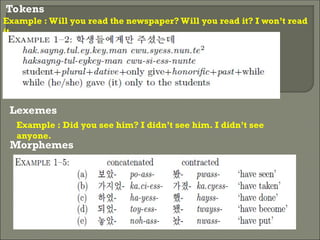
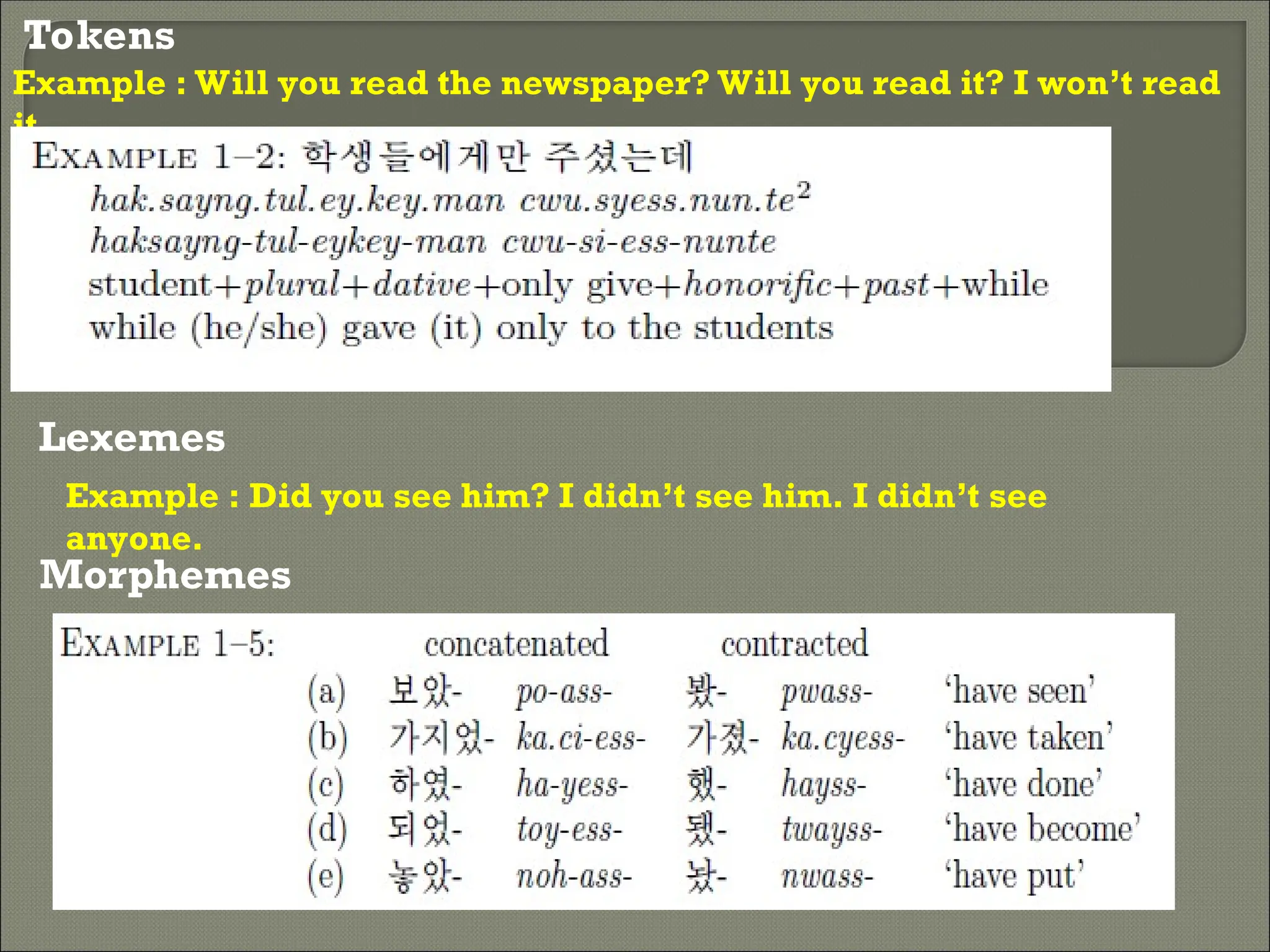
Tokens
Example : Will you read the newspaper? Will you read it? I won’t read
it.
Lexemes
Example : Did you see him? I didn’t see him. I didn’t see
anyone.
Morphemes
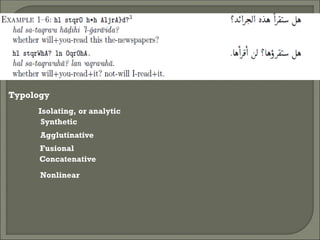
Typology
Isolating, or analytic
Synthetic
Agglutinative
Fusional
Concatenative
Nonlinear
 Morphological parsing tries to eliminate or reduce the variability
of word forms
 to provide higher-level linguistic units whose lexical and
morphological properties are explicit and well defined.
 It removes unnecessary irregularity and ambiguity
 In irregularity, such forms and structures that are not described
appropriately by a prototypical linguistic model.
 Some irregularities can be understood by redesigning the model
and improving its rules
 but other lexically dependent irregularities often cannot be
generalized.
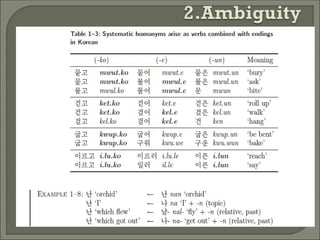
 Ambiguity is indeterminacy in interpretation of expressions of
language.
 Accidental ambiguity and ambiguity due to lexemes having
multiple senses
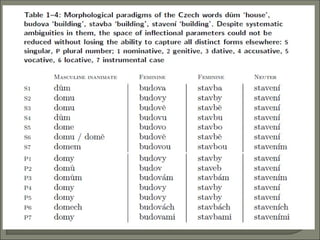
 we note the issue of syncretism, or systematic ambiguity.
 Morphological modeling also faces the problem of productivity
and creativity in language
 Usually, though, words are not licensed in lexicon of a
morphological system
 This unknown word problem is particularly severe in speech or
writing
Issues:
 1.Irregularity
 2.Ambiguity
 3.Productivity
 1. Irregularity:
 Morphological parsing is motivated by generalization and
abstraction in the world of words.
 Immediate descriptions of given linguistic data may not b ultimate
ones
 Due to either their inadequate accuracy or inappropriate
complexity, and better formulations may be needed.
 The design principles of the morphological models are very
important.
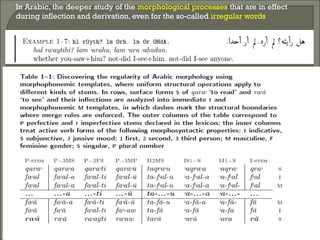
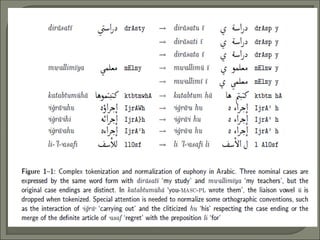
 In Arabic, the deeper study of the morphological processes that are in effect
during inflection and derivation, even for the so-called irregular words
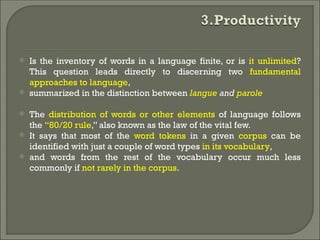
 Is the inventory of words in a language finite, or is it unlimited?
This question leads directly to discerning two fundamental
approaches to language,
 summarized in the distinction between langue and parole
 The distribution of words or other elements of language follows
the “80/20 rule,” also known as the law of the vital few.
 It says that most of the word tokens in a given corpus can be
identified with just a couple of word types in its vocabulary,
 and words from the rest of the vocabulary occur much less
commonly if not rarely in the corpus.
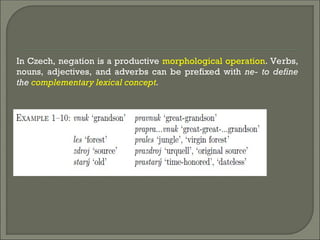
In Czech, negation is a productive morphological operation. Verbs,
nouns, adjectives, and adverbs can be prefixed with ne- to define
the complementary lexical concept.
 There are many possible approaches to designing and
implementing morphological models
 computational linguistics has witnessed the development of a
number of formalisms and frameworks, in particular grammars.
 Types of Models
1. Dictionary Lookup
2. Finite-State Morphology
3. Unification-Based Morphology
4. Functional Morphology
5. Morphology Induction
 Morphological parsing is a process by which word forms of a
language are associated with corresponding linguistic
descriptions.
 In sophisticated models of the language uses word lists,
dictionaries, or databases.
 A dictionary is understood as a data structure that directly
enables obtaining some pre computed results, in our case word
analyses
 Dictionaries can be implemented, for instance, as lists, binary
search trees, tries, hash tables, and so on.
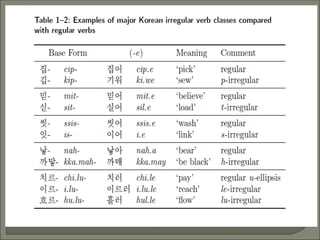
 Korean depend on a large dictionary of all possible combinations
of allomorphs and morphological alternations.
 The word list or dictionary-based approach used various ad hoc
implementations for many languages.
 In finite-state morphological models, which the specifications
written by human programmers are directly compiled into finite-
state transducers.
 The two most popular tools supporting this approach,
 For multiple languages are available online,
 1. XFST (Xerox Finite-State Tool)
 2. LexTools
 The role of finite-state transducers is to capture and compute
regular relations on sets
 Transducers specify relations between the input and output
languages.
 input word forms as surface strings and to the
 output descriptions as lexical strings
 In English, a finite-state transducer could analyze the
 surface string children into the lexical string child [+plural],
 for instance, or generate women from woman [+plural].
 Relations on languages can also be viewed as functions. Let
 Let us have a relation R,and let us denote by [ ] the set of all sequences
Σ over some set of symbols Σ,
 so that the domain and the range of R are subsets of [ ].
Σ
 We can then consider R as a function mapping an input string into a set of output strings.
 We rewrite rules of phonology and morphology have been around since the two-level morphology
model,
 Further presented in Computational Approaches to Morphology and Syntax and Morphology and
Computation.
 Compile-replace transducer operation for handling non
concatenative phenomena in morphology
 A theoretical limitation of finite-state models of morphology is the
problem of capturing reduplication of words or their elements
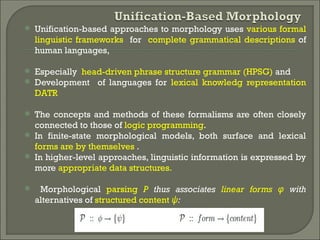
 Unification-based approaches to morphology uses various formal
linguistic frameworks for complete grammatical descriptions of
human languages,
 Especially head-driven phrase structure grammar (HPSG) and
 Development of languages for lexical knowledg representation
DATR
 The concepts and methods of these formalisms are often closely
connected to those of logic programming.
 In finite-state morphological models, both surface and lexical
forms are by themselves .
 In higher-level approaches, linguistic information is expressed by
more appropriate data structures.
 Morphological parsing P thus associates linear forms φ with
alternatives of structured content ψ:
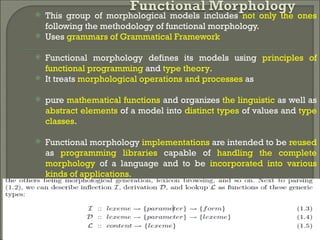
 This group of morphological models includes not only the ones
following the methodology of functional morphology.
 Uses grammars of Grammatical Framework
 Functional morphology defines its models using principles of
functional programming and type theory.
 It treats morphological operations and processes as
 pure mathematical functions and organizes the linguistic as well as
abstract elements of a model into distinct types of values and type
classes.
 Functional morphology implementations are intended to be reused
as programming libraries capable of handling the complete
morphology of a language and to be incorporated into various
kinds of applications.
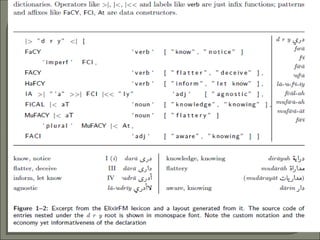
 Grammars in the OpenCCG project can be viewed as functional
models, too.
 Their formalism discerns declarations of features, categories, and
families
 Morphology Induction
 the structure of words
 the directions of research in this domain
 There are several challenging issues about deducing word
structure
 In order to improve the chances of statistical inference, parallel
learning of morphologies for multiple languages is proposed by
Snyder and Barzilay.
 The discriminative log-linear model of Poon, Cherry, and
Toutanova,
 enhances its generalization options by employing overlapping
contextual features when making segmentation decisions.
Issues & Morphological models NLP engineering

Issues & Morphological models NLP engineering

  • 1.
    Tokens Example : Willyou read the newspaper? Will you read it? I won’t read it. Lexemes Example : Did you see him? I didn’t see him. I didn’t see anyone. Morphemes
  • 2.
  • 3.
     Morphological parsingtries to eliminate or reduce the variability of word forms  to provide higher-level linguistic units whose lexical and morphological properties are explicit and well defined.  It removes unnecessary irregularity and ambiguity  In irregularity, such forms and structures that are not described appropriately by a prototypical linguistic model.  Some irregularities can be understood by redesigning the model and improving its rules  but other lexically dependent irregularities often cannot be generalized.
  • 4.
     Ambiguity isindeterminacy in interpretation of expressions of language.  Accidental ambiguity and ambiguity due to lexemes having multiple senses  we note the issue of syncretism, or systematic ambiguity.  Morphological modeling also faces the problem of productivity and creativity in language  Usually, though, words are not licensed in lexicon of a morphological system  This unknown word problem is particularly severe in speech or writing
  • 5.
    Issues:  1.Irregularity  2.Ambiguity 3.Productivity  1. Irregularity:  Morphological parsing is motivated by generalization and abstraction in the world of words.  Immediate descriptions of given linguistic data may not b ultimate ones  Due to either their inadequate accuracy or inappropriate complexity, and better formulations may be needed.  The design principles of the morphological models are very important.
  • 6.
     In Arabic,the deeper study of the morphological processes that are in effect during inflection and derivation, even for the so-called irregular words
  • 11.
     Is theinventory of words in a language finite, or is it unlimited? This question leads directly to discerning two fundamental approaches to language,  summarized in the distinction between langue and parole  The distribution of words or other elements of language follows the “80/20 rule,” also known as the law of the vital few.  It says that most of the word tokens in a given corpus can be identified with just a couple of word types in its vocabulary,  and words from the rest of the vocabulary occur much less commonly if not rarely in the corpus.
  • 12.
    In Czech, negationis a productive morphological operation. Verbs, nouns, adjectives, and adverbs can be prefixed with ne- to define the complementary lexical concept.
  • 13.
     There aremany possible approaches to designing and implementing morphological models  computational linguistics has witnessed the development of a number of formalisms and frameworks, in particular grammars.  Types of Models 1. Dictionary Lookup 2. Finite-State Morphology 3. Unification-Based Morphology 4. Functional Morphology 5. Morphology Induction
  • 14.
     Morphological parsingis a process by which word forms of a language are associated with corresponding linguistic descriptions.  In sophisticated models of the language uses word lists, dictionaries, or databases.  A dictionary is understood as a data structure that directly enables obtaining some pre computed results, in our case word analyses  Dictionaries can be implemented, for instance, as lists, binary search trees, tries, hash tables, and so on.  Korean depend on a large dictionary of all possible combinations of allomorphs and morphological alternations.  The word list or dictionary-based approach used various ad hoc implementations for many languages.
  • 15.
     In finite-statemorphological models, which the specifications written by human programmers are directly compiled into finite- state transducers.  The two most popular tools supporting this approach,  For multiple languages are available online,  1. XFST (Xerox Finite-State Tool)  2. LexTools  The role of finite-state transducers is to capture and compute regular relations on sets  Transducers specify relations between the input and output languages.  input word forms as surface strings and to the  output descriptions as lexical strings
  • 16.
     In English,a finite-state transducer could analyze the  surface string children into the lexical string child [+plural],  for instance, or generate women from woman [+plural].  Relations on languages can also be viewed as functions. Let  Let us have a relation R,and let us denote by [ ] the set of all sequences Σ over some set of symbols Σ,  so that the domain and the range of R are subsets of [ ]. Σ  We can then consider R as a function mapping an input string into a set of output strings.  We rewrite rules of phonology and morphology have been around since the two-level morphology model,  Further presented in Computational Approaches to Morphology and Syntax and Morphology and Computation.
  • 17.
     Compile-replace transduceroperation for handling non concatenative phenomena in morphology  A theoretical limitation of finite-state models of morphology is the problem of capturing reduplication of words or their elements
  • 18.
     Unification-based approachesto morphology uses various formal linguistic frameworks for complete grammatical descriptions of human languages,  Especially head-driven phrase structure grammar (HPSG) and  Development of languages for lexical knowledg representation DATR  The concepts and methods of these formalisms are often closely connected to those of logic programming.  In finite-state morphological models, both surface and lexical forms are by themselves .  In higher-level approaches, linguistic information is expressed by more appropriate data structures.  Morphological parsing P thus associates linear forms φ with alternatives of structured content ψ:
  • 19.
     This groupof morphological models includes not only the ones following the methodology of functional morphology.  Uses grammars of Grammatical Framework  Functional morphology defines its models using principles of functional programming and type theory.  It treats morphological operations and processes as  pure mathematical functions and organizes the linguistic as well as abstract elements of a model into distinct types of values and type classes.  Functional morphology implementations are intended to be reused as programming libraries capable of handling the complete morphology of a language and to be incorporated into various kinds of applications.
  • 20.
     Grammars inthe OpenCCG project can be viewed as functional models, too.  Their formalism discerns declarations of features, categories, and families  Morphology Induction  the structure of words  the directions of research in this domain  There are several challenging issues about deducing word structure  In order to improve the chances of statistical inference, parallel learning of morphologies for multiple languages is proposed by Snyder and Barzilay.  The discriminative log-linear model of Poon, Cherry, and Toutanova,  enhances its generalization options by employing overlapping contextual features when making segmentation decisions.