Psychology of Reading (2nd ed.)
Chap. 3. Word Perception I:
Some Basic Issues and Methods
Graduate Student, Kwansei Gakuin University
KANAZAWA, Yu(金澤 佑)
yu-kanazawa@kwansei.ac.jp
pp. (49-) 71-88
JACET Study Group of Reading
@ Umeda Campus, Kwansei Gakuin University
May 22, 2014. 1:40 pm-
Review:
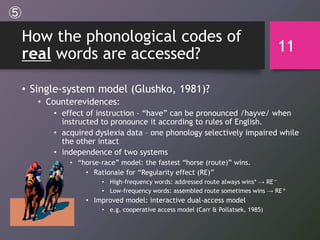
• Word identification/ recognition/ access/
processing/ encoding/decoding:
• The central issue to understanding reading
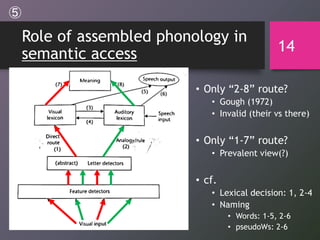
• A major focus of research in cognitive psychology in the
last 40 years
• The focus of this chapter:
• Word perception of (a) skilled readers (b) of English (c)
reading isolated printed words
2
Content
① Introduction
② How long does it take to identify a word?
③ Is word processing automatic?
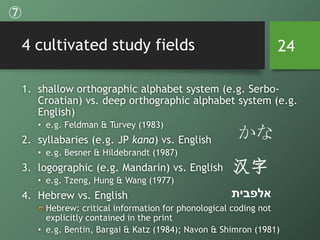
④ How does the processing of words relate to the
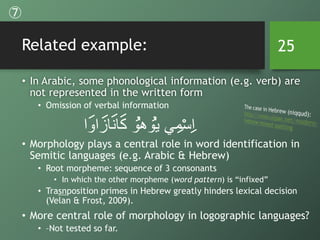
processing of letters?
⑤ The role of sound in the encoding of words
⑥ Processing simple and complex words
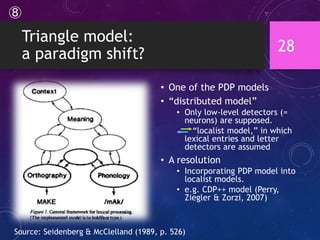
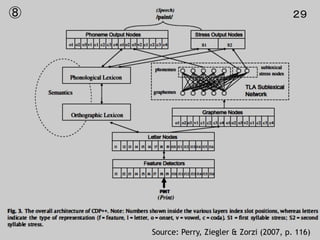
⑦ Cross-language studies of word perception
⑧ A final issue
⑨ Summary and conclusions
3
⑤
• The role of sound in the encoding of words
(単語の符号化における音声の役割)
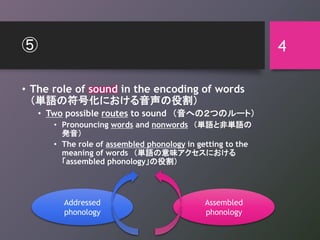
• Two possible routes to sound (音への2つのルート)
• Pronouncing words and nonwords (単語と非単語の
発音)
• The role of assembled phonology in getting to the
meaning of words (単語の意味アクセスにおける
「assembled phonology」の役割)
4
Addressed
phonology
Assembled
phonology
The role of sound in the
encoding of words
• Paap et al. model: meaning, etymology, and
pronunciation is available after the lexical entry
has been accessed via a direct visual route.
Does the sound of word irrelevant to getting to
the meaning? → No.
• The controversial issues:
a. How important a role sound coding plays?
b. How to conceptualize the relationship between
sound coding and orthographic coding?
c. How early the phonological codes are activated?
5
⑤
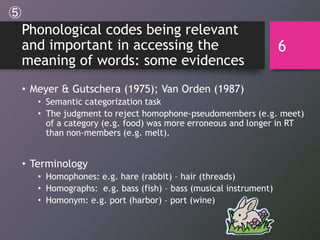
Phonological codes being relevant
and important in accessing the
meaning of words: some evidences
• Meyer & Gutschera (1975); Van Orden (1987)
• Semantic categorization task
• The judgment to reject homophone-pseudomembers (e.g. meet)
of a category (e.g. food) was more erroneous and longer in RT
than non-members (e.g. melt).
• Terminology
• Homophones: e.g. hare (rabbit) – hair (threads)
• Homographs: e.g. bass (fish) – bass (musical instrument)
• Homonym: e.g. port (harbor) – port (wine)
6
⑤
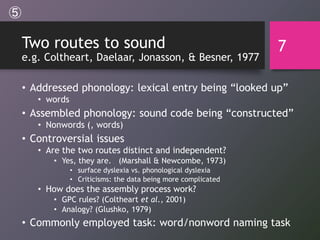
Two routes to sound
e.g. Coltheart, Daelaar, Jonasson, & Besner, 1977
• Addressed phonology: lexical entry being “looked up”
• words
• Assembled phonology: sound code being “constructed”
• Nonwords (, words)
• Controversial issues
• Are the two routes distinct and independent?
• Yes, they are. (Marshall & Newcombe, 1973)
• surface dyslexia vs. phonological dyslexia
• Criticisms: the data being more complicated
• How does the assembly process work?
• GPC rules? (Coltheart et al., 2001)
• Analogy? (Glushko, 1979)
• Commonly employed task: word/nonword naming task
7
⑤
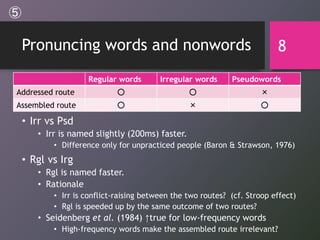
Pronuncing words and nonwords
• Irr vs Psd
• Irr is named slightly (200ms) faster.
• Difference only for unpracticed people (Baron & Strawson, 1976)
• Rgl vs Irg
• Rgl is named faster.
• Rationale
• Irr is conflict-raising between the two routes? (cf. Stroop effect)
• Rgl is speeded up by the same outcome of two routes?
• Seidenberg et al. (1984) ↑true for low-frequency words
• High-frequency words make the assembled route irrelevant?
8
Regular words Irregular words Pseudowords
Addressed route ○ ○ ×
Assembled route ○ × ○
⑤
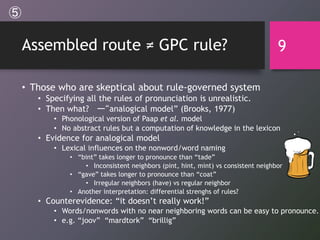
Assembled route ≠ GPC rule?
• Those who are skeptical about rule-governed system
• Specifying all the rules of pronunciation is unrealistic.
• Then what? ー“analogical model” (Brooks, 1977)
• Phonological version of Paap et al. model
• No abstract rules but a computation of knowledge in the lexicon
• Evidence for analogical model
• Lexical influences on the nonword/word naming
• “bint” takes longer to pronounce than “tade”
• Inconsistent neighbors (pint, hint, mint) vs consistent neighbor
• “gave” takes longer to pronounce than “coat”
• Irregular neighbors (have) vs regular neighbor
• Another interpretation: differential strenghs of rules?
• Counterevidence: “it doesn’t really work!”
• Words/nonwords with no near neighboring words can be easy to pronounce.
• e.g. “joov” “mardtork” “brillig”
9
⑤
Assembly route: analogy vs. rule
• Regarding subsets of words as components of lexicon?
→ equivalent to rule-view
• Analogical rationale is not needed especially for
languages with regular spelling system.
• English as an outlier language regarding regularity &
complexity of spelling
• a thought experiment: L1 Eng. learning L2 Spanish rules
• Rule system works well enough.
• Difference in focus
• Analogical hypothesis: simultaneous processing
• Rule hypothesis: sequential processing
10
cf. Share (2008)
⑤
How the phonological codes of
real words are accessed?
• Single-system model (Glushko, 1981)?
• Counterevidences:
• effect of instruction – “have” can be pronounced /hayve/ when
instructed to pronounce it according to rules of English.
• acquired dyslexia data – one phonology selectively impaired while
the other intact
• independence of two systems
• “horse-race” model: the fastest “horse (route)” wins.
• Rationale for “Regularity effect (RE)”
• High-frequency words: addressed route always wins* → RE-
• Low-frequency words: assembled route sometimes wins → RE+
• Improved model: interactive dual-access model
• e.g. cooperative access model (Carr & Pollatsek, 1985)
11
⑤
Interactive [cooperate computation]
model
• single-system model + two distinct systems
• e.g. when the presentation of “one” activates:
• (assembly) /own/ /on/ /cone/
• (addressed) /wʌn/ & associated phonological codes
→ the lexical entry which gets the most summed activation is
identified as the word
• Can irregular words produce inhibition?
• Not really for mildly irregular words (majority; e.g. “pint”)
• True for wildly irregular words (minority; e.g. “choir”)
• Unusual orthographic structure can also be the factor.
12
⑤
Not only the addressed channel but
also assembled channel is used to
access the sounds of real words.
• Related issue: 2 routes to comprehend what is said:
• (a) sound of the speech and (b) visual information of the lips
• (a w/o b): talking on a phone
• (b w/o a): lip-reading of deaf people
• (b → a): McGurk Effect (McGurk & MacDonald, 1976)
• (a)/ba/ + (b)/ga/ → /da/ (highest total excitation from a & b)
• Lip information is integrated with (or even facilitates; Yoshida, 2009) the
sound information in processing speech.
• Assembled phonology in identifying high-frequency words*
• Masked priming study (Pollatsek, Perea & Carreiras, 2005)
• Early phonological effects detected even in high-freq word recog
• Bigger priming effect in [conal → CANAL] than in [cinal → CANAL]
13
⑤
Role of assembled phonology in
semantic access
• Only “2-8” route?
• Gough (1972)
• Invalid (their vs there)
• Only “1-7” route?
• Prevalent view(?)
• cf.
• Lexical decision: 1, 2-4
• Naming
• Words: 1-5, 2-6
• pseudoWs: 2-6
14
⑤
Phonological involvement in the
access of the meaning of a word
• Is rule/analogy system involved in semantic access?
• Regularity effect in correct “Yes” responses in LDT: inconsistent
• Pseudohomophones of correct “No” responses in LDT: consistent
• E.g. “phocks” is slower than other nonwords.
• Problems:
• Any implication to lexical access of “real” words?
• pseudohomophone effect being an artifact (visuality)?
• ⇔ deep[phon.] dyslexic patients not showing the effect
• Meyer, Schvaneveldt & Ruddy (1974): the evidence
• [couch → touch] slower than [chair → touch] in LDT
• Problem: LDT does not ensure semantic access (e.g. Balota & Chumbley, 1984).
• How about semantic categorization task?
• Another interfering variable (robin vs penguin as a exemplar of birds)
• Van Orden, Johnson & Hale (1987); Lesch & Pollatsek (1998)
• False homophone pairs are slower & erroneous to respond “No.”
• e.g. pillow-bead cf. bead vs. head
15
⑤
⑥
• Processing simple and complex words (簡略
な単語と複雑な単語の処理)
• Function words (機能語)
• Complex (multimorphemic) words (複数形態素語)
16
Stimuli words in lexical access
studies. . .
• Word identification experiments:
• 3- to 6-letter words
• Word superiority effect experiments & simulations:
• 4-letter words (in all the cases!)
• Regularity literature:
• 6-7 (or less) letter words consisting of only one morpheme
• Class: nouns, verb, adjectives
→ What is the case when function words are used?
→ What is the case when multimorphemic words are used?
17
⑥
Function words:
prepositions, conjunctions, articles & pronouns
• Function words vs. content words
• Closed class vs. open class
• A few hundred vs. infinite number (and is still increasing)
• Meaning little in isolation (jointers) vs. meaningful in isolation
• Most frequent words vs. miscellaneous
• Processing of function words ≠ content words?
• Some people with brain damage (e.g. phonemic dyslexic, Broca’s
aphasic patients) can read aloud and comprehend content words
but not function words (Coltheart, Patterson & Mashall, 1980)
• The two lexicons may be separate from each other.
18
⑥
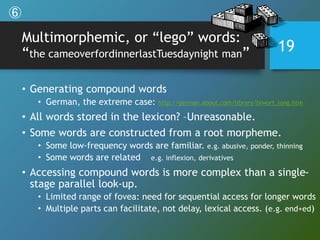
Multimorphemic, or “lego” words:
“the cameoverfordinnerlastTuesdaynight man”
• Generating compound words
• German, the extreme case: http://german.about.com/library/blwort_long.htm
• All words stored in the lexicon? –Unreasonable.
• Some words are constructed from a root morpheme.
• Some low-frequency words are familiar. e.g. abusive, ponder, thinning
• Some words are related e.g. inflexion, derivatives
• Accessing compound words is more complex than a single-
stage parallel look-up.
• Limited range of fovea: need for sequential access for longer words
• Multiple parts can facilitate, not delay, lexical access. (e.g. end+ed)
19
⑥
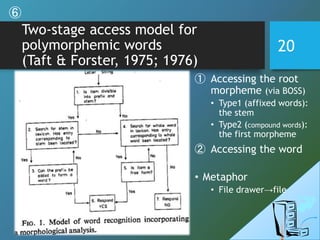
Two-stage access model for
polymorphemic words
(Taft & Forster, 1975; 1976)
① Accessing the root
morpheme (via BOSS)
• Type1 (affixed words):
the stem
• Type2 (compound words):
the first morpheme
② Accessing the word
• Metaphor
• File drawer→file
20
⑥
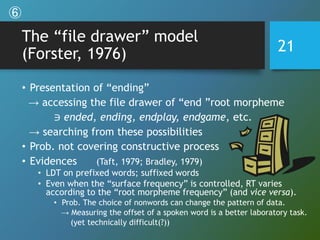
The “file drawer” model
(Forster, 1976)
• Presentation of “ending”
→ accessing the file drawer of “end ”root morpheme
∋ ended, ending, endplay, endgame, etc.
→ searching from these possibilities
• Prob. not covering constructive process
• Evidences (Taft, 1979; Bradley, 1979)
• LDT on prefixed words; suffixed words
• Even when the “surface frequency” is controlled, RT varies
according to the “root morpheme frequency” (and vice versa).
• Prob. The choice of nonwords can change the pattern of data.
→ Measuring the offset of a spoken word is a better laboratory task.
(yet technically difficult(?))
21
⑥
More promising approach:
masked priming paradigm
• Priming effect bigger for [CLEANER → clean] type of pairs
than for [BROTHER → broth] type of pairs.
• e.g. Feldman (2000); Pastizzo & Feldman (2002); Rastle, Davis, &
New (2004)
Morphemes play some role at a early stage of word
identification.
• Another rationale: suffixes (not morphemes) are extracted
as units early in word processing.
• Greater priming effect for [CORNER-corn] than for [BROTHEL-broth]
• Another possible methodology
• Eye movement measures in reading experiments
• To be continued in Chapter 5
22
⑥
Study using English words:
applicable to other languages?
• First issue: Letter processing vs. Word processing
• Different writing systems
• Alphabetic (representing phonemes; e.g. alphabet)
• Logographic (representing morphemes; e.g. kanji)
• Syllabic (representing syllabaries; e.g. kana)
• Letter processing vs. Word processing
• = Kanji processing vs. Word processing? (no direct evidence)
• Second issue: Role of sound representation in accessing the lexicon
• Extensive studies: Henderson (1982, 1984); Hung & Tzeng (1981) etc.
• 3 types of study
23
Cross-language studies of word perception (単語認知の言語縦断研究)⑦
4 cultivated study fields
1. shallow orthographic alphabet system (e.g. Serbo-
Croatian) vs. deep orthographic alphabet system (e.g.
English)
• e.g. Feldman & Turvey (1983)
2. syllabaries (e.g. JP kana) vs. English
• e.g. Besner & Hildebrandt (1987)
3. logographic (e.g. Mandarin) vs. English
• e.g. Tzeng, Hung & Wang (1977)
4. Hebrew vs. English
Hebrew: critical information for phonological coding not
explicitly contained in the print
• e.g. Bentin, Bargai & Katz (1984); Navon & Shimron (1981)
24
かな
汉字
‫אלפבית‬
⑦
Related example:
• In Arabic, some phonological information (e.g. verb) are
not represented in the written form
• Omission of verbal information
• Morphology plays a central role in word identification in
Semitic languages (e.g. Arabic & Hebrew)
• Root morpheme: sequence of 3 consonants
• In which the other morpheme (word pattern) is “infixed”
• Trasnposition primes in Hebrew greatly hinders lexical decision
(Velan & Frost, 2009).
• More central role of morphology in logographic languages?
• –Not tested so far.
25
‫يوهو‬ ‫اسمي‬‫كانازاوا‬
⑦
Beyond cultural variations
• Two routes to the lexicon exist cross-culturally.
• Different orthographies alter the relative proportions.
• Morton & Sasanuma (1984)
• Ideographic system (e.g. Kanji): heavier reliance on direct visual route
• Syllabic system: phonological coding → lexical access
• However… Japanese loan words in カタカナ being named faster than
nonwords (Besner & Hildebrandt, 1987): Lexicon may precede.
• Semitic languages: direct visual route is dominant.
• However… Hebrew readers can also utilize phonological route before
lexical access (Bentin et al., 1984; Navon & Shimron, 1981).
• Reading MAY be a relatively culture-free cognitive activity.
26
⑦
⑧
• A final issue (最後の問題)
27
Triangle model:
a paradigm shift?
• One of the PDP models
• “distributed model”
• Only low-level detectors (=
neurons) are supposed.
“localist model,” in which
lexical entries and letter
detectors are assumed
• A resolution
• Incorporating PDP model into
localist models.
• e.g. CDP++ model (Perry,
Ziegler & Zorzi, 2007)
28
Source: Seidenberg & McClelland (1989, p. 526)
⑧
29
Source: Perry, Ziegler & Zorzi (2007, p. 116)
⑧ 29
To sum up. . .
• Word identification: 200-250 ms/a word
• can be an automatic process without awareness or intention
• Processing letters in words: basically parallel
• Sound encoding: “direct visual access is important and that
sound encoding plays some part.”
• Three systems of word encoding
• Direct visual route
• Spelling-to-sound route - - - assembly (analogy/rule)
• Morphemic decomposition route - - - for compound words
30
Summary and conclusions (まとめと結論)⑨
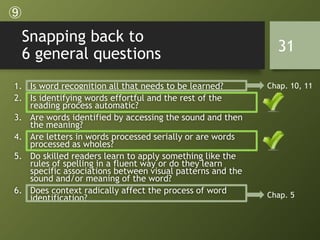
Snapping back to
6 general questions
1. Is word recognition all that needs to be learned?
2. Is identifying words effortful and the rest of the
reading process automatic?
3. Are words identified by accessing the sound and then
the meaning?
4. Are letters in words processed serially or are words
processed as wholes?
5. Do skilled readers learn to apply something like the
rules of spelling in a fluent way or do they learn
specific associations between visual patterns and the
sound and/or meaning of the word?
6. Does context radically affect the process of word
identification?
Chap. 10, 11
Chap. 5
31
⑨
The reference book
• Pollatsek, A. (2012). Word perception I: Some
basic issues and methods. In, K. Rayner, A.
Pollatsek, J. Ashby, and C. Clifton Jr.
Psychology of reading: 2nd edition (pp. 49-88).
New York: Psychology Press.
32
Note. blink frequency: 250 ms

リーディング研究会2014年6月輪読_最終版(関西学院大学大学院・金澤)

  • 1.
    Psychology of Reading(2nd ed.) Chap. 3. Word Perception I: Some Basic Issues and Methods Graduate Student, Kwansei Gakuin University KANAZAWA, Yu(金澤 佑) yu-kanazawa@kwansei.ac.jp pp. (49-) 71-88 JACET Study Group of Reading @ Umeda Campus, Kwansei Gakuin University May 22, 2014. 1:40 pm-
  • 2.
    Review: • Word identification/recognition/ access/ processing/ encoding/decoding: • The central issue to understanding reading • A major focus of research in cognitive psychology in the last 40 years • The focus of this chapter: • Word perception of (a) skilled readers (b) of English (c) reading isolated printed words 2
  • 3.
    Content ① Introduction ② Howlong does it take to identify a word? ③ Is word processing automatic? ④ How does the processing of words relate to the processing of letters? ⑤ The role of sound in the encoding of words ⑥ Processing simple and complex words ⑦ Cross-language studies of word perception ⑧ A final issue ⑨ Summary and conclusions 3
  • 4.
    ⑤ • The roleof sound in the encoding of words (単語の符号化における音声の役割) • Two possible routes to sound (音への2つのルート) • Pronouncing words and nonwords (単語と非単語の 発音) • The role of assembled phonology in getting to the meaning of words (単語の意味アクセスにおける 「assembled phonology」の役割) 4 Addressed phonology Assembled phonology
  • 5.
    The role ofsound in the encoding of words • Paap et al. model: meaning, etymology, and pronunciation is available after the lexical entry has been accessed via a direct visual route. Does the sound of word irrelevant to getting to the meaning? → No. • The controversial issues: a. How important a role sound coding plays? b. How to conceptualize the relationship between sound coding and orthographic coding? c. How early the phonological codes are activated? 5 ⑤
  • 6.
    Phonological codes beingrelevant and important in accessing the meaning of words: some evidences • Meyer & Gutschera (1975); Van Orden (1987) • Semantic categorization task • The judgment to reject homophone-pseudomembers (e.g. meet) of a category (e.g. food) was more erroneous and longer in RT than non-members (e.g. melt). • Terminology • Homophones: e.g. hare (rabbit) – hair (threads) • Homographs: e.g. bass (fish) – bass (musical instrument) • Homonym: e.g. port (harbor) – port (wine) 6 ⑤
  • 7.
    Two routes tosound e.g. Coltheart, Daelaar, Jonasson, & Besner, 1977 • Addressed phonology: lexical entry being “looked up” • words • Assembled phonology: sound code being “constructed” • Nonwords (, words) • Controversial issues • Are the two routes distinct and independent? • Yes, they are. (Marshall & Newcombe, 1973) • surface dyslexia vs. phonological dyslexia • Criticisms: the data being more complicated • How does the assembly process work? • GPC rules? (Coltheart et al., 2001) • Analogy? (Glushko, 1979) • Commonly employed task: word/nonword naming task 7 ⑤
  • 8.
    Pronuncing words andnonwords • Irr vs Psd • Irr is named slightly (200ms) faster. • Difference only for unpracticed people (Baron & Strawson, 1976) • Rgl vs Irg • Rgl is named faster. • Rationale • Irr is conflict-raising between the two routes? (cf. Stroop effect) • Rgl is speeded up by the same outcome of two routes? • Seidenberg et al. (1984) ↑true for low-frequency words • High-frequency words make the assembled route irrelevant? 8 Regular words Irregular words Pseudowords Addressed route ○ ○ × Assembled route ○ × ○ ⑤
  • 9.
    Assembled route ≠GPC rule? • Those who are skeptical about rule-governed system • Specifying all the rules of pronunciation is unrealistic. • Then what? ー“analogical model” (Brooks, 1977) • Phonological version of Paap et al. model • No abstract rules but a computation of knowledge in the lexicon • Evidence for analogical model • Lexical influences on the nonword/word naming • “bint” takes longer to pronounce than “tade” • Inconsistent neighbors (pint, hint, mint) vs consistent neighbor • “gave” takes longer to pronounce than “coat” • Irregular neighbors (have) vs regular neighbor • Another interpretation: differential strenghs of rules? • Counterevidence: “it doesn’t really work!” • Words/nonwords with no near neighboring words can be easy to pronounce. • e.g. “joov” “mardtork” “brillig” 9 ⑤
  • 10.
    Assembly route: analogyvs. rule • Regarding subsets of words as components of lexicon? → equivalent to rule-view • Analogical rationale is not needed especially for languages with regular spelling system. • English as an outlier language regarding regularity & complexity of spelling • a thought experiment: L1 Eng. learning L2 Spanish rules • Rule system works well enough. • Difference in focus • Analogical hypothesis: simultaneous processing • Rule hypothesis: sequential processing 10 cf. Share (2008) ⑤
  • 11.
    How the phonologicalcodes of real words are accessed? • Single-system model (Glushko, 1981)? • Counterevidences: • effect of instruction – “have” can be pronounced /hayve/ when instructed to pronounce it according to rules of English. • acquired dyslexia data – one phonology selectively impaired while the other intact • independence of two systems • “horse-race” model: the fastest “horse (route)” wins. • Rationale for “Regularity effect (RE)” • High-frequency words: addressed route always wins* → RE- • Low-frequency words: assembled route sometimes wins → RE+ • Improved model: interactive dual-access model • e.g. cooperative access model (Carr & Pollatsek, 1985) 11 ⑤
  • 12.
    Interactive [cooperate computation] model •single-system model + two distinct systems • e.g. when the presentation of “one” activates: • (assembly) /own/ /on/ /cone/ • (addressed) /wʌn/ & associated phonological codes → the lexical entry which gets the most summed activation is identified as the word • Can irregular words produce inhibition? • Not really for mildly irregular words (majority; e.g. “pint”) • True for wildly irregular words (minority; e.g. “choir”) • Unusual orthographic structure can also be the factor. 12 ⑤
  • 13.
    Not only theaddressed channel but also assembled channel is used to access the sounds of real words. • Related issue: 2 routes to comprehend what is said: • (a) sound of the speech and (b) visual information of the lips • (a w/o b): talking on a phone • (b w/o a): lip-reading of deaf people • (b → a): McGurk Effect (McGurk & MacDonald, 1976) • (a)/ba/ + (b)/ga/ → /da/ (highest total excitation from a & b) • Lip information is integrated with (or even facilitates; Yoshida, 2009) the sound information in processing speech. • Assembled phonology in identifying high-frequency words* • Masked priming study (Pollatsek, Perea & Carreiras, 2005) • Early phonological effects detected even in high-freq word recog • Bigger priming effect in [conal → CANAL] than in [cinal → CANAL] 13 ⑤
  • 14.
    Role of assembledphonology in semantic access • Only “2-8” route? • Gough (1972) • Invalid (their vs there) • Only “1-7” route? • Prevalent view(?) • cf. • Lexical decision: 1, 2-4 • Naming • Words: 1-5, 2-6 • pseudoWs: 2-6 14 ⑤
  • 15.
    Phonological involvement inthe access of the meaning of a word • Is rule/analogy system involved in semantic access? • Regularity effect in correct “Yes” responses in LDT: inconsistent • Pseudohomophones of correct “No” responses in LDT: consistent • E.g. “phocks” is slower than other nonwords. • Problems: • Any implication to lexical access of “real” words? • pseudohomophone effect being an artifact (visuality)? • ⇔ deep[phon.] dyslexic patients not showing the effect • Meyer, Schvaneveldt & Ruddy (1974): the evidence • [couch → touch] slower than [chair → touch] in LDT • Problem: LDT does not ensure semantic access (e.g. Balota & Chumbley, 1984). • How about semantic categorization task? • Another interfering variable (robin vs penguin as a exemplar of birds) • Van Orden, Johnson & Hale (1987); Lesch & Pollatsek (1998) • False homophone pairs are slower & erroneous to respond “No.” • e.g. pillow-bead cf. bead vs. head 15 ⑤
  • 16.
    ⑥ • Processing simpleand complex words (簡略 な単語と複雑な単語の処理) • Function words (機能語) • Complex (multimorphemic) words (複数形態素語) 16
  • 17.
    Stimuli words inlexical access studies. . . • Word identification experiments: • 3- to 6-letter words • Word superiority effect experiments & simulations: • 4-letter words (in all the cases!) • Regularity literature: • 6-7 (or less) letter words consisting of only one morpheme • Class: nouns, verb, adjectives → What is the case when function words are used? → What is the case when multimorphemic words are used? 17 ⑥
  • 18.
    Function words: prepositions, conjunctions,articles & pronouns • Function words vs. content words • Closed class vs. open class • A few hundred vs. infinite number (and is still increasing) • Meaning little in isolation (jointers) vs. meaningful in isolation • Most frequent words vs. miscellaneous • Processing of function words ≠ content words? • Some people with brain damage (e.g. phonemic dyslexic, Broca’s aphasic patients) can read aloud and comprehend content words but not function words (Coltheart, Patterson & Mashall, 1980) • The two lexicons may be separate from each other. 18 ⑥
  • 19.
    Multimorphemic, or “lego”words: “the cameoverfordinnerlastTuesdaynight man” • Generating compound words • German, the extreme case: http://german.about.com/library/blwort_long.htm • All words stored in the lexicon? –Unreasonable. • Some words are constructed from a root morpheme. • Some low-frequency words are familiar. e.g. abusive, ponder, thinning • Some words are related e.g. inflexion, derivatives • Accessing compound words is more complex than a single- stage parallel look-up. • Limited range of fovea: need for sequential access for longer words • Multiple parts can facilitate, not delay, lexical access. (e.g. end+ed) 19 ⑥
  • 20.
    Two-stage access modelfor polymorphemic words (Taft & Forster, 1975; 1976) ① Accessing the root morpheme (via BOSS) • Type1 (affixed words): the stem • Type2 (compound words): the first morpheme ② Accessing the word • Metaphor • File drawer→file 20 ⑥
  • 21.
    The “file drawer”model (Forster, 1976) • Presentation of “ending” → accessing the file drawer of “end ”root morpheme ∋ ended, ending, endplay, endgame, etc. → searching from these possibilities • Prob. not covering constructive process • Evidences (Taft, 1979; Bradley, 1979) • LDT on prefixed words; suffixed words • Even when the “surface frequency” is controlled, RT varies according to the “root morpheme frequency” (and vice versa). • Prob. The choice of nonwords can change the pattern of data. → Measuring the offset of a spoken word is a better laboratory task. (yet technically difficult(?)) 21 ⑥
  • 22.
    More promising approach: maskedpriming paradigm • Priming effect bigger for [CLEANER → clean] type of pairs than for [BROTHER → broth] type of pairs. • e.g. Feldman (2000); Pastizzo & Feldman (2002); Rastle, Davis, & New (2004) Morphemes play some role at a early stage of word identification. • Another rationale: suffixes (not morphemes) are extracted as units early in word processing. • Greater priming effect for [CORNER-corn] than for [BROTHEL-broth] • Another possible methodology • Eye movement measures in reading experiments • To be continued in Chapter 5 22 ⑥
  • 23.
    Study using Englishwords: applicable to other languages? • First issue: Letter processing vs. Word processing • Different writing systems • Alphabetic (representing phonemes; e.g. alphabet) • Logographic (representing morphemes; e.g. kanji) • Syllabic (representing syllabaries; e.g. kana) • Letter processing vs. Word processing • = Kanji processing vs. Word processing? (no direct evidence) • Second issue: Role of sound representation in accessing the lexicon • Extensive studies: Henderson (1982, 1984); Hung & Tzeng (1981) etc. • 3 types of study 23 Cross-language studies of word perception (単語認知の言語縦断研究)⑦
  • 24.
    4 cultivated studyfields 1. shallow orthographic alphabet system (e.g. Serbo- Croatian) vs. deep orthographic alphabet system (e.g. English) • e.g. Feldman & Turvey (1983) 2. syllabaries (e.g. JP kana) vs. English • e.g. Besner & Hildebrandt (1987) 3. logographic (e.g. Mandarin) vs. English • e.g. Tzeng, Hung & Wang (1977) 4. Hebrew vs. English Hebrew: critical information for phonological coding not explicitly contained in the print • e.g. Bentin, Bargai & Katz (1984); Navon & Shimron (1981) 24 かな 汉字 ‫אלפבית‬ ⑦
  • 25.
    Related example: • InArabic, some phonological information (e.g. verb) are not represented in the written form • Omission of verbal information • Morphology plays a central role in word identification in Semitic languages (e.g. Arabic & Hebrew) • Root morpheme: sequence of 3 consonants • In which the other morpheme (word pattern) is “infixed” • Trasnposition primes in Hebrew greatly hinders lexical decision (Velan & Frost, 2009). • More central role of morphology in logographic languages? • –Not tested so far. 25 ‫يوهو‬ ‫اسمي‬‫كانازاوا‬ ⑦
  • 26.
    Beyond cultural variations •Two routes to the lexicon exist cross-culturally. • Different orthographies alter the relative proportions. • Morton & Sasanuma (1984) • Ideographic system (e.g. Kanji): heavier reliance on direct visual route • Syllabic system: phonological coding → lexical access • However… Japanese loan words in カタカナ being named faster than nonwords (Besner & Hildebrandt, 1987): Lexicon may precede. • Semitic languages: direct visual route is dominant. • However… Hebrew readers can also utilize phonological route before lexical access (Bentin et al., 1984; Navon & Shimron, 1981). • Reading MAY be a relatively culture-free cognitive activity. 26 ⑦
  • 27.
    ⑧ • A finalissue (最後の問題) 27
  • 28.
    Triangle model: a paradigmshift? • One of the PDP models • “distributed model” • Only low-level detectors (= neurons) are supposed. “localist model,” in which lexical entries and letter detectors are assumed • A resolution • Incorporating PDP model into localist models. • e.g. CDP++ model (Perry, Ziegler & Zorzi, 2007) 28 Source: Seidenberg & McClelland (1989, p. 526) ⑧
  • 29.
    29 Source: Perry, Ziegler& Zorzi (2007, p. 116) ⑧ 29
  • 30.
    To sum up.. . • Word identification: 200-250 ms/a word • can be an automatic process without awareness or intention • Processing letters in words: basically parallel • Sound encoding: “direct visual access is important and that sound encoding plays some part.” • Three systems of word encoding • Direct visual route • Spelling-to-sound route - - - assembly (analogy/rule) • Morphemic decomposition route - - - for compound words 30 Summary and conclusions (まとめと結論)⑨
  • 31.
    Snapping back to 6general questions 1. Is word recognition all that needs to be learned? 2. Is identifying words effortful and the rest of the reading process automatic? 3. Are words identified by accessing the sound and then the meaning? 4. Are letters in words processed serially or are words processed as wholes? 5. Do skilled readers learn to apply something like the rules of spelling in a fluent way or do they learn specific associations between visual patterns and the sound and/or meaning of the word? 6. Does context radically affect the process of word identification? Chap. 10, 11 Chap. 5 31 ⑨
  • 32.
    The reference book •Pollatsek, A. (2012). Word perception I: Some basic issues and methods. In, K. Rayner, A. Pollatsek, J. Ashby, and C. Clifton Jr. Psychology of reading: 2nd edition (pp. 49-88). New York: Psychology Press. 32 Note. blink frequency: 250 ms

Editor's Notes

  • #2 非表示スライドのナンバリングに注意
  • #7 Pair, rock fruit
  • #8 Surface: addressed route is impaired. Phonological: assembled route is impaired.
  • #9 e.g. one, two, choir, women (irregular words)
  • #10 Pint パイント
  • #12 Glushko 1981, Humphreys and Evett, 1985 the lexical entry and its neighbors are activated. Dyslexia dataの説明方法の別の可能性。大きいユニットがdisabledなるとsurface dyslexiaで、小さいユニットだとphonological dyslexia? だがそれは2つのルートを想定するのに等しいという。
  • #13 Regularity effect が 見つかるのは、ワイルドにイレギュラーな単語のみ(たとえば、droonと書いて/step/と読むといったような。)
  • #16 Regularity in spelling irregularity in spelling coltheart et al 1977 Rubenstein, Lewis, and Ruberstein, 1971 Deep dyslexic data, Patterson and Marcel 1977 Meyer & Gutschera (1975) のフォローアップが、 van ordenなど
  • #19 Neuropsychological field
  • #21 Basic Orthographic Syllabic Structure always the first morpheme, regardless of its linguistically motivated definition (e.g. Selkirk, 1982) BOSS is from Taft (1979; 1985; 1986) Taft (2006) is more complex: morphemic decomposition at seceral processing stages
  • #27 At least, the authors seem to hope it is.
  • #31 The final point: to what representation?
  • #32 結論から言うと・・・。