
“The hardest thing to see is what is in front of your eyes.”
                                                  - Goethe
These leaves could
   save millions of lives.
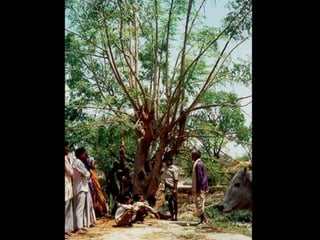
The Moringa Tree
 Moringa oleifera
Varieties
Thirteen Moringa species are known:

            M. oleifera
            M. arborea
            M. borziana
            M. concanensis
            M. drouhardii
            M. hildebrandtii
            M. longituba
            M. ovalifolia
            M. peregrina
            M. pygmaea
            M. rivae
            M. ruspoliana
            M. stenopetala
Moringa Knowledge in the Ancient World
Ancient World
                       Knowledge


Sources: 1, 2, 3, 4, 5, 6, 7, 8, 9, 10, 11, 12
Scientific
Knowledge
Nutritional Value
7 times    the Vitamin C of Oranges


                     4 times    the Vitamin A of Carrots


                     4 times    the Calcium of Milk


                     3 times    the Potassium of Bananas


Tiny leaves.
Enormous Benefits.   2 times   the Protein of Yogurt


                                           Gram-for-gram comparison of nutritional data 1
It’s like growing multi-vitamins
at your doorstep.


                                             Vitamin A
                                             Vitamin B1
                                            Vitamin B2
                                           Vitamin B3
                                        Vitamin C
                                   Calcium
                            Chromium
                       Copper
                    Iron
                  Magnesium
                 Manganese
                  Phosphorus
                    Potassium
                      Protein
                           Zinc
Rare for a
plant source,
Moringa leaves
contain all
the essential
amino acids…


                 ...to build
                        strong, healthy bodies.
Moringa even
contains argenine
and histidine—
two amino acids
especially
important for
infants.
Fresh leaves and common foods1, Dried leaves2
Note: Iron from plants, including spinach and Moringa, is generally difficult for the body to absorb.


                                                                                      Fresh leaves and common foods1, Dried leaves2
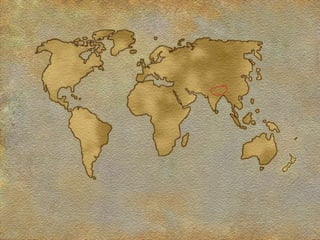
Common Names for Moringa
   Oceania
   Fiji: Sajina
  (See more at: treesforlife.org/moringa/names)
    Guam: Katdes
    Palau: Malungkai
Malnutrition
    Moringa    Malnutrition map13
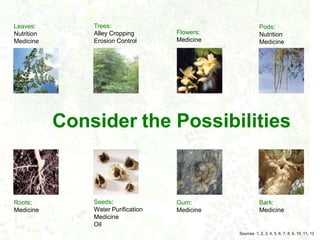
Leaves:         Trees:                                      Pods:
Nutrition       Alley Cropping       Flowers:               Nutrition
Medicine        Erosion Control      Medicine               Medicine


            Consider the Possibilities


Roots:          Seeds:               Gum:                   Bark:
Medicine        Water Purification   Medicine               Medicine
                Medicine
                Oil
                                                Sources: 1, 2, 3, 4, 5, 6, 7, 8, 9, 10, 11, 12
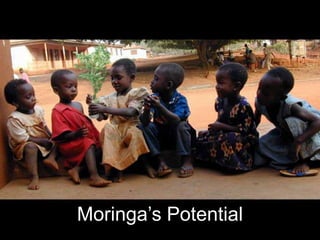
Moringa’s Potential
• Human Health

• Livestock Fodder

• Plant Growth Enhancer
• Biogas
Human Health
Test in Senegal

      Conducted by:

• Mr. Lowell Fuglie,
  Church World Service in
  Dakar

• AGADA
  (Alternative Action for
  African Development)
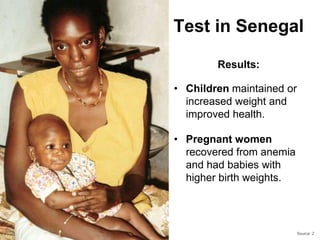
Test in Senegal

        Results:

• Children maintained or
  increased weight and
  improved health.

• Pregnant women
  recovered from anemia
  and had babies with
  higher birth weights.


                           Source: 2
Research in Nicaragua
Nikolaus Foidl
                 Leonardo Mayorga
Dr. Nadir Reyes Sánchez
Intensive Cultivation
Livestock Fodder
Increases daily
weight gain
up to 32%

Increases milk
production
43% to 65%


                  Weight gain14, Milk production15, 16
Plant Growth Enhancer
Plant Growth Spray
• Extract juice from green matter

• Dilute with 36 parts water

• Spray 25ml on each plant
Effects of Spray
• Accelerates growth of young plants
• Plants are firmer, more resistant to
  pests and disease
• Longer life-span
• Heavier roots, stems and leaves
• Produce more fruit
• Larger fruit
• Increase in yield 20-35%


                                         Source: 14
Biogas
Need for Studies

  • Human Health

  • Livestock Fodder

  • Plant Growth Enhancer

  • Biogas
How to Help
• Share this information with key
  decision-makers in your country.

• Promote field studies and
  clinical studies in your country.

• Share your findings with the rest
  of the world.
Trees for Life Journal
Share your findings with the world at:
    www.TFLJournal.org
Consider the Possibilities
References
1.    Gopalan, C., B.V. Rama Sastri, and S.C. Balasubramanian. Nutritive value of Indian foods. Hyderabad, India: (National Institute of
      Nutrition), 1971 (revised and updated by B.S. Narasinga Rao, Y.G. Deosthale, and K.C. Pant, 1989).
2.    Fuglie, Lowell J., ed. The Miracle Tree—Moringa oleifera: Natural Nutrition for the Tropics. Training Manual. 2001. Church World
      Service, Dakar, Senegal. May 2002.
3.    Price, Martin L. “The Moringa Tree.” Educational Concerns for Hunger Organization (ECHO) Technical Note. 1985 (revised 2002).
      May 2002. <www.echotech.org/technical/technotes/moringabiomasa.pdf>.
4.    Saint Sauveur (de), Armelle. “Moringa exploitation in the world: State of knowledge and challenges.” Development Potential for
      Moringa Products. International Workshop, Dar es Salaam, Tanzania, 29 Oct. - 2 Nov. 2001.
5.    Morton, Julia F. “The Horseradish Tree, Moringa pterygosperma (Moringaceae)—A Boon to Arid Lands?” Economic Botany. 45 (3),
      (1991): 318-333.
6.    IndianGyan: The Source for Alternative Medicines and Holistic Health. Home Remedies for Common Ailments. May 2002.
      <www.indiangyan.com/books/healthbooks/remedies/cataract.shtml>.
7.    Bakhru, H.K. Foods That heal: The Natural Way to Good Health. South Asia Books, 1995.
8.    New Crop Resource Online Program (NewCROP). “Moringa Oleifera Lam.” 7 Jan.1998. Purdue U. Jan. 2005.
      <www.hort.purdue.edu/newcrop/duke_energy/Moringa_oleifera.html>.
9.    Sairam, T.V. Home remedies, Vol II: A Handbook of Herbal Cures for Commons Ailments. New Delhi, India: Penguin, 1999.
10.   M.S. Swaminathan Research Foundation. Moringa oleifera Lam, Moringaceae. May 2002. <www.mssrf.org./fris9809/
      fris1157.html>.
11.   Participatory Development Resource Centre for Africa (PDRCA) Page. United Nations Volunteers. Aug. 2000.
      <www.unv.org/projects/pdrca/pdrca22.htm>.
12.   Home Truths Page. Morepen Laboratories. March 2002. <www.morepen.com/morepen/newsletter/hometruths.htm>.
13.   United Nations World Food Programme. Interactive Hunger Map. 2004. December 2004.
      <www.wfp.org/country_brief/hunger_map/map/hungermap_popup/map_popup.html>.
14.   Foidl, N., Makkar, H.P.S. and Becker, K. The potential of Moringa oleifera for agricultural and industrial uses. In: L.J. Fuglie (Ed.),
      The Miracle Tree: The Multiple Attributes of Moringa (pp. 45-76). Dakar, Senegal: Church World Service, 2001.
15.   Fuglie, L. New Uses of Moringa Studied in Nicaragua. ECHO Development Notes #68, June, 2000.
      <http://www.echotech.org/network/modules.php?name=News&file=article&sid=194>.
16.   Reyes, S.N. Moringa oleifera and Cratylia argentea: potential fodder species for ruminants in Nicaragua. Doctoral thesis, Swedish
      University of Agricultural Sciences, Uppsala. 2006.

Moringa Aleifera-The Miracle Herb

  • 1.
    “The hardest thingto see is what is in front of your eyes.” - Goethe
  • 2.
    These leaves could save millions of lives.
  • 3.
    The Moringa Tree Moringa oleifera
  • 5.
    Varieties Thirteen Moringa speciesare known: M. oleifera M. arborea M. borziana M. concanensis M. drouhardii M. hildebrandtii M. longituba M. ovalifolia M. peregrina M. pygmaea M. rivae M. ruspoliana M. stenopetala
  • 6.
    Moringa Knowledge inthe Ancient World
  • 7.
    Ancient World Knowledge Sources: 1, 2, 3, 4, 5, 6, 7, 8, 9, 10, 11, 12
  • 8.
  • 9.
  • 10.
    7 times the Vitamin C of Oranges 4 times the Vitamin A of Carrots 4 times the Calcium of Milk 3 times the Potassium of Bananas Tiny leaves. Enormous Benefits. 2 times the Protein of Yogurt Gram-for-gram comparison of nutritional data 1
  • 11.
    It’s like growingmulti-vitamins at your doorstep. Vitamin A Vitamin B1 Vitamin B2 Vitamin B3 Vitamin C Calcium Chromium Copper Iron Magnesium Manganese Phosphorus Potassium Protein Zinc
  • 12.
    Rare for a plantsource, Moringa leaves contain all the essential amino acids… ...to build strong, healthy bodies.
  • 13.
    Moringa even contains argenine andhistidine— two amino acids especially important for infants.
  • 14.
    Fresh leaves andcommon foods1, Dried leaves2
  • 15.
    Note: Iron fromplants, including spinach and Moringa, is generally difficult for the body to absorb. Fresh leaves and common foods1, Dried leaves2
  • 16.
    Common Names forMoringa Oceania Fiji: Sajina (See more at: treesforlife.org/moringa/names) Guam: Katdes Palau: Malungkai
  • 17.
    Malnutrition Moringa Malnutrition map13
  • 18.
    Leaves: Trees: Pods: Nutrition Alley Cropping Flowers: Nutrition Medicine Erosion Control Medicine Medicine Consider the Possibilities Roots: Seeds: Gum: Bark: Medicine Water Purification Medicine Medicine Medicine Oil Sources: 1, 2, 3, 4, 5, 6, 7, 8, 9, 10, 11, 12
  • 19.
  • 20.
    • Human Health •Livestock Fodder • Plant Growth Enhancer • Biogas
  • 21.
  • 22.
    Test in Senegal Conducted by: • Mr. Lowell Fuglie, Church World Service in Dakar • AGADA (Alternative Action for African Development)
  • 23.
    Test in Senegal Results: • Children maintained or increased weight and improved health. • Pregnant women recovered from anemia and had babies with higher birth weights. Source: 2
  • 24.
  • 25.
    Nikolaus Foidl Leonardo Mayorga
  • 26.
  • 27.
  • 34.
  • 35.
    Increases daily weight gain upto 32% Increases milk production 43% to 65% Weight gain14, Milk production15, 16
  • 36.
  • 37.
    Plant Growth Spray •Extract juice from green matter • Dilute with 36 parts water • Spray 25ml on each plant
  • 41.
    Effects of Spray •Accelerates growth of young plants • Plants are firmer, more resistant to pests and disease • Longer life-span • Heavier roots, stems and leaves • Produce more fruit • Larger fruit • Increase in yield 20-35% Source: 14
  • 46.
  • 48.
    Need for Studies • Human Health • Livestock Fodder • Plant Growth Enhancer • Biogas
  • 49.
    How to Help •Share this information with key decision-makers in your country. • Promote field studies and clinical studies in your country. • Share your findings with the rest of the world.
  • 50.
    Trees for LifeJournal Share your findings with the world at: www.TFLJournal.org
  • 51.
  • 52.
    References 1. Gopalan, C., B.V. Rama Sastri, and S.C. Balasubramanian. Nutritive value of Indian foods. Hyderabad, India: (National Institute of Nutrition), 1971 (revised and updated by B.S. Narasinga Rao, Y.G. Deosthale, and K.C. Pant, 1989). 2. Fuglie, Lowell J., ed. The Miracle Tree—Moringa oleifera: Natural Nutrition for the Tropics. Training Manual. 2001. Church World Service, Dakar, Senegal. May 2002. 3. Price, Martin L. “The Moringa Tree.” Educational Concerns for Hunger Organization (ECHO) Technical Note. 1985 (revised 2002). May 2002. <www.echotech.org/technical/technotes/moringabiomasa.pdf>. 4. Saint Sauveur (de), Armelle. “Moringa exploitation in the world: State of knowledge and challenges.” Development Potential for Moringa Products. International Workshop, Dar es Salaam, Tanzania, 29 Oct. - 2 Nov. 2001. 5. Morton, Julia F. “The Horseradish Tree, Moringa pterygosperma (Moringaceae)—A Boon to Arid Lands?” Economic Botany. 45 (3), (1991): 318-333. 6. IndianGyan: The Source for Alternative Medicines and Holistic Health. Home Remedies for Common Ailments. May 2002. <www.indiangyan.com/books/healthbooks/remedies/cataract.shtml>. 7. Bakhru, H.K. Foods That heal: The Natural Way to Good Health. South Asia Books, 1995. 8. New Crop Resource Online Program (NewCROP). “Moringa Oleifera Lam.” 7 Jan.1998. Purdue U. Jan. 2005. <www.hort.purdue.edu/newcrop/duke_energy/Moringa_oleifera.html>. 9. Sairam, T.V. Home remedies, Vol II: A Handbook of Herbal Cures for Commons Ailments. New Delhi, India: Penguin, 1999. 10. M.S. Swaminathan Research Foundation. Moringa oleifera Lam, Moringaceae. May 2002. <www.mssrf.org./fris9809/ fris1157.html>. 11. Participatory Development Resource Centre for Africa (PDRCA) Page. United Nations Volunteers. Aug. 2000. <www.unv.org/projects/pdrca/pdrca22.htm>. 12. Home Truths Page. Morepen Laboratories. March 2002. <www.morepen.com/morepen/newsletter/hometruths.htm>. 13. United Nations World Food Programme. Interactive Hunger Map. 2004. December 2004. <www.wfp.org/country_brief/hunger_map/map/hungermap_popup/map_popup.html>. 14. Foidl, N., Makkar, H.P.S. and Becker, K. The potential of Moringa oleifera for agricultural and industrial uses. In: L.J. Fuglie (Ed.), The Miracle Tree: The Multiple Attributes of Moringa (pp. 45-76). Dakar, Senegal: Church World Service, 2001. 15. Fuglie, L. New Uses of Moringa Studied in Nicaragua. ECHO Development Notes #68, June, 2000. <http://www.echotech.org/network/modules.php?name=News&file=article&sid=194>. 16. Reyes, S.N. Moringa oleifera and Cratylia argentea: potential fodder species for ruminants in Nicaragua. Doctoral thesis, Swedish University of Agricultural Sciences, Uppsala. 2006.