What is the moon?
• A natural satellite
• One of more than the 96 moons in
our solar system
• The only moon of the planet Earth
LOCATION AND SIZE
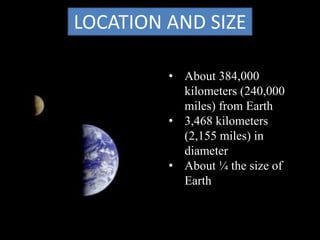
• About 384,000
kilometers (240,000
miles) from Earth
• 3,468 kilometers
(2,155 miles) in
diameter
• About ¼ the size of
Earth
Movements of the Moon
• Orbit is an ellipse, not circular
• Apogee (farthest from Earth)
• Perigee (closest to Earth)
• Revolution – Moon orbits the
Earth every 27 1/3 days
• The moon rises in the East and
sets in the West
• The moon rises and sets 50
minutes later each day
• Rotation – Moon turns on its axis
every 27 days
• Same side of the Moon always
faces Earth
As the Moon
completes its
revolution in about a
month’s time, we
always see the same
side facing us.
Movements of the Moon
Because the moon’s
period of rotation is
equal to its period of
revolution (Scientists
call this
SYNCHRONOUS
ROTATION).
Movements of the Moon
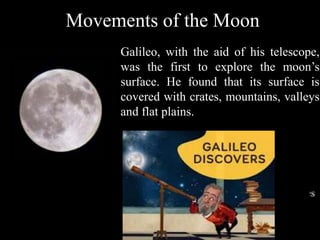
Galileo, with the aid of his telescope,
was the first to explore the moon’s
surface. He found that its surface is
covered with crates, mountains, valleys
and flat plains.
Movements of the Moon
The Moon’s Surface
• No atmosphere
• No liquid water
• Extreme temperatures
– Daytime = 130°C
(265° F)
– Nighttime = -190°C
(-310°F)
• 1/6 of Earth’s gravity
The Moon’s Surface
• Lunar rocks and dust cover most of the surface
• This layer is called the regolith
• 1 – 6 meters deep
• The lack of an atmosphere let many more meteorites
strike the moon’s surface, creating this layer of
crushed rock.
• Anorthosites are light-colored, coarse-grained rocks
found in the lunar highlands.
• Breccia contains fragments of other rocks that have
melted together, and are found everywhere on the
moon.
Lunar Features – Craters
• Bowl shaped depressions
• Up to 2500 kilometers (1,553 miles) across
• Most formed by meteorite impact on the Moon
• Some formed by volcanic action inside the Moon
Lunar Features – Craters
• When meteorites struck
the surface they
“displaced material”
• Like a “splash”
• Marks left are called
rays
DO YOU
KNOW?
There are
about 30,000
craters of
varying sizes.
TRIVIA
Lunar Features – Highlands
• Mountains up to 7500
meters (25,000 feet)
tall
• Rilles (trenchlike
valleys)
PHASES OF THE MOON
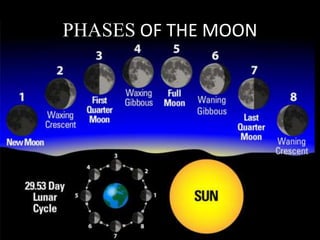
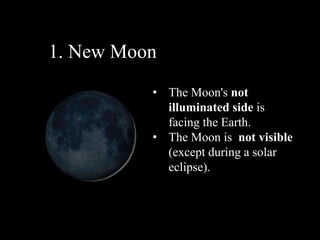
1. New Moon
• The Moon's not
illuminated side is
facing the Earth.
• The Moon is not visible
(except during a solar
eclipse).
2. Waxing Crescent
• The Moon appears to be
partly but less than one-
half illuminated by direct
sunlight.
• The fraction of the Moon's
disk that is illuminated is
increasing.
3. First Quarter
• One-half of the Moon
appears to be illuminated
by direct sunlight.
• The fraction of the
Moon's disk that is
illuminated is
increasing.
4. Waxing Gibbous
• The Moon appears to be
more than one-half but
not fully illuminated by
direct sunlight.
• The fraction of the
Moon's disk that is
illuminated is
increasing.
5. Full Moon
• The Moon's illuminated
side is facing the Earth.
• The Moon appears to be
completely illuminated
by direct sunlight.
6. Waning Gibbous
• The Moon appears to be
more than one-half but
not fully illuminated by
direct sunlight.
• The fraction of the
Moon's disk that is
illuminated is
decreasing.
7. Last Quarter
• One-half of the Moon
appears to be illuminated
by direct sunlight.
• The fraction of the
Moon's disk that is
illuminated is
decreasing.
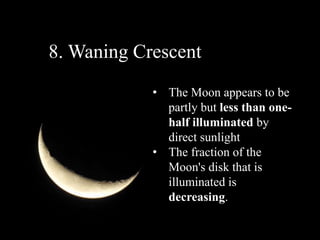
8. Waning Crescent
• The Moon appears to be
partly but less than one-
half illuminated by
direct sunlight
• The fraction of the
Moon's disk that is
illuminated is
decreasing.
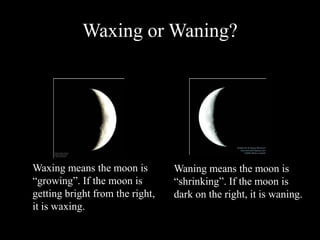
Waxing or Waning?
Waxing means the moon is
“growing”. If the moon is
getting bright from the right,
it is waxing.
Waning means the moon is
“shrinking”. If the moon is
dark on the right, it is waning.
WHAT ARE THOSE?
Lunar Eclipse
A lunar eclipse occurs when
the Moon passes directly
behind Earth and into its
shadow. This can occur only
when the Sun, Earth, and
Moon are exactly or very
closely aligned (in syzygy),
with Earth between the other
two.
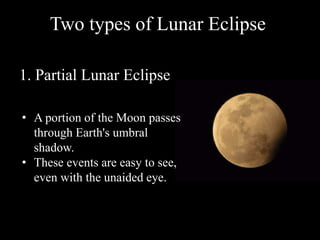
Two types of Lunar Eclipse
1. Partial Lunar Eclipse
• A portion of the Moon passes
through Earth's umbral
shadow.
• These events are easy to see,
even with the unaided eye.
2. Total Lunar Eclipse
Two types of Lunar Eclipse
• The entire Moon passes
through Earth's umbral
shadow.
• These events are quite
striking due to the Moon's
vibrant red color during the
total phase (totality).
Solar Eclipse
A solar eclipse occurs when an
observer (on Earth) passes
through the shadow cast by the
Moon which fully or partially
blocks ("occults") the Sun.
Two types of Solar Eclipse
1. Partial Solar Eclipse
A partial solar eclipse
happens when the Moon
only partially covers the
disk of the Sun.
Two types of Solar Eclipse
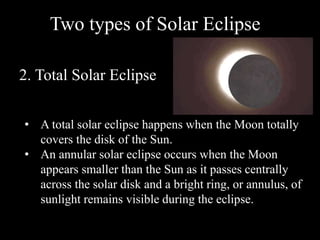
2. Total Solar Eclipse
• A total solar eclipse happens when the Moon totally
covers the disk of the Sun.
• An annular solar eclipse occurs when the Moon
appears smaller than the Sun as it passes centrally
across the solar disk and a bright ring, or annulus, of
sunlight remains visible during the eclipse.
Saros is the roughly 18-year periodic cycle of the
Earth-Moon-Sun system. Every 6,585 days, the
Earth, Moon, and Sun are in exactly the same
position. When there is a lunar eclipse, there will
also be one exactly 6,585 days later.
Saros
References
Users:
Abbie Mahinay
Rodelina Japson
duncanpatti
Presented by:
Sid Marnny Lopena
Jymuelle Abejo
Drake Lewis Garcia
Bernadette Villa

Is moon

  • 2.
    What is themoon? • A natural satellite • One of more than the 96 moons in our solar system • The only moon of the planet Earth
  • 3.
    LOCATION AND SIZE •About 384,000 kilometers (240,000 miles) from Earth • 3,468 kilometers (2,155 miles) in diameter • About ¼ the size of Earth
  • 4.
    Movements of theMoon • Orbit is an ellipse, not circular • Apogee (farthest from Earth) • Perigee (closest to Earth) • Revolution – Moon orbits the Earth every 27 1/3 days • The moon rises in the East and sets in the West • The moon rises and sets 50 minutes later each day • Rotation – Moon turns on its axis every 27 days • Same side of the Moon always faces Earth
  • 5.
    As the Moon completesits revolution in about a month’s time, we always see the same side facing us. Movements of the Moon
  • 6.
    Because the moon’s periodof rotation is equal to its period of revolution (Scientists call this SYNCHRONOUS ROTATION). Movements of the Moon
  • 7.
    Galileo, with theaid of his telescope, was the first to explore the moon’s surface. He found that its surface is covered with crates, mountains, valleys and flat plains. Movements of the Moon
  • 8.
    The Moon’s Surface •No atmosphere • No liquid water • Extreme temperatures – Daytime = 130°C (265° F) – Nighttime = -190°C (-310°F) • 1/6 of Earth’s gravity
  • 9.
    The Moon’s Surface •Lunar rocks and dust cover most of the surface • This layer is called the regolith • 1 – 6 meters deep • The lack of an atmosphere let many more meteorites strike the moon’s surface, creating this layer of crushed rock. • Anorthosites are light-colored, coarse-grained rocks found in the lunar highlands. • Breccia contains fragments of other rocks that have melted together, and are found everywhere on the moon.
  • 10.
    Lunar Features –Craters • Bowl shaped depressions • Up to 2500 kilometers (1,553 miles) across • Most formed by meteorite impact on the Moon • Some formed by volcanic action inside the Moon
  • 11.
    Lunar Features –Craters • When meteorites struck the surface they “displaced material” • Like a “splash” • Marks left are called rays
  • 12.
    DO YOU KNOW? There are about30,000 craters of varying sizes. TRIVIA
  • 13.
    Lunar Features –Highlands • Mountains up to 7500 meters (25,000 feet) tall • Rilles (trenchlike valleys)
  • 14.
  • 15.
    1. New Moon •The Moon's not illuminated side is facing the Earth. • The Moon is not visible (except during a solar eclipse).
  • 16.
    2. Waxing Crescent •The Moon appears to be partly but less than one- half illuminated by direct sunlight. • The fraction of the Moon's disk that is illuminated is increasing.
  • 17.
    3. First Quarter •One-half of the Moon appears to be illuminated by direct sunlight. • The fraction of the Moon's disk that is illuminated is increasing.
  • 18.
    4. Waxing Gibbous •The Moon appears to be more than one-half but not fully illuminated by direct sunlight. • The fraction of the Moon's disk that is illuminated is increasing.
  • 19.
    5. Full Moon •The Moon's illuminated side is facing the Earth. • The Moon appears to be completely illuminated by direct sunlight.
  • 20.
    6. Waning Gibbous •The Moon appears to be more than one-half but not fully illuminated by direct sunlight. • The fraction of the Moon's disk that is illuminated is decreasing.
  • 21.
    7. Last Quarter •One-half of the Moon appears to be illuminated by direct sunlight. • The fraction of the Moon's disk that is illuminated is decreasing.
  • 22.
    8. Waning Crescent •The Moon appears to be partly but less than one- half illuminated by direct sunlight • The fraction of the Moon's disk that is illuminated is decreasing.
  • 23.
    Waxing or Waning? Waxingmeans the moon is “growing”. If the moon is getting bright from the right, it is waxing. Waning means the moon is “shrinking”. If the moon is dark on the right, it is waning.
  • 24.
  • 25.
    Lunar Eclipse A lunareclipse occurs when the Moon passes directly behind Earth and into its shadow. This can occur only when the Sun, Earth, and Moon are exactly or very closely aligned (in syzygy), with Earth between the other two.
  • 26.
    Two types ofLunar Eclipse 1. Partial Lunar Eclipse • A portion of the Moon passes through Earth's umbral shadow. • These events are easy to see, even with the unaided eye.
  • 27.
    2. Total LunarEclipse Two types of Lunar Eclipse • The entire Moon passes through Earth's umbral shadow. • These events are quite striking due to the Moon's vibrant red color during the total phase (totality).
  • 28.
    Solar Eclipse A solareclipse occurs when an observer (on Earth) passes through the shadow cast by the Moon which fully or partially blocks ("occults") the Sun.
  • 29.
    Two types ofSolar Eclipse 1. Partial Solar Eclipse A partial solar eclipse happens when the Moon only partially covers the disk of the Sun.
  • 30.
    Two types ofSolar Eclipse 2. Total Solar Eclipse • A total solar eclipse happens when the Moon totally covers the disk of the Sun. • An annular solar eclipse occurs when the Moon appears smaller than the Sun as it passes centrally across the solar disk and a bright ring, or annulus, of sunlight remains visible during the eclipse.
  • 31.
    Saros is theroughly 18-year periodic cycle of the Earth-Moon-Sun system. Every 6,585 days, the Earth, Moon, and Sun are in exactly the same position. When there is a lunar eclipse, there will also be one exactly 6,585 days later. Saros
  • 32.
  • 33.
    Presented by: Sid MarnnyLopena Jymuelle Abejo Drake Lewis Garcia Bernadette Villa

Editor's Notes

  • #4 About 384,000 kilometers (240,000 miles) from Earth 3,468 kilometers (2,155 miles) in diameter About ¼ the size of Earth
  • #5 Orbit is an ellipse, not circular ***Apogee*** (farthest from Earth) ***Perigee*** (closest to Earth) Revolution – Moon orbits the Earth every 27 1/3 days The moon rises in the East and sets in the West The moon rises and sets 50 minutes later each day Rotation – Moon turns on its axis every 27 days Same side of the Moon always faces Earth
  • #14 Mountains up to 7500 meters (25,000 feet) tall Rilles (trenchlike valleys)