Earth, Sun and Moon Systems Earth, Sun and Moon Systems www.starmanproductions.com
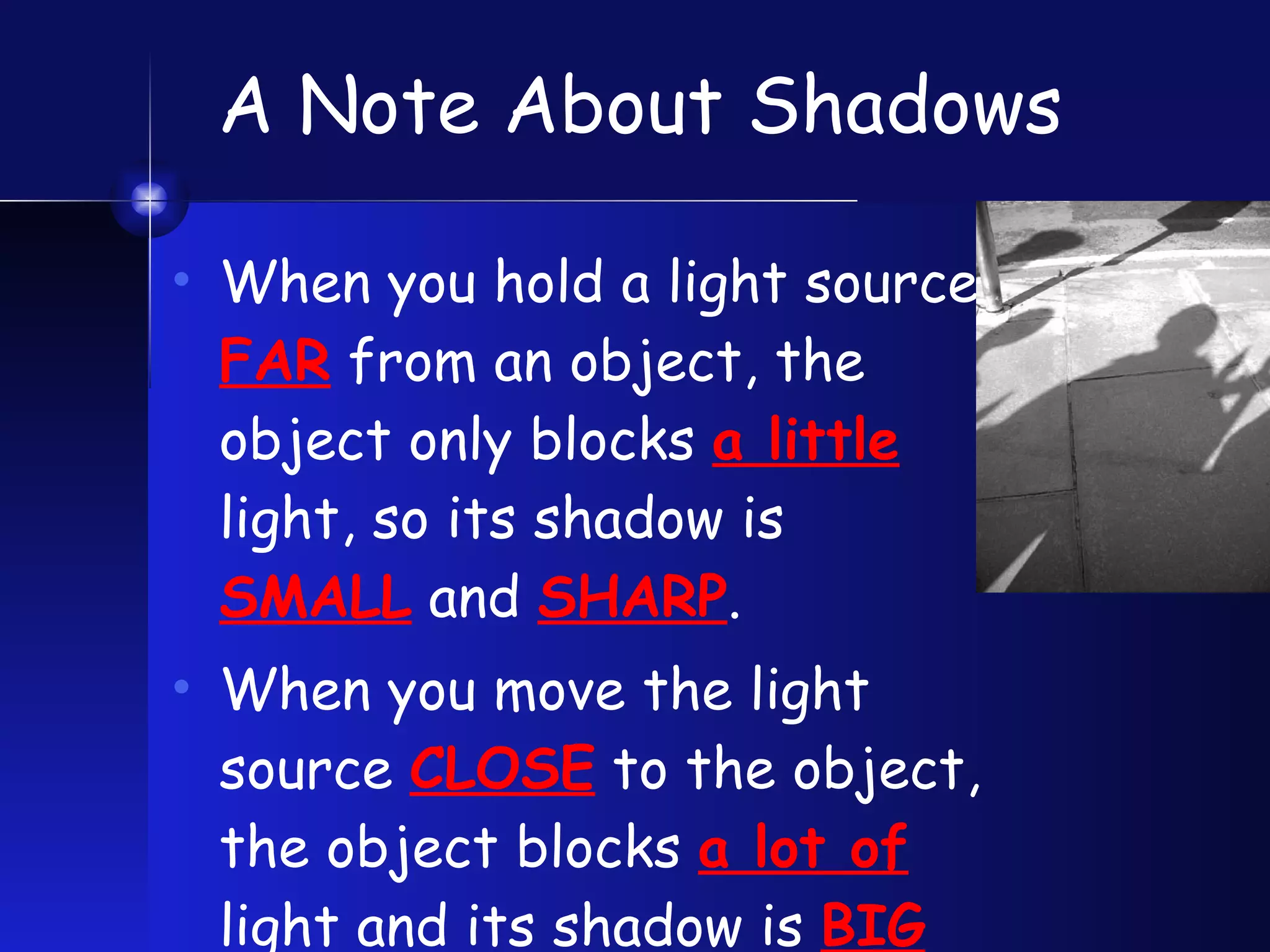
A Note About Shadows When you hold a light source  FAR  from an object, the object only blocks  a little  light, so its shadow is  SMALL  and  SHARP . When you move the light source  CLOSE  to the object, the object blocks  a lot of  light and its shadow is  BIG  and  FUZZY .
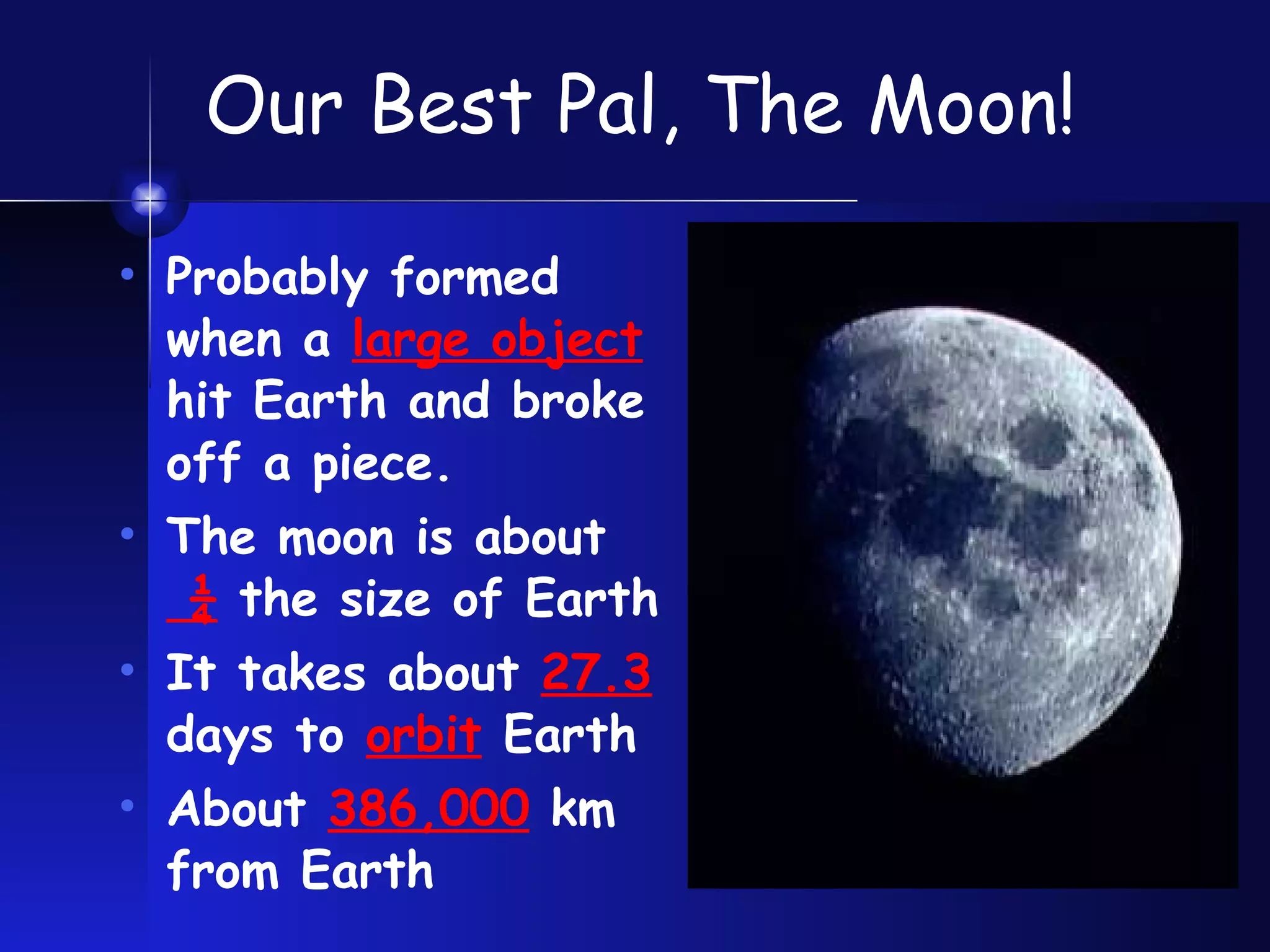
Our Best Pal, The Moon! Probably formed when a  large object  hit Earth and broke off a piece. The moon is about  ¼  the size of Earth It takes about  27.3  days to  orbit  Earth About  386,000  km from Earth
 
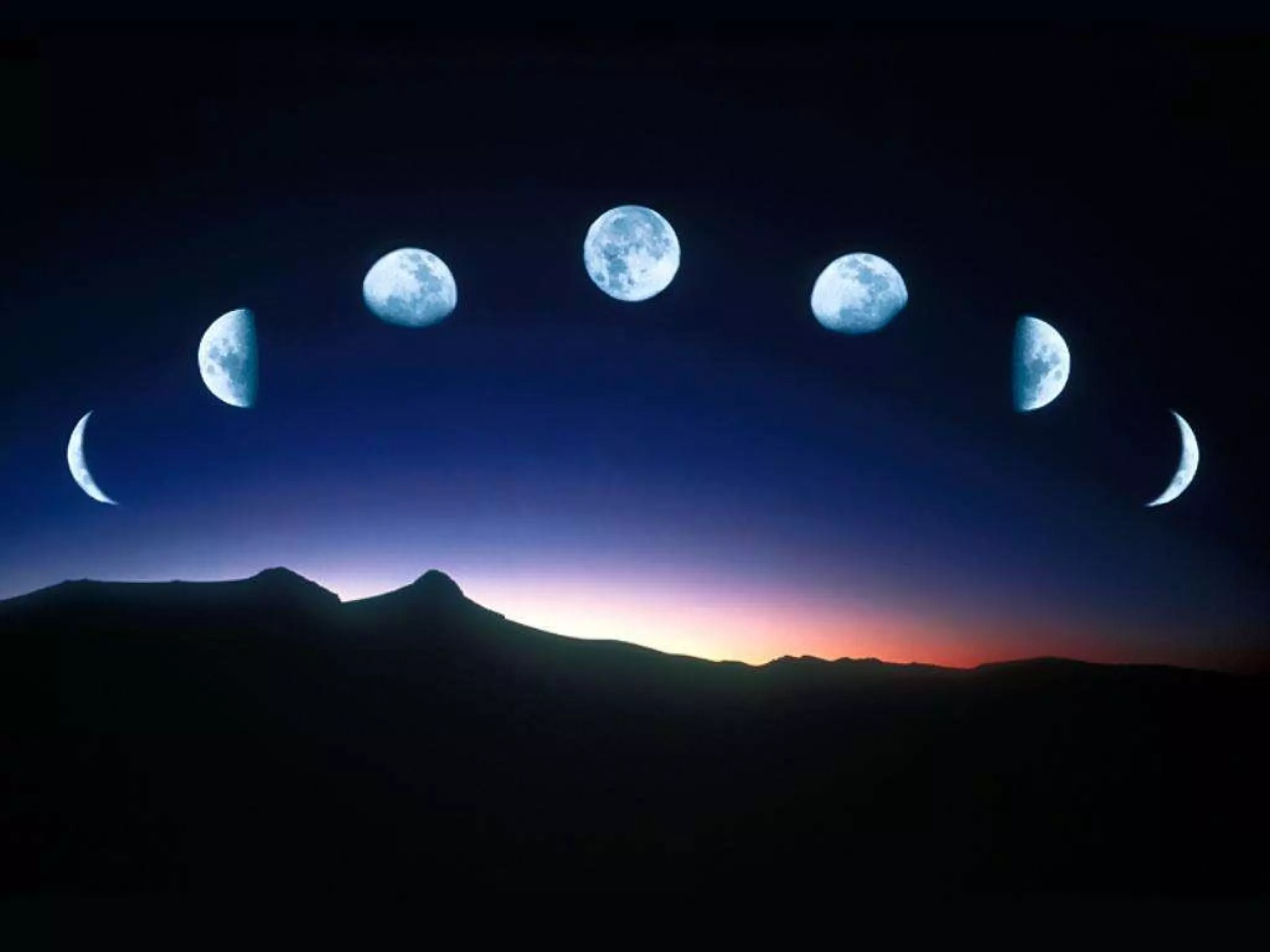
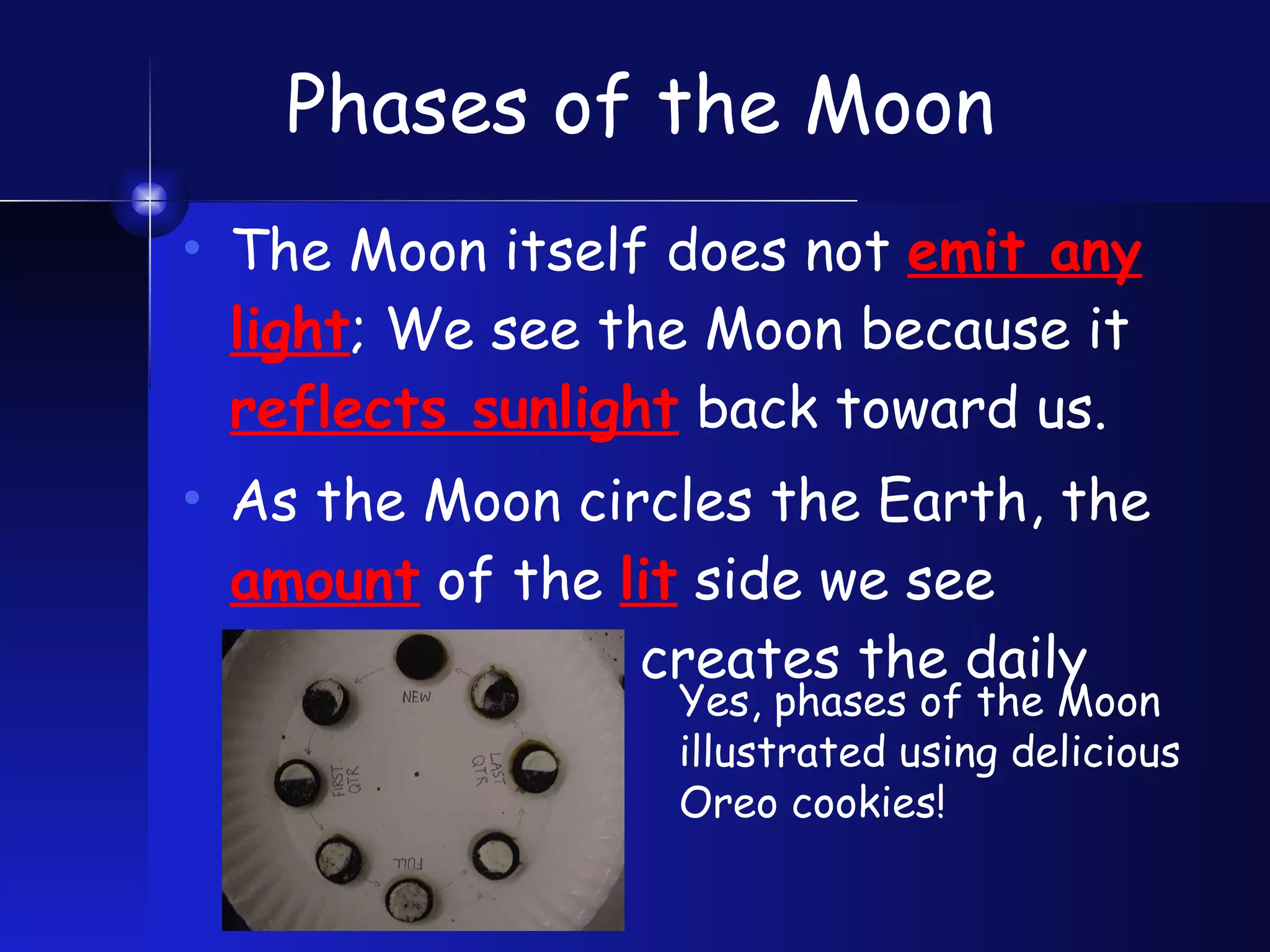
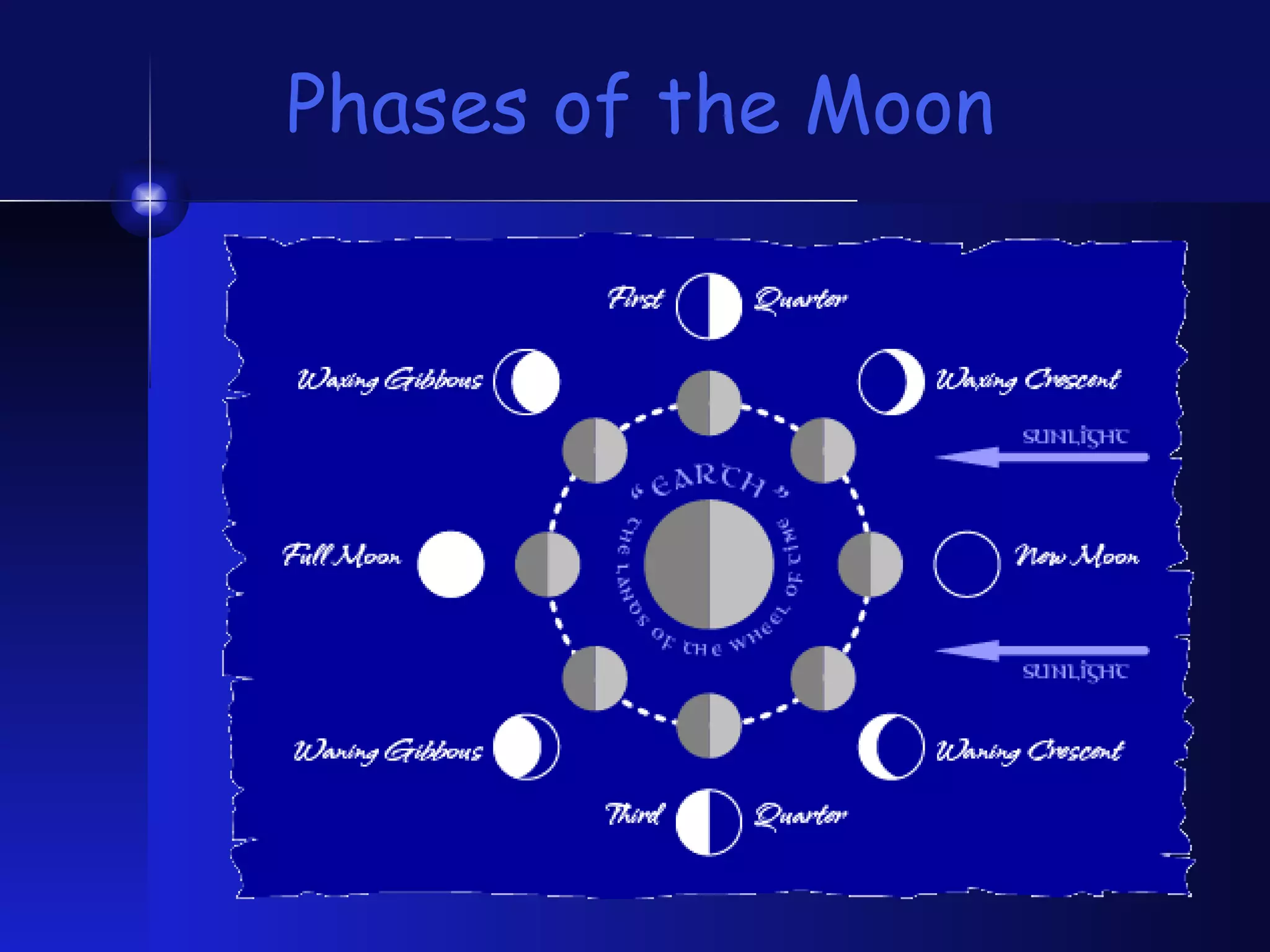
Phases of the Moon The Moon itself does not  emit any light ; We see the Moon because it  reflects sunlight  back toward us. As the Moon circles the Earth, the  amount  of the  lit  side we see  changes , which creates the daily  “phases.”  Yes, phases of the Moon illustrated using delicious Oreo cookies!
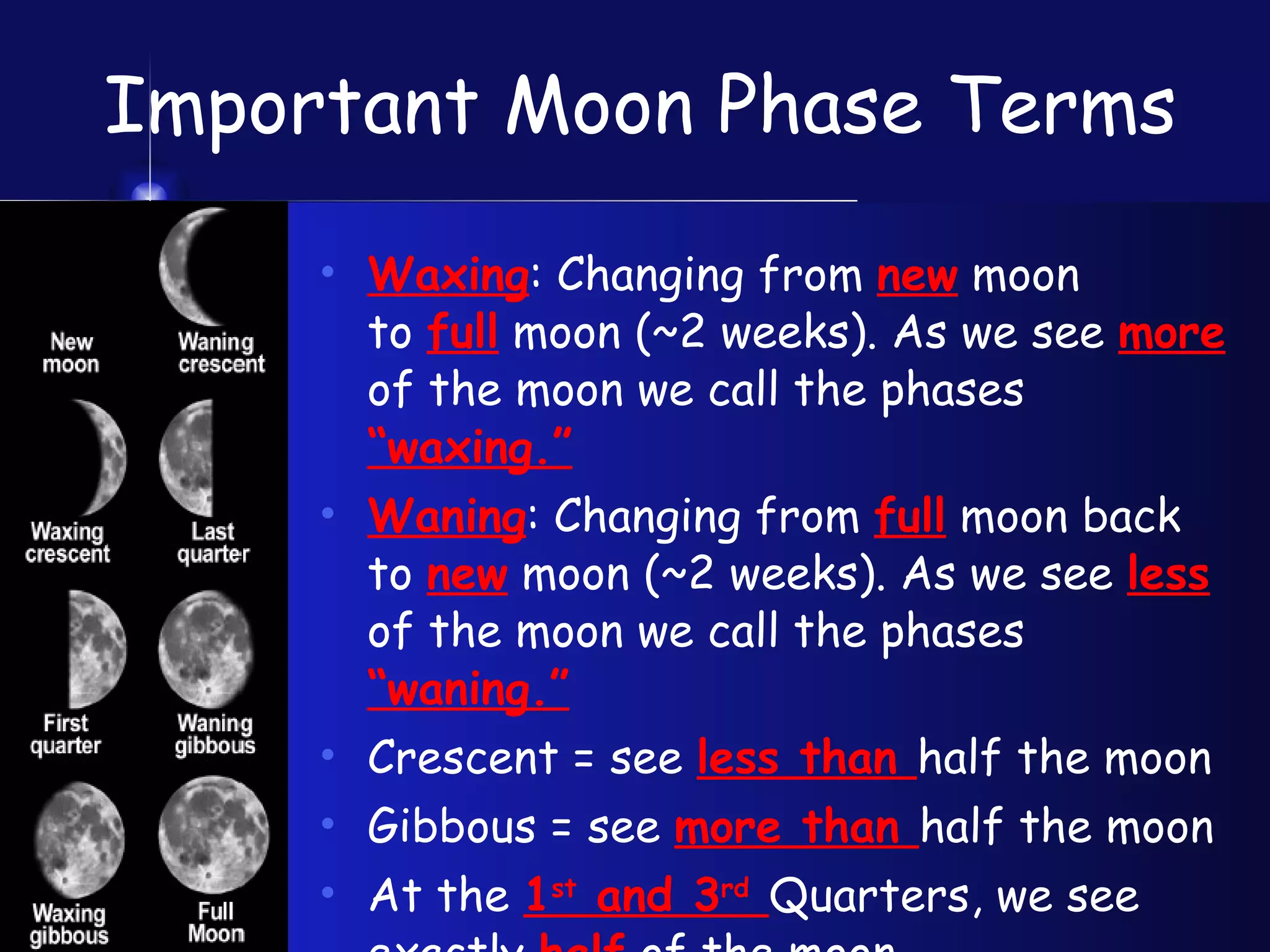
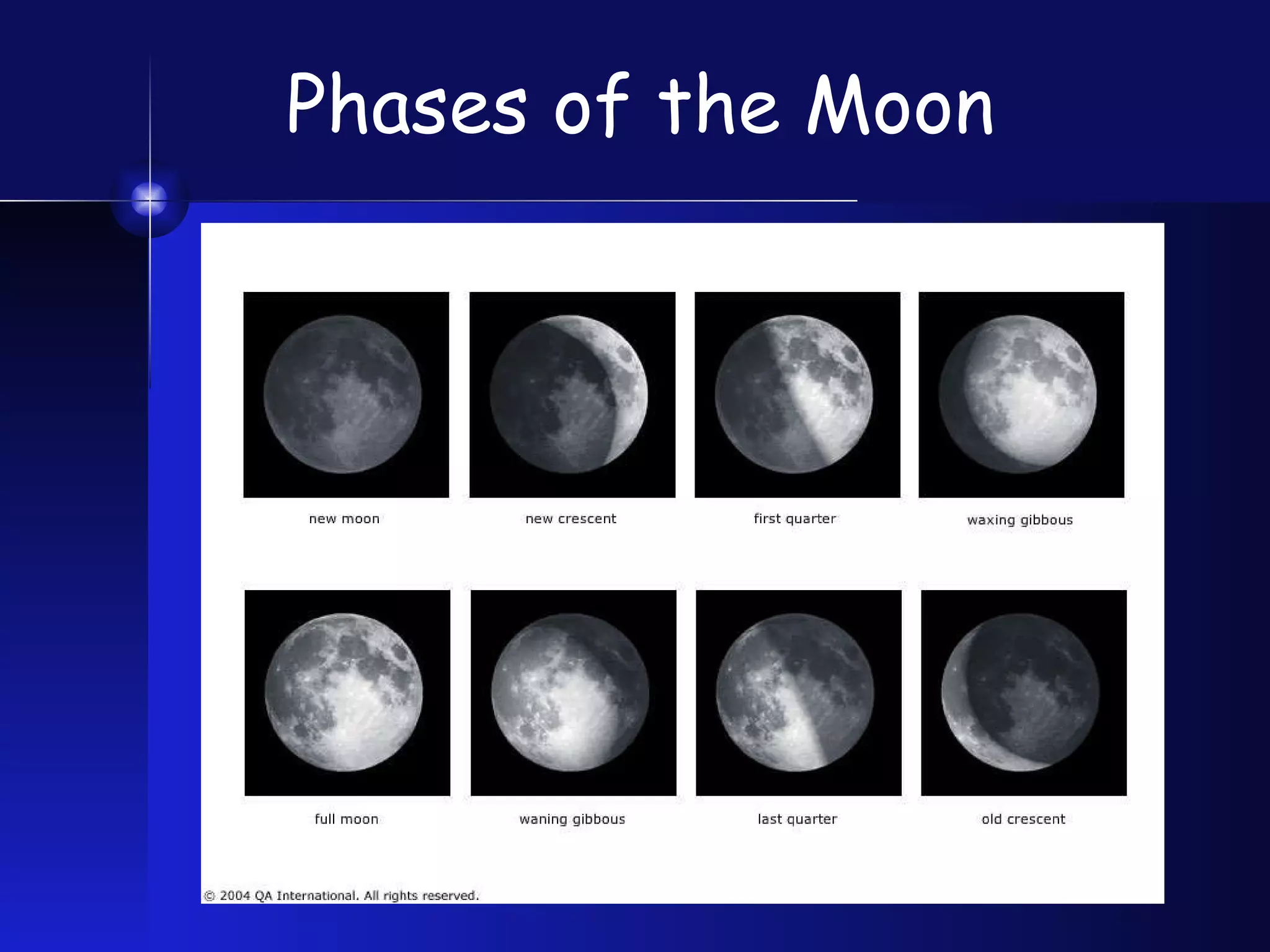
Important Moon Phase Terms Waxing : Changing from  new  moon  to  full  moon (~2 weeks). As we see  more  of the moon we call the phases  “waxing.” Waning : Changing from  full  moon back to  new  moon (~2 weeks). As we see  less  of the moon we call the phases  “waning.” Crescent = see  less than  half the moon Gibbous = see  more than  half the moon At the  1 st  and 3 rd   Quarters, we see  exactly  half  of the moon.
Phases of the Moon
Phases of the Moon
Dark Side of the Moon? Why does the moon have a dark side?  Why does the illuminated side always look the same (the moon revolves, after all!) Physics Connection!  It’s  “synchronous rotation.”  The time it takes the moon to  rotate   once  on its axis is the  same  as the  time it takes it to  revolve  around the Earth. This is caused by the Earth’s  “tidal force”  or differential (uneven)  gravitational   force  on the Moon.
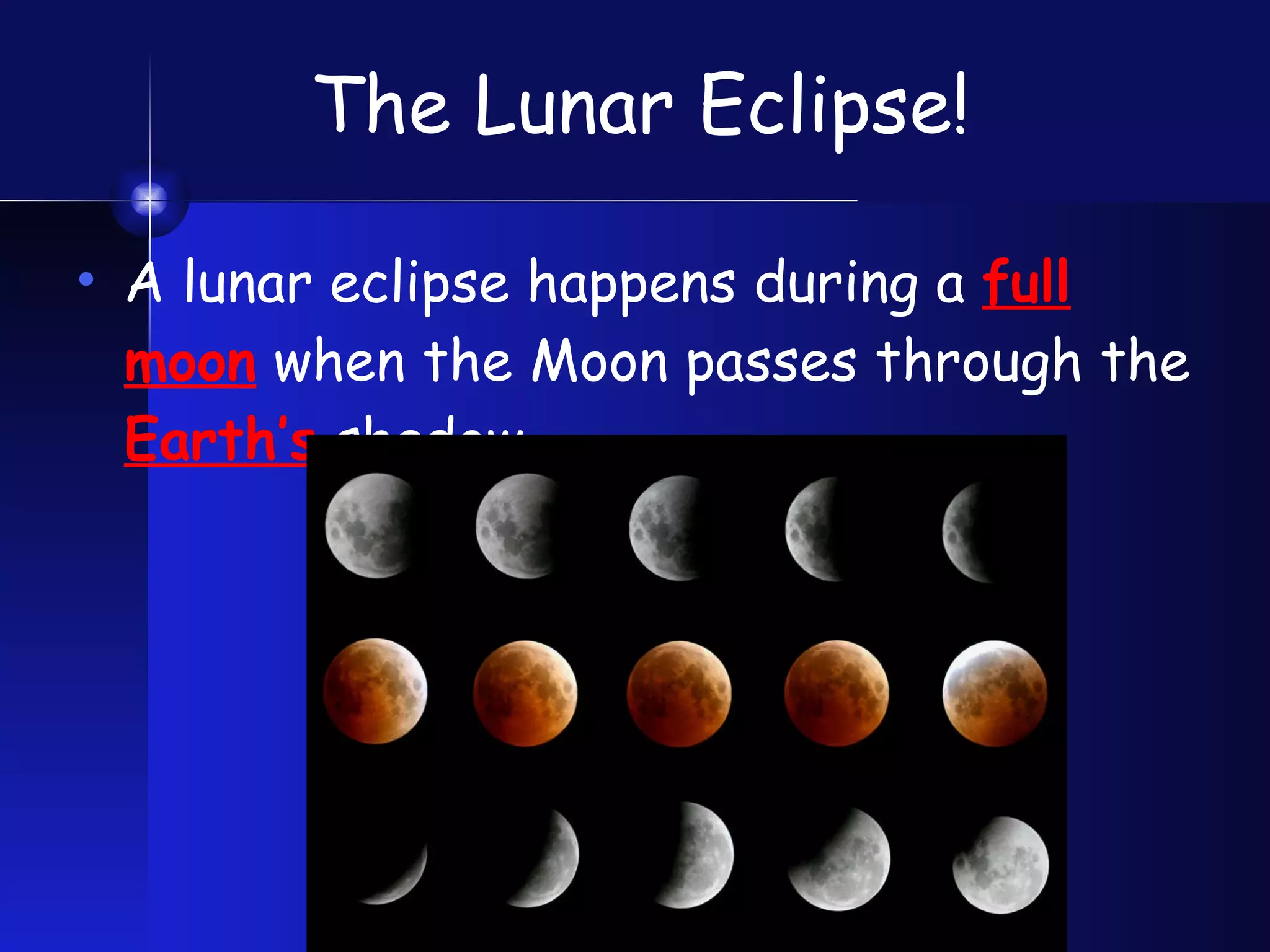
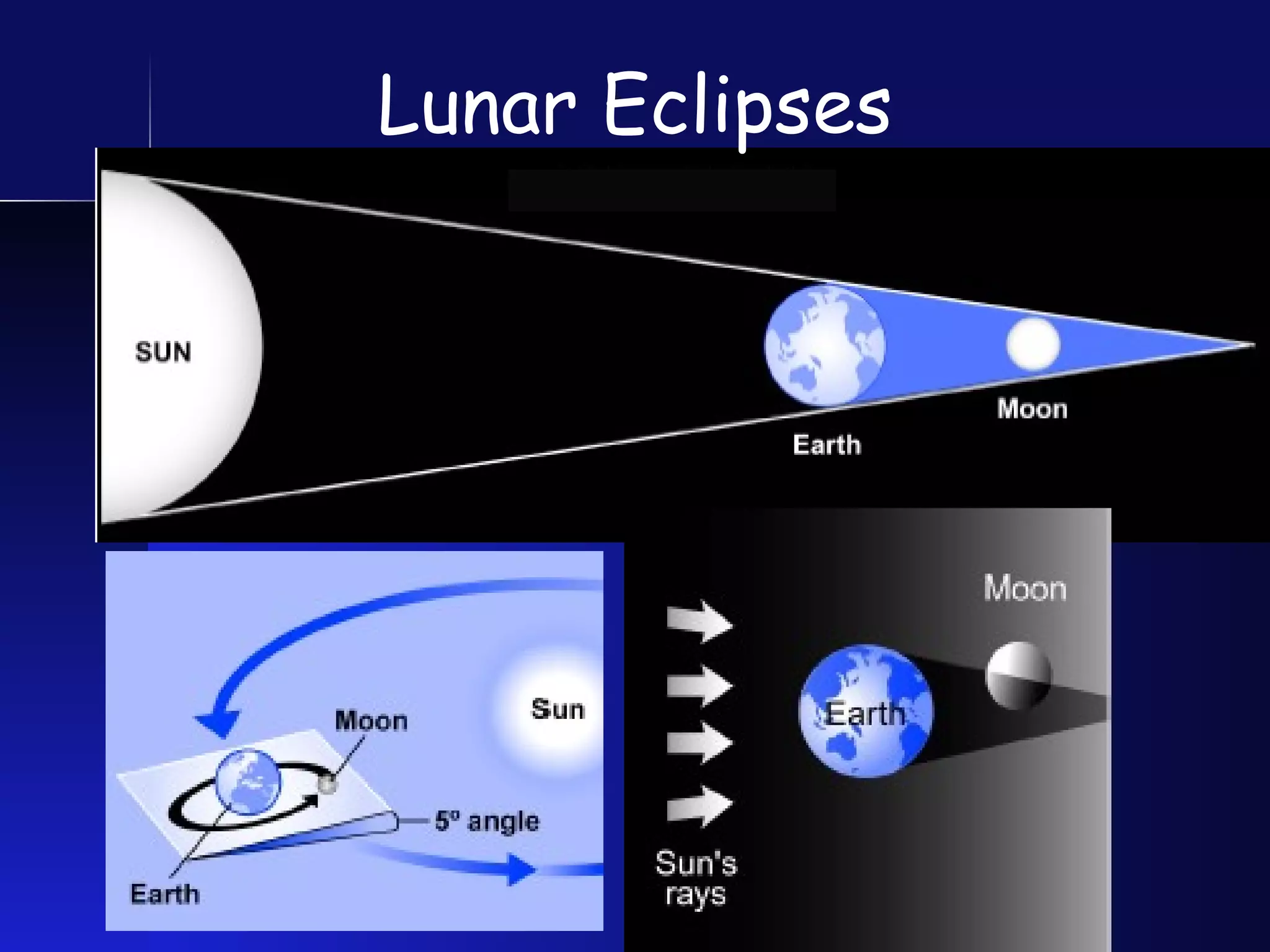
The Lunar Eclipse! A lunar eclipse happens during a  full   moon  when the Moon passes through the  Earth’s  shadow.
Lunar Eclipses
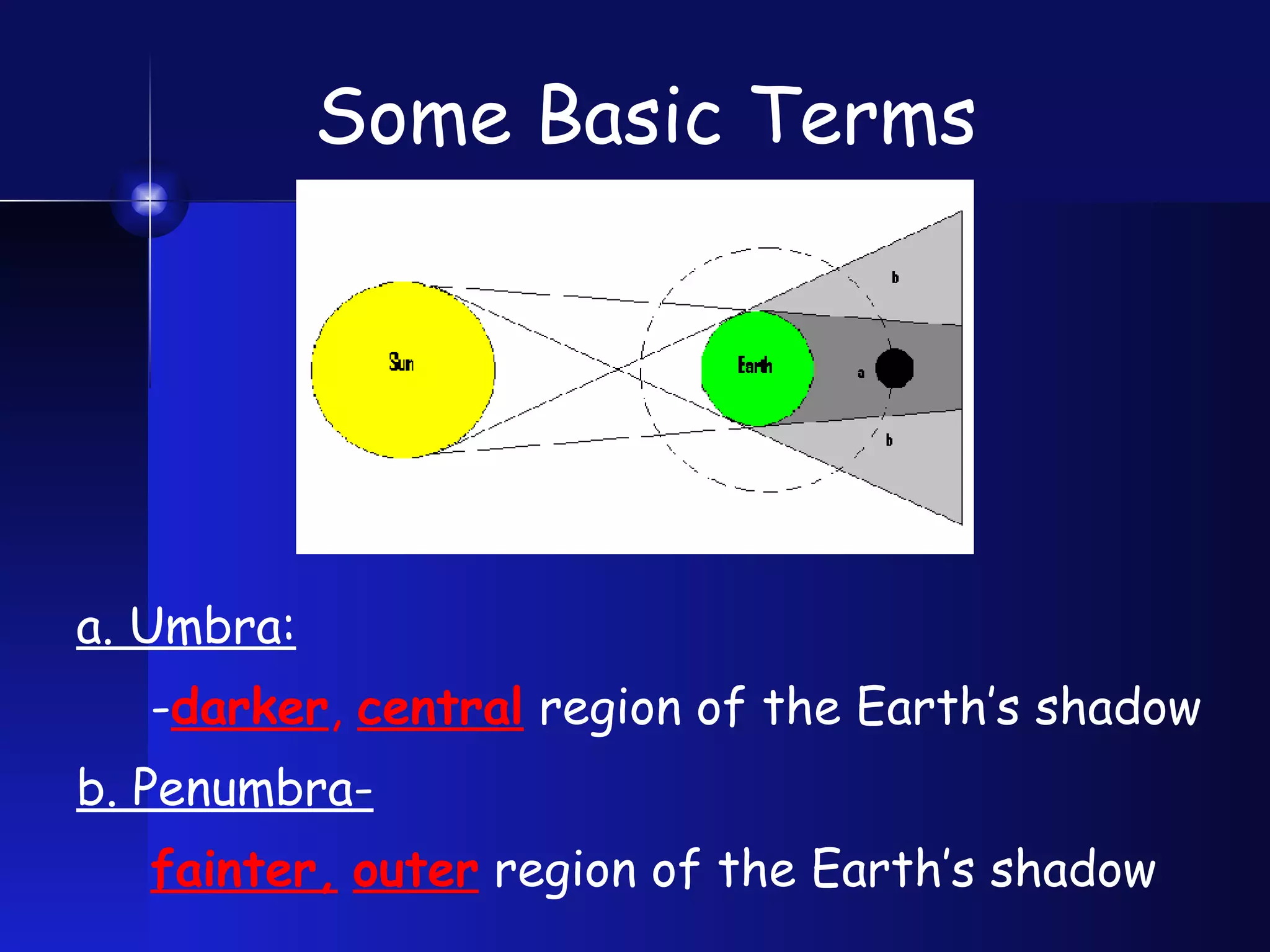
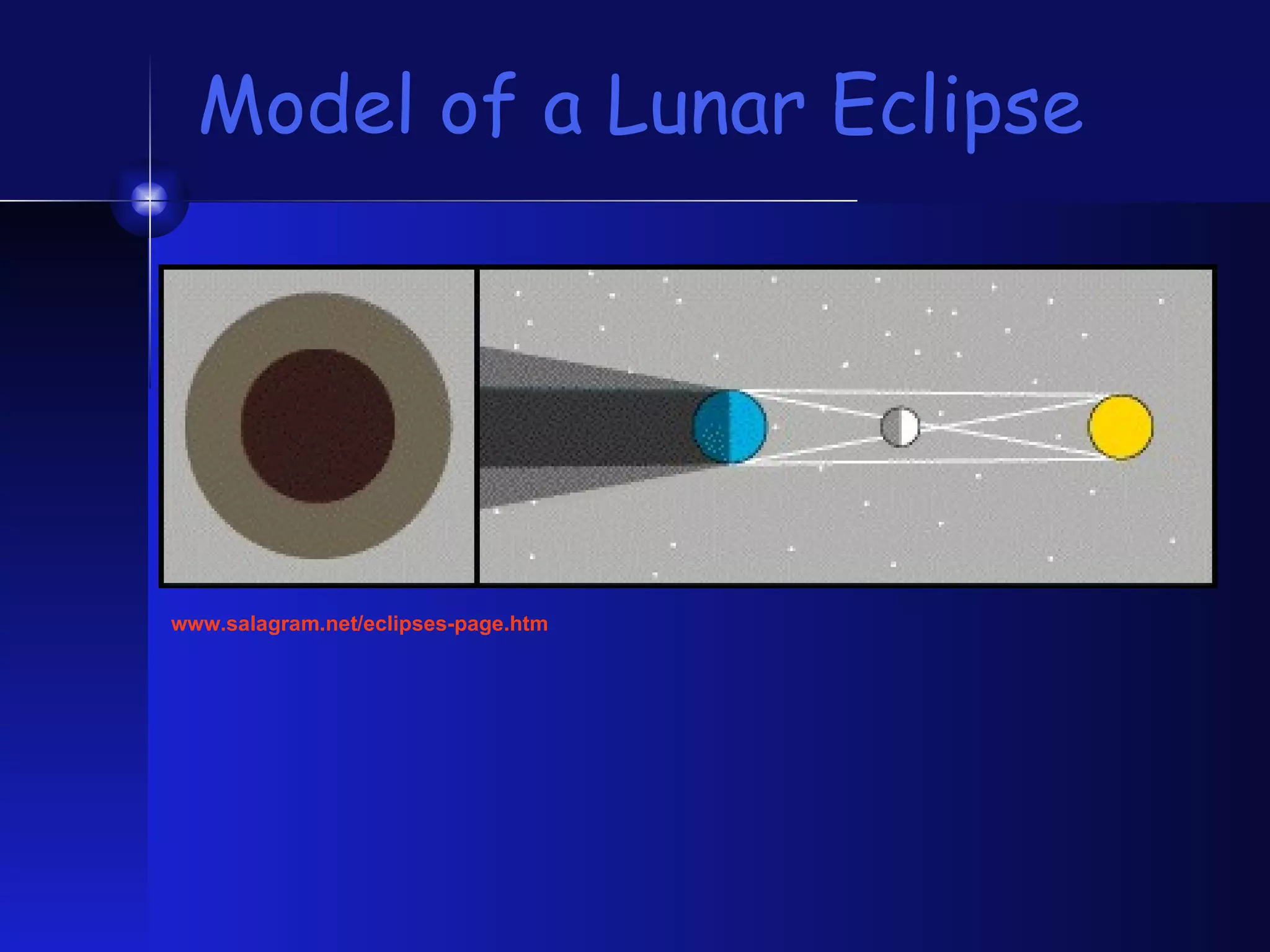
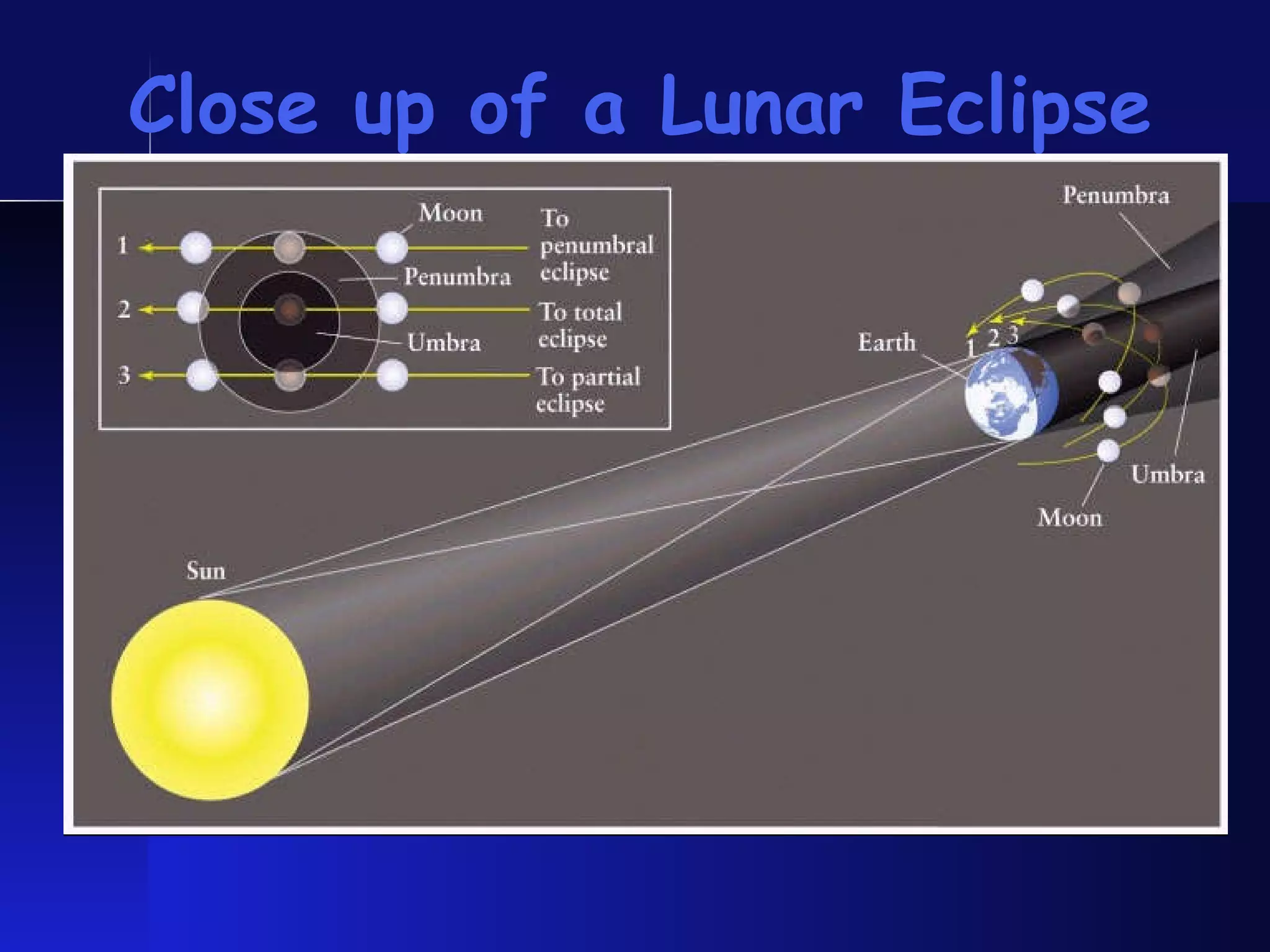
Some Basic Terms a. Umbra: - darker ,  central   region of the Earth’s shadow b. Penumbra- fainter,   outer   region of the Earth’s shadow
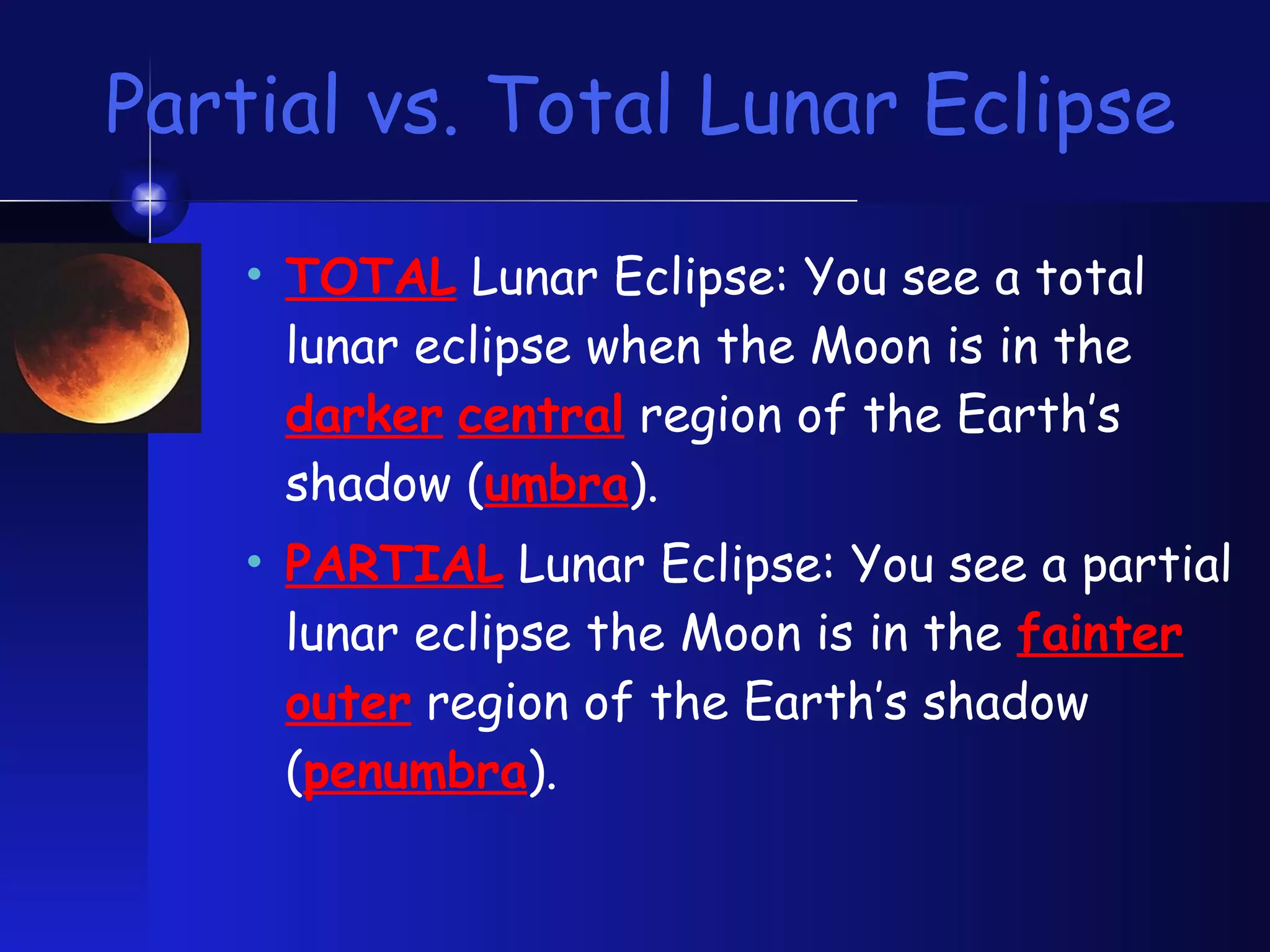
Partial vs. Total Lunar Eclipse TOTAL  Lunar Eclipse: You see a total lunar eclipse when the Moon is in the  darker   central   region of the Earth’s shadow ( umbra ). PARTIAL  Lunar Eclipse: You see a partial lunar eclipse the Moon is in the  fainter   outer  region of the Earth’s shadow ( penumbra ).
Model of a Lunar Eclipse www.salagram.net/eclipses-page.htm
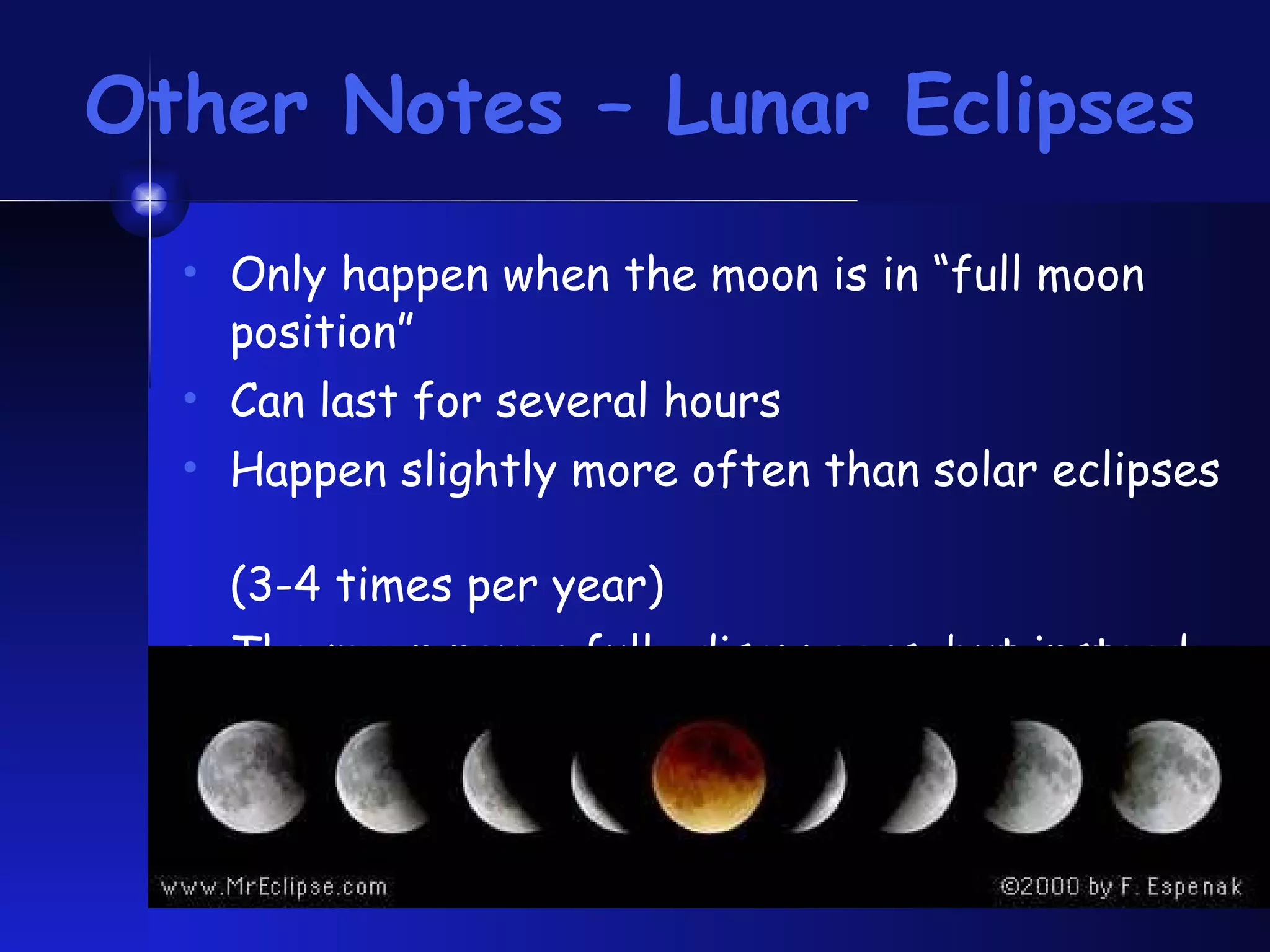
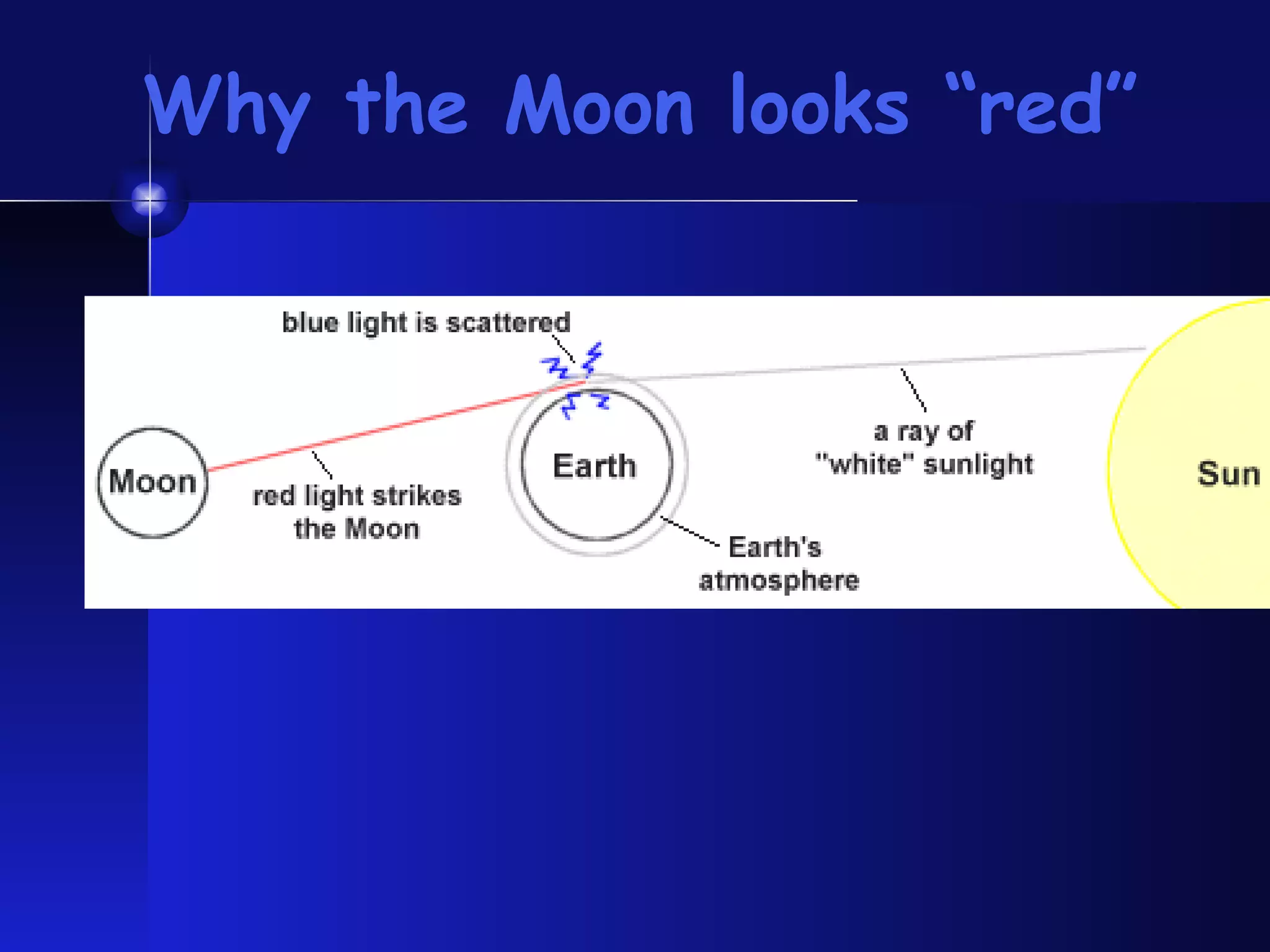
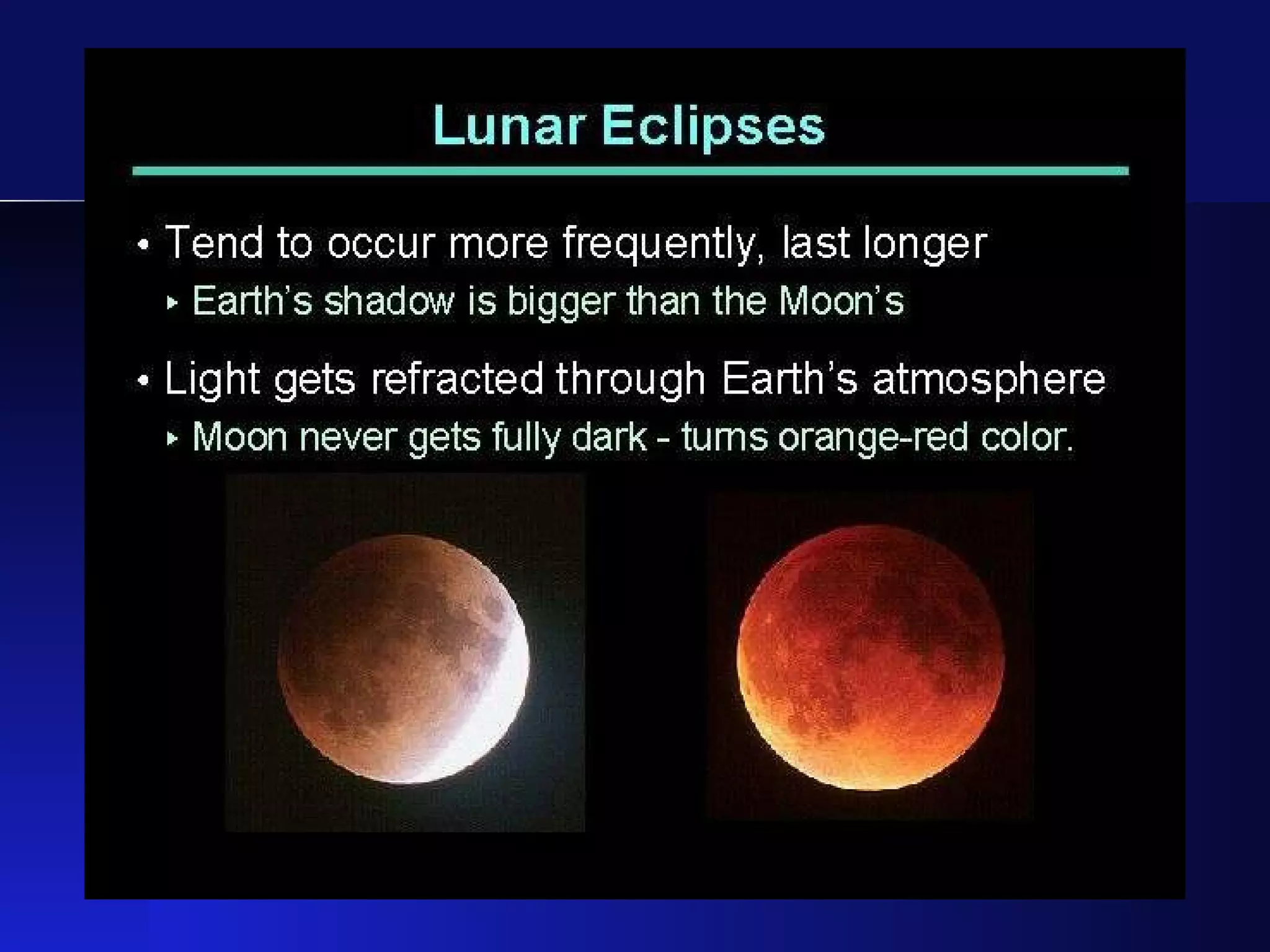
Other Notes – Lunar Eclipses Only happen when the moon is in “full moon position” Can last for several hours Happen slightly more often than solar eclipses  (3-4 times per year) The moon never fully disappears, but instead turns red in color
Why the Moon looks “red”
 
Close up of a Lunar Eclipse
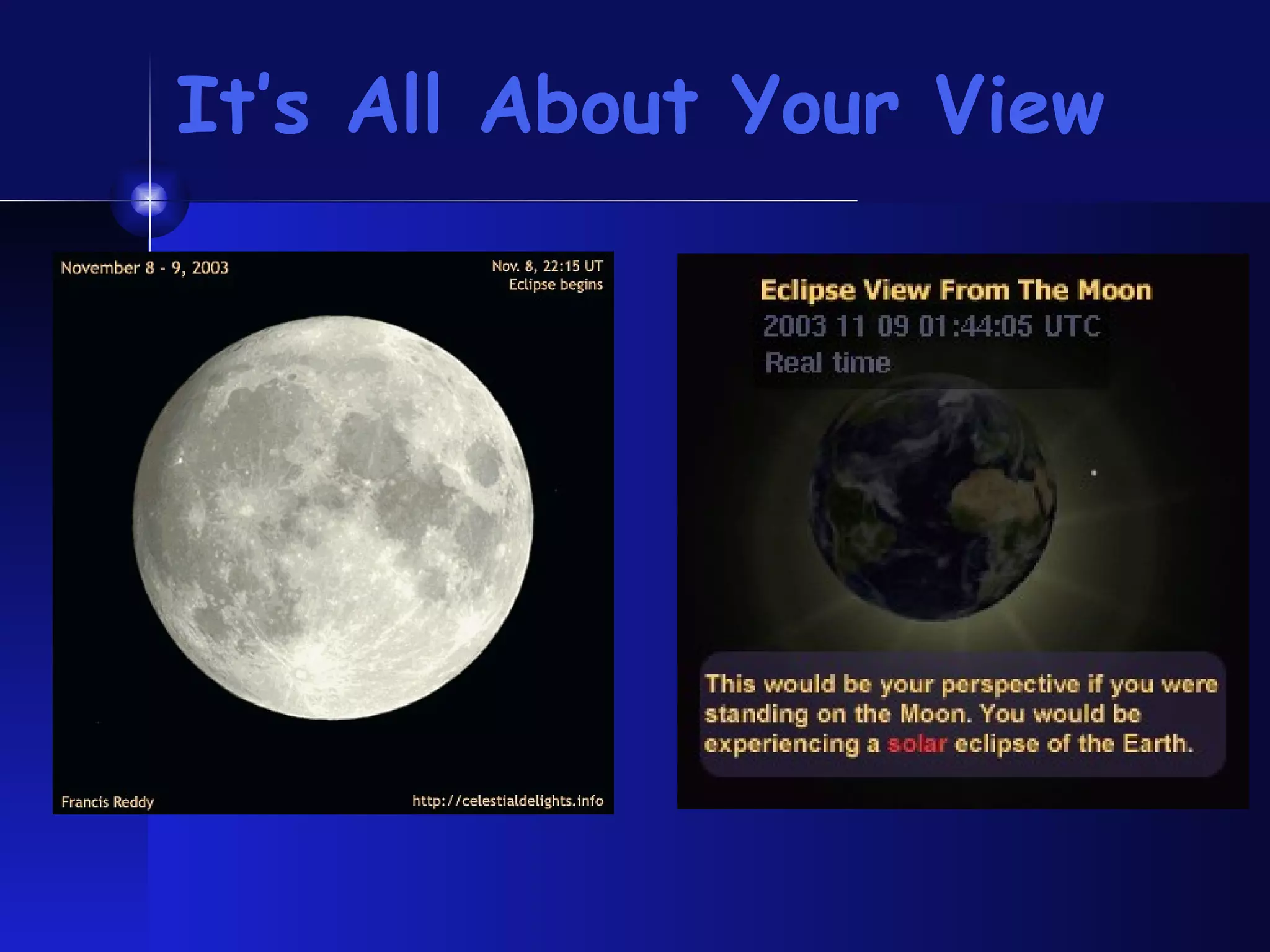
It’s All About Your View
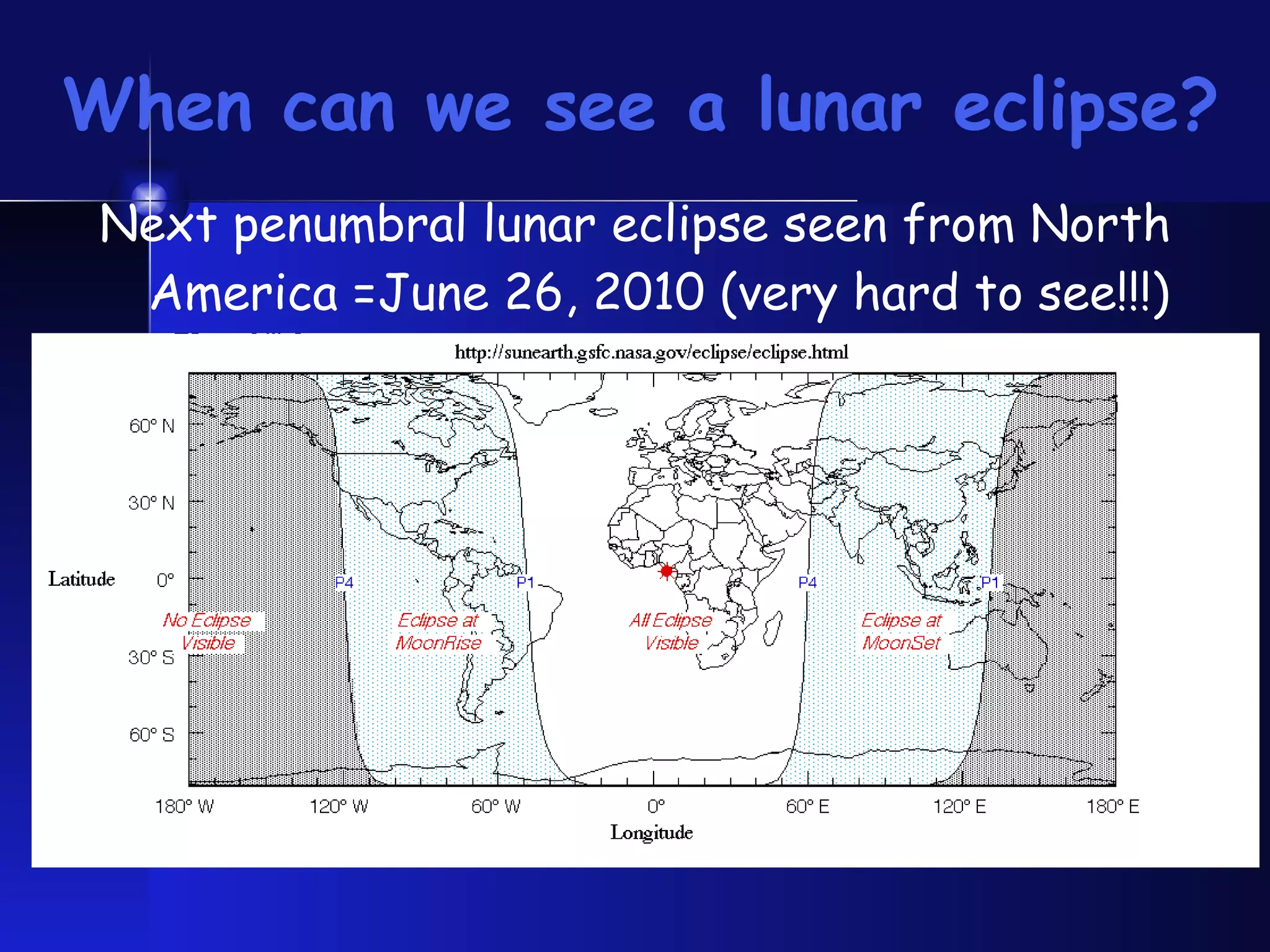
When can we see a lunar eclipse? Next penumbral lunar eclipse seen from North America =June 26, 2010 (very hard to see!!!)
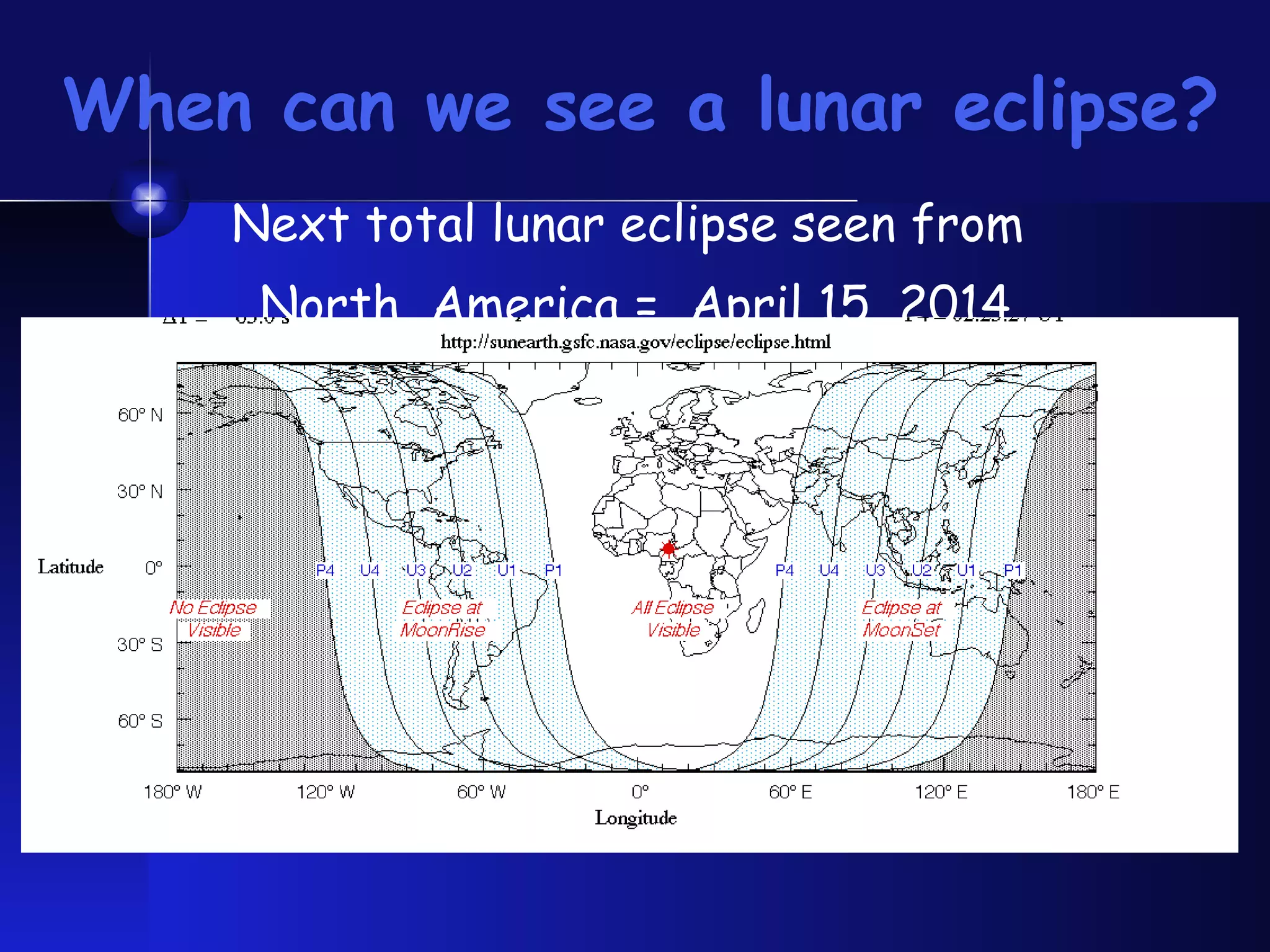
When can we see a lunar eclipse? Next total lunar eclipse seen from  North  America =  April 15, 2014
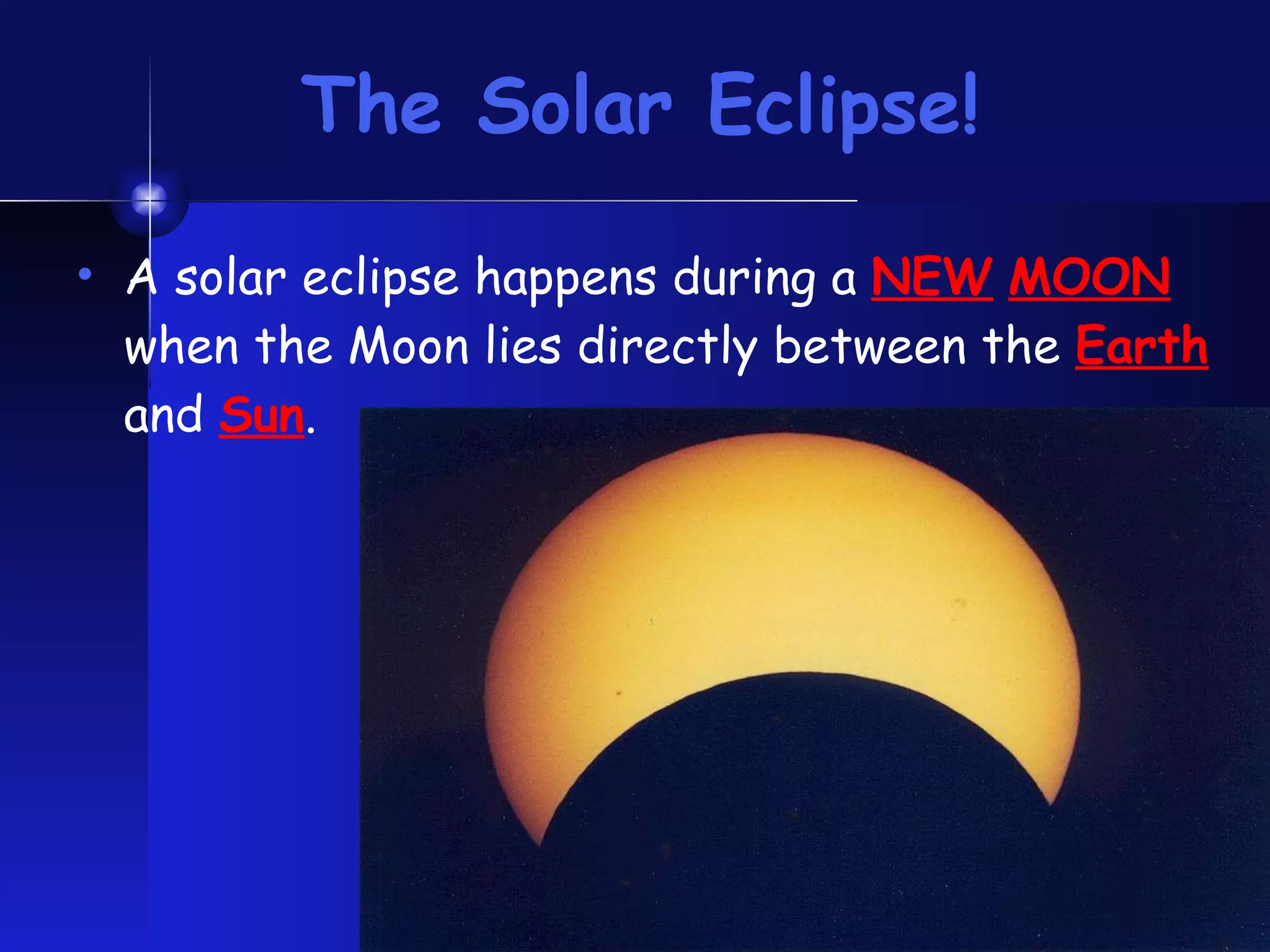
The Solar Eclipse! A solar eclipse happens during a  NEW   MOON  when the Moon lies directly between the  Earth  and  Sun .
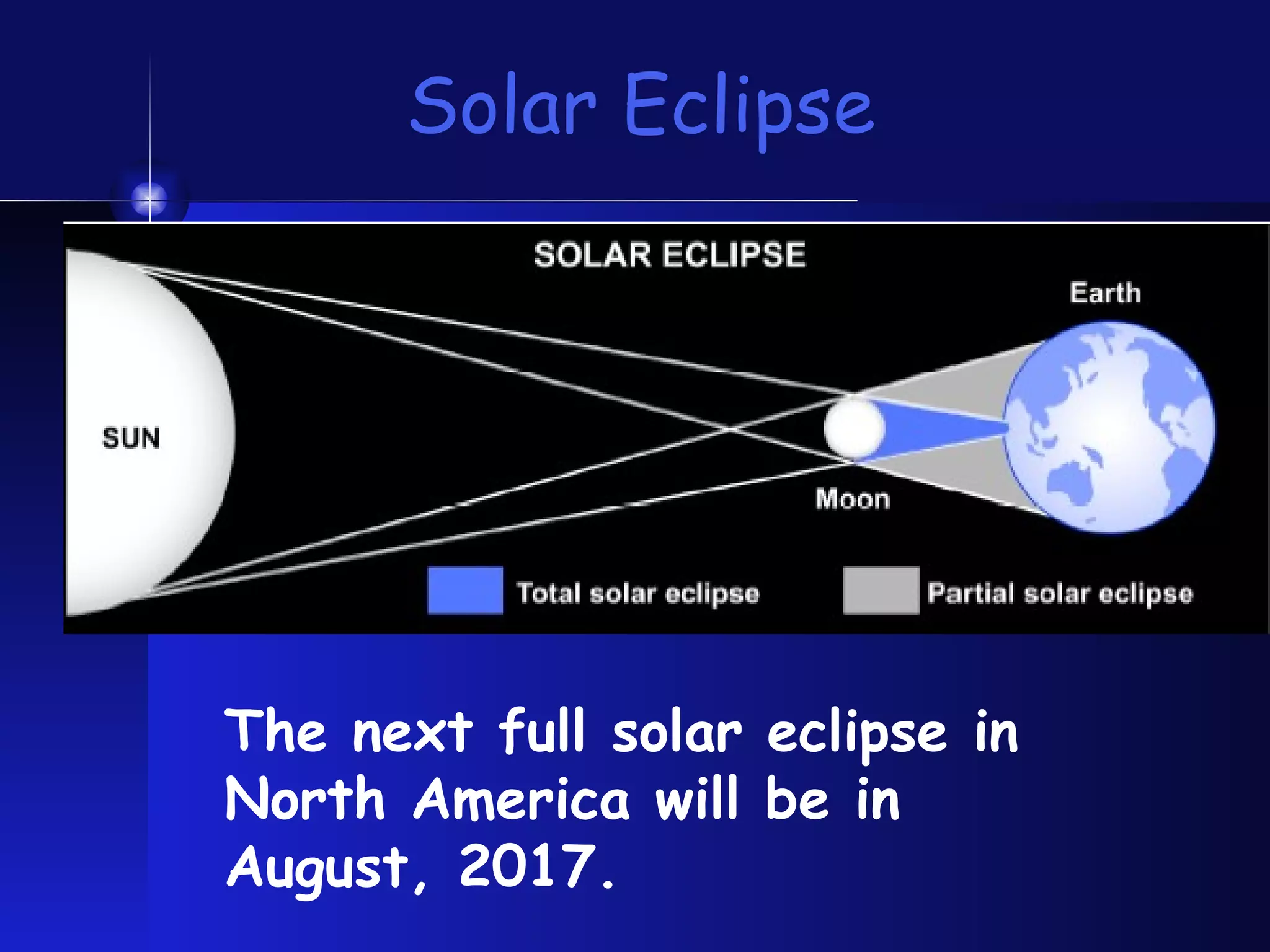
Solar Eclipse The next full solar eclipse in  North America will be in  August, 2017.
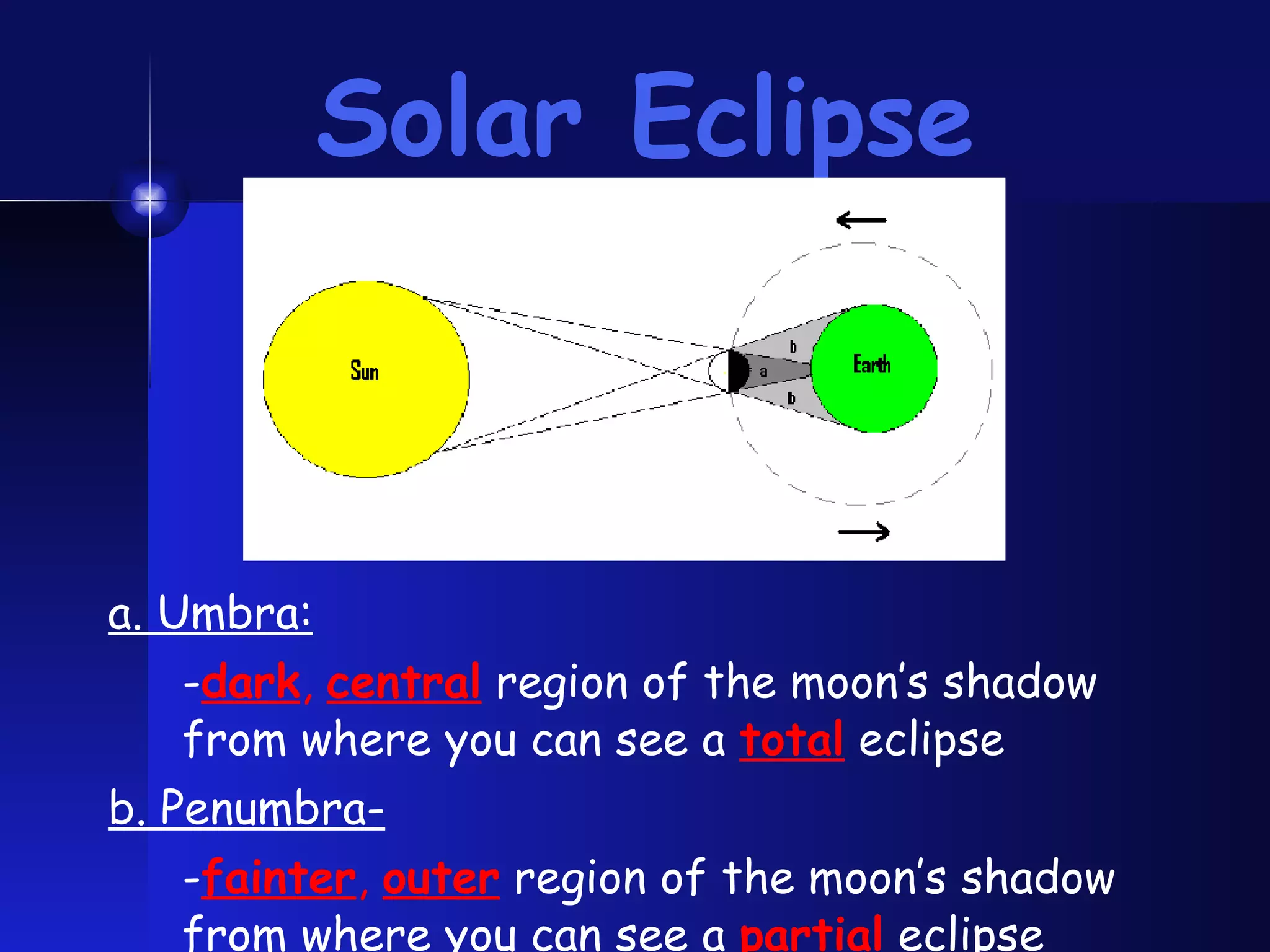
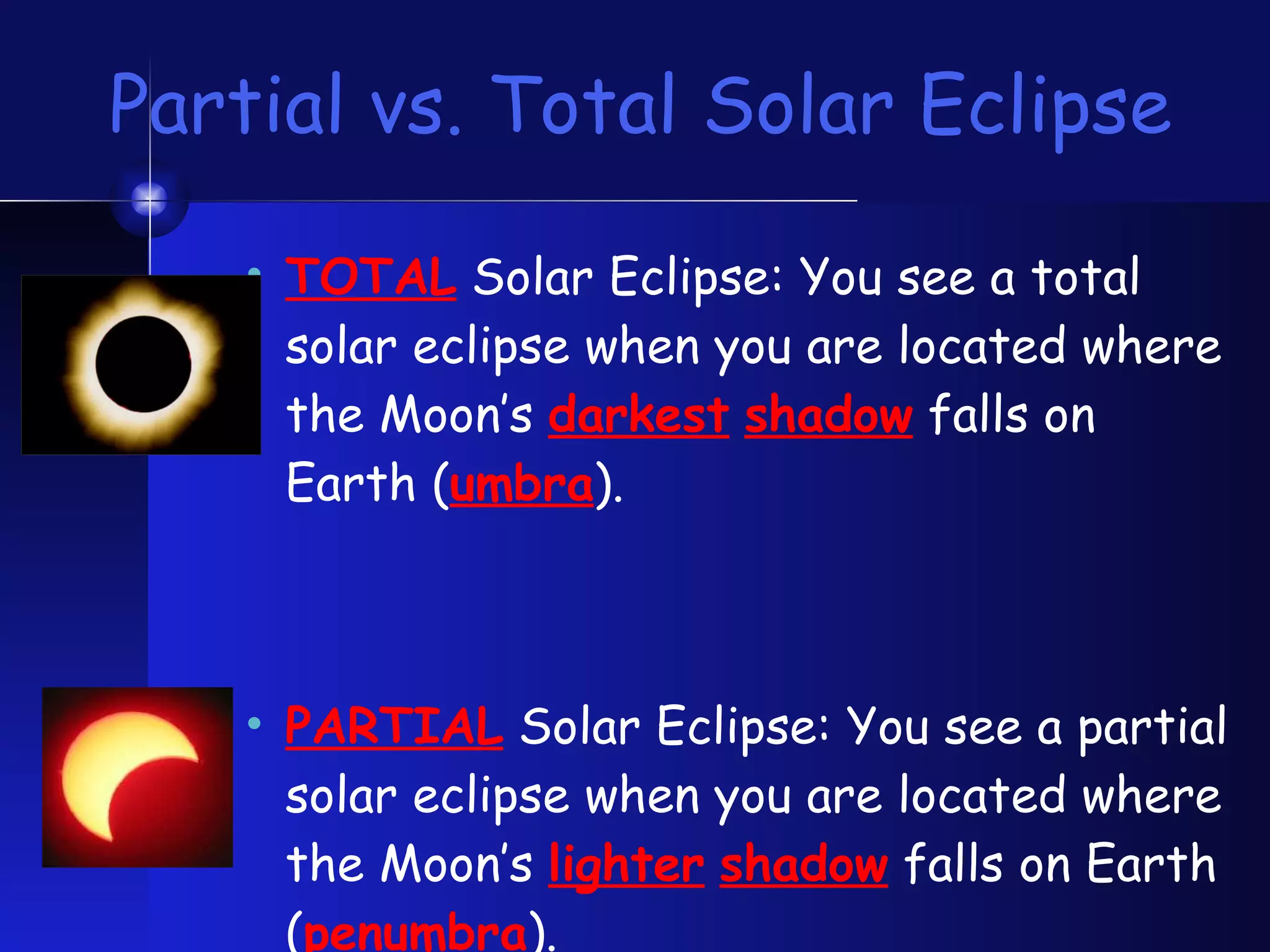
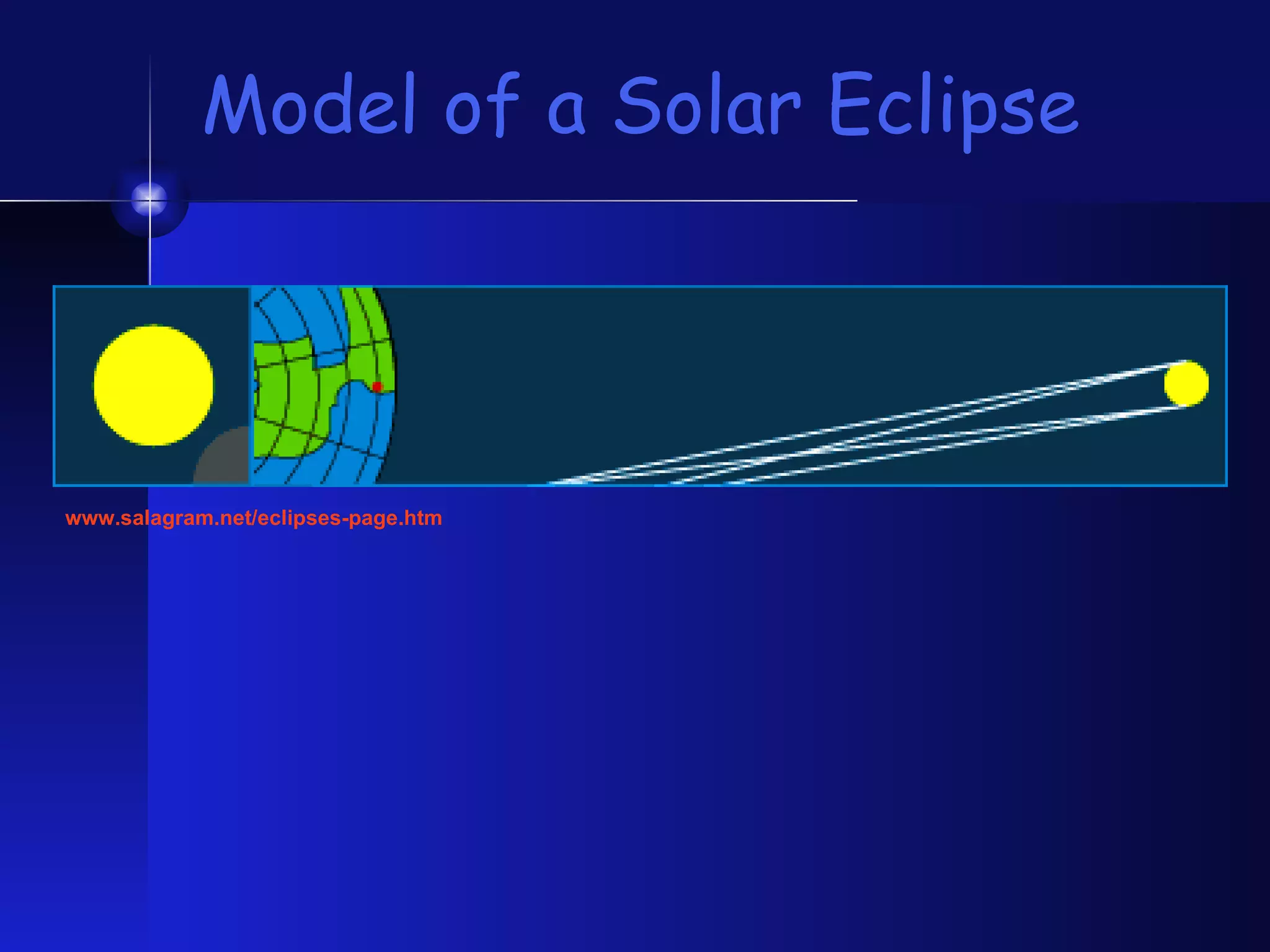
Solar Eclipse a. Umbra: - dark ,  central   region of the moon’s shadow from where you can see a  total  eclipse b. Penumbra- - fainter ,  outer   region of the moon’s shadow from where you can see a  partial  eclipse
Partial vs. Total Solar Eclipse TOTAL  Solar Eclipse: You see a total solar eclipse when you are located where the Moon’s  darkest   shadow   falls on Earth ( umbra ). PARTIAL  Solar Eclipse: You see a partial solar eclipse when you are located where the Moon’s  lighter   shadow   falls on Earth ( penumbra ).
Model of a Solar Eclipse www.salagram.net/eclipses-page.htm
Other Notes on Solar Eclipses… Only happen when the moon is in “new moon position” Only lasts a few minutes (totality) Happens 2-3 times per year
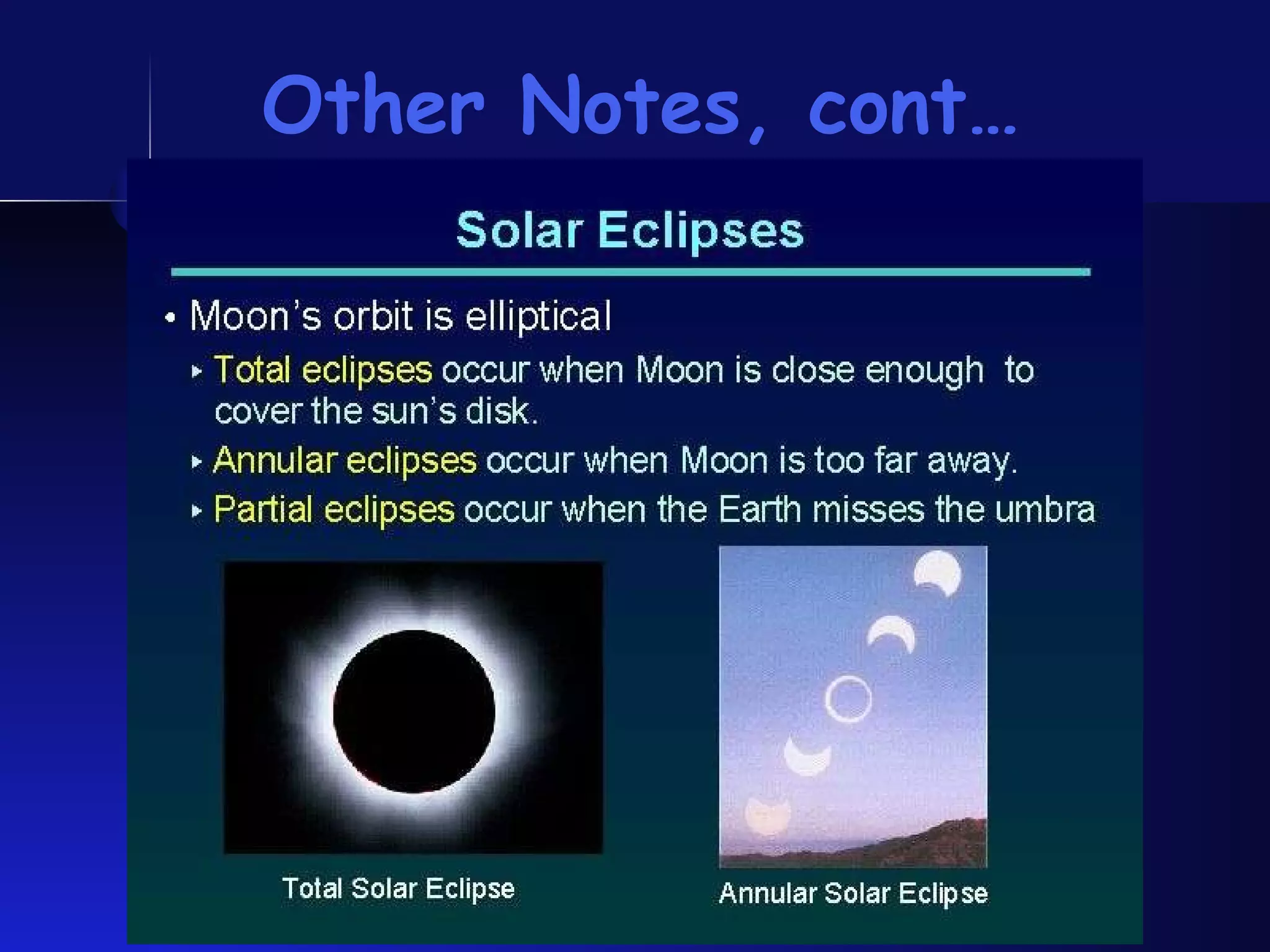
Other Notes, cont…
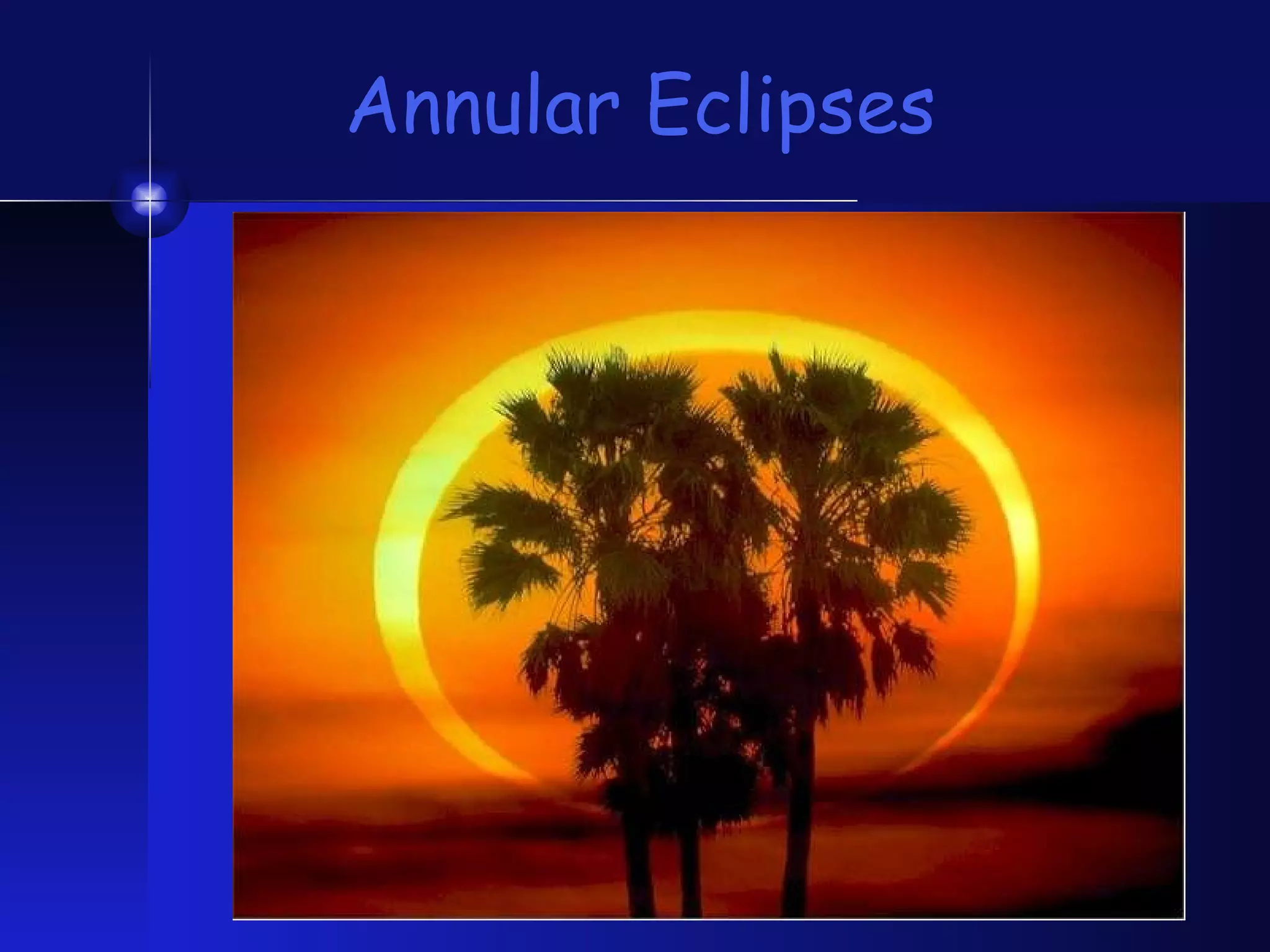
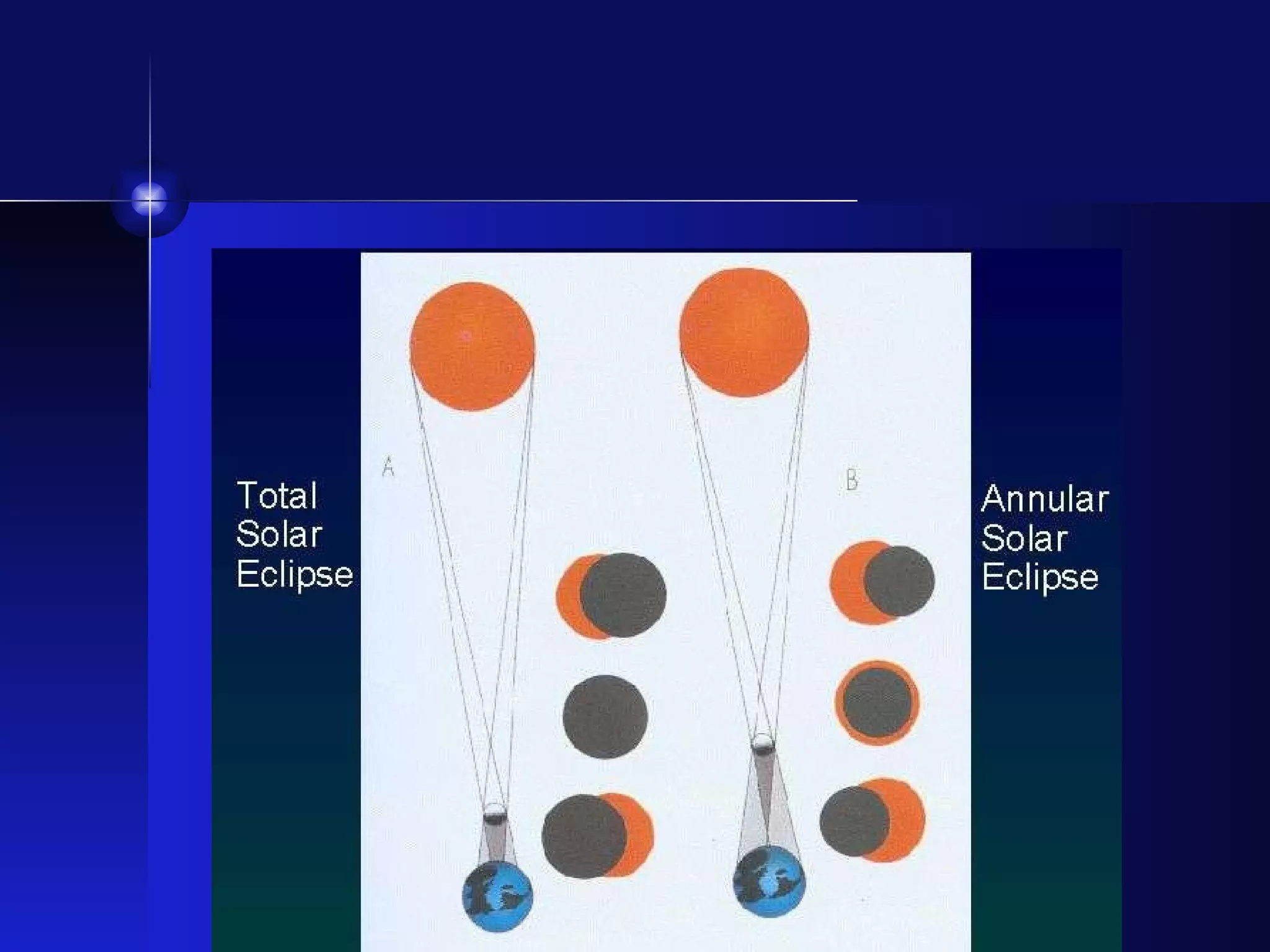
Annular Eclipses The Moon’s distance from Earth changes during the year, and when it is farthest away (at its “apogee”) it looks smaller. If an eclipse happens at this point, the moon looks too small  to completely block the sun, so you see an “annular eclipse.”
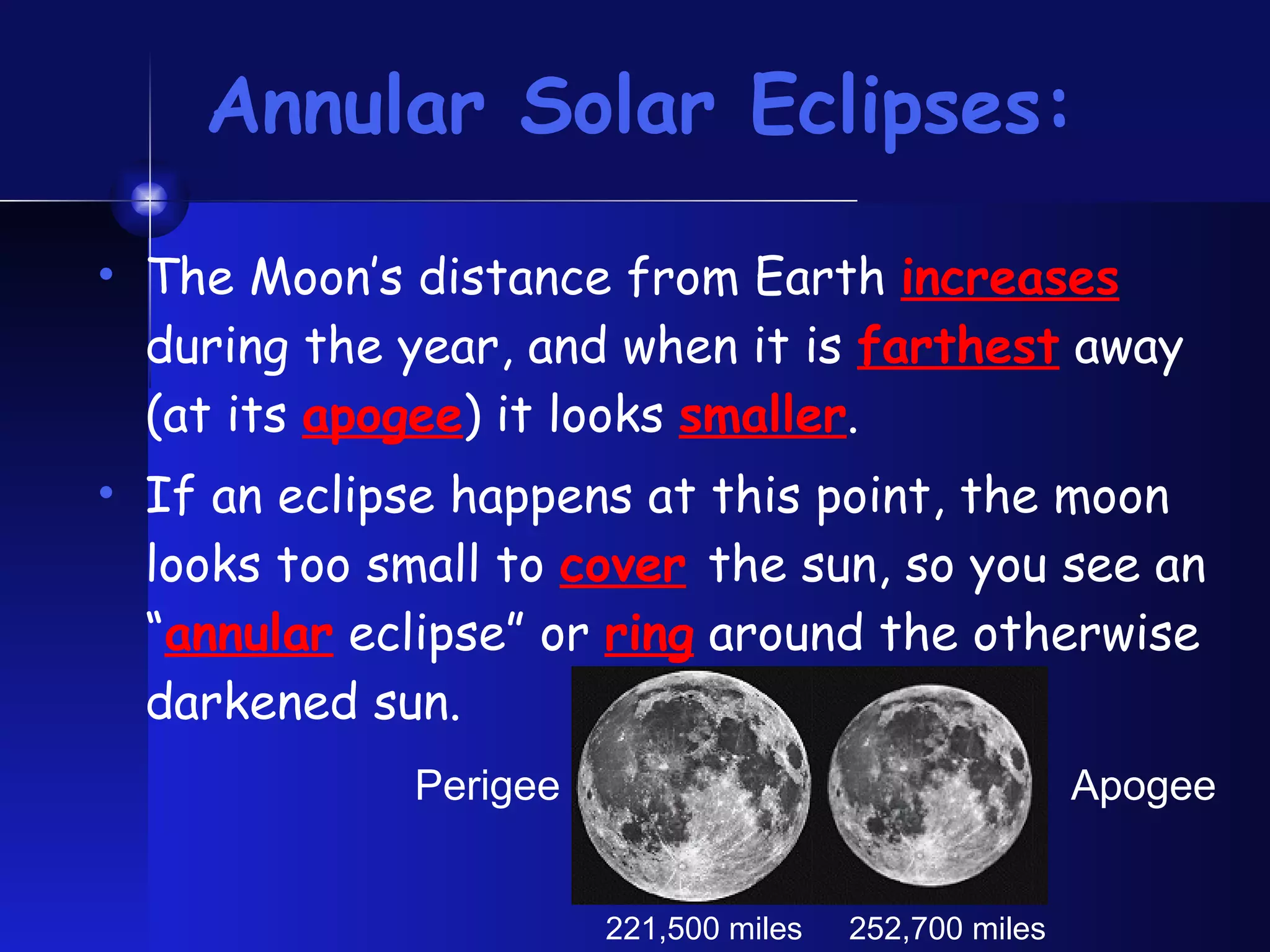
Annular Solar Eclipses: The Moon’s distance from Earth  increases  during the year, and when it is  farthest  away (at its  apogee ) it looks  smaller . If an eclipse happens at this point, the moon looks too small to  cover   the sun, so you see an “ annular  eclipse” or  ring  around the otherwise darkened sun.  Apogee Perigee 221,500 miles 252,700 miles
 
Why don’t eclipses happen every month?
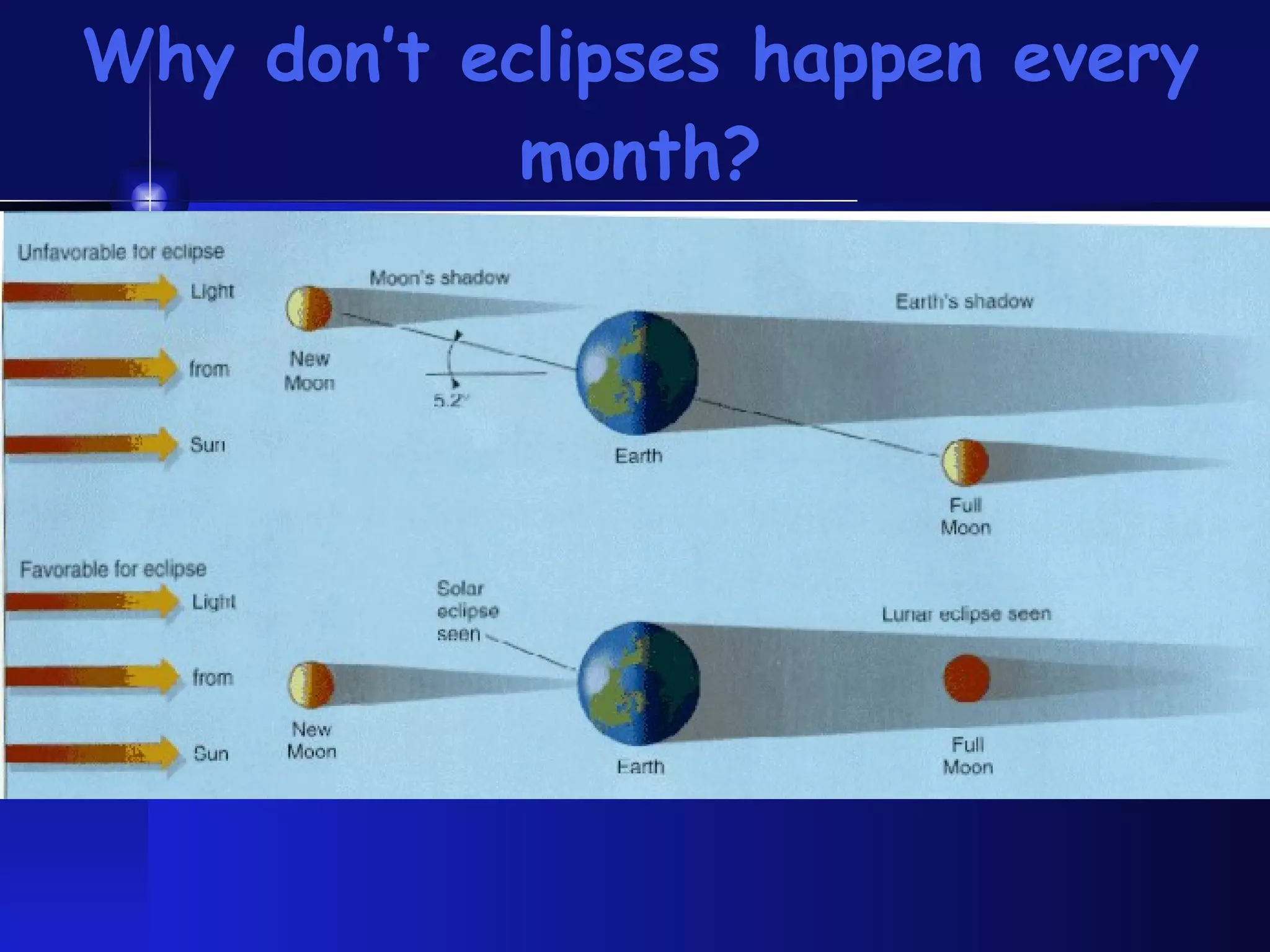
Why don’t eclipses happen every month? The moon’s orbit around the Earth is  tilted  at  5 degrees  compared to the Earth’s  orbit  around the sun. Therefore, the moon, Sun and Earth are  not perfectly lined up  every  new  or  full  moon to create an eclipse. http://observe.phy.sfasu.edu/courses/ast105/lectures105/chapter02/moon_orbit_tilt_vs_ecliptic.htm
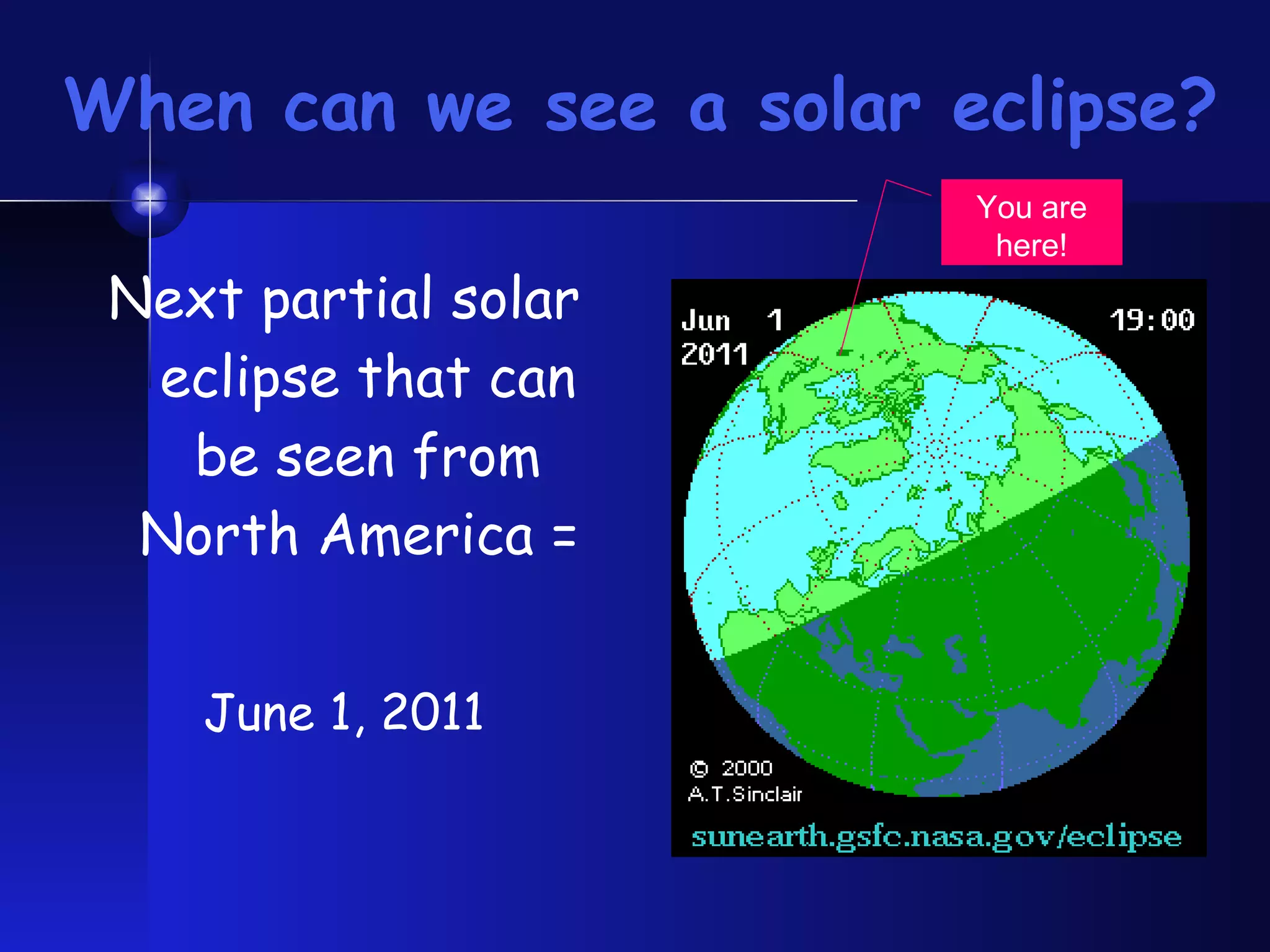
When can we see a solar eclipse? Next partial solar eclipse that can be seen from North America =  June 1, 2011 You are here!
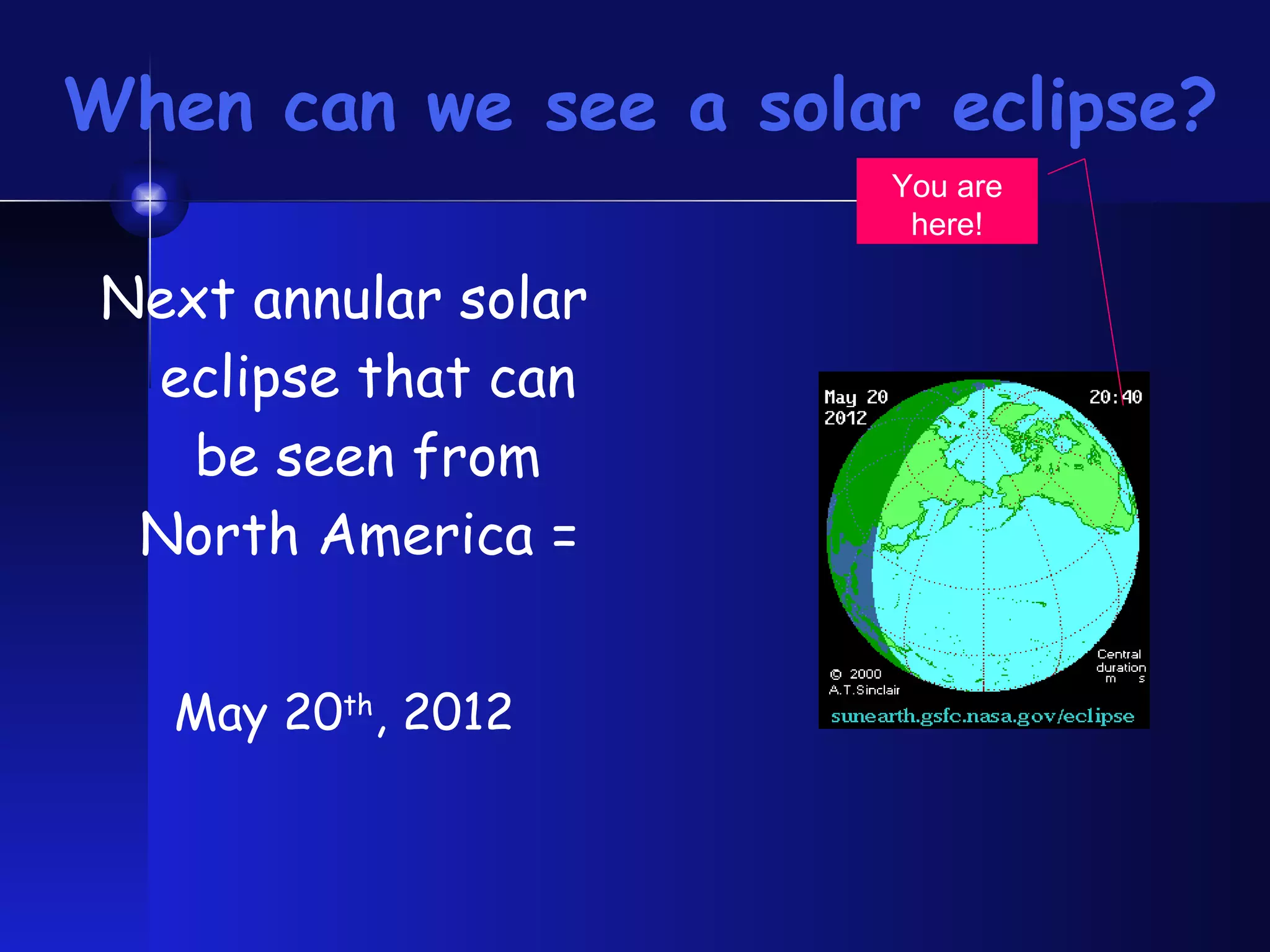
When can we see a solar eclipse? Next annular solar eclipse that can be seen from North America =  May 20 th , 2012 You are here!

Sp11 -notes--moon and eclipses

  • 1.
    Earth, Sun andMoon Systems Earth, Sun and Moon Systems www.starmanproductions.com
  • 2.
    A Note AboutShadows When you hold a light source FAR from an object, the object only blocks a little light, so its shadow is SMALL and SHARP . When you move the light source CLOSE to the object, the object blocks a lot of light and its shadow is BIG and FUZZY .
  • 3.
    Our Best Pal,The Moon! Probably formed when a large object hit Earth and broke off a piece. The moon is about ¼ the size of Earth It takes about 27.3 days to orbit Earth About 386,000 km from Earth
  • 4.
  • 5.
    Phases of theMoon The Moon itself does not emit any light ; We see the Moon because it reflects sunlight back toward us. As the Moon circles the Earth, the amount of the lit side we see changes , which creates the daily “phases.” Yes, phases of the Moon illustrated using delicious Oreo cookies!
  • 6.
    Important Moon PhaseTerms Waxing : Changing from new moon to full moon (~2 weeks). As we see more of the moon we call the phases “waxing.” Waning : Changing from full moon back to new moon (~2 weeks). As we see less of the moon we call the phases “waning.” Crescent = see less than half the moon Gibbous = see more than half the moon At the 1 st and 3 rd Quarters, we see exactly half of the moon.
  • 7.
  • 8.
  • 9.
    Dark Side ofthe Moon? Why does the moon have a dark side? Why does the illuminated side always look the same (the moon revolves, after all!) Physics Connection! It’s “synchronous rotation.” The time it takes the moon to rotate once on its axis is the same as the time it takes it to revolve around the Earth. This is caused by the Earth’s “tidal force” or differential (uneven) gravitational force on the Moon.
  • 10.
    The Lunar Eclipse!A lunar eclipse happens during a full moon when the Moon passes through the Earth’s shadow.
  • 11.
  • 12.
    Some Basic Termsa. Umbra: - darker , central region of the Earth’s shadow b. Penumbra- fainter, outer region of the Earth’s shadow
  • 13.
    Partial vs. TotalLunar Eclipse TOTAL Lunar Eclipse: You see a total lunar eclipse when the Moon is in the darker central region of the Earth’s shadow ( umbra ). PARTIAL Lunar Eclipse: You see a partial lunar eclipse the Moon is in the fainter outer region of the Earth’s shadow ( penumbra ).
  • 14.
    Model of aLunar Eclipse www.salagram.net/eclipses-page.htm
  • 15.
    Other Notes –Lunar Eclipses Only happen when the moon is in “full moon position” Can last for several hours Happen slightly more often than solar eclipses (3-4 times per year) The moon never fully disappears, but instead turns red in color
  • 16.
    Why the Moonlooks “red”
  • 17.
  • 18.
    Close up ofa Lunar Eclipse
  • 19.
  • 20.
    When can wesee a lunar eclipse? Next penumbral lunar eclipse seen from North America =June 26, 2010 (very hard to see!!!)
  • 21.
    When can wesee a lunar eclipse? Next total lunar eclipse seen from North America = April 15, 2014
  • 22.
    The Solar Eclipse!A solar eclipse happens during a NEW MOON when the Moon lies directly between the Earth and Sun .
  • 23.
    Solar Eclipse Thenext full solar eclipse in North America will be in August, 2017.
  • 24.
    Solar Eclipse a.Umbra: - dark , central region of the moon’s shadow from where you can see a total eclipse b. Penumbra- - fainter , outer region of the moon’s shadow from where you can see a partial eclipse
  • 25.
    Partial vs. TotalSolar Eclipse TOTAL Solar Eclipse: You see a total solar eclipse when you are located where the Moon’s darkest shadow falls on Earth ( umbra ). PARTIAL Solar Eclipse: You see a partial solar eclipse when you are located where the Moon’s lighter shadow falls on Earth ( penumbra ).
  • 26.
    Model of aSolar Eclipse www.salagram.net/eclipses-page.htm
  • 27.
    Other Notes onSolar Eclipses… Only happen when the moon is in “new moon position” Only lasts a few minutes (totality) Happens 2-3 times per year
  • 28.
  • 29.
    Annular Eclipses TheMoon’s distance from Earth changes during the year, and when it is farthest away (at its “apogee”) it looks smaller. If an eclipse happens at this point, the moon looks too small to completely block the sun, so you see an “annular eclipse.”
  • 30.
    Annular Solar Eclipses:The Moon’s distance from Earth increases during the year, and when it is farthest away (at its apogee ) it looks smaller . If an eclipse happens at this point, the moon looks too small to cover the sun, so you see an “ annular eclipse” or ring around the otherwise darkened sun. Apogee Perigee 221,500 miles 252,700 miles
  • 31.
  • 32.
    Why don’t eclipseshappen every month?
  • 33.
    Why don’t eclipseshappen every month? The moon’s orbit around the Earth is tilted at 5 degrees compared to the Earth’s orbit around the sun. Therefore, the moon, Sun and Earth are not perfectly lined up every new or full moon to create an eclipse. http://observe.phy.sfasu.edu/courses/ast105/lectures105/chapter02/moon_orbit_tilt_vs_ecliptic.htm
  • 34.
    When can wesee a solar eclipse? Next partial solar eclipse that can be seen from North America = June 1, 2011 You are here!
  • 35.
    When can wesee a solar eclipse? Next annular solar eclipse that can be seen from North America = May 20 th , 2012 You are here!