KeshavAgarwal(21)
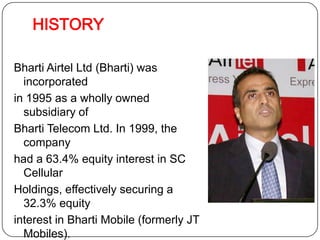
HISTORYBhartiAirtel Ltd (Bharti) was incorporated in 1995 as a wholly owned subsidiary of Bharti Telecom Ltd. In 1999, the company had a 63.4% equity interest in SC Cellular Holdings, effectively securing a 32.3% equity interest in Bharti Mobile (formerly JT Mobiles). In 2000,  Bharti acquired BhartiTelenet.
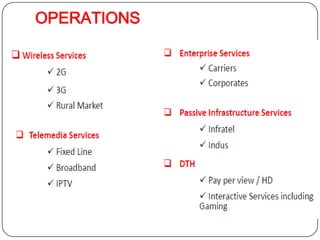
OPERATIONS
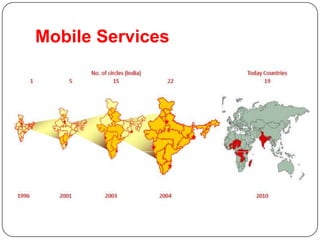
Mobile Services
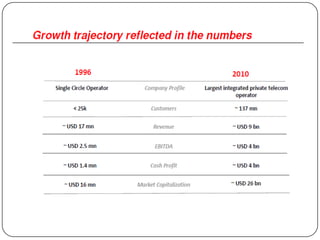
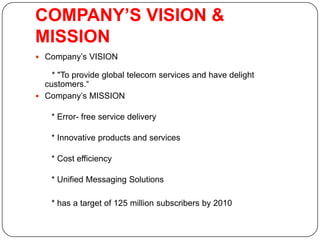
COMPANY’S VISION & MISSIONCompany’s VISION    * "To provide global telecom services and have delight customers.“Company’s MISSION       * Error- free service delivery          * Innovative products and services          * Cost efficiency          * Unified Messaging Solutions        * has a target of 125 million subscribers by 2010
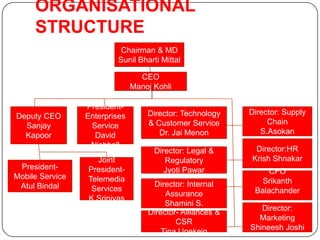
ORGANISATIONAL STRUCTUREChairman & MDSunil BhartiMittalCEO ManojKohliDeputy CEOSanjay KapoorPresident- Enterprises ServiceDavid NishballDirector: Technology & Customer Service Dr. Jai MenonDirector: Supply ChainS.AsokanDirector:HRKrishShnakarDirector: Legal & RegulatoryJyotiPawarJoint President- Telemedia ServicesK SrinivasPresident- Mobile ServiceAtulBindalCFOSrikanthBalachanderDirector: Internal Assurance Shamini S.Director: MarketingShineesh JoshiDirector- Alliances & CSRTina Unekein
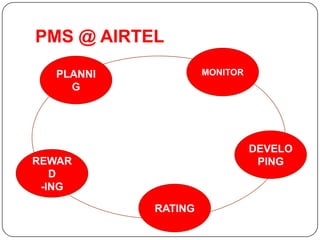
PMS @ AIRTELMONITORPLANNIGDEVELOPINGREWARD-INGRATING
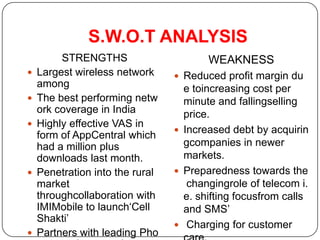
S.W.O.T ANALYSISWEAKNESS1.Reduced profit margin due toincreasing cost per minute and fallingselling price.2.Increased debt by acquiringcompanies in newer markets.3.Preparedness towards the changingrole of telecom i.e. shifting focusfrom calls and SMS’.4.Penetration into rural market.5.Charging for customer care.8STRENGTHSLargest wireless network amongThe best performing network coverage in IndiaHighly effective VAS in form of AppCentral which had a million plus downloads last month.Penetration into the rural market throughcollaboration with IMIMobile to launch‘CellShakti’Partners with leading Phonemanufacturers for distribution.WEAKNESSReduced profit margin due toincreasing cost per minute and fallingselling price.
Increased debt by acquiringcompanies in newer markets.
Preparedness towards the changingrole of telecom i.e. shifting focusfrom calls and SMS’
 Charging for customer care.OPPORTUNITIESThe entry into the newer markets of Africa as the domestic market goes through a state of unrest.Large section of the population which is not exposed to internet need better connectivity.Mobile Banking Services.THREATSToo many players.
Internet based services such as Skype and Gtalk take over a part of the tele-comm. domain.
Customer prefrence of price over performance.AIRTEL & FAYOL’S PRINCIPLESDivision of labour:     A complicated work is divided into many small jobs and each small job is allocated to individuals. When the individual does the job again and again he becomes expert in it and this leads to specialization.Authority is the legal right to command over others to do an act or not to do an act. In the other words it is the power given to a person to extract work from his subordinates.Responsibility crops up with authority. It is the obligation of a person to perform his duties towards a job.Discipline:     Discipline is very much essential for the smooth running of any organization. Discipline is “respect for agreements, sincere effort for completing a given task and outward marks of respect”. The essence of discipline is obedience, diligence, correct attitude and outward mark of respects, with in the limits fixed by the agreement between management and its employees.
Unity of Command:     A subordinate should receive orders and instructions from one superior only. But it does not mean that a superior should have only one sub-ordinate. If it is not followed, there will not be any discipline.Unity of Direction: One head – One Plan.     This means that there should be one head and one plan for each group of activities having the same objectives. Similar activities should be grouped together under one manager. Only then all efforts could be directed towards the common goal.Sub – ordination of individual’s interest to the common interest:     Individuals who work for an organization should sacrifice their interest for the benefit of the organization i.e. the common interest. The interest of an organization is more important than the interest of an employee.Remuneration of personnel:     Remuneration is the money paid to the employees for their physical and mental efforts in carrying out a work.  Fair and equitable remuneration should be provided to employees to ensure better production and satisfaction.Centralization:     If the power and responsibilities are retained at top level management, the organization is centralized. Only the top executive at the centre takes all the decisions. It has more span of control.

Airtel Management

  • 1.
  • 2.
    HISTORYBhartiAirtel Ltd (Bharti)was incorporated in 1995 as a wholly owned subsidiary of Bharti Telecom Ltd. In 1999, the company had a 63.4% equity interest in SC Cellular Holdings, effectively securing a 32.3% equity interest in Bharti Mobile (formerly JT Mobiles). In 2000, Bharti acquired BhartiTelenet.
  • 3.
  • 5.
  • 6.
    COMPANY’S VISION &MISSIONCompany’s VISION * "To provide global telecom services and have delight customers.“Company’s MISSION * Error- free service delivery   * Innovative products and services   * Cost efficiency   * Unified Messaging Solutions * has a target of 125 million subscribers by 2010
  • 7.
    ORGANISATIONAL STRUCTUREChairman &MDSunil BhartiMittalCEO ManojKohliDeputy CEOSanjay KapoorPresident- Enterprises ServiceDavid NishballDirector: Technology & Customer Service Dr. Jai MenonDirector: Supply ChainS.AsokanDirector:HRKrishShnakarDirector: Legal & RegulatoryJyotiPawarJoint President- Telemedia ServicesK SrinivasPresident- Mobile ServiceAtulBindalCFOSrikanthBalachanderDirector: Internal Assurance Shamini S.Director: MarketingShineesh JoshiDirector- Alliances & CSRTina Unekein
  • 8.
  • 9.
    S.W.O.T ANALYSISWEAKNESS1.Reduced profit margin due toincreasing cost perminute and fallingselling price.2.Increased debt by acquiringcompanies in newer markets.3.Preparedness towards the changingrole of telecom i.e. shifting focusfrom calls and SMS’.4.Penetration into rural market.5.Charging for customer care.8STRENGTHSLargest wireless network amongThe best performing network coverage in IndiaHighly effective VAS in form of AppCentral which had a million plus downloads last month.Penetration into the rural market throughcollaboration with IMIMobile to launch‘CellShakti’Partners with leading Phonemanufacturers for distribution.WEAKNESSReduced profit margin due toincreasing cost per minute and fallingselling price.
  • 10.
  • 11.
  • 12.
    Charging forcustomer care.OPPORTUNITIESThe entry into the newer markets of Africa as the domestic market goes through a state of unrest.Large section of the population which is not exposed to internet need better connectivity.Mobile Banking Services.THREATSToo many players.
  • 13.
    Internet based servicessuch as Skype and Gtalk take over a part of the tele-comm. domain.
  • 14.
    Customer prefrence ofprice over performance.AIRTEL & FAYOL’S PRINCIPLESDivision of labour: A complicated work is divided into many small jobs and each small job is allocated to individuals. When the individual does the job again and again he becomes expert in it and this leads to specialization.Authority is the legal right to command over others to do an act or not to do an act. In the other words it is the power given to a person to extract work from his subordinates.Responsibility crops up with authority. It is the obligation of a person to perform his duties towards a job.Discipline: Discipline is very much essential for the smooth running of any organization. Discipline is “respect for agreements, sincere effort for completing a given task and outward marks of respect”. The essence of discipline is obedience, diligence, correct attitude and outward mark of respects, with in the limits fixed by the agreement between management and its employees.
  • 15.
    Unity of Command: A subordinate should receive orders and instructions from one superior only. But it does not mean that a superior should have only one sub-ordinate. If it is not followed, there will not be any discipline.Unity of Direction: One head – One Plan. This means that there should be one head and one plan for each group of activities having the same objectives. Similar activities should be grouped together under one manager. Only then all efforts could be directed towards the common goal.Sub – ordination of individual’s interest to the common interest: Individuals who work for an organization should sacrifice their interest for the benefit of the organization i.e. the common interest. The interest of an organization is more important than the interest of an employee.Remuneration of personnel: Remuneration is the money paid to the employees for their physical and mental efforts in carrying out a work.  Fair and equitable remuneration should be provided to employees to ensure better production and satisfaction.Centralization: If the power and responsibilities are retained at top level management, the organization is centralized. Only the top executive at the centre takes all the decisions. It has more span of control.

Editor's Notes

  • #4 Sub Strategic Business UnitTelecom services : 68 % GROSS REVENUET &b 14 %Enterprise 21 %Aslo introduced airtel live along with mchqEnterprise business – BhartiAirtel provides integrated services comprising mobile, telephone, broadband, data and connectivity services internationally as well as nationally for small, medium and large scale enterprises. Its carrier service provides network connectivity through optic fiber over a distance of more than 35,000 km. BhartiAirtel is a member of South East Asia – Middle East – Western Europe – 4 consortium which includes 15 global telecommunication service providers.In FY05, BhartiAirtel joined with ICICI and VISA to introduce mChq.
  • #6 Worldwide PresenceCoverage map of BhartiAirtel across 19 countriesAirtel is the 5th largest mobile operator in the world in terms of subscriber base and has a commercial presence in 19 countries and theChannel Islands.Its area of operations include:The Indian Subcontinent:AirtelBangla, in BangladeshAirtel, in IndiaAirtel Sri Lanka, in Sri LankaAirtel Africa, which operates in 16 African countries:Burkina Faso, Chad, Democratic Republic of the Congo, Republic of the Congo, Gabon, Ghana, Kenya, Madagascar, Malawi, Niger, Nigeria, Seychelles, Sierra Leone, Tanzania, Uganda andZambia.The British Crown Dependency islands of Jersey and Guernsey, under the brand name Airtel-Vodafone, through an agreement with Vodafone
  • #8 The organisational structure that existed till recently concentrated on the hierarchy of the operations(not services)inside the company as a whole. The structure depicts the corresponding operation/region of different in-charges and hence it didn't hold anyone responsible for each of its services.  So, the company found it better to restructure its organisational chart and it came into implementation from 1st August. The transformed organisational structure will have two distinct Customer Business Units (CBU) with clear focus on B2C (Business to Customer) and B2B (Business to Business) segments. BhartiAirtel's B2C business unit will comprehensively service the retail consumers, homes and small offices, by combining the erstwhile business units - Mobile, Telemedia, Digital TV, and other emerging businesses (like M-commerce, M-health, M-advertising etc.). The B2C organization will consist of Consumer Business and Market Operations.. DESCRIPTION OF BHARTI AIRTEL CHART:-THIS ORGANISATIONAL CHART GIVES A BRIEF DESCRIPTION OF THE LEVELS OFMANAGENT IN THE ORGANISATION. THE CHAIRMAN AND THE MANAGINGDIRECTOR HERE IS THE HEAD OF THE ORGANISATION I.E THEY CONSTITUTE THETOP LEVEL MANAGEMENT. THE NEXT LEVEL IS THE PRESIDENT AND CEO AFTERTHE CHAIRMAN WHO IS AGAIN FURTHER SUB-DIVIDED INTO VARIOUS STAGES I.E.THEPRESIDENTFORVARIOUSDEPARTMENTSUCHASMOBILESERVICES,TELEMEDIA,ETC. BELOW THE PRESIDENT ARE THE DIRECTORS OFVARIOUS OTHER DEPARTMENT PRESENT IN THE ORGANISATION LIKE CUSTOMERSERVICES,SUPPLY CHAIN,TECHNOLOGY,ETC.
  • #9 PERFORMANCE MANAGEMENT SYSTEM – PMSPLANNIG ::Employees Accountability-Work Assignments orResponsibilities.Performance Plans are Flexible.MONITOR ::Assignments and Projects are MonitoredContinually.Methods:Conducting Progress Reviews.Ongoing MonitoringDEVELPOING::Giving Assignments that Introduce New Skillsor Higher Levels of Responsibility.Improving Work ProcessesRATING::Rating-Evaluating Employee or GroupPerformance.Rating of record-According to Procedures.Based on KSA’s decided360*/ 270*/ 180*Impact on Various Personnel ActionsPromotions.Pay increases.Reduction in ForceREWARDING::Good Performance is Recognized.Recognition: ongoing and part of day-to-dayexperience.Awards:Cash.Day off.Other Non-monetary Items.Suggestions are also Rewarded
  • #10 all the players in the market. Followed by thelargest market share. Customer base of 133 million. High Customer Service andQuality.
  • #11 Threat from competition :Customer bargaining power.Threat of substitutesSupplier bargaining power
  • #12 There will not be any friction among the employees.12. Stability of tenure of personnel:People who work in an organization should not be allowed to move out quite frequently because stable and secure work force is an asset to any organization.It is better to keep a manager of average ability than a very efficient manager who merely comes and goes.The management should create favorable working conditions by providing good salary, promotion opportunities, welfare facilities etc.13. Initiative:Initiative is the power of thinking and executing any task with enthusiasm voluntarily.Everyone should be given an equal opportunity to use their creativity and come out with better ideas of doing the work.When employees come forward with new ideas, new methods etc., they must be encouraged. It improves good morale among the employees.14. Espirit de corps:It is a French word, which means “feeling of harmony and union among personnel” of an organization.Union is strength. Team spirit and a sense of unity and togetherness should be fostered and administrated.Management should avoid the policy of “divide and rule”.