MOOD DISORDER
MS. PUSPASANA YUMNAM
M.Sc in Psychiatric Nursing
MOOD DISORDER
• Mood defined as a temporary state of mind or feeling.
• Mood disorder are characterized by a disturbance of
mood , accompanied by a full or partial manic or
depressive syndrome which is not due to physical or
mental disorder
Classification of mood disorder
• F30-F39: Mood (affective ) disorders
• F30 : Manic episode
• F31: Bipolar affective disorder
• F32: Depressive episode
• F33: Recurrent depressive disorder
• F34: Persistent mood disorder
• F38: Other mood disorder
• F39: Unspecified Mood disorder
Manic episode
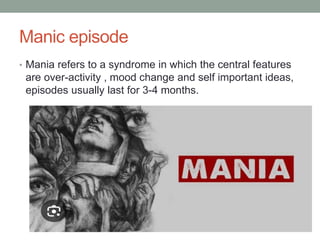
• Mania refers to a syndrome in which the central features
are over-activity , mood change and self important ideas,
episodes usually last for 3-4 months.
Classification of mania
• F30: Manic episode
• F30.0 : Hypomania
• F30.1: Mania without psychotic symptoms
• F30.2 :Mania with psychotic symptoms
• F30.8 : Other manic episode
• F30.9 : Manic episode unspecified
Etiology
• Neurotransmitter and structural hypothesis :
excessive levels of norepinephrine and dopamine ,
imbalance between cholinergic and noradrenergic system
or a deficiency in serotonin.
• Genetic consideration :
 1ST degree relative : 5-10%
Identical twin : 40-70%
• Psychodynamic theories : faulty family dynamics during
early life, manic episodes as a defense against or denial
of depression.
Psychopathology
Stages of elevated mood
• EUPHORIA ( Stage I) : Increased sense of psychological
well being and happiness not keeping with ongoing
events
• ELATION ( Stage II) : moderate elevation of mood with
increased psychomotor activity
• EXALTATION ( Stage III) : Intense elevation of mood with
delusions of grandeur
• ECSTASY (Stage IV ) : Severe elevation of mood ,
intense sense of rapture or blissfulness seen in delirious
or stuporous mania
STAGES OF MANIA
• Stage I : Hypomania (cheerful and expansive)
• Stage II : Acute mania ( euphoria , elation and continuous
high )
• Stage III : Delirious mania ( labile )
Clinical features
• Elevated , expansive or irritable mood
• Increased psychomotor activity
• Flight of ideas
• Pressure of speech
• Clang association
• Delusion of grandeur
• Delusion of persecution
• Distractibility
• Increased sociablities
• Disinhibition
• Hypersexual and promiscuous behavior
• Poor judgment
• High risk activities ( eg; reckless driving , foolish business
investment )
• Dressed up in flamboyant and gaudy clothes
• Decreased need for sleep
• Decreased need for sleep (less than 3 hours)
• Decreased food intake
• Decreased attention and concentration
• Absent insight .
DSM DIAGNOSTIC CRITERIA
• A distinct period of abnormally and persistently elevated ,
expansive or irritable mood ; persistently increased goal
directed activity , lasting for atleast 1 week and present
most of the day.
• Three or more following symptoms are present :
Inflated self esteem or grandiosity
Decreased need for sleep
More talkative than usual or pressure to keep talking
Flight of ideas, distractibility
Excessive involvement in activities that have a high
potential for painful consequences
• The mood disturbance is sufficiently severe to cause mark
impairment in social or occupational functioning or to
necessitate hospitalization to prevent harm to self or
others or there are psychotic features
• The episode is not attributed to the physiological effects
of a substance or to another medical condition
Treatment modalities
• Pharmacotherapy
 Lithium :900-2100 mg/day
Carbamazepine : 600-1800mg /day
Sodium valproate : 600-2600mg/day
Lamotrigine : 25-200mg/ day
Other drugs : Clonazepam , calcium channel blockers
ELECTROCONVULSIVE THERAPY
PSYCHOSOCIAL TREATMENT
• Family and marital therapy.
• The main purpose is to ensure continuity of treatment and
adequate drug compliance.
Nursing diagnosis
• High risk for injury related to extreme hyperactivity and
impulsive behavior , evidenced by lack of control over
purposeless and potentially injurious movements.
• High risk for violence , self directed or directed to others
related to manic excitement , delusional thinking and
hallucination
• Imbalanced nutrition less than body requirements related
to refusal or inability to sit still long enough to eat as
evidenced by weightloss.
Bibliography
• R Sreevani , A Guide to Mental Health & Psychiatric
Nursing , Jaypee Publication , 4th Edition
• Mary C Townsend , Psychiatric Mental Health Nursing ,
Concepts of Care in Evidence- Based Practice , Jaypee
Publication , 8th Edition
• Diagnostic and Statistical Manual of Mental Disorders,
American Psychiatric Publishing , 5th Edition

MOOD DISORDER Mania, CLASSIFICATION.pptx

  • 1.
    MOOD DISORDER MS. PUSPASANAYUMNAM M.Sc in Psychiatric Nursing
  • 2.
    MOOD DISORDER • Mooddefined as a temporary state of mind or feeling. • Mood disorder are characterized by a disturbance of mood , accompanied by a full or partial manic or depressive syndrome which is not due to physical or mental disorder
  • 3.
    Classification of mooddisorder • F30-F39: Mood (affective ) disorders • F30 : Manic episode • F31: Bipolar affective disorder • F32: Depressive episode • F33: Recurrent depressive disorder • F34: Persistent mood disorder • F38: Other mood disorder • F39: Unspecified Mood disorder
  • 4.
    Manic episode • Maniarefers to a syndrome in which the central features are over-activity , mood change and self important ideas, episodes usually last for 3-4 months.
  • 5.
    Classification of mania •F30: Manic episode • F30.0 : Hypomania • F30.1: Mania without psychotic symptoms • F30.2 :Mania with psychotic symptoms • F30.8 : Other manic episode • F30.9 : Manic episode unspecified
  • 6.
    Etiology • Neurotransmitter andstructural hypothesis : excessive levels of norepinephrine and dopamine , imbalance between cholinergic and noradrenergic system or a deficiency in serotonin. • Genetic consideration :  1ST degree relative : 5-10% Identical twin : 40-70% • Psychodynamic theories : faulty family dynamics during early life, manic episodes as a defense against or denial of depression.
  • 7.
  • 8.
    Stages of elevatedmood • EUPHORIA ( Stage I) : Increased sense of psychological well being and happiness not keeping with ongoing events • ELATION ( Stage II) : moderate elevation of mood with increased psychomotor activity • EXALTATION ( Stage III) : Intense elevation of mood with delusions of grandeur • ECSTASY (Stage IV ) : Severe elevation of mood , intense sense of rapture or blissfulness seen in delirious or stuporous mania
  • 9.
    STAGES OF MANIA •Stage I : Hypomania (cheerful and expansive) • Stage II : Acute mania ( euphoria , elation and continuous high ) • Stage III : Delirious mania ( labile )
  • 10.
    Clinical features • Elevated, expansive or irritable mood • Increased psychomotor activity • Flight of ideas • Pressure of speech • Clang association • Delusion of grandeur • Delusion of persecution • Distractibility • Increased sociablities • Disinhibition • Hypersexual and promiscuous behavior
  • 11.
    • Poor judgment •High risk activities ( eg; reckless driving , foolish business investment ) • Dressed up in flamboyant and gaudy clothes • Decreased need for sleep • Decreased need for sleep (less than 3 hours) • Decreased food intake • Decreased attention and concentration • Absent insight .
  • 12.
    DSM DIAGNOSTIC CRITERIA •A distinct period of abnormally and persistently elevated , expansive or irritable mood ; persistently increased goal directed activity , lasting for atleast 1 week and present most of the day. • Three or more following symptoms are present : Inflated self esteem or grandiosity Decreased need for sleep More talkative than usual or pressure to keep talking Flight of ideas, distractibility Excessive involvement in activities that have a high potential for painful consequences
  • 13.
    • The mooddisturbance is sufficiently severe to cause mark impairment in social or occupational functioning or to necessitate hospitalization to prevent harm to self or others or there are psychotic features • The episode is not attributed to the physiological effects of a substance or to another medical condition
  • 14.
    Treatment modalities • Pharmacotherapy Lithium :900-2100 mg/day Carbamazepine : 600-1800mg /day Sodium valproate : 600-2600mg/day Lamotrigine : 25-200mg/ day Other drugs : Clonazepam , calcium channel blockers
  • 15.
  • 16.
    PSYCHOSOCIAL TREATMENT • Familyand marital therapy. • The main purpose is to ensure continuity of treatment and adequate drug compliance.
  • 17.
    Nursing diagnosis • Highrisk for injury related to extreme hyperactivity and impulsive behavior , evidenced by lack of control over purposeless and potentially injurious movements. • High risk for violence , self directed or directed to others related to manic excitement , delusional thinking and hallucination • Imbalanced nutrition less than body requirements related to refusal or inability to sit still long enough to eat as evidenced by weightloss.
  • 18.
    Bibliography • R Sreevani, A Guide to Mental Health & Psychiatric Nursing , Jaypee Publication , 4th Edition • Mary C Townsend , Psychiatric Mental Health Nursing , Concepts of Care in Evidence- Based Practice , Jaypee Publication , 8th Edition • Diagnostic and Statistical Manual of Mental Disorders, American Psychiatric Publishing , 5th Edition