Carsten Montzka 1 , Heye Bogena 1 , Lutz Weihermueller 1 , Francois Jonard 1 , Marin Dimitrov 1 , Catherine Bouzinac 2 , Juha Kainulainen 3 , Jan E. Balling 4 , Jan Vanderborght 1  and Harry Vereecken 1 (1)Research Centre Jülich, Agrosphere Institute (ICG 4), Leo-Brandt-Strasse, 52425 Jülich, GERMANY (2)European Space Agency, ESTEC, Noordwijk, THE NETHERLANDS (3)Helsinki University of Technology, Department of Radio Science and Engineering, Espoo, FINLAND (4)Technical University of Denmark, DTU Space, Microwaves and Remote Sensing, DENMARK Radiobrightness validation on different spatial scales during the SMOS Validation Campaign 2010 in the Rur catchment, Germany
 
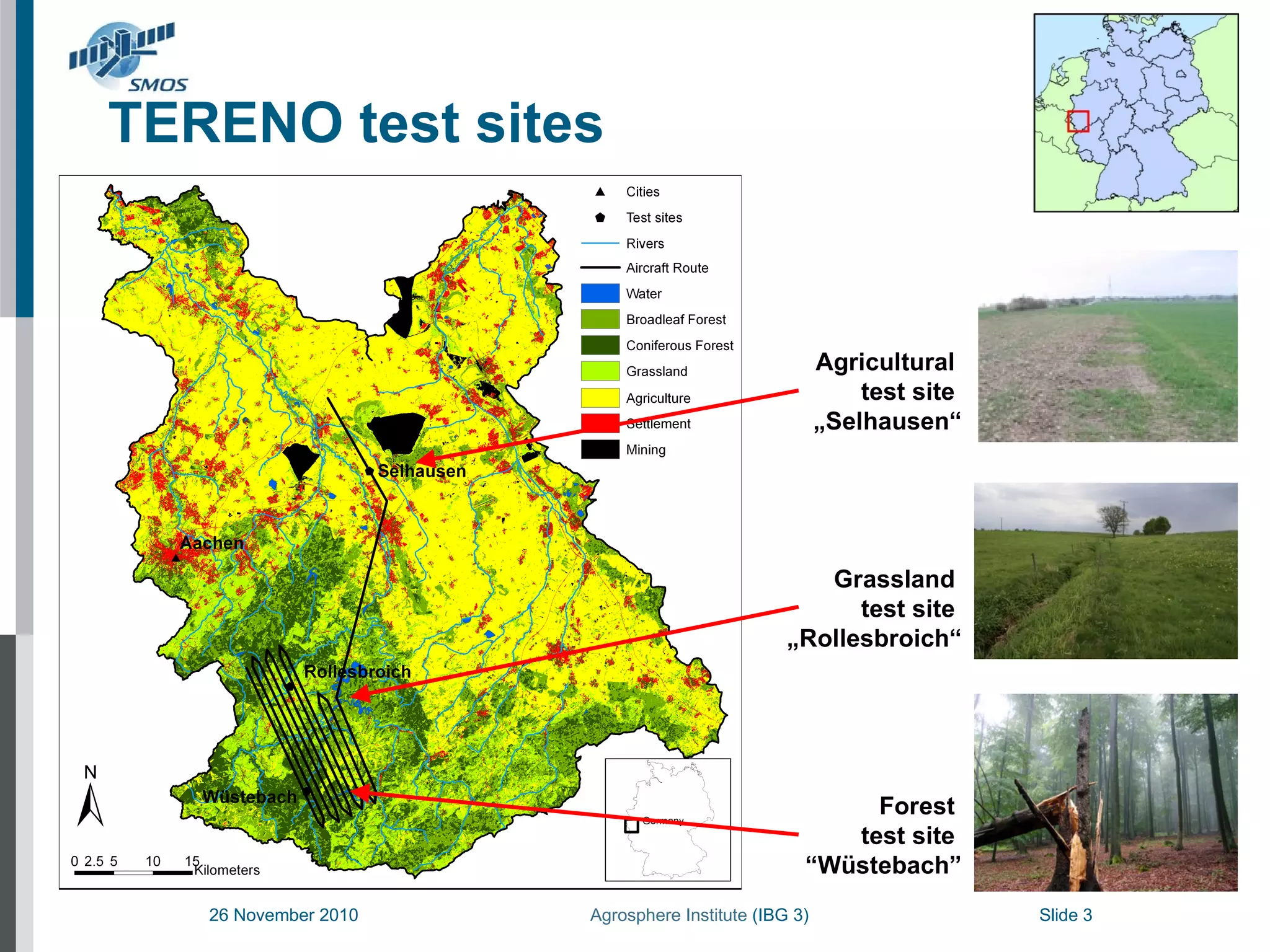
TERENO test sites Agricultural  test site  „ Selhausen“ Forest  test site  “ Wüstebach” Grassland  test site  „ Rollesbroich“
MEASUREMENTS
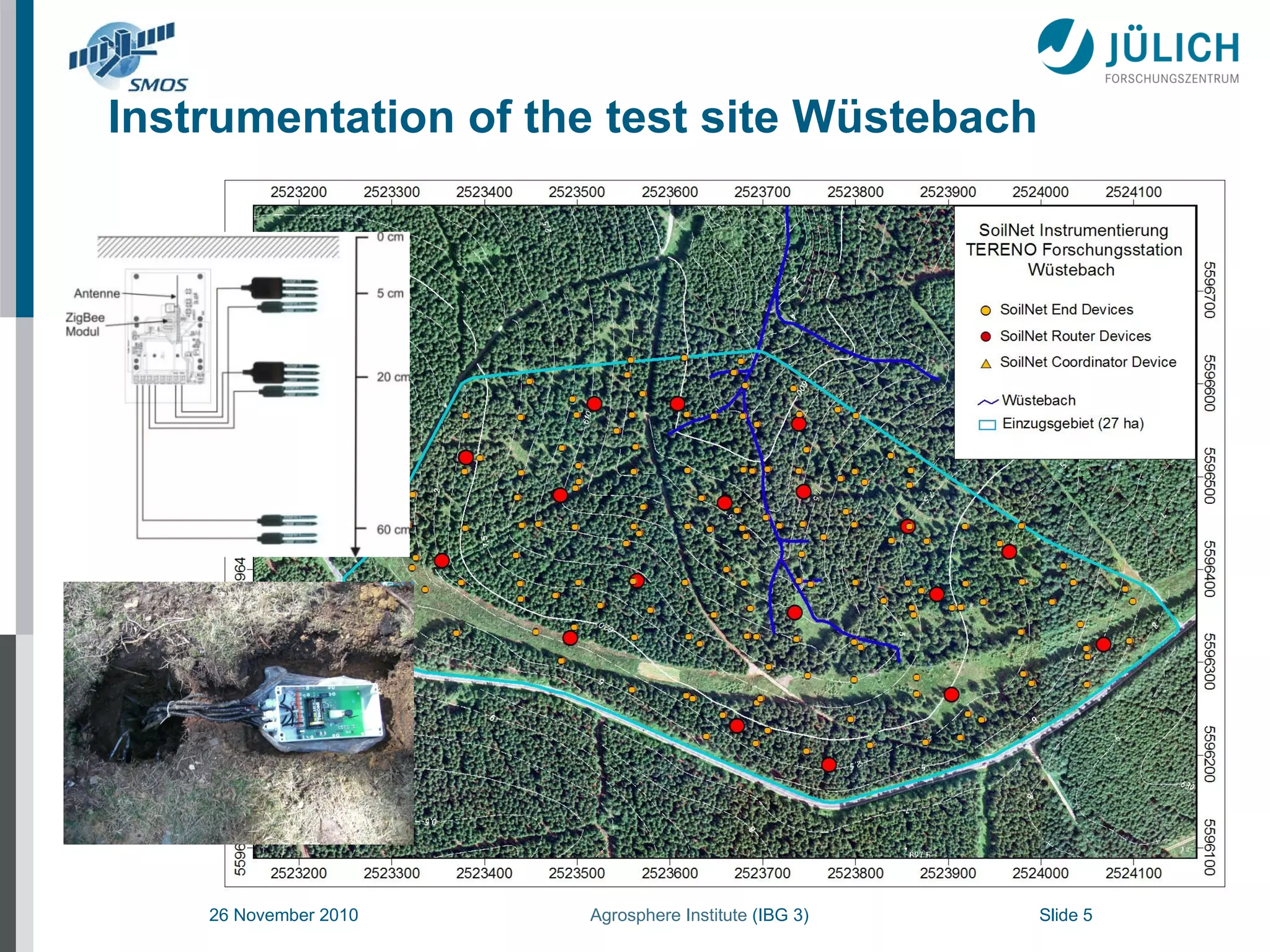
Instrumentation of the test site Wüstebach
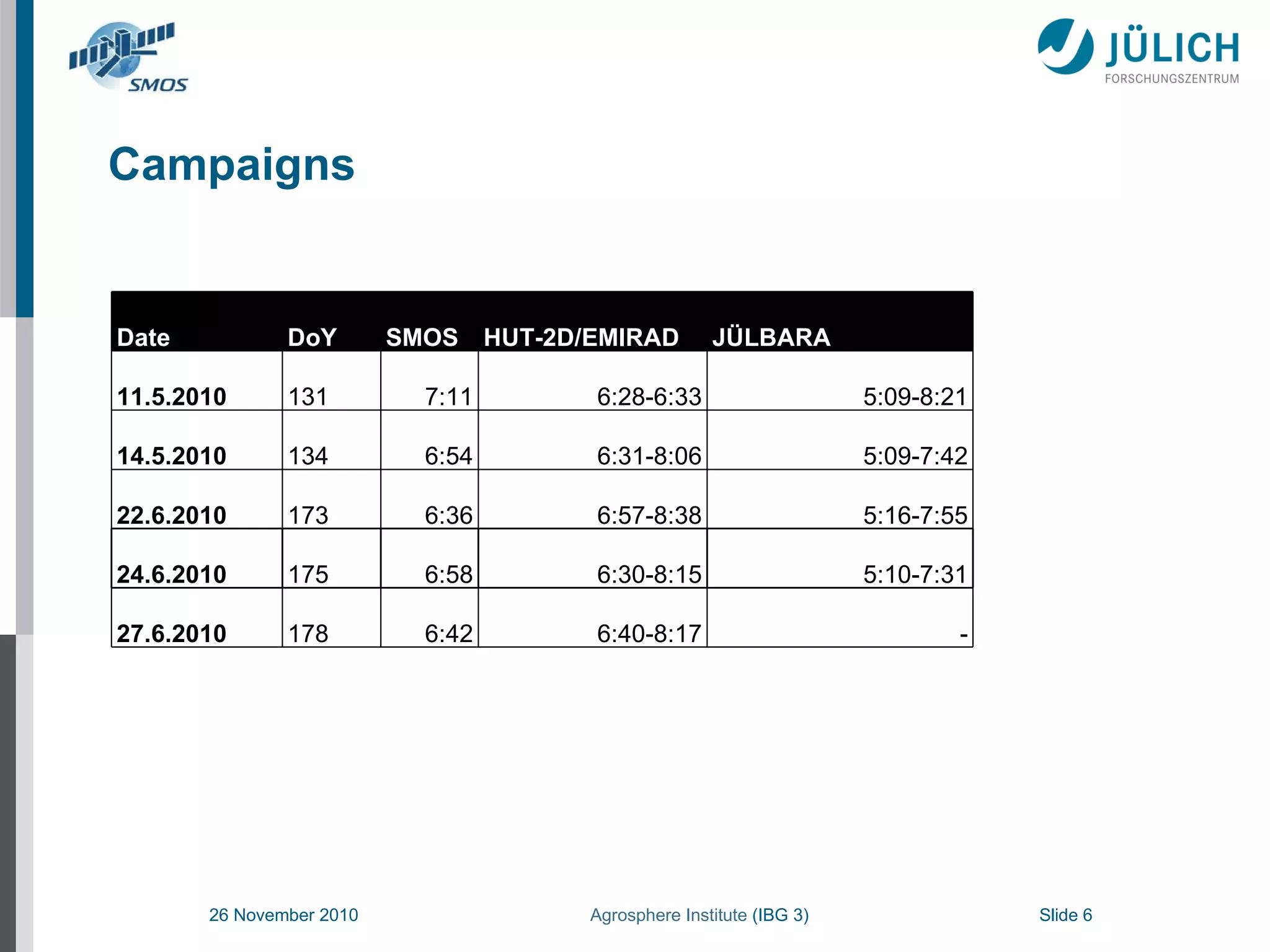
Campaigns Date DoY SMOS HUT-2D/EMIRAD JÜLBARA 11.5.2010 131 7:11 6:28-6:33 5:09-8:21 14.5.2010 134 6:54 6:31-8:06 5:09-7:42 22.6.2010 173 6:36 6:57-8:38 5:16-7:55 24.6.2010 175 6:58 6:30-8:15 5:10-7:31 27.6.2010 178 6:42 6:40-8:17 -
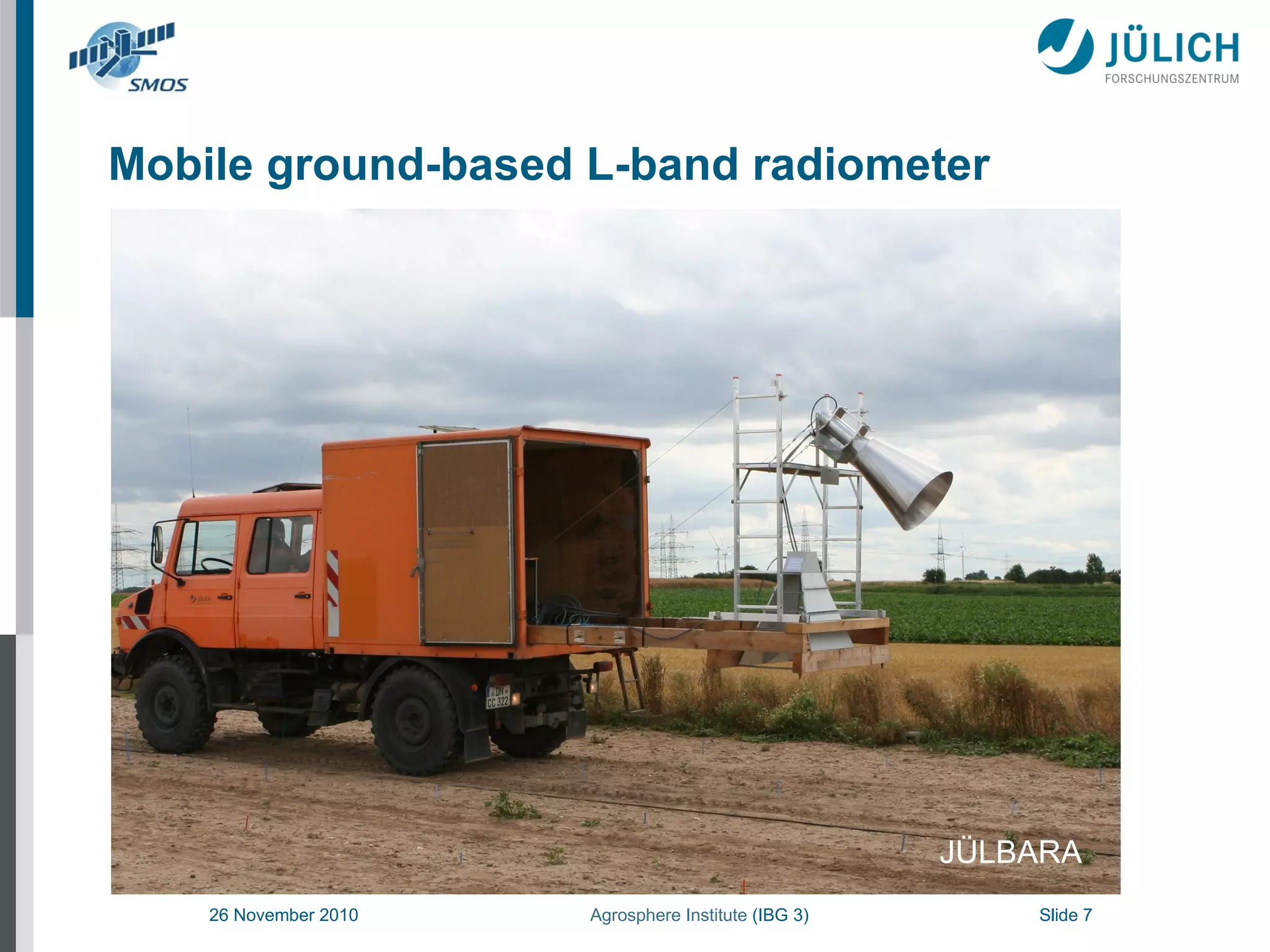
Mobile ground-based L-band radiometer JÜLBARA
Airborne measurements with the Short Skyvan of Aalto University Helsinki
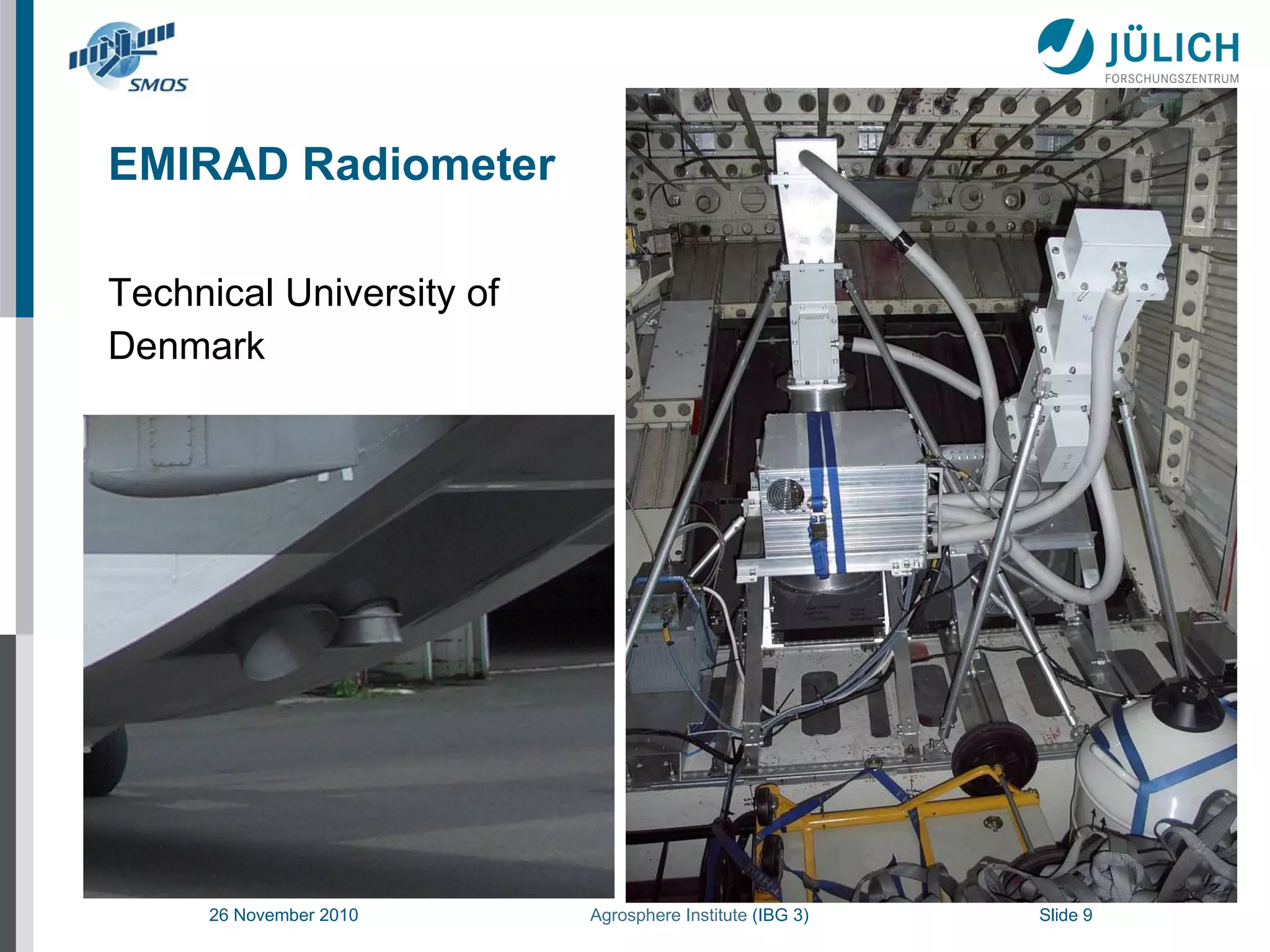
EMIRAD Radiometer Technical University of  Denmark
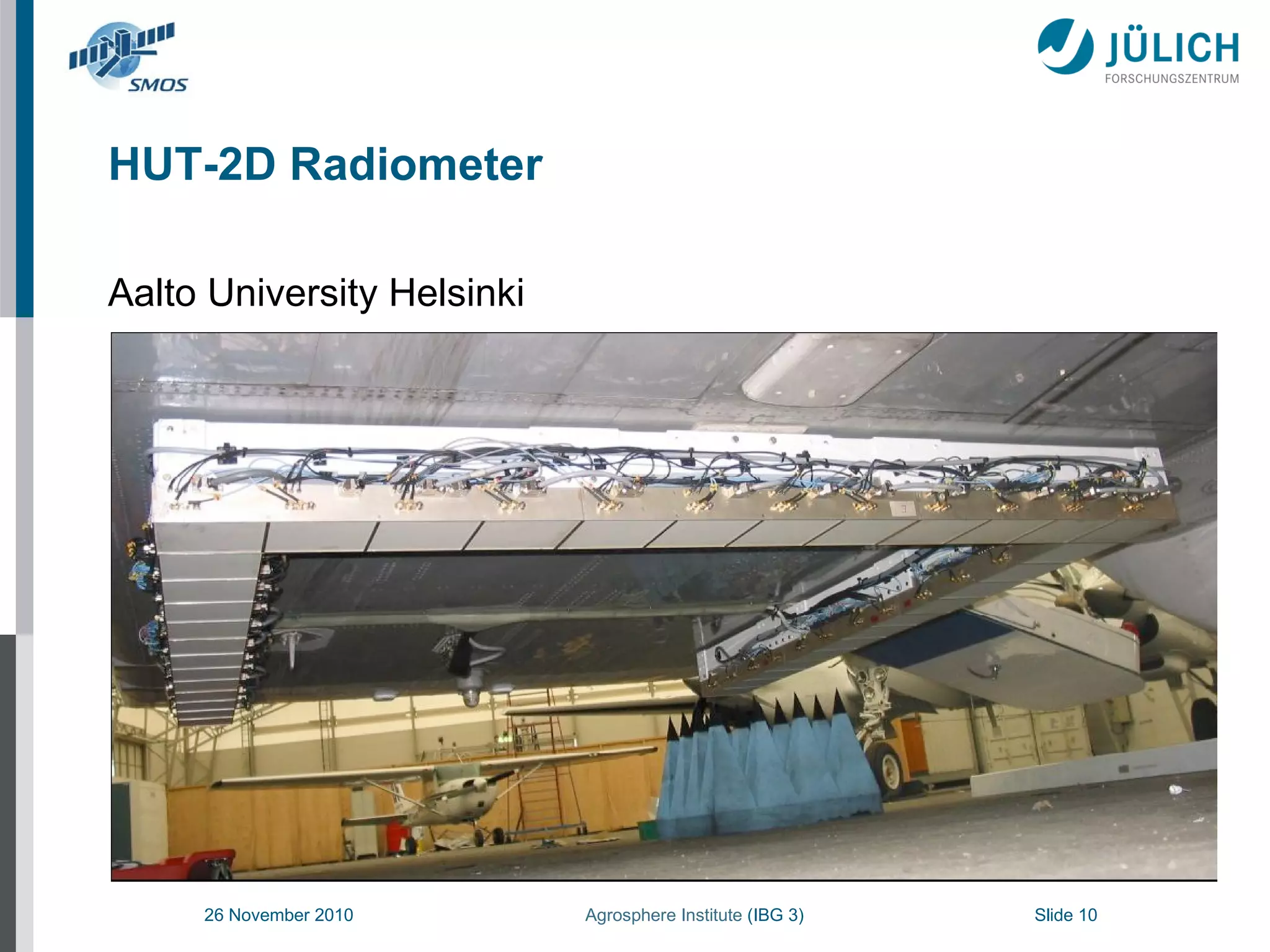
HUT-2D Radiometer Aalto University Helsinki
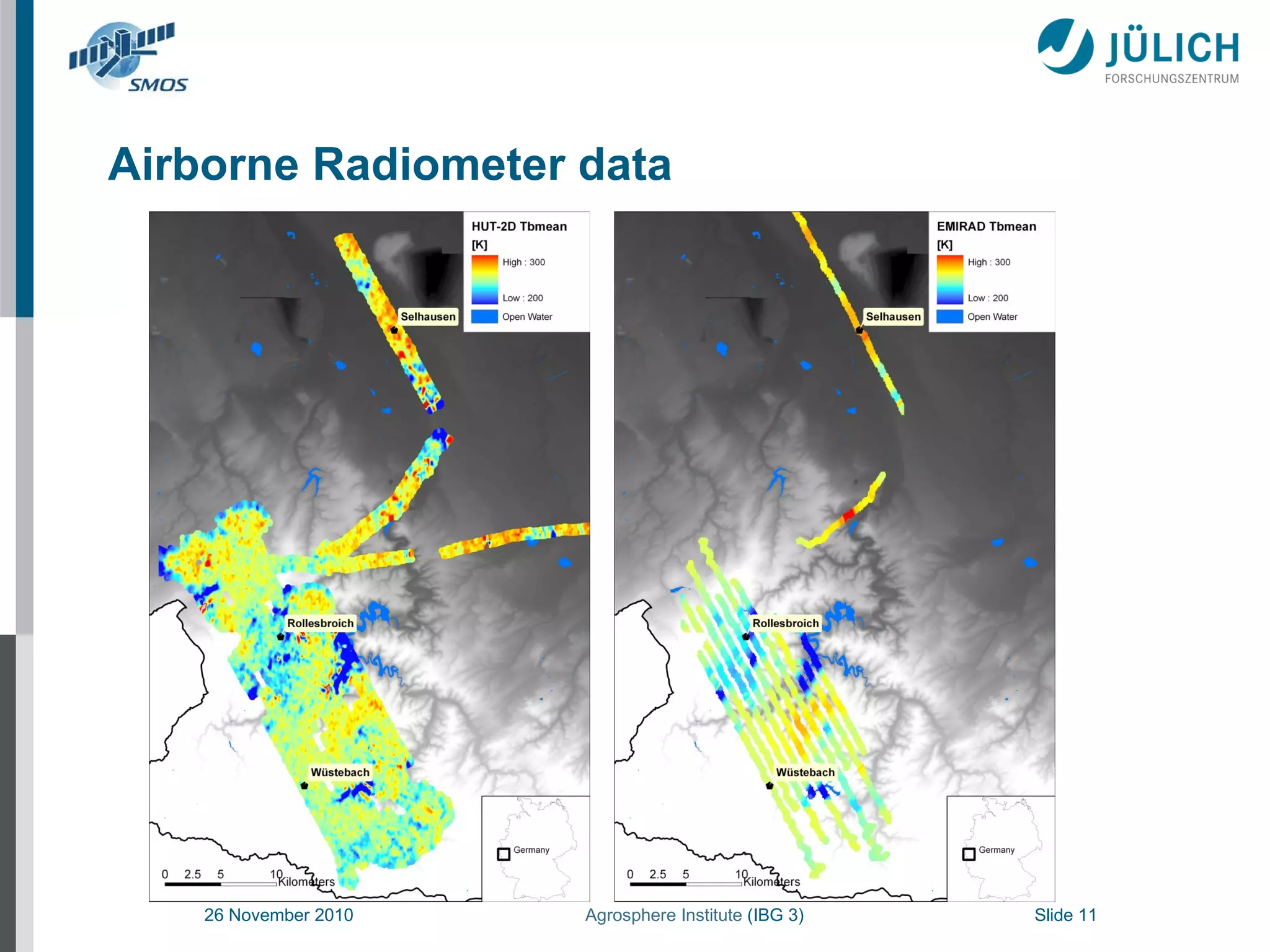
Airborne Radiometer data
RADIATIVE TRANSFER PARAMETER ESTIMATION
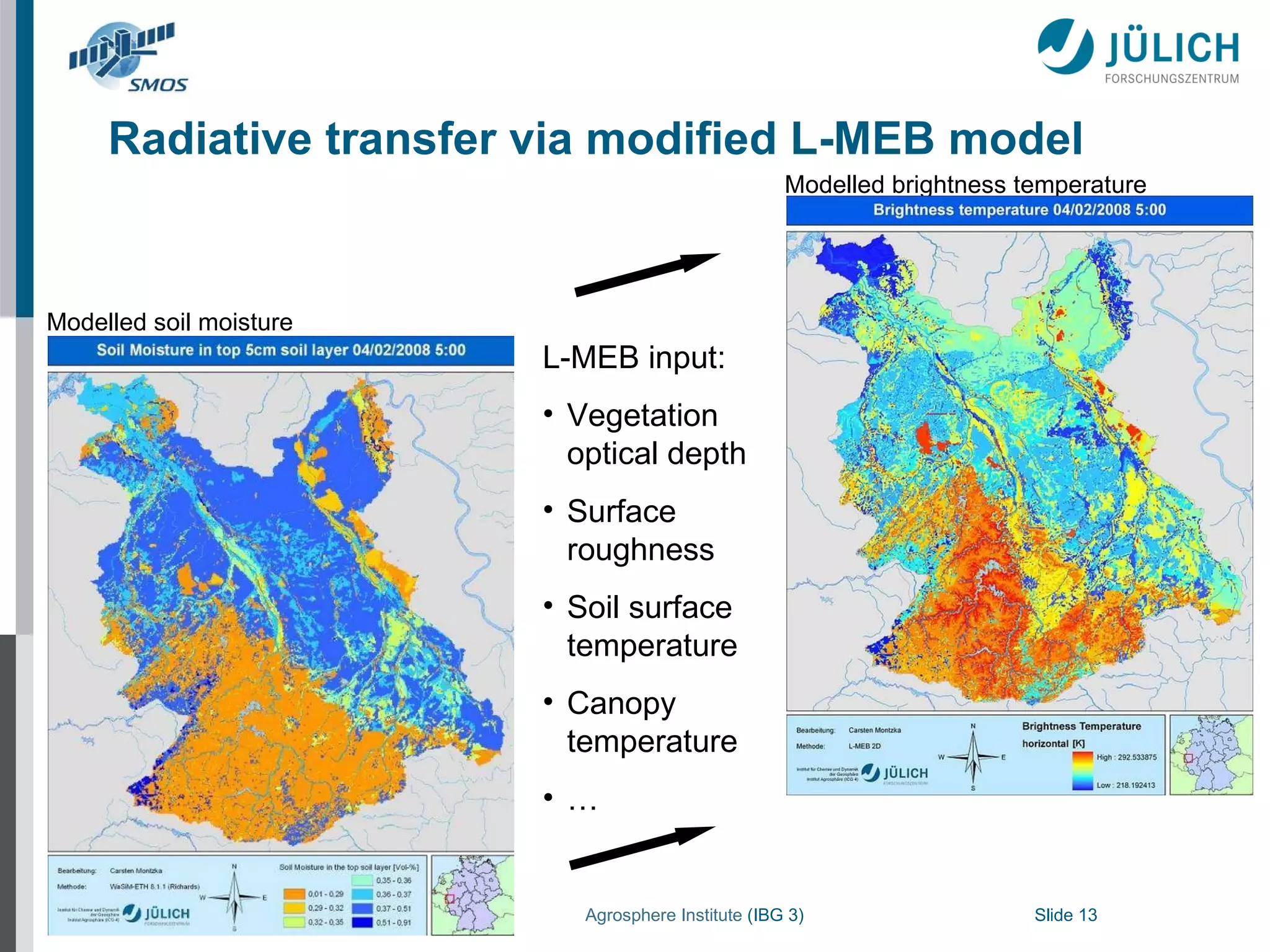
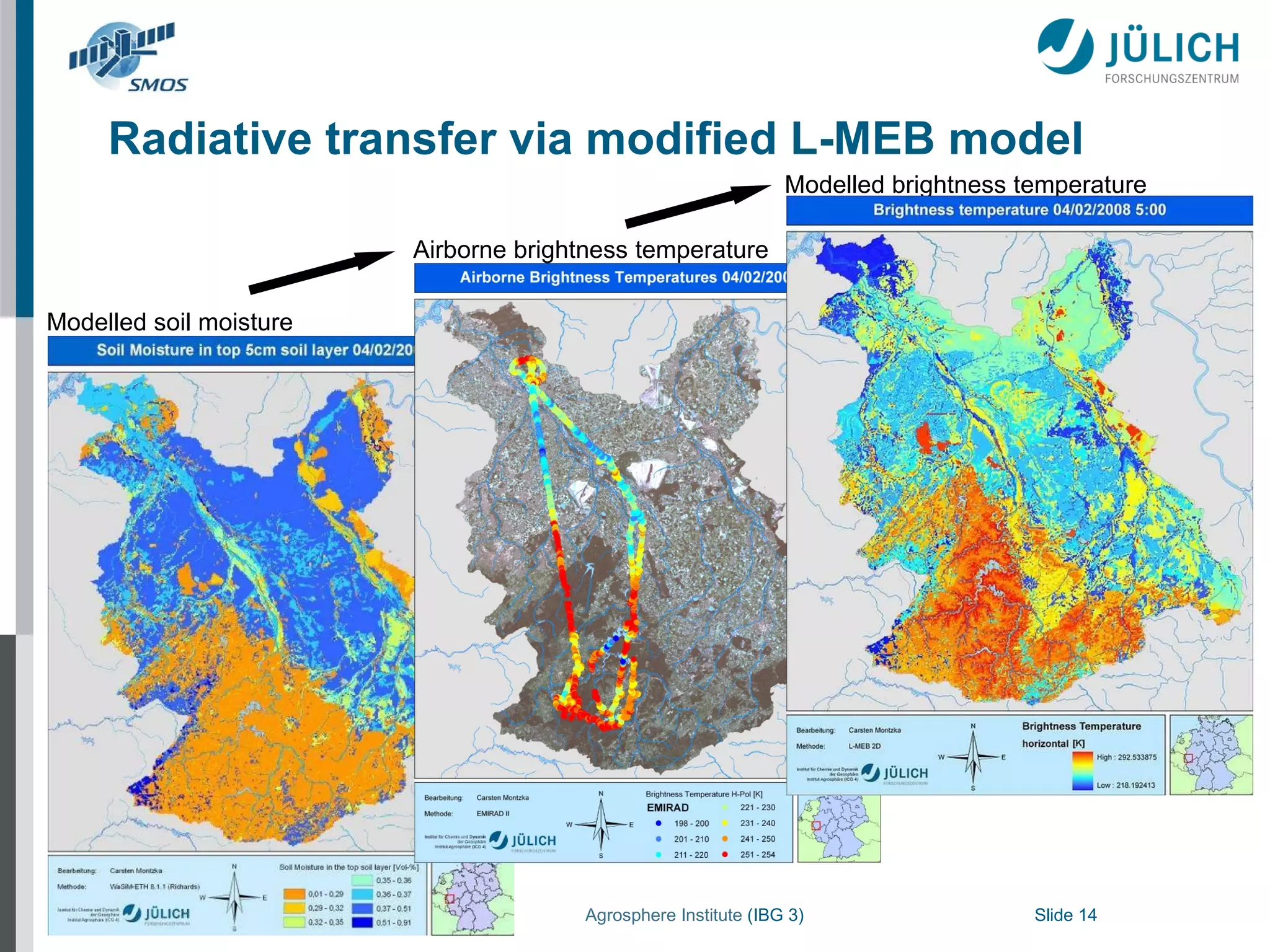
Radiative transfer via modified L-MEB model Modelled soil moisture Modelled brightness temperature L-MEB input: Vegetation optical depth Surface roughness Soil surface temperature Canopy temperature …
Radiative transfer via modified L-MEB model Modelled soil moisture Modelled brightness temperature Airborne brightness temperature
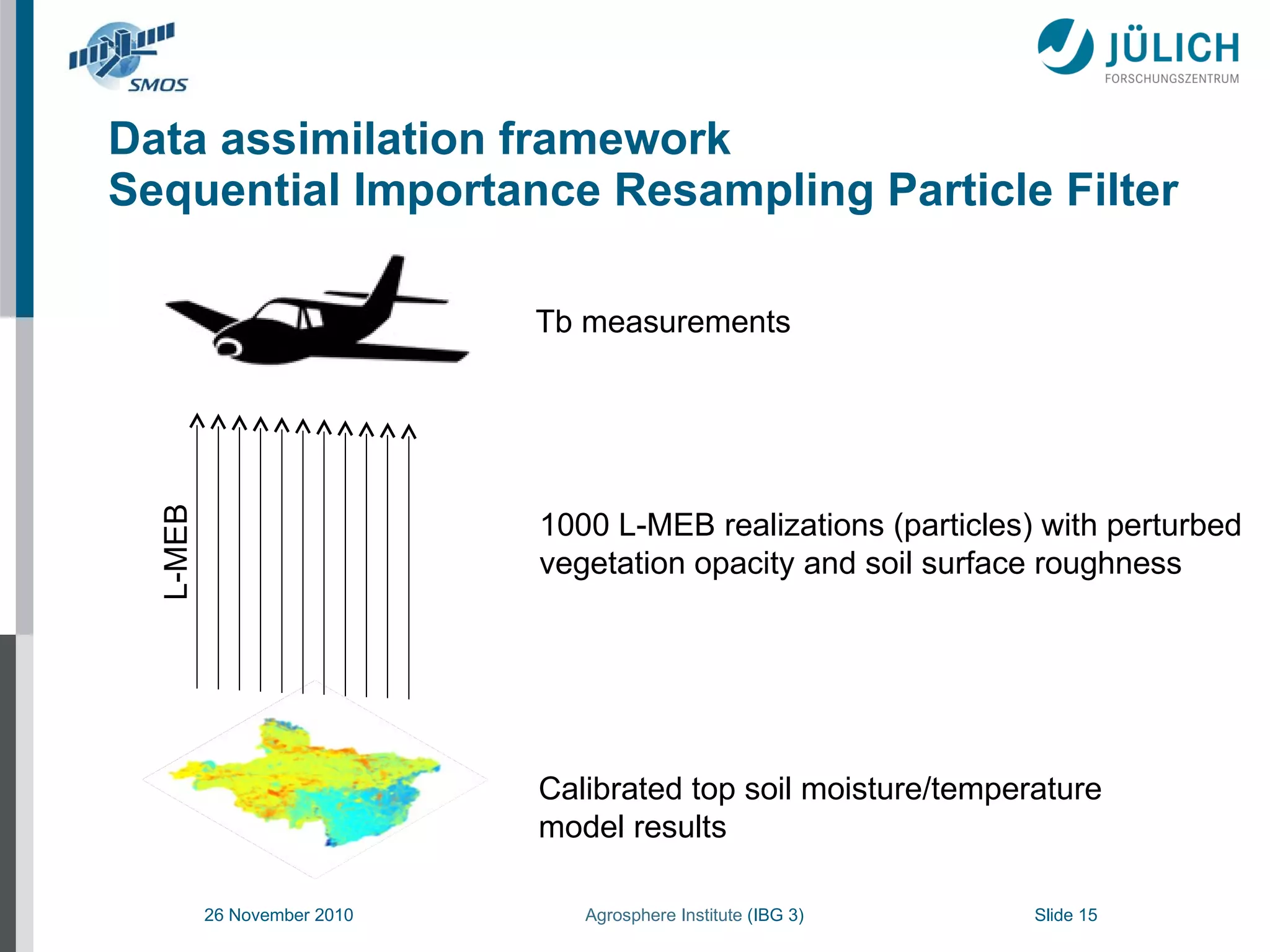
Data assimilation framework Sequential Importance Resampling Particle Filter Tb measurements Calibrated top soil moisture/temperature model results L-MEB 1000 L-MEB realizations (particles) with perturbed  vegetation opacity and soil surface roughness
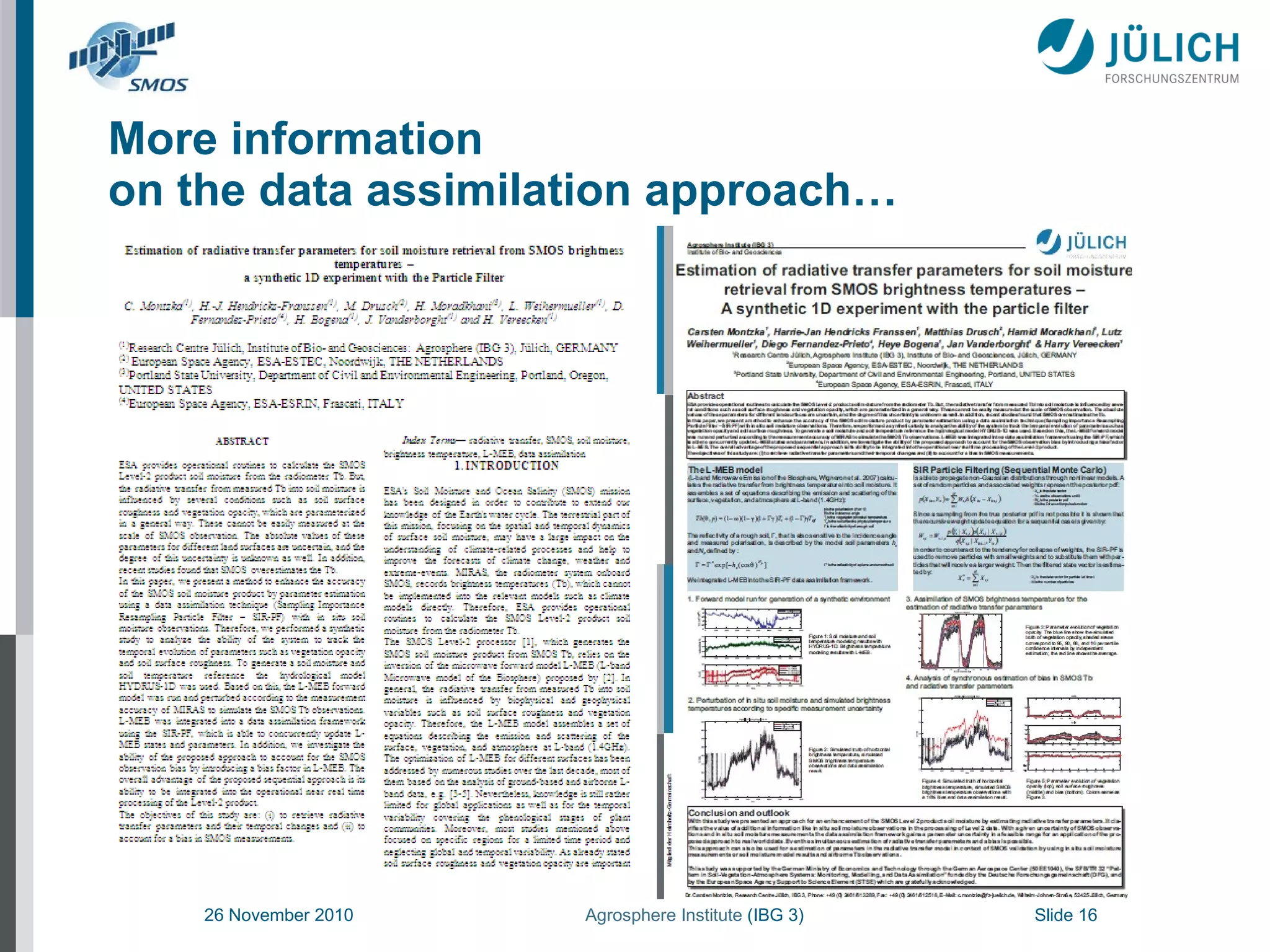
More information  on the data assimilation approach…
REFERENCE VALIDATION
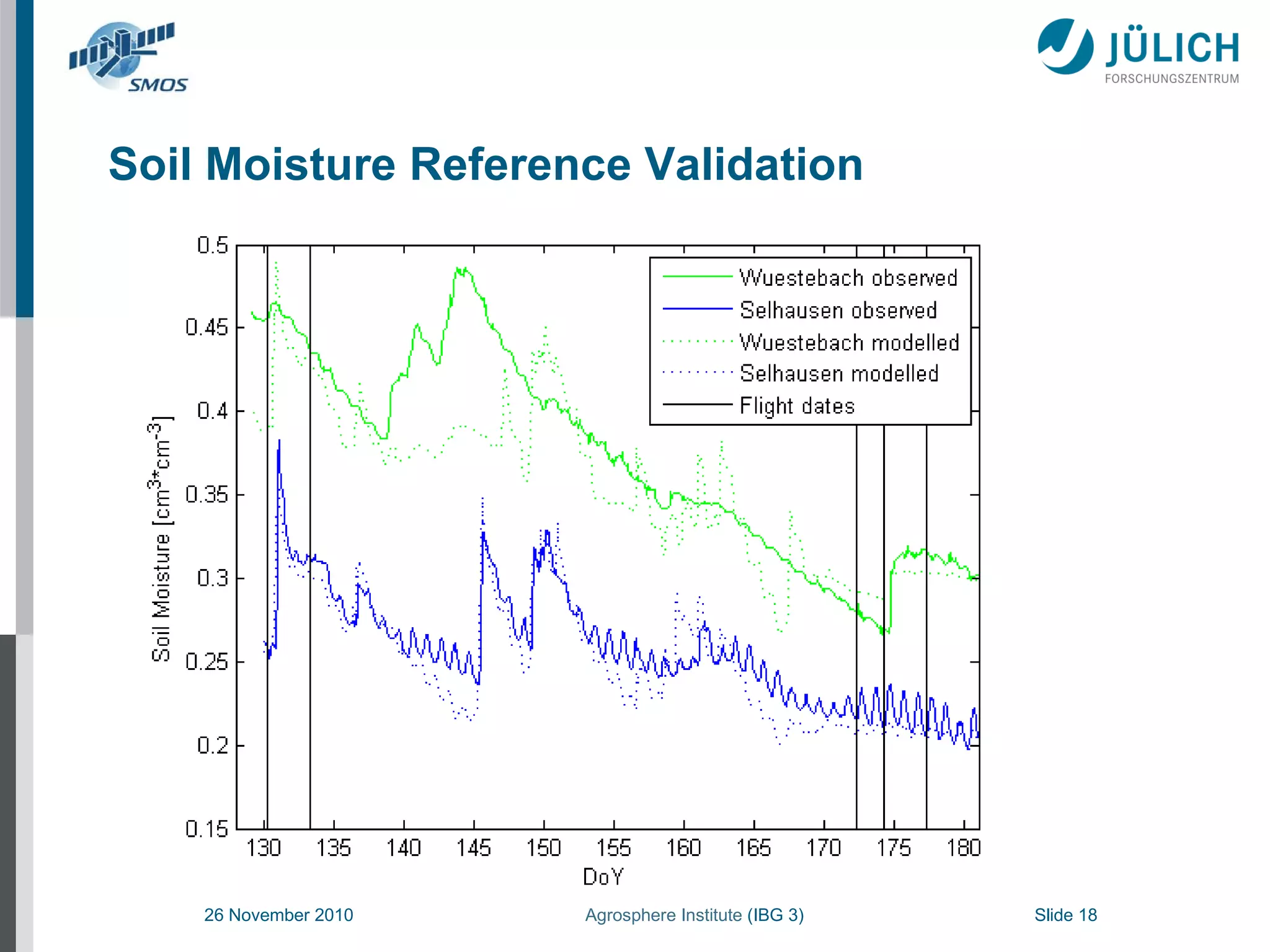
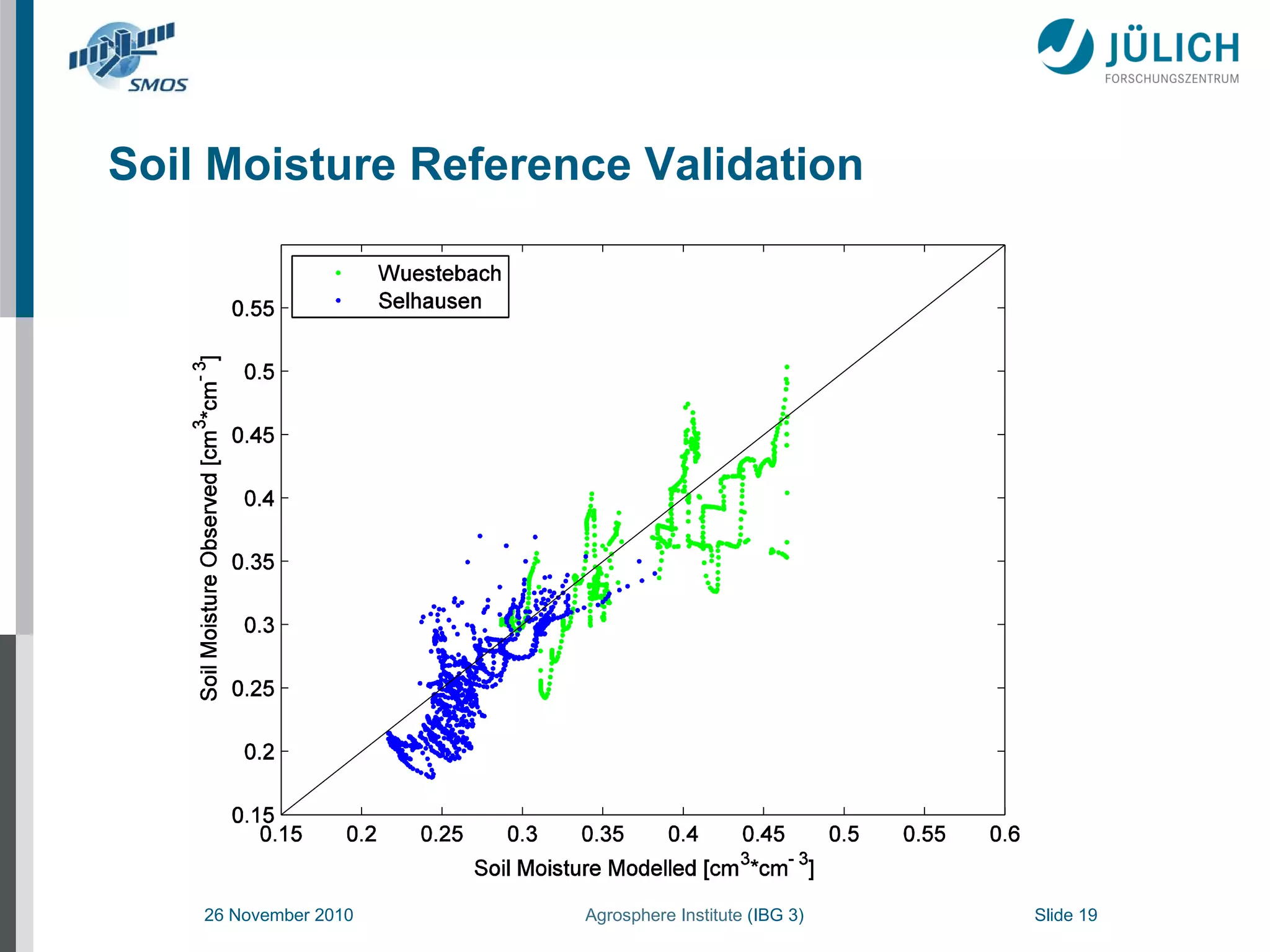
Soil Moisture Reference Validation
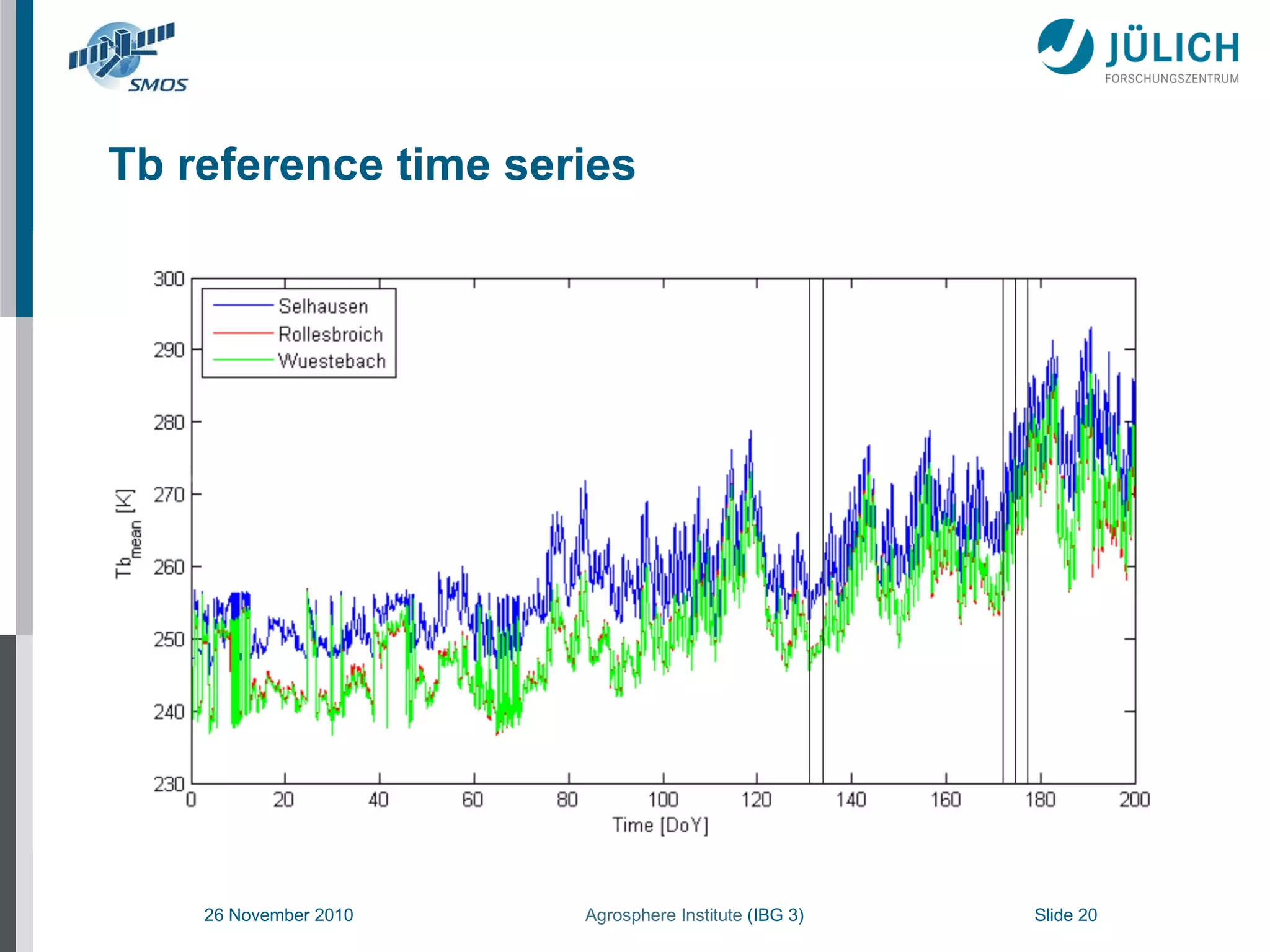
Tb reference time series
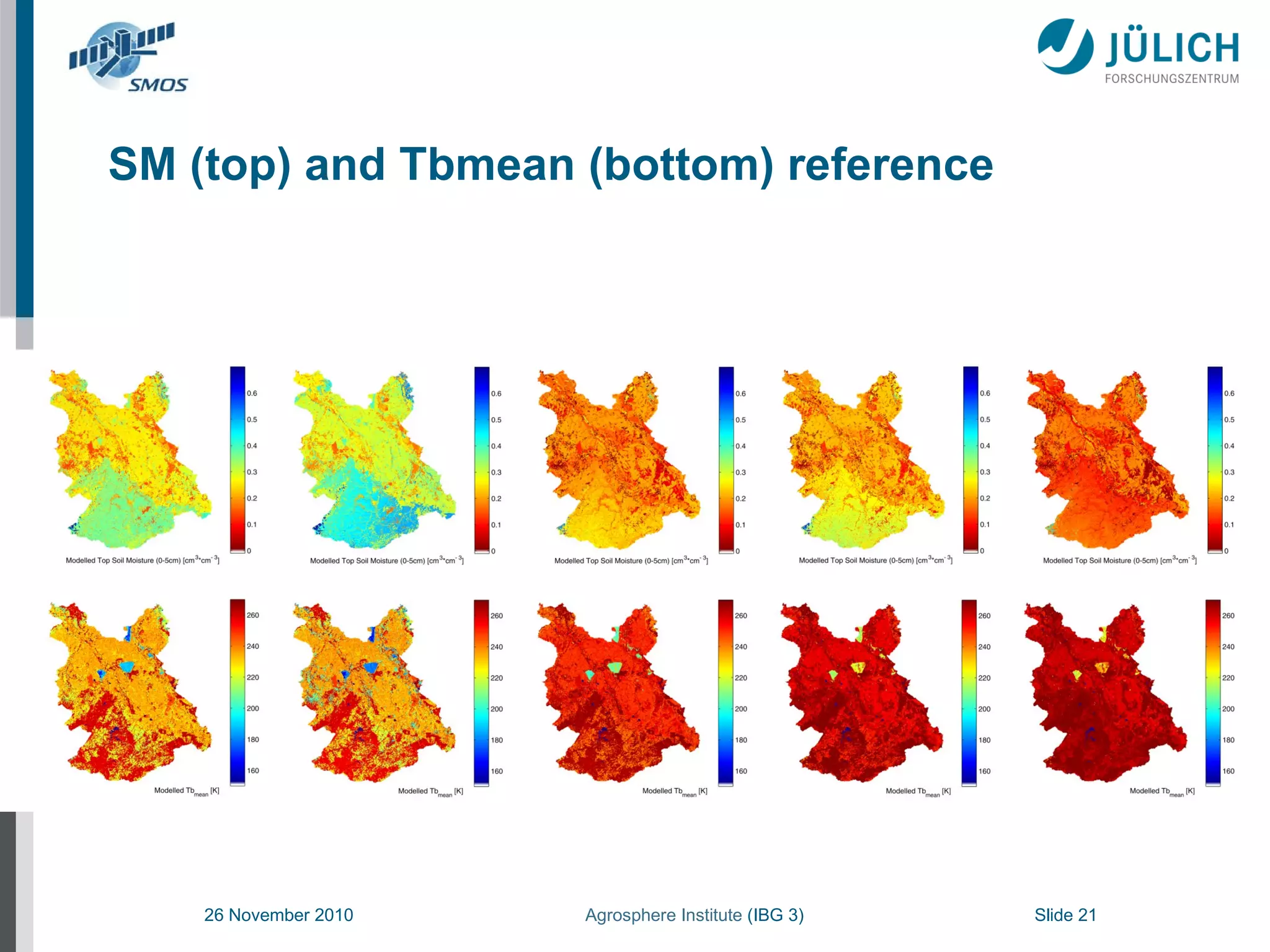
SM (top) and Tbmean (bottom) reference
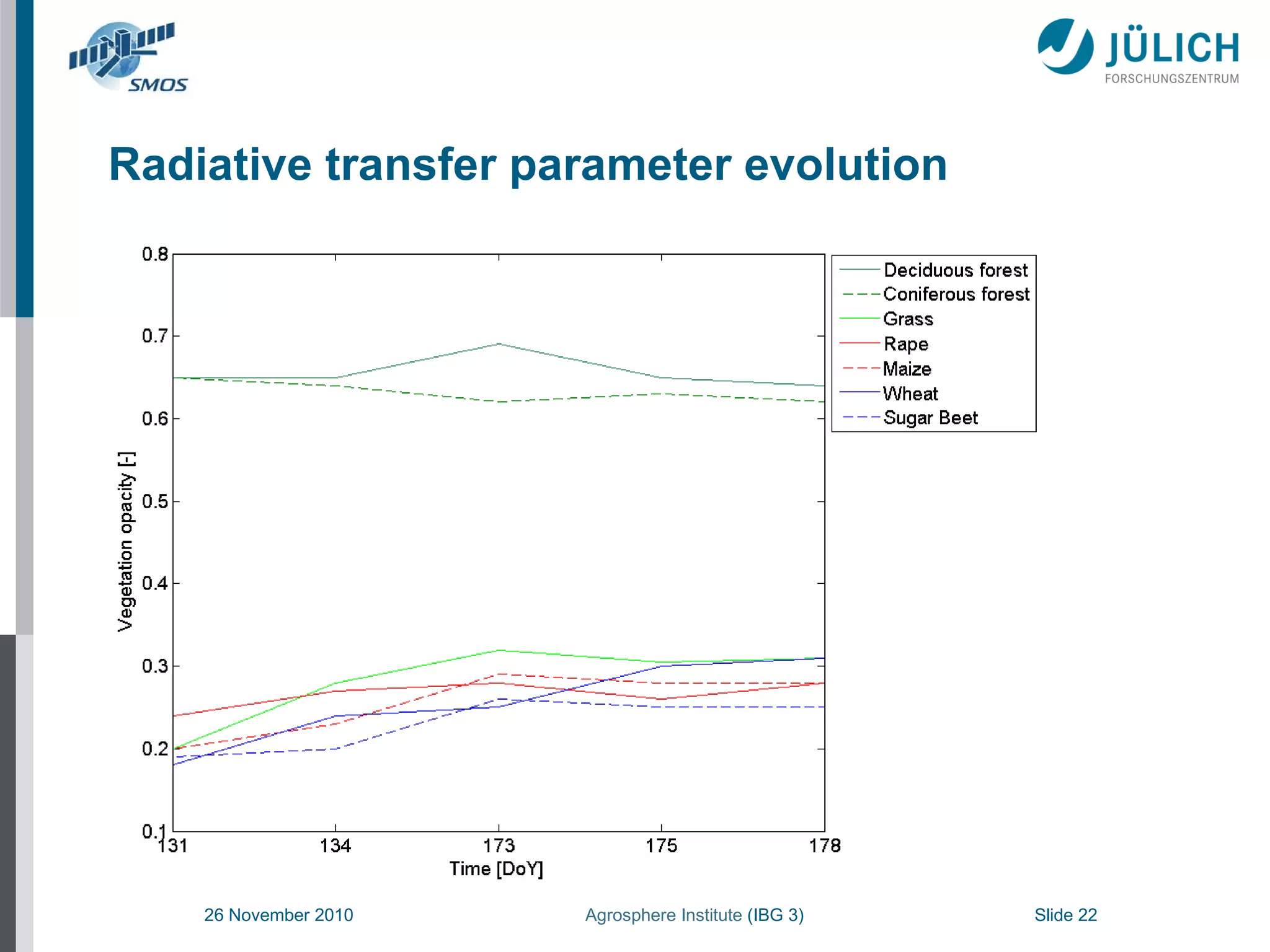
Radiative transfer parameter evolution
SMOS Validation RMSE [K] over the campaign period
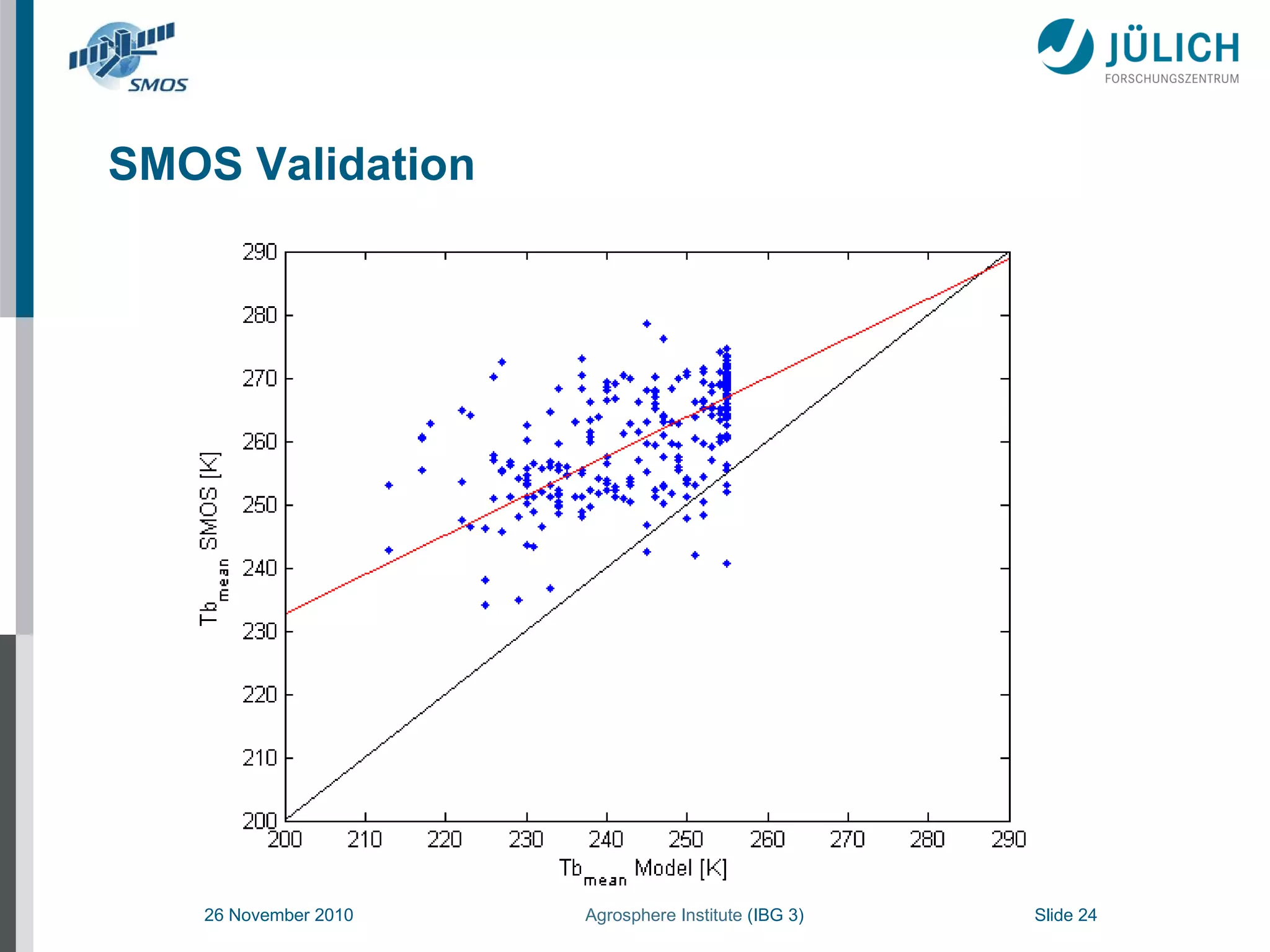
SMOS Validation
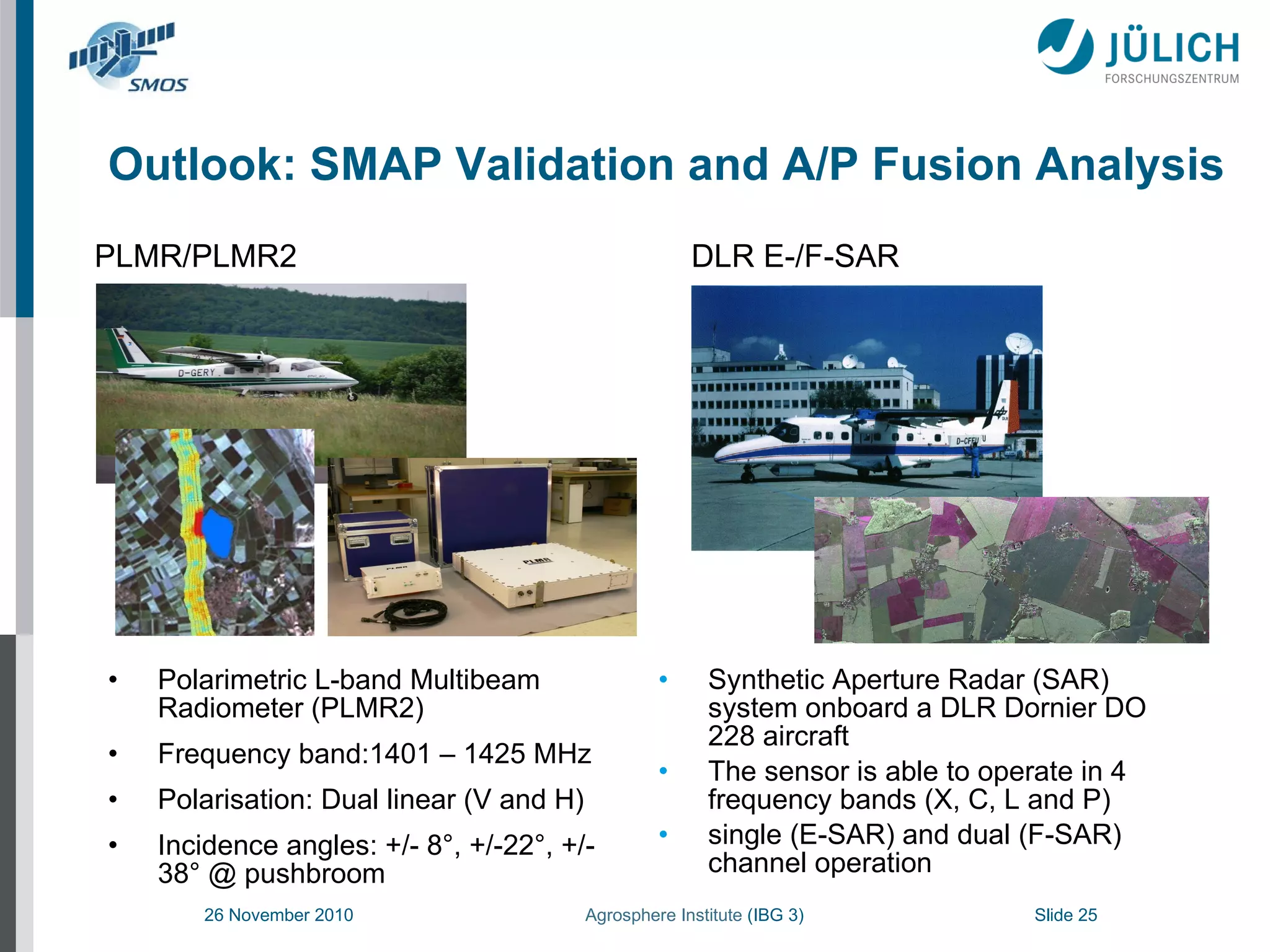
Outlook: SMAP Validation and A/P Fusion Analysis Polarimetric L-band Multibeam Radiometer (PLMR2) Frequency band:1401 – 1425 MHz Polarisation: Dual linear (V and H) Incidence angles: +/- 8°, +/-22°, +/- 38° @ pushbroom Synthetic Aperture Radar (SAR) system onboard a DLR Dornier DO 228 aircraft The sensor is able to operate in 4 frequency bands (X, C, L and P)  single (E-SAR) and dual (F-SAR) channel operation PLMR/PLMR2   DLR E-/F-SAR
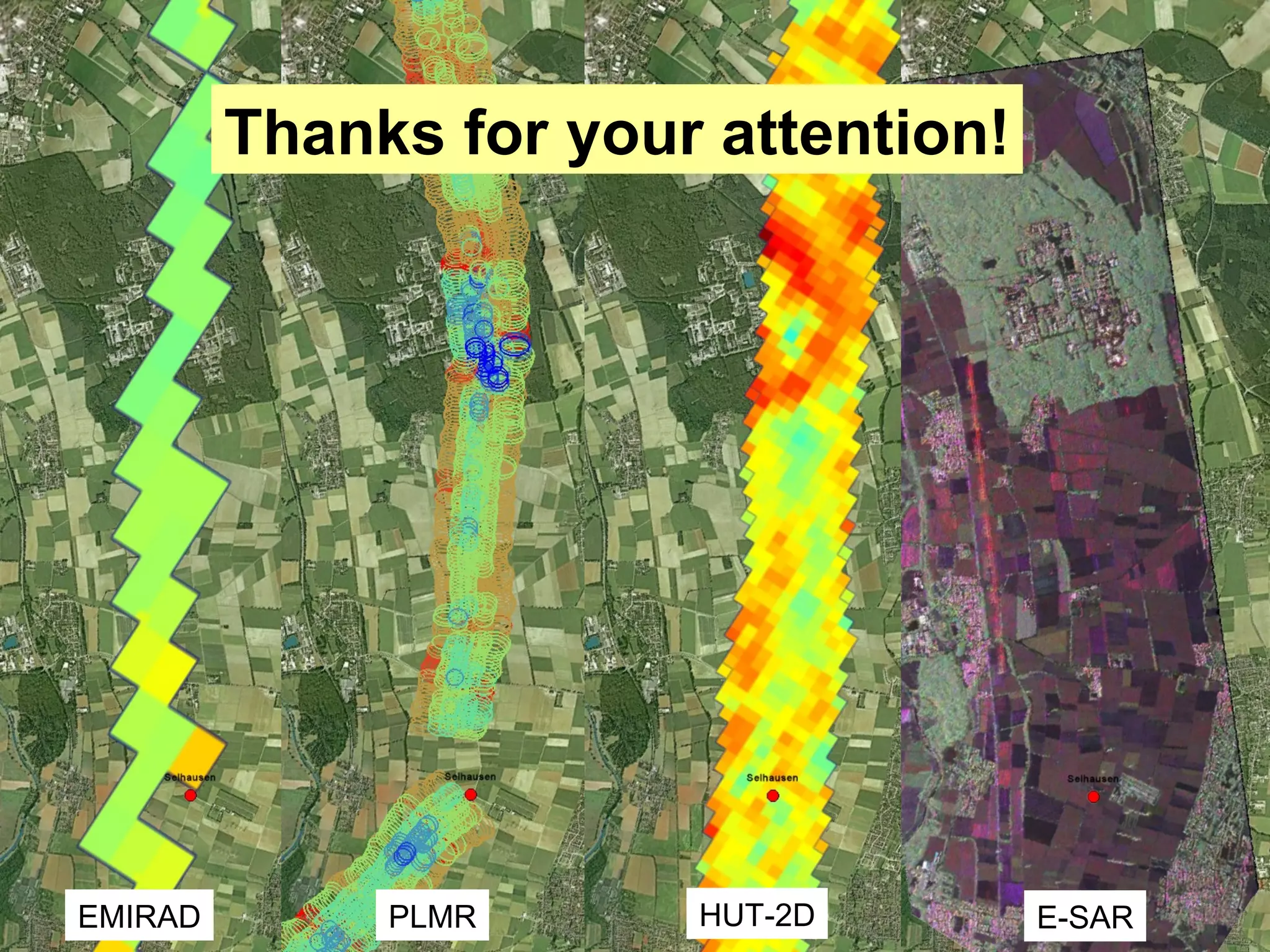
EMIRAD PLMR HUT-2D E-SAR Thanks for your attention!

Montzka SMOS Validation IGARSS 2011.ppt

  • 1.
    Carsten Montzka 1, Heye Bogena 1 , Lutz Weihermueller 1 , Francois Jonard 1 , Marin Dimitrov 1 , Catherine Bouzinac 2 , Juha Kainulainen 3 , Jan E. Balling 4 , Jan Vanderborght 1 and Harry Vereecken 1 (1)Research Centre Jülich, Agrosphere Institute (ICG 4), Leo-Brandt-Strasse, 52425 Jülich, GERMANY (2)European Space Agency, ESTEC, Noordwijk, THE NETHERLANDS (3)Helsinki University of Technology, Department of Radio Science and Engineering, Espoo, FINLAND (4)Technical University of Denmark, DTU Space, Microwaves and Remote Sensing, DENMARK Radiobrightness validation on different spatial scales during the SMOS Validation Campaign 2010 in the Rur catchment, Germany
  • 2.
  • 3.
    TERENO test sitesAgricultural test site „ Selhausen“ Forest test site “ Wüstebach” Grassland test site „ Rollesbroich“
  • 4.
  • 5.
    Instrumentation of thetest site Wüstebach
  • 6.
    Campaigns Date DoYSMOS HUT-2D/EMIRAD JÜLBARA 11.5.2010 131 7:11 6:28-6:33 5:09-8:21 14.5.2010 134 6:54 6:31-8:06 5:09-7:42 22.6.2010 173 6:36 6:57-8:38 5:16-7:55 24.6.2010 175 6:58 6:30-8:15 5:10-7:31 27.6.2010 178 6:42 6:40-8:17 -
  • 7.
    Mobile ground-based L-bandradiometer JÜLBARA
  • 8.
    Airborne measurements withthe Short Skyvan of Aalto University Helsinki
  • 9.
    EMIRAD Radiometer TechnicalUniversity of Denmark
  • 10.
    HUT-2D Radiometer AaltoUniversity Helsinki
  • 11.
  • 12.
  • 13.
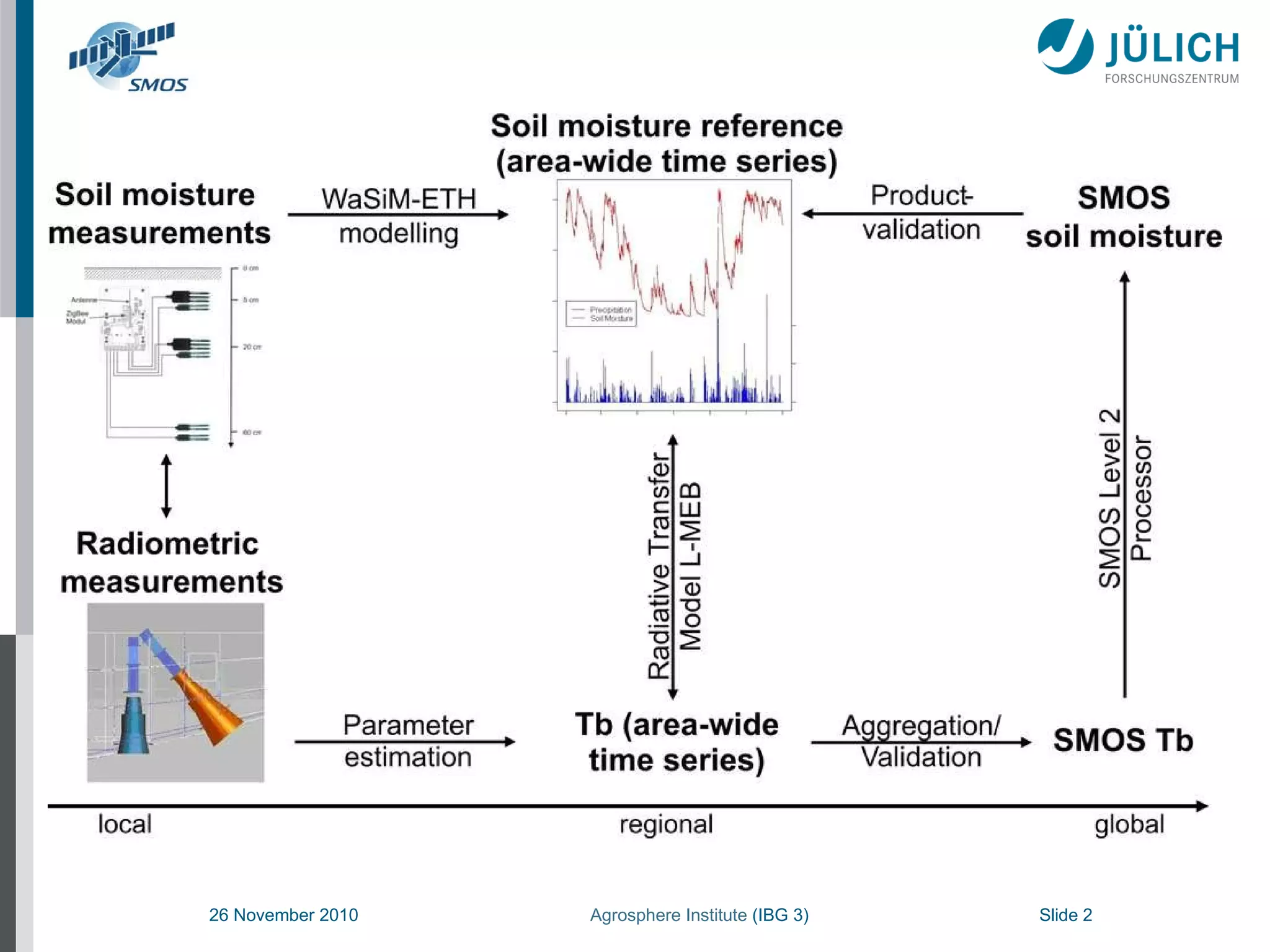
    Radiative transfer viamodified L-MEB model Modelled soil moisture Modelled brightness temperature L-MEB input: Vegetation optical depth Surface roughness Soil surface temperature Canopy temperature …
  • 14.
    Radiative transfer viamodified L-MEB model Modelled soil moisture Modelled brightness temperature Airborne brightness temperature
  • 15.
    Data assimilation frameworkSequential Importance Resampling Particle Filter Tb measurements Calibrated top soil moisture/temperature model results L-MEB 1000 L-MEB realizations (particles) with perturbed vegetation opacity and soil surface roughness
  • 16.
    More information on the data assimilation approach…
  • 17.
  • 18.
  • 19.
  • 20.
  • 21.
    SM (top) andTbmean (bottom) reference
  • 22.
  • 23.
    SMOS Validation RMSE[K] over the campaign period
  • 24.
  • 25.
    Outlook: SMAP Validationand A/P Fusion Analysis Polarimetric L-band Multibeam Radiometer (PLMR2) Frequency band:1401 – 1425 MHz Polarisation: Dual linear (V and H) Incidence angles: +/- 8°, +/-22°, +/- 38° @ pushbroom Synthetic Aperture Radar (SAR) system onboard a DLR Dornier DO 228 aircraft The sensor is able to operate in 4 frequency bands (X, C, L and P) single (E-SAR) and dual (F-SAR) channel operation PLMR/PLMR2 DLR E-/F-SAR
  • 26.
    EMIRAD PLMR HUT-2DE-SAR Thanks for your attention!

Editor's Notes

  • #6 Wireless soil moisture sensor network (SoilNet) in a forest stand with 150 nodes (ca. 900 sensors) Installation is ongoing also for a grassland stand with 150 nodes
  • #26 Campaign data from 27th May 2008 Simultaneous flight of PLMR and E-SAR Campaign ongoing now and at the end of May with PLMR2 and F-SAR PLMR2 is owned by the Agrosphere Institute