ICCC MRV-Cluster Activities on Methodology Development 
Dadang Hilman 
ICCC Coffee Morning Meeting, Apr 15th, 2014 
www.iccc-network.net
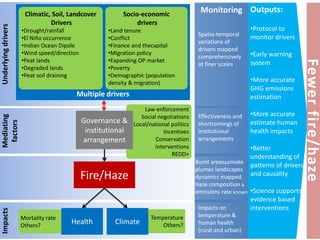
Monitoring 
Underlying drivers 
Mediating factors 
Impacts 
Fire/Haze 
Multiple drivers 
Law enforcement 
Social negotiations 
Local/national politics 
Incentives 
Conservation interventions 
REDD+ 
Governance & institutional arrangement 
Effectiveness and shortcomings of institutional arrangements 
Impacts on temperature & human health (rural and urban) 
Outputs: 
•Protocol to monitor drivers 
•Early warning system 
•More accurate GHG emissions estimation 
•More accurate estimate human health impacts 
•Better understanding of patterns of drivers and causality 
•Science supports evidence based interventions 
Fewer fire/haze 
Burnt areas&smoke plumes landscapes dynamics mapped. 
Haze composition & emissions rate known 
Socio-economic drivers 
•Land tenure 
•Conflict 
•Finance and thecapital 
•Migration policy 
•Expanding OP market 
•Poverty 
•Demographic (population density & migration) 
Climatic, Soil, Landcover Drivers 
•Drought/rainfall 
•El Niño occurrence 
•Indian Ocean Dipole 
•Wind speed/direction 
•Peat lands 
•Degraded lands 
•Peat soil draining 
Mortality rate Others? 
Temperature 
Others? 
Health 
Climate 
Spatio-temporal 
variations of drivers mapped comprehensively at finer scales
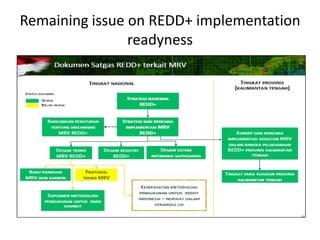
Remaining issue on REDD+ implementation readyness
PERPRES 61 / 2011 
RAN-GRK 
PERPRES 71 / 2011 
INVENT GRK 
KONTRIBUSI EMISI (SNC) 
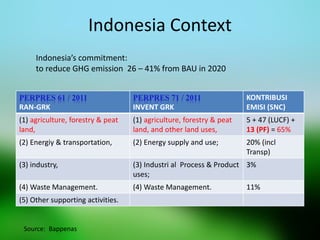
(1) agriculture, forestry & peat land, 
(1) agriculture, forestry & peat land, and other land uses, 
5 + 47 (LUCF) + 13 (PF) = 65% 
(2) Energiy & transportation, 
(2) Energy supply and use; 
20% (incl Transp) 
(3) industry, 
(3) Industri al Process & Product uses; 
3% 
(4) Waste Management. 
11% 
(5) Other supporting activities. 
Indonesia Context 
Indonesia’s commitment: to reduce GHG emission 26 – 41% from BAU in 2020 
Source: Bappenas
Various PL Data 
Source 
Peat land area 
(M ha) 
Polak (1952) 
16.35 
Nugroho et al (1992) 
15.43 
Rieley et al (1996) 
20 
Puslitbangtanak (1997) 
16.27 
Subagyo et al (2000) 
14.89 
Wetland International (2004; 2005) 
20.60 
BBSDLP (2011) 
14.91 
Source: Nursyamsi and Maswar (2013) modified
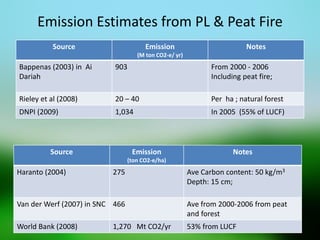
Emission Estimates from PL & Peat Fire 
Source 
Emission 
(M ton CO2-e/ yr) 
Notes 
Bappenas (2003) in Ai Dariah 
903 
From 2000 - 2006 
Including peat fire; 
Rieley et al (2008) 
20 – 40 
Per ha ; natural forest 
DNPI (2009) 
1,034 
In 2005 (55% of LUCF) 
Source 
Emission 
(ton CO2-e/ha) 
Notes 
Haranto (2004) 
275 
Ave Carbon content: 50 kg/m3 
Depth: 15 cm; 
Van der Werf (2007) in SNC 
466 
Ave from 2000-2006 from peat and forest 
World Bank (2008) 
1,270 Mt CO2/yr 
53% from LUCF
ICCC MRV Cluster On-going Activities 
I.Methodology Development For Estimating GHGs Emissions From Peatfire 
II.ICCC – LAPAN - NOAA - NGDC (National Geophysical Data Center)’s ‘Estimating Peatland Fire Emissions Using Nighttime Satellite Data’ 
III.Training workshop on Application of IPCC methodology on GHG emission estimation for peat fire from recently burned area in Riau
The Challenges of Peatland Burning 
•Peatland burning often presents a mixture of flaming and smoldering phases within a single VIIRS. 600 K is considered the break point between flaming (above 600 K) and smoldering (below 600 K). 
•Emissions are distinctly different for flaming versus smoldering peatland fires. 
•Satellite detection works well for detection of flaming peatland fires. 
•Detection and characterization of smoldering peatland fires from satellites is challenging: 
–Much of the burning is underground – while satellites observe the surface. 
–Detection of low temperature sources requires large source areas to yield sufficient infrared emissions. 
–Many satellite fire detection algorithms rely on a background radiance subtraction derived from analysis of pixels surrounding suspected fire pixels. Undetected smoldering fires can corrupt the background radiance subtraction.
Why Nighttime Satellite Data? 
•Smoldering peatland fires go on day and night for extended periods. 
•The flaming phase of burning is common in the day, but subsides at night. 
•The infrared emissions from the flaming phase can easily overwhelm the signal from smoldering in pixels with both. 
•Therefore night is a better time to observe smoldering. 
•In addition, daytime imaging bands can be used for multispectral detection and Planck curve fitting.
Nightfire hot pixel detections for June 19, 2013 
Detections are color coded based on temperature. 
Hot gas flares are red and yellow. Fires are cooler colors. Sizes are set based on radiant heat of the source. Full set of detections are in the csv file. KMZ has local maxima.
Project II: Estimating peatland fire emissions using nighttime satellite data 
•Phase 1 is retrospective, focused on 2013 burning in Sumatra (Riau). To be completed by June 2014. 
•Phase 2 is focused on the 2014 burn season.
Project II: Objectives 
•To modify an existing fire emission model to accept the enhanced information content of the Nightfire product (temperature, source area, radiant heat). Phase 1. 
•To validate Nightfire detections through comparison with other satellite fire products and a combination of high resolution satellite data and field surveys. Phase 1 and 2. 
•To evaluate the utility of nighttime Landsat data for peatland fire detection and characterization. Phase 2. 
•To produce an authoritative set of emission estimates (trace gases and particulates) for the 2013 Sumatra fires based on VIIRS Nightfire (VNF) data. Phase 1. 
•To expand the emission modeling to all or Indonesia for the 2014 burn season. Phase 2.
Proj II: two primary tasks: 
a)explore the detection and characterization of peatland fires in Indonesia with nighttime satellite data collected by VIIRS and Landsat 8; 
b)modify an existing atmospheric emission model to make use of the VIIRS temperature and source size estimates.
FINN Fire Emission Model 
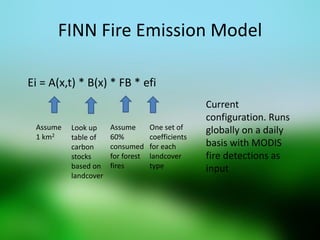
Ei = A(x,t) * B(x) * FB * efi 
Assume 
1 km2 
Look up table of carbon stocks based on landcover 
Assume 60% consumed for forest fires 
One set of coefficients for each landcover type 
Current configuration. Runs globally on a daily basis with MODIS fire detections as input
(Temporary) Findings 
•Riau had 91% of the fire detections and 97% of the burn area. 
•82% of the fires in Riau were on areas mapped as peatlands. The total area of burning detected by VNF for Riau was 13.3 km2
Thank you

ICCC MRV Cluster Activities on Methodology Development

  • 1.
    ICCC MRV-Cluster Activitieson Methodology Development Dadang Hilman ICCC Coffee Morning Meeting, Apr 15th, 2014 www.iccc-network.net
  • 2.
    Monitoring Underlying drivers Mediating factors Impacts Fire/Haze Multiple drivers Law enforcement Social negotiations Local/national politics Incentives Conservation interventions REDD+ Governance & institutional arrangement Effectiveness and shortcomings of institutional arrangements Impacts on temperature & human health (rural and urban) Outputs: •Protocol to monitor drivers •Early warning system •More accurate GHG emissions estimation •More accurate estimate human health impacts •Better understanding of patterns of drivers and causality •Science supports evidence based interventions Fewer fire/haze Burnt areas&smoke plumes landscapes dynamics mapped. Haze composition & emissions rate known Socio-economic drivers •Land tenure •Conflict •Finance and thecapital •Migration policy •Expanding OP market •Poverty •Demographic (population density & migration) Climatic, Soil, Landcover Drivers •Drought/rainfall •El Niño occurrence •Indian Ocean Dipole •Wind speed/direction •Peat lands •Degraded lands •Peat soil draining Mortality rate Others? Temperature Others? Health Climate Spatio-temporal variations of drivers mapped comprehensively at finer scales
  • 3.
    Remaining issue onREDD+ implementation readyness
  • 4.
    PERPRES 61 /2011 RAN-GRK PERPRES 71 / 2011 INVENT GRK KONTRIBUSI EMISI (SNC) (1) agriculture, forestry & peat land, (1) agriculture, forestry & peat land, and other land uses, 5 + 47 (LUCF) + 13 (PF) = 65% (2) Energiy & transportation, (2) Energy supply and use; 20% (incl Transp) (3) industry, (3) Industri al Process & Product uses; 3% (4) Waste Management. (4) Waste Management. 11% (5) Other supporting activities. Indonesia Context Indonesia’s commitment: to reduce GHG emission 26 – 41% from BAU in 2020 Source: Bappenas
  • 5.
    Various PL Data Source Peat land area (M ha) Polak (1952) 16.35 Nugroho et al (1992) 15.43 Rieley et al (1996) 20 Puslitbangtanak (1997) 16.27 Subagyo et al (2000) 14.89 Wetland International (2004; 2005) 20.60 BBSDLP (2011) 14.91 Source: Nursyamsi and Maswar (2013) modified
  • 6.
    Emission Estimates fromPL & Peat Fire Source Emission (M ton CO2-e/ yr) Notes Bappenas (2003) in Ai Dariah 903 From 2000 - 2006 Including peat fire; Rieley et al (2008) 20 – 40 Per ha ; natural forest DNPI (2009) 1,034 In 2005 (55% of LUCF) Source Emission (ton CO2-e/ha) Notes Haranto (2004) 275 Ave Carbon content: 50 kg/m3 Depth: 15 cm; Van der Werf (2007) in SNC 466 Ave from 2000-2006 from peat and forest World Bank (2008) 1,270 Mt CO2/yr 53% from LUCF
  • 7.
    ICCC MRV ClusterOn-going Activities I.Methodology Development For Estimating GHGs Emissions From Peatfire II.ICCC – LAPAN - NOAA - NGDC (National Geophysical Data Center)’s ‘Estimating Peatland Fire Emissions Using Nighttime Satellite Data’ III.Training workshop on Application of IPCC methodology on GHG emission estimation for peat fire from recently burned area in Riau
  • 8.
    The Challenges ofPeatland Burning •Peatland burning often presents a mixture of flaming and smoldering phases within a single VIIRS. 600 K is considered the break point between flaming (above 600 K) and smoldering (below 600 K). •Emissions are distinctly different for flaming versus smoldering peatland fires. •Satellite detection works well for detection of flaming peatland fires. •Detection and characterization of smoldering peatland fires from satellites is challenging: –Much of the burning is underground – while satellites observe the surface. –Detection of low temperature sources requires large source areas to yield sufficient infrared emissions. –Many satellite fire detection algorithms rely on a background radiance subtraction derived from analysis of pixels surrounding suspected fire pixels. Undetected smoldering fires can corrupt the background radiance subtraction.
  • 9.
    Why Nighttime SatelliteData? •Smoldering peatland fires go on day and night for extended periods. •The flaming phase of burning is common in the day, but subsides at night. •The infrared emissions from the flaming phase can easily overwhelm the signal from smoldering in pixels with both. •Therefore night is a better time to observe smoldering. •In addition, daytime imaging bands can be used for multispectral detection and Planck curve fitting.
  • 10.
    Nightfire hot pixeldetections for June 19, 2013 Detections are color coded based on temperature. Hot gas flares are red and yellow. Fires are cooler colors. Sizes are set based on radiant heat of the source. Full set of detections are in the csv file. KMZ has local maxima.
  • 11.
    Project II: Estimatingpeatland fire emissions using nighttime satellite data •Phase 1 is retrospective, focused on 2013 burning in Sumatra (Riau). To be completed by June 2014. •Phase 2 is focused on the 2014 burn season.
  • 12.
    Project II: Objectives •To modify an existing fire emission model to accept the enhanced information content of the Nightfire product (temperature, source area, radiant heat). Phase 1. •To validate Nightfire detections through comparison with other satellite fire products and a combination of high resolution satellite data and field surveys. Phase 1 and 2. •To evaluate the utility of nighttime Landsat data for peatland fire detection and characterization. Phase 2. •To produce an authoritative set of emission estimates (trace gases and particulates) for the 2013 Sumatra fires based on VIIRS Nightfire (VNF) data. Phase 1. •To expand the emission modeling to all or Indonesia for the 2014 burn season. Phase 2.
  • 13.
    Proj II: twoprimary tasks: a)explore the detection and characterization of peatland fires in Indonesia with nighttime satellite data collected by VIIRS and Landsat 8; b)modify an existing atmospheric emission model to make use of the VIIRS temperature and source size estimates.
  • 14.
    FINN Fire EmissionModel Ei = A(x,t) * B(x) * FB * efi Assume 1 km2 Look up table of carbon stocks based on landcover Assume 60% consumed for forest fires One set of coefficients for each landcover type Current configuration. Runs globally on a daily basis with MODIS fire detections as input
  • 15.
    (Temporary) Findings •Riauhad 91% of the fire detections and 97% of the burn area. •82% of the fires in Riau were on areas mapped as peatlands. The total area of burning detected by VNF for Riau was 13.3 km2
  • 16.