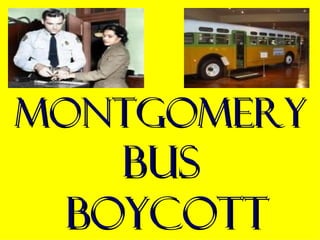
Montgomery
   bus
 Boycott
Struggle continues
• Just because the Brown v.
  Board of Education case
  had been won did not
  mean that African-
  Americans got equality
  immediately.
Struggle continues
• In August, 1955, an
  African-American boy
  was killed for talking to a
  white woman.
Struggle continues
• When the jury found his
  killer innocent, a number
  of protests broke out in
  many southern cities.
Bus Ride
• In December, 1955, a
  seamstress named Rosa
  Parks was heading home
  from a day of work to her
  home in Montgomery,
  Alabama.
  Alabama
Bus Ride
• Because the buses of
  Montgomery were
  segregated she took a seat in
  the rear of the bus in the
  section that was supposed to
  be for African-Americans.
Bus Ride
• When a white man got on
  the bus, the driver, who had
  police power to do so,
  ordered Parks to get up
  from her seat so the white
  man could sit there.
Bus Ride
• She refused and was
  arrested for not giving
  up her seat.
Bus Ride
• Almost immediately,
  throughout Montgomery,
  African-Americans began
  to talk to one another
  about what their response
  to this should be.
Bus Ride
• They decided that the best
  way to handle it was to
  boycott, or refuse, to ride
  the public bus lines,
  choosing instead to walk
  to work or take taxis.
Bus Ride
• This decision meant a heavy
  financial loss for the city’s
  bus system and, a year later,
  led to the Supreme Court of
  the United States stating that
  Alabama’s segregation laws
  were unconstitutional.
Bus Ride
• One of the leaders of this
  movement was the Reverend
  Martin Luther King, Jr., who
  quickly now became a leader
  for change in the African-
  American community.

Montgomery bus boycott

  • 1.
    Montgomery bus Boycott
  • 2.
    Struggle continues • Justbecause the Brown v. Board of Education case had been won did not mean that African- Americans got equality immediately.
  • 3.
    Struggle continues • InAugust, 1955, an African-American boy was killed for talking to a white woman.
  • 4.
    Struggle continues • Whenthe jury found his killer innocent, a number of protests broke out in many southern cities.
  • 5.
    Bus Ride • InDecember, 1955, a seamstress named Rosa Parks was heading home from a day of work to her home in Montgomery, Alabama. Alabama
  • 6.
    Bus Ride • Becausethe buses of Montgomery were segregated she took a seat in the rear of the bus in the section that was supposed to be for African-Americans.
  • 7.
    Bus Ride • Whena white man got on the bus, the driver, who had police power to do so, ordered Parks to get up from her seat so the white man could sit there.
  • 8.
    Bus Ride • Sherefused and was arrested for not giving up her seat.
  • 9.
    Bus Ride • Almostimmediately, throughout Montgomery, African-Americans began to talk to one another about what their response to this should be.
  • 10.
    Bus Ride • Theydecided that the best way to handle it was to boycott, or refuse, to ride the public bus lines, choosing instead to walk to work or take taxis.
  • 11.
    Bus Ride • Thisdecision meant a heavy financial loss for the city’s bus system and, a year later, led to the Supreme Court of the United States stating that Alabama’s segregation laws were unconstitutional.
  • 12.
    Bus Ride • Oneof the leaders of this movement was the Reverend Martin Luther King, Jr., who quickly now became a leader for change in the African- American community.