1. What is the relationship between state and
   federal government in the US?

2. What is the Constitution?

3. What is the role of the Supreme Court?
Using the Supreme Court against
                 discrimination.
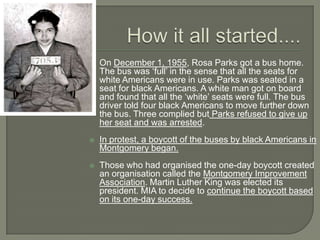
   On December 1, 1955, Rosa Parks got a bus home.
    The bus was ‘full’ in the sense that all the seats for
    white Americans were in use. Parks was seated in a
    seat for black Americans. A white man got on board
    and found that all the ‘white’ seats were full. The bus
    driver told four black Americans to move further down
    the bus. Three complied but Parks refused to give up
    her seat and was arrested.
   In protest, a boycott of the buses by black Americans in
    Montgomery began.
   Those who had organised the one-day boycott created
    an organisation called the Montgomery Improvement
    Association. Martin Luther King was elected its
    president. MIA to decide to continue the boycott based
    on its one-day success.
   City officials in Montgomery tried to undermine the boycott.
    They made it illegal for cab drivers to charge less than 45
    cents a fare. (They had been charging the equivalent of a bus
    fare which was 10 cents.)

   The white community of Montgomery also tried to undermine
    the boycott. Carpool drivers were frequently arrested for the
    most minor of traffic violations. Insurance firms withdrew their
    insurance for the vehicles. On February 21st, King along with
    88 other people were arrested for organising a boycott which
    violated an obscure law. He was ordered to pay $500 as a
    fine.

   MIA took their case to a federal court which deemed
    segregation on buses to be unconstitutional.

   The boycott ended on December 21st 1956.
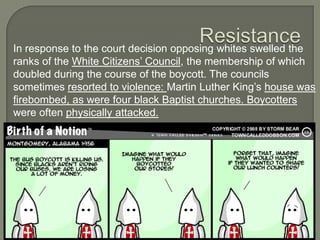
In response to the court decision opposing whites swelled the
ranks of the White Citizens’ Council, the membership of which
doubled during the course of the boycott. The councils
sometimes resorted to violence: Martin Luther King’s house was
firebombed, as were four black Baptist churches. Boycotters
were often physically attacked.
1.   What similarities can you identify between
     the Montgomery Bus Boycott and the Linda
     Brown Case?
2.   What methods were used to fight
     discrimination in this civil rights action?
3.   In your opinion what was the most important
     outcome of the Montgomery Bus Boycott?

Montgomery bus boycott

  • 1.
    1. What isthe relationship between state and federal government in the US? 2. What is the Constitution? 3. What is the role of the Supreme Court?
  • 2.
    Using the SupremeCourt against discrimination.
  • 3.
    On December 1, 1955, Rosa Parks got a bus home. The bus was ‘full’ in the sense that all the seats for white Americans were in use. Parks was seated in a seat for black Americans. A white man got on board and found that all the ‘white’ seats were full. The bus driver told four black Americans to move further down the bus. Three complied but Parks refused to give up her seat and was arrested.  In protest, a boycott of the buses by black Americans in Montgomery began.  Those who had organised the one-day boycott created an organisation called the Montgomery Improvement Association. Martin Luther King was elected its president. MIA to decide to continue the boycott based on its one-day success.
  • 4.
    City officials in Montgomery tried to undermine the boycott. They made it illegal for cab drivers to charge less than 45 cents a fare. (They had been charging the equivalent of a bus fare which was 10 cents.)  The white community of Montgomery also tried to undermine the boycott. Carpool drivers were frequently arrested for the most minor of traffic violations. Insurance firms withdrew their insurance for the vehicles. On February 21st, King along with 88 other people were arrested for organising a boycott which violated an obscure law. He was ordered to pay $500 as a fine.  MIA took their case to a federal court which deemed segregation on buses to be unconstitutional.  The boycott ended on December 21st 1956.
  • 5.
    In response tothe court decision opposing whites swelled the ranks of the White Citizens’ Council, the membership of which doubled during the course of the boycott. The councils sometimes resorted to violence: Martin Luther King’s house was firebombed, as were four black Baptist churches. Boycotters were often physically attacked.
  • 6.
    1. What similarities can you identify between the Montgomery Bus Boycott and the Linda Brown Case? 2. What methods were used to fight discrimination in this civil rights action? 3. In your opinion what was the most important outcome of the Montgomery Bus Boycott?