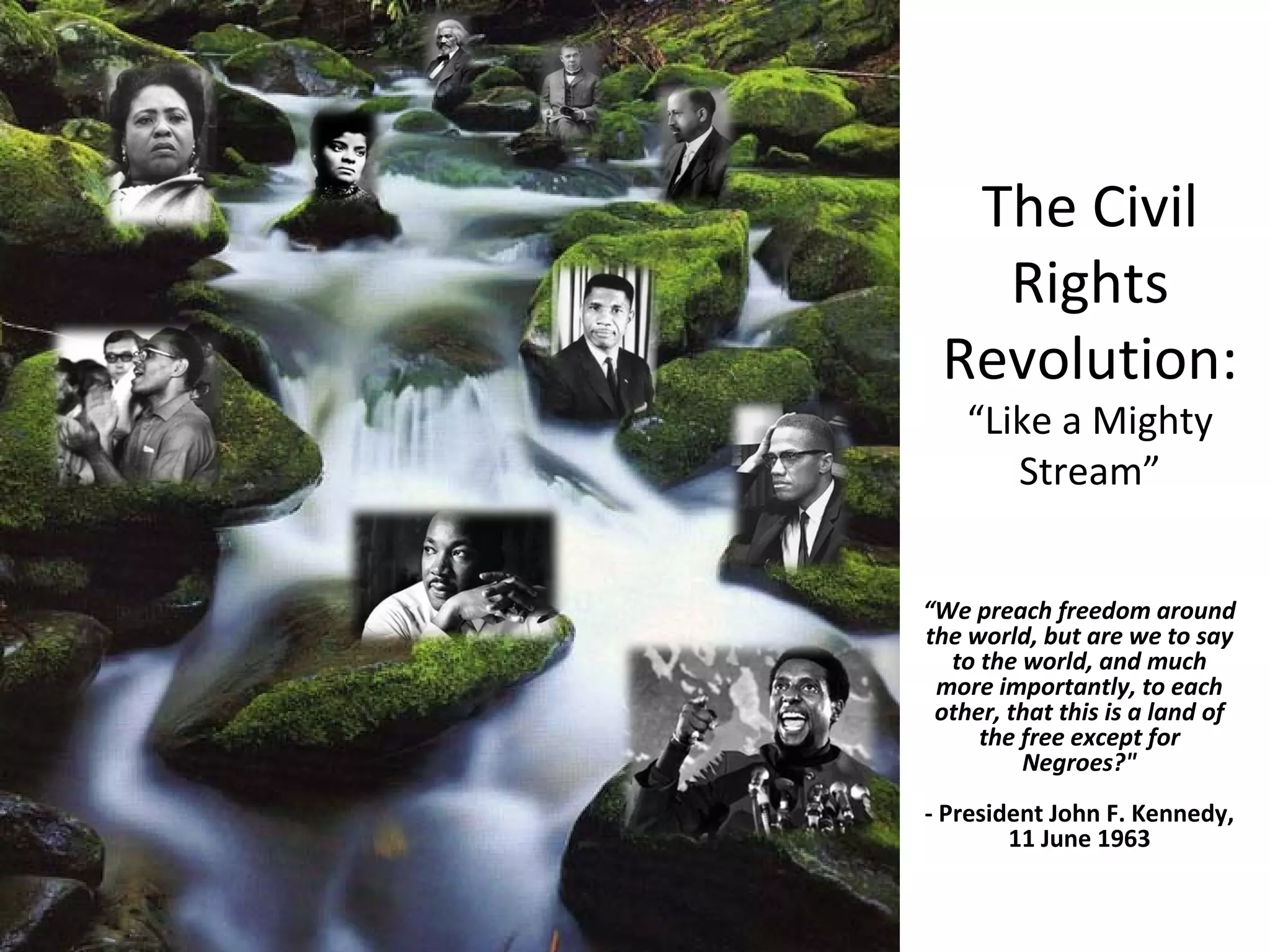
The Civil
Rights
Revolution:
“Like a Mighty
Stream”
“We preach freedom around
the world, but are we to say
to the world, and much
more importantly, to each
other, that this is a land of
the free except for
Negroes?"
- President John F. Kennedy,
11 June 1963
A Boycott in Montgomery Inspires a
Movement:
• In 1954, the Supreme
Court decision Brown v.
Board of Education
outlawed segregation in
public schools, yet
segregation continued
in much of the South
• In 1955, however, a
boycott in Montgomery,
Alabama began to shake
up the Jim Crow South
Protesting Unfair Bus Laws (1950s)
• Segregated public busses
throughout the South
required blacks to sit in the
back and give up their seat to
whites if the busses were full
• On December 1, 1955, Rosa
Parks refused to give up her
seat
• She was arrested, but shortly
after a group of African-
American ministers met to
plan a one day boycott of the
busses
Protesting Unfair Bus Laws (1950s)
• This event was so
successful, the
Montgomery
Improvement Association
(MIA) decided to extend it
• The MIA chose a 26 year-
old Baptist minister
named Martin Luther King
Jr. to lead the
Montgomery Bus Boycott
Protesting Unfair Bus Laws (1950s)
• The boycott lasted for 381
days when finally the
Supreme Court upheld an
Alabama court’s ruling that
segregation on busses was
unconstitutional (1956)
• As a result of the
Montgomery Bus Boycott,
Martin Luther King Jr.
earned a national
reputation as a civil rights
leader
African-American Churches Support
the Movement:
• The creation of the
Southern Christian
Leadership Conference
(SCLC) in 1957 played a
major role in the civil
rights movement
• Martin Luther King Jr.
was elected president
of this organization and
preached a message of
nonviolent resistance
School Desegregation:
• Little Rock Nine- a federal judge
ordered public schools in Little Rock,
Arkansas to begin desegregation
(Nine African-American students
tried to go to Central High School)
-the governor (Orval Faubus) called
out the National Guard to prevent
the students from going to school
-President Eisenhower issues
Executive Order 10730 that sent in
federal troops to maintain order and
enforce the integration of the school
School Desegregation:
• James Meredith enrolls at the
University of Mississippi
-In 1961, James Meredith applied
for admissions into the university
-the governor (Ross Barnett)
refused to allow a black student to
enroll
-secretly, President Kennedy had
worked out a deal to quietly enroll
Meredith
-the news got out and riots ensued,
Kennedy called for federal marshals
to protect Meredith
Sit-ins and Freedom Rides:
• Sit ins (Greensboro) challenged
the notion of segregated
restaurants and stores
• Student organizations such as
the Student Nonviolent
Coordinating Committee
(SNCC) called for student civil
rights activists to confront
segregation and racism in
nonviolent intercourse
• SNCC practiced civil
disobedience by breaking laws
they considered unjust
Sit-ins and Freedom Rides:
• SNCC members also participated
and planned direct action-
referring to political acts designed
to have an immediate impact
• Freedom Rides were organized by
the civil rights group Congress of
Racial Equality (CORE) to test
whether southern states were
complying with the Supreme
Court rulings
• Because of intense fire-bombings
of busses, CORE discontinued the
Freedom Rides, but SNCC still
used them
The Birmingham Campaign (1963)
• A strategic movement organized by
SCLC to bring attention to the unequal
treatment that black Americans
endured in Birmingham, Alabama.
• The campaign ran during the spring of
1963, culminating in widely publicized
confrontations between black youth
and white civic authorities
• Organizers, led by Martin Luther King,
Jr. used nonviolent direct action
tactics to defy laws they considered
unfair.
• In the early 1960s, Birmingham was
one of the most racially divided cities
in the United States
The Birmingham Campaign (1963)
• Black citizens faced legal and
economic disparities as well as violent
retribution when they attempted to
bring attention to their problems.
• Protests in Birmingham began with a
boycott to pressure business leaders
to provide employment opportunities
to people of all races, and end
segregation in public facilities,
restaurants, and stores.
• When business leaders resisted the
boycott, SCLC organizers began what
they termed Project C, a series of sit-
ins and marches intended to provoke
mass arrests.
The Birmingham Campaign (1963)
• After the campaign ran low on adult
volunteers, high school, college, and
elementary students were trained by
SCLC to participate, resulting in hundreds
of arrests and an instant intensification of
national media attention on the
campaign.
• To dissuade demonstrators and control
the protests the Birmingham Police
Department, led by Eugene "Bull"
Connor, used high-pressure water jets
and police dogs on children and
bystanders.
• Media coverage of these events brought
intense scrutiny on racial segregation in
the South.
The Birmingham Campaign (1963)
• Scenes of the ensuing mayhem caused an
international outcry, leading to federal intervention
by the Kennedy administration.
• By the end of the campaign, King's reputation surged,
Connor lost his job, the "Jim Crow" signs in
Birmingham came down, and public places became
more open to blacks.
• The Birmingham campaign was a model of direct
action protest, as it effectively shut down the city.
• By attracting media attention to the adverse
treatment of black Americans, it brought national
force to bear on the issue of segregation.
• Although desegregation occurred slowly in
Birmingham, the campaign was a major factor in the
national push towards the Civil Rights Act of 1964,
which prohibited racial discrimination in hiring
practices and public services in the United States.
Martin Luther King has a Dream
• In 1963, Martin Luther
King Jr. led a march on
Washington D.C.
• On August 8, 1963 over
250,000 people marched
on the nation’s capital
• Martin Luther King Jr.
inspires the nation with
his “I Have a Dream
Speech”
Achieving Landmark Civil Rights
Legislation:
• The Civil Rights Act of 1964 outlawed major
forms of discrimination against African
Americans and women, including racial
segregation. It ended unequal application of
voter registration requirements and racial
segregation in schools, at the workplace and by
facilities that served the general public
• The Twenty-fourth Amendment to the
Constitution prohibited poll taxes
• Freedom Summer was a campaign by CORE and
SNCC to register black voters in Mississippi
Achieving Landmark Civil Rights
Legislation:
• Selma March in 1965 was another protest to
encourage activists to continue their voter
registration campaign
• The Voting Rights Act of 1965 outlawed
discriminatory voting practices that had been
responsible for the widespread
disenfranchisement of African Americans
(literacy exams and poll taxes)

The Civil Rights Revolution

  • 1.
    The Civil Rights Revolution: “Like aMighty Stream” “We preach freedom around the world, but are we to say to the world, and much more importantly, to each other, that this is a land of the free except for Negroes?" - President John F. Kennedy, 11 June 1963
  • 2.
    A Boycott inMontgomery Inspires a Movement: • In 1954, the Supreme Court decision Brown v. Board of Education outlawed segregation in public schools, yet segregation continued in much of the South • In 1955, however, a boycott in Montgomery, Alabama began to shake up the Jim Crow South
  • 3.
    Protesting Unfair BusLaws (1950s) • Segregated public busses throughout the South required blacks to sit in the back and give up their seat to whites if the busses were full • On December 1, 1955, Rosa Parks refused to give up her seat • She was arrested, but shortly after a group of African- American ministers met to plan a one day boycott of the busses
  • 4.
    Protesting Unfair BusLaws (1950s) • This event was so successful, the Montgomery Improvement Association (MIA) decided to extend it • The MIA chose a 26 year- old Baptist minister named Martin Luther King Jr. to lead the Montgomery Bus Boycott
  • 5.
    Protesting Unfair BusLaws (1950s) • The boycott lasted for 381 days when finally the Supreme Court upheld an Alabama court’s ruling that segregation on busses was unconstitutional (1956) • As a result of the Montgomery Bus Boycott, Martin Luther King Jr. earned a national reputation as a civil rights leader
  • 6.
    African-American Churches Support theMovement: • The creation of the Southern Christian Leadership Conference (SCLC) in 1957 played a major role in the civil rights movement • Martin Luther King Jr. was elected president of this organization and preached a message of nonviolent resistance
  • 7.
    School Desegregation: • LittleRock Nine- a federal judge ordered public schools in Little Rock, Arkansas to begin desegregation (Nine African-American students tried to go to Central High School) -the governor (Orval Faubus) called out the National Guard to prevent the students from going to school -President Eisenhower issues Executive Order 10730 that sent in federal troops to maintain order and enforce the integration of the school
  • 8.
    School Desegregation: • JamesMeredith enrolls at the University of Mississippi -In 1961, James Meredith applied for admissions into the university -the governor (Ross Barnett) refused to allow a black student to enroll -secretly, President Kennedy had worked out a deal to quietly enroll Meredith -the news got out and riots ensued, Kennedy called for federal marshals to protect Meredith
  • 9.
    Sit-ins and FreedomRides: • Sit ins (Greensboro) challenged the notion of segregated restaurants and stores • Student organizations such as the Student Nonviolent Coordinating Committee (SNCC) called for student civil rights activists to confront segregation and racism in nonviolent intercourse • SNCC practiced civil disobedience by breaking laws they considered unjust
  • 10.
    Sit-ins and FreedomRides: • SNCC members also participated and planned direct action- referring to political acts designed to have an immediate impact • Freedom Rides were organized by the civil rights group Congress of Racial Equality (CORE) to test whether southern states were complying with the Supreme Court rulings • Because of intense fire-bombings of busses, CORE discontinued the Freedom Rides, but SNCC still used them
  • 11.
    The Birmingham Campaign(1963) • A strategic movement organized by SCLC to bring attention to the unequal treatment that black Americans endured in Birmingham, Alabama. • The campaign ran during the spring of 1963, culminating in widely publicized confrontations between black youth and white civic authorities • Organizers, led by Martin Luther King, Jr. used nonviolent direct action tactics to defy laws they considered unfair. • In the early 1960s, Birmingham was one of the most racially divided cities in the United States
  • 12.
    The Birmingham Campaign(1963) • Black citizens faced legal and economic disparities as well as violent retribution when they attempted to bring attention to their problems. • Protests in Birmingham began with a boycott to pressure business leaders to provide employment opportunities to people of all races, and end segregation in public facilities, restaurants, and stores. • When business leaders resisted the boycott, SCLC organizers began what they termed Project C, a series of sit- ins and marches intended to provoke mass arrests.
  • 13.
    The Birmingham Campaign(1963) • After the campaign ran low on adult volunteers, high school, college, and elementary students were trained by SCLC to participate, resulting in hundreds of arrests and an instant intensification of national media attention on the campaign. • To dissuade demonstrators and control the protests the Birmingham Police Department, led by Eugene "Bull" Connor, used high-pressure water jets and police dogs on children and bystanders. • Media coverage of these events brought intense scrutiny on racial segregation in the South.
  • 14.
    The Birmingham Campaign(1963) • Scenes of the ensuing mayhem caused an international outcry, leading to federal intervention by the Kennedy administration. • By the end of the campaign, King's reputation surged, Connor lost his job, the "Jim Crow" signs in Birmingham came down, and public places became more open to blacks. • The Birmingham campaign was a model of direct action protest, as it effectively shut down the city. • By attracting media attention to the adverse treatment of black Americans, it brought national force to bear on the issue of segregation. • Although desegregation occurred slowly in Birmingham, the campaign was a major factor in the national push towards the Civil Rights Act of 1964, which prohibited racial discrimination in hiring practices and public services in the United States.
  • 15.
    Martin Luther Kinghas a Dream • In 1963, Martin Luther King Jr. led a march on Washington D.C. • On August 8, 1963 over 250,000 people marched on the nation’s capital • Martin Luther King Jr. inspires the nation with his “I Have a Dream Speech”
  • 16.
    Achieving Landmark CivilRights Legislation: • The Civil Rights Act of 1964 outlawed major forms of discrimination against African Americans and women, including racial segregation. It ended unequal application of voter registration requirements and racial segregation in schools, at the workplace and by facilities that served the general public • The Twenty-fourth Amendment to the Constitution prohibited poll taxes • Freedom Summer was a campaign by CORE and SNCC to register black voters in Mississippi
  • 17.
    Achieving Landmark CivilRights Legislation: • Selma March in 1965 was another protest to encourage activists to continue their voter registration campaign • The Voting Rights Act of 1965 outlawed discriminatory voting practices that had been responsible for the widespread disenfranchisement of African Americans (literacy exams and poll taxes)