INTRODUCTION
• Monsoon is traditionally defined as a seasonal
reversing wind accompanied by corresponding
changes in precipitation.
• It is also described as seasonal changes in
atmospheric circulation and precipitation associated
with the asymmetric heating of land and sea.
• Usually, the term monsoon is used to refer to the
rainy phase of a seasonally changing pattern, although
technically there is also a dry phase.
• The English word monsoon came from Arabic
word mausim and Hindi word "mausam”.
• The climate of India is described as ‘monsoon’ type.
In Asia, this type of climate is found mainly in the
south and the south-east.
• Despite an overall unity in the general pattern,
there are perceptible seasonal variations in climatic
conditions within the country.
FACTORS AFFECTING MONSOON
•LATITUDE
•ALTITUDE
•PRESSURE AND WINDS-
i. Pressureand surface winds.
ii. Upperaircirculation.
iii. Western cyclonicdisturbances and tropical cyclones
LATITUDE:- Latitude is an angle (defined below)
which ranges from 0° at the Equator to 90° (North or
South) at the poles. Lines of constant latitude, or
parallels, run east-west as circles parallel to the
equator.
Latitude is used together with longitude to specify
the precise location of features on the surface of the
Earth.
ALTITUDE:- The distance measured
perpendicularly from a figure's vertex to the
opposite side of the vertex. The perpendicular height
of a triangle is known as its altitude. The angular
distance of a heavenly body above our Earth's
horizon.
PRESSURE AND WINDS:-
•Pressure is the amount of force exerted per unit of
surface area. It always decreases vertically with
height and is exerted equally in all directions.
•Wind is the perceptible natural movement of the air,
especially in the form of a current of air blowing from a
particular direction.
THE INDIAN MONSOON
• The climate of India is strongly influenced by
monsoon winds.
• The Arabs, who had also come to India as traders
named this seasonal reversal of the wind system
'monsoon'.
• The monsoon advances in the early June creating
a low-pressure condition over the Northern Plains
while during October – November, with the
apparent movement of the sun towards the south
retreats the monsoon which is marked by clear
skies and rise in temperature.
• It is accompanied by some seasonal winds such as
Loo, Mango showers, Kaal-baisakhi.
THE MONSOON SEASONS OF INDIA
The monsoon type of climate is characterized by a distinct
seasonal pattern. They are the Cold Weather season(Winter) and
The Hot Weather season(Summer).
The Cold Weather Season begins from mid-November in
northern India and stays till February. December and January are
the coldest months in the northern part of India.
Days remain warm and nights become cold. Although the total
amount of winter rainfall is locally known as ‘mahawat’ is small,
theyare of immense importance for the
cultivation of rabi crops.
THE MONSOON SEASONS OF INDIA
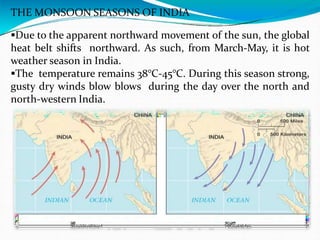
Due to the apparent northward movement of the sun, the global
heat belt shifts northward. As such, from March-May, it is hot
weather season in India.
The temperature remains 38°C-45°C. During this season strong,
gusty dry winds blow blows during the day over the north and
north-western India.
THE ADVANCING MONSOON
(THE RAINY SEASON)
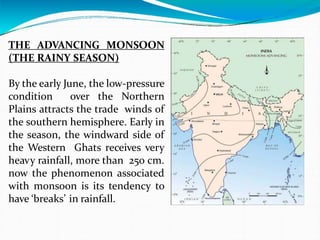
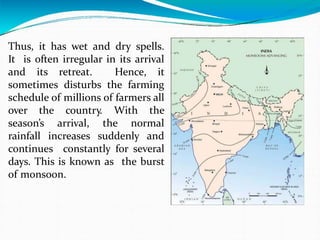
By the early June, the low-pressure
condition over the Northern
Plains attracts the trade winds of
the southern hemisphere. Early in
the season, the windward side of
the Western Ghats receives very
heavy rainfall, more than 250 cm.
now the phenomenon associated
with monsoon is its tendency to
have ‘breaks’ in rainfall.
Thus, it has wet and dry spells.
It is often irregular in its arrival
and its retreat. Hence, it
sometimes disturbs the farming
schedule of millions of farmers all
over the country. With the
season’s arrival, the normal
rainfall increases suddenly and
continues constantly for several
days. This is known as the burst
of monsoon.
THE RETREATING MONSOON
(THE TRANSITION SEASON)
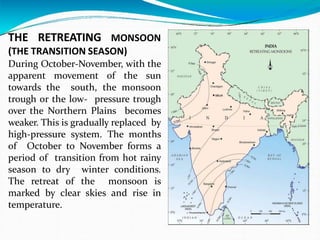
During October-November, with the
apparent movement of the sun
towards the south, the monsoon
trough or the low- pressure trough
over the Northern Plains becomes
weaker. This is gradually replaced by
high-pressure system. The months
of October to November forms a
period of transition from hot rainy
season to dry winter conditions.
The retreat of the monsoon is
marked by clear skies and rise in
temperature.
While day temperatures are
high, nights are cool and
pleasant. Owing to the
conditions of high temperature
and humidity, the weather
becomes rather oppressive
during the day. This is commonly
known as October heat.
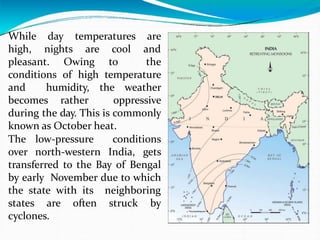
The low-pressure conditions
over north-western India, gets
transferred to the Bay of Bengal
by early November due to which
the state with its neighboring
states are often struck by
cyclones.
DISTRIBUTION OF RAINFALL
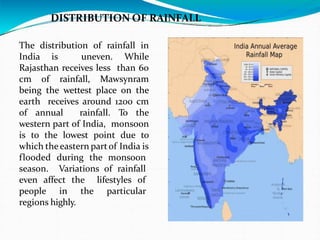
The distribution of rainfall in
India is uneven. While
Rajasthan receives less than 60
cm of rainfall, Mawsynram
being the wettest place on the
earth receives around 1200 cm
of annual rainfall. To the
western part of India, monsoon
is to the lowest point due to
which theeastern partof India is
flooded during the monsoon
season. Variations of rainfall
even affect the lifestyles of
people in the particular
regions highly.
CONCLUSION
Monsoon has always been an unifying bond for
India. The seasonal alternation of the wind systems
and the associated weather condition provide a
rhythmic cycle of seasons. The uncertainties of rain
and uneven distribution are very much typical of
the monsoons. The Indian landscape, its animal
and plant life, its entre agricultural calendar and the
life of the people including their festivities revolve
around this phenomenon. The river valleys which
carry this water also unites as a single river valley
unit.
Presentation prepared by :
Muhammad Saleem, Teacher
Government High School Chanderkote
District Ramban (J&K)

Monsoon.pptx

  • 2.
    INTRODUCTION • Monsoon istraditionally defined as a seasonal reversing wind accompanied by corresponding changes in precipitation. • It is also described as seasonal changes in atmospheric circulation and precipitation associated with the asymmetric heating of land and sea. • Usually, the term monsoon is used to refer to the rainy phase of a seasonally changing pattern, although technically there is also a dry phase.
  • 3.
    • The Englishword monsoon came from Arabic word mausim and Hindi word "mausam”. • The climate of India is described as ‘monsoon’ type. In Asia, this type of climate is found mainly in the south and the south-east. • Despite an overall unity in the general pattern, there are perceptible seasonal variations in climatic conditions within the country.
  • 4.
    FACTORS AFFECTING MONSOON •LATITUDE •ALTITUDE •PRESSUREAND WINDS- i. Pressureand surface winds. ii. Upperaircirculation. iii. Western cyclonicdisturbances and tropical cyclones
  • 5.
    LATITUDE:- Latitude isan angle (defined below) which ranges from 0° at the Equator to 90° (North or South) at the poles. Lines of constant latitude, or parallels, run east-west as circles parallel to the equator. Latitude is used together with longitude to specify the precise location of features on the surface of the Earth. ALTITUDE:- The distance measured perpendicularly from a figure's vertex to the opposite side of the vertex. The perpendicular height of a triangle is known as its altitude. The angular distance of a heavenly body above our Earth's horizon.
  • 6.
    PRESSURE AND WINDS:- •Pressureis the amount of force exerted per unit of surface area. It always decreases vertically with height and is exerted equally in all directions. •Wind is the perceptible natural movement of the air, especially in the form of a current of air blowing from a particular direction.
  • 7.
    THE INDIAN MONSOON •The climate of India is strongly influenced by monsoon winds. • The Arabs, who had also come to India as traders named this seasonal reversal of the wind system 'monsoon'. • The monsoon advances in the early June creating a low-pressure condition over the Northern Plains while during October – November, with the apparent movement of the sun towards the south retreats the monsoon which is marked by clear skies and rise in temperature. • It is accompanied by some seasonal winds such as Loo, Mango showers, Kaal-baisakhi.
  • 8.
    THE MONSOON SEASONSOF INDIA The monsoon type of climate is characterized by a distinct seasonal pattern. They are the Cold Weather season(Winter) and The Hot Weather season(Summer). The Cold Weather Season begins from mid-November in northern India and stays till February. December and January are the coldest months in the northern part of India. Days remain warm and nights become cold. Although the total amount of winter rainfall is locally known as ‘mahawat’ is small, theyare of immense importance for the cultivation of rabi crops.
  • 9.
    THE MONSOON SEASONSOF INDIA Due to the apparent northward movement of the sun, the global heat belt shifts northward. As such, from March-May, it is hot weather season in India. The temperature remains 38°C-45°C. During this season strong, gusty dry winds blow blows during the day over the north and north-western India.
  • 10.
    THE ADVANCING MONSOON (THERAINY SEASON) By the early June, the low-pressure condition over the Northern Plains attracts the trade winds of the southern hemisphere. Early in the season, the windward side of the Western Ghats receives very heavy rainfall, more than 250 cm. now the phenomenon associated with monsoon is its tendency to have ‘breaks’ in rainfall.
  • 11.
    Thus, it haswet and dry spells. It is often irregular in its arrival and its retreat. Hence, it sometimes disturbs the farming schedule of millions of farmers all over the country. With the season’s arrival, the normal rainfall increases suddenly and continues constantly for several days. This is known as the burst of monsoon.
  • 12.
    THE RETREATING MONSOON (THETRANSITION SEASON) During October-November, with the apparent movement of the sun towards the south, the monsoon trough or the low- pressure trough over the Northern Plains becomes weaker. This is gradually replaced by high-pressure system. The months of October to November forms a period of transition from hot rainy season to dry winter conditions. The retreat of the monsoon is marked by clear skies and rise in temperature.
  • 13.
    While day temperaturesare high, nights are cool and pleasant. Owing to the conditions of high temperature and humidity, the weather becomes rather oppressive during the day. This is commonly known as October heat. The low-pressure conditions over north-western India, gets transferred to the Bay of Bengal by early November due to which the state with its neighboring states are often struck by cyclones.
  • 14.
    DISTRIBUTION OF RAINFALL Thedistribution of rainfall in India is uneven. While Rajasthan receives less than 60 cm of rainfall, Mawsynram being the wettest place on the earth receives around 1200 cm of annual rainfall. To the western part of India, monsoon is to the lowest point due to which theeastern partof India is flooded during the monsoon season. Variations of rainfall even affect the lifestyles of people in the particular regions highly.
  • 15.
    CONCLUSION Monsoon has alwaysbeen an unifying bond for India. The seasonal alternation of the wind systems and the associated weather condition provide a rhythmic cycle of seasons. The uncertainties of rain and uneven distribution are very much typical of the monsoons. The Indian landscape, its animal and plant life, its entre agricultural calendar and the life of the people including their festivities revolve around this phenomenon. The river valleys which carry this water also unites as a single river valley unit.
  • 16.
    Presentation prepared by: Muhammad Saleem, Teacher Government High School Chanderkote District Ramban (J&K)