


Indian Monsoon System
Dr. Kuldip Singh Kait
Associate Professor,
Government College for Girls,
Sector-14, Gurugram
Academic Session: 2020-21
03-06-2021
Dr. Kuldip Singh Kait, Associate Professor,
Government College for Girls, Sector-14,
Gurugram 1
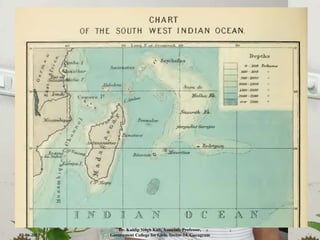
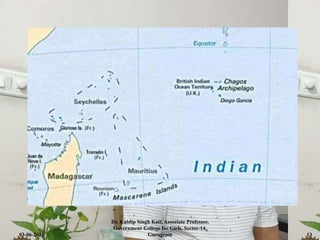
The term monsoon is derived from an ARABIC
word ‘MAUSIM' or from the ‘MONSIM’
which means season.
Monsoon refers to regional winds produced by
thermodynamics modifications in the trade
winds .
03-06-2021
Dr. Kuldip Singh Kait, Associate Professor,
Government College for Girls, Sector-14,
Gurugram 2
Monsoon can be defined as a seasonal reversal of
wind over Indian Sub-Continent due to the
apparent shift of the sun.
03-06-2021
Dr. Kuldip Singh Kait, Associate Professor,
Government College for Girls, Sector-14,
Gurugram 3
1. Thermodynamic modification of the south easterly
trades.
2. During the JULY month the frequency of wind must
increase by 40% .
3. The acceleration of wind during the monsoon month
JULY shall be more than 3m/sec.
Features
03-06-2021
Dr. Kuldip Singh Kait, Associate Professor,
Government College for Girls, Sector-14,
Gurugram 4
4. Rain bearing system .
5. Break in the monsoon .
6. Onset of the monsoon.
Features
03-06-2021
Dr. Kuldip Singh Kait, Associate Professor,
Government College for Girls, Sector-14,
Gurugram 5
Monsoon Winds
An interchange of air between land and oceans
due to the unequal heating and cooling of the
continents and oceans is known as MONSOON
WINDS.
03-06-2021
Dr. Kuldip Singh Kait, Associate Professor,
Government College for Girls, Sector-14,
Gurugram 6
Monsoon Winds
It has an annual period of occurrence :-
During summer, the land is heated very
much as compared to the oceans which
cause low pressure over the land and the
wind blow from oceans to the continents.
03-06-2021
Dr. Kuldip Singh Kait, Associate Professor,
Government College for Girls, Sector-14,
Gurugram 7
 During winters, land cool down faster than the
oceans causing high pressure over continents
and low pressure over the oceans and the wind
blow from continents to oceans.
The Indian monsoon is the best known example
of this alternating circulation system
03-06-2021
Dr. Kuldip Singh Kait, Associate Professor,
Government College for Girls, Sector-14,
Gurugram 8
 There are two types of monsoons over India
that is
1. South-West Monsoon and
2. North-East Monsoon.
03-06-2021
Dr. Kuldip Singh Kait, Associate Professor,
Government College for Girls, Sector-14,
Gurugram 9
South-West Monsoon Winds
It originates at 10 degree south near MASCARNES
high pressure east of Madagascar by the
convergence of south easterly trades with the out
flow of MASCARNES.
The convergent air is directed towards equator by the
fin latter jet and the eastern highland of Africa. It
crosses the equator between 44 to 66 degree east
and bifurcated by the projection of peninsula.
03-06-2021
Dr. Kuldip Singh Kait, Associate Professor,
Government College for Girls, Sector-14, Gurugram 10
Location of Mascarene Island in Indian Ocean
03-06-2021
Dr. Kuldip Singh Kait, Associate Professor,
Government College for Girls, Sector-14, Gurugram 11
South-West Monsoon Winds
It originates at 10 degree south near
MASCARNES high pressure east of
Madagascar by the convergence of
south easterly trades with the out flow
of MASCARNES.
03-06-2021
Dr. Kuldip Singh Kait, Associate Professor,
Government College for Girls, Sector-14,
Gurugram 12
03-06-2021
Dr. Kuldip Singh Kait, Associate Professor,
Government College for Girls, Sector-14,
Gurugram 13
South-West Monsoon Winds
It develops into two main branches :-
1. Arabian Sea branch and
2. Bay of Bengal branch
03-06-2021
Dr. Kuldip Singh Kait, Associate Professor,
Government College for Girls, Sector-14,
Gurugram 14
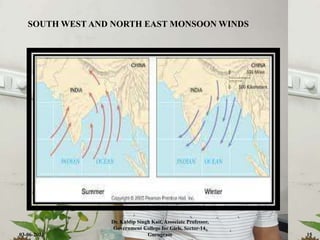
SOUTH WEST AND NORTH EAST MONSOON WINDS
03-06-2021
Dr. Kuldip Singh Kait, Associate Professor,
Government College for Girls, Sector-14,
Gurugram 15
Arabian Sea Branch
Due to COROILIS force, the wind direction is
south WESTERLIES.
Therefore it is oblique to the western Ghats.
Hence 200-300 cm orographic rainfall occur while
in the rain shadow areas of Deccan plateau 40-60
cm rainfall is found.
03-06-2021
Dr. Kuldip Singh Kait, Associate Professor,
Government College for Girls, Sector-14,
Gurugram 16
What is Coriolis Force ?
An effect whereby a mass moving in a rotating
system experiences a force (the Coriolis force)
acting perpendicular to the direction of motion
and to the axis of rotation. On the earth, the
effect tends to deflect moving objects to the
right in the northern hemisphere and to the left
in the southern and is important in the
formation of cyclonic weather systems.
03-06-2021
Dr. Kuldip Singh Kait, Associate Professor,
Government College for Girls, Sector-14,
Gurugram 17
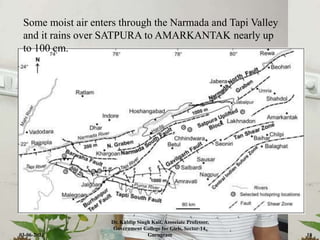
Some moist air enters through the Narmada and Tapi Valley
and it rains over SATPURA to AMARKANTAK nearly up
to 100 cm.
03-06-2021
Dr. Kuldip Singh Kait, Associate Professor,
Government College for Girls, Sector-14,
Gurugram 18
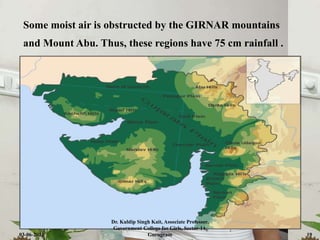
Some moist air is obstructed by the GIRNAR mountains
and Mount Abu. Thus, these regions have 75 cm rainfall .
03-06-2021
Dr. Kuldip Singh Kait, Associate Professor,
Government College for Girls, Sector-14,
Gurugram 19
 Bay of Bengal Branch
 It is parallel to the Coromandel coast and Tamil Nadu.
 Thus, during summer these regions remain dry.
 It picks up more moisture from the Bay of Bengal.
03-06-2021
Dr. Kuldip Singh Kait, Associate Professor,
Government College for Girls, Sector-14,
Gurugram 20
Bay of Bengal Branch
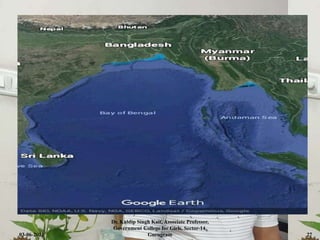
 It hits the ARAKAN YOMA and turns along the
foothills of HIMALAYAS parallel to
SHIWALIS which receive 100 cm rainfall and
 Meghalaya plateaus especially the KHASI hills
receives highest rainfall in the world at
MANSYRURAM, CHERAPOUNJI, because of
funnel shaped valley which has wide inlet but
very narrow outlet .
03-06-2021
Dr. Kuldip Singh Kait, Associate Professor,
Government College for Girls, Sector-14,
Gurugram 21
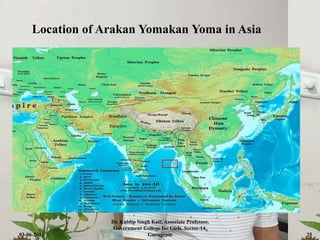
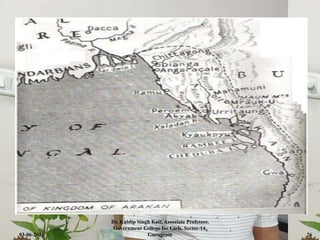
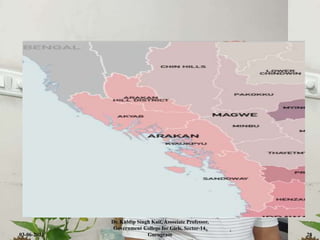
Location of Arakan Yoma
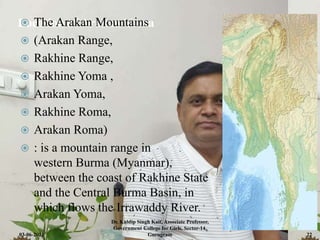
 The Arakan Mountains
 (Arakan Range,
 Rakhine Range,
 Rakhine Yoma ,
 Arakan Yoma,
 Rakhine Roma,
 Arakan Roma)
 : is a mountain range in
western Burma (Myanmar),
between the coast of Rakhine State
and the Central Burma Basin, in
which flows the Irrawaddy River.
03-06-2021
Dr. Kuldip Singh Kait, Associate Professor,
Government College for Girls, Sector-14,
Gurugram 22
Location of Arakan Yoma
 It is the most prominent of a
series of parallel ridges that
arc through
Assam, Nagaland, Mizoram
and Burma.
 The Arakan Mountains run
from Cape Negrais in the
south in to the Manipur State
of India in the north.
03-06-2021
Dr. Kuldip Singh Kait, Associate Professor,
Government College for Girls, Sector-14,
Gurugram 23
Location of Arakan Yoma
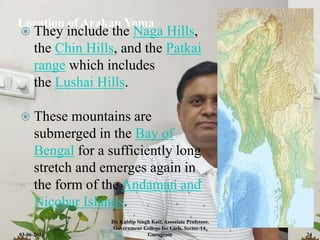
 They include the Naga Hills,
the Chin Hills, and the Patkai
range which includes
the Lushai Hills.
 These mountains are
submerged in the Bay of
Bengal for a sufficiently long
stretch and emerges again in
the form of the Andaman and
Nicobar Islands.
03-06-2021
Dr. Kuldip Singh Kait, Associate Professor,
Government College for Girls, Sector-14,
Gurugram 24
Location of Arakan Yomakan Yoma in Asia
03-06-2021
Dr. Kuldip Singh Kait, Associate Professor,
Government College for Girls, Sector-14,
Gurugram 25
Kingdom of Rakhine / Arakan Yoma
03-06-2021
Dr. Kuldip Singh Kait, Associate Professor,
Government College for Girls, Sector-14,
Gurugram 26
03-06-2021
Dr. Kuldip Singh Kait, Associate Professor,
Government College for Girls, Sector-14,
Gurugram 27
03-06-2021
Dr. Kuldip Singh Kait, Associate Professor,
Government College for Girls, Sector-14,
Gurugram 28
PURAVANCHAL hills receive 200 cm while
Assam HIMALAYAS 250, Meghalaya
Plateau 200 cm and upper Assam 150-200 cm.
The GANGETIC Plains and the Central
Indian Plateau receive neither from Bay of
Bengal nor from the Arabian Sea branch .
They receive rain from the mild tropical
disturbances .
03-06-2021
Dr. Kuldip Singh Kait, Associate Professor,
Government College for Girls, Sector-14,
Gurugram 29
North-East Monsoon
 North East Monsoon winds is an
oceanic wind and is an extension of
retreating monsoon.
 It sweeps over BAY OF BENGAL
between December to March.
03-06-2021
Dr. Kuldip Singh Kait, Associate Professor,
Government College for Girls, Sector-14,
Gurugram 30
North-East Monsoon
 The North East Monsoon is oblique to
the Coromandel coast which receive
100 cm rainfall during winters other
places like NILGIRI, PILINI also
receive 15–20 cm rainfall.
03-06-2021
Dr. Kuldip Singh Kait, Associate Professor,
Government College for Girls, Sector-14,
Gurugram 31
North-East Monsoon
 On 1st SEPTEMBER below the trough of the
sub tropical jet, the retreat of the monsoon
begin.
 This retreat is gradual from 1st September to
30 November. It may cause 10-15 cm rainfall
over GANGETIC plains .
03-06-2021
Dr. Kuldip Singh Kait, Associate Professor,
Government College for Girls, Sector-14,
Gurugram 32
Conclusions:
Thus we can conclude that monsoon is
a seasonal reversal of wind
or
A regional wind produced by
thermodynamic modification in the
trade winds.
03-06-2021
Dr. Kuldip Singh Kait, Associate Professor,
Government College for Girls, Sector-14,
Gurugram 33
Conclusions:
There are two types of trade winds and ultimately
two types of monsoon winds :-
1. South West Monsoon Wind.
2. North East Monsoon Wind.
Hence, it is concluded that India is an agriculture
country and most of our agriculture activities
depend upon the monsoon rainfall.
03-06-2021
Dr. Kuldip Singh Kait, Associate Professor,
Government College for Girls, Sector-14,
Gurugram 34
References:
1. Critchfield, Howard J. (1967), "General
Climatology", Second Edition, Prentice-
Hall, Inc., Englewood Cliffs,. New Jersey,
1966, 420 pages.
2. Lal, D. S. (2011), “Climatology”,
3. Web Surfing
03-06-2021
Dr. Kuldip Singh Kait, Associate Professor,
Government College for Girls, Sector-14,
Gurugram 35

Indian Monsoon System

  • 1.
    Indian Monsoon System Dr.Kuldip Singh Kait Associate Professor, Government College for Girls, Sector-14, Gurugram Academic Session: 2020-21 03-06-2021 Dr. Kuldip Singh Kait, Associate Professor, Government College for Girls, Sector-14, Gurugram 1
  • 2.
    The term monsoonis derived from an ARABIC word ‘MAUSIM' or from the ‘MONSIM’ which means season. Monsoon refers to regional winds produced by thermodynamics modifications in the trade winds . 03-06-2021 Dr. Kuldip Singh Kait, Associate Professor, Government College for Girls, Sector-14, Gurugram 2
  • 3.
    Monsoon can bedefined as a seasonal reversal of wind over Indian Sub-Continent due to the apparent shift of the sun. 03-06-2021 Dr. Kuldip Singh Kait, Associate Professor, Government College for Girls, Sector-14, Gurugram 3
  • 4.
    1. Thermodynamic modificationof the south easterly trades. 2. During the JULY month the frequency of wind must increase by 40% . 3. The acceleration of wind during the monsoon month JULY shall be more than 3m/sec. Features 03-06-2021 Dr. Kuldip Singh Kait, Associate Professor, Government College for Girls, Sector-14, Gurugram 4
  • 5.
    4. Rain bearingsystem . 5. Break in the monsoon . 6. Onset of the monsoon. Features 03-06-2021 Dr. Kuldip Singh Kait, Associate Professor, Government College for Girls, Sector-14, Gurugram 5
  • 6.
    Monsoon Winds An interchangeof air between land and oceans due to the unequal heating and cooling of the continents and oceans is known as MONSOON WINDS. 03-06-2021 Dr. Kuldip Singh Kait, Associate Professor, Government College for Girls, Sector-14, Gurugram 6
  • 7.
    Monsoon Winds It hasan annual period of occurrence :- During summer, the land is heated very much as compared to the oceans which cause low pressure over the land and the wind blow from oceans to the continents. 03-06-2021 Dr. Kuldip Singh Kait, Associate Professor, Government College for Girls, Sector-14, Gurugram 7
  • 8.
     During winters,land cool down faster than the oceans causing high pressure over continents and low pressure over the oceans and the wind blow from continents to oceans. The Indian monsoon is the best known example of this alternating circulation system 03-06-2021 Dr. Kuldip Singh Kait, Associate Professor, Government College for Girls, Sector-14, Gurugram 8
  • 9.
     There aretwo types of monsoons over India that is 1. South-West Monsoon and 2. North-East Monsoon. 03-06-2021 Dr. Kuldip Singh Kait, Associate Professor, Government College for Girls, Sector-14, Gurugram 9
  • 10.
    South-West Monsoon Winds Itoriginates at 10 degree south near MASCARNES high pressure east of Madagascar by the convergence of south easterly trades with the out flow of MASCARNES. The convergent air is directed towards equator by the fin latter jet and the eastern highland of Africa. It crosses the equator between 44 to 66 degree east and bifurcated by the projection of peninsula. 03-06-2021 Dr. Kuldip Singh Kait, Associate Professor, Government College for Girls, Sector-14, Gurugram 10
  • 11.
    Location of MascareneIsland in Indian Ocean 03-06-2021 Dr. Kuldip Singh Kait, Associate Professor, Government College for Girls, Sector-14, Gurugram 11
  • 12.
    South-West Monsoon Winds Itoriginates at 10 degree south near MASCARNES high pressure east of Madagascar by the convergence of south easterly trades with the out flow of MASCARNES. 03-06-2021 Dr. Kuldip Singh Kait, Associate Professor, Government College for Girls, Sector-14, Gurugram 12
  • 13.
    03-06-2021 Dr. Kuldip SinghKait, Associate Professor, Government College for Girls, Sector-14, Gurugram 13
  • 14.
    South-West Monsoon Winds Itdevelops into two main branches :- 1. Arabian Sea branch and 2. Bay of Bengal branch 03-06-2021 Dr. Kuldip Singh Kait, Associate Professor, Government College for Girls, Sector-14, Gurugram 14
  • 15.
    SOUTH WEST ANDNORTH EAST MONSOON WINDS 03-06-2021 Dr. Kuldip Singh Kait, Associate Professor, Government College for Girls, Sector-14, Gurugram 15
  • 16.
    Arabian Sea Branch Dueto COROILIS force, the wind direction is south WESTERLIES. Therefore it is oblique to the western Ghats. Hence 200-300 cm orographic rainfall occur while in the rain shadow areas of Deccan plateau 40-60 cm rainfall is found. 03-06-2021 Dr. Kuldip Singh Kait, Associate Professor, Government College for Girls, Sector-14, Gurugram 16
  • 17.
    What is CoriolisForce ? An effect whereby a mass moving in a rotating system experiences a force (the Coriolis force) acting perpendicular to the direction of motion and to the axis of rotation. On the earth, the effect tends to deflect moving objects to the right in the northern hemisphere and to the left in the southern and is important in the formation of cyclonic weather systems. 03-06-2021 Dr. Kuldip Singh Kait, Associate Professor, Government College for Girls, Sector-14, Gurugram 17
  • 18.
    Some moist airenters through the Narmada and Tapi Valley and it rains over SATPURA to AMARKANTAK nearly up to 100 cm. 03-06-2021 Dr. Kuldip Singh Kait, Associate Professor, Government College for Girls, Sector-14, Gurugram 18
  • 19.
    Some moist airis obstructed by the GIRNAR mountains and Mount Abu. Thus, these regions have 75 cm rainfall . 03-06-2021 Dr. Kuldip Singh Kait, Associate Professor, Government College for Girls, Sector-14, Gurugram 19
  • 20.
     Bay ofBengal Branch  It is parallel to the Coromandel coast and Tamil Nadu.  Thus, during summer these regions remain dry.  It picks up more moisture from the Bay of Bengal. 03-06-2021 Dr. Kuldip Singh Kait, Associate Professor, Government College for Girls, Sector-14, Gurugram 20
  • 21.
    Bay of BengalBranch  It hits the ARAKAN YOMA and turns along the foothills of HIMALAYAS parallel to SHIWALIS which receive 100 cm rainfall and  Meghalaya plateaus especially the KHASI hills receives highest rainfall in the world at MANSYRURAM, CHERAPOUNJI, because of funnel shaped valley which has wide inlet but very narrow outlet . 03-06-2021 Dr. Kuldip Singh Kait, Associate Professor, Government College for Girls, Sector-14, Gurugram 21
  • 22.
    Location of ArakanYoma  The Arakan Mountains  (Arakan Range,  Rakhine Range,  Rakhine Yoma ,  Arakan Yoma,  Rakhine Roma,  Arakan Roma)  : is a mountain range in western Burma (Myanmar), between the coast of Rakhine State and the Central Burma Basin, in which flows the Irrawaddy River. 03-06-2021 Dr. Kuldip Singh Kait, Associate Professor, Government College for Girls, Sector-14, Gurugram 22
  • 23.
    Location of ArakanYoma  It is the most prominent of a series of parallel ridges that arc through Assam, Nagaland, Mizoram and Burma.  The Arakan Mountains run from Cape Negrais in the south in to the Manipur State of India in the north. 03-06-2021 Dr. Kuldip Singh Kait, Associate Professor, Government College for Girls, Sector-14, Gurugram 23
  • 24.
    Location of ArakanYoma  They include the Naga Hills, the Chin Hills, and the Patkai range which includes the Lushai Hills.  These mountains are submerged in the Bay of Bengal for a sufficiently long stretch and emerges again in the form of the Andaman and Nicobar Islands. 03-06-2021 Dr. Kuldip Singh Kait, Associate Professor, Government College for Girls, Sector-14, Gurugram 24
  • 25.
    Location of ArakanYomakan Yoma in Asia 03-06-2021 Dr. Kuldip Singh Kait, Associate Professor, Government College for Girls, Sector-14, Gurugram 25
  • 26.
    Kingdom of Rakhine/ Arakan Yoma 03-06-2021 Dr. Kuldip Singh Kait, Associate Professor, Government College for Girls, Sector-14, Gurugram 26
  • 27.
    03-06-2021 Dr. Kuldip SinghKait, Associate Professor, Government College for Girls, Sector-14, Gurugram 27
  • 28.
    03-06-2021 Dr. Kuldip SinghKait, Associate Professor, Government College for Girls, Sector-14, Gurugram 28
  • 29.
    PURAVANCHAL hills receive200 cm while Assam HIMALAYAS 250, Meghalaya Plateau 200 cm and upper Assam 150-200 cm. The GANGETIC Plains and the Central Indian Plateau receive neither from Bay of Bengal nor from the Arabian Sea branch . They receive rain from the mild tropical disturbances . 03-06-2021 Dr. Kuldip Singh Kait, Associate Professor, Government College for Girls, Sector-14, Gurugram 29
  • 30.
    North-East Monsoon  NorthEast Monsoon winds is an oceanic wind and is an extension of retreating monsoon.  It sweeps over BAY OF BENGAL between December to March. 03-06-2021 Dr. Kuldip Singh Kait, Associate Professor, Government College for Girls, Sector-14, Gurugram 30
  • 31.
    North-East Monsoon  TheNorth East Monsoon is oblique to the Coromandel coast which receive 100 cm rainfall during winters other places like NILGIRI, PILINI also receive 15–20 cm rainfall. 03-06-2021 Dr. Kuldip Singh Kait, Associate Professor, Government College for Girls, Sector-14, Gurugram 31
  • 32.
    North-East Monsoon  On1st SEPTEMBER below the trough of the sub tropical jet, the retreat of the monsoon begin.  This retreat is gradual from 1st September to 30 November. It may cause 10-15 cm rainfall over GANGETIC plains . 03-06-2021 Dr. Kuldip Singh Kait, Associate Professor, Government College for Girls, Sector-14, Gurugram 32
  • 33.
    Conclusions: Thus we canconclude that monsoon is a seasonal reversal of wind or A regional wind produced by thermodynamic modification in the trade winds. 03-06-2021 Dr. Kuldip Singh Kait, Associate Professor, Government College for Girls, Sector-14, Gurugram 33
  • 34.
    Conclusions: There are twotypes of trade winds and ultimately two types of monsoon winds :- 1. South West Monsoon Wind. 2. North East Monsoon Wind. Hence, it is concluded that India is an agriculture country and most of our agriculture activities depend upon the monsoon rainfall. 03-06-2021 Dr. Kuldip Singh Kait, Associate Professor, Government College for Girls, Sector-14, Gurugram 34
  • 35.
    References: 1. Critchfield, HowardJ. (1967), "General Climatology", Second Edition, Prentice- Hall, Inc., Englewood Cliffs,. New Jersey, 1966, 420 pages. 2. Lal, D. S. (2011), “Climatology”, 3. Web Surfing 03-06-2021 Dr. Kuldip Singh Kait, Associate Professor, Government College for Girls, Sector-14, Gurugram 35