
Monitoring and evaluation approaches
for key population programs: perils,
pitfalls, and promising practices
Sharon Weir
Department of Epidemiology
University of North Carolina at Chapel Hill
December 4 2015
What is programmatic mapping?
Programmatic mapping is
a collaborative method to
systematically map public
locations where key
populations congregate,
assess the availability of
HIV prevention and
treatment services among
people at those locations,
and use the results to
improve service delivery.
“Focusing on the areas where
the HIV epidemic is highly
concentrated, identifying the
places where services are
lacking and reaching the
people in need of prevention
services, testing, treatment
and support are the first steps
towards achieving more
efficient and effective
programs.” UNAIDS Location
Location Report, 2014
What is size estimation?
Size estimation methods estimate the number
of people in a defined key population who can
be reached at a single spot or in a geographic
area over a defined period. The numbers are
used by programs to set targets, provide
denominators for program coverage, identify
gaps in services, and advocate for funding.
Perils
1. serious and
immediate
danger.
2. synonyms:
danger, jeopardy,
risk, hazard,
insecurity,
uncertainty,
menace, threat
Promising Practice
“Do no harm”.
Simple idea.
Challenging to implement.
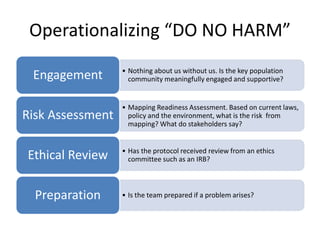
Operationalizing “DO NO HARM”
• Nothing about us without us. Is the key population
community meaningfully engaged and supportive?Engagement
• Mapping Readiness Assessment. Based on current laws,
policy and the environment, what is the risk from
mapping? What do stakeholders say?
Risk Assessment
• Has the protocol received review from an ethics
committee such as an IRB?Ethical Review
• Is the team prepared if a problem arises?Preparation
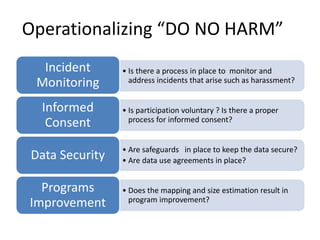
Operationalizing “DO NO HARM”
• Is there a process in place to monitor and
address incidents that arise such as harassment?
Incident
Monitoring
• Is participation voluntary ? Is there a proper
process for informed consent?
Informed
Consent
• Are safeguards in place to keep the data secure?
• Are data use agreements in place?Data Security
• Does the mapping and size estimation result in
program improvement?
Programs
Improvement
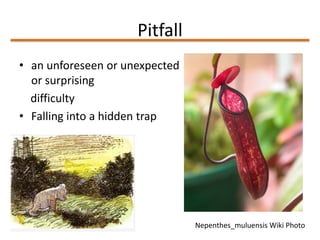
Pitfall
• an unforeseen or unexpected
or surprising
difficulty
• Falling into a hidden trap
Nepenthes_muluensis Wiki Photo
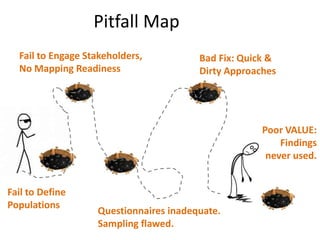
Pitfall Map
Fail to Define
Populations
Fail to Engage Stakeholders,
No Mapping Readiness
Bad Fix: Quick &
Dirty Approaches
Poor VALUE:
Findings
never used.
Questionnaires inadequate.
Sampling flawed.
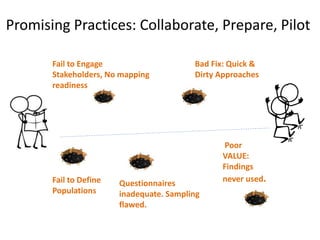
Promising Practices: Collaborate, Prepare, Pilot
Fail to Define
Populations
Fail to Engage
Stakeholders, No mapping
readiness
Questionnaires
inadequate. Sampling
flawed.
Bad Fix: Quick &
Dirty Approaches
Poor
VALUE:
Findings
never used.
Thank-You!

monitoring and evaluation approaches for key population programs: perils, pitfalls, and promising practices

  • 1.
    Monitoring and evaluationapproaches for key population programs: perils, pitfalls, and promising practices Sharon Weir Department of Epidemiology University of North Carolina at Chapel Hill December 4 2015
  • 2.
    What is programmaticmapping? Programmatic mapping is a collaborative method to systematically map public locations where key populations congregate, assess the availability of HIV prevention and treatment services among people at those locations, and use the results to improve service delivery. “Focusing on the areas where the HIV epidemic is highly concentrated, identifying the places where services are lacking and reaching the people in need of prevention services, testing, treatment and support are the first steps towards achieving more efficient and effective programs.” UNAIDS Location Location Report, 2014
  • 3.
    What is sizeestimation? Size estimation methods estimate the number of people in a defined key population who can be reached at a single spot or in a geographic area over a defined period. The numbers are used by programs to set targets, provide denominators for program coverage, identify gaps in services, and advocate for funding.
  • 4.
    Perils 1. serious and immediate danger. 2.synonyms: danger, jeopardy, risk, hazard, insecurity, uncertainty, menace, threat
  • 5.
    Promising Practice “Do noharm”. Simple idea. Challenging to implement.
  • 6.
    Operationalizing “DO NOHARM” • Nothing about us without us. Is the key population community meaningfully engaged and supportive?Engagement • Mapping Readiness Assessment. Based on current laws, policy and the environment, what is the risk from mapping? What do stakeholders say? Risk Assessment • Has the protocol received review from an ethics committee such as an IRB?Ethical Review • Is the team prepared if a problem arises?Preparation
  • 7.
    Operationalizing “DO NOHARM” • Is there a process in place to monitor and address incidents that arise such as harassment? Incident Monitoring • Is participation voluntary ? Is there a proper process for informed consent? Informed Consent • Are safeguards in place to keep the data secure? • Are data use agreements in place?Data Security • Does the mapping and size estimation result in program improvement? Programs Improvement
  • 9.
    Pitfall • an unforeseenor unexpected or surprising difficulty • Falling into a hidden trap Nepenthes_muluensis Wiki Photo
  • 10.
    Pitfall Map Fail toDefine Populations Fail to Engage Stakeholders, No Mapping Readiness Bad Fix: Quick & Dirty Approaches Poor VALUE: Findings never used. Questionnaires inadequate. Sampling flawed.
  • 11.
    Promising Practices: Collaborate,Prepare, Pilot Fail to Define Populations Fail to Engage Stakeholders, No mapping readiness Questionnaires inadequate. Sampling flawed. Bad Fix: Quick & Dirty Approaches Poor VALUE: Findings never used.
  • 12.