Humanitarian advocacy
Originally presented at
“Communicating in humanitarian settings - DAS Module III”
CERAH
6 December 2018
Dr Glenn O’Neil
What is advocacy?
“ A mix of persuasive communication and targeted actions aiming at
‘pleading the cause of’, ‘acting on behalf of’ and ‘speaking out for or in
support of others’, is designed to change policies, positions and actions
on a specific issue or cause on behalf of the voiceless”
Piccinini (2008)
"Championing or supporting a cause or policy goal"
Gardner and Brindis (2017)
“Advocacy is the attempt to influence public policy, either directly or
indirectly”
Pekkanen et al. (2014).
What is humanitarian
advocacy?
“The term ‘humanitarian advocacy’ encompasses not only advocacy in emergencies, but also
advocacy conducted before and after crises and in situations of protracted vulnerability,
suffering or conflict. In these situations we try to influence the policies and actions of local,
national, regional and international institutions and actors so that they better address the
unique challenges faced by children.” Save the Children (undated)
“Norwegian Refugee Council focuses advocacy efforts on improving the lives of those who are
most vulnerable during crises. We advocate through direct consultations or by speaking out
publicly. We must strive to denounce violations and speak out when that is the best way to
help the displaced and vulnerable, without risking their safety or that of our staff.” NRC
(2014)
“OCHA’s public and private advocacy raises awareness of forgotten crises, promotes respect
for international humanitarian law (IHL), brings the voices of crisis-affected people to the
forefront, and helps people obtain access to humanitarian assistance.” OCHA (undated)
“Our advocacy aims to raise awareness of the conditions facing people who are affected by
poverty around the world.” Muslim Aid (undated)
“Humanitarian advocacy is understood to constitute deliberate efforts, based on demonstrated
evidence, aimed at persuading decision-makers to adopt policies and take actions to promote
and protect the rights of children and women in humanitarian situations.” Unicef (2010)
What is humanitarian
advocacy?“The term ‘humanitarian advocacy’ encompasses not only advocacy in emergencies, but also
advocacy conducted before and after crises and in situations of protracted vulnerability,
suffering or conflict. In these situations we try to influence the policies and actions of
local, national, regional and international institutions and actors so that they better address
the unique challenges faced by children.” Save the Children (undated)
“Norwegian Refugee Council focuses advocacy efforts on improving the lives of those who are
most vulnerable during crises. We advocate through direct consultations or by speaking
out publicly. We must strive to denounce violations and speak out when that is the best way
to help the displaced and vulnerable, without risking their safety or that of our staff.”
NRC (2014)
“OCHA’s public and private advocacy raises awareness of forgotten crises, promotes respect
for international humanitarian law (IHL), brings the voices of crisis-affected people to the
forefront, and helps people obtain access to humanitarian assistance.” OCHA (undated)
“Our advocacy aims to raise awareness of the conditions facing people who are affected by
poverty around the world.” Muslim Aid (undated)
“Humanitarian advocacy is understood to constitute deliberate efforts, based on
demonstrated evidence, aimed at persuading decision-makers to adopt policies and take
actions to promote and protect the rights of children and women in humanitarian situations.”
Unicef (2010)
Goals of humanitarian
advocacy
Key goals often highlighted:
– Ensure respect for humanitarian principles, space and access
– Ensure that affected populations are respected and protected
– Ensure optimal functioning of the humanitarian system
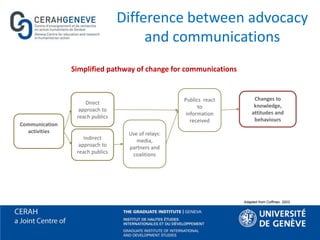
Difference between advocacy
and communications
Communication
activities
Indirect
approach to
reach publics
Direct
approach to
reach publics
Publics react
to
information
received
Use of relays:
media,
partners and
coalitions
Changes to
knowledge,
attitudes and
behaviours
Simplified pathway of change for communications
Adapted from Coffman, 2003.
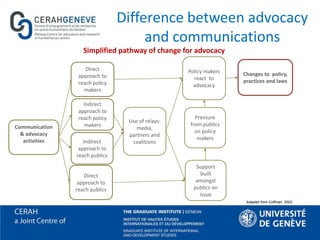
Difference between advocacy
and communications
Support
built
amongst
publics on
issue
Changes to policy,
practices and laws
Communication
& advocacy
activities
Indirect
approach to
reach policy
makers
Direct
approach to
reach policy
makers
Policy makers
react to
advocacy
Use of relays:
media,
partners and
coalitions
Simplified pathway of change for advocacy
Indirect
approach to
reach publics
Direct
approach to
reach publics
Pressure
from publics
on policy
makers
Adapted from Coffman, 2003.
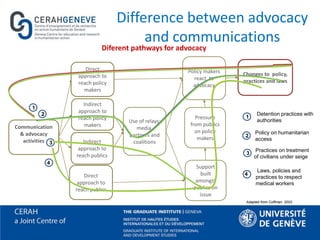
Difference between advocacy
and communications
Support
built
amongst
publics on
issue
Changes to policy,
practices and laws
Communication
& advocacy
activities
Indirect
approach to
reach policy
makers
Direct
approach to
reach policy
makers
Policy makers
react to
advocacy
Use of relays:
media,
partners and
coalitions
Diferent pathways for advocacy
Indirect
approach to
reach publics
Direct
approach to
reach publics
Pressure
from publics
on policy
makers
Adapted from Coffman, 2003.
1
1
Detention practices with
authorities
2
2
Policy on humanitarian
access
3
3
Practices on treatment
of civilians under seige
4
Laws, policies and
practices to respect
medical workers
4
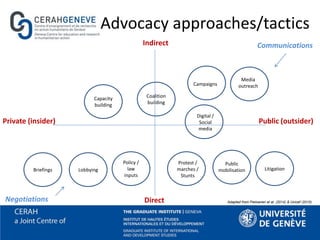
Advocacy approaches/tactics
Indirect
Direct
Private (insider) Public (outsider)
Adapted from Pekkanen et al. (2014) & Unicef (2010)
Lobbying
Policy /
law
inputs
Campaigns
Coalition
building
Protest /
marches /
Stunts
Media
outreach
Public
mobilisation
Capacity
building
Litigation
Digital /
Social
media
Briefings
Negotiations
Communications
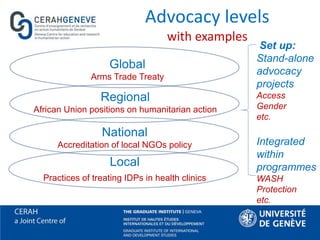
Advocacy levels
with examples
Global
Arms Trade Treaty
National
Accreditation of local NGOs policy
Regional
African Union positions on humanitarian action
Local
Practices of treating IDPs in health clinics
Set up:
Stand-alone
advocacy
projects
Access
Gender
etc.
Integrated
within
programmes
WASH
Protection
etc.
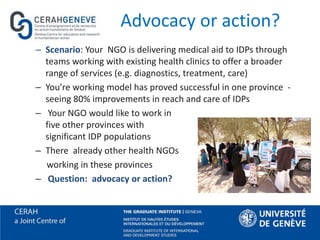
Advocacy or action?
– Scenario: Your NGO is delivering medical aid to IDPs through
teams working with existing health clinics to offer a broader
range of services (e.g. diagnostics, treatment, care)
– You’re working model has proved successful in one province -
seeing 80% improvements in reach and care of IDPs
– Your NGO would like to work in
five other provinces with
significant IDP populations
– There already other health NGOs
working in these provinces
– Question: advocacy or action?
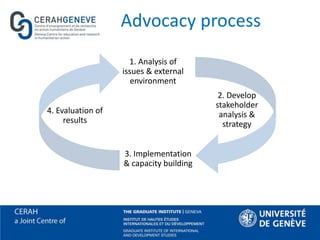
Advocacy process
1. Analysis of
issues & external
environment
4. Evaluation of
results
3. Implementation
& capacity building
2. Develop
stakeholder
analysis &
strategy
1. Analysis
– What is the humanitarian issue(s) precisely?
– Is it possible that your organisation (alone or in coalition)
could influence the change needed?
– Is advocacy the solution required?
– Do you have resources to act?
– Is extra research required?
– How is change envisaged to happen?
– Is this in the best interests of affected populations?
2. Strategy
– Objectives: what are your desired outcomes?
– Audiences: who can make the changes happen?
– Messages: what do they need to hear?
– Approach: what is the appropriate approach?
– Tactics: how will it be implemented?
– Monitoring: how do we know if it is working?
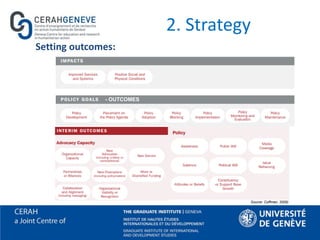
2. Strategy
Setting outcomes:
Source: Coffman, 2009)
- OUTCOMES
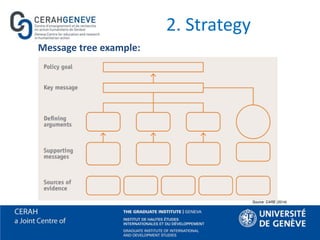
2. Strategy
Message tree example:
Source: CARE (2014)
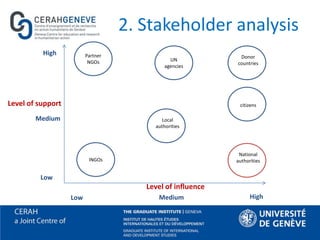
2. Stakeholder analysis
Level of support
Level of influence
High
Medium
Low
Low Medium High
Partner
NGOs
National
authoritiesINGOs
UN
agencies
Donor
countries
Local
authorities
citizens
3. Implementation
– Timing: Is timing clear – all opportunities explored?
– Roles and responsibility: who will do what and when?
– Monitoring: are we adjusting as we progress?
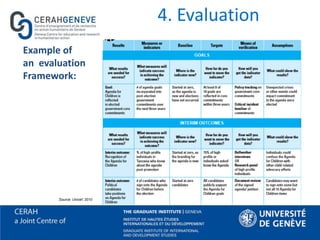
4. Evaluation
Example of
an evaluation
Framework:
Source: Unicef, 2010
Challenges
– Speaking out verses operational risks for organisations
– Balancing short-term reactive advocacy with long-term
proactive advocacy
– Limitations on organisations right to advocate
– The “crowded” policy environment for some contexts /
issues
– Are organisations able to represent the advocacy needs
of affected populations
Conclusions
Humanitarian organisations are increasingly
seeing the value of advocacy as way to bring
about change
Advocacy will increasingly become integrated
within humanitarian programming
References
• CARE (2014). The CARE International Advocacy Handbook.
• Coffman, J. (2003). Lessons in evaluating communications campaigns: Five case studies. Cambridge, MA: Harvard
Family Research Project.
• Coffman, J. (2009). A user’s guide to advocacy evaluation planning. Cambridge (MA): Harvard Family Research
Project.
• Gardner, A., & Brindis, C. (2017). Advocacy and policy change evaluation: Theory and practice. Stanford University
Press.
• INNE (undated). Education in Emergencies.
• NRC (2014). NRC as a courageous advocate for the rights of displaced people; Strategy for Global Advocacy 2015-
2017.
• Pekkanen, R. J., Smith, S. R., & Tsujinaka, Y. (Eds.). (2014). Non-profits and advocacy: Engaging community and
government in an era of retrenchment. JHU Press.
• Piccinini, C. (2018). Public humanitarian advocacy: challenges, opportunities and its channeling through the
celebrities, MA of International Communications, University of Leeds, Institute of Communication Studies.
• Rhoades, A. (2010). Displaced Futures: Internally Displaced Persons and the Right to Education. EI Rodeo, Costa
Rica: United Nations University for Peace.
• Save the Children (undated). Advocacy and Campaigning; Humanitarian advocacy Session. The Open University.
• Unicef (2010). Advocacy toolkit.
• Resources on advocacy evaluation: https://intelligentmeasurement.net/category/advocacy-evaluation/

Humanitarian advocacy

  • 1.
    Humanitarian advocacy Originally presentedat “Communicating in humanitarian settings - DAS Module III” CERAH 6 December 2018 Dr Glenn O’Neil
  • 2.
    What is advocacy? “A mix of persuasive communication and targeted actions aiming at ‘pleading the cause of’, ‘acting on behalf of’ and ‘speaking out for or in support of others’, is designed to change policies, positions and actions on a specific issue or cause on behalf of the voiceless” Piccinini (2008) "Championing or supporting a cause or policy goal" Gardner and Brindis (2017) “Advocacy is the attempt to influence public policy, either directly or indirectly” Pekkanen et al. (2014).
  • 3.
    What is humanitarian advocacy? “Theterm ‘humanitarian advocacy’ encompasses not only advocacy in emergencies, but also advocacy conducted before and after crises and in situations of protracted vulnerability, suffering or conflict. In these situations we try to influence the policies and actions of local, national, regional and international institutions and actors so that they better address the unique challenges faced by children.” Save the Children (undated) “Norwegian Refugee Council focuses advocacy efforts on improving the lives of those who are most vulnerable during crises. We advocate through direct consultations or by speaking out publicly. We must strive to denounce violations and speak out when that is the best way to help the displaced and vulnerable, without risking their safety or that of our staff.” NRC (2014) “OCHA’s public and private advocacy raises awareness of forgotten crises, promotes respect for international humanitarian law (IHL), brings the voices of crisis-affected people to the forefront, and helps people obtain access to humanitarian assistance.” OCHA (undated) “Our advocacy aims to raise awareness of the conditions facing people who are affected by poverty around the world.” Muslim Aid (undated) “Humanitarian advocacy is understood to constitute deliberate efforts, based on demonstrated evidence, aimed at persuading decision-makers to adopt policies and take actions to promote and protect the rights of children and women in humanitarian situations.” Unicef (2010)
  • 4.
    What is humanitarian advocacy?“Theterm ‘humanitarian advocacy’ encompasses not only advocacy in emergencies, but also advocacy conducted before and after crises and in situations of protracted vulnerability, suffering or conflict. In these situations we try to influence the policies and actions of local, national, regional and international institutions and actors so that they better address the unique challenges faced by children.” Save the Children (undated) “Norwegian Refugee Council focuses advocacy efforts on improving the lives of those who are most vulnerable during crises. We advocate through direct consultations or by speaking out publicly. We must strive to denounce violations and speak out when that is the best way to help the displaced and vulnerable, without risking their safety or that of our staff.” NRC (2014) “OCHA’s public and private advocacy raises awareness of forgotten crises, promotes respect for international humanitarian law (IHL), brings the voices of crisis-affected people to the forefront, and helps people obtain access to humanitarian assistance.” OCHA (undated) “Our advocacy aims to raise awareness of the conditions facing people who are affected by poverty around the world.” Muslim Aid (undated) “Humanitarian advocacy is understood to constitute deliberate efforts, based on demonstrated evidence, aimed at persuading decision-makers to adopt policies and take actions to promote and protect the rights of children and women in humanitarian situations.” Unicef (2010)
  • 5.
    Goals of humanitarian advocacy Keygoals often highlighted: – Ensure respect for humanitarian principles, space and access – Ensure that affected populations are respected and protected – Ensure optimal functioning of the humanitarian system
  • 6.
    Difference between advocacy andcommunications Communication activities Indirect approach to reach publics Direct approach to reach publics Publics react to information received Use of relays: media, partners and coalitions Changes to knowledge, attitudes and behaviours Simplified pathway of change for communications Adapted from Coffman, 2003.
  • 7.
    Difference between advocacy andcommunications Support built amongst publics on issue Changes to policy, practices and laws Communication & advocacy activities Indirect approach to reach policy makers Direct approach to reach policy makers Policy makers react to advocacy Use of relays: media, partners and coalitions Simplified pathway of change for advocacy Indirect approach to reach publics Direct approach to reach publics Pressure from publics on policy makers Adapted from Coffman, 2003.
  • 8.
    Difference between advocacy andcommunications Support built amongst publics on issue Changes to policy, practices and laws Communication & advocacy activities Indirect approach to reach policy makers Direct approach to reach policy makers Policy makers react to advocacy Use of relays: media, partners and coalitions Diferent pathways for advocacy Indirect approach to reach publics Direct approach to reach publics Pressure from publics on policy makers Adapted from Coffman, 2003. 1 1 Detention practices with authorities 2 2 Policy on humanitarian access 3 3 Practices on treatment of civilians under seige 4 Laws, policies and practices to respect medical workers 4
  • 9.
    Advocacy approaches/tactics Indirect Direct Private (insider)Public (outsider) Adapted from Pekkanen et al. (2014) & Unicef (2010) Lobbying Policy / law inputs Campaigns Coalition building Protest / marches / Stunts Media outreach Public mobilisation Capacity building Litigation Digital / Social media Briefings Negotiations Communications
  • 10.
    Advocacy levels with examples Global ArmsTrade Treaty National Accreditation of local NGOs policy Regional African Union positions on humanitarian action Local Practices of treating IDPs in health clinics Set up: Stand-alone advocacy projects Access Gender etc. Integrated within programmes WASH Protection etc.
  • 11.
    Advocacy or action? –Scenario: Your NGO is delivering medical aid to IDPs through teams working with existing health clinics to offer a broader range of services (e.g. diagnostics, treatment, care) – You’re working model has proved successful in one province - seeing 80% improvements in reach and care of IDPs – Your NGO would like to work in five other provinces with significant IDP populations – There already other health NGOs working in these provinces – Question: advocacy or action?
  • 12.
    Advocacy process 1. Analysisof issues & external environment 4. Evaluation of results 3. Implementation & capacity building 2. Develop stakeholder analysis & strategy
  • 13.
    1. Analysis – Whatis the humanitarian issue(s) precisely? – Is it possible that your organisation (alone or in coalition) could influence the change needed? – Is advocacy the solution required? – Do you have resources to act? – Is extra research required? – How is change envisaged to happen? – Is this in the best interests of affected populations?
  • 14.
    2. Strategy – Objectives:what are your desired outcomes? – Audiences: who can make the changes happen? – Messages: what do they need to hear? – Approach: what is the appropriate approach? – Tactics: how will it be implemented? – Monitoring: how do we know if it is working?
  • 15.
    2. Strategy Setting outcomes: Source:Coffman, 2009) - OUTCOMES
  • 16.
    2. Strategy Message treeexample: Source: CARE (2014)
  • 17.
    2. Stakeholder analysis Levelof support Level of influence High Medium Low Low Medium High Partner NGOs National authoritiesINGOs UN agencies Donor countries Local authorities citizens
  • 18.
    3. Implementation – Timing:Is timing clear – all opportunities explored? – Roles and responsibility: who will do what and when? – Monitoring: are we adjusting as we progress?
  • 19.
    4. Evaluation Example of anevaluation Framework: Source: Unicef, 2010
  • 20.
    Challenges – Speaking outverses operational risks for organisations – Balancing short-term reactive advocacy with long-term proactive advocacy – Limitations on organisations right to advocate – The “crowded” policy environment for some contexts / issues – Are organisations able to represent the advocacy needs of affected populations
  • 21.
    Conclusions Humanitarian organisations areincreasingly seeing the value of advocacy as way to bring about change Advocacy will increasingly become integrated within humanitarian programming
  • 22.
    References • CARE (2014).The CARE International Advocacy Handbook. • Coffman, J. (2003). Lessons in evaluating communications campaigns: Five case studies. Cambridge, MA: Harvard Family Research Project. • Coffman, J. (2009). A user’s guide to advocacy evaluation planning. Cambridge (MA): Harvard Family Research Project. • Gardner, A., & Brindis, C. (2017). Advocacy and policy change evaluation: Theory and practice. Stanford University Press. • INNE (undated). Education in Emergencies. • NRC (2014). NRC as a courageous advocate for the rights of displaced people; Strategy for Global Advocacy 2015- 2017. • Pekkanen, R. J., Smith, S. R., & Tsujinaka, Y. (Eds.). (2014). Non-profits and advocacy: Engaging community and government in an era of retrenchment. JHU Press. • Piccinini, C. (2018). Public humanitarian advocacy: challenges, opportunities and its channeling through the celebrities, MA of International Communications, University of Leeds, Institute of Communication Studies. • Rhoades, A. (2010). Displaced Futures: Internally Displaced Persons and the Right to Education. EI Rodeo, Costa Rica: United Nations University for Peace. • Save the Children (undated). Advocacy and Campaigning; Humanitarian advocacy Session. The Open University. • Unicef (2010). Advocacy toolkit. • Resources on advocacy evaluation: https://intelligentmeasurement.net/category/advocacy-evaluation/