Making it Matter
Sex Workers Panel
December 2014
A sex worker? Single parent?
HIV positive women who needs treatment?
Strong advocate for herself?
Upstream and downstream
transmission pathways
SW
Client
Lower-risk
Pregnancy
Clients infect
SW who infect
other clients
Clients infect
regular and
casual partners
Women can pass
infection to foetus
and newborn
Targeted interventions aim to interrupt
upstream transmission in highest risk
sexual networks
Good clinical STI services shorten
duration of infectivity and reduce
onward transmission
Screening and treatment in
pregnancy reduces adverse
outcomes
Steen et al., (forthcoming) No exception – interrupt transmission in sex work, provide treatment, involve sex
workers, implement efficiently, PLoS
Is Sex Work driving ‘generalized’
HIV epidemics?
18 SSA
countries
- Modes of
Transmission
PAF 1
year
SW
2%
3 SSA
Countries
- KP
models
PAF 10 years
SW
58%-89%
Mishra S, Moses S, Boily MC, et al. Characterizing the contribution of sex work to HIV epidemics in Sub-
Saharan Africa: a systematic review, meta-analysis, and mathematical modelling study. Submitted. PLoS
Comprehensive SW programs
work when they are high quality
Condoms and Lubricant
STI Treatment
Structural Interventions
Community Mobilization
Peer Outreach
ART Coverage
Retention on ART
Oral Prep + Test & Treat
SA Reductions in Incidence 70%1
Boost Preventive effect of condoms by 15%. 5,6
Address Violence, Avert 17% of Infections2
STI & HIV Averted, Cost Savings3,4
Empowering KP as Peers led to 3-fold coverage5
0.4%-47.5% HIV-infected FSWs6
90-97% retained in RCT settings6
40% incidence reduction of SW + clients of over
a 10-year period1
Citations
1. Bekker et al., (2014) Combination HIV prevention for female sex workers: what is the
evidence? The Lancet
2. Shannon et al. (2014) Global epidemiology of HIV among female sex workers: influence
of structural determinants. The Lancet
3. Kerrigan et al., (2014) A community empowerment approach to the HIV response among
sex workers: effectiveness, challenges, and considerations for implementation and scale-
up The Lancet
4. Vassall A, et al., (2014) Community mobilization and empowerment interventions as part
of HIV prevention for female sex workers in Southern India: a cost-effectiveness analysis.
PLoS One.
5. Wheeler et al., (2012) Learning about scale, measurement and community mobilisation:
reflections on the implementation of the Avahan HIV/AIDS initiative in India. J Epidemiol
Community Health 66 Suppl 2: ii16-25
6. Steen et al., (forthcoming) No exception – interrupt transmission in sex work, provide
treatment, involve sex workers, implement efficiently, PLoS
7. Steen et al., (2014) Looking upstream to prevent HIV transmission: can interventions with
sex workers alter the course of HIV epidemics in Africa as they did in Asia? AIDS 28:
891-899.
8. Mountain E, Mishra S, Vickerman P, Pickles M, Gilks C, et al. (2014) Systematic review
and meta-analysis of antiretroviral therapy use, attrition, and outcomes among HIV-
infected female sex workers. PLoS ONE 9: e105645
Community Driven Responses
© 2008 Bill & Melinda Gates Foundation | 7
Action WITH
partnership;
work with others
to set priorities
and course of
action
Action BY,
being in control;
little or no input
by others
Action FOR
being informed;
or set tasks; others
set the agenda and
direct the process
Action
FOR/WITH
being consulted;
others analyze
and decide
course of action
Action ON
being
manipulated;
no real input or
power
Source: 2005, Project Planning Sourcebook, Centre for International Development and Training, University of Wolverhampton and London School of Economics
Decided by
others
Decided by
Themselves
Tisha Wheeler, USAID (Facilitating)
Ruth Morgan Thomas, Network of Sex Work Projects
Sharmistha Mishra, University of Toronto
Kate Thompson, GFATM
Mishra S, Moses S, Boily MC, et al. Characterizing the contribution of sex work to HIV epidemics in Sub-Saharan Africa:
a systematic review, meta-analysis, and mathematical modelling study. Submitted. PLoS One.
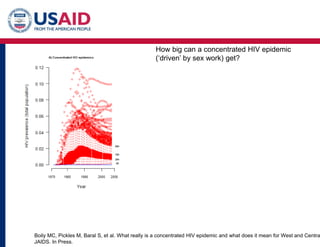
How big can a concentrated HIV epidemic
(‘driven’ by sex work) get?
Boily MC, Pickles M, Baral S, et al. What really is a concentrated HIV epidemic and what does it mean for West and Centra
JAIDS. In Press.
Ruth Morgan Thomas
Global Coordinator
Global Network of Sex Work
Projects
NSWP members across the world
Sex Worker Freedom Festival: the
alternative IAC 2012 event for sex workers
and their allies,
Ghana – NSWP members from all five regions
participate in the SWIT consultation
www.nswp.org

Making it Matter: Sex Workers Panel

  • 1.
    Making it Matter SexWorkers Panel December 2014
  • 2.
    A sex worker?Single parent? HIV positive women who needs treatment? Strong advocate for herself?
  • 3.
    Upstream and downstream transmissionpathways SW Client Lower-risk Pregnancy Clients infect SW who infect other clients Clients infect regular and casual partners Women can pass infection to foetus and newborn Targeted interventions aim to interrupt upstream transmission in highest risk sexual networks Good clinical STI services shorten duration of infectivity and reduce onward transmission Screening and treatment in pregnancy reduces adverse outcomes Steen et al., (forthcoming) No exception – interrupt transmission in sex work, provide treatment, involve sex workers, implement efficiently, PLoS
  • 4.
    Is Sex Workdriving ‘generalized’ HIV epidemics? 18 SSA countries - Modes of Transmission PAF 1 year SW 2% 3 SSA Countries - KP models PAF 10 years SW 58%-89% Mishra S, Moses S, Boily MC, et al. Characterizing the contribution of sex work to HIV epidemics in Sub- Saharan Africa: a systematic review, meta-analysis, and mathematical modelling study. Submitted. PLoS
  • 5.
    Comprehensive SW programs workwhen they are high quality Condoms and Lubricant STI Treatment Structural Interventions Community Mobilization Peer Outreach ART Coverage Retention on ART Oral Prep + Test & Treat SA Reductions in Incidence 70%1 Boost Preventive effect of condoms by 15%. 5,6 Address Violence, Avert 17% of Infections2 STI & HIV Averted, Cost Savings3,4 Empowering KP as Peers led to 3-fold coverage5 0.4%-47.5% HIV-infected FSWs6 90-97% retained in RCT settings6 40% incidence reduction of SW + clients of over a 10-year period1
  • 6.
    Citations 1. Bekker etal., (2014) Combination HIV prevention for female sex workers: what is the evidence? The Lancet 2. Shannon et al. (2014) Global epidemiology of HIV among female sex workers: influence of structural determinants. The Lancet 3. Kerrigan et al., (2014) A community empowerment approach to the HIV response among sex workers: effectiveness, challenges, and considerations for implementation and scale- up The Lancet 4. Vassall A, et al., (2014) Community mobilization and empowerment interventions as part of HIV prevention for female sex workers in Southern India: a cost-effectiveness analysis. PLoS One. 5. Wheeler et al., (2012) Learning about scale, measurement and community mobilisation: reflections on the implementation of the Avahan HIV/AIDS initiative in India. J Epidemiol Community Health 66 Suppl 2: ii16-25 6. Steen et al., (forthcoming) No exception – interrupt transmission in sex work, provide treatment, involve sex workers, implement efficiently, PLoS 7. Steen et al., (2014) Looking upstream to prevent HIV transmission: can interventions with sex workers alter the course of HIV epidemics in Africa as they did in Asia? AIDS 28: 891-899. 8. Mountain E, Mishra S, Vickerman P, Pickles M, Gilks C, et al. (2014) Systematic review and meta-analysis of antiretroviral therapy use, attrition, and outcomes among HIV- infected female sex workers. PLoS ONE 9: e105645
  • 7.
    Community Driven Responses ©2008 Bill & Melinda Gates Foundation | 7 Action WITH partnership; work with others to set priorities and course of action Action BY, being in control; little or no input by others Action FOR being informed; or set tasks; others set the agenda and direct the process Action FOR/WITH being consulted; others analyze and decide course of action Action ON being manipulated; no real input or power Source: 2005, Project Planning Sourcebook, Centre for International Development and Training, University of Wolverhampton and London School of Economics Decided by others Decided by Themselves
  • 8.
    Tisha Wheeler, USAID(Facilitating) Ruth Morgan Thomas, Network of Sex Work Projects Sharmistha Mishra, University of Toronto Kate Thompson, GFATM
  • 9.
    Mishra S, MosesS, Boily MC, et al. Characterizing the contribution of sex work to HIV epidemics in Sub-Saharan Africa: a systematic review, meta-analysis, and mathematical modelling study. Submitted. PLoS One.
  • 10.
    How big cana concentrated HIV epidemic (‘driven’ by sex work) get? Boily MC, Pickles M, Baral S, et al. What really is a concentrated HIV epidemic and what does it mean for West and Centra JAIDS. In Press.
  • 11.
    Ruth Morgan Thomas GlobalCoordinator Global Network of Sex Work Projects
  • 12.
  • 13.
    Sex Worker FreedomFestival: the alternative IAC 2012 event for sex workers and their allies,
  • 14.
    Ghana – NSWPmembers from all five regions participate in the SWIT consultation
  • 15.

Editor's Notes

  • #3 The disproportionate burden of HIV borne by sex workers calls for expedited and facilitated access to appropriate services. Targeted prevention and treatment interventions should be scaled up first and foremost to reduce high HIV/STI burden and avert serious morbidity and mortality among sex workers themselves.
  • #4 High rates of partner change in sex work – whether in professional, ‘transactional’ or other contexts – disproportionately drive transmission of HIV and other sexually transmitted infections. Several countries in Asia have demonstrated that reducing transmission in sex work can reverse established epidemics among both high-risk groups and the general population.
  • #5 Experience and emerging research from Africa reaffirms unprotected sex work to be a key driver of sexual transmission in different contexts and regardless of stage or classification of HIV epidemic. MOT underestimates the transmission PAF in the medium to long-term. This is because the model was designed to understand data available on the general population and not on key populations. PAF - Estimates of the contribution of sex work to generalized HIV epidemics. Data in this supplement shows the discrepancy in the conclusions between the MOT and more robust data collection and modelling done with a focus on understanding SW PAF over 10 years.
  • #6 Protecting sex work is, without exception, both feasible and necessary for controlling HIV/STI epidemics. The women, men, and transgender people who sell sex globally have disproportionate risks and burdens of HIV in countries of low, middle, and high income, and in concentrated and generalised epidemic contexts. The greatest HIV burdens continue to be in African female sex workers. Worldwide, sex workers still face reduced access to needed HIV prevention, treatment, and care services. Legal environments, policies, police practices, absence of funding for research and HIV programmes, human rights violations, and stigma and discrimination continue to challenge sex workers' abilities to protect themselves, their families, and their sexual partners from HIV. These realities must change to realise the benefits of advances in HIV prevention and treatment and to achieve global control of the HIV pandemic. Effective combination prevention and treatment approaches are feasible, can be tailored for cultural competence, can be cost-saving, and can help to address the unmet needs of sex workers and their communities in ways that uphold their human rights. To address HIV in sex workers will need sustained community engagement and empowerment, continued research, political will, structural and policy reform, and innovative programmes. But such actions can and must be achieved for sex worker communities everywhere. (Taken from Beyrer et al., Lancet 2014, http://www.thelancet.com/journals/lancet/article/PIIS0140-6736(14)60933-8/fulltext#article_upsell). A combination is needed of addressing direct risk through condom use, still the most important prevention method we have and treating STI which are disproportionately prevalent in SW and facilitate both HIV transmission and acquisition. In addition, addressing structural barriers. The fundamentals have been in place for decades. Intervention components such as peer outreach, condom programming, STI services and ART have long been shown to be feasible and effective, and are remarkably consistent across countries and regions.[13,20,21] Direct interventions act proximally during sexual contact to reduce probabilities of transmission – condom use (by reducing exposure), STI treatment and ART (by shortening duration of infectiousness, reducing HIV cofactor effects, suppressing viral load). Structural interventions, on the other hand, influence transmission by changing conditions under which sex work takes place – reducing vulnerability, removing barriers and making direct interventions easier to adopt, more frequently applied or more effective.[13,22,23] Peer-based outreach and community mobilisation interventions facilitate both direct and structural interventions and provide a critical link between the sex worker community and public health interventions and services. Increased clinic attendance and participation in interventions have been attributed to community mobilisation efforts. (Steen, forthecoming, PLoS)
  • #8 High rates of partner change in sex work – whether in professional, ‘transactional’ or other contexts – disproportionately drive transmission of HIV and other sexually transmitted infections. Several countries in Asia have demonstrated that reducing transmission in sex work can reverse established epidemics among both high-risk groups and the general population.
  • #10 Figure 5. “Contribution” of sex work to HIV infections in females and relative HIV expenditure on FSWs/clients. The orange bars show the median of the classic population attributable fraction (classic PAF) of sex work on prevalent HIV infections among females estimated using empirical data on HIV prevalence and female sex worker (FSW) population size estimates, in each country. The black bars represent the upper and lower bounds of the classic PAF. The percentage of new HIV infections acquired by FSWs (and upper and lower bounds, if available) as estimated from the Modes of Transmission (MOT) models is shown in red. Both the classic PAF and the percentage of new HIV infections acquired by FSWs reflect an underestimate of the contribution of sex work to HIV epidemics because they do not account for onward transmission. The relative expenditure on FSWs/clients from the National AIDS Spending Assessments (2007-2012[47]) is substantially lower (blue bars, green circles) than underestimates of the role of sex work in local HIV epidemics. *Epidemic classification based on the numerical proxy approach of using HIV prevalence thresholds[2]. CI (confidence intervals); STP (San Tome and Principe); DRC (Democratic Republic of Congo); CAR (Central African Republic).
  • #11 Figure 1: HIV prevalence in synthetic, concentrated HIV epidemics driven by sex work (SW). Panel A shows the overall HIV prevalence in the total population from 1,000 synthetic HIV epidemics using the best available data from West and Central Africa, where the solid red bars indicate the inter-quartile range, the dashed lines indicate the 5-25 percentiles and the 75-95 percentiles, and the red circles indicate the >95th percentile. The blue line shows that HIV prevalence would have remained at 0% in the overall population in absence of HIV transmission during sex work from epidemic onset.
  • #15 1. Advocate for universal access to health services, including primary health care, HIV and sexual and reproductive health services;