Welcome to our presentation
Different treatments of wet processing
 Md. Monirul Islam
 Fazle Rabby
 Shawpon
 Ovi Islam
 Faridul Islam Milon
 Manab sharkar
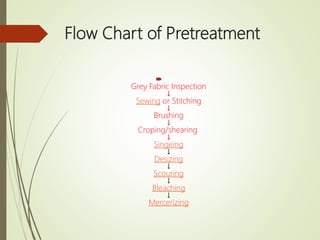
Flow Chart of Pretreatment

Grey Fabric Inspection
↓
Sewing or Stitching
↓
Brushing
↓
Croping/shearing
↓
Singeing
↓
Desizing
↓
Scouring
↓
Bleaching
↓
Mercerizing
Grey Fabric Inspection
Grey fabric inspection is the process of identifying weaving faults
in the fabric just after the grey fabric production in the loom
To find:
 Stop mark
 Pick faults, e.g.-miss pick and double pick.
 Wrong density /drawing
 Pattern or design break
 Selvedge faults, e.g.-lashing in, cut selvedge.
 Oil stain.
 Crack, hole 8. Missing ends
 Slubs.
Process of grey fabric inspection
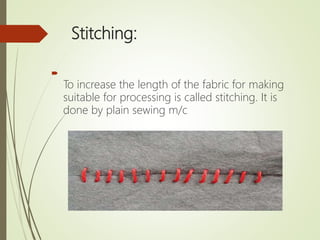
Stitching:

To increase the length of the fabric for making
suitable for processing is called stitching. It is
done by plain sewing m/c
Brushing:
 To remove the dirt, dust, loose fibre & loose
ends of the warp & weft threads is known as
brushing.
Shearing / Cropping:

The process by which the attached ends of the warp & weft thread is
removed by cutting by the knives or blades is called shearing. Shearing is
done for cotton & cropping for jute. After Shearing or cropping fabrics
goes under singeing process.
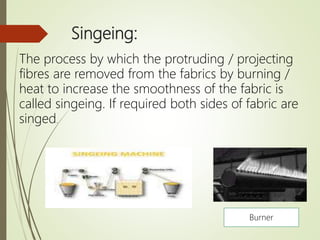
Singeing:
The process by which the protruding / projecting
fibres are removed from the fabrics by burning /
heat to increase the smoothness of the fabric is
called singeing. If required both sides of fabric are
singed.
Burner
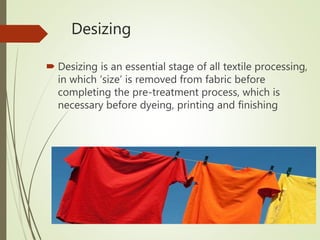
Desizing
 Desizing is an essential stage of all textile processing,
in which ‘size’ is removed from fabric before
completing the pre-treatment process, which is
necessary before dyeing, printing and finishing
Scouring
 Scouring is the first process carried out with or
without chemicals, at room temperature or at
suitable higher temperatures with the addition of
suitable wetting agents, alkali and so on. Scouring
removes all the waxes, pectins and makes the textile
material hydrophilic or water absorbent.
Bleaching
 Bleaching is chemical treatment employed for the
removal of natural coloring matter from the
substrate. The source of natural color is organic
compounds with conjugated double bonds , by
doing chemical bleaching the discoloration takes
place by the breaking the chromophore , most likely
destroying the one or more double bonds with in
this conjugated system. The material appears whiter
after the bleaching.
Mercerizing:
A treatment of cotton yarn or fabric to increase its luster and affinity for
dyes. The material is immersed under tension in a cold sodium
hydroxide (caustic soda) solution in warp or skein form or in the piece,
and is later neutralized in acid. The process causes a permanent
swelling of the fiber and thus increases its luster. It is the process of
treatment of cellulosic material with cold or hot caustic conditions under
specific conditions to improve its appearance and physical as well as
chemical properties.
 Objects:
 1.To improve the lusture
2.To improve the strength
3. To improve the dye uptake and moisture
regain.
Sizing:
Size is a gelatinous film forming substance in solution or
dispersion form, applied normally to warp yarns. It can
sometimes be applied to weft yarns. Sizing is the process of
applying the size material on yarn. A generic term for
compounds that are applied to warp yarn to bind the fiber
together and stiffen the yarn to provide abrasion resistance
during weaving.
Starch, gelatin, oil, wax, and manufactured polymers such as
polyvinyl alcohol, polystyrene, polyacrylic acid, and
polyacetates are employed. The process of applying sizing
compounds. The process of weighing sample lengths of yarn
to determine the count.
 -pre-treatment

-pre-treatment

  • 1.
    Welcome to ourpresentation Different treatments of wet processing  Md. Monirul Islam  Fazle Rabby  Shawpon  Ovi Islam  Faridul Islam Milon  Manab sharkar
  • 2.
    Flow Chart ofPretreatment  Grey Fabric Inspection ↓ Sewing or Stitching ↓ Brushing ↓ Croping/shearing ↓ Singeing ↓ Desizing ↓ Scouring ↓ Bleaching ↓ Mercerizing
  • 3.
    Grey Fabric Inspection Greyfabric inspection is the process of identifying weaving faults in the fabric just after the grey fabric production in the loom To find:  Stop mark  Pick faults, e.g.-miss pick and double pick.  Wrong density /drawing  Pattern or design break  Selvedge faults, e.g.-lashing in, cut selvedge.  Oil stain.  Crack, hole 8. Missing ends  Slubs.
  • 4.
    Process of greyfabric inspection
  • 5.
    Stitching:  To increase thelength of the fabric for making suitable for processing is called stitching. It is done by plain sewing m/c
  • 6.
    Brushing:  To removethe dirt, dust, loose fibre & loose ends of the warp & weft threads is known as brushing.
  • 7.
    Shearing / Cropping:  Theprocess by which the attached ends of the warp & weft thread is removed by cutting by the knives or blades is called shearing. Shearing is done for cotton & cropping for jute. After Shearing or cropping fabrics goes under singeing process.
  • 8.
    Singeing: The process bywhich the protruding / projecting fibres are removed from the fabrics by burning / heat to increase the smoothness of the fabric is called singeing. If required both sides of fabric are singed. Burner
  • 9.
    Desizing  Desizing isan essential stage of all textile processing, in which ‘size’ is removed from fabric before completing the pre-treatment process, which is necessary before dyeing, printing and finishing
  • 10.
    Scouring  Scouring isthe first process carried out with or without chemicals, at room temperature or at suitable higher temperatures with the addition of suitable wetting agents, alkali and so on. Scouring removes all the waxes, pectins and makes the textile material hydrophilic or water absorbent.
  • 12.
    Bleaching  Bleaching ischemical treatment employed for the removal of natural coloring matter from the substrate. The source of natural color is organic compounds with conjugated double bonds , by doing chemical bleaching the discoloration takes place by the breaking the chromophore , most likely destroying the one or more double bonds with in this conjugated system. The material appears whiter after the bleaching.
  • 14.
    Mercerizing: A treatment ofcotton yarn or fabric to increase its luster and affinity for dyes. The material is immersed under tension in a cold sodium hydroxide (caustic soda) solution in warp or skein form or in the piece, and is later neutralized in acid. The process causes a permanent swelling of the fiber and thus increases its luster. It is the process of treatment of cellulosic material with cold or hot caustic conditions under specific conditions to improve its appearance and physical as well as chemical properties.
  • 15.
     Objects:  1.Toimprove the lusture 2.To improve the strength 3. To improve the dye uptake and moisture regain.
  • 16.
    Sizing: Size is agelatinous film forming substance in solution or dispersion form, applied normally to warp yarns. It can sometimes be applied to weft yarns. Sizing is the process of applying the size material on yarn. A generic term for compounds that are applied to warp yarn to bind the fiber together and stiffen the yarn to provide abrasion resistance during weaving.
  • 17.
    Starch, gelatin, oil,wax, and manufactured polymers such as polyvinyl alcohol, polystyrene, polyacrylic acid, and polyacetates are employed. The process of applying sizing compounds. The process of weighing sample lengths of yarn to determine the count.