Money Laundering
What is Money Laundering?
The process in which large amounts of money
obtained from illegal activities conducted are
created to be appeared as legitimate.
Ex: crimes such as drug trafficking, terrorist
activities etc.
It is proved that billions of dollars are laundered through financial
institutions on an annual basis.
Why Money Laundering is considered as a growing
concern?
Why is it difficult to track of Money
Laundering activities?
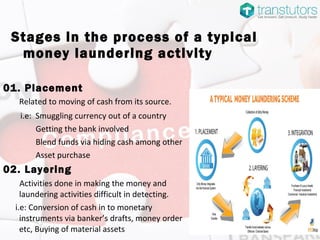
01. Placement
Related to moving of cash from its source.
i.e: Smuggling currency out of a country
Getting the bank involved
Blend funds via hiding cash among other
Asset purchase
02. Layering
Activities done in making the money and
laundering activities difficult in detecting.
i.e: Conversion of cash in to monetary
instruments via banker’s drafts, money order
etc, Buying of material assets
Stages in the process of a typical
money laundering activity
03. Integration
Moving laundered money in to the economy via the banking system, ensuring
that they seem to be via normal earnings.
i.e.
- Selling off of properties to integrate money back in to the economy
- Implementing front companies and falsify loans
- Off shore account maintenance
- Usage of false export or import invoices
Impacts on economy due to Money
Laundering
 Undermining the legitimate private sector
 Undermining the integrity of financial markets
 Loss of control across economic policy
 Distortion of the economy and instability
 Revenue losses
 Risks faced in privatization efforts
 Reputation risk
How to identify money laundering?
Financial Institutions should have close watch on:
• Insufficient and suspicious behavior
• Maintenance of records
• Observing of changing business activities
• Changes in transaction patterns
AML Software system used to address
the issues:
• Transaction monitoring systems
• Currency transaction reporting (CTR) systems
• Customer identity management systems
• Compliance management software
Conclusion
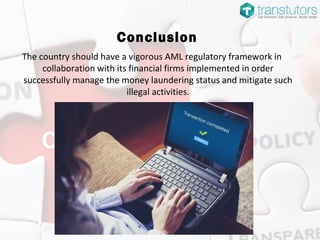
The country should have a vigorous AML regulatory framework in
collaboration with its financial firms implemented in order
successfully manage the money laundering status and mitigate such
illegal activities.
Hey Friend,
This was just a summary on Money Laundering. For more detailed information on this
topic, please type the link given below or copy it from the description of this PPT and
open it in a new browser window.
www.transtutors.com/homework-help/finance/money-
laundering.aspx

Money Laundering | Finance

  • 1.
  • 2.
    What is MoneyLaundering? The process in which large amounts of money obtained from illegal activities conducted are created to be appeared as legitimate. Ex: crimes such as drug trafficking, terrorist activities etc. It is proved that billions of dollars are laundered through financial institutions on an annual basis. Why Money Laundering is considered as a growing concern?
  • 3.
    Why is itdifficult to track of Money Laundering activities?
  • 4.
    01. Placement Related tomoving of cash from its source. i.e: Smuggling currency out of a country Getting the bank involved Blend funds via hiding cash among other Asset purchase 02. Layering Activities done in making the money and laundering activities difficult in detecting. i.e: Conversion of cash in to monetary instruments via banker’s drafts, money order etc, Buying of material assets Stages in the process of a typical money laundering activity
  • 5.
    03. Integration Moving launderedmoney in to the economy via the banking system, ensuring that they seem to be via normal earnings. i.e. - Selling off of properties to integrate money back in to the economy - Implementing front companies and falsify loans - Off shore account maintenance - Usage of false export or import invoices
  • 6.
    Impacts on economydue to Money Laundering  Undermining the legitimate private sector  Undermining the integrity of financial markets  Loss of control across economic policy  Distortion of the economy and instability  Revenue losses  Risks faced in privatization efforts  Reputation risk
  • 7.
    How to identifymoney laundering? Financial Institutions should have close watch on: • Insufficient and suspicious behavior • Maintenance of records • Observing of changing business activities • Changes in transaction patterns
  • 8.
    AML Software systemused to address the issues: • Transaction monitoring systems • Currency transaction reporting (CTR) systems • Customer identity management systems • Compliance management software
  • 9.
    Conclusion The country shouldhave a vigorous AML regulatory framework in collaboration with its financial firms implemented in order successfully manage the money laundering status and mitigate such illegal activities.
  • 10.
    Hey Friend, This wasjust a summary on Money Laundering. For more detailed information on this topic, please type the link given below or copy it from the description of this PPT and open it in a new browser window. www.transtutors.com/homework-help/finance/money- laundering.aspx