2/9/2017 1
MONEY LAUNDERING
• The word “laundry” literally means “cleaning”
• Metaphorically, money laundering refers to “cleaning of money”
2/9/2017 2
2/9/2017 3
What is Money Laundering?
Money laundering is the name given to the process by which illegally obtained
funds are given the appearance of having been legitimately obtained.
According to Swiss Bank:
Money laundering is a process whereby the origin of funds generated by illegal
means is concealed (drug trafficking, gun smuggling, corruption, etc.)
2/9/2017 4
Objectives of Money Laundering
Money laundering is performed systematically and clandestinely, making it difficult
to identify exactly how much money is involved, what methods are employed and
what the magnitude of the problem is.
Hide:
To reflect the fact that cash is often introduced to the economy via commercial
concerns which may knowingly or not knowingly be part of the laundering scheme,
and it is these which ultimately prove to be the interface between the criminal and
the financial sector
Contd..
Move:
Clearly explains that the money launderer uses transfers, sales and purchase
of assets, and changes the shape and size of the lump of money so as to
overshadow the trail between money and crime or money and criminal.
Invest:
The criminal spends the money: he/she may invest it in assets, or in his/her
lifestyles.
Criminals Of Money Laundering
• Drug dealers – Drug trafficking
• Mobsters / Gang members - Extortion
• Bad politicians – Corruption
• Bad public officers - Corruption
• Embezzlers - Fraud
• Terrorists – Terrorist activities
2/9/2017 7
2/9/2017 8
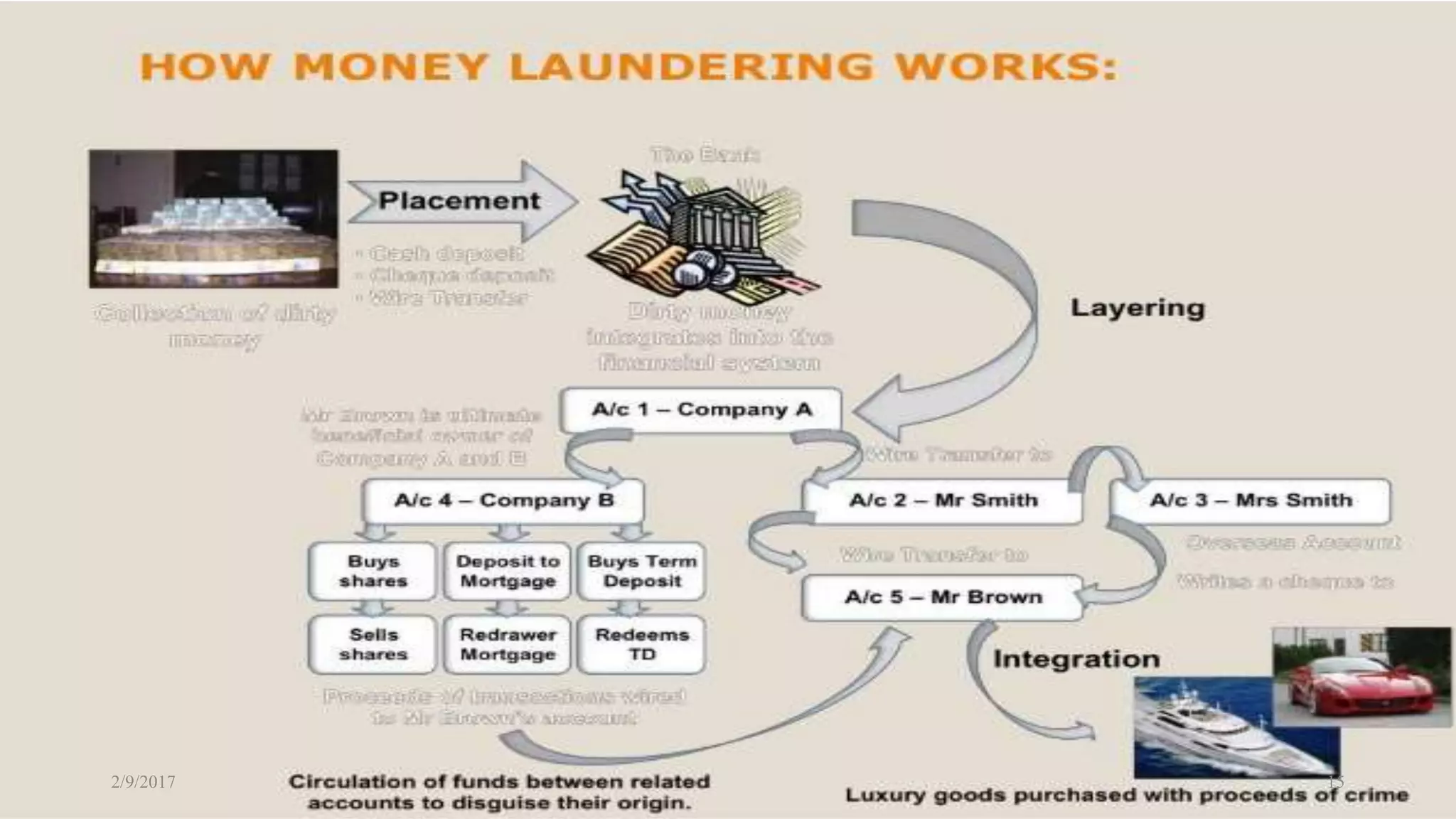
Stages in Money Laundering
1. Placement: Obtaining the money or introducing it into the financial
system in some way
2. Layering: Transferring or concealing the source of the money
through complex or multiple transactions
3. Integration: Returning the money back into the financial world so
that it appears legitimate.
2/9/2017 9
Placement
Placement refers to the physical disposal of bulk cash proceeds derived
from illegal activity. This is the first step of the money-laundering
process and the ultimate aim of this phase is to remove the cash from
the location of acquisition so as to avoid detection from the authorities.
2/9/2017 10
Contd…
This is achieved by investing criminal money into the legal financial
system by opening up a bank account in the name of unknown
individuals or organizations and depositing the money in that account. It
may involve use of smurfing techniques through which the launderers
make numerous deposits of amounts of money that are small enough to
avoid raising suspicion.
2/9/2017 11
Layering
Layering is the movement of funds from institution to hide their origin.
It consists of putting funds, which have entered the financial system,
through series of financial operations to mislead potential investigators
and to give the funds the appearance of having legal origins. Again,
obscuring the source is the key. Launderers may purchase expensive
items such as jewellery or cars in order to change the money form.
2/9/2017 12
Layering
Integration
2/9/2017 13
Integration
Integration refers to the reinsertion of the laundered proceeds back into
the economy in such a way that they re-enter the financial system as
normal business funds. The funds may be reintroduced in the economy
through, for instance, the purchase of luxury items or through
investment in assets such as shares in a company or real estate.
2/9/2017 14
2/9/2017 15
Money Laundering Techniques
• Bulk cash smuggling involves literally smuggling cash into another
country for deposit into offshore banks or other type of financial
institutions that honour client secrecy.
• Structuring also referred to as “smurfing,” is a method in which cash
is broken down into smaller amount, which are then used to purchase
money orders or other instruments to avoid detection or suspicion.
2/9/2017 16
Contd…
• Cash-intensive business occurs when a business that legitimately
deals with large amounts of cash uses its accounts to deposit money
obtained from both everyday business proceeds and money obtained
through illegal means. Businesses able to claim all of these proceeds
as legitimate income include those that provide services rather than
goods, such as strip clubs, car washes, parking buildings or lots, and
other businesses with low variable costs.
2/9/2017 17
Contd…
• Trade-based laundering is in which invoices are altered to show a
higher or lower amount in order to mask the movement of money.
• Shell companies and trusts are used to disguise the true owner or
agent of a large amount of money.
• Bank capture refers to the use of a bank owned by money launderers
or criminals, who then move funds through the bank without fear of
investigation.2/9/2017 18
Contd…
• Real estate laundering occurs when someone purchases real estate with
money obtained illegally, then sells the property. This makes it seem as if
the profits are legitimate.
• Casino laundering involves an individual going into a casino with illegally
obtained money. The individual purchases chips with the cash, plays for a
while, then cashes out the chips, and claims the money as gambling
winnings.
2/9/2017 19
Causes Of Money Laundering
• Absence of legislation
• Evasion of tax
• Increase in profits
• To make black money appear white money
• Limited risks of exposure
2/9/2017 20
Absence of legislation against money laundering
Absence of legislation against money laundering give a free hand to
criminals. Sometimes governments itself is involved they do this to win
political rivals, to please their allies and to strengthen their rule. Also
CBR (Central Board of Revenue) has never bothered to unearth
laundered money, rather always joined hands with the money
launderers.
2/9/2017 21
Evasion of tax
Tax evaders launder money so that they can
lie about where money and assets came from
in order to evade tax. And sometimes they
simply operate outside that part of the
economy where records are kept.
2/9/2017 22
Increase profits
When people have incentive for more
profit in any particular area, such as in
production and trading of drugs, arms,
and across the borders trade, they start
taking risk to earn higher profits.
2/9/2017 23
To Appear black money legitimate
In money laundering, black money
usually becomes legitimate after a series
of process. And less risk is involved of
being caught. This doesn’t happen in
other economic crimes. So in order to
appear their money more legitimate they
go for money laundering.
2/9/2017 24
Limited risks
The availability of multiple opportunities
for personal enrichment without the risk of
being exposed is another cause of money
laundering. Such economic environments
are much more conducive to make black
money.
2/9/2017 25
Effects of Money Laundering
• Effects of money laundering on Economy
• Effects of money laundering on society
• Effects of money laundering on Business
2/9/2017 26
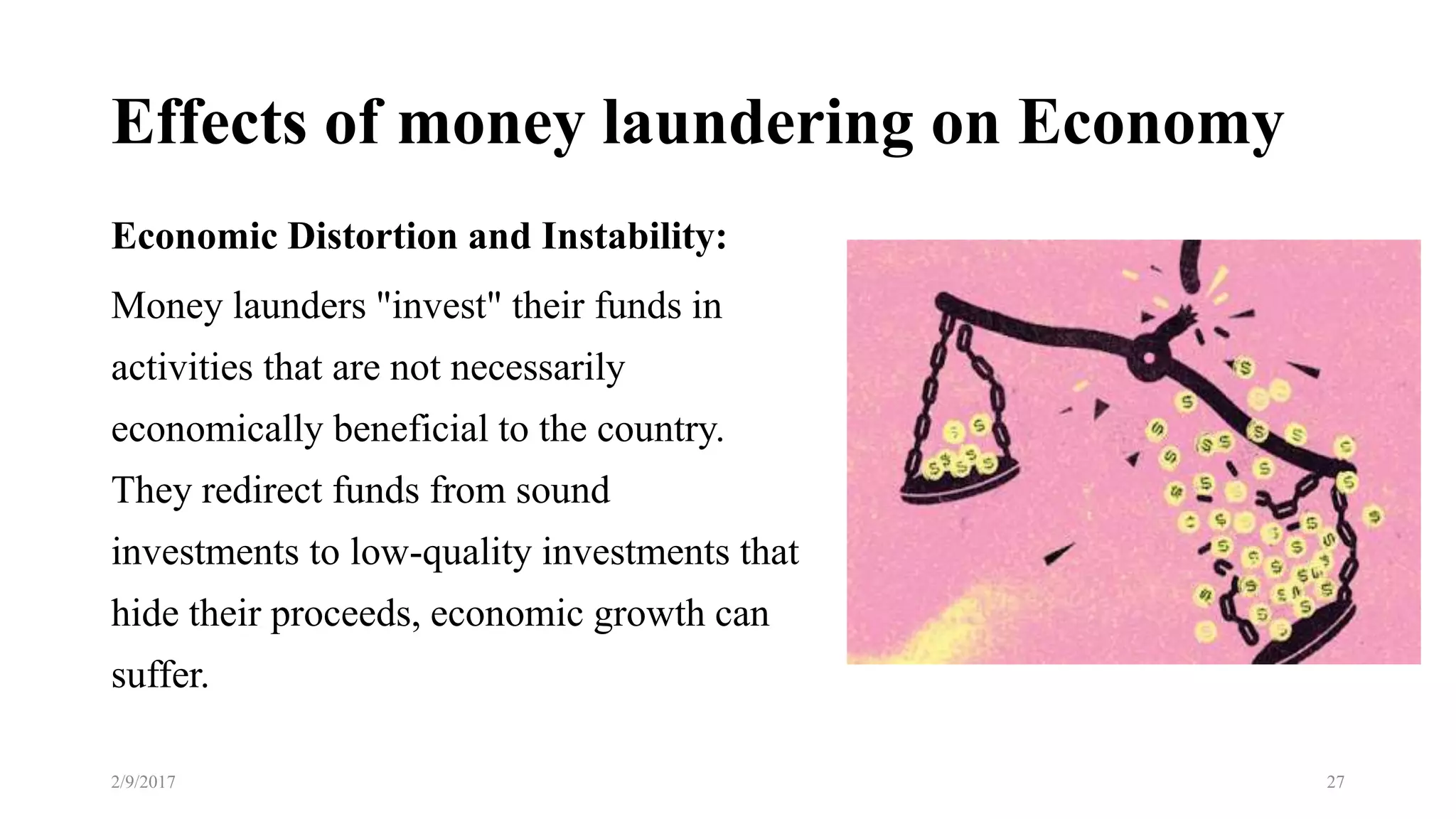
Effects of money laundering on Economy
Economic Distortion and Instability:
Money launders "invest" their funds in
activities that are not necessarily
economically beneficial to the country.
They redirect funds from sound
investments to low-quality investments that
hide their proceeds, economic growth can
suffer.
2/9/2017 27
Money laundering facilitates corruption and
crime
Money laundering reduces criminal’s
cost of crime, thereby increasing the
level of crime. Lax anti- money-
laundering policies encourage the
criminal activities and corruption.
2/9/2017 28
Loss of Control of Economic Policy
Some phases of money laundering
transactions are "underground" or in the
informal sector of the economy, such
transactions do not appear in official
monetary and financial statistics, thus giving
misleading information to policymakers and
leads to misallocation of resources.
2/9/2017 29
Undermining the integrity of financial markets
Large sums of laundered money may arrive at a
financial institution but then disappear suddenly,
without notice, This can result in liquidity
problems to financial institutions. Indeed,
criminal activity has been associated with a
number of bank failures around the globe.
2/9/2017 30
Evasion of tax
Laundered money is usually untaxed, meaning the
rest of us ultimately have to make up the loss in
tax revenue. People who indulge into money
laundering do not declare the funds to the tax
authorities. As a result taxes are not paid for the
ill-gotten funds. This effectively reduces tax
revenues for the governments and ends up
damaging economic development.
2/9/2017 31
Effects of money laundering on society
Increase In Criminal Activities:
Money Laundering allows drug traffickers,
smugglers, and other criminals to expand their
operations. This drives up the cost of
government due to the need for increased law
enforcement and health care expenditures (for
example, for treatment of drug addicts) to
combat the serious consequences that result.
2/9/2017 32
Concentration Of Power To Criminals
Among its other negative socioeconomic effects, money laundering
transfers economic power from the market, government, and citizens to
criminals. As the economic power is in the hands of criminals so they
have a corrupting effect on all elements of society. In extreme cases, it
can lead to the virtual take-over of legitimate government.
2/9/2017 33
Undermines Democracy
The economic and political influence
of criminal organizations can weaken
the social fabric, collective ethical
standards, and ultimately the
democratic institutions of society.
2/9/2017 34
Effects of money laundering on Business
If funds from criminal activity can be easily processed
through a particular business – either because its employees
or director shave been bribed or because the institution turns
a blind eye to the criminal nature of such funds – the
institution could be drawn into active complicity with
criminals and become part of the criminal network itself.
Evidence of such complicity will have a damaging effect on
the attitudes all stakeholders of company i.e. shareholders,
suppliers, customers, employees etc.2/9/2017 35
Anti-Money Laundering Laws
Anti-money laundering laws reflect an effort made the government to stop
money laundering methods that involve financial institutions. Under the
guidelines set forth by anti-money laundering, or “AML” financial
institutions are required to verify large sums of money passing through the
institution, and they are required to report suspicious transactions. It is
estimated that money laundering is so prominent globally, that it is impossible
for the Financial Action Task Force to produce estimates or figures as to its
scope.
2/9/2017 36
Prevention of money laundering act, 2002
(PMLA)
It is an act to prevent Money Laundering and to provide for confiscation of property derived
from, or involved in, money laundering and to punish those who commit the offence of
money laundering.
WHO CAN INVESTIGATE A CASE OF MONEY LAUNDERING ?
As per Sections 48 & 49 of the PMLA, the officers of the Directorate of Enforcement have
been given powers to investigate cases of Money Laundering. The officers have also been
authorised to initiate proceedings for attachment of property and to launch prosecution in
the designated Special Court for the offence of money laundering.
2/9/2017 37
What are the possible actions which can be taken against persons / properties involved in
money laundering?
1. Attachment of property under sec 5.
1. Where the Director, or any other officer not below the rank of Deputy Director authorised by him for the
purposes of this section, has reason to believe (the reason for such belief to be recorded in writing), on the
basis of material in his possession, that—
2. (a) any person is in possession of any proceeds of crime;
3. (b) such person has been charged of having committed a scheduled offence;
2. Imprisonment for a term not less than 3 years, it may extend up to 7 years and shall be liable to
fine which may extend to 5 Lakh rupees. (It may extend up to 10 years and In case offence is
punishable under the Narcotics and Psychotropic substances Act, 1985)
3. The prosecution or conviction of any legal juridical person is not contingent on the prosecution
or conviction of any individual.
2/9/2017 38
Financial Action Task Force (FATF)
• It was formed in 1989 by a coalition of countries. This
intergovernmental agency was designed to develop and promote
international cooperation for combating money laundering.
• As of 2015, the FATF is comprised of 34 different countries, but the
agency is always seeking to expand its membership to more regions.
• Headquartered in Paris, France, the FATF also works to combat the
financing of terrorism.
2/9/2017 39
FATF
The FATF has developed recommendations to combat money laundering, and
the agency has three functions in regards to this criminal activity:
• Monitoring the progress of member countries in their anti-money
laundering measures
• Reviewing trends and techniques in money laundering, reporting these, as
well as new counter measures, to member countries
• Promoting FATF anti-money laundering measures and standards globally
2/9/2017 40
Bank Secrecy Act
• The Bank Secrecy Act (the “BSA”) also known as Currency and Foreign Transactions
Reporting Act was enacted by US Congress in 1970, as an effort to combat the use of financial
institutions in money laundering crimes. The Act contains laws that require financial institutions to
report certain transactions to the United States Department of Treasury, including transactions in
excess of $10,000(cash transactions on daily aggregate basis).
• The institutions must also file a Suspicious Activity Report, or “SAR,” if they consider any
financial transaction suspicious or believe the funds comes from unlawful activities. The Act is also
responsible for the creation of the Financial Crimes Enforcement Network, which makes reports of
money-laundering or suspicious activity available to criminal investigators around the world.
2/9/2017 41
Other Anti-Money Laundering Regulations
• The Money Laundering Control Act of 1986, which prohibits engaging in any
transactions involving proceeds generated from illegal activities.
• The 1988 Anti-Drug Abuse Act, which expanded the definition of “financial
institution” to include car dealers and real estate personnel, requiring them to file
reports on transactions involving large amounts of currency.
• The Money Laundering Suppression Act of 1994 requires banks to develop and
institute training in anti money laundering examination procedures.
2/9/2017 42
Contd..
• The 1992 Annunzio-Wylie Anti-Money Laundering Act, which requires more
strict sanctions for violations of the BSA, and requiring additional verifications,
recordkeeping, and reporting for wire transfers.
• The Money Laundering and Financial Crimes Strategy Act of 1998 requires
banking agencies to develop training for examiners.
Unfortunately, as these money laundering regulations are put into place, criminals
work to find new methods to prevent their activity from becoming detected or
considered suspicious.
2/9/2017 43
The Role of Financial Institutions in Combating
Money Laundering
In this age of electronic transactions to and from financial institutions around the
globe, anti money laundering laws attempt to quell money laundering by requiring
these institutions to identify and report suspicious activities. Technology has also
paved the way for anti-money laundering software, detects large increases in
account balances or large withdrawals, and which filters data and classifies it
according to levels of suspicion. Software is also used to detect transactions with
banking institutions in blacklisted or hostile countries. When such transactions are
identified, the program alerts bank managers who then study the information and
decide whether it should be reported to the government.
2/9/2017 44
Penalties for Money Laundering
The penalties for money laundering vary greatly
depending on the circumstance and the amount of
funds involved. The penalties may also vary if the
acts occurred in more than one jurisdiction. In
addition to imprisonment, punishment for money
laundering may include large fines, restitution,
and community service. Typically, more the
money involved, the harsher the punishment.
2/9/2017 45
Recent Money Laundering Example cases
• Union Minister VK Singh's Aide Questioned In Money Laundering
Case
• THE ENFORCEMENT Directorate (ED) questioned a former aide of Union
minister V K Singh and recorded his statement under the Prevention of Money
Laundering Act (PMLA) for allegedly defaulting on a bank loan of approximately
Rs 30 crore and providing bogus documents while securing the loan.
2/9/2017 46
2/9/2017 47
2/9/2017 48
Recommendations
• Financial institutions should maintain, for at least five years, all necessary records on transactions,
both domestic or international, to enable them to comply swiftly with information.
• Financial institutions should pay special attention to all complex, unusual large transactions, and all
unusual patterns of transactions, which have no apparent economic or visible lawful purpose¨.
• If a financial institution suspects or has reasonable grounds to suspect that funds are the proceeds
of a criminal activity, or are related to terrorist financing, it should be required, directly by law or
regulation, to report promptly its suspicions to the financial intelligence unit (FIU).
• Other global organizations fighting money laundering include: The United Nations, The
International Monetary Fund, The World Bank.
2/9/2017 49
2/9/2017 50

Money laundering

  • 1.
  • 2.
    MONEY LAUNDERING • Theword “laundry” literally means “cleaning” • Metaphorically, money laundering refers to “cleaning of money” 2/9/2017 2
  • 3.
  • 4.
    What is MoneyLaundering? Money laundering is the name given to the process by which illegally obtained funds are given the appearance of having been legitimately obtained. According to Swiss Bank: Money laundering is a process whereby the origin of funds generated by illegal means is concealed (drug trafficking, gun smuggling, corruption, etc.) 2/9/2017 4
  • 5.
    Objectives of MoneyLaundering Money laundering is performed systematically and clandestinely, making it difficult to identify exactly how much money is involved, what methods are employed and what the magnitude of the problem is. Hide: To reflect the fact that cash is often introduced to the economy via commercial concerns which may knowingly or not knowingly be part of the laundering scheme, and it is these which ultimately prove to be the interface between the criminal and the financial sector
  • 6.
    Contd.. Move: Clearly explains thatthe money launderer uses transfers, sales and purchase of assets, and changes the shape and size of the lump of money so as to overshadow the trail between money and crime or money and criminal. Invest: The criminal spends the money: he/she may invest it in assets, or in his/her lifestyles.
  • 7.
    Criminals Of MoneyLaundering • Drug dealers – Drug trafficking • Mobsters / Gang members - Extortion • Bad politicians – Corruption • Bad public officers - Corruption • Embezzlers - Fraud • Terrorists – Terrorist activities 2/9/2017 7
  • 8.
  • 9.
    Stages in MoneyLaundering 1. Placement: Obtaining the money or introducing it into the financial system in some way 2. Layering: Transferring or concealing the source of the money through complex or multiple transactions 3. Integration: Returning the money back into the financial world so that it appears legitimate. 2/9/2017 9
  • 10.
    Placement Placement refers tothe physical disposal of bulk cash proceeds derived from illegal activity. This is the first step of the money-laundering process and the ultimate aim of this phase is to remove the cash from the location of acquisition so as to avoid detection from the authorities. 2/9/2017 10
  • 11.
    Contd… This is achievedby investing criminal money into the legal financial system by opening up a bank account in the name of unknown individuals or organizations and depositing the money in that account. It may involve use of smurfing techniques through which the launderers make numerous deposits of amounts of money that are small enough to avoid raising suspicion. 2/9/2017 11
  • 12.
    Layering Layering is themovement of funds from institution to hide their origin. It consists of putting funds, which have entered the financial system, through series of financial operations to mislead potential investigators and to give the funds the appearance of having legal origins. Again, obscuring the source is the key. Launderers may purchase expensive items such as jewellery or cars in order to change the money form. 2/9/2017 12
  • 13.
  • 14.
    Integration Integration refers tothe reinsertion of the laundered proceeds back into the economy in such a way that they re-enter the financial system as normal business funds. The funds may be reintroduced in the economy through, for instance, the purchase of luxury items or through investment in assets such as shares in a company or real estate. 2/9/2017 14
  • 15.
  • 16.
    Money Laundering Techniques •Bulk cash smuggling involves literally smuggling cash into another country for deposit into offshore banks or other type of financial institutions that honour client secrecy. • Structuring also referred to as “smurfing,” is a method in which cash is broken down into smaller amount, which are then used to purchase money orders or other instruments to avoid detection or suspicion. 2/9/2017 16
  • 17.
    Contd… • Cash-intensive businessoccurs when a business that legitimately deals with large amounts of cash uses its accounts to deposit money obtained from both everyday business proceeds and money obtained through illegal means. Businesses able to claim all of these proceeds as legitimate income include those that provide services rather than goods, such as strip clubs, car washes, parking buildings or lots, and other businesses with low variable costs. 2/9/2017 17
  • 18.
    Contd… • Trade-based launderingis in which invoices are altered to show a higher or lower amount in order to mask the movement of money. • Shell companies and trusts are used to disguise the true owner or agent of a large amount of money. • Bank capture refers to the use of a bank owned by money launderers or criminals, who then move funds through the bank without fear of investigation.2/9/2017 18
  • 19.
    Contd… • Real estatelaundering occurs when someone purchases real estate with money obtained illegally, then sells the property. This makes it seem as if the profits are legitimate. • Casino laundering involves an individual going into a casino with illegally obtained money. The individual purchases chips with the cash, plays for a while, then cashes out the chips, and claims the money as gambling winnings. 2/9/2017 19
  • 20.
    Causes Of MoneyLaundering • Absence of legislation • Evasion of tax • Increase in profits • To make black money appear white money • Limited risks of exposure 2/9/2017 20
  • 21.
    Absence of legislationagainst money laundering Absence of legislation against money laundering give a free hand to criminals. Sometimes governments itself is involved they do this to win political rivals, to please their allies and to strengthen their rule. Also CBR (Central Board of Revenue) has never bothered to unearth laundered money, rather always joined hands with the money launderers. 2/9/2017 21
  • 22.
    Evasion of tax Taxevaders launder money so that they can lie about where money and assets came from in order to evade tax. And sometimes they simply operate outside that part of the economy where records are kept. 2/9/2017 22
  • 23.
    Increase profits When peoplehave incentive for more profit in any particular area, such as in production and trading of drugs, arms, and across the borders trade, they start taking risk to earn higher profits. 2/9/2017 23
  • 24.
    To Appear blackmoney legitimate In money laundering, black money usually becomes legitimate after a series of process. And less risk is involved of being caught. This doesn’t happen in other economic crimes. So in order to appear their money more legitimate they go for money laundering. 2/9/2017 24
  • 25.
    Limited risks The availabilityof multiple opportunities for personal enrichment without the risk of being exposed is another cause of money laundering. Such economic environments are much more conducive to make black money. 2/9/2017 25
  • 26.
    Effects of MoneyLaundering • Effects of money laundering on Economy • Effects of money laundering on society • Effects of money laundering on Business 2/9/2017 26
  • 27.
    Effects of moneylaundering on Economy Economic Distortion and Instability: Money launders "invest" their funds in activities that are not necessarily economically beneficial to the country. They redirect funds from sound investments to low-quality investments that hide their proceeds, economic growth can suffer. 2/9/2017 27
  • 28.
    Money laundering facilitatescorruption and crime Money laundering reduces criminal’s cost of crime, thereby increasing the level of crime. Lax anti- money- laundering policies encourage the criminal activities and corruption. 2/9/2017 28
  • 29.
    Loss of Controlof Economic Policy Some phases of money laundering transactions are "underground" or in the informal sector of the economy, such transactions do not appear in official monetary and financial statistics, thus giving misleading information to policymakers and leads to misallocation of resources. 2/9/2017 29
  • 30.
    Undermining the integrityof financial markets Large sums of laundered money may arrive at a financial institution but then disappear suddenly, without notice, This can result in liquidity problems to financial institutions. Indeed, criminal activity has been associated with a number of bank failures around the globe. 2/9/2017 30
  • 31.
    Evasion of tax Launderedmoney is usually untaxed, meaning the rest of us ultimately have to make up the loss in tax revenue. People who indulge into money laundering do not declare the funds to the tax authorities. As a result taxes are not paid for the ill-gotten funds. This effectively reduces tax revenues for the governments and ends up damaging economic development. 2/9/2017 31
  • 32.
    Effects of moneylaundering on society Increase In Criminal Activities: Money Laundering allows drug traffickers, smugglers, and other criminals to expand their operations. This drives up the cost of government due to the need for increased law enforcement and health care expenditures (for example, for treatment of drug addicts) to combat the serious consequences that result. 2/9/2017 32
  • 33.
    Concentration Of PowerTo Criminals Among its other negative socioeconomic effects, money laundering transfers economic power from the market, government, and citizens to criminals. As the economic power is in the hands of criminals so they have a corrupting effect on all elements of society. In extreme cases, it can lead to the virtual take-over of legitimate government. 2/9/2017 33
  • 34.
    Undermines Democracy The economicand political influence of criminal organizations can weaken the social fabric, collective ethical standards, and ultimately the democratic institutions of society. 2/9/2017 34
  • 35.
    Effects of moneylaundering on Business If funds from criminal activity can be easily processed through a particular business – either because its employees or director shave been bribed or because the institution turns a blind eye to the criminal nature of such funds – the institution could be drawn into active complicity with criminals and become part of the criminal network itself. Evidence of such complicity will have a damaging effect on the attitudes all stakeholders of company i.e. shareholders, suppliers, customers, employees etc.2/9/2017 35
  • 36.
    Anti-Money Laundering Laws Anti-moneylaundering laws reflect an effort made the government to stop money laundering methods that involve financial institutions. Under the guidelines set forth by anti-money laundering, or “AML” financial institutions are required to verify large sums of money passing through the institution, and they are required to report suspicious transactions. It is estimated that money laundering is so prominent globally, that it is impossible for the Financial Action Task Force to produce estimates or figures as to its scope. 2/9/2017 36
  • 37.
    Prevention of moneylaundering act, 2002 (PMLA) It is an act to prevent Money Laundering and to provide for confiscation of property derived from, or involved in, money laundering and to punish those who commit the offence of money laundering. WHO CAN INVESTIGATE A CASE OF MONEY LAUNDERING ? As per Sections 48 & 49 of the PMLA, the officers of the Directorate of Enforcement have been given powers to investigate cases of Money Laundering. The officers have also been authorised to initiate proceedings for attachment of property and to launch prosecution in the designated Special Court for the offence of money laundering. 2/9/2017 37
  • 38.
    What are thepossible actions which can be taken against persons / properties involved in money laundering? 1. Attachment of property under sec 5. 1. Where the Director, or any other officer not below the rank of Deputy Director authorised by him for the purposes of this section, has reason to believe (the reason for such belief to be recorded in writing), on the basis of material in his possession, that— 2. (a) any person is in possession of any proceeds of crime; 3. (b) such person has been charged of having committed a scheduled offence; 2. Imprisonment for a term not less than 3 years, it may extend up to 7 years and shall be liable to fine which may extend to 5 Lakh rupees. (It may extend up to 10 years and In case offence is punishable under the Narcotics and Psychotropic substances Act, 1985) 3. The prosecution or conviction of any legal juridical person is not contingent on the prosecution or conviction of any individual. 2/9/2017 38
  • 39.
    Financial Action TaskForce (FATF) • It was formed in 1989 by a coalition of countries. This intergovernmental agency was designed to develop and promote international cooperation for combating money laundering. • As of 2015, the FATF is comprised of 34 different countries, but the agency is always seeking to expand its membership to more regions. • Headquartered in Paris, France, the FATF also works to combat the financing of terrorism. 2/9/2017 39
  • 40.
    FATF The FATF hasdeveloped recommendations to combat money laundering, and the agency has three functions in regards to this criminal activity: • Monitoring the progress of member countries in their anti-money laundering measures • Reviewing trends and techniques in money laundering, reporting these, as well as new counter measures, to member countries • Promoting FATF anti-money laundering measures and standards globally 2/9/2017 40
  • 41.
    Bank Secrecy Act •The Bank Secrecy Act (the “BSA”) also known as Currency and Foreign Transactions Reporting Act was enacted by US Congress in 1970, as an effort to combat the use of financial institutions in money laundering crimes. The Act contains laws that require financial institutions to report certain transactions to the United States Department of Treasury, including transactions in excess of $10,000(cash transactions on daily aggregate basis). • The institutions must also file a Suspicious Activity Report, or “SAR,” if they consider any financial transaction suspicious or believe the funds comes from unlawful activities. The Act is also responsible for the creation of the Financial Crimes Enforcement Network, which makes reports of money-laundering or suspicious activity available to criminal investigators around the world. 2/9/2017 41
  • 42.
    Other Anti-Money LaunderingRegulations • The Money Laundering Control Act of 1986, which prohibits engaging in any transactions involving proceeds generated from illegal activities. • The 1988 Anti-Drug Abuse Act, which expanded the definition of “financial institution” to include car dealers and real estate personnel, requiring them to file reports on transactions involving large amounts of currency. • The Money Laundering Suppression Act of 1994 requires banks to develop and institute training in anti money laundering examination procedures. 2/9/2017 42
  • 43.
    Contd.. • The 1992Annunzio-Wylie Anti-Money Laundering Act, which requires more strict sanctions for violations of the BSA, and requiring additional verifications, recordkeeping, and reporting for wire transfers. • The Money Laundering and Financial Crimes Strategy Act of 1998 requires banking agencies to develop training for examiners. Unfortunately, as these money laundering regulations are put into place, criminals work to find new methods to prevent their activity from becoming detected or considered suspicious. 2/9/2017 43
  • 44.
    The Role ofFinancial Institutions in Combating Money Laundering In this age of electronic transactions to and from financial institutions around the globe, anti money laundering laws attempt to quell money laundering by requiring these institutions to identify and report suspicious activities. Technology has also paved the way for anti-money laundering software, detects large increases in account balances or large withdrawals, and which filters data and classifies it according to levels of suspicion. Software is also used to detect transactions with banking institutions in blacklisted or hostile countries. When such transactions are identified, the program alerts bank managers who then study the information and decide whether it should be reported to the government. 2/9/2017 44
  • 45.
    Penalties for MoneyLaundering The penalties for money laundering vary greatly depending on the circumstance and the amount of funds involved. The penalties may also vary if the acts occurred in more than one jurisdiction. In addition to imprisonment, punishment for money laundering may include large fines, restitution, and community service. Typically, more the money involved, the harsher the punishment. 2/9/2017 45
  • 46.
    Recent Money LaunderingExample cases • Union Minister VK Singh's Aide Questioned In Money Laundering Case • THE ENFORCEMENT Directorate (ED) questioned a former aide of Union minister V K Singh and recorded his statement under the Prevention of Money Laundering Act (PMLA) for allegedly defaulting on a bank loan of approximately Rs 30 crore and providing bogus documents while securing the loan. 2/9/2017 46
  • 47.
  • 48.
  • 49.
    Recommendations • Financial institutionsshould maintain, for at least five years, all necessary records on transactions, both domestic or international, to enable them to comply swiftly with information. • Financial institutions should pay special attention to all complex, unusual large transactions, and all unusual patterns of transactions, which have no apparent economic or visible lawful purpose¨. • If a financial institution suspects or has reasonable grounds to suspect that funds are the proceeds of a criminal activity, or are related to terrorist financing, it should be required, directly by law or regulation, to report promptly its suspicions to the financial intelligence unit (FIU). • Other global organizations fighting money laundering include: The United Nations, The International Monetary Fund, The World Bank. 2/9/2017 49
  • 50.