 Definition: The process of concealing the proceeds of
crime in an effort to conceal their illicit origins and
legitimize their future use.
 Originated from: The mafia ownership of laundromats
in the united states
 Techniques: They can be simple, diverse, complex,
subtle, but secret.
“After foreign exchange and the oil industry, the
laundering of dirty money is the world’s third-largest
business.”
Money laundering - a social menace affecting the globe
Estimated cost of laundering - 2% to 5% of GDP
between $ 500b to 1.5 million annually
India included in ‘High Risk’ group (along with Pakistan,
Singapore, Brazil and Zimbabwe) for susceptibility to
money laundering and ‘Terrorism Finance’ (Source: PWC
report)
India has set up FIU (Financial Intelligence Unit) for
tracking money laundering.
 Money Laundering, Directly or indirectly, Attempts or assists
knowingly or party to any activity, Connected with proceeds
of crime, Projecting it as untainted property, Property or
value of such property derived or obtained, Directly or
indirectly
Property is a result of crime related to a “scheduled offence”
 Under the Arms Act
 Acquire, possess or use prohibited weapons
 Wildlife Protection
 Immoral Trafficking
 Prevention of Corruption Act
 Public servant taking bribe, or taking bribe to influence
public servant
 Against the country
 Terrorism, conspiracy, etc
 Relating to Drugs
 Possessing or dealing with Poppy straw, opium,
cannabis
 Under the Indian Penal Code
 Murder, Kidnapping, Extortion, counterfeit notes and
securities, etc
 Structuring:
 Bulk cash smuggling:
 Cash-intensive businesses:
 Trade-based laundering:
 Shell companies and trusts:
 Round-tripping:
 Bank capture:.
 Casinos:
 Other gambling
 Real estate: manipulated
 Black salaries:
 Bank capture:.
 Casinos:
 Other gambling
 Real estate: manipulated
 Black salaries:
 Tax amnesties:
 Fictional loans
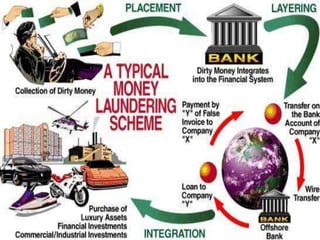
 Money laundering is commonly defined as occurring in
three steps:
 the first step involves introducing cash into the
financial system by some means ("placement");
 the second involves carrying out complex financial
transactions to camouflage the illegal source ("layering");
 and the final step entails acquiring wealth generated
from the transactions of the illicit funds
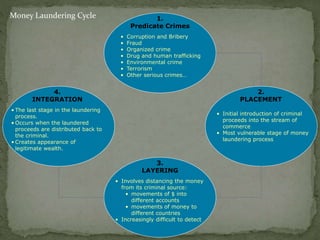
2.
PLACEMENT
3.
LAYERING
4.
INTEGRATION
• The last stage in the laundering
process.
• Occurs when the laundered
proceeds are distributed back to
the criminal.
• Creates appearance of
legitimate wealth.
• Involves distancing the money
from its criminal source:
• movements of $ into
different accounts
• movements of money to
different countries
• Increasingly difficult to detect
• Initial introduction of criminal
proceeds into the stream of
commerce
• Most vulnerable stage of money
laundering process
1.
Predicate Crimes
• Corruption and Bribery
• Fraud
• Organized crime
• Drug and human trafficking
• Environmental crime
• Terrorism
• Other serious crimes…
Money Laundering Cycle
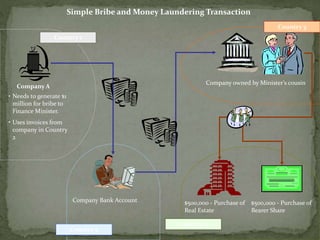
Simple Bribe and Money Laundering Transaction
Company A
• Needs to generate $1
million for bribe to
Finance Minister.
• Uses invoices from
company in Country
2
Country 1
Country 2
Company Bank Account
Country 3
Company owned by Minister’s cousin
Country 4
$500,000 - Purchase of
Real Estate
$500,000 - Purchase of
Bearer Share
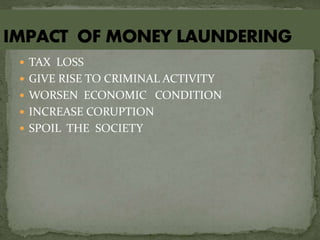
 TAX LOSS
 GIVE RISE TO CRIMINAL ACTIVITY
 WORSEN ECONOMIC CONDITION
 INCREASE CORUPTION
 SPOIL THE SOCIETY
 INTERNATIONAL AFFORTS
o Setting up of org. as FATF
o Coordination & sharing of information by agencies
 NATIONAL LEVEL AFFORTS
o Allowing FDI , prevention of money laundering act
2002
Money   laundering
Money   laundering
Money   laundering

Money laundering

  • 2.
     Definition: Theprocess of concealing the proceeds of crime in an effort to conceal their illicit origins and legitimize their future use.  Originated from: The mafia ownership of laundromats in the united states  Techniques: They can be simple, diverse, complex, subtle, but secret. “After foreign exchange and the oil industry, the laundering of dirty money is the world’s third-largest business.”
  • 3.
    Money laundering -a social menace affecting the globe Estimated cost of laundering - 2% to 5% of GDP between $ 500b to 1.5 million annually India included in ‘High Risk’ group (along with Pakistan, Singapore, Brazil and Zimbabwe) for susceptibility to money laundering and ‘Terrorism Finance’ (Source: PWC report) India has set up FIU (Financial Intelligence Unit) for tracking money laundering.
  • 4.
     Money Laundering,Directly or indirectly, Attempts or assists knowingly or party to any activity, Connected with proceeds of crime, Projecting it as untainted property, Property or value of such property derived or obtained, Directly or indirectly Property is a result of crime related to a “scheduled offence”  Under the Arms Act  Acquire, possess or use prohibited weapons  Wildlife Protection
  • 5.
     Immoral Trafficking Prevention of Corruption Act  Public servant taking bribe, or taking bribe to influence public servant  Against the country  Terrorism, conspiracy, etc  Relating to Drugs  Possessing or dealing with Poppy straw, opium, cannabis  Under the Indian Penal Code  Murder, Kidnapping, Extortion, counterfeit notes and securities, etc
  • 6.
     Structuring:  Bulkcash smuggling:  Cash-intensive businesses:  Trade-based laundering:  Shell companies and trusts:  Round-tripping:  Bank capture:.  Casinos:  Other gambling  Real estate: manipulated  Black salaries:
  • 7.
     Bank capture:. Casinos:  Other gambling  Real estate: manipulated  Black salaries:  Tax amnesties:  Fictional loans
  • 8.
     Money launderingis commonly defined as occurring in three steps:  the first step involves introducing cash into the financial system by some means ("placement");  the second involves carrying out complex financial transactions to camouflage the illegal source ("layering");  and the final step entails acquiring wealth generated from the transactions of the illicit funds
  • 10.
    2. PLACEMENT 3. LAYERING 4. INTEGRATION • The laststage in the laundering process. • Occurs when the laundered proceeds are distributed back to the criminal. • Creates appearance of legitimate wealth. • Involves distancing the money from its criminal source: • movements of $ into different accounts • movements of money to different countries • Increasingly difficult to detect • Initial introduction of criminal proceeds into the stream of commerce • Most vulnerable stage of money laundering process 1. Predicate Crimes • Corruption and Bribery • Fraud • Organized crime • Drug and human trafficking • Environmental crime • Terrorism • Other serious crimes… Money Laundering Cycle
  • 11.
    Simple Bribe andMoney Laundering Transaction Company A • Needs to generate $1 million for bribe to Finance Minister. • Uses invoices from company in Country 2 Country 1 Country 2 Company Bank Account Country 3 Company owned by Minister’s cousin Country 4 $500,000 - Purchase of Real Estate $500,000 - Purchase of Bearer Share
  • 12.
     TAX LOSS GIVE RISE TO CRIMINAL ACTIVITY  WORSEN ECONOMIC CONDITION  INCREASE CORUPTION  SPOIL THE SOCIETY
  • 13.
     INTERNATIONAL AFFORTS oSetting up of org. as FATF o Coordination & sharing of information by agencies  NATIONAL LEVEL AFFORTS o Allowing FDI , prevention of money laundering act 2002