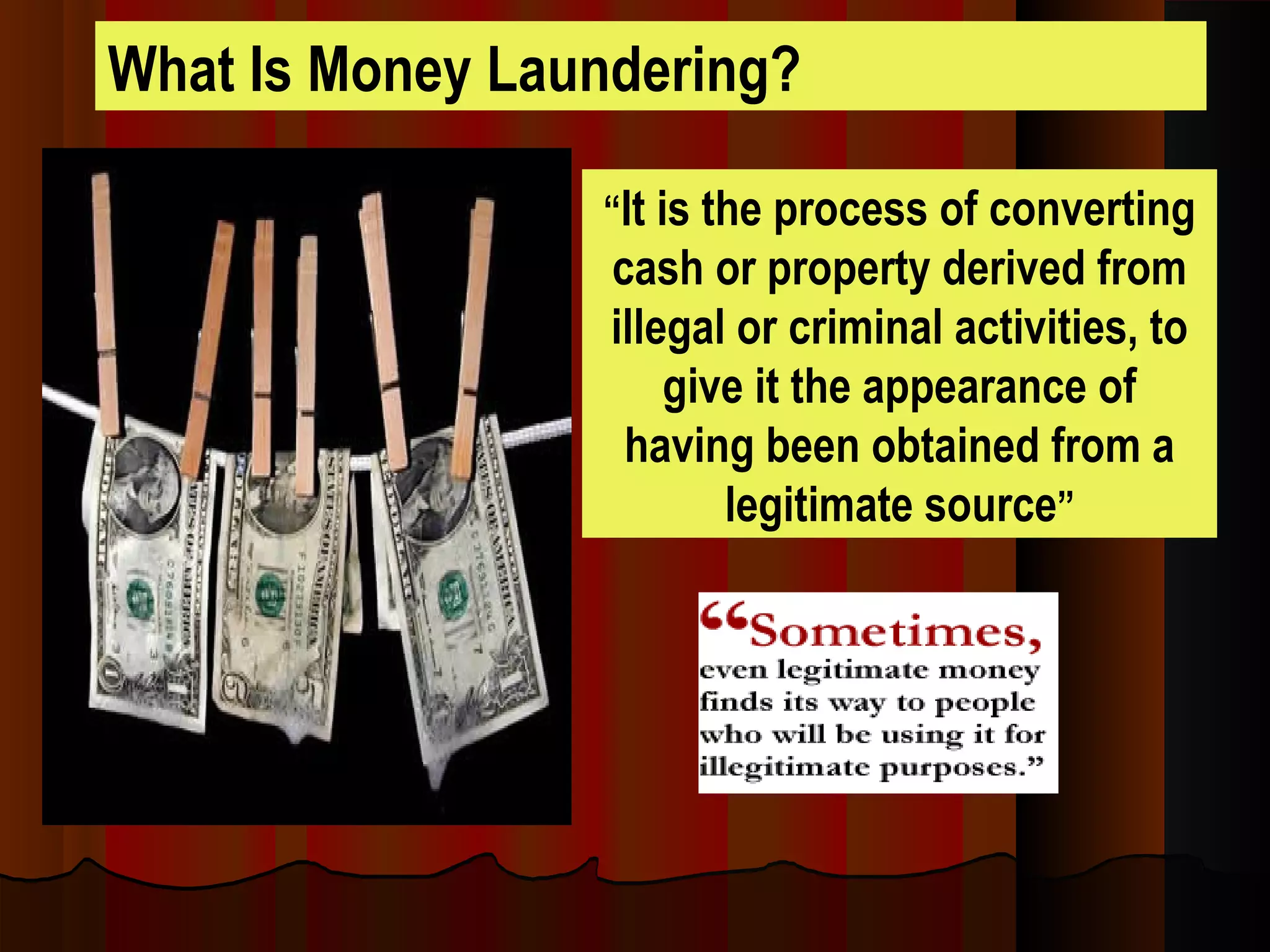


What Is Money Laundering?
“It is the process of converting
cash or property derived from
illegal or criminal activities, to
give it the appearance of
having been obtained from a
legitimate source”
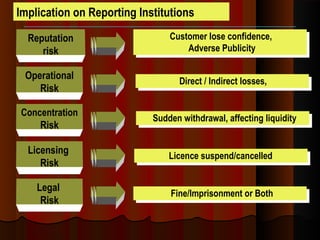
Reputation
risk
Customer lose confidence,
Adverse Publicity
Customer lose confidence,
Adverse Publicity
Operational
Risk Direct / Indirect losses,Direct / Indirect losses,
Concentration
Risk Sudden withdrawal, affecting liquiditySudden withdrawal, affecting liquidity
Legal
Risk Fine/Imprisonment or BothFine/Imprisonment or Both
Licensing
Risk Licence suspend/cancelledLicence suspend/cancelled
Implication on Reporting Institutions
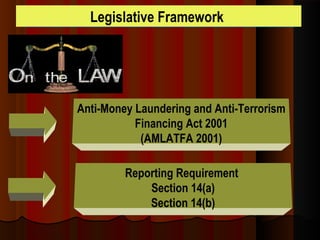
Legislative Framework
Anti-Money Laundering and Anti-Terrorism
Financing Act 2001
(AMLATFA 2001)
Reporting Requirement
Section 14(a)
Section 14(b)
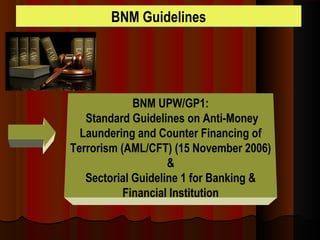
BNM Guidelines
BNM UPW/GP1:
Standard Guidelines on Anti-Money
Laundering and Counter Financing of
Terrorism (AML/CFT) (15 November 2006)
&
Sectorial Guideline 1 for Banking &
Financial Institution
Types of money laundering offences
Protection for informers
Function of BNM as competent authority
Record keeping by reporting institution (RI)
Reporting of suspicious transaction by RI
Investigation by Competent Authority and Enforcement
Agencies
Freezing, seizure and forfeiture of property
What does AMLA provide ?
Obligations to fight money laundering/terrorist financing
Obtain sufficient customer identification
(CDD, Enhanced CDD, AMLATFA Watchlist check)
Identify suspicious transactions
Monitor suspicious
`
Report suspicious transaction (STR form)
Record Keeping of documents (Not less than 6 years –Sec 11)
Duty of Reporting Institutions (Banks)
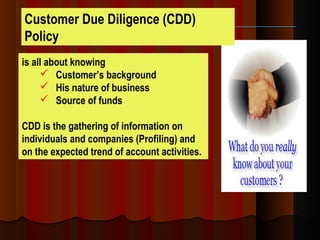
Customer Due Diligence (CDD)
Policy
is all about knowing
 Customer’s background
 His nature of business
 Source of funds
CDD is the gathering of information on
individuals and companies (Profiling) and
on the expected trend of account activities.
Customer due diligence must be conducted when:
 Establishing business relationship with any customer.
 Carrying out cash or occasional transaction in excess
of BNM specification.
 It has any suspicion of money laundering or terrorism.
 It has doubts of the correctness of previously obtained
information.
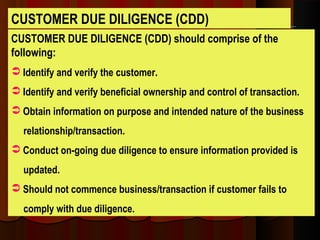
CUSTOMER DUE DILIGENCE (CDD)
CUSTOMER DUE DILIGENCE (CDD) should comprise of the
following:
 Identify and verify the customer.
 Identify and verify beneficial ownership and control of transaction.
 Obtain information on purpose and intended nature of the business
relationship/transaction.
 Conduct on-going due diligence to ensure information provided is
updated.
 Should not commence business/transaction if customer fails to
comply with due diligence.
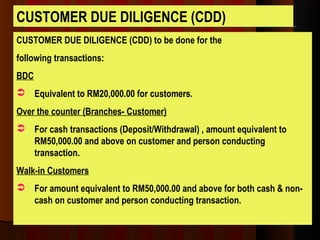
CUSTOMER DUE DILIGENCE (CDD)
CUSTOMER DUE DILIGENCE (CDD) to be done for the
following transactions:
BDC
 Equivalent to RM20,000.00 for customers.
Over the counter (Branches- Customer)
 For cash transactions (Deposit/Withdrawal) , amount equivalent to
RM50,000.00 and above on customer and person conducting
transaction.
Walk-in Customers
 For amount equivalent to RM50,000.00 and above for both cash & non-
cash on customer and person conducting transaction.
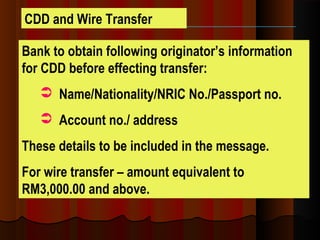
CUSTOMER DUE DILIGENCE (CDD)
Bank to obtain following originator’s information
for CDD before effecting transfer:
 Name/Nationality/NRIC No./Passport no.
 Account no./ address
These details to be included in the message.
For wire transfer – amount equivalent to
RM3,000.00 and above.
CDD and Wire Transfer
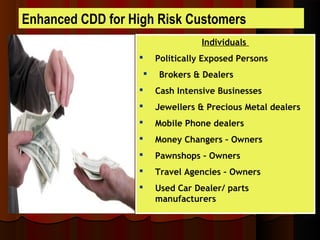
Enhanced CDD for High Risk Customers
Individuals
 Politically Exposed Persons
 Brokers & Dealers
 Cash Intensive Businesses
 Jewellers & Precious Metal dealers
 Mobile Phone dealers
 Money Changers – Owners
 Pawnshops – Owners
 Travel Agencies – Owners
 Used Car Dealer/ parts
manufacturers
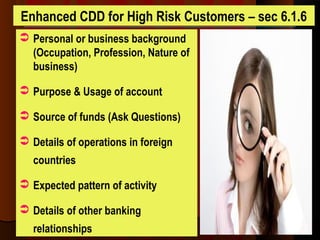
Enhanced CDD for High Risk Customers – sec 6.1.6
 Personal or business background
(Occupation, Profession, Nature of
business)
 Purpose & Usage of account
 Source of funds (Ask Questions)
 Details of operations in foreign
countries
 Expected pattern of activity
 Details of other banking
relationships
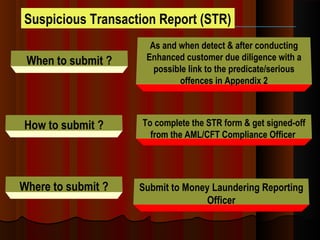
Suspicious Transaction Report (STR)
When to submit ?
As and when detect & after conducting
Enhanced customer due diligence with a
possible link to the predicate/serious
offences in Appendix 2
How to submit ?
Where to submit ?
To complete the STR form & get signed-off
from the AML/CFT Compliance Officer
Submit to Money Laundering Reporting
Officer
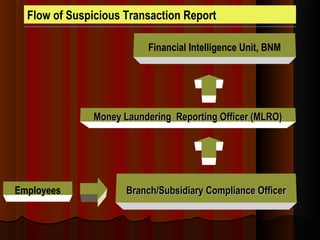
Financial Intelligence Unit, BNM
Branch/Subsidiary Compliance OfficerBranch/Subsidiary Compliance Officer
Money Laundering Reporting Officer (MLRO)Money Laundering Reporting Officer (MLRO)
Flow of Suspicious Transaction Report
Employees
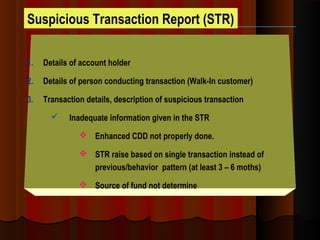
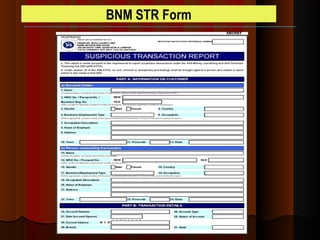
Suspicious Transaction Report (STR)
1. Details of account holder
2. Details of person conducting transaction (Walk-In customer)
3. Transaction details, description of suspicious transaction
 Inadequate information given in the STR
 Enhanced CDD not properly done.
 STR raise based on single transaction instead of
previous/behavior pattern (at least 3 – 6 moths)
 Source of fund not determine
BNM STR Form
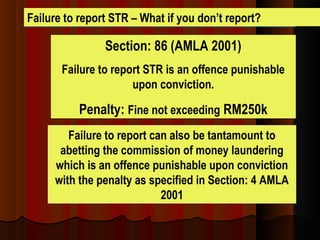
Failure to report STR – What if you don’t report?
Section: 86 (AMLA 2001)
Failure to report STR is an offence punishable
upon conviction.
Penalty: Fine not exceeding RM250k
Failure to report can also be tantamount to
abetting the commission of money laundering
which is an offence punishable upon conviction
with the penalty as specified in Section: 4 AMLA
2001
HOW TO HANDLE SUSPICIOUS CUSTOMERS
• Don’t create his suspicion
• Be discreet
• Don’t panic
• Use a phone that is out off suspect’s sight
• Don’t discuss with staff in suspect’s
presence
“ NO TIPPING
OFF ”
AMLA Penalties
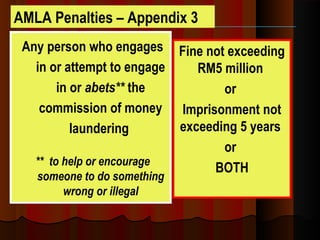
Any person who engages
in or attempt to engage
in or abets** the
commission of money
laundering
** to help or encourage
someone to do something
wrong or illegal
Fine not exceeding
RM5 million
or
Imprisonment not
exceeding 5 years
or
BOTH
AMLA Penalties – Appendix 3
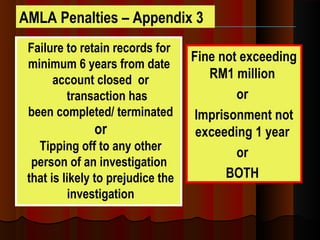
Failure to retain records for
minimum 6 years from date
account closed or
transaction has
been completed/ terminated
or
Tipping off to any other
person of an investigation
that is likely to prejudice the
investigation
Fine not exceeding
RM1 million
or
Imprisonment not
exceeding 1 year
or
BOTH
AMLA Penalties – Appendix 3
BANKS PENALIZED UNDER AMLA
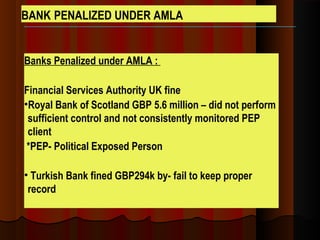
Banks Penalized under AMLA :
Financial Services Authority UK fine
•Royal Bank of Scotland GBP 5.6 million – did not perform
sufficient control and not consistently monitored PEP
client
*PEP- Political Exposed Person
• Turkish Bank fined GBP294k by- fail to keep proper
record
BANK PENALIZED UNDER AMLA
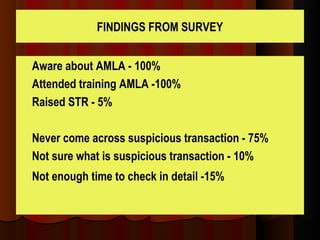
FINDINGS FROM SURVEY
 Aware about AMLA - 100%
 Attended training AMLA -100%
 Raised STR - 5%
 Never come across suspicious transaction - 75%
 Not sure what is suspicious transaction - 10%
 Not enough time to check in detail -15%
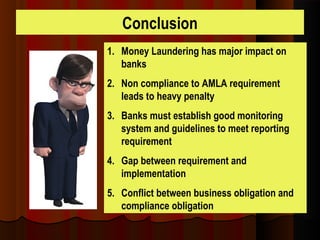
Conclusion
1. Money Laundering has major impact on
banks
2. Non compliance to AMLA requirement
leads to heavy penalty
3. Banks must establish good monitoring
system and guidelines to meet reporting
requirement
4. Gap between requirement and
implementation
5. Conflict between business obligation and
compliance obligation
Recomendations
1. Establish comprehensive written
guidelines and SOP
2. Systems to monitor and alert suspicious
transaction
3. Continuous training and awareness
programme for all staff especially
frontliners
4. Regular and comprehensive audit by BNM
5. Internal check and audit
Disclaim Notes
All photos Illustrated in this presentation are for Illustration purpose only.
Photos are obtained from varies sources from Internet and are for acedemic purpose only.
Q & A

Law amla presentation

  • 1.
    What Is MoneyLaundering? “It is the process of converting cash or property derived from illegal or criminal activities, to give it the appearance of having been obtained from a legitimate source”
  • 2.
    Reputation risk Customer lose confidence, AdversePublicity Customer lose confidence, Adverse Publicity Operational Risk Direct / Indirect losses,Direct / Indirect losses, Concentration Risk Sudden withdrawal, affecting liquiditySudden withdrawal, affecting liquidity Legal Risk Fine/Imprisonment or BothFine/Imprisonment or Both Licensing Risk Licence suspend/cancelledLicence suspend/cancelled Implication on Reporting Institutions
  • 3.
    Legislative Framework Anti-Money Launderingand Anti-Terrorism Financing Act 2001 (AMLATFA 2001) Reporting Requirement Section 14(a) Section 14(b)
  • 4.
    BNM Guidelines BNM UPW/GP1: StandardGuidelines on Anti-Money Laundering and Counter Financing of Terrorism (AML/CFT) (15 November 2006) & Sectorial Guideline 1 for Banking & Financial Institution
  • 5.
    Types of moneylaundering offences Protection for informers Function of BNM as competent authority Record keeping by reporting institution (RI) Reporting of suspicious transaction by RI Investigation by Competent Authority and Enforcement Agencies Freezing, seizure and forfeiture of property What does AMLA provide ?
  • 6.
    Obligations to fightmoney laundering/terrorist financing Obtain sufficient customer identification (CDD, Enhanced CDD, AMLATFA Watchlist check) Identify suspicious transactions Monitor suspicious ` Report suspicious transaction (STR form) Record Keeping of documents (Not less than 6 years –Sec 11) Duty of Reporting Institutions (Banks)
  • 7.
    Customer Due Diligence(CDD) Policy is all about knowing  Customer’s background  His nature of business  Source of funds CDD is the gathering of information on individuals and companies (Profiling) and on the expected trend of account activities.
  • 8.
    Customer due diligencemust be conducted when:  Establishing business relationship with any customer.  Carrying out cash or occasional transaction in excess of BNM specification.  It has any suspicion of money laundering or terrorism.  It has doubts of the correctness of previously obtained information. CUSTOMER DUE DILIGENCE (CDD)
  • 9.
    CUSTOMER DUE DILIGENCE(CDD) should comprise of the following:  Identify and verify the customer.  Identify and verify beneficial ownership and control of transaction.  Obtain information on purpose and intended nature of the business relationship/transaction.  Conduct on-going due diligence to ensure information provided is updated.  Should not commence business/transaction if customer fails to comply with due diligence. CUSTOMER DUE DILIGENCE (CDD)
  • 10.
    CUSTOMER DUE DILIGENCE(CDD) to be done for the following transactions: BDC  Equivalent to RM20,000.00 for customers. Over the counter (Branches- Customer)  For cash transactions (Deposit/Withdrawal) , amount equivalent to RM50,000.00 and above on customer and person conducting transaction. Walk-in Customers  For amount equivalent to RM50,000.00 and above for both cash & non- cash on customer and person conducting transaction. CUSTOMER DUE DILIGENCE (CDD)
  • 11.
    Bank to obtainfollowing originator’s information for CDD before effecting transfer:  Name/Nationality/NRIC No./Passport no.  Account no./ address These details to be included in the message. For wire transfer – amount equivalent to RM3,000.00 and above. CDD and Wire Transfer
  • 12.
    Enhanced CDD forHigh Risk Customers Individuals  Politically Exposed Persons  Brokers & Dealers  Cash Intensive Businesses  Jewellers & Precious Metal dealers  Mobile Phone dealers  Money Changers – Owners  Pawnshops – Owners  Travel Agencies – Owners  Used Car Dealer/ parts manufacturers
  • 13.
    Enhanced CDD forHigh Risk Customers – sec 6.1.6  Personal or business background (Occupation, Profession, Nature of business)  Purpose & Usage of account  Source of funds (Ask Questions)  Details of operations in foreign countries  Expected pattern of activity  Details of other banking relationships
  • 14.
    Suspicious Transaction Report(STR) When to submit ? As and when detect & after conducting Enhanced customer due diligence with a possible link to the predicate/serious offences in Appendix 2 How to submit ? Where to submit ? To complete the STR form & get signed-off from the AML/CFT Compliance Officer Submit to Money Laundering Reporting Officer
  • 15.
    Financial Intelligence Unit,BNM Branch/Subsidiary Compliance OfficerBranch/Subsidiary Compliance Officer Money Laundering Reporting Officer (MLRO)Money Laundering Reporting Officer (MLRO) Flow of Suspicious Transaction Report Employees
  • 16.
    Suspicious Transaction Report(STR) 1. Details of account holder 2. Details of person conducting transaction (Walk-In customer) 3. Transaction details, description of suspicious transaction  Inadequate information given in the STR  Enhanced CDD not properly done.  STR raise based on single transaction instead of previous/behavior pattern (at least 3 – 6 moths)  Source of fund not determine
  • 17.
  • 18.
    Failure to reportSTR – What if you don’t report? Section: 86 (AMLA 2001) Failure to report STR is an offence punishable upon conviction. Penalty: Fine not exceeding RM250k Failure to report can also be tantamount to abetting the commission of money laundering which is an offence punishable upon conviction with the penalty as specified in Section: 4 AMLA 2001
  • 19.
    HOW TO HANDLESUSPICIOUS CUSTOMERS • Don’t create his suspicion • Be discreet • Don’t panic • Use a phone that is out off suspect’s sight • Don’t discuss with staff in suspect’s presence “ NO TIPPING OFF ”
  • 20.
  • 21.
    Any person whoengages in or attempt to engage in or abets** the commission of money laundering ** to help or encourage someone to do something wrong or illegal Fine not exceeding RM5 million or Imprisonment not exceeding 5 years or BOTH AMLA Penalties – Appendix 3
  • 22.
    Failure to retainrecords for minimum 6 years from date account closed or transaction has been completed/ terminated or Tipping off to any other person of an investigation that is likely to prejudice the investigation Fine not exceeding RM1 million or Imprisonment not exceeding 1 year or BOTH AMLA Penalties – Appendix 3
  • 23.
  • 24.
    Banks Penalized underAMLA : Financial Services Authority UK fine •Royal Bank of Scotland GBP 5.6 million – did not perform sufficient control and not consistently monitored PEP client *PEP- Political Exposed Person • Turkish Bank fined GBP294k by- fail to keep proper record BANK PENALIZED UNDER AMLA
  • 25.
    FINDINGS FROM SURVEY Aware about AMLA - 100%  Attended training AMLA -100%  Raised STR - 5%  Never come across suspicious transaction - 75%  Not sure what is suspicious transaction - 10%  Not enough time to check in detail -15%
  • 26.
    Conclusion 1. Money Launderinghas major impact on banks 2. Non compliance to AMLA requirement leads to heavy penalty 3. Banks must establish good monitoring system and guidelines to meet reporting requirement 4. Gap between requirement and implementation 5. Conflict between business obligation and compliance obligation
  • 27.
    Recomendations 1. Establish comprehensivewritten guidelines and SOP 2. Systems to monitor and alert suspicious transaction 3. Continuous training and awareness programme for all staff especially frontliners 4. Regular and comprehensive audit by BNM 5. Internal check and audit
  • 28.
    Disclaim Notes All photosIllustrated in this presentation are for Illustration purpose only. Photos are obtained from varies sources from Internet and are for acedemic purpose only. Q & A