MOLECULAR
DYNAMICS
SIMULATIONS
WITH
GROMACS
By:
Mayur Mukhi,
WATER Lab.,
SSSIHL, PSN
Campus
COMPONENTS
Introduction
Procedure
Data Analysis
INTRODUCTION
What is MD Simulations?
Computer programs that simulate the atomic
behavior of molecules to mimic the real-life physical
forces that they experience.
Why do MD Simulations?
To bring the molecule to a natural (physiological)
and dynamic system.
Assess stability and structural compactness
THINGS TO NOTE
1. .MDP files are parameter files
2. .TPR are prerequisite files
3. .GRO is a protein file format
4. You can play around with GROMACS
PROCEDURE
(USING UBUNTU
TERMINAL)
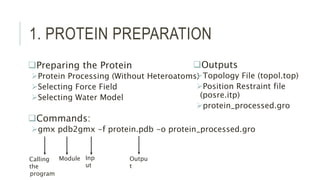
1. PROTEIN PREPARATION
Preparing the Protein
Protein Processing (Without Heteroatoms)
Selecting Force Field
Selecting Water Model
Commands:
gmx pdb2gmx -f protein.pdb -o protein_processed.gro
Calling
the
program
Module Inp
ut
Outpu
t
Outputs
Topology File (topol.top)
Position Restraint file
(posre.itp)
protein_processed.gro
2. SOLVATING THE SYSTEM
Solvation
Creating a box
Adding Water
Commands:
gmx editconf -f protein_processed.gro -o newbox.gro -bt cubic -d 1.0
(Creating Box)
gmx solvate -cp newbox.gro -cs spc216.gro -p topol.top -o solv.gro
Shape Siz
e
Outputs
Newbox.gro
Solv.gro
3. ADDING IONS
Commands:
gmx grompp -f ions.mdp -c solv.gro -p topol.top -o ions.tpr
gmx genion -s ions.tpr -o solv_ions.gro -p topol.top -pname
NA -nname CL -neutral
Outputs
Ions.tpr
solv_ions.gro
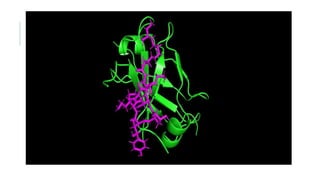
SOLVATED
PROTEIN
WITH
IONS
4. ENERGY MINIMIZATION
To obtain the lowest energy conformation of the
protein in the particular system
Commands:
gmx grompp -f em.mdp -c solv_ions.gro -p topol.top -o em.tpr
gmx mdrun -v -deffnm em
Outputs
em.tpr
em.gro
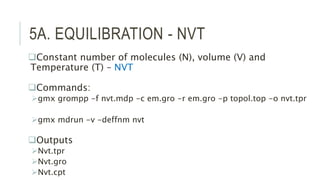
5A. EQUILIBRATION - NVT
Constant number of molecules (N), volume (V) and
Temperature (T) – NVT
Commands:
gmx grompp -f nvt.mdp -c em.gro -r em.gro -p topol.top -o nvt.tpr
gmx mdrun -v -deffnm nvt
Outputs
Nvt.tpr
Nvt.gro
Nvt.cpt
5B. EQUILIBRATION - NPT
Constant number of molecules (N), Pressure (P) and
Temperature (T) – NPT
Commands:
gmx grompp -f npt.mdp -c nvt.gro -t nvt.cpt -r nvt.gro -p topol.top -o
npt.tpr
gmx mdrun -v -deffnm npt
Outputs
Npt.tpr
Npt.gro
Npt.ctp
6. FINAL MD RUN
Constant temperature and pressure for a particular
amount of time
Commands:
gmx grompp -f md.mdp -c npt.gro -t npt.cpt -p topol.top -o
md_0_30.tpr
gmx mdrun -v -deffnm md_0_30
Outputs
Md_0.30.xtc (Trajectory
file)
Md_0.30.gro
DATA ANALSYIS
THINGS TO NOTE
All plots generated from GROMACS (.xvg) format can be
plotted
Using QtGrace or XmGRACE
1. ROOT-MEAN-SQUARE DEVIATION
(RMSD)
Commands:
gmx trjconv -s md_0_30.tpr -f md_0_30.xtc -o md_0_30_center.xtc -
center -pbc mol -ur compact (Correcting the trajectory)
gmx rms -s md_0_30.tpr -f md_0_30_center.xtc -o protein_rmsd.xvg -tu
ns
Outputs
md_0_30_center.xtc (Corrected
Trajectory)
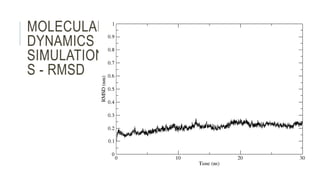
To evaluate stability of the protein by comparing
structure of every frame with energy minimized initial
structure
MOLECULAR
DYNAMICS
SIMULATION
S - RMSD
1. RADIUS OF GYRATION (RG)
Commands:
gmx gyrate -s md_0_30.tpr -f md_0_30_center.xtc -o gyrate.xvg
Outputs
gyrate.xvg
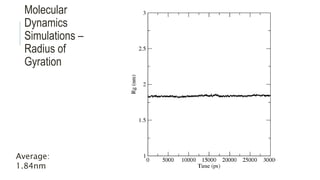
To evaluate compactness of the structure
Molecular
Dynamics
Simulations –
Radius of
Gyration
Average:
1.84nm
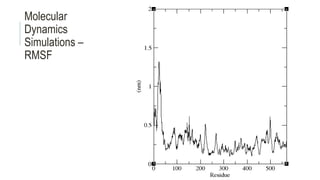
RMS FLUCTUATION (RMSF)
Commands:
gmx rmsf -s md_0_30.tpr -f md_0_30_center.xtc -o protein_rmsf.xvg –tu
res
To evaluate per residue flexibility
Outputs
Protein_rmsf.xvg
Molecular
Dynamics
Simulations –
RMSF
IMPORTANT LINKS
http://www.mdtutorials.com/gmx/index.html
(Detailed Tutorial)
https://bioinformaticsreview.com/20151126/how-
to-install-gromacs-5-x-x-on-linux-ubuntu-14-04-
lts/ (Installation Instructions)
THANK YOU
By:
Mayur Mukhi,
WATER Lab.,
SSSIHL, PSN
Campus

GROMACS Tutorial - Introduction, Procedure & Data Analysis