By: Abdul-Rahman,Aamir, Sadam & Muhammad-Bux (BS III & Previous)
RNA polymerase functions:
RNA polymerase (RNAP or RNApol),
also known as DNA-dependent RNA
polymerase, is an enzyme that produces
primary transcript RNA. In cells, RNAP
is necessary for constructing RNA chains
using DNA genes as templates, a process
called transcription.
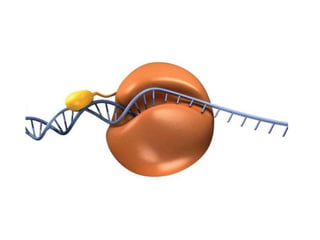
RNA polymerase is a huge factory with
many moving parts. It is composed of a
dozen different proteins. Together, they
form a machine that surrounds DNA
strands, unwinds them, and builds an
RNA strand based on the information held
inside the DNA. Once the enzyme gets
started, RNA polymerase marches
confidently along the DNA copying RNA
strands thousands of nucleotides long.
RNA polymerase needs to be accurate in its
copying of genetic information. To improve
its accuracy, it performs a simple proof
reading step as it builds an RNA strand.
The active site is designed to be able to
remove nucleotides as well as add them to
the growing strand. The enzyme
tends to over around mismatched
nucleotides longer than properly added
ones, giving the enzyme time to remove
them.
This process is some what wasteful, since
proper nucleotides are also occasionally
removed, but this is a small price to pay for
creating better RNA transcripts. Overall,
RNA polymerase makes an error about once
in 10,000 nucleotides added, or about once
per RNA strand created.
RNA polymerase: The enzyme that controls
transcription and is characterized by:
1. Search DNA for initiation site.
2. It unwinds a short stretch of double helical
DNA to produce a single-stranded DNA
template.
3. It selects the correct ribonucleotide and
catalyzes the formation of a phosphodiester
bond,
4. It detects termination signals where
transcript ends.
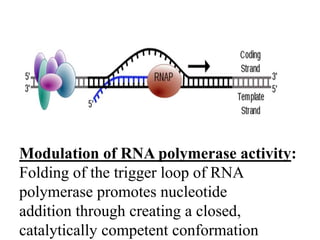
Modulation of RNA polymerase activity:
Folding of the trigger loop of RNA
polymerase promotes nucleotide
addition through creating a closed,
catalytically competent conformation
of the active center. Here, we discuss the
impact of adjacent RNA polymerase
elements, including the F loop and the jaw
domain, as well as external regulatory
factors on the trigger loop folding and
catalysis.
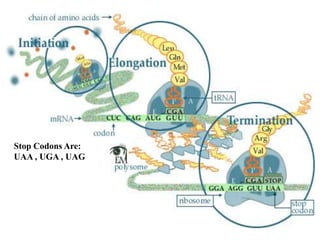
Termination: After translation has
been initiated the peptide chain is
extended by the addition of further amino
acid residues (elongation) until the
ribosome reaches a stop codon on the mRNA
and the process is interrupted (termination).
When one of the three stop codons (UAA,
UAG, or UGA) appears at the A site,
termination starts.
There are no complementary tRNAs for
the stop codons. Instead, two releasing factors
bind to the ribosome. One of these factors
(RF–1) catalyzes hydrolytic cleavage of the
ester bond between the tRNA and the C–
terminus of the peptide chain, thereby
Releasing the protein.
Hydrolysis of GTP by factor RF–3 supplies
the energy for the dissociation of the whole
complex into its component parts. Energy
requirements in protein synthesis are high.
Four energy-rich phosphoric acid anhydride
bonds are hydrolyzed for each amino acid
residue. Amino acid activation uses up two
energy-rich bonds per amino acid (ATP AMP
+ PP, and two GTPs are consumed per
elongation cycle. In addition, initiation and
Stop Codons Are:
UAA , UGA , UAG
termination each require one GTP per chain.
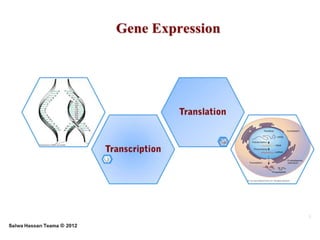
Gene Expression: The process by which a
gene's information is converted into the
structures and functions of a cell by a process
of producing a biologically functional
molecule of either protein or RNA (gene
product) is made.
Gene expression is assumed to be controlled
at various points in the sequence leading to
protein synthesis.
Gene Expression is done in two phases:
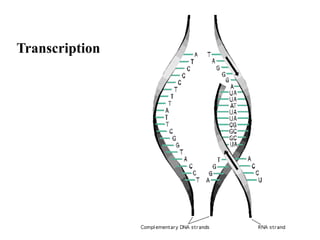
Transcription :
Synthesis of an RNA that is
complementary to one of the strands of DNA.
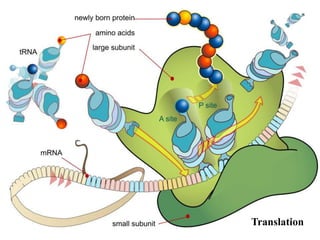
Translation :
Ribosomes read a messenger RNA and make
protein according to its instruction.
Transcription
Translation
Regulation of gene expression :
It includes a wide range of mechanisms that
are used by cells to increase or decrease the
production of specific gene products (protein
or RNA), and is informally termed gene
regulation. Sophisticated programs of gene
expression are widely observed in biology, for
example to trigger developmental pathways,
respond to environmental stimuli, or adapt to
new food sources. Virtually any step of gene
expression can be modulated, from -
transcriptional initiation, to RNA processing,
and to the post-translational modification of a
protein. Gene regulation is essential for
viruses, prokaryotes and eukaryotes as it
increases the versatility and adaptability of an
organism by allowing the cell to express
protein when needed. Although as early as
1951, Barbara McClintock showed
interaction between two genetic loci,
Activator (Ac) and Dissociator (Ds), in the
color formation of maize seeds, the first
discovery of a gene regulation system is
widely considered to be the identification in
1961 of the lac operon, discovered by Jacques
Monod, in which some enzymes involved in
lactose metabolism are expressed by E. coli
only in the presence of lactose and absence of
glucose. Furthermore, in multicellular
organisms, gene regulation drives the
processes of cellular differentiation and
morphogenesis, leading to the creation of
different cell types that possess different gene
expression profiles, and hence produce
different proteins/have different
ultrastructures that suit them to their
functions (though they all possess the
genotype, which follows the same genome
sequence).
Post translational modifications (PTM):
It refers to the covalent and generally
enzymatic modification of proteins during or
after protein biosynthesis. Proteins are
synthesized by ribosomes translating mRNA
into polypeptide chains, which may then
undergo PTM to form the mature protein
product. PTMs are important components in
cell signaling.
Post-translational modifications can occur on
the amino acid side chains or at the protein's
C- or N- termini. They can extend the
chemical repertoire of the 20 standard amino
acids by introducing new functional groups
such as phosphate, acetate, amide groups, or
methyl groups.
Phosphorylation is a very common
mechanism for regulating the activity of
enzymes and is the most common post-
translational modification. Many eukaryotic
proteins also have carbohydrate molecules
attached to them in a process called
glycosylation, which can promote protein
foldings and improve stability as well as
serving regulatory functions. Attachment of
lipid molecules, known as lipidation, often
targets a protein or part of a protein to the cell
membrane.
Other forms of post-translational modification
consist of cleaving peptide bonds, as in
processing a propeptide to a mature form or
removing the initiator methionine residue.
The formation of disulfide bonds from
cysteine residues may also be referred to as a
post-translational modification. For instance,
the peptide hormone insulin is cut twice after
disulfide bonds are formed, and a propeptide
is removed from the middle of the chain; the
resulting protein consists of two
polypeptide chains connected by disulfide
bonds. Some types of post-translational
modification are consequences of oxidative
stress. Carbonylation is one example that
targets the modified protein for degradation
and can result in the formation of protein
aggregates. Specific amino acid modifications
can be used as biomarkers indicating
oxidative damage. Sites that often undergo
post-translational modifications are those that
have a functional group that can serve as a
nucleophile in the reaction: the hydroxyl
groups of serine, threonine, and tyrosine; the
amine forms of lysine, arginine, and histidine;
the thiolate anion of cysteine; the
carboxylates of aspartate and glutamate; and
the N- and C-termini. In addition, although
the amides of aspargine and glutamine are
weak nucleophiles, both can serve as
attachment points for glycans. Rarer
modifications can occur at oxidized
methionines and at some methylenes in side
chains.
Post-translational modification of proteins can
be experimentally detected by a variety of
techniques, including mass spectrometry,
Eastern blotting, and Western blotting.
Molecular biology presentation

Molecular biology presentation

  • 2.
    By: Abdul-Rahman,Aamir, Sadam& Muhammad-Bux (BS III & Previous)
  • 4.
    RNA polymerase functions: RNApolymerase (RNAP or RNApol), also known as DNA-dependent RNA polymerase, is an enzyme that produces primary transcript RNA. In cells, RNAP is necessary for constructing RNA chains using DNA genes as templates, a process called transcription.
  • 5.
    RNA polymerase isa huge factory with many moving parts. It is composed of a dozen different proteins. Together, they form a machine that surrounds DNA strands, unwinds them, and builds an RNA strand based on the information held inside the DNA. Once the enzyme gets started, RNA polymerase marches confidently along the DNA copying RNA strands thousands of nucleotides long.
  • 7.
    RNA polymerase needsto be accurate in its copying of genetic information. To improve its accuracy, it performs a simple proof reading step as it builds an RNA strand. The active site is designed to be able to remove nucleotides as well as add them to the growing strand. The enzyme tends to over around mismatched nucleotides longer than properly added ones, giving the enzyme time to remove them.
  • 8.
    This process issome what wasteful, since proper nucleotides are also occasionally removed, but this is a small price to pay for creating better RNA transcripts. Overall, RNA polymerase makes an error about once in 10,000 nucleotides added, or about once per RNA strand created.
  • 10.
    RNA polymerase: Theenzyme that controls transcription and is characterized by: 1. Search DNA for initiation site. 2. It unwinds a short stretch of double helical DNA to produce a single-stranded DNA template. 3. It selects the correct ribonucleotide and catalyzes the formation of a phosphodiester bond, 4. It detects termination signals where transcript ends.
  • 12.
    Modulation of RNApolymerase activity: Folding of the trigger loop of RNA polymerase promotes nucleotide addition through creating a closed, catalytically competent conformation
  • 13.
    of the activecenter. Here, we discuss the impact of adjacent RNA polymerase elements, including the F loop and the jaw domain, as well as external regulatory factors on the trigger loop folding and catalysis. Termination: After translation has been initiated the peptide chain is extended by the addition of further amino acid residues (elongation) until the
  • 14.
    ribosome reaches astop codon on the mRNA and the process is interrupted (termination). When one of the three stop codons (UAA, UAG, or UGA) appears at the A site, termination starts. There are no complementary tRNAs for the stop codons. Instead, two releasing factors bind to the ribosome. One of these factors (RF–1) catalyzes hydrolytic cleavage of the ester bond between the tRNA and the C– terminus of the peptide chain, thereby
  • 15.
    Releasing the protein. Hydrolysisof GTP by factor RF–3 supplies the energy for the dissociation of the whole complex into its component parts. Energy requirements in protein synthesis are high. Four energy-rich phosphoric acid anhydride bonds are hydrolyzed for each amino acid residue. Amino acid activation uses up two energy-rich bonds per amino acid (ATP AMP + PP, and two GTPs are consumed per elongation cycle. In addition, initiation and
  • 16.
  • 17.
    termination each requireone GTP per chain. Gene Expression: The process by which a gene's information is converted into the structures and functions of a cell by a process of producing a biologically functional molecule of either protein or RNA (gene product) is made. Gene expression is assumed to be controlled at various points in the sequence leading to protein synthesis. Gene Expression is done in two phases:
  • 19.
    Transcription : Synthesis ofan RNA that is complementary to one of the strands of DNA. Translation : Ribosomes read a messenger RNA and make protein according to its instruction.
  • 20.
  • 21.
  • 22.
    Regulation of geneexpression : It includes a wide range of mechanisms that are used by cells to increase or decrease the production of specific gene products (protein or RNA), and is informally termed gene regulation. Sophisticated programs of gene expression are widely observed in biology, for example to trigger developmental pathways, respond to environmental stimuli, or adapt to new food sources. Virtually any step of gene expression can be modulated, from -
  • 23.
    transcriptional initiation, toRNA processing, and to the post-translational modification of a protein. Gene regulation is essential for viruses, prokaryotes and eukaryotes as it increases the versatility and adaptability of an organism by allowing the cell to express protein when needed. Although as early as 1951, Barbara McClintock showed interaction between two genetic loci, Activator (Ac) and Dissociator (Ds), in the color formation of maize seeds, the first
  • 24.
    discovery of agene regulation system is widely considered to be the identification in 1961 of the lac operon, discovered by Jacques Monod, in which some enzymes involved in lactose metabolism are expressed by E. coli only in the presence of lactose and absence of glucose. Furthermore, in multicellular organisms, gene regulation drives the processes of cellular differentiation and morphogenesis, leading to the creation of different cell types that possess different gene
  • 25.
    expression profiles, andhence produce different proteins/have different ultrastructures that suit them to their functions (though they all possess the genotype, which follows the same genome sequence). Post translational modifications (PTM): It refers to the covalent and generally enzymatic modification of proteins during or after protein biosynthesis. Proteins are synthesized by ribosomes translating mRNA
  • 26.
    into polypeptide chains,which may then undergo PTM to form the mature protein product. PTMs are important components in cell signaling. Post-translational modifications can occur on the amino acid side chains or at the protein's C- or N- termini. They can extend the chemical repertoire of the 20 standard amino acids by introducing new functional groups such as phosphate, acetate, amide groups, or methyl groups.
  • 27.
    Phosphorylation is avery common mechanism for regulating the activity of enzymes and is the most common post- translational modification. Many eukaryotic proteins also have carbohydrate molecules attached to them in a process called glycosylation, which can promote protein foldings and improve stability as well as serving regulatory functions. Attachment of lipid molecules, known as lipidation, often targets a protein or part of a protein to the cell membrane.
  • 28.
    Other forms ofpost-translational modification consist of cleaving peptide bonds, as in processing a propeptide to a mature form or removing the initiator methionine residue. The formation of disulfide bonds from cysteine residues may also be referred to as a post-translational modification. For instance, the peptide hormone insulin is cut twice after disulfide bonds are formed, and a propeptide is removed from the middle of the chain; the resulting protein consists of two
  • 29.
    polypeptide chains connectedby disulfide bonds. Some types of post-translational modification are consequences of oxidative stress. Carbonylation is one example that targets the modified protein for degradation and can result in the formation of protein aggregates. Specific amino acid modifications can be used as biomarkers indicating oxidative damage. Sites that often undergo post-translational modifications are those that have a functional group that can serve as a
  • 30.
    nucleophile in thereaction: the hydroxyl groups of serine, threonine, and tyrosine; the amine forms of lysine, arginine, and histidine; the thiolate anion of cysteine; the carboxylates of aspartate and glutamate; and the N- and C-termini. In addition, although the amides of aspargine and glutamine are weak nucleophiles, both can serve as attachment points for glycans. Rarer modifications can occur at oxidized methionines and at some methylenes in side chains.
  • 31.
    Post-translational modification ofproteins can be experimentally detected by a variety of techniques, including mass spectrometry, Eastern blotting, and Western blotting.