MOLAR PREGNANCY
DEFINITIONS
 Trophoblastic tissue, which is part of the blastocyst
that normally invades the endometrium, proliferates
more aggressive way than normal.
 HCG is usually excreted excessively.
PATHOLOGY
 Hydatiform can be divided into two: complete and
partial
 Alternatively, the proliferation may have
characteristics of malignant tissue.
 If the invasion is only present locally within the uterus,
this is an INVASIVE MOLE
 If metastasis occurs : CHORIOCARCINOMA
 If there is persistent gestational trophoblastic disease
(GTD), commonly defined as persistent elevation of
bHCG, it is called as GESTATIONAL TROPHOBLASTIC
NEOPLASIA (GTN)
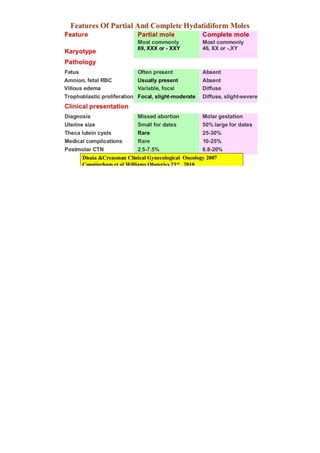
COMPLETE MOLE:
 Entirely paternal in origin.
 Usually when one sperm fertilises an empty oocyte
and undergoes mitosis.
 There is no foetal tissue, merely a proliferation of
swollen chorionic villi.
 The result is diploid tissue, 46 XX.
PARTIAL MOLE
 Two sperms entering one oocyte.
 Triploid
EPIDEMIOLOGY
 1 in 500-1000.
 Common in extreme productive age.
 Asians
CLINICAL FEATURES
 Heavy bleeding.
 Uterus is often larger than gestational age.
 Early pregnancy pre-eclampsia and hyperthyroidism
may occur.
 Severe vomiting (hyperemesis).
 Can be detected using USS (vesicles)
INVESTIGATIONS
1. USS: snowstorm appearance of the swollen villi with
complete moles.
2. Serum bHCG may be VERY HIGH
MANAGEMENT
1. It is removed by suction curettage (ERPC).
2. The diagnosis is confirmed histologically.
FOLLOW-UP
1. Serum bHCG are taken: persistent or rising suggest
malignancy.
2. Pregnancy and the COCP are avoided until HCG levels
are normal b/c they may increase the need for
chemotherapy.
COMPLICATIONS
1. Recurrence occurs in 1 in 60 subsequent pregnancies.
2. After every future pregnancy subsequent further HCG
samples are required to exclude recurrence.
Molar pregnancy

Molar pregnancy

  • 1.
    MOLAR PREGNANCY DEFINITIONS  Trophoblastictissue, which is part of the blastocyst that normally invades the endometrium, proliferates more aggressive way than normal.  HCG is usually excreted excessively. PATHOLOGY  Hydatiform can be divided into two: complete and partial  Alternatively, the proliferation may have characteristics of malignant tissue.  If the invasion is only present locally within the uterus, this is an INVASIVE MOLE  If metastasis occurs : CHORIOCARCINOMA  If there is persistent gestational trophoblastic disease (GTD), commonly defined as persistent elevation of bHCG, it is called as GESTATIONAL TROPHOBLASTIC NEOPLASIA (GTN) COMPLETE MOLE:  Entirely paternal in origin.  Usually when one sperm fertilises an empty oocyte and undergoes mitosis.  There is no foetal tissue, merely a proliferation of swollen chorionic villi.  The result is diploid tissue, 46 XX. PARTIAL MOLE  Two sperms entering one oocyte.  Triploid EPIDEMIOLOGY  1 in 500-1000.  Common in extreme productive age.  Asians CLINICAL FEATURES  Heavy bleeding.  Uterus is often larger than gestational age.  Early pregnancy pre-eclampsia and hyperthyroidism may occur.  Severe vomiting (hyperemesis).  Can be detected using USS (vesicles) INVESTIGATIONS 1. USS: snowstorm appearance of the swollen villi with complete moles. 2. Serum bHCG may be VERY HIGH MANAGEMENT 1. It is removed by suction curettage (ERPC). 2. The diagnosis is confirmed histologically. FOLLOW-UP 1. Serum bHCG are taken: persistent or rising suggest malignancy. 2. Pregnancy and the COCP are avoided until HCG levels are normal b/c they may increase the need for chemotherapy. COMPLICATIONS 1. Recurrence occurs in 1 in 60 subsequent pregnancies. 2. After every future pregnancy subsequent further HCG samples are required to exclude recurrence.