Tintometer in Vanaspathi Analysis
Name -Grishma.Mehta
Roll no. - BFT-18012
Subject Name –Principles of
Food Analysis
Subject Code -BFT-505
Subject Teacher -Dr. Pravin
Bhushette
Among the many tests that need to be carried out on edible oils and fats during the
refining process is the measurement of color.
Color measurements are used not only to ascertain aesthetic quality but also as a
means to optimize bleaching, deodorizing, and other production processes.
Most, if not all, refined oils are sold on the basis of their color, and each type of oil
will have its own “sell by color” instructions.
So, it is necessary to monitor each stage of the refining process to establish
whether the correct color has been reached.
Some crude seed oils can have unexpectedly high pigmentation, often attributable
to adverse growing conditions, such as too little or too much moisture or frost
damage to the plant.
As a result the color tends to darken in storage.
Early color measurement often can alert the refiner to potential expensive bleaching
and blending problems.
Mixing problem oil can occur if one does not know about the color
Obtaining color data regularly on oil suspected to be unstable would indicate its
condition and help to avoid making incorrect decisions regarding blending
There are many other reasons why color measurement of oils and fats is
important, but ultimately it all relates to the cost of refining, the quality of
the finished product, and what the product looks like to the end user.
That end user may be a food producer who is very aware of how the color
of the oil could enhance or diminish that product’s appearance.
An end user may not consciously notice the color of a cooking oil unless it
appears different than usual; then, suddenly, color is all important.
As soon as a color difference is perceived, the end user may infer that
“different” means “not as good.”
Consequently, it is the goal of the edible oil plant production and quality
processes to produce a consistent product in color—from plant to plant, lot
to lot, and year to year.
Color is a perceptual property in human beings.
Color derives from the spectrum of light (distribution of
light energy vs. wavelength) interacting in the eye with
light-sensitive cells.
In the human environment, materials are colored
depending on the wavelengths of light they reflect or
transmit.
The visible color spectrum runs from red through to blue
wavelengths, approximately 360–720 nm.
Electromagnetic
Spectrum
1
Light
source
2
Object
3
Observer
Three things are necessary to perceive color are as
follows:-
However, each person describes and therefore defines an object’s color
differently.
As a result, objectively communicating a particular color to someone without
some type of physical standard is difficult.
Describing in words the precise color difference between two objects is very
challenging.
A person’s perceptions and interpretations of color and color comparisons are
highly subjective. Fatigue, age, gender, and other physiological factors can
influence color perception.
But even without such physical considerations, each observer interprets color
based on their personal perspective, feelings, beliefs, and desires.
For example, some people may convince themselves that a certain color match is
within tolerance if they are under pressure to declare a color match as
acceptable.
To quote the great 19th-century British scholar Lord Kelvin: “When you can measure
what you are speaking about and express it in numbers you know something about
it; but when you cannot express it in numbers your knowledge is of a meager and
unsatisfactory kind.”
With this in mind, over the years various methods have been developed to
measure the color of edible oils and fats.
Before the development of electronic instruments using multiple wavelengths
and photodetectors, quantitative color measurements were completed by
comparing the sample to known glass color standards.
One of these was the Tintometer colorimeter, invented by Joseph Lovibond in England
in the late 19th century.
Lovibond was a brewer by trade—and he needed a method to consistently evaluate
and regulate the color of his beer.
The Tintometer uses a series of gradient red, yellow, blue, and neutral(gray)-colored
glasses.
It is arranged with two adjacent fields of view, seen through the viewing tube, so that
the product in the sample field and a white reflective surface in the comparison field are
observed side by side, suitably illuminated.
This is known as the Lovibond color scale
Joseph Lovibond
Tintometer
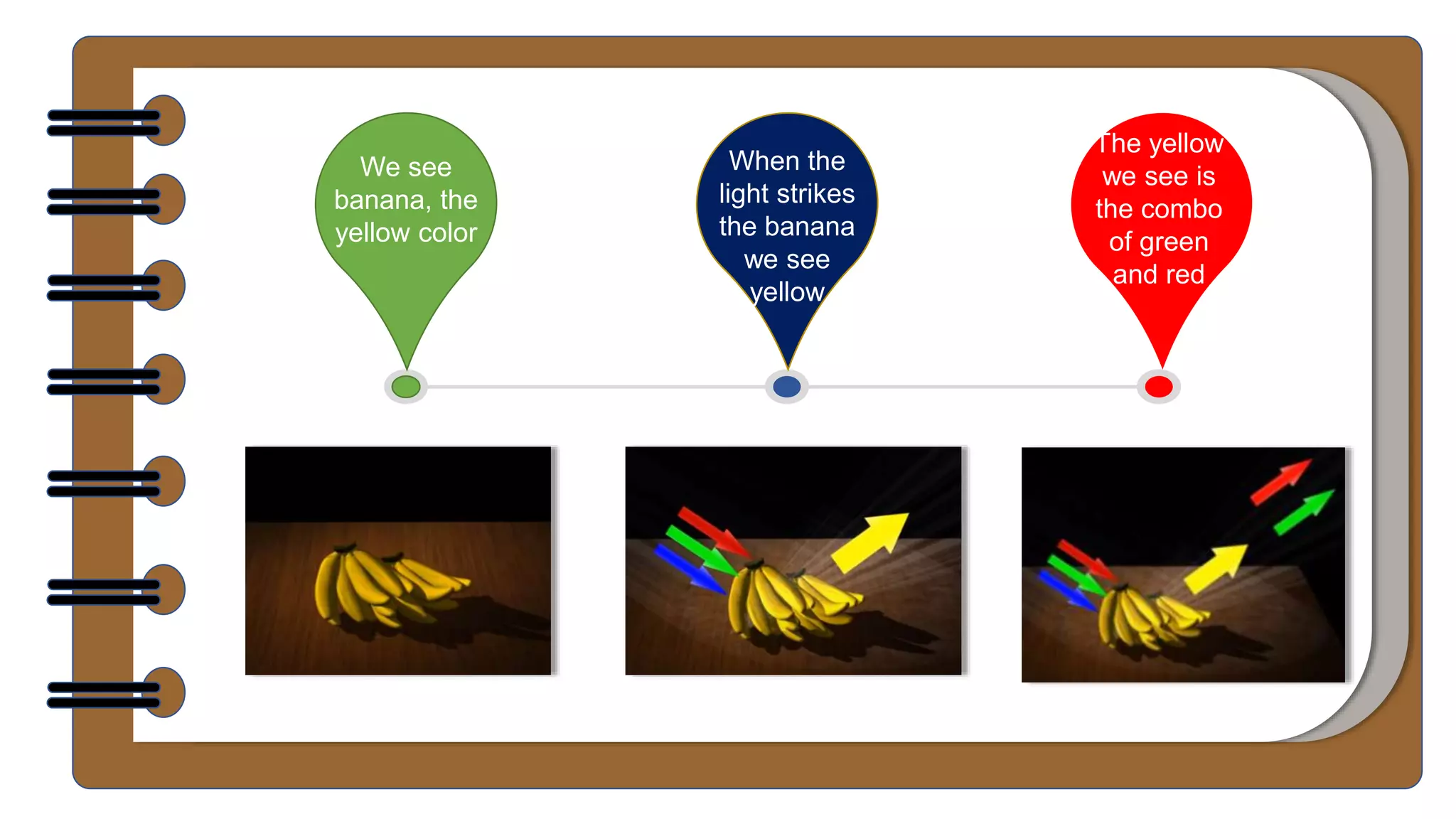
We see
banana, the
yellow color
When the
light strikes
the banana
we see
yellow
The yellow
we see is
the combo
of green
and red
Light
source
Lens
Filter
Cuvette
When the light falls on the lens the light is focused so that light moves in one
direction and further falls on the colored filter.
The filter absorbs some light and further passes on the light to the sample
The sample absorbs some light and the rest of the light is reflected
The detector measures the absorbance
Darker sample will absorb more light and light sample will absorb less light
Colorimetric analysis is used to determine the concentration of the substance
that light in the visible region(400-800nm) by measuring the intensity which
depends on the color
Colorimeter
Switch
Cuvette small
Cuvette large
Cuvette medium
Sample box
Color filter
Color glasses
Ocular unit
Tintometer
This is the sample box
where cuvette is kept.
In this image the switch is
off
In this image the cuvette is
kept in the sample box
The switch is on
It has two parts out of which only one
can be used to touch by hand.
The light penetrates from the second
part
It is mandatory to wipe the cuvette
before placing it in the sample box to
avoid false results
The sample box has a lid
Once the cuvette is kept in the
sample box the lid is closed as
shown the image
Cuvette
Lid of sample box
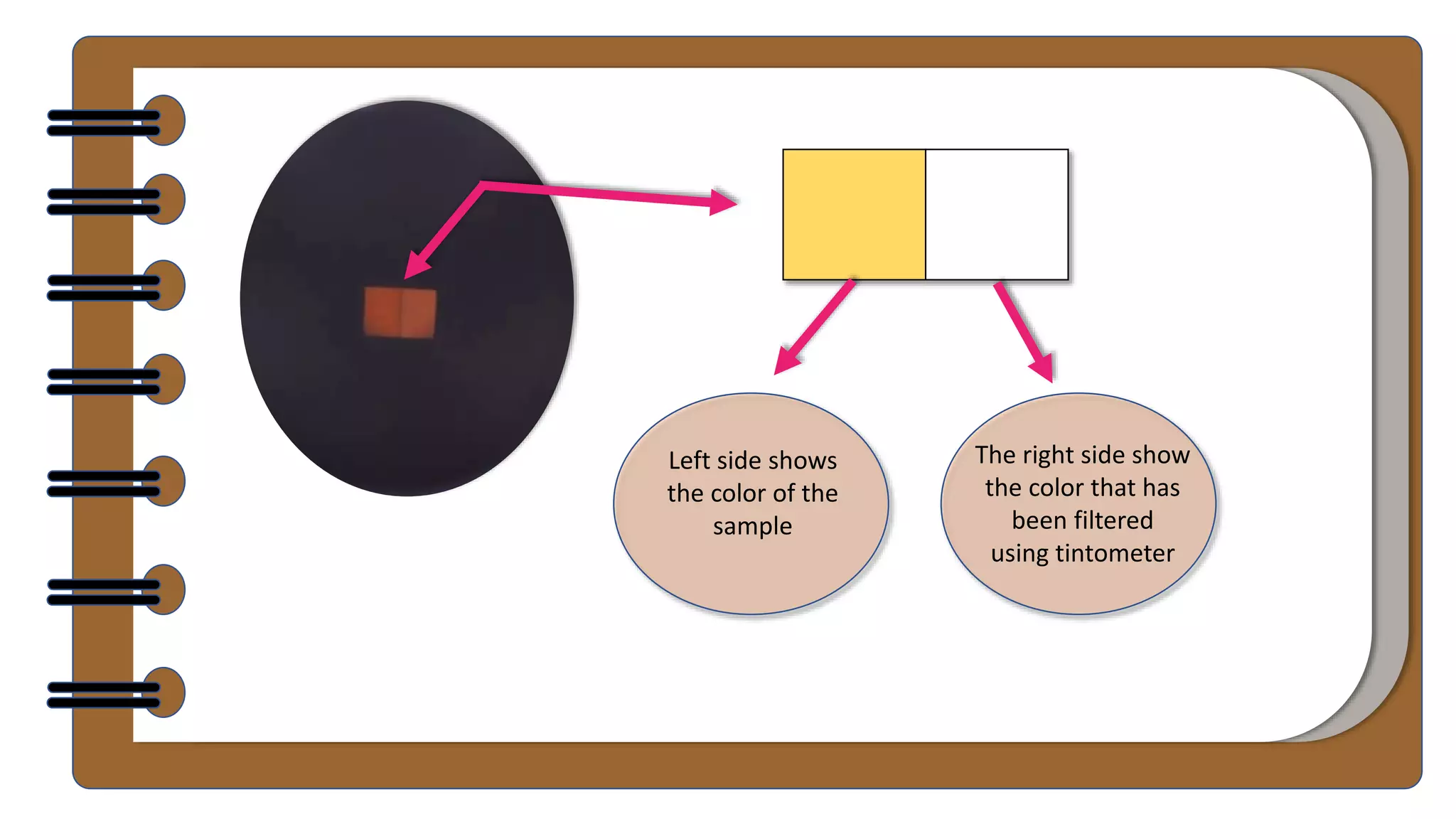
Left side shows
the color of the
sample
The right side show
the color that has
been filtered
using tintometer
0-79.9
Yellow Red Blue Neutral
0.1-79.9 0.1-79.9 0.1-39.9 0.1-3.9 Range
Color filter
It has only units and decimals place
A series of neutral/gray glasses in racks is introduced to dull the
colour of products which are too bright to obtain a good colour
match using Lovibond Red, Yellow or Blue glasses
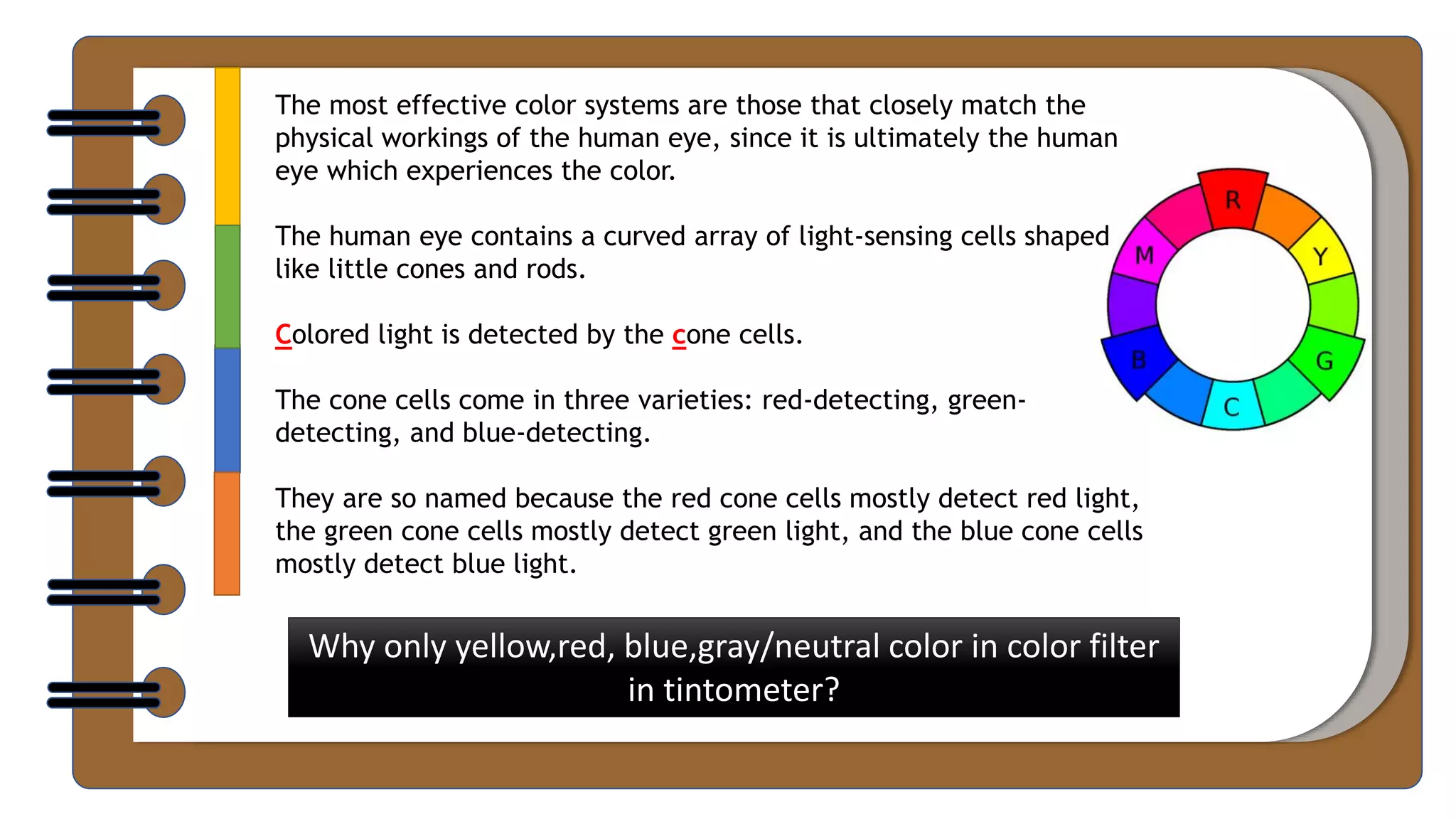
The most effective color systems are those that closely match the
physical workings of the human eye, since it is ultimately the human
eye which experiences the color.
The human eye contains a curved array of light-sensing cells shaped
like little cones and rods.
Colored light is detected by the cone cells.
The cone cells come in three varieties: red-detecting, green-
detecting, and blue-detecting.
They are so named because the red cone cells mostly detect red light,
the green cone cells mostly detect green light, and the blue cone cells
mostly detect blue light.
Why only yellow,red, blue,gray/neutral color in color filter
in tintometer?
Note that even though a red cone cell predominantly detects the color red, it
can also detect a little bit of some other colors.
Therefore, even though humans do not have yellow cone cells, we can still see
yellow light when it triggers a red cone cell and a green cone cell.
In this way, humans have a built-in color decoding mechanism which enables us
to experience millions of colors, although we only have vision cells that
predominantly see red, green, and blue.
It should be obvious at this point that the most effective color systems are ones
that closely match the human eye, i.e. color systems that mix red, green, and
blue light.
METHOD
1
Melt the sample if it is not already liquid and filter the oil through a
filter paper to remove any impurities and traces of moisture
2 Make sure sample is clear and free from turbidity clean the glass
cell of desired size with carbon tetrachloride and allow it to dry
3 Fill it with oil and place the cell in position in the tintometer
4 Match the color with the sliding red,yellow and blue colors
Report the color of the oil in terms of Lovibond unists as follows
Color reading = (aY+5bR) OR (aY+10bR) in cell
Where
a = sum total of the various yellow slides (Y) used
b= sum total of the various red slides used
Y+5R is the mode of expressing the color of the light colored oils
Y+10R is for the dark coloured oils
Commonly known as dalda ghee, vanaspati is any refined edible vegetable oil
(generally palm oil) or oils subject to a process of hydrogenation.
Hydrogenation is performed using nickel metal as a catalyst, in reactors at low
medium pressure.
Vanaspati ghee is a cheaper substitute for the clarified butter (desi ghee) made
from milk fat.
Since vanaspati is one of the cooking medium in the country, it is desirable that
proper quality controls are exercised in the making of this product.
Lovibond red and yellow color indices of the vanaspati
were found to be in the range of 5.0–7.3 and 69.5–70.2,
respectively
Vanaspati
Precautions
Fat should be melted and any fat or oil that is cloudy should be filtered at a
temperature not more than 60 C
During matching the sample should be at room temperature for oils or not
more than 10 C above the melting point
Do not strain your eyes for longer time,allow to relax from time to time
Lamp should not be used for longer time

Tintometer

  • 1.
  • 2.
    Name -Grishma.Mehta Roll no.- BFT-18012 Subject Name –Principles of Food Analysis Subject Code -BFT-505 Subject Teacher -Dr. Pravin Bhushette
  • 3.
    Among the manytests that need to be carried out on edible oils and fats during the refining process is the measurement of color. Color measurements are used not only to ascertain aesthetic quality but also as a means to optimize bleaching, deodorizing, and other production processes. Most, if not all, refined oils are sold on the basis of their color, and each type of oil will have its own “sell by color” instructions. So, it is necessary to monitor each stage of the refining process to establish whether the correct color has been reached. Some crude seed oils can have unexpectedly high pigmentation, often attributable to adverse growing conditions, such as too little or too much moisture or frost damage to the plant.
  • 4.
    As a resultthe color tends to darken in storage. Early color measurement often can alert the refiner to potential expensive bleaching and blending problems. Mixing problem oil can occur if one does not know about the color Obtaining color data regularly on oil suspected to be unstable would indicate its condition and help to avoid making incorrect decisions regarding blending
  • 5.
    There are manyother reasons why color measurement of oils and fats is important, but ultimately it all relates to the cost of refining, the quality of the finished product, and what the product looks like to the end user. That end user may be a food producer who is very aware of how the color of the oil could enhance or diminish that product’s appearance. An end user may not consciously notice the color of a cooking oil unless it appears different than usual; then, suddenly, color is all important. As soon as a color difference is perceived, the end user may infer that “different” means “not as good.” Consequently, it is the goal of the edible oil plant production and quality processes to produce a consistent product in color—from plant to plant, lot to lot, and year to year.
  • 6.
    Color is aperceptual property in human beings. Color derives from the spectrum of light (distribution of light energy vs. wavelength) interacting in the eye with light-sensitive cells. In the human environment, materials are colored depending on the wavelengths of light they reflect or transmit. The visible color spectrum runs from red through to blue wavelengths, approximately 360–720 nm.
  • 7.
  • 8.
    1 Light source 2 Object 3 Observer Three things arenecessary to perceive color are as follows:-
  • 9.
    However, each persondescribes and therefore defines an object’s color differently. As a result, objectively communicating a particular color to someone without some type of physical standard is difficult. Describing in words the precise color difference between two objects is very challenging. A person’s perceptions and interpretations of color and color comparisons are highly subjective. Fatigue, age, gender, and other physiological factors can influence color perception. But even without such physical considerations, each observer interprets color based on their personal perspective, feelings, beliefs, and desires. For example, some people may convince themselves that a certain color match is within tolerance if they are under pressure to declare a color match as acceptable.
  • 10.
    To quote thegreat 19th-century British scholar Lord Kelvin: “When you can measure what you are speaking about and express it in numbers you know something about it; but when you cannot express it in numbers your knowledge is of a meager and unsatisfactory kind.” With this in mind, over the years various methods have been developed to measure the color of edible oils and fats. Before the development of electronic instruments using multiple wavelengths and photodetectors, quantitative color measurements were completed by comparing the sample to known glass color standards.
  • 11.
    One of thesewas the Tintometer colorimeter, invented by Joseph Lovibond in England in the late 19th century. Lovibond was a brewer by trade—and he needed a method to consistently evaluate and regulate the color of his beer. The Tintometer uses a series of gradient red, yellow, blue, and neutral(gray)-colored glasses. It is arranged with two adjacent fields of view, seen through the viewing tube, so that the product in the sample field and a white reflective surface in the comparison field are observed side by side, suitably illuminated. This is known as the Lovibond color scale
  • 12.
  • 13.
    We see banana, the yellowcolor When the light strikes the banana we see yellow The yellow we see is the combo of green and red
  • 14.
  • 17.
    When the lightfalls on the lens the light is focused so that light moves in one direction and further falls on the colored filter. The filter absorbs some light and further passes on the light to the sample The sample absorbs some light and the rest of the light is reflected The detector measures the absorbance Darker sample will absorb more light and light sample will absorb less light Colorimetric analysis is used to determine the concentration of the substance that light in the visible region(400-800nm) by measuring the intensity which depends on the color
  • 18.
  • 19.
    Switch Cuvette small Cuvette large Cuvettemedium Sample box Color filter Color glasses Ocular unit Tintometer
  • 20.
    This is thesample box where cuvette is kept. In this image the switch is off In this image the cuvette is kept in the sample box The switch is on
  • 21.
    It has twoparts out of which only one can be used to touch by hand. The light penetrates from the second part It is mandatory to wipe the cuvette before placing it in the sample box to avoid false results The sample box has a lid Once the cuvette is kept in the sample box the lid is closed as shown the image Cuvette Lid of sample box
  • 22.
    Left side shows thecolor of the sample The right side show the color that has been filtered using tintometer
  • 23.
    0-79.9 Yellow Red BlueNeutral 0.1-79.9 0.1-79.9 0.1-39.9 0.1-3.9 Range Color filter
  • 24.
    It has onlyunits and decimals place A series of neutral/gray glasses in racks is introduced to dull the colour of products which are too bright to obtain a good colour match using Lovibond Red, Yellow or Blue glasses
  • 25.
    The most effectivecolor systems are those that closely match the physical workings of the human eye, since it is ultimately the human eye which experiences the color. The human eye contains a curved array of light-sensing cells shaped like little cones and rods. Colored light is detected by the cone cells. The cone cells come in three varieties: red-detecting, green- detecting, and blue-detecting. They are so named because the red cone cells mostly detect red light, the green cone cells mostly detect green light, and the blue cone cells mostly detect blue light. Why only yellow,red, blue,gray/neutral color in color filter in tintometer?
  • 26.
    Note that eventhough a red cone cell predominantly detects the color red, it can also detect a little bit of some other colors. Therefore, even though humans do not have yellow cone cells, we can still see yellow light when it triggers a red cone cell and a green cone cell. In this way, humans have a built-in color decoding mechanism which enables us to experience millions of colors, although we only have vision cells that predominantly see red, green, and blue. It should be obvious at this point that the most effective color systems are ones that closely match the human eye, i.e. color systems that mix red, green, and blue light.
  • 27.
    METHOD 1 Melt the sampleif it is not already liquid and filter the oil through a filter paper to remove any impurities and traces of moisture 2 Make sure sample is clear and free from turbidity clean the glass cell of desired size with carbon tetrachloride and allow it to dry 3 Fill it with oil and place the cell in position in the tintometer 4 Match the color with the sliding red,yellow and blue colors
  • 28.
    Report the colorof the oil in terms of Lovibond unists as follows Color reading = (aY+5bR) OR (aY+10bR) in cell Where a = sum total of the various yellow slides (Y) used b= sum total of the various red slides used Y+5R is the mode of expressing the color of the light colored oils Y+10R is for the dark coloured oils
  • 29.
    Commonly known asdalda ghee, vanaspati is any refined edible vegetable oil (generally palm oil) or oils subject to a process of hydrogenation. Hydrogenation is performed using nickel metal as a catalyst, in reactors at low medium pressure. Vanaspati ghee is a cheaper substitute for the clarified butter (desi ghee) made from milk fat. Since vanaspati is one of the cooking medium in the country, it is desirable that proper quality controls are exercised in the making of this product. Lovibond red and yellow color indices of the vanaspati were found to be in the range of 5.0–7.3 and 69.5–70.2, respectively Vanaspati
  • 30.
    Precautions Fat should bemelted and any fat or oil that is cloudy should be filtered at a temperature not more than 60 C During matching the sample should be at room temperature for oils or not more than 10 C above the melting point Do not strain your eyes for longer time,allow to relax from time to time Lamp should not be used for longer time