Corporate Financial Strategy
Chapter 1
Corporate financial strategy: setting the
context
Corporate Financial Strategy
4th edition
Dr Ruth Bender
Corporate Financial Strategy
Setting the context: contents
 Learning objectives
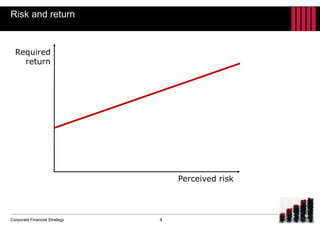
 Risk and return
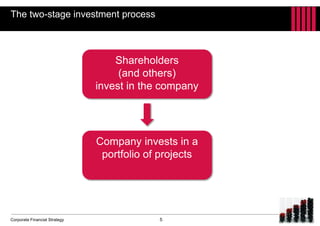
 The two-stage investment process
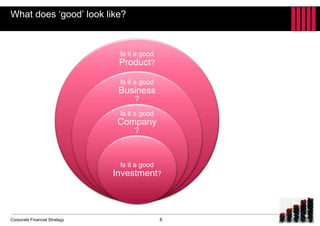
 What does ‘good’ look like?
 NPV illustration (Working Insight 1.3)
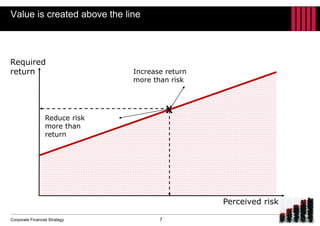
 Value is created ‘above the line’ (Figure 1.4)
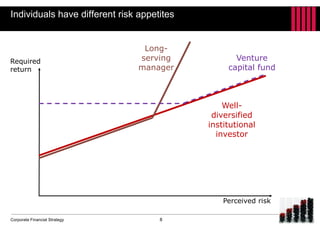
 Individuals have different risk appetites (Figure 1.5)
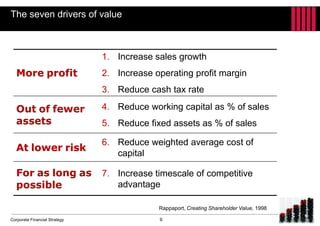
 The seven drivers of value
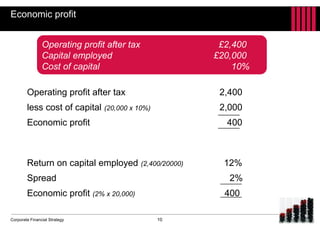
 Economic profit (Working Insight 1.5)
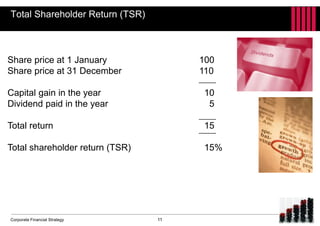
 Total shareholder return (Working Insight 1.6)
 The value matrix (Figure 1.6)
 Stakeholders are important
 Agency and double agency
2
Corporate Financial Strategy
Learning objectives
1. Understand what financial strategy is, and how it can add value.
2. Explain why shareholder value is created by investments with a
positive net present value.
3. Appreciate how the relationship between perceived risk and required
return governs companies and investors.
4. Differentiate the different models of measuring shareholder value.
5. Explain why share price is not necessarily a good proxy for company
value.
6. Outline how agency theory is relevant to corporate finance.
3
Corporate Financial Strategy
Perceived risk
Required
return
Risk and return
4
Corporate Financial Strategy
The two-stage investment process
Shareholders
(and others)
invest in the company
Company invests in a
portfolio of projects
5
Corporate Financial Strategy
What does ‘good’ look like?
6
Is it a good
Product?Is it a good
Product?
Is it a good
Business
?
Is it a good
Company
?
Is it a good
Investment?
Corporate Financial Strategy
Reduce risk
more than
return
Increase return
more than risk
Perceived risk
Required
return
X
Value is created above the line
7
Corporate Financial Strategy
Perceived risk
Required
return
Individuals have different risk appetites
Well-
diversified
institutional
investor
Long-
serving
manager
Venture
capital fund
8
Corporate Financial Strategy
The seven drivers of value
Rappaport, Creating Shareholder Value, 1998
More profit
1. Increase sales growth
2. Increase operating profit margin
3. Reduce cash tax rate
Out of fewer
assets
4. Reduce working capital as % of sales
5. Reduce fixed assets as % of sales
At lower risk
6. Reduce weighted average cost of
capital
For as long as
possible
7. Increase timescale of competitive
advantage
9
Corporate Financial Strategy
Economic profit
10
Operating profit after tax 2,400
less cost of capital (20,000 x 10%) 2,000
Economic profit 400
Operating profit after tax £2,400
Capital employed £20,000
Cost of capital 10%
Return on capital employed (2,400/20000) 12%
Spread 2%
Economic profit (2% x 20,000) 400
Corporate Financial Strategy
Total Shareholder Return (TSR)
11
Share price at 1 January 100
Share price at 31 December 110
Capital gain in the year 10
Dividend paid in the year 5
Total return 15
Total shareholder return (TSR) 15%
Corporate Financial Strategy
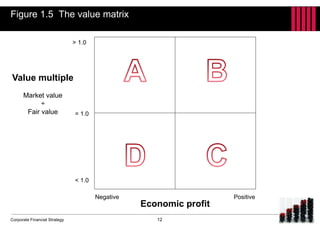
Figure 1.5 The value matrix
Economic profit
Value multiple
Market value
÷
Fair value
Negative Positive
> 1.0
< 1.0
= 1.0
12
Corporate Financial Strategy
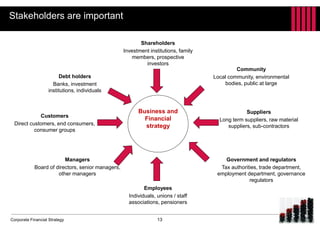
Stakeholders are important
Business and
Financial
strategy
Shareholders
Investment institutions, family
members, prospective
investors
Debt holders
Banks, investment
institutions, individuals
Customers
Direct customers, end consumers,
consumer groups
Managers
Board of directors, senior managers,
other managers
Employees
Individuals, unions / staff
associations, pensioners
Government and regulators
Tax authorities, trade department,
employment department, governance
regulators
Suppliers
Long term suppliers, raw material
suppliers, sub-contractors
Community
Local community, environmental
bodies, public at large
13
Corporate Financial Strategy
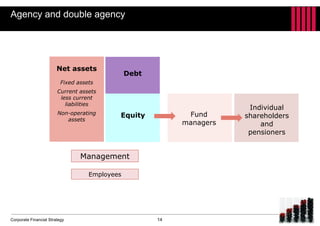
Agency and double agency
14
Net assets
Fixed assets
Current assets
less current
liabilities
Non-operating
assets
Debt
Equity Fund
managers
Individual
shareholders
and
pensioners
Management
Employees

Corporate financial strategy

  • 1.
    Corporate Financial Strategy Chapter1 Corporate financial strategy: setting the context Corporate Financial Strategy 4th edition Dr Ruth Bender
  • 2.
    Corporate Financial Strategy Settingthe context: contents  Learning objectives  Risk and return  The two-stage investment process  What does ‘good’ look like?  NPV illustration (Working Insight 1.3)  Value is created ‘above the line’ (Figure 1.4)  Individuals have different risk appetites (Figure 1.5)  The seven drivers of value  Economic profit (Working Insight 1.5)  Total shareholder return (Working Insight 1.6)  The value matrix (Figure 1.6)  Stakeholders are important  Agency and double agency 2
  • 3.
    Corporate Financial Strategy Learningobjectives 1. Understand what financial strategy is, and how it can add value. 2. Explain why shareholder value is created by investments with a positive net present value. 3. Appreciate how the relationship between perceived risk and required return governs companies and investors. 4. Differentiate the different models of measuring shareholder value. 5. Explain why share price is not necessarily a good proxy for company value. 6. Outline how agency theory is relevant to corporate finance. 3
  • 4.
    Corporate Financial Strategy Perceivedrisk Required return Risk and return 4
  • 5.
    Corporate Financial Strategy Thetwo-stage investment process Shareholders (and others) invest in the company Company invests in a portfolio of projects 5
  • 6.
    Corporate Financial Strategy Whatdoes ‘good’ look like? 6 Is it a good Product?Is it a good Product? Is it a good Business ? Is it a good Company ? Is it a good Investment?
  • 7.
    Corporate Financial Strategy Reducerisk more than return Increase return more than risk Perceived risk Required return X Value is created above the line 7
  • 8.
    Corporate Financial Strategy Perceivedrisk Required return Individuals have different risk appetites Well- diversified institutional investor Long- serving manager Venture capital fund 8
  • 9.
    Corporate Financial Strategy Theseven drivers of value Rappaport, Creating Shareholder Value, 1998 More profit 1. Increase sales growth 2. Increase operating profit margin 3. Reduce cash tax rate Out of fewer assets 4. Reduce working capital as % of sales 5. Reduce fixed assets as % of sales At lower risk 6. Reduce weighted average cost of capital For as long as possible 7. Increase timescale of competitive advantage 9
  • 10.
    Corporate Financial Strategy Economicprofit 10 Operating profit after tax 2,400 less cost of capital (20,000 x 10%) 2,000 Economic profit 400 Operating profit after tax £2,400 Capital employed £20,000 Cost of capital 10% Return on capital employed (2,400/20000) 12% Spread 2% Economic profit (2% x 20,000) 400
  • 11.
    Corporate Financial Strategy TotalShareholder Return (TSR) 11 Share price at 1 January 100 Share price at 31 December 110 Capital gain in the year 10 Dividend paid in the year 5 Total return 15 Total shareholder return (TSR) 15%
  • 12.
    Corporate Financial Strategy Figure1.5 The value matrix Economic profit Value multiple Market value ÷ Fair value Negative Positive > 1.0 < 1.0 = 1.0 12
  • 13.
    Corporate Financial Strategy Stakeholdersare important Business and Financial strategy Shareholders Investment institutions, family members, prospective investors Debt holders Banks, investment institutions, individuals Customers Direct customers, end consumers, consumer groups Managers Board of directors, senior managers, other managers Employees Individuals, unions / staff associations, pensioners Government and regulators Tax authorities, trade department, employment department, governance regulators Suppliers Long term suppliers, raw material suppliers, sub-contractors Community Local community, environmental bodies, public at large 13
  • 14.
    Corporate Financial Strategy Agencyand double agency 14 Net assets Fixed assets Current assets less current liabilities Non-operating assets Debt Equity Fund managers Individual shareholders and pensioners Management Employees