MITOSIS


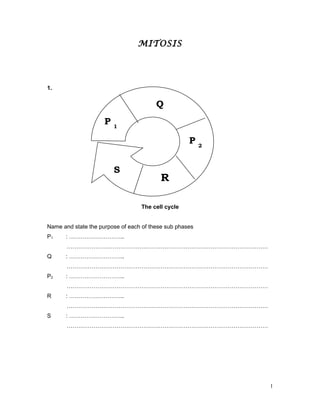
1.

                                        Q
                     P   1

                                                    P    2


                         S
                                          R

                                  The cell cycle


Name and state the purpose of each of these sub phases
P1    : ………………………..
       ……………………………………………………………………………………………
Q     : ………………………..
       ……………………………………………………………………………………………
P2    : ………………………..
       ……………………………………………………………………………………………
R     : ………………………..
       ……………………………………………………………………………………………
S     : ………………………..
       ……………………………………………………………………………………………


                                                             1
2. State the definition of Mitosis.


                                 Process by which a nucleus divides to produce _____________ daughter cells,
  MITOSIS                        each containing the __________ number of chromosomes as the parental cells.


3. Rearrange the jumbled words .
          The importance of mitosis is :


          a. W O T H G R                                        _____________________


          b. ELLC       ECALPNETERM                             _____________________


          c. G E T O I R E N E N A                              _____________________


          d. X E S A A U L D U T C I N E R R O P                _____________________


4. Label the diagram below.


                                                                   i.


                                                                   ii.
   iii.


                                                                                                2
5. Underline the correct words in the bracket.


Cytokinesis in eukaryotes occurs ( just prior to , after ) mitosis; cell division in

prokaryotes occurs by a ( simpler, more complex ) process called, binary ( fission ,

fusion ). Between divisions, eukaryotic cells are in ( dormant-phase , interphase ) , an

active period during which chromosomal DNA is duplicated, the cell mass ( increases,

decreases) and new organelles are produced. Nuclear DNA is replicated only during S

phase. The process of mitosis occurs in the following order : prophase, ( anaphase ,

metaphase )     , ( anaphase , metaphase ) and telophase. The mitotic spindle is a

complex of ( microtubules , microfilaments ) that ( prevents , assists ) chromosome

movement. The spindle is attached to each chromosome at a site called the

( connector , centromere ). Following nuclear division, the cytosol of the cells is divided.

The soon-to-be daughter cells are separated by the cleavage ( plane , furrow ) in

animals cells and the cell ( plate , furrow ) in the plant cells.


6. How does mitosis in plant cells differ from mitosis in animal cells ?


Cell division in plant and animal cells differs in two ways : (1) animal cells have

…………………………… , whereas plants cells ……………………. , and (2) animal cells

have ………………………………….. , whereas plant cells have ………………………..


                                                                                          3
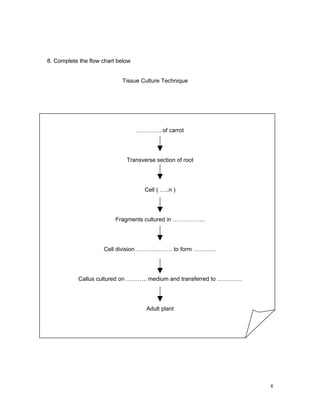
8. Complete the flow chart below


                            Tissue Culture Technique


                                   …………. of carrot


                              Transverse section of root


                                     Cell ( …..n )


                          Fragments cultured in ……………..


                     Cell division ………………. to form …………


           Callus cultured on ……….. medium and transferred to ………….


                                      Adult plant


                                                                      4
9. Explain briefly how Dolly the sheep was produced by cloning. Give your answer in the
form of a diagram which shows the successive steps with explanatory notes for each
step.


                                                                                     5
10. ADVANTAGES AND DISADVANTAGES OF CLONING


              Advantage                  Disadvantage
Cloned plant are ……………………… is Clones are …………………… to new
size and shape                                    diseases
Plants can be produced ………… the year              Clones are easily destroyed if there is a
                                                  …………………. in the environment
Plant maintain the …………….. designed
characteristics of the mother plants
Tissue culture techniques are            cost
……………………
Clones can be produced in ………………..
numbers in a short time


                                     MEIOSIS


11.


 MEIOSIS                       Process by which a nucleus divides to produce ____________
                               daughter cells, each containing ___________ the number of
                               chromosomes of the parental cell.


12. Fill in the blank using the words provided.


                                                                                            6
Synapsis        Sister Chromatids      Metaphase II           four

         Haploid         Haploid          Homologous chromosomes

         Two             Diploid         Prophase I    Diploid


   1. At __________ phase of meiosis are these two cells, each with sister chromatids
       aligned at the spindle equator.
   2. The meiotic process by which homologues are paired during prophase I is called
        __________ .
   3. Crossing occurs during ________ .
   4. Meiosis consists of __________ nuclear divisions, producing ___________
       haploid cells.
   5. The function of meiosis I is to separate _________ . The function of meiosis II is
       to separate _____________ .
   6. Meiosis I produces two ____________ cells.
   7. Meiosis II produces four ______________ cells.


13. By using two different colours show the result of crossing-over.


                                                                                      7
14. Complete the table below.


Name of Phase                            Description
1.                                       Homologous chromosomes pair up and form tetrad
                                         Spindle fibers move homologous chromosomes to opposite
2.
                                         sides
                                         Nuclear membrane reforms, cytoplasm divides, 4 daughter
3.
                                         cells formed
4.                                       Chromosomes line up along equator, not in homologous pairs
5.                                       Crossing-over occurs
6.                                       Chromatids separate
7.                                       Homologs line up alone equator
8.                                       Cytoplasm divides, 2 daughter cells are formed


       15. Name the stages in the figures above .


                                                                                          8
16. If a diploid cell has two chromosomes ( 2n = 4 ) , Draw and describe the events that
occur in each stage in mitosis and meiosis.


               Mitosis Prophase          Meiosis I Prophase         Meiosis II Prophase


Chromosome
behaviour


               Mitosis Metaphase          Meiosis I Metaphase       Meiosis II Metaphase


Chromosome     o                          o
behaviour


               Mitosis Anaphase               Meiosis I Anaphase    Meiosis II Anaphase


                                                                                       9
Chromosome    o                   o
behaviour


              Mitosis Telophase   Meiosis I Telophase   Meiosis II
                                                        Telophase


Chromosome    o                   o
behaviour


17. COMPARE AND CONTRAST


   1. Complete the table below.


                                                                     10
Meiosis I                          Similarities              Meiosis II


   1. The chromosomes become …………………………. and …………………….
          during prophase.
   2. The chromosomes are arranged at the …………………………. plate.


        MEIOSIS I            Aspect compared                                 MEIOSIS II
Homologous chromosomes pair Prophase                           Synapsis        of   homologous
up and …………………………...                                           chromosomes                      and
between non-sister chromatids                                  ………………………….between
occurs.                                                        non- sister chromatids does not
                                                               take place
……………………………………. Metaphase                                      ……………………….               align    at
align at the metaphase plate of                                the metaphase plate ( equator)
the cell                                                       of the cell
Homologous               chromosomes Anaphase                  Sister                  chromatids
…………………… and move to                                           …………………………becoming
opposite           poles.              Sister                  daughter       chromosomes       that
chromatids are still attached                                  move to opposite poles.
together and move as a unit.
……….. haploid daughter cells Telophase                         …………. haploid daughter are
are formed.                                                    formed.
Each daughter cell has only Set of chromosome                  Each daughter cell has the
………….         of    each         type      of                  …………….              number         of
chromosome          :         either     the                   chromosome as the haploid cell
paternal     or         the      maternal                      produced in meiosis I but each
chromosome.                                                    cell has only one of the sister
                                                               chromatids.


   18. Complete the table below.


          Mitosis                               Similarities                 Meiosis
   1. A nuclear division process
   2. Nuclear division occur


                                                                                                 11
MITOSIS              Aspect compared          MEIOSIS
                              Place occur


                              Role


                              Number of
                              sitokinesis

                              Synapsis of
                              homologous
                              chromosomes
                              Number of
                              daughter cells

                              Set of
                              chromosomes

                              Genetic
                              composition of
                              daughter cells
                              Variation


                                EXERCISES


1. Figure 1.1 shows phases M and N during meiosis I.


                                                                 12
M phase :                              N phase :
Description :                          Description :


      a. In the space provided,


                i.    State the both stages in M and N


                ii.   Describe the behaviour of both chromosomes in above stages.


      b. Figure 1.2 shows the chromosome behaviour during Prophase I in meiosis.


                                                                               13
UV ray


        i.       State the M process
                 ……………………………..


        ii.      State the part of chromatid where the M process occurs.
                 ……………………………...


c. Based on figure 1.2, draw the chromosome behaviour during Prophase II.


   Statement :                         Case :

   Meiosis is a process to             In a family, there are
   produce gametes that                variability occurs in
   take place in sex organ .           offspring.                           14
d. Based on the above statement, explain how the situation happens.
          ………………………………………………………………………………………
          ………………………………………………………………………………………
          ………………………………………………………………………………………
          ………………………………………………………………………………………
          ……………………………………………………………………………………….


       e. Figure 1.3 shows the formation of cancer cell in epithelium .


                                      UV ray


         Epithelium cell                                            Cancer cells


          Based on figure 1.3 , explain how the cancer happens.
          ………………………………………………………………………………………
          ………………………………………………………………………………………
          ………………………………………………………………………………………
          ………………………………………………………………………………………
          ……………………………………………………………………………………….


2. Meiosis is involved in the production of gametes for sexual reproduction. Offspring
   produced by sexual reproduction differ genetically from one another and from the


                                                                                   15
parents. Draw a diagram and explain briefly how meiosis makes genetic variation
   possible.
   ………………………………………………………………………………………………
   ………………………………………………………………………………………………
   ………………………………………………………………………………………………
   ………………………………………………………………………………………………
   ………………………………………………………………………………………………
   ………………………………………………………………………………………………
   ………………………………………………………………………………………………..
   ………………………………………………………………………………………………
   ………………………………………………………………………………………………
   ………………………………………………………………………………………………
   ………………………………………………………………………………………………
   ………………………………………………………………………………………………


3. Figure shows the differences that occur in a family member.


Based on figure 8, identify the differences among the family members. Discuss how
the differences are inherited.
   ………………………………………………………………………………………………
   ………………………………………………………………………………………………

                                                                               16
………………………………………………………………………………………………
     ………………………………………………………………………………………………
     ………………………………………………………………………………………………
     ………………………………………………………………………………………………
     ………………………………………………………………………………………………..
     ………………………………………………………………………………………………
     ………………………………………………………………………………………………
     ………………………………………………………………………………………………
     ………………………………………………………………………………………………
     ………………………………………………………………………………………………


4.   Diagram 2.1 shows phase X and phase Y in the cell cycle of an organism.
     Phase X consists of three sub-phase, P, Q and R. Phase Y involves two
     processes, U and Y.


                                    Diagram 2.1


     (a)     (i)    Name process U.
                    ……………………………………………
      (ii)     State two roles of process U in an organism.


                                                                               17
……………………………………………………………………………………
          ……………………………………………………………………………………
          ……………………………………………………………………………………


    (b)   Diagram 2.2 shows the various stages in process U.


                                  Diagram 2.2


          (i)      Based on Diagram 2.2 complete the correct sequence of stages in
                   process U.


                   Stage     →    Stage →          Stage →     Stage
                        IV        …………             ………         ………


          (ii)     Name the stages in process U.


                 Stage               Name of stage


                   I
                  II
                  III
                  IV

(c) (i)   Name phase X in Diagram 2.1.
          …………………………………


                                                                                18
(ii)   Describe what happens in the cell during phase X.
       ……………………………………………………………………………………
       ……………………………………………………………………………………
       ……………………………………………………………………………………
       ……………………………………………………………………………………


(d)    A technique which involves the cell cycle shown in Diagram 2.1 could
       used in cattle farming. A researcher to use the technique to increase the
       number of beef cattle. Describe the technique.


………………………………………………………………………………………………
………………………………………………………………………………………………
………………………………………………………………………………………………
………………………………………………………………………………………………
………………………………………………………………………………………………
………………………………………………………………………………………………
………………………………………………………………………………………………..
………………………………………………………………………………………………
………………………………………………………………………………………………
………………………………………………………………………………………………
………………………………………………………………………………………………
………………………………………………………………………………………………


                                                                               19

Module biology chapter5 student

  • 1.
    MITOSIS 1. Q P 1 P 2 S R The cell cycle Name and state the purpose of each of these sub phases P1 : ……………………….. …………………………………………………………………………………………… Q : ……………………….. …………………………………………………………………………………………… P2 : ……………………….. …………………………………………………………………………………………… R : ……………………….. …………………………………………………………………………………………… S : ……………………….. …………………………………………………………………………………………… 1
  • 2.
    2. State thedefinition of Mitosis. Process by which a nucleus divides to produce _____________ daughter cells, MITOSIS each containing the __________ number of chromosomes as the parental cells. 3. Rearrange the jumbled words . The importance of mitosis is : a. W O T H G R _____________________ b. ELLC ECALPNETERM _____________________ c. G E T O I R E N E N A _____________________ d. X E S A A U L D U T C I N E R R O P _____________________ 4. Label the diagram below. i. ii. iii. 2
  • 3.
    5. Underline thecorrect words in the bracket. Cytokinesis in eukaryotes occurs ( just prior to , after ) mitosis; cell division in prokaryotes occurs by a ( simpler, more complex ) process called, binary ( fission , fusion ). Between divisions, eukaryotic cells are in ( dormant-phase , interphase ) , an active period during which chromosomal DNA is duplicated, the cell mass ( increases, decreases) and new organelles are produced. Nuclear DNA is replicated only during S phase. The process of mitosis occurs in the following order : prophase, ( anaphase , metaphase ) , ( anaphase , metaphase ) and telophase. The mitotic spindle is a complex of ( microtubules , microfilaments ) that ( prevents , assists ) chromosome movement. The spindle is attached to each chromosome at a site called the ( connector , centromere ). Following nuclear division, the cytosol of the cells is divided. The soon-to-be daughter cells are separated by the cleavage ( plane , furrow ) in animals cells and the cell ( plate , furrow ) in the plant cells. 6. How does mitosis in plant cells differ from mitosis in animal cells ? Cell division in plant and animal cells differs in two ways : (1) animal cells have …………………………… , whereas plants cells ……………………. , and (2) animal cells have ………………………………….. , whereas plant cells have ……………………….. 3
  • 4.
    8. Complete theflow chart below Tissue Culture Technique …………. of carrot Transverse section of root Cell ( …..n ) Fragments cultured in …………….. Cell division ………………. to form ………… Callus cultured on ……….. medium and transferred to …………. Adult plant 4
  • 5.
    9. Explain brieflyhow Dolly the sheep was produced by cloning. Give your answer in the form of a diagram which shows the successive steps with explanatory notes for each step. 5
  • 6.
    10. ADVANTAGES ANDDISADVANTAGES OF CLONING Advantage Disadvantage Cloned plant are ……………………… is Clones are …………………… to new size and shape diseases Plants can be produced ………… the year Clones are easily destroyed if there is a …………………. in the environment Plant maintain the …………….. designed characteristics of the mother plants Tissue culture techniques are cost …………………… Clones can be produced in ……………….. numbers in a short time MEIOSIS 11. MEIOSIS Process by which a nucleus divides to produce ____________ daughter cells, each containing ___________ the number of chromosomes of the parental cell. 12. Fill in the blank using the words provided. 6
  • 7.
    Synapsis Sister Chromatids Metaphase II four Haploid Haploid Homologous chromosomes Two Diploid Prophase I Diploid 1. At __________ phase of meiosis are these two cells, each with sister chromatids aligned at the spindle equator. 2. The meiotic process by which homologues are paired during prophase I is called __________ . 3. Crossing occurs during ________ . 4. Meiosis consists of __________ nuclear divisions, producing ___________ haploid cells. 5. The function of meiosis I is to separate _________ . The function of meiosis II is to separate _____________ . 6. Meiosis I produces two ____________ cells. 7. Meiosis II produces four ______________ cells. 13. By using two different colours show the result of crossing-over. 7
  • 8.
    14. Complete thetable below. Name of Phase Description 1. Homologous chromosomes pair up and form tetrad Spindle fibers move homologous chromosomes to opposite 2. sides Nuclear membrane reforms, cytoplasm divides, 4 daughter 3. cells formed 4. Chromosomes line up along equator, not in homologous pairs 5. Crossing-over occurs 6. Chromatids separate 7. Homologs line up alone equator 8. Cytoplasm divides, 2 daughter cells are formed 15. Name the stages in the figures above . 8
  • 9.
    16. If adiploid cell has two chromosomes ( 2n = 4 ) , Draw and describe the events that occur in each stage in mitosis and meiosis. Mitosis Prophase Meiosis I Prophase Meiosis II Prophase Chromosome behaviour Mitosis Metaphase Meiosis I Metaphase Meiosis II Metaphase Chromosome o o behaviour Mitosis Anaphase Meiosis I Anaphase Meiosis II Anaphase 9
  • 10.
    Chromosome o o behaviour Mitosis Telophase Meiosis I Telophase Meiosis II Telophase Chromosome o o behaviour 17. COMPARE AND CONTRAST 1. Complete the table below. 10
  • 11.
    Meiosis I Similarities Meiosis II 1. The chromosomes become …………………………. and ……………………. during prophase. 2. The chromosomes are arranged at the …………………………. plate. MEIOSIS I Aspect compared MEIOSIS II Homologous chromosomes pair Prophase Synapsis of homologous up and …………………………... chromosomes and between non-sister chromatids ………………………….between occurs. non- sister chromatids does not take place ……………………………………. Metaphase ………………………. align at align at the metaphase plate of the metaphase plate ( equator) the cell of the cell Homologous chromosomes Anaphase Sister chromatids …………………… and move to …………………………becoming opposite poles. Sister daughter chromosomes that chromatids are still attached move to opposite poles. together and move as a unit. ……….. haploid daughter cells Telophase …………. haploid daughter are are formed. formed. Each daughter cell has only Set of chromosome Each daughter cell has the …………. of each type of ……………. number of chromosome : either the chromosome as the haploid cell paternal or the maternal produced in meiosis I but each chromosome. cell has only one of the sister chromatids. 18. Complete the table below. Mitosis Similarities Meiosis 1. A nuclear division process 2. Nuclear division occur 11
  • 12.
    MITOSIS Aspect compared MEIOSIS Place occur Role Number of sitokinesis Synapsis of homologous chromosomes Number of daughter cells Set of chromosomes Genetic composition of daughter cells Variation EXERCISES 1. Figure 1.1 shows phases M and N during meiosis I. 12
  • 13.
    M phase : N phase : Description : Description : a. In the space provided, i. State the both stages in M and N ii. Describe the behaviour of both chromosomes in above stages. b. Figure 1.2 shows the chromosome behaviour during Prophase I in meiosis. 13
  • 14.
    UV ray i. State the M process …………………………….. ii. State the part of chromatid where the M process occurs. ……………………………... c. Based on figure 1.2, draw the chromosome behaviour during Prophase II. Statement : Case : Meiosis is a process to In a family, there are produce gametes that variability occurs in take place in sex organ . offspring. 14
  • 15.
    d. Based onthe above statement, explain how the situation happens. ……………………………………………………………………………………… ……………………………………………………………………………………… ……………………………………………………………………………………… ……………………………………………………………………………………… ………………………………………………………………………………………. e. Figure 1.3 shows the formation of cancer cell in epithelium . UV ray Epithelium cell Cancer cells Based on figure 1.3 , explain how the cancer happens. ……………………………………………………………………………………… ……………………………………………………………………………………… ……………………………………………………………………………………… ……………………………………………………………………………………… ………………………………………………………………………………………. 2. Meiosis is involved in the production of gametes for sexual reproduction. Offspring produced by sexual reproduction differ genetically from one another and from the 15
  • 16.
    parents. Draw adiagram and explain briefly how meiosis makes genetic variation possible. ……………………………………………………………………………………………… ……………………………………………………………………………………………… ……………………………………………………………………………………………… ……………………………………………………………………………………………… ……………………………………………………………………………………………… ……………………………………………………………………………………………… ……………………………………………………………………………………………….. ……………………………………………………………………………………………… ……………………………………………………………………………………………… ……………………………………………………………………………………………… ……………………………………………………………………………………………… ……………………………………………………………………………………………… 3. Figure shows the differences that occur in a family member. Based on figure 8, identify the differences among the family members. Discuss how the differences are inherited. ……………………………………………………………………………………………… ……………………………………………………………………………………………… 16
  • 17.
    ……………………………………………………………………………………………… ……………………………………………………………………………………………… ……………………………………………………………………………………………… ……………………………………………………………………………………………… ……………………………………………………………………………………………….. ……………………………………………………………………………………………… ……………………………………………………………………………………………… ……………………………………………………………………………………………… ……………………………………………………………………………………………… ……………………………………………………………………………………………… 4. Diagram 2.1 shows phase X and phase Y in the cell cycle of an organism. Phase X consists of three sub-phase, P, Q and R. Phase Y involves two processes, U and Y. Diagram 2.1 (a) (i) Name process U. …………………………………………… (ii) State two roles of process U in an organism. 17
  • 18.
    …………………………………………………………………………………… …………………………………………………………………………………… …………………………………………………………………………………… (b) Diagram 2.2 shows the various stages in process U. Diagram 2.2 (i) Based on Diagram 2.2 complete the correct sequence of stages in process U. Stage → Stage → Stage → Stage IV ………… ……… ……… (ii) Name the stages in process U. Stage Name of stage I II III IV (c) (i) Name phase X in Diagram 2.1. ………………………………… 18
  • 19.
    (ii) Describe what happens in the cell during phase X. …………………………………………………………………………………… …………………………………………………………………………………… …………………………………………………………………………………… …………………………………………………………………………………… (d) A technique which involves the cell cycle shown in Diagram 2.1 could used in cattle farming. A researcher to use the technique to increase the number of beef cattle. Describe the technique. ……………………………………………………………………………………………… ……………………………………………………………………………………………… ……………………………………………………………………………………………… ……………………………………………………………………………………………… ……………………………………………………………………………………………… ……………………………………………………………………………………………… ……………………………………………………………………………………………….. ……………………………………………………………………………………………… ……………………………………………………………………………………………… ……………………………………………………………………………………………… ……………………………………………………………………………………………… ……………………………………………………………………………………………… 19