DISCIPLINES AND IDEAS IN
THE SOCIAL SCIENCES
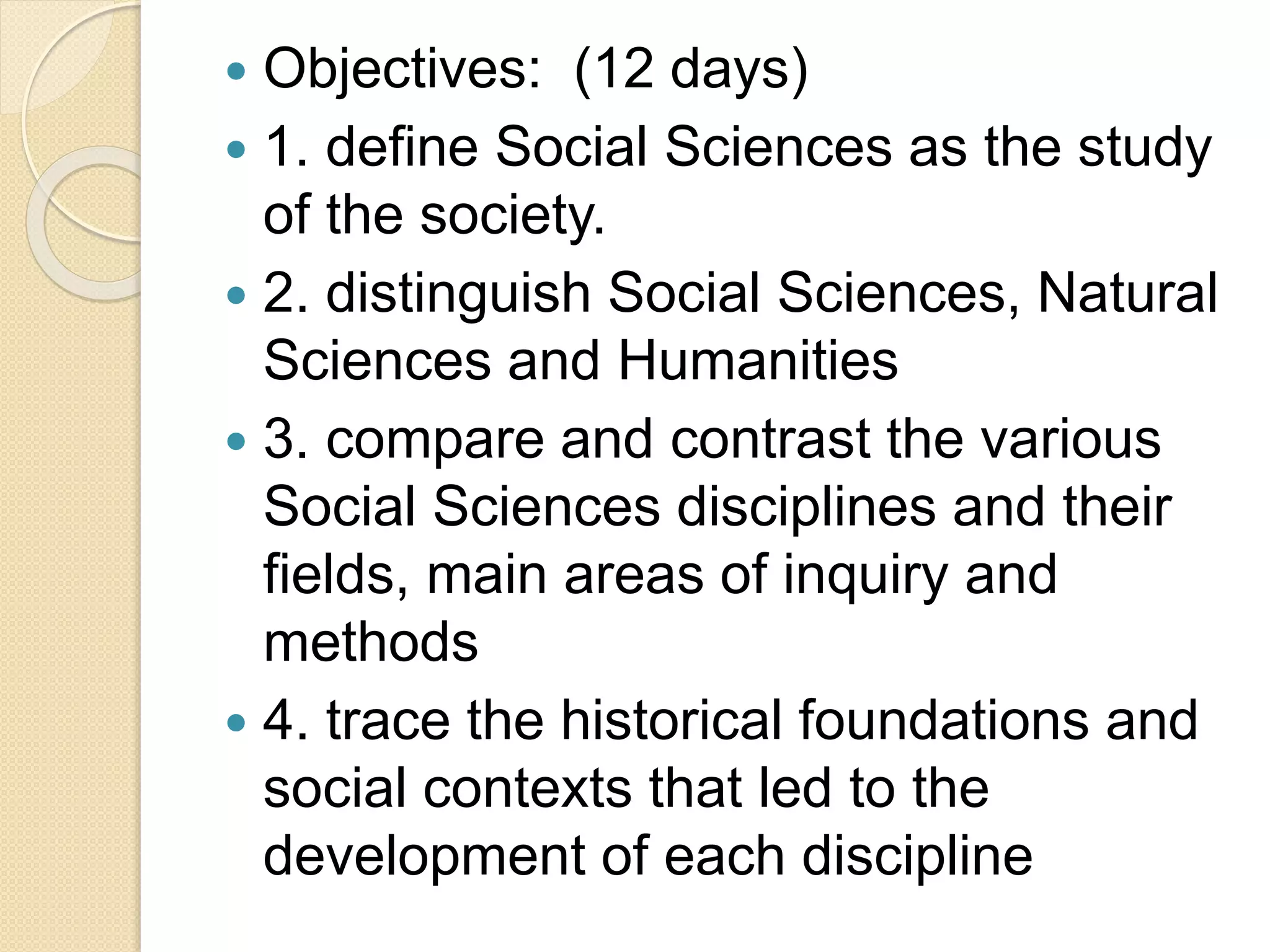
 Objectives: (12 days)
 1. define Social Sciences as the study
of the society.
 2. distinguish Social Sciences, Natural
Sciences and Humanities
 3. compare and contrast the various
Social Sciences disciplines and their
fields, main areas of inquiry and
methods
 4. trace the historical foundations and
social contexts that led to the
development of each discipline
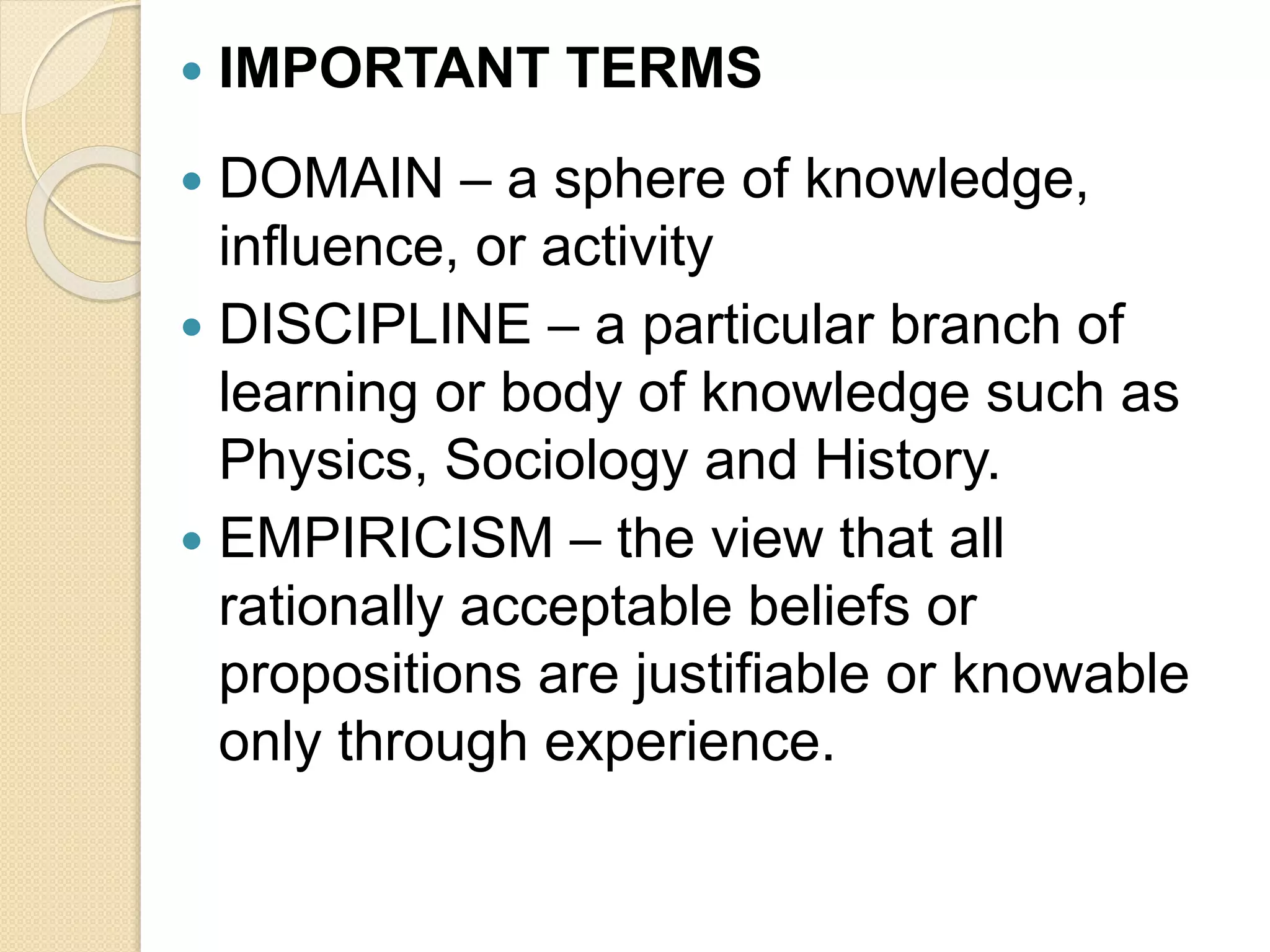
 IMPORTANT TERMS
 DOMAIN – a sphere of knowledge,
influence, or activity
 DISCIPLINE – a particular branch of
learning or body of knowledge such as
Physics, Sociology and History.
 EMPIRICISM – the view that all
rationally acceptable beliefs or
propositions are justifiable or knowable
only through experience.
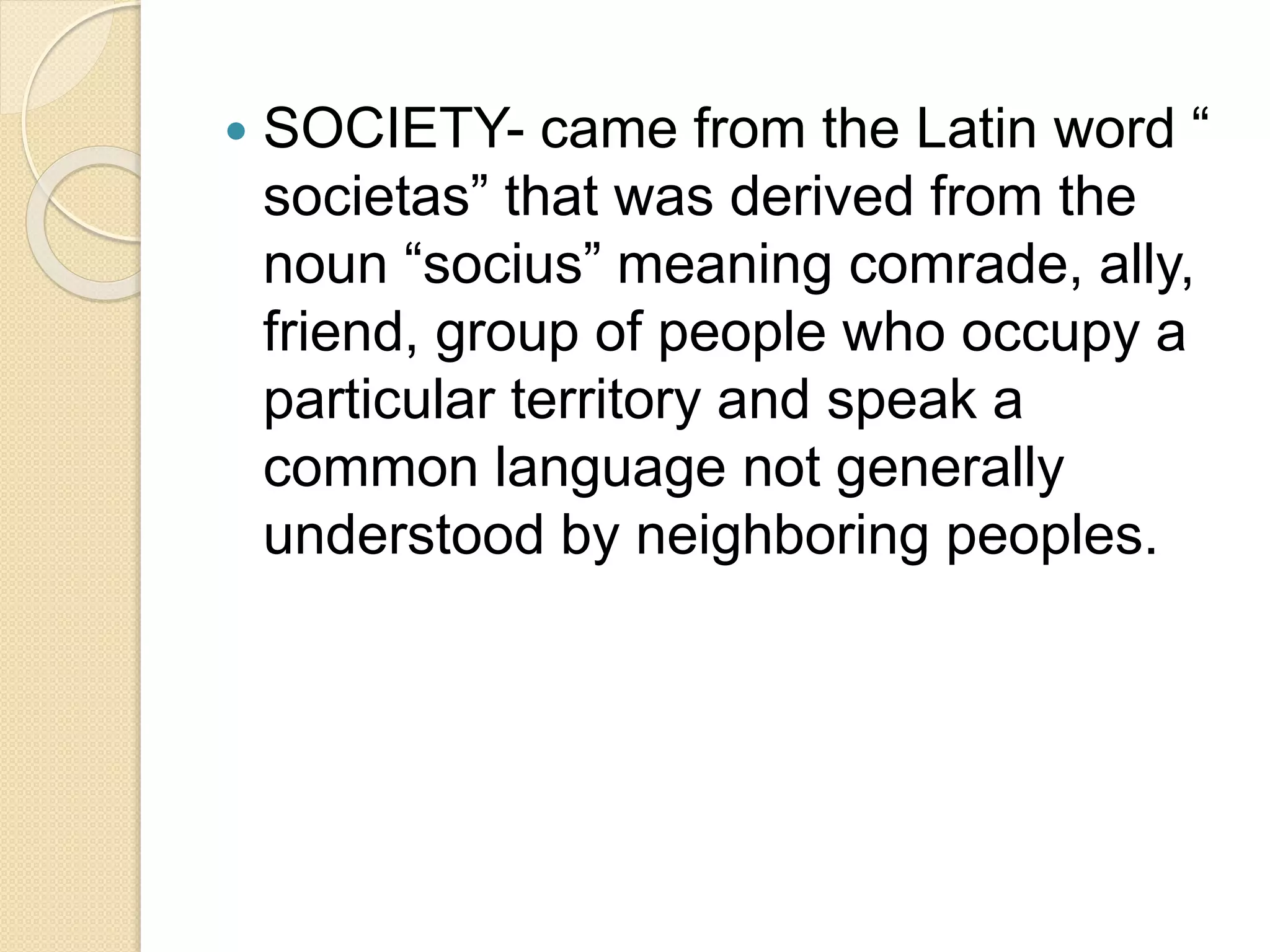
 SOCIETY- came from the Latin word “
societas” that was derived from the
noun “socius” meaning comrade, ally,
friend, group of people who occupy a
particular territory and speak a
common language not generally
understood by neighboring peoples.
 The Great Greek Philosopher Aristotle wrote
that “man is a social animal”. We are all born
and raised in a society. We belong to a
particular group, share the same territory, we
interact with one another and build a
relationship in the hope of pursuing a better
life. As a rational animals we use reason in
order to satisfy our curiosity and discover the
how and why of so many things around us. It
is quite obvious that we need to study
society in order for us to provide explanation
on its workings and to understand a wide
array of phenomena that baffles the human
mind. This lesson will understand the social
sciences, its importance and the difference
from the field of natural science.
HUMAN KNOWLEDGE
Classification of Human Knowledge
1. Natural Sciences (Hard Sciences) –
aims to explain and predict various
phenomena in nature such as cellular
composition, atomic particles, weather
conditions and earthquake patterns.
 Examples of disciplines under the
natural science includes biology,
chemistry, earth sciences, and physics
.
 2. Social Sciences (soft sciences)
refer to the study of the foundation,
establishment and growth of human
society. Disciplines under this
knowledge includes: anthropology,
psychology, sociology, economics and
political science
 3. Humanities – a branch of knowledge
that tends to humanize human as they
express themselves in various forms.
This includes art, art history, literature,
music, etc
4. Philosophy –the search for meaning,
love of wisdom, and search for absolute
truth. This includes Metaphysics (Being)
Epistemology (knowledge) Theodicy
(God) and Phenomenology (experience
and meaning
 5. Applied Professions – involves
practical application of knowledge
drawn-out from other branches,
examples include: business,
communication, criminal justice,
education, journalism, law, social work,
counselling, nursing and medicine.
 Activity 1
SOCIAL SCIENCES – is the of
society. It refers to all academic
disciplines which deal with the
man in their social context. - A
science which deals with the
study of human behavior in its
social and cultural context.
Social Institutions
FAMILY
ECONOMICS
RELIGION
EDUCATION
STATE
 IMPORTANCE OF SOCIAL SCIENCES
 Help us figure out the complexities
of human behaviour and relations
as its attempts to solve the
aforementioned societal problems
 Help researchers solve the
complexities of human behaviour in
order to help alleviate problems and
improve human conditions
HUMAN TABLEAU
 Activity 2
 SCIENCE – came from the Latin word
“scientia” meaning knowledge organized
in a logical manner and the method by
which the knowledge is obtained.
 a systematized body of knowledge
based on facts learned through
experiments and observation
 refers to the different modes or methods
of inquiry utilized in order to obtain
knowledge
 Oftentimes, the scientific study related
with matter rocks, plants, constellation,
motion, the intricacies of human
experience such as attitudes, opinions,
behaviours, feelings and ideologies
 Important Characteristic of Science
 Empirical – a phenomenon should be
observable using the different senses
 Propositional- things are explained in the
form of statements of generalizations.
 Logical – employs the rules of logic in
order to validate inferences
 Public – ideas are communicated from
one scientist to another
 Problem solving – present rational
explanations about unexplained
observations
 Continuous – knowledge is built upon by
previous and future research on the
subject
 The Scientific Method
 1. Topic – the researcher selects a particular
subject matter depending on his or her interest.
 2. Problem- the researcher defines the nature
of the problem where a theory can be
developed along the way, this is the most
important phase of inquiry
 3. Hypothesis – formulates a general statement
of the problem that could give him idea on what
data to gather or omit. An idea or theory that is
not yet proven but that leads to further
discussion
 4. Methods of Inquiry and Data gathering –
empirical research involving the use of senses
and or precision instruments.
 5. Analysis – classifying and organizing of data
 6. Conclusion – formulation of scientific theory
after a thorough analysis of data

Disciplines and IDeas in Social Sciences.pptx

  • 1.
    DISCIPLINES AND IDEASIN THE SOCIAL SCIENCES
  • 2.
     Objectives: (12days)  1. define Social Sciences as the study of the society.  2. distinguish Social Sciences, Natural Sciences and Humanities  3. compare and contrast the various Social Sciences disciplines and their fields, main areas of inquiry and methods  4. trace the historical foundations and social contexts that led to the development of each discipline
  • 3.
     IMPORTANT TERMS DOMAIN – a sphere of knowledge, influence, or activity  DISCIPLINE – a particular branch of learning or body of knowledge such as Physics, Sociology and History.  EMPIRICISM – the view that all rationally acceptable beliefs or propositions are justifiable or knowable only through experience.
  • 4.
     SOCIETY- camefrom the Latin word “ societas” that was derived from the noun “socius” meaning comrade, ally, friend, group of people who occupy a particular territory and speak a common language not generally understood by neighboring peoples.
  • 5.
     The GreatGreek Philosopher Aristotle wrote that “man is a social animal”. We are all born and raised in a society. We belong to a particular group, share the same territory, we interact with one another and build a relationship in the hope of pursuing a better life. As a rational animals we use reason in order to satisfy our curiosity and discover the how and why of so many things around us. It is quite obvious that we need to study society in order for us to provide explanation on its workings and to understand a wide array of phenomena that baffles the human mind. This lesson will understand the social sciences, its importance and the difference from the field of natural science.
  • 6.
    HUMAN KNOWLEDGE Classification ofHuman Knowledge 1. Natural Sciences (Hard Sciences) – aims to explain and predict various phenomena in nature such as cellular composition, atomic particles, weather conditions and earthquake patterns.  Examples of disciplines under the natural science includes biology, chemistry, earth sciences, and physics .
  • 7.
     2. SocialSciences (soft sciences) refer to the study of the foundation, establishment and growth of human society. Disciplines under this knowledge includes: anthropology, psychology, sociology, economics and political science  3. Humanities – a branch of knowledge that tends to humanize human as they express themselves in various forms. This includes art, art history, literature, music, etc
  • 8.
    4. Philosophy –thesearch for meaning, love of wisdom, and search for absolute truth. This includes Metaphysics (Being) Epistemology (knowledge) Theodicy (God) and Phenomenology (experience and meaning  5. Applied Professions – involves practical application of knowledge drawn-out from other branches, examples include: business, communication, criminal justice, education, journalism, law, social work, counselling, nursing and medicine.
  • 9.
  • 10.
    SOCIAL SCIENCES –is the of society. It refers to all academic disciplines which deal with the man in their social context. - A science which deals with the study of human behavior in its social and cultural context.
  • 11.
  • 12.
     IMPORTANCE OFSOCIAL SCIENCES  Help us figure out the complexities of human behaviour and relations as its attempts to solve the aforementioned societal problems  Help researchers solve the complexities of human behaviour in order to help alleviate problems and improve human conditions
  • 13.
  • 14.
     SCIENCE –came from the Latin word “scientia” meaning knowledge organized in a logical manner and the method by which the knowledge is obtained.  a systematized body of knowledge based on facts learned through experiments and observation  refers to the different modes or methods of inquiry utilized in order to obtain knowledge  Oftentimes, the scientific study related with matter rocks, plants, constellation, motion, the intricacies of human experience such as attitudes, opinions, behaviours, feelings and ideologies
  • 15.
     Important Characteristicof Science  Empirical – a phenomenon should be observable using the different senses  Propositional- things are explained in the form of statements of generalizations.  Logical – employs the rules of logic in order to validate inferences  Public – ideas are communicated from one scientist to another  Problem solving – present rational explanations about unexplained observations  Continuous – knowledge is built upon by previous and future research on the subject
  • 16.
     The ScientificMethod  1. Topic – the researcher selects a particular subject matter depending on his or her interest.  2. Problem- the researcher defines the nature of the problem where a theory can be developed along the way, this is the most important phase of inquiry  3. Hypothesis – formulates a general statement of the problem that could give him idea on what data to gather or omit. An idea or theory that is not yet proven but that leads to further discussion  4. Methods of Inquiry and Data gathering – empirical research involving the use of senses and or precision instruments.  5. Analysis – classifying and organizing of data  6. Conclusion – formulation of scientific theory after a thorough analysis of data