COGNITIVE BEHAVIORAL THERAPY
Gradian Health Systems
Basic Principles of Critical Care
PSYCHOSOCIAL DIMENSIONS OF CARE
Disclaimer
Basic Principles of Critical Care Training I Cognitive Behavioral Therapy
Disclaimer: Gradian Health Systems cannot provide formal recommendations or indications
regarding medical care and clinical service delivery. The tables, checklists, and other clinical
documents referenced in this training have not been validated in all settings. These documents are
intended to serve as examples only. We recognize that all clinical training content and activities
must be customized to meet the needs of each facility and its clinical staff, factoring in available
resources, practitioner skill level, and other environmental considerations.
For any questions regarding the contents or applications of this training,
please contact Gradian Health Systems:
40 W 25th St, 6th Floor
New York, NY 10010 USA
+1 212-537-0340
training@gradianhealth.org
Module 8
Gradian Health Systems
Basics Principles of Critical Care
Psychosocial Dimensions of Care
Module 8: Psychosocial Dimensions of Care
MODULE OVERVIEW
Lesson 1 I Psychosocial Support for Patients
Lesson 2 I Psychosocial Support for Staff
Lesson 3 I Psychosocial Support for Relatives
Lesson 4 I Cognitive Behavioral Therapy
Basic Principles of Critical Care Training I Cognitive Behavioral Therapy
Components of the Gradian CCV SystemLesson 4: Cognitive Behavioral Therapy
Lesson Objectives
• Understand how thoughts and beliefs impact emotions
• Describe the core concepts of cognitive behavioral therapy (CBT)
• Review the ABC cycle
• Discuss cognitive restructuring and disputation
Basic Principles of Critical Care Training I Cognitive Behavioral Therapy
Components of the Gradian CCV SystemLesson 4: Cognitive Behavioral Therapy
Key Concepts
• Cognitive behavioral therapy
• Cognitive restructuring
• Disputation
Basic Principles of Critical Care Training I Cognitive Behavioral Therapy
Components of the Gradian CCV SystemCognitive Behavioral Therapy
Cognitive Behavioral Therapy
• Therapy based on cognition, which refers to the thoughts an individual has,
and the resultant behavior
• CBT proponents state that individuals’ core beliefs influence their automatic
thoughts
• Core beliefs (and automatic thoughts) that are negative are reinforced by
cognitive distortions and lead to negative emotions
Basic Principles of Critical Care Training I Cognitive Behavioral Therapy
Components of the Gradian CCV SystemCognitive Behavioral Therapy
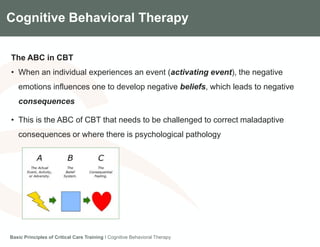
The ABC in CBT
• When an individual experiences an event (activating event), the negative
emotions influences one to develop negative beliefs, which leads to negative
consequences
• This is the ABC of CBT that needs to be challenged to correct maladaptive
consequences or where there is psychological pathology
Basic Principles of Critical Care Training I Cognitive Behavioral Therapy
Components of the Gradian CCV SystemCognitive Behavioral Therapy
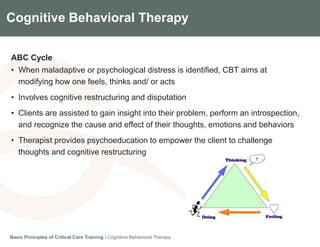
ABC Cycle
• When maladaptive or psychological distress is identified, CBT aims at
modifying how one feels, thinks and/ or acts
• Involves cognitive restructuring and disputation
• Clients are assisted to gain insight into their problem, perform an introspection,
and recognize the cause and effect of their thoughts, emotions and behaviors
• Therapist provides psychoeducation to empower the client to challenge
thoughts and cognitive restructuring
Basic Principles of Critical Care Training I Cognitive Behavioral Therapy
Components of the Gradian CCV SystemCognitive Behavioral Therapy
Cognitive Restructuring
An active process where a client identifies the negative thoughts causing them to
develop unhealthy or dysfunctional beliefs that lead to maladaptive
consequences or pathology
• Common negative thoughts include catastrophizing, “all or nothing” thinking,
minimization and negative self-labeling, etc.
• Common maladaptive consequences and psychological distressing states or
pathologies include depression, anxiety, and fear
Disputation
Involves challenging these beliefs
Basic Principles of Critical Care Training I Cognitive Behavioral Therapy
Components of the Gradian CCV SystemCognitive Behavioral Therapy
ABC from the CBT Perspective
• A – informed of ICU admission
• B – catastrophizing “ICU is a unit where hospital acquired infections (HAIs)
occur”
• C – fear which can lead to anxiety
Cognitive Restructuring and Disputation
• Thoughts – I will develop a COVID infection in ICU
• Feeling – fear
• Doing - decline cardiac surgery as I will require ICU care post-operatively
Basic Principles of Critical Care Training I Cognitive Behavioral Therapy
Components of the Gradian CCV SystemCognitive Behavioral Therapy
Cognitive Restructuring and Disputation
• Explore, challenge and dispute the belief (ABC)
• Minimize fear of acquiring an infection
• Accept to undergo surgery
Basic Principles of Critical Care Training I Cognitive Behavioral Therapy
Components of the Gradian CCV SystemCognitive Behavioral Therapy
CBT
• CBT therapists appreciate that individuals have experiences in life (A)
• Their core beliefs (B) influence their thoughts and the feelings and emotional
consequences (C) that lead to the either maladaptive behavior or pathology
• Therapy involves:
• Assessing a patient’s core beliefs
• Identifying the effect of the negative thoughts
• Recognizing how these thoughts cause maladaptive behavior or negative
emotions
Basic Principles of Critical Care Training I Cognitive Behavioral Therapy
Components of the Gradian CCV SystemCognitive Behavioral Therapy
CBT
• The goal is to empower the client to develop insight into the influence of core
beliefs on their situation (A)
• A conscious cognitive assessment leads to the process of disputing cognitive
distortions (i.e. negative beliefs and thoughts) thereby influencing the feelings,
emotions or behavior
Basic Principles of Critical Care Training I Cognitive Behavioral Therapy
Components of the Gradian CCV SystemLesson 4: Summary
CBT Summary
• Activating events – environmental incidences
• Beliefs – cognitive distortions influence how one interprets the events
• Consequences – the visible resultant behavior or emotional distress
• CBT involves understanding this cycle and cognitively recognizing the facets
of this cycle and breaking the cycle (structural restructuring and disputation)
Basic Principles of Critical Care Training I Cognitive Behavioral Therapy

Module 8.4 Cognitive Behavioral Therapy

  • 1.
    COGNITIVE BEHAVIORAL THERAPY GradianHealth Systems Basic Principles of Critical Care PSYCHOSOCIAL DIMENSIONS OF CARE
  • 2.
    Disclaimer Basic Principles ofCritical Care Training I Cognitive Behavioral Therapy Disclaimer: Gradian Health Systems cannot provide formal recommendations or indications regarding medical care and clinical service delivery. The tables, checklists, and other clinical documents referenced in this training have not been validated in all settings. These documents are intended to serve as examples only. We recognize that all clinical training content and activities must be customized to meet the needs of each facility and its clinical staff, factoring in available resources, practitioner skill level, and other environmental considerations. For any questions regarding the contents or applications of this training, please contact Gradian Health Systems: 40 W 25th St, 6th Floor New York, NY 10010 USA +1 212-537-0340 training@gradianhealth.org
  • 3.
    Module 8 Gradian HealthSystems Basics Principles of Critical Care Psychosocial Dimensions of Care
  • 4.
    Module 8: PsychosocialDimensions of Care MODULE OVERVIEW Lesson 1 I Psychosocial Support for Patients Lesson 2 I Psychosocial Support for Staff Lesson 3 I Psychosocial Support for Relatives Lesson 4 I Cognitive Behavioral Therapy Basic Principles of Critical Care Training I Cognitive Behavioral Therapy
  • 5.
    Components of theGradian CCV SystemLesson 4: Cognitive Behavioral Therapy Lesson Objectives • Understand how thoughts and beliefs impact emotions • Describe the core concepts of cognitive behavioral therapy (CBT) • Review the ABC cycle • Discuss cognitive restructuring and disputation Basic Principles of Critical Care Training I Cognitive Behavioral Therapy
  • 6.
    Components of theGradian CCV SystemLesson 4: Cognitive Behavioral Therapy Key Concepts • Cognitive behavioral therapy • Cognitive restructuring • Disputation Basic Principles of Critical Care Training I Cognitive Behavioral Therapy
  • 7.
    Components of theGradian CCV SystemCognitive Behavioral Therapy Cognitive Behavioral Therapy • Therapy based on cognition, which refers to the thoughts an individual has, and the resultant behavior • CBT proponents state that individuals’ core beliefs influence their automatic thoughts • Core beliefs (and automatic thoughts) that are negative are reinforced by cognitive distortions and lead to negative emotions Basic Principles of Critical Care Training I Cognitive Behavioral Therapy
  • 8.
    Components of theGradian CCV SystemCognitive Behavioral Therapy The ABC in CBT • When an individual experiences an event (activating event), the negative emotions influences one to develop negative beliefs, which leads to negative consequences • This is the ABC of CBT that needs to be challenged to correct maladaptive consequences or where there is psychological pathology Basic Principles of Critical Care Training I Cognitive Behavioral Therapy
  • 9.
    Components of theGradian CCV SystemCognitive Behavioral Therapy ABC Cycle • When maladaptive or psychological distress is identified, CBT aims at modifying how one feels, thinks and/ or acts • Involves cognitive restructuring and disputation • Clients are assisted to gain insight into their problem, perform an introspection, and recognize the cause and effect of their thoughts, emotions and behaviors • Therapist provides psychoeducation to empower the client to challenge thoughts and cognitive restructuring Basic Principles of Critical Care Training I Cognitive Behavioral Therapy
  • 10.
    Components of theGradian CCV SystemCognitive Behavioral Therapy Cognitive Restructuring An active process where a client identifies the negative thoughts causing them to develop unhealthy or dysfunctional beliefs that lead to maladaptive consequences or pathology • Common negative thoughts include catastrophizing, “all or nothing” thinking, minimization and negative self-labeling, etc. • Common maladaptive consequences and psychological distressing states or pathologies include depression, anxiety, and fear Disputation Involves challenging these beliefs Basic Principles of Critical Care Training I Cognitive Behavioral Therapy
  • 11.
    Components of theGradian CCV SystemCognitive Behavioral Therapy ABC from the CBT Perspective • A – informed of ICU admission • B – catastrophizing “ICU is a unit where hospital acquired infections (HAIs) occur” • C – fear which can lead to anxiety Cognitive Restructuring and Disputation • Thoughts – I will develop a COVID infection in ICU • Feeling – fear • Doing - decline cardiac surgery as I will require ICU care post-operatively Basic Principles of Critical Care Training I Cognitive Behavioral Therapy
  • 12.
    Components of theGradian CCV SystemCognitive Behavioral Therapy Cognitive Restructuring and Disputation • Explore, challenge and dispute the belief (ABC) • Minimize fear of acquiring an infection • Accept to undergo surgery Basic Principles of Critical Care Training I Cognitive Behavioral Therapy
  • 13.
    Components of theGradian CCV SystemCognitive Behavioral Therapy CBT • CBT therapists appreciate that individuals have experiences in life (A) • Their core beliefs (B) influence their thoughts and the feelings and emotional consequences (C) that lead to the either maladaptive behavior or pathology • Therapy involves: • Assessing a patient’s core beliefs • Identifying the effect of the negative thoughts • Recognizing how these thoughts cause maladaptive behavior or negative emotions Basic Principles of Critical Care Training I Cognitive Behavioral Therapy
  • 14.
    Components of theGradian CCV SystemCognitive Behavioral Therapy CBT • The goal is to empower the client to develop insight into the influence of core beliefs on their situation (A) • A conscious cognitive assessment leads to the process of disputing cognitive distortions (i.e. negative beliefs and thoughts) thereby influencing the feelings, emotions or behavior Basic Principles of Critical Care Training I Cognitive Behavioral Therapy
  • 15.
    Components of theGradian CCV SystemLesson 4: Summary CBT Summary • Activating events – environmental incidences • Beliefs – cognitive distortions influence how one interprets the events • Consequences – the visible resultant behavior or emotional distress • CBT involves understanding this cycle and cognitively recognizing the facets of this cycle and breaking the cycle (structural restructuring and disputation) Basic Principles of Critical Care Training I Cognitive Behavioral Therapy