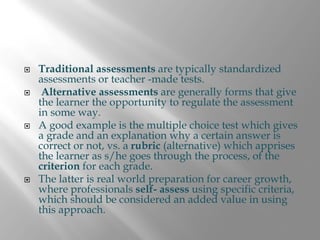
Traditional assessments are typically standardized
assessments or teacher -made tests.
 Alternative assessments are generally forms that give
the learner the opportunity to regulate the assessment
in some way.
A good example is the multiple choice test which gives
a grade and an explanation why a certain answer is
correct or not, vs. a rubric (alternative) which apprises
the learner as s/he goes through the process, of the
criterion for each grade.
The latter is real world preparation for career growth,
where professionals self- assess using specific criteria,
which should be considered an added value in using
this approach.
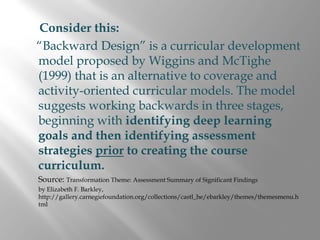
Consider this:
“Backward Design” is a curricular development
model proposed by Wiggins and McTighe
(1999) that is an alternative to coverage and
activity-oriented curricular models. The model
suggests working backwards in three stages,
beginning with identifying deep learning
goals and then identifying assessment
strategies prior to creating the course
curriculum.
Source: Transformation Theme: Assessment Summary of Significant Findings
by Elizabeth F. Barkley,
http://gallery.carnegiefoundation.org/collections/castl_he/ebarkley/themes/themesmenu.h
tml
Authentic assessment is a component of
performance assessment that calls for
application of concepts to real life expectations.

Work by Wiggins (1989) provides these basic
characteristics of authentic assessment:

Designed to represent performance in the field

The criteria for meeting the course objectives
are given greater attention during the teaching
and learning process than the criteria applied
to the traditional assessment approach.
Students’ self assessment is a critical difference
in the two approaches.

Students are expected to present and defend
their work to demonstrate mastery.

Formats for project based and authentic
learning opportunities include CDs and DVDs,
audio tapes, debates, constructed models (for
design classes, science classes, other), articles
contributed to the school or local paper, oral,
visual or virtual presentation to a group,
investigations and science projects, and artistic
renderings.
What disciplines are very likely to use this kind
of assessment? Let’s make some associations of
selected methods with selected disciplines or
courses, as a means for comprehending these
concepts.

Do you believe that students will feel
comfortable being evaluated in this way?

Why /Why not?
Portfolio Assessment
The early roots of today’s portfolios can be
traced to the mid-1980s, with the work of Peter
Elbow and Pat Belanoff (1986). They served as
administrators in a writing program and were
dissatisfied with the scoring. They shifted
emphasis to the process, rather than simply the
product. Purdue University, Miami University
of Ohio, and the University of Michigan were
some of the first universities to apply this
model of assessment, using process and or
product type portfolios.
To demonstrate the growth of the learner, over
a period of time, you are best using a process
oriented portfolio. This could be the many
iterations of a paper or a project, that show
development and growth.

Product oriented portfolios focus on the best
work of the student in a particular unit or
discipline or concept.
Types of Portfolios

1) Product Portfolio
    Used to document or provide evidence of
    completion
    Used to demonstrate competence or mastery
    (showcase portfolios)


2) Process Portfolio
      Used to illustrate steps in a process
      Used to share experiences
Product Portfolios
•   Documentation
•   Showcase
Since about 1992, students have been able to do
portfolios using the internet. These are referred to
as electronic portfolios, webfolios or digital
portfolios. The work may be posted to a website, a
course management system such as Blackboard, or

The National Council for Accreditation of Teacher
Education (NCATE) 2000 requires universities to
utilize assessment systems that are aligned with
program, institutional, state, and national
standards. Portfolios provide clear evidences of
student growth as it relates to a given standard or
set of indicators. These are learner-centered
products.
Another kind of assessment is that which must
be conducted on the university as a whole, or a
department or program. For this we use
Assessment Management Systems such as Task
Stream, Weave, and Folio Live, which are
designed around the standards for each state.
These tools allow the organization to collect
and aggregate data in an effort to see where
they are in their address of leadership or
teaching goals. These are teacher- centered
products.
E-portfolios can be highly provocative and can further
knowledge by rallying people around a set of personal
experiences that are shared for others’ interests.
(Greenberg 2004).

Universities including Penn State, Minnesota State and
Elon University (right here in our area), who are
affiliated with the Carnegie Foundation have
developed great portfolio practices. Students are given
passwords and can give permission to selected persons
for viewing their work.
Planning for effective use of portfolios as assessment
tools
Source: Paul S. George, (1995). What Is Portfolio Assessment Really and How Can I Use It in
My Classroom? Gainesville, FL: Teacher Education Resources.


What observable behaviors or learning experiences
might provide evidence of learning and meeting
identified goals?

How will I ensure that students understand the
portfolio expectation, the process, and the expected
content and quality?

Will I use rubrics, rules, scoring keys, and/or checklists
to guide the process?

How might I integrate oral communication skills and
virtual learning into the portfolio assessment process?
Portfolio assessment is a multi-faceted process
characterized by the following recurrent
qualities:
It is continuous and ongoing, providing both
formative (i.e., ongoing) and summative (i.e.,
culminating) opportunities for monitoring
students' progress toward achieving essential
outcomes.
It is multidimensional, i.e., reflecting a wide
variety of artifacts and processes reflecting
various aspects of students' learning
process(es).
It provides for collaborative reflection,
including ways for students to reflect about
their own thinking processes and
metacognitions as they monitor their own
comprehension, reflect upon their approaches
to problem-solving and decision-making, and
observe their emerging understanding of
subjects and skills.

They clearly reflect stated learner outcomes
identified in the core or essential curriculum
that students are expected to study.
They focus upon students' performance-based
learning experiences as well as their acquisition
of key knowledge, skills, and attitudes.

They contain samples of work that stretch over
an entire marking period, rather than single
points in time.

They contain works that represent a variety of
different assessment tools.

They contain a variety of work samples and
evaluations of that work by the student, peers,
and teachers, possible even parents' reactions.
Do you like the portfolio method for student
assessment? Discuss.

Which type would work well for you? Discuss.

Which would be best for students? Discuss.

What do you believe to be the advantages of these
alternative methods of assessment?

What are the disadvantages?

Source: Paul S. George, (1995). What Is Portfolio Assessment Really and How Can I Use It
in My Classroom? Gainesville, FL: Teacher Education Resources.
Do you like the portfolio method for student
assessment? Discuss.

Which type would work well for you? Discuss.

Which would be best for students? Discuss.

What do you believe to be the advantages of
these alternative methods of assessment?

What are the disadvantages?
References
Elbow, P., and P. Belanoff. 1986. Portfolios as a substitute for
proficiency examination. College Composition and Communication 37:
336–39.

Greenberg, G. 2004. The digital convergence: Extending the portfolio
model. Educause Review 39 (4): 28.

George, P. (1995). What Is Portfolio Assessment Really and How Can
I Use It in My Classroom? Gainesville, FL: Teacher Education
Resources.

Stewart, S., Choate, J., & Poteet, J. (1995) The revolution in assessment
within and across educational settings. Preventing School Failure,
39,3(20-24.

 http://www.pgcps.pg.k12.md.us/~elc/portfolio2.html, Prince
George’s County Schools, Department of Staff Development, in
collaboration with the Division of Instruction.

A view toward more effective (student centered)

  • 2.
    Traditional assessments aretypically standardized assessments or teacher -made tests. Alternative assessments are generally forms that give the learner the opportunity to regulate the assessment in some way. A good example is the multiple choice test which gives a grade and an explanation why a certain answer is correct or not, vs. a rubric (alternative) which apprises the learner as s/he goes through the process, of the criterion for each grade. The latter is real world preparation for career growth, where professionals self- assess using specific criteria, which should be considered an added value in using this approach.
  • 3.
    Consider this: “Backward Design”is a curricular development model proposed by Wiggins and McTighe (1999) that is an alternative to coverage and activity-oriented curricular models. The model suggests working backwards in three stages, beginning with identifying deep learning goals and then identifying assessment strategies prior to creating the course curriculum. Source: Transformation Theme: Assessment Summary of Significant Findings by Elizabeth F. Barkley, http://gallery.carnegiefoundation.org/collections/castl_he/ebarkley/themes/themesmenu.h tml
  • 10.
    Authentic assessment isa component of performance assessment that calls for application of concepts to real life expectations. Work by Wiggins (1989) provides these basic characteristics of authentic assessment: Designed to represent performance in the field The criteria for meeting the course objectives are given greater attention during the teaching and learning process than the criteria applied to the traditional assessment approach.
  • 11.
    Students’ self assessmentis a critical difference in the two approaches. Students are expected to present and defend their work to demonstrate mastery. Formats for project based and authentic learning opportunities include CDs and DVDs, audio tapes, debates, constructed models (for design classes, science classes, other), articles contributed to the school or local paper, oral, visual or virtual presentation to a group, investigations and science projects, and artistic renderings.
  • 12.
    What disciplines arevery likely to use this kind of assessment? Let’s make some associations of selected methods with selected disciplines or courses, as a means for comprehending these concepts. Do you believe that students will feel comfortable being evaluated in this way? Why /Why not?
  • 13.
    Portfolio Assessment The earlyroots of today’s portfolios can be traced to the mid-1980s, with the work of Peter Elbow and Pat Belanoff (1986). They served as administrators in a writing program and were dissatisfied with the scoring. They shifted emphasis to the process, rather than simply the product. Purdue University, Miami University of Ohio, and the University of Michigan were some of the first universities to apply this model of assessment, using process and or product type portfolios.
  • 14.
    To demonstrate thegrowth of the learner, over a period of time, you are best using a process oriented portfolio. This could be the many iterations of a paper or a project, that show development and growth. Product oriented portfolios focus on the best work of the student in a particular unit or discipline or concept.
  • 15.
    Types of Portfolios 1)Product Portfolio Used to document or provide evidence of completion Used to demonstrate competence or mastery (showcase portfolios) 2) Process Portfolio Used to illustrate steps in a process Used to share experiences
  • 17.
    Product Portfolios • Documentation • Showcase
  • 18.
    Since about 1992,students have been able to do portfolios using the internet. These are referred to as electronic portfolios, webfolios or digital portfolios. The work may be posted to a website, a course management system such as Blackboard, or The National Council for Accreditation of Teacher Education (NCATE) 2000 requires universities to utilize assessment systems that are aligned with program, institutional, state, and national standards. Portfolios provide clear evidences of student growth as it relates to a given standard or set of indicators. These are learner-centered products.
  • 19.
    Another kind ofassessment is that which must be conducted on the university as a whole, or a department or program. For this we use Assessment Management Systems such as Task Stream, Weave, and Folio Live, which are designed around the standards for each state. These tools allow the organization to collect and aggregate data in an effort to see where they are in their address of leadership or teaching goals. These are teacher- centered products.
  • 20.
    E-portfolios can behighly provocative and can further knowledge by rallying people around a set of personal experiences that are shared for others’ interests. (Greenberg 2004). Universities including Penn State, Minnesota State and Elon University (right here in our area), who are affiliated with the Carnegie Foundation have developed great portfolio practices. Students are given passwords and can give permission to selected persons for viewing their work.
  • 21.
    Planning for effectiveuse of portfolios as assessment tools Source: Paul S. George, (1995). What Is Portfolio Assessment Really and How Can I Use It in My Classroom? Gainesville, FL: Teacher Education Resources. What observable behaviors or learning experiences might provide evidence of learning and meeting identified goals? How will I ensure that students understand the portfolio expectation, the process, and the expected content and quality? Will I use rubrics, rules, scoring keys, and/or checklists to guide the process? How might I integrate oral communication skills and virtual learning into the portfolio assessment process?
  • 22.
    Portfolio assessment isa multi-faceted process characterized by the following recurrent qualities: It is continuous and ongoing, providing both formative (i.e., ongoing) and summative (i.e., culminating) opportunities for monitoring students' progress toward achieving essential outcomes. It is multidimensional, i.e., reflecting a wide variety of artifacts and processes reflecting various aspects of students' learning process(es).
  • 23.
    It provides forcollaborative reflection, including ways for students to reflect about their own thinking processes and metacognitions as they monitor their own comprehension, reflect upon their approaches to problem-solving and decision-making, and observe their emerging understanding of subjects and skills. They clearly reflect stated learner outcomes identified in the core or essential curriculum that students are expected to study.
  • 24.
    They focus uponstudents' performance-based learning experiences as well as their acquisition of key knowledge, skills, and attitudes. They contain samples of work that stretch over an entire marking period, rather than single points in time. They contain works that represent a variety of different assessment tools. They contain a variety of work samples and evaluations of that work by the student, peers, and teachers, possible even parents' reactions.
  • 25.
    Do you likethe portfolio method for student assessment? Discuss. Which type would work well for you? Discuss. Which would be best for students? Discuss. What do you believe to be the advantages of these alternative methods of assessment? What are the disadvantages? Source: Paul S. George, (1995). What Is Portfolio Assessment Really and How Can I Use It in My Classroom? Gainesville, FL: Teacher Education Resources.
  • 26.
    Do you likethe portfolio method for student assessment? Discuss. Which type would work well for you? Discuss. Which would be best for students? Discuss. What do you believe to be the advantages of these alternative methods of assessment? What are the disadvantages?
  • 27.
    References Elbow, P., andP. Belanoff. 1986. Portfolios as a substitute for proficiency examination. College Composition and Communication 37: 336–39. Greenberg, G. 2004. The digital convergence: Extending the portfolio model. Educause Review 39 (4): 28. George, P. (1995). What Is Portfolio Assessment Really and How Can I Use It in My Classroom? Gainesville, FL: Teacher Education Resources. Stewart, S., Choate, J., & Poteet, J. (1995) The revolution in assessment within and across educational settings. Preventing School Failure, 39,3(20-24. http://www.pgcps.pg.k12.md.us/~elc/portfolio2.html, Prince George’s County Schools, Department of Staff Development, in collaboration with the Division of Instruction.