
ENVIRONMENTALSANITATION
ENRICHED MODULAR
PACKAGES FOR
WOMEN
MAC PAULV. ALARIAO, RN, MSN
Regional GADFocalPersom
Water
Human waste disposal
Garbage Disposal
Global Warming
Water
At the end of the session, the participants
should be able to:
 Define waterand identify its use
Identify the sources of water in the
community, and distinguish unclean/unsafe
waterfromclean/potable water;
Do the return – demonstration on the
methods of purifying water; and
Identify existing problems regarding water
supply and the different resources available
in the community to respond to these
problems
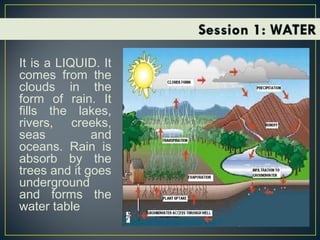
It is a LIQUID. It
comes from the
clouds in the
form of rain. It
fills the lakes,
rivers, creeks,
seas and
oceans. Rain is
absorb by the
trees and it goes
underground
and forms the
water table
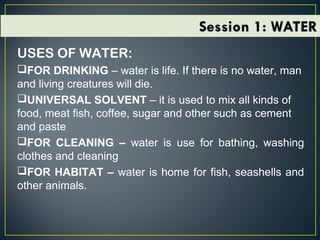
USES OF WATER:
FOR DRINKING – water is life. If there is no water, man
and living creatures will die.
UNIVERSAL SOLVENT – it is used to mix all kinds of
food, meat fish, coffee, sugar and other such as cement
and paste
FOR CLEANING – water is use for bathing, washing
clothes and cleaning
FOR HABITAT – water is home for fish, seashells and
other animals.
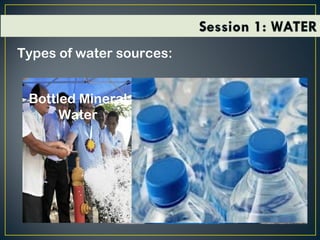
Types of water sources:
Rain Water
Water from
river, lake
Water from Deep Well
Water from
Local Water
Districts (LWD)
Bottled Mineral
Water
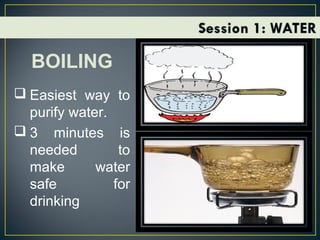
BOILING
 Easiest way to
purify water.
 3 minutes is
needed to
make water
safe for
drinking
Excreta/ Human
Waste Disposal
At the end of the session, the participants
should be able to:
 Name the different types of toilet or ways
of human waste disposal;
Enumerate the illnesses caused by
unsanitary human waste disposal;
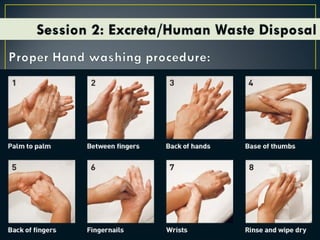
Practice the proper hand washing
procedure; and
Discuss various resources available within
and outside of the community for proper
human waste disposal.
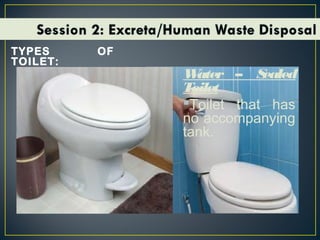
Flushedtoilet
Toilet with tank
for flushing the
human waste
TYPES OF
TOILET:
Water – Sealed
Toilet
Toilet that has
no accompanying
tank.
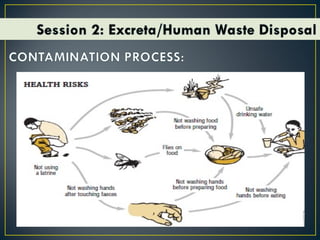
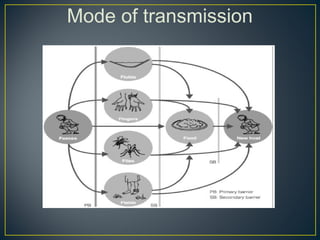
Mode of transmission
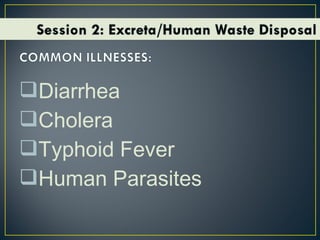
Diarrhea
Cholera
Typhoid Fever
Human Parasites
Garbage Disposal
At the end of the session, the participants
should be able to:
 Identify the different types and methods
of garbage disposal
Discuss policies and legislations
concerning environmental sanitation;
Identify existing problems regarding
refuse disposal and theirproposed solutions;
Learn and practice the reduce, reuse,
recycle (3Rs) and
Demonstrate the scientific preparation of
compost
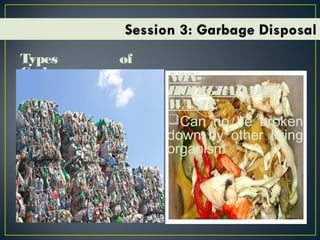
Types of
Garbage:BIODEGRADABLE
WASTE
Waste that
physical originates
from plant or animal
sources which may
be broken down by
other living
organisms.
NON-
BIODEGRADABLE
WASTE
Can no be broken
down by other living
organism
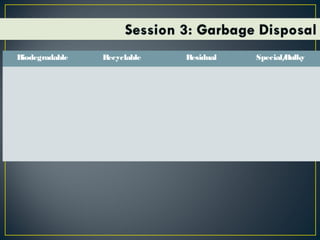
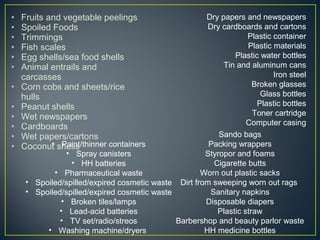
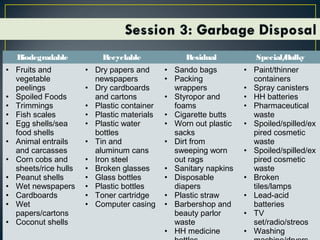
Biodegradable Recyclable Residual Special/Bulky
• Fruits and vegetable peelings
• Spoiled Foods
• Trimmings
• Fish scales
• Egg shells/sea food shells
• Animal entrails and
carcasses
• Corn cobs and sheets/rice
hulls
• Peanut shells
• Wet newspapers
• Cardboards
• Wet papers/cartons
• Coconut shells
Dry papers and newspapers
Dry cardboards and cartons
Plastic container
Plastic materials
Plastic water bottles
Tin and aluminum cans
Iron steel
Broken glasses
Glass bottles
Plastic bottles
Toner cartridge
Computer casing
Sando bags
Packing wrappers
Styropor and foams
Cigarette butts
Worn out plastic sacks
Dirt from sweeping worn out rags
Sanitary napkins
Disposable diapers
Plastic straw
Barbershop and beauty parlor waste
HH medicine bottles
• Paint/thinner containers
• Spray canisters
• HH batteries
• Pharmaceutical waste
• Spoiled/spilled/expired cosmetic waste
• Broken tiles/lamps
• Lead-acid batteries
• TV set/radio/streos
• Washing machine/dryers
Biodegradable Recyclable Residual Special/Bulky
• Fruits and
vegetable
peelings
• Spoiled Foods
• Trimmings
• Fish scales
• Egg shells/sea
food shells
• Animal entrails
and carcasses
• Corn cobs and
sheets/rice hulls
• Peanut shells
• Wet newspapers
• Cardboards
• Wet
papers/cartons
• Coconut shells
• Dry papers and
newspapers
• Dry cardboards
and cartons
• Plastic container
• Plastic materials
• Plastic water
bottles
• Tin and
aluminum cans
• Iron steel
• Broken glasses
• Glass bottles
• Plastic bottles
• Toner cartridge
• Computer casing
• Sando bags
• Packing
wrappers
• Styropor and
foams
• Cigarette butts
• Worn out plastic
sacks
• Dirt from
sweeping worn
out rags
• Sanitary napkins
• Disposable
diapers
• Plastic straw
• Barbershop and
beauty parlor
waste
• HH medicine
• Paint/thinner
containers
• Spray canisters
• HH batteries
• Pharmaceutical
waste
• Spoiled/spilled/ex
pired cosmetic
waste
• Spoiled/spilled/ex
pired cosmetic
waste
• Broken
tiles/lamps
• Lead-acid
batteries
• TV
set/radio/streos
• Washing
POLICIES AND LEGISLATIONS:
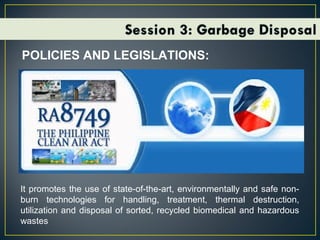
It promotes the use of state-of-the-art, environmentally and safe non-
burn technologies for handling, treatment, thermal destruction,
utilization and disposal of sorted, recycled biomedical and hazardous
wastes
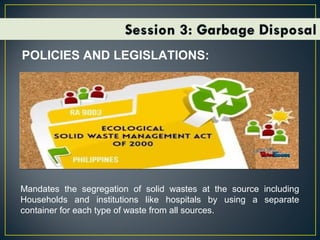
POLICIES AND LEGISLATIONS:
Mandates the segregation of solid wastes at the source including
Households and institutions like hospitals by using a separate
container for each type of waste from all sources.
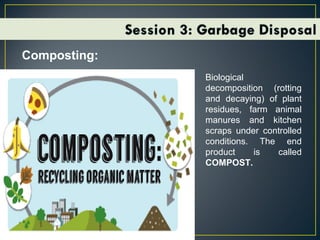
Composting:
Biological
decomposition (rotting
and decaying) of plant
residues, farm animal
manures and kitchen
scraps under controlled
conditions. The end
product is called
COMPOST.
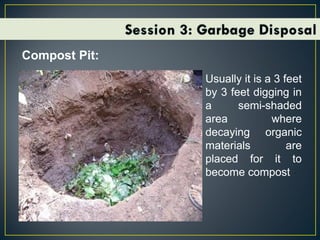
Compost Pit:
Usually it is a 3 feet
by 3 feet digging in
a semi-shaded
area where
decaying organic
materials are
placed for it to
become compost
Global Warming and
Climate Change
At the end of the session, the participants
should be able to:
 Understand Global warming
Understand the causes and effects of
global warming
Global
Warming:Refers to an increase in
average earth’s mean
temperature due to the so-
called enhanced green
house effect, which in turn
causes climate change.
Worldwide
Deforestation
Increase Industrial Activity
Motor
Vehicle
Emission
Waste
Management
Practices
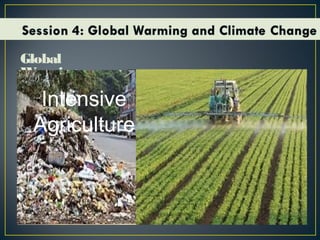
Intensive
Agriculture
PREVENTION:
Personal Efforts (Individual Level)
Energy
Conservation
Tips
Impact of Climate Change:
Agriculture
Fishing communities
Disastrous effects on rural and urban poor
Burned out Health sector
Otherhealth related conditions
Groundwatersources maybe contaminated
1. What is the impact of Climate Change to
Women?
2. What is the impact of Climate Change to
Indigenous People?
3. What is the impact of Climate Change to
Older Person?
4. What is the impact of Climate Change to
Children?
MODULE 6: ENVIRONMENTAL SANITATION

MODULE 6: ENVIRONMENTAL SANITATION

  • 1.
    ENVIRONMENTALSANITATION ENRICHED MODULAR PACKAGES FOR WOMEN MACPAULV. ALARIAO, RN, MSN Regional GADFocalPersom
  • 2.
  • 3.
  • 4.
    At the endof the session, the participants should be able to:  Define waterand identify its use Identify the sources of water in the community, and distinguish unclean/unsafe waterfromclean/potable water; Do the return – demonstration on the methods of purifying water; and Identify existing problems regarding water supply and the different resources available in the community to respond to these problems
  • 5.
    It is aLIQUID. It comes from the clouds in the form of rain. It fills the lakes, rivers, creeks, seas and oceans. Rain is absorb by the trees and it goes underground and forms the water table
  • 6.
    USES OF WATER: FORDRINKING – water is life. If there is no water, man and living creatures will die. UNIVERSAL SOLVENT – it is used to mix all kinds of food, meat fish, coffee, sugar and other such as cement and paste FOR CLEANING – water is use for bathing, washing clothes and cleaning FOR HABITAT – water is home for fish, seashells and other animals.
  • 7.
    Types of watersources: Rain Water Water from river, lake Water from Deep Well Water from Local Water Districts (LWD) Bottled Mineral Water
  • 8.
    BOILING  Easiest wayto purify water.  3 minutes is needed to make water safe for drinking
  • 9.
  • 10.
    At the endof the session, the participants should be able to:  Name the different types of toilet or ways of human waste disposal; Enumerate the illnesses caused by unsanitary human waste disposal; Practice the proper hand washing procedure; and Discuss various resources available within and outside of the community for proper human waste disposal.
  • 11.
    Flushedtoilet Toilet with tank forflushing the human waste TYPES OF TOILET: Water – Sealed Toilet Toilet that has no accompanying tank.
  • 13.
  • 14.
  • 16.
  • 17.
    At the endof the session, the participants should be able to:  Identify the different types and methods of garbage disposal Discuss policies and legislations concerning environmental sanitation; Identify existing problems regarding refuse disposal and theirproposed solutions; Learn and practice the reduce, reuse, recycle (3Rs) and Demonstrate the scientific preparation of compost
  • 18.
    Types of Garbage:BIODEGRADABLE WASTE Waste that physicaloriginates from plant or animal sources which may be broken down by other living organisms. NON- BIODEGRADABLE WASTE Can no be broken down by other living organism
  • 19.
  • 20.
    • Fruits andvegetable peelings • Spoiled Foods • Trimmings • Fish scales • Egg shells/sea food shells • Animal entrails and carcasses • Corn cobs and sheets/rice hulls • Peanut shells • Wet newspapers • Cardboards • Wet papers/cartons • Coconut shells Dry papers and newspapers Dry cardboards and cartons Plastic container Plastic materials Plastic water bottles Tin and aluminum cans Iron steel Broken glasses Glass bottles Plastic bottles Toner cartridge Computer casing Sando bags Packing wrappers Styropor and foams Cigarette butts Worn out plastic sacks Dirt from sweeping worn out rags Sanitary napkins Disposable diapers Plastic straw Barbershop and beauty parlor waste HH medicine bottles • Paint/thinner containers • Spray canisters • HH batteries • Pharmaceutical waste • Spoiled/spilled/expired cosmetic waste • Spoiled/spilled/expired cosmetic waste • Broken tiles/lamps • Lead-acid batteries • TV set/radio/streos • Washing machine/dryers
  • 21.
    Biodegradable Recyclable ResidualSpecial/Bulky • Fruits and vegetable peelings • Spoiled Foods • Trimmings • Fish scales • Egg shells/sea food shells • Animal entrails and carcasses • Corn cobs and sheets/rice hulls • Peanut shells • Wet newspapers • Cardboards • Wet papers/cartons • Coconut shells • Dry papers and newspapers • Dry cardboards and cartons • Plastic container • Plastic materials • Plastic water bottles • Tin and aluminum cans • Iron steel • Broken glasses • Glass bottles • Plastic bottles • Toner cartridge • Computer casing • Sando bags • Packing wrappers • Styropor and foams • Cigarette butts • Worn out plastic sacks • Dirt from sweeping worn out rags • Sanitary napkins • Disposable diapers • Plastic straw • Barbershop and beauty parlor waste • HH medicine • Paint/thinner containers • Spray canisters • HH batteries • Pharmaceutical waste • Spoiled/spilled/ex pired cosmetic waste • Spoiled/spilled/ex pired cosmetic waste • Broken tiles/lamps • Lead-acid batteries • TV set/radio/streos • Washing
  • 22.
    POLICIES AND LEGISLATIONS: Itpromotes the use of state-of-the-art, environmentally and safe non- burn technologies for handling, treatment, thermal destruction, utilization and disposal of sorted, recycled biomedical and hazardous wastes
  • 23.
    POLICIES AND LEGISLATIONS: Mandatesthe segregation of solid wastes at the source including Households and institutions like hospitals by using a separate container for each type of waste from all sources.
  • 24.
    Composting: Biological decomposition (rotting and decaying)of plant residues, farm animal manures and kitchen scraps under controlled conditions. The end product is called COMPOST.
  • 25.
    Compost Pit: Usually itis a 3 feet by 3 feet digging in a semi-shaded area where decaying organic materials are placed for it to become compost
  • 26.
  • 27.
    At the endof the session, the participants should be able to:  Understand Global warming Understand the causes and effects of global warming
  • 28.
    Global Warming:Refers to anincrease in average earth’s mean temperature due to the so- called enhanced green house effect, which in turn causes climate change. Worldwide Deforestation Increase Industrial Activity Motor Vehicle Emission Waste Management Practices Intensive Agriculture
  • 30.
    PREVENTION: Personal Efforts (IndividualLevel) Energy Conservation Tips
  • 31.
    Impact of ClimateChange: Agriculture Fishing communities Disastrous effects on rural and urban poor Burned out Health sector Otherhealth related conditions Groundwatersources maybe contaminated
  • 32.
    1. What isthe impact of Climate Change to Women? 2. What is the impact of Climate Change to Indigenous People? 3. What is the impact of Climate Change to Older Person? 4. What is the impact of Climate Change to Children?