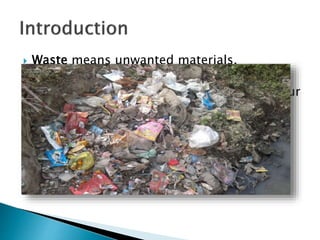
 Waste means unwanted materials.
 Waste has been a major environmental
problem. We can find waste anywhere in our
surroundings since the industrial
revolution. Because of the waste many
health problems are arising.
 Cleanliness is both the abstract state of being
clean and free from dirt, and the process of
achieving and maintaining that state.
 Without cleanliness hygiene cannot be achieved.
 Hygiene is a set of practices performed for the
preservation of health. According to the World
Health Organization (WHO), "Hygiene refers to
conditions and practices that help to maintain
health and prevent the spread of diseases.
 Waste creates many diseases and causes
death of many people all across the globe.
 The rapid growth of world population is
responsible for increase in all forms of
waste.
 Therefore maintaining the cleanliness is
inevitable.
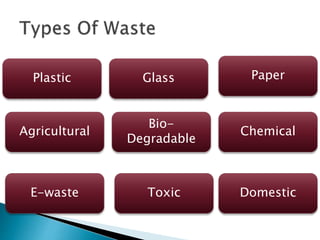
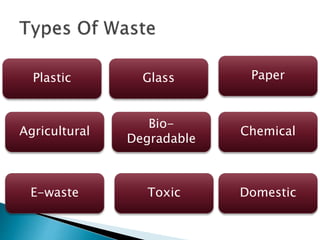
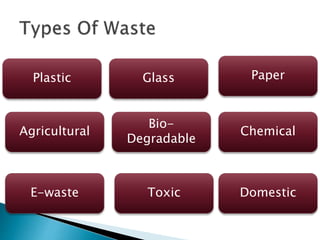
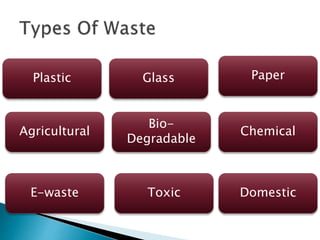
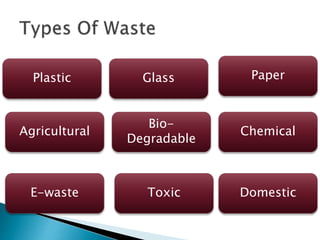
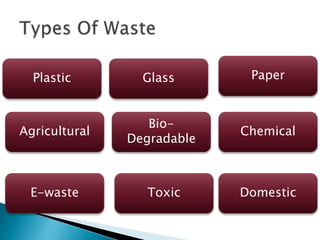
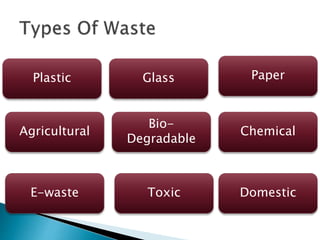
Plastic
Chemical
Glass
E-waste
Agricultural
Toxic
Bio-
Degradable
Paper
Domestic
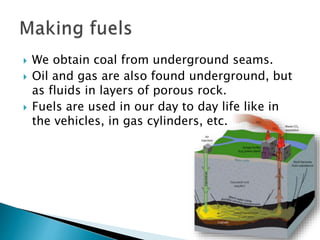
 We obtain coal from underground seams.
 Oil and gas are also found underground, but
as fluids in layers of porous rock.
 Fuels are used in our day to day life like in
the vehicles, in gas cylinders, etc.
 Collect waste 500 gms. of polythene bags
and cut them in small pieces.
 Melt the plastics.
 Add additive to remove impurities.
 Heat the melted plastic at definite
temperature to collect naphta, kerosene,
diesel, etc.
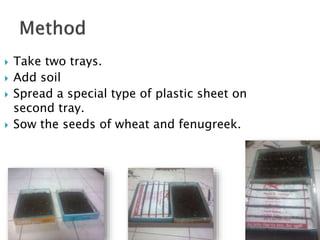
 Take two trays.
 Add soil
 Spread a special type of plastic sheet on
second tray.
 Sow the seeds of wheat and fenugreek.
0
1
2
3
4
5
6
H
e
i
g
h
t
i
n
c
m
Days from germination
Wheat
1st tray
2nd tray
0
1
2
3
4
5
6
H
e
i
g
h
t
i
n
c
m
Days from germination
Fenugreek
1st tray
2nd tray
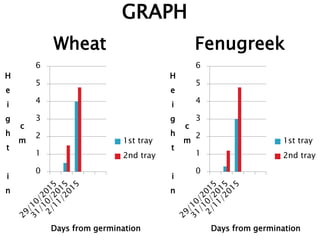
GRAPH
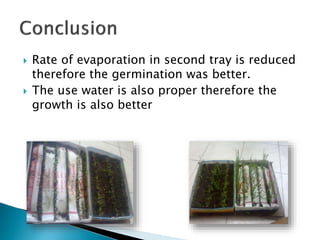
 Rate of evaporation in second tray is reduced
therefore the germination was better.
 The use water is also proper therefore the
growth is also better
 The plants does not get adequate oxygen for
respiration.
Plastic
Chemical
Glass
E-waste
Agricultural
Toxic
Bio-
Degradable
Paper
Domestic
 Recycling is a process to change
(waste) materials into new products to
prevent waste of potentially useful
materials, reduce the consumption of
fresh raw materials and to reduce
energy usage.
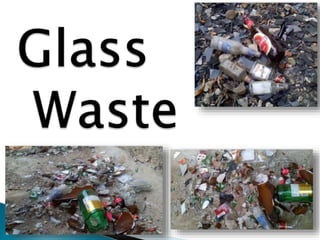
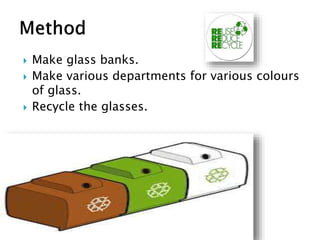
 Make glass banks.
 Make various departments for various colours
of glass.
 Recycle the glasses.
 Consumption of energy is reduced.
 New things are formed.
Plastic
Chemical
Glass
E-waste
Agricultural
Toxic
Bio-
Degradable
Paper
Domestic
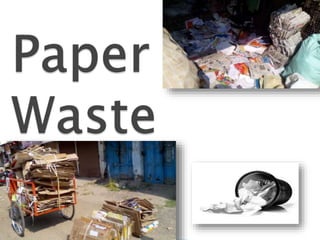
 We should collect all types of papers.
 We should segregate paper into departments
such as inked paper and blank paper
also 1 sided used and both sided used.
 Recycle the paper.
 Reduce consumption
of paper.
 Cutting down of trees will be stopped.
 Prey predator chain will be balanced.
Plastic
Chemical
Glass
E-waste
Agricultural
Toxic
Bio-
Degradable
Paper
Domestic
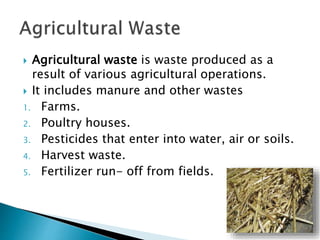
 Agricultural waste is waste produced as a
result of various agricultural operations.
 It includes manure and other wastes
1. Farms.
2. Poultry houses.
3. Pesticides that enter into water, air or soils.
4. Harvest waste.
5. Fertilizer run- off from fields.
Plastic
Chemical
Glass
E-waste
Agricultural
Toxic
Bio-
Degradable
Paper
Domestic
 Biodegradable waste is a type of waste which
can be broken down, in a matter of weeks or
few months, into its base compounds by
micro-organisms and other living things,
regardless of what those compounds may be.
 Biodegradable waste can be used for
composting or a resource for heat, electricity
and fuel by means of inclinator or anaerobic
digestion.
Plastic
Chemical
Glass
E-waste
Agricultural
Toxic
Bio-
Degradable
Paper
Domestic
 Chemical waste is a waste that is made from
harmful chemicals.
Plastic
Chemical
Glass
E-waste
Agricultural
Toxic
Bio-
Degradable
Paper
Domestic
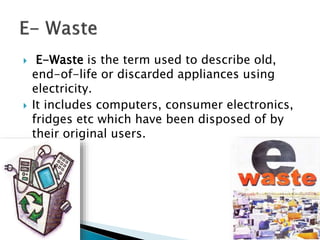
 E-Waste is the term used to describe old,
end-of-life or discarded appliances using
electricity.
 It includes computers, consumer electronics,
fridges etc which have been disposed of by
their original users.
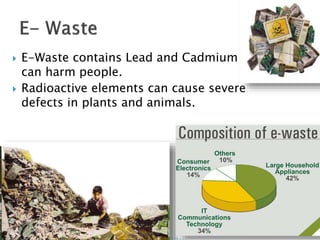
 E-Waste contains Lead and Cadmium which
can harm people.
 Radioactive elements can cause severe
defects in plants and animals.
Plastic
Chemical
Glass
E-waste
Agricultural
Toxic
Bio-
Degradable
Paper
Domestic
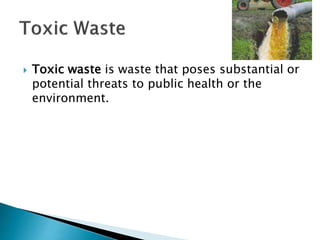
 Toxic waste is waste that poses substantial or
potential threats to public health or the
environment.
Plastic
Chemical
Glass
E-waste
Agricultural
Toxic
Bio-
Degradable
Paper
Domestic
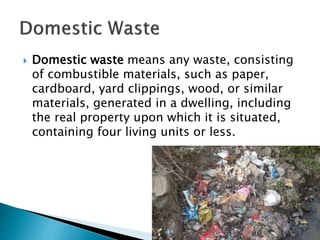
 Domestic waste means any waste, consisting
of combustible materials, such as paper,
cardboard, yard clippings, wood, or similar
materials, generated in a dwelling, including
the real property upon which it is situated,
containing four living units or less.
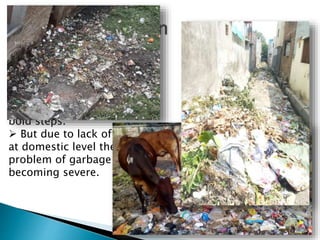
 Day by day the garbage is
increasing in various forms.
 In order to check the
spreading of garbage the
government has taken some
bold steps.
 But due to lack of planning
at domestic level the
problem of garbage is
becoming severe.
 Making jeans from plastic.
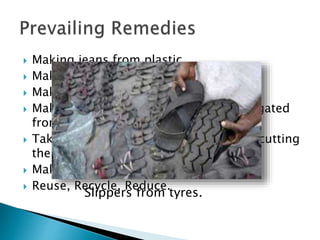
 Making slippers from tyres.
 Making oil paint from thermocol.
 Making solar panels from silicon segregated
from E-Waste.
 Taking out genes from pigs instead of cutting
their ears and nose.
 Making mats from waste plastic.
 Reuse, Recycle, Reduce.
Slippers from tyres.
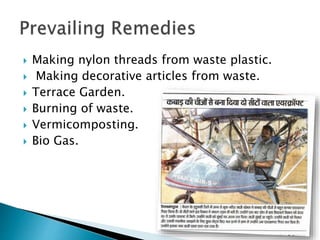
 Making nylon threads from waste plastic.
 Making decorative articles from waste.
 Terrace Garden.
 Burning of waste.
 Vermicomposting.
 Bio Gas.
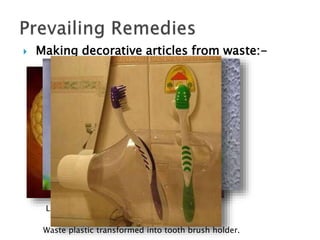
 Making decorative articles from waste:-
Lamp made from disposal glasses.
Plant grown in plastic bottle.
Waste plastic transformed into tooth brush holder.
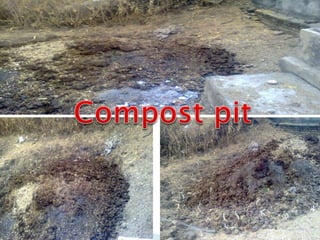
Composting:-
 Composting is a method in which organic
matter is decomposed and used as fertilizers.
 At the simplest level, the process of
composting simply requires making a heap of
wetted organic matter and waiting for the
materials to break down into humus after a
period of weeks or months.
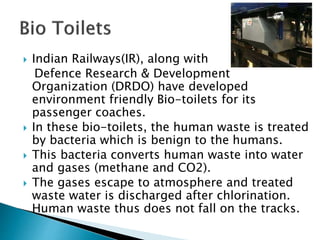
 Indian Railways(IR), along with
Defence Research & Development
Organization (DRDO) have developed
environment friendly Bio-toilets for its
passenger coaches.
 In these bio-toilets, the human waste is treated
by bacteria which is benign to the humans.
 This bacteria converts human waste into water
and gases (methane and CO2).
 The gases escape to atmosphere and treated
waste water is discharged after chlorination.
Human waste thus does not fall on the tracks.
 They are time consuming in the case of
domestic level.
 The products created by the waste are not
durable.
 The products created from waste again
creates the waste after their use.
 The gases emitted while burning are harmful
for biotic factors.
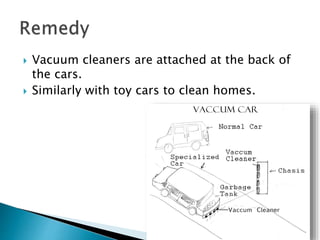
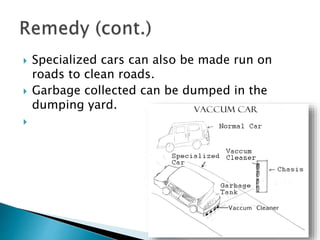
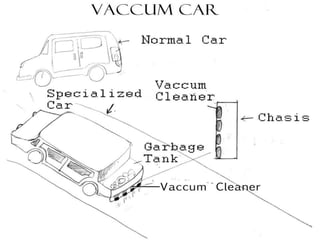
 Vacuum cleaners are attached at the back of
the cars.
 Similarly with toy cars to clean homes.
 Specialized cars can also be made run on
roads to clean roads.
 Garbage collected can be dumped in the
dumping yard.

To purify gutter water:-
 The solid waste from the water of gutter is
first removed.
 Then the liquid waste is collected in a
container.
 From the container it is move to a tank
above the ground.
 In which it is converted into steam with the
help of sunlight.
 By condensing the steam we can get pure
water.
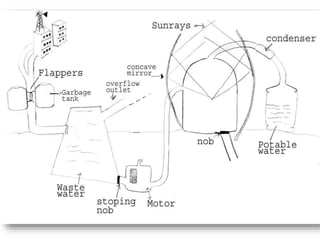
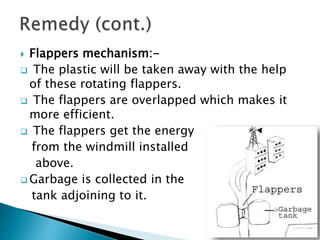
 Flappers mechanism:-
 The plastic will be taken away with the help
of these rotating flappers.
 The flappers are overlapped which makes it
more efficient.
 The flappers get the energy
from the windmill installed
above.
 Garbage is collected in the
tank adjoining to it.
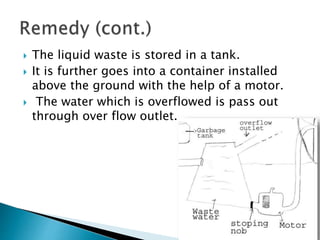
 The liquid waste is stored in a tank.
 It is further goes into a container installed
above the ground with the help of a motor.
 The water which is overflowed is pass out
through over flow outlet.
 Container:-
 The cuboidal container is made of glass which
absorbs heat.
 The container is painted with black colour which is
non reflective.
 The maximum surface area is concentrated
towards the mirror, hence the heat absorbed is
more.
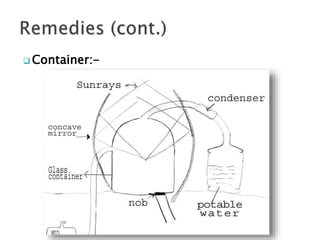
 The container is surrounded vertically by concave
mirror.
 The mirror focuses the rays of sun towards the
container.
 Due to this the water in the container gets
converted into steam.
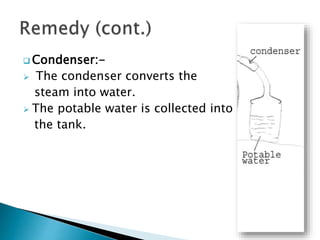
 Container:-
 Condenser:-
 The condenser converts the
steam into water.
 The potable water is collected into
the tank.
 “Environment and pollution”
Writer – A.H.Hashmi
 “Gram Geeta”
Writer – Tukdoji Maharaj
 “Twinkle star”
Publisher – Aasawari Shirolkar
 “Junior Science refresher”
Chief Editor- Pritam Singh
 “Personality Development” M.S.E.C.R.T.
Maharashtra State Board of Secondary Education
 “Climate Change and Energy Policy: Proceedings of
the International ...”
Writer- Louis Rosen
Clean India

Clean India

  • 3.
     Waste meansunwanted materials.  Waste has been a major environmental problem. We can find waste anywhere in our surroundings since the industrial revolution. Because of the waste many health problems are arising.
  • 4.
     Cleanliness isboth the abstract state of being clean and free from dirt, and the process of achieving and maintaining that state.  Without cleanliness hygiene cannot be achieved.  Hygiene is a set of practices performed for the preservation of health. According to the World Health Organization (WHO), "Hygiene refers to conditions and practices that help to maintain health and prevent the spread of diseases.
  • 5.
     Waste createsmany diseases and causes death of many people all across the globe.  The rapid growth of world population is responsible for increase in all forms of waste.  Therefore maintaining the cleanliness is inevitable.
  • 6.
  • 8.
     We obtaincoal from underground seams.  Oil and gas are also found underground, but as fluids in layers of porous rock.  Fuels are used in our day to day life like in the vehicles, in gas cylinders, etc.
  • 9.
     Collect waste500 gms. of polythene bags and cut them in small pieces.  Melt the plastics.  Add additive to remove impurities.  Heat the melted plastic at definite temperature to collect naphta, kerosene, diesel, etc.
  • 10.
     Take twotrays.  Add soil  Spread a special type of plastic sheet on second tray.  Sow the seeds of wheat and fenugreek.
  • 11.
    0 1 2 3 4 5 6 H e i g h t i n c m Days from germination Wheat 1sttray 2nd tray 0 1 2 3 4 5 6 H e i g h t i n c m Days from germination Fenugreek 1st tray 2nd tray GRAPH
  • 12.
     Rate ofevaporation in second tray is reduced therefore the germination was better.  The use water is also proper therefore the growth is also better
  • 13.
     The plantsdoes not get adequate oxygen for respiration.
  • 14.
  • 16.
     Recycling isa process to change (waste) materials into new products to prevent waste of potentially useful materials, reduce the consumption of fresh raw materials and to reduce energy usage.
  • 17.
     Make glassbanks.  Make various departments for various colours of glass.  Recycle the glasses.
  • 18.
     Consumption ofenergy is reduced.  New things are formed.
  • 19.
  • 21.
     We shouldcollect all types of papers.  We should segregate paper into departments such as inked paper and blank paper also 1 sided used and both sided used.  Recycle the paper.  Reduce consumption of paper.
  • 22.
     Cutting downof trees will be stopped.  Prey predator chain will be balanced.
  • 23.
  • 24.
     Agricultural wasteis waste produced as a result of various agricultural operations.  It includes manure and other wastes 1. Farms. 2. Poultry houses. 3. Pesticides that enter into water, air or soils. 4. Harvest waste. 5. Fertilizer run- off from fields.
  • 25.
  • 26.
     Biodegradable wasteis a type of waste which can be broken down, in a matter of weeks or few months, into its base compounds by micro-organisms and other living things, regardless of what those compounds may be.  Biodegradable waste can be used for composting or a resource for heat, electricity and fuel by means of inclinator or anaerobic digestion.
  • 27.
  • 28.
     Chemical wasteis a waste that is made from harmful chemicals.
  • 29.
  • 30.
     E-Waste isthe term used to describe old, end-of-life or discarded appliances using electricity.  It includes computers, consumer electronics, fridges etc which have been disposed of by their original users.
  • 31.
     E-Waste containsLead and Cadmium which can harm people.  Radioactive elements can cause severe defects in plants and animals.
  • 32.
  • 33.
     Toxic wasteis waste that poses substantial or potential threats to public health or the environment.
  • 34.
  • 35.
     Domestic wastemeans any waste, consisting of combustible materials, such as paper, cardboard, yard clippings, wood, or similar materials, generated in a dwelling, including the real property upon which it is situated, containing four living units or less.
  • 36.
     Day byday the garbage is increasing in various forms.  In order to check the spreading of garbage the government has taken some bold steps.  But due to lack of planning at domestic level the problem of garbage is becoming severe.
  • 37.
     Making jeansfrom plastic.  Making slippers from tyres.  Making oil paint from thermocol.  Making solar panels from silicon segregated from E-Waste.  Taking out genes from pigs instead of cutting their ears and nose.  Making mats from waste plastic.  Reuse, Recycle, Reduce. Slippers from tyres.
  • 38.
     Making nylonthreads from waste plastic.  Making decorative articles from waste.  Terrace Garden.  Burning of waste.  Vermicomposting.  Bio Gas.
  • 39.
     Making decorativearticles from waste:- Lamp made from disposal glasses. Plant grown in plastic bottle. Waste plastic transformed into tooth brush holder.
  • 40.
    Composting:-  Composting isa method in which organic matter is decomposed and used as fertilizers.  At the simplest level, the process of composting simply requires making a heap of wetted organic matter and waiting for the materials to break down into humus after a period of weeks or months.
  • 42.
     Indian Railways(IR),along with Defence Research & Development Organization (DRDO) have developed environment friendly Bio-toilets for its passenger coaches.  In these bio-toilets, the human waste is treated by bacteria which is benign to the humans.  This bacteria converts human waste into water and gases (methane and CO2).  The gases escape to atmosphere and treated waste water is discharged after chlorination. Human waste thus does not fall on the tracks.
  • 43.
     They aretime consuming in the case of domestic level.  The products created by the waste are not durable.  The products created from waste again creates the waste after their use.  The gases emitted while burning are harmful for biotic factors.
  • 44.
     Vacuum cleanersare attached at the back of the cars.  Similarly with toy cars to clean homes.
  • 45.
     Specialized carscan also be made run on roads to clean roads.  Garbage collected can be dumped in the dumping yard. 
  • 47.
    To purify gutterwater:-  The solid waste from the water of gutter is first removed.  Then the liquid waste is collected in a container.  From the container it is move to a tank above the ground.  In which it is converted into steam with the help of sunlight.  By condensing the steam we can get pure water.
  • 49.
     Flappers mechanism:- The plastic will be taken away with the help of these rotating flappers.  The flappers are overlapped which makes it more efficient.  The flappers get the energy from the windmill installed above.  Garbage is collected in the tank adjoining to it.
  • 50.
     The liquidwaste is stored in a tank.  It is further goes into a container installed above the ground with the help of a motor.  The water which is overflowed is pass out through over flow outlet.
  • 51.
     Container:-  Thecuboidal container is made of glass which absorbs heat.  The container is painted with black colour which is non reflective.  The maximum surface area is concentrated towards the mirror, hence the heat absorbed is more.  The container is surrounded vertically by concave mirror.  The mirror focuses the rays of sun towards the container.  Due to this the water in the container gets converted into steam.
  • 52.
  • 53.
     Condenser:-  Thecondenser converts the steam into water.  The potable water is collected into the tank.
  • 54.
     “Environment andpollution” Writer – A.H.Hashmi  “Gram Geeta” Writer – Tukdoji Maharaj  “Twinkle star” Publisher – Aasawari Shirolkar  “Junior Science refresher” Chief Editor- Pritam Singh  “Personality Development” M.S.E.C.R.T. Maharashtra State Board of Secondary Education  “Climate Change and Energy Policy: Proceedings of the International ...” Writer- Louis Rosen