Definition of Recruitment
1
Recruitmentis the process of searching for prospective employees and stimulating them to apply for
jobs int eh organization. (Edwin B. Flippo)
Recruitment is a form of competition. Just as corporations compete to develop, manufacture, and
market the best product or service, so they must also compete to identify, attract and hire the most
qualified people. (Lord)
Recruitment is a process to discover the sources of manpower to meet the requirements of the staffing
schedule to employ effective measures for attracting that manpower in adequate numbers to facilitate
effective selection of an efficient working force. (Dale Yoder)
Recruitment is the process of finding and attracting capable applicants for employment. The process
begins when new recruits are sought and ends when their applications are submitted. The result is a
pool of applicants form which new employees are selected. (Werther and Davis)
Recruitment is the development and maintenance of adequate manpower resources. It involves the
creation of a pool of available labor upon whom the organization can depend when it needs additional
employees. (Dales S. Beach)
2.
Process of Recruitment
2
1.Recruitment process begins when the personnel department receives requisition for
recruitment from any department of the Company. The personnel requisitions contain
details about the position to be filled, number of persons to be recruited, the duties to be
performed, qualifications expected from the candidates, terms and conditions of employment
and the time by which the persons should be available for appointment, etc.
2. Locating and developing the sources of required number and type of employees.
3. Identifying the prospective employees with required characteristics.
4. Developing the techniques to attract the desired candidates. The good will of an organization
in the market may be one technique. The publicity about the Company being a good
employer may also help in stimulating candidates to apply. There may be others of attractive
salaries, proper facilities for development, etc.
5. Evaluating the effectiveness of recruitment process.
3.
Elements of Recruitment
3
1.Recruitment Policy:
It specifies the objectives of recruitment and provides a framework for the implementation of
the recruitment program. It also involves the employer’s commitment to some principles as
to find and employ the best qualified persons for each job, to retain the most promising of
those hired, etc. It should be based on the goals, needs and environment of the organization.
Elements of Recruitment
5
2.Recruitment Organization
The recruitment may be centralized like public sector banks or decentralized. Both practices have their own merits. The choice
between the two will depend on the managerial philosophy and the particular needs of the organization.
3.
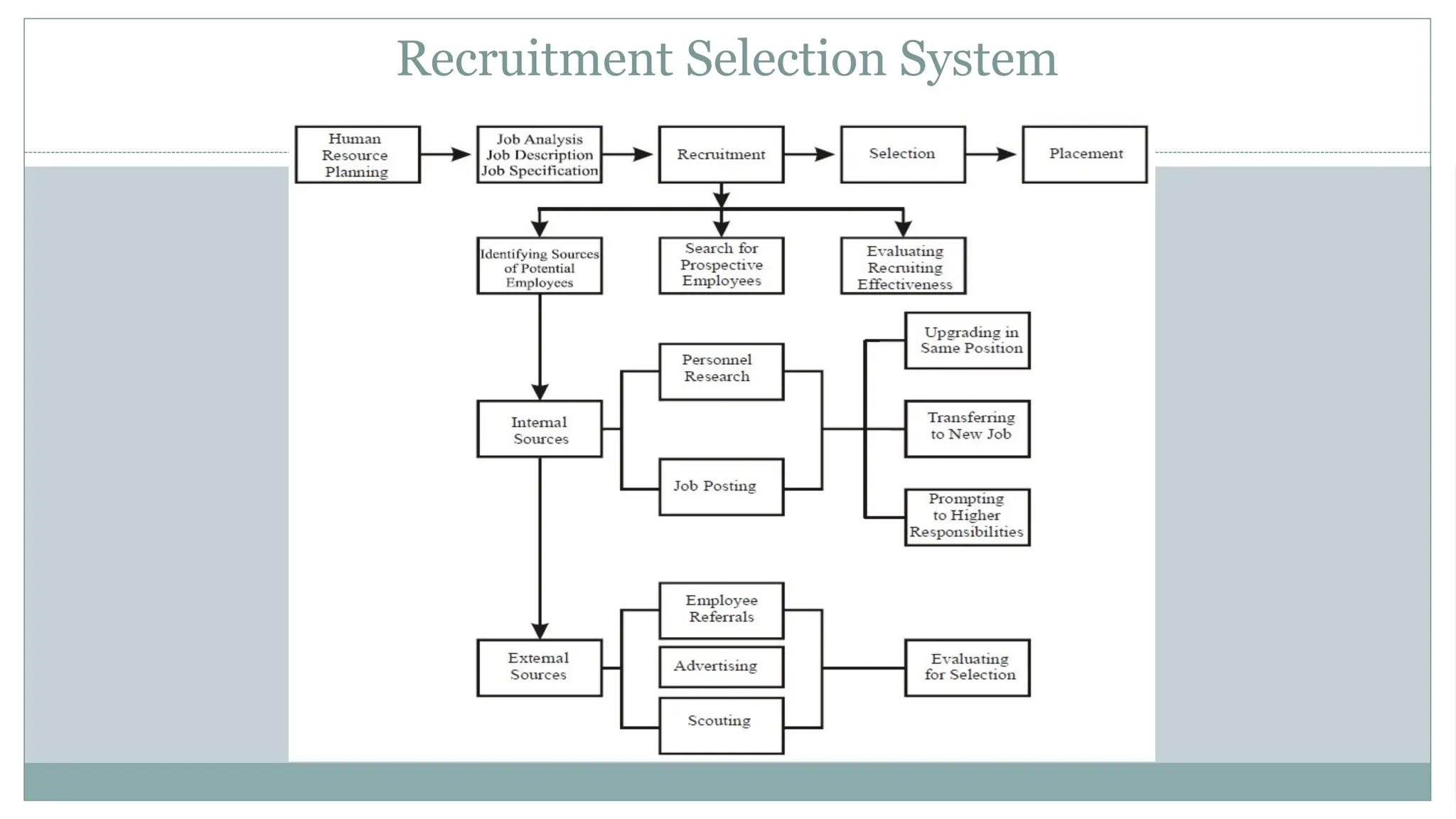
Sources of Recruitment
Various sources of recruitment may be classified as internal and external. These have their own merits and demerits.
4.
Methods of Recruitment
Recruitment techniques are the means to make the contact with potential candidates, to provide them necessary information
and to encourage them to apply for jobs.
5.
Evaluation of Recruitment programme
The recruitment process must be evaluated periodically. The criteria for evaluation may consist of cost per applicant, the hiring
ratio, performance appraisal, tenure of stay. Etc. After evaluation, necessary improvement should be made in the recruitment
programme.
6.
Factors Affecting Recruitment
6
Thefactors affecting recruitment can be classified as internal and external factors.
The Internal Factors are:
1. Wage and salary policies
2. The age composition if existing working force
3. Promotion and retirement policies.
4. Turnover rates
5. The nature of operations involved the kind of personnel required
6. The level and seasonality of operations in question
7. Future expansion and reductio programmes
8. Recruiting policy of the organization
9. Human Resource Planning Strategy of the Company
10. Size of the organization and the number of employees employed
11. Cost involved in recruiting employees
12. Growth and expansion plans of the organization.
7.
Factors Affecting Recruitment
7
Thefactors affecting recruitment can be classified as internal and external factors.
The External Factors are:
1. Supply and demand of specific skills in the labor market
2. Company’s image perception of the job seekers about the company
3. External cultural factors: The culture may exert considerable check on recruitment.
Example: women may not be recruited in certain jobs in industry.
4. Economic Factors: such as tight or loose labor market, the reputation of the enterprise in
the community as a good pay master or otherwise and such allied issues which terminate the
quality and quantity of manpower submitting itself for recruitment.
5. Political and legal factors also exert retrains in respect of nature and hours of work for
women and children.
8.
Sources of Recruitment
8
1.Internal Sources
It includes a review of the present employees and nomination of candidates by employees.
Effective utilization of internal sources necessitates an understanding of the skills and
information regarding relationships of jobs.
Merits of Internal Sources
1. It creates a sense of security among employees when they are assured that they would be preferred in filling up vacancies.
2. It improves the morale of employees, for they are assured of the fact that they would be preferred over outsiders when
vacancies occur.
3. It promotes loyalty and commitment among employees due to sense of job security and opportunities for advancement.
4. The employer is in a better position to evaluate those presently employed than outside candidates.
9.
Sources of Recruitment
9
Meritsof Internal Sources
5.Time and cost of training will be low because employees remain familiar with the organization and its policies.
6.Relations with trade unions remain good. Labor turnover is reduced.
7.It encourages self-development among the employees,
8.It encourages stability from continuity of employment.
9.It can also act as a training device for developing middle and top-level managers.
10.
Sources of Recruitment
10
Demeritsof Internal Sources
1.There are possibilities that internal sources may “dry up”, and it may be difficult to find the requisite personnel from
within an organization.
2.It often leads to inbreeding, and discourages new blood from entering the organization.
3.As promotion is based on seniority, the danger is that really capable hands may not be chose, The likes and dislikes of
the management may also play an important role in the selection of personnel.
4.Since the learner does not know more that the lectures, no innovations worth the name can be made, Therefore, on jobs
which require original thinking (such as advertising, style, designing and basic research), this practice is not allowed.
11.
Sources of Recruitment
11
2.External Sources
Occasionally, it may be necessary to bring in some “new blood” to broaden the present ideas,
knowledge, and enthusiasm. Thus, all organizations have to depend on external sources of
recruitment. Among these sources are includes:
1. Employment agencies
2, Educational and technical institutes, and
3. Casual labor or applicant's oat the gate and nail applicants
12.
Sources of Recruitment
12
1.External Sources
Advantages of External Recruitment
1. It will help in bringing new ideas, better techniques and improved methods to the organization.
2. The cost of employees will be minimized because candidates selected in this method will be placed in the
minimum pay scale.
3. The existing employees will also broaden their personality.
4. The entry of qualitative persons from outside will be in the interest of the organization in the long run.
5. The suitable candidates with skill, talent, knowledge are available from external sources.
6. The entry of new persons with varied expansion and talent will help in human resource mix.
13.
Sources of Recruitment
13
1.External Sources
Disadvantages of External Recruitment
1. Orientation and training are required as the employees remain unfamiliar with the organization.
2. It is more expensive and time-consuming. Detailed screening is necessary as very little is known about the
candidate.
3. If new entrant fails to adjust himself to the working in the enterprise, it means yet more expenditure on looking
for his replacement.
4. motivation, morale and loyalty of existing staff are affected, if higher level of jobs are filled from external sources.
It becomes a source of heart-burning and demoralization among existing employees.
14.
Methods of Recruitment
14
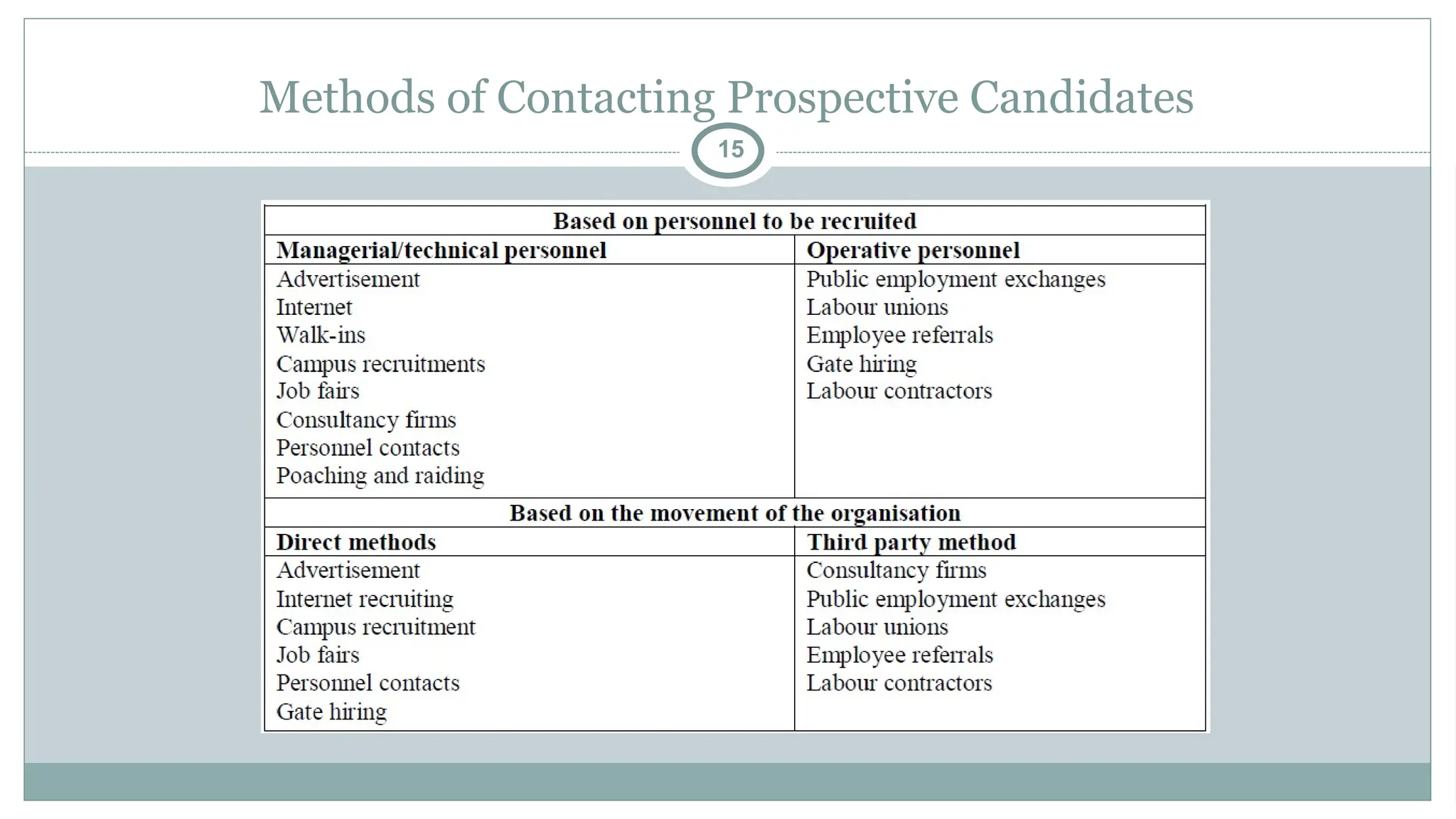
1.DirectMethod
This includes sending recruiters to educational and professional institutions, employees, contract with
public and manned exhibits. One of hie widely used methods is that of sending of recruiters to college and
technical schools.
2.Indirect Method
The most frequently used indirect method of recruitment is advertisement in newspaper, journals and on radio and television.
Advertisement enables candidates to assess their suitability. It is appropriate when the organization wants to reach out to a large target
group scattered nationwide.
3.Third-Party Method
The most frequently used third-party methods are public and private employment agencies. Public employment exchanges have been
largely concerned with factory workers and clerical jobs. They also provide help in recruiting professional employees. Private agencies
provide consultancy services and charge a fee. There are usually specialized for different categories of operatives, office workers,
salesmen, supervisory and managerial personnel.


![recruitment _ppt [Autosaved].pptx](https://cdn.slidesharecdn.com/ss_thumbnails/recruitmentpptautosaved-230728173614-374d5871-thumbnail.jpg?width=640&height=640&fit=bounds)


