THECHALLENGEOF
GLOBAL DIVISION
WORKING
DEFINITIONS
OF RACE,
ETHNICITY, &
NATIONALITY
 Ethnicity, ethnic group
 The word ethnicity derives from the
Greek ethnos, a people. Ethnic identity gives a
sense of peoplehood to an unique human
collectivity.
 In anthropology and in sociology, "ethnic
group" is used to designate a culturally
distinctive, autonomous group, but in the U.S.
the more general application is to identify a
distinct segment of the population also sharing
common cultural features and social
institutions as a group
WORKING
DEFINITIONS
OF RACE,
ETHNICITY, &
NATIONALITY
Ethnicity, ethnic group
An ethnic group may overlap with a
political group and it may be thought
racially distinct as happens in relatively
more homogeneous societies.
Nationalist movements have often
appealed to ethnic sentiments and used
evidence of ethnic distinctiveness as a
justification for political claims.
WORKING
DEFINITIONS
OF RACE,
ETHNICITY, &
NATIONALITY
Some social scientists argue that
ethnicity is a primordial affinity, part of a
person's basic group identity.
Others infer that ethnic sentiments are
variable and that their intensity and
significance are determined by the social,
economic, and political situation of the
group.
 Much of the sociological interest on ethnicity
has derived from the study of processes
associated with immigration and the
persistence of cultural distinctiveness among
immigrant ethnic groups.
 Initially sociologists believed that immigrant
ethnic groups would adopt the culture of the
majority society (cultural assimilation).
 However, recent experiences with "Latinos"
and other new immigrants have challenged
this view.
An minority ethnic group is a
collectivity within a larger population
having common ancestry, memories of
a shared past, and a cultural
identification upon one or more
symbolic elements which define the
group's identity, such as kinship,
religion, language, national origin, and
historicity.
Members of an ethnic group are
conscious of belonging to the group
Race
 In sociology race is understood as a socio-
culturally defined category of people who
share genetically transmitted physical
characteristics.
 The word came into the English language at
the beginning of the 16th century and from
then until early in the 19th century was used
primarily to refer to common features
present because of shared genetic descent.
 During the past decades the term has been
reshaped and redefined. However, "race"
remains a controversial concept.
 Though there are discernible differences in
skin color, head form or type of hair among
members of the human species, no
satisfactory general classification of "races"
exists to which individuals may be assigned
on the basis of these characteristics.
 Scientifically speaking, there's no such thing
as "race".
 There is considerable variation within racial
groups as between them.
 Moreover, the continued sharing of genetic
materials has maintained all of humankind as
a single species.
Today, most social scientists may
argue, race is a culturally based social
category that was originally invented
between the 16th and the 18th-century
when European settlers in the new
world sought to differentiate
themselves from the native inhabitants
they found, and the African slaves they
brought over.
Sociologically speaking, it may
be preferable to talk about
"ethnicity" or "ethnic origin"
instead of "race" since the later
basically is a descriptive rather
than an explanatory concept.
Nation,
nationality
 The roots of a nation are to be found in
ethnic groups and primordial kinship, and a
nation grows by a process of differentiation
and opposition, –but a nation is not simply
an ethnic group–.
 A nation is not simply a cultural
togetherness.
 It is also a political togetherness (polity)
concerned with the structuration and
organization of political arrangements and
the potential creation of its own state.
 A nation exists with other nations,
and because other nations exist
A nation is a community of people
sharing a territory whose symbolic
boundaries are rooted on a common
ethnicity and a collective sentiment of
peoplehood.
It is a political togetherness which is
rooted in a distinct collective identity,
language, history, and a national
culture.
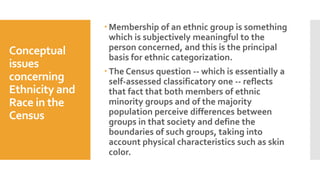
Conceptual
issues
concerning
Ethnicity and
Race in the
Census
 Membership of an ethnic group is something
which is subjectively meaningful to the
person concerned, and this is the principal
basis for ethnic categorization.
 The Census question -- which is essentially a
self-assessed classificatory one -- reflects
that fact that both members of ethnic
minority groups and of the majority
population perceive differences between
groups in that society and define the
boundaries of such groups, taking into
account physical characteristics such as skin
color.
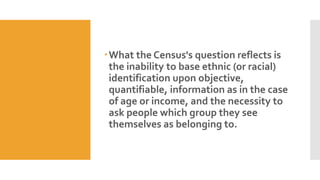
What the Census's question reflects is
the inability to base ethnic (or racial)
identification upon objective,
quantifiable, information as in the case
of age or income, and the necessity to
ask people which group they see
themselves as belonging to.
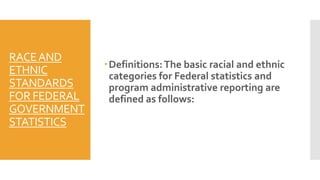
RACEAND
ETHNIC
STANDARDS
FOR FEDERAL
GOVERNMENT
STATISTICS
Definitions:The basic racial and ethnic
categories for Federal statistics and
program administrative reporting are
defined as follows:
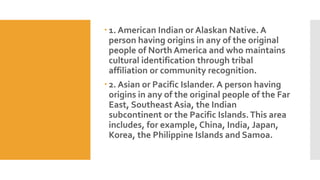
 1. American Indian or Alaskan Native. A
person having origins in any of the original
people of North America and who maintains
cultural identification through tribal
affiliation or community recognition.
 2. Asian or Pacific Islander. A person having
origins in any of the original people of the Far
East, Southeast Asia, the Indian
subcontinent or the Pacific Islands.This area
includes, for example, China, India, Japan,
Korea, the Philippine Islands and Samoa.
3. Black. A person having origins in any
of the black racial groups of Africa.
4. Hispanic. A person of Mexican,
Puerto Rican, Cuban, Central or South
American or other Spanish culture or
origin, regardless of race.
5. White, not of Hispanic origin. A
person having origins in any of the
original people of Europe, North Africa,
or the Middle East.

module 2.pptx

  • 1.
  • 2.
    WORKING DEFINITIONS OF RACE, ETHNICITY, & NATIONALITY Ethnicity, ethnic group  The word ethnicity derives from the Greek ethnos, a people. Ethnic identity gives a sense of peoplehood to an unique human collectivity.  In anthropology and in sociology, "ethnic group" is used to designate a culturally distinctive, autonomous group, but in the U.S. the more general application is to identify a distinct segment of the population also sharing common cultural features and social institutions as a group
  • 3.
    WORKING DEFINITIONS OF RACE, ETHNICITY, & NATIONALITY Ethnicity,ethnic group An ethnic group may overlap with a political group and it may be thought racially distinct as happens in relatively more homogeneous societies. Nationalist movements have often appealed to ethnic sentiments and used evidence of ethnic distinctiveness as a justification for political claims.
  • 4.
    WORKING DEFINITIONS OF RACE, ETHNICITY, & NATIONALITY Somesocial scientists argue that ethnicity is a primordial affinity, part of a person's basic group identity. Others infer that ethnic sentiments are variable and that their intensity and significance are determined by the social, economic, and political situation of the group.
  • 5.
     Much ofthe sociological interest on ethnicity has derived from the study of processes associated with immigration and the persistence of cultural distinctiveness among immigrant ethnic groups.  Initially sociologists believed that immigrant ethnic groups would adopt the culture of the majority society (cultural assimilation).  However, recent experiences with "Latinos" and other new immigrants have challenged this view.
  • 6.
    An minority ethnicgroup is a collectivity within a larger population having common ancestry, memories of a shared past, and a cultural identification upon one or more symbolic elements which define the group's identity, such as kinship, religion, language, national origin, and historicity. Members of an ethnic group are conscious of belonging to the group
  • 7.
    Race  In sociologyrace is understood as a socio- culturally defined category of people who share genetically transmitted physical characteristics.  The word came into the English language at the beginning of the 16th century and from then until early in the 19th century was used primarily to refer to common features present because of shared genetic descent.  During the past decades the term has been reshaped and redefined. However, "race" remains a controversial concept.
  • 8.
     Though thereare discernible differences in skin color, head form or type of hair among members of the human species, no satisfactory general classification of "races" exists to which individuals may be assigned on the basis of these characteristics.  Scientifically speaking, there's no such thing as "race".  There is considerable variation within racial groups as between them.  Moreover, the continued sharing of genetic materials has maintained all of humankind as a single species.
  • 9.
    Today, most socialscientists may argue, race is a culturally based social category that was originally invented between the 16th and the 18th-century when European settlers in the new world sought to differentiate themselves from the native inhabitants they found, and the African slaves they brought over.
  • 10.
    Sociologically speaking, itmay be preferable to talk about "ethnicity" or "ethnic origin" instead of "race" since the later basically is a descriptive rather than an explanatory concept.
  • 11.
    Nation, nationality  The rootsof a nation are to be found in ethnic groups and primordial kinship, and a nation grows by a process of differentiation and opposition, –but a nation is not simply an ethnic group–.  A nation is not simply a cultural togetherness.  It is also a political togetherness (polity) concerned with the structuration and organization of political arrangements and the potential creation of its own state.  A nation exists with other nations, and because other nations exist
  • 12.
    A nation isa community of people sharing a territory whose symbolic boundaries are rooted on a common ethnicity and a collective sentiment of peoplehood. It is a political togetherness which is rooted in a distinct collective identity, language, history, and a national culture.
  • 13.
    Conceptual issues concerning Ethnicity and Race inthe Census  Membership of an ethnic group is something which is subjectively meaningful to the person concerned, and this is the principal basis for ethnic categorization.  The Census question -- which is essentially a self-assessed classificatory one -- reflects that fact that both members of ethnic minority groups and of the majority population perceive differences between groups in that society and define the boundaries of such groups, taking into account physical characteristics such as skin color.
  • 14.
    What the Census'squestion reflects is the inability to base ethnic (or racial) identification upon objective, quantifiable, information as in the case of age or income, and the necessity to ask people which group they see themselves as belonging to.
  • 15.
    RACEAND ETHNIC STANDARDS FOR FEDERAL GOVERNMENT STATISTICS Definitions:The basicracial and ethnic categories for Federal statistics and program administrative reporting are defined as follows:
  • 16.
     1. AmericanIndian or Alaskan Native. A person having origins in any of the original people of North America and who maintains cultural identification through tribal affiliation or community recognition.  2. Asian or Pacific Islander. A person having origins in any of the original people of the Far East, Southeast Asia, the Indian subcontinent or the Pacific Islands.This area includes, for example, China, India, Japan, Korea, the Philippine Islands and Samoa.
  • 17.
    3. Black. Aperson having origins in any of the black racial groups of Africa. 4. Hispanic. A person of Mexican, Puerto Rican, Cuban, Central or South American or other Spanish culture or origin, regardless of race. 5. White, not of Hispanic origin. A person having origins in any of the original people of Europe, North Africa, or the Middle East.