M
ic
ha
el
B
. T
ho
m
as
/G
et
ty
Im
ag
es
10
Copyright 2017 Cengage Learning. All Rights Reserved. May
not be copied, scanned, or duplicated, in whole or in part. Due
to electronic rights, some third party content may be suppressed
from the eBook and/or eChapter(s).
Editorial review has deemed that any suppressed content does
not materially affect the overall learning experience. Cengage
Learning reserves the right to remove additional content at any
time if subsequent rights restrictions require it.
227
You might expect a society based on the values of freedom and
equality, such as the United States, not to be deeply afflicted
by racial–ethnic conflict, but
think of the following situations:
● In 2009, James von Brunn, an eighty-eight-year-old self-
proclaimed White supremacist, gunned down and killed
a security guard at the U.S. Holocaust Memorial Museum
in Washington, DC. Federal authorities knew James von
Brunn was affiliated with various hate groups. The shooter
left an anti-Semitic letter in his car parked outside the
museum, charging that “Obama was created by Jews.” The
guard who was shot and killed, Stephen T. Johns, was a
thirty-nine-year-old African American guard who worked
at the museum.
● A sorority at a major East Coast university posted a photo
of their group dressed in sombreros, ponchos, and fake
mustaches, also carrying signs that said, “Will mow lawn
for weed and beer.” Such denigrating and offensive “racial
theme parties” are common on college campuses (Cabrera
2014), including the March 2015 event in which a chapter
of Sigma Alpha Epsilon at the University of Oklahoma was
closed after a busload of fraternity brothers chanted a
highly racist tune: “There will never be a ni**** at SAE. You
can hang him from a tree, but he can never sign with me.
There will never be a ni**** at SAE” (cnn.com).
● A thirty-eight-year-old American man of East Indian
descent and vice president of a major bank was attacked
on a Lake Tahoe beach as his attackers called him a “ter-
rorist,” “relative of Osama bin Laden,” and “Indian garbage.”
The attack broke his eye socket and he will have dizzy spells
for the rest of his life.
These are all ugly incidents. They all have one thing in
common—racial–ethnic prejudice and overt racism. Race and
ethnicity have fundamental importance in human social inter-
action and are integral parts of the social institutions in the
United States. Unfortunately, ethnic prejudice and racism are
also integral to American society.
Of course, racial and ethnic groups do not always interact
as enemies, and interracial tension is not always obvious. It can
be as subtle as a White person who simply does not initiate
Race and Ethnicity
Race and Ethnicity 228
Racial Stereotypes 232
Prejudice and Discrimination 234
Racism 236
Theories of Prejudice
and Racism 238
Diverse Groups, Diverse
Histories 240
Attaining Racial and Ethnic
Equality: The Challenge 247
Chapter Summary 250
● Define race as a social
construction
● Define and give examples of
stereotype interchangeability
● Understand the difference
between prejudice and racism
● Define and distinguish the
different forms of racism
● Show how sociological theory
broadens our understanding
of prejudice and discrimination
● Discuss at least one common
thread present in the histories
of Blacks, Mexican Americans,
and Japanese Americans in
the United States
● Compare and contrast the
different social change
strategies toward the
attainment of racial–ethnic
equality and freedom in the
United States
in this chapter, you will learn to:
Copyright 2017 Cengage Learning. All Rights Reserved. May
not be copied, scanned, or duplicated, in whole or in part. Due
to electronic rights, some third party content may be suppressed
from the eBook and/or eChapter(s).
Editorial review has deemed that any suppressed content does
not materially affect the overall learning experience. Cengage
Learning reserves the right to remove additional content at any
time if subsequent rights restrictions require it.
2 2 8 CHA PT ER 10
interactions with African Americans and Latinos, or an elderly
White man who almost imperceptibly
leans backward at a cocktail party as a Japanese American man
approaches him.
In everyday human interaction, as African American
philosopher Cornel West has cogently argued,
race matters and still matters a lot (West 2004; 1994). What is
race, and what is ethnicity? Why does
society treat racial and ethnic groups differently, and why is
there social inequality—stratification—
between these groups? Racial and ethnic inequality is so strong
and persistent in American society
that sociologists reject the notion that we are a “postracial”
society. As this chapter will show, race and
ethnicity remain two of the most important axes of social
stratification in the United States.
Race and Ethnicity
Within sociology, the terms ethnicity, race, minority,
and dominant group have very specific meanings, dif-
ferent from their meanings in common usage. These
concepts are important in developing a sociological
perspective on race and ethnicity.
Ethnicity
An ethnic group is a social category of people who share
a common culture, for example, a common language
or dialect, a common nationality, a common religion,
and common norms, practices, customs, and history.
Ethnic groups have a consciousness of their com-
mon cultural bond—a “consciousness of kind.” Italian
Americans, Japanese Americans, Arab Americans, Polish
Americans, Greek Americans, Mexican Americans, and
Irish Americans are all examples of ethnic groups in
the United States. Ethnic groups are also found in other
societies, such as the Pashtuns in Afghanistan or the
Shiites and Sunnis in Iraq, whose ethnicity is based on
religious differences.
An ethnic group does not exist only because of
the common national or cultural origins of a group,
however. Ethnic groups develop also because of their
unique historical and social experiences. These experi -
ences become the basis for the group’s ethnic identity,
meaning the definition the group has of itself as sharing
a common cultural bond. Prior to immigration to the
United States, Italians, for example, did not necessarily
think of themselves as a distinct group with common
interests and experiences. Originating from different
villages, cities, and regions of Italy, Italian immigrants
identified themselves by their family background and
community of origin. However, the process of immigra-
tion and the experiences Italian Americans faced as a
group in the United States, including discrimination,
created a new identity for the group, who subsequently
began to define themselves as “Italians” (Waters and
Levitt 2002; Alba 1990; Waters 1990).
The social and cultural basis of ethnicity allows
ethnic groups to develop more or less intense ethnic
identification at different points in time. Ethnic iden-
tification may grow stronger when groups face preju-
dice or hostility from other groups. Perceived or real
threats and perceived competition from other groups
may unite an ethnic group around common politi-
cal and economic interests, which as you may recall
was an idea advanced by early sociological theo-
rist Emile Durkheim (see Chapter 1). Ethnic unity
can develop voluntarily, or it may be involuntarily
imposed when more powerful groups exclude ethnic
groups from certain residential areas, occupations, or
social clubs. Exclusionary practices strengthen ethnic
identity.
Defining Race
Like ethnicity, race is primarily, though not exclu-
sively, a socially constructed category. A race is a group
treated as distinct in society based on certain charac-
teristics, some of may be biological, that have been
assigned or attributed social importance. Because of
presumed biologically or culturally inferior character-
istics (as defined by powerful groups in society), a race
is often singled out for differential and unfair treat-
ment. It is not the biological characteristics per se that
define racial groups but how groups have been treated
and labeled historically and socially (Higginbotham
and Andersen 2012).
Society assigns people to racial categories, such as
Black, White, and so on, not because of science, logic,
or fact, but because of opinion and social experience.
In other words, how groups are defined racially is a
social process. This is what is meant when one says that
race is “socially constructed.” Although the meaning of
race begins with alleged biological/genetic differences
between groups (such as differences in physical char-
acteristics like skin color, lip form, and hair texture), on
closer examination, the assumption that racial differ-
ences are purely biological breaks down. In fact, biolo-
gists have pointed out that there is little correspondence
between races as defined biologically/genetically and
the actual naming of the races (Taylor 2012; Morning
2011; Ledger 2009; Lewontin 1996).
Copyright 2017 Cengage Learning. All Rights Reserved. May
not be copied, scanned, or duplicated, in whole or in part. Due
to electronic rights, some third party content may be suppressed
from the eBook and/or eChapter(s).
Editorial review has deemed that any suppressed content does
not materially affect the overall learning experience. Cengage
Learning reserves the right to remove additional content at any
time if subsequent rights restrictions require it.
RACE AND ETH N ICI TY 2 2 9
DEBUNKING Society’s Myths←
Myth: Racial differences are fixed, biological categories.
Sociological Perspective: Race is a social construct,
one in which certain physical or cultural characteris-
tics take on social meanings that become the basis for
racism and discrimination. The definition of race varies
across cultures within a society, across different societ-
ies, and at different times in the history of a given society
(Graves 2004).
The social categories used to divide groups into
races are not fixed. They vary from society to society and
at different times in the history of a given society (Morn-
ing 2011, 2008; Washington 2011). Within the United
States, laws defining who is Black have historically var-
ied from state to state. North Carolina and Tennessee
law historically defined people as Black if they have
even one great-grandparent who was Black (thus being
one-eighth Black—called “octoroon” in the 1890 Cen-
sus; see Table 10.1). In other southern states, having any
Black ancestry at all defined one as a Black person—the
so-called one-drop rule, that is, one drop of Black blood
(Washington 2011; Broyard 2007; Malcomson 2000).
This one-drop rule still applies to a great extent today in
the United States, even though its use for defining one’s
race has eroded somewhat.
This is even more complex when we consider the
meaning of race in other countries. In Brazil, a light-
skinned Black person could well be considered White,
especially if the person is of high socioeconomic sta-
tus. This demonstrates that one’s race in Brazil is in
part actually defined by one’s social class. Thus, in
parts of Brazil, it is often said that “money lightens” (o
dinheiro embranquence). In this sense, a category such
as social class can become racialized. In fact, people in
Brazil are considered Black only if they are clearly of
African descent and have little or no discernible White
ancestry at all. A large percentage of U.S. Blacks would
not be considered Black in Brazil (Telles et al. 2011;
Telles 2004). Although Brazil is often touted as being
a utopia of race “mixing” and racial social equality,
nonetheless, as sociologist Edward Telles notes, light-
skinned Brazilians continue to be privileged and con-
tinue to hold a disproportionate share of the wealth
and power. Brazilians of darker skin color have signifi -
cantly lower earnings, occupational status, and lower
access to education (Telles et al. 2011; Villareal 2010;
Telles 2004, 1994).
Racialization is a process whereby some social
category, such as a social class or nationality, takes
on what society perceives to be racial characteristics
(Omi and Winant 2014; Harrison 2000; Malcomson
2000). The experiences of Jewish people provide a good
example of what it means to say that race is a socially
constructed category. Jews are more accurately called
an ethnic group because of common religious and cul-
tural heritage, but in Nazi Germany, Hitler defined Jews
as a “race.” An ethnic group thus became racialized. Jews
were presumed to be biologically inferior to the group
Hitler labeled the Aryans—white-skinned, blonde,
tall, blue-eyed people. On the basis of this definition—
which was supported through Nazi law, taught in Nazi
schools, and enforced by the Nazi military—Jewish
people were brutally mistreated. They were segregated,
persecuted, and systematically murdered in what has
come to be called the Holocaust during the Second
World War.
Mixed-race people defy the biological categories
that are typically used to define race. Is someone
who is the child of an Asian mother and an African
American father Asian or Black? Reflecting this issue,
the U.S. Census’s current practice is for people to have
the option of checking several racial categories rather
than just one, thus defining one’s self as “biracial”
or “multiracial” (Spencer 2011; Waters 1990). As
◆Table 10.1 shows, the decennial U.S. census (taken
every ten years) has dramatically changed its racial and
ethnic classifications since 1890, reflecting the fact that
society’s thinking about racial and ethnic categoriza-
tion has not remained constant through time (Spencer
2012; Saulny 2011; Washington 2011; Rodriguez 2000;
Lee 1993).
Opposition to the multiple categorization of races
has arisen upon both scholarly and political grounds.
Some (Spencer 2012) have argued that advocating
simultaneous multiple categorization of races tends
to downplay the rich cultural traditions in the case of
Blacks in the United States, including but not limited
to language (“Ebonics”), music (jazz, blues, rock, hip-
hop, and so on), dance, a vast literature, and many,
many others. Some people have argued that multira-
cial classification will ultimately lead to a “postracial”
society and thus a solution of sorts to race problems in
the United States. Wiping out single-race categorization
will not, and has not, however, led to less discrimina-
tion against minorities of color.
The “postracial dream” conflicts with the hard
realities of housing discrimination, higher foreclo-
sure rates during the recession, racial discrimination
in education and in standardized testing, differential
access to medical care, a lower life expectancy, and
many other forms of discrimination (Bobo 2012; Rugh
and Massey 2010). Some of these forms of racial dis-
crimination actually increased even within the last
decade! At least one sociological analyst concluded
that “Those who proclaim that multiracial identity will
destroy racial distinctions are living a lie” (Spencer
2012: 70).
Copyright 2017 Cengage Learning. All Rights Reserved. May
not be copied, scanned, or duplicated, in whole or in part. Due
to electronic rights, some third party content may be suppressed
from the eBook and/or eChapter(s).
Editorial review has deemed that any suppressed content does
not materially affect the overall learning experience. Cengage
Learning reserves the right to remove additional content at any
time if subsequent rights restrictions require it.
23 0 CHA PTER 10
The Significance of Defining Race. The biologi-
cal characteristics that have been used to define dif-
ferent racial groups vary considerably both within and
between groups. Many Asians, for example, are actu-
ally lighter skinned than many Europeans and White
Americans but, regardless of their skin color, have been
defined in racial terms as “yellow.” Some light-skinned
African Americans are also lighter in skin color than
some White Americans. Developing racial categories
overlooks the fact that human groups defined as races
are—biologically speaking—much more alike than they
are different (Graves 2004).
The biological differences that are presumed to
define different racial groups are somewhat arbitrary.
Why, for example, do we differentiate people based
on skin color and not some other characteristic such
as height or hair color? You might ask yourself how
a society based on the presumed racial inferiority
of red-haired people would compare to other racial
inequalities in the United States. The likelihood is that
if a powerful group defined another group as infe-
rior because of some biological characteristics and
they used their power to create social institutions that
treated this group unfairly, a system of racial inequal -
ity would result. In fact, very few biological differences
exist between racial groups. As we already noted, most
of the variability in almost all biological characteristics,
even blood type and various bodily chemicals, is within
and not between racial groups.
Different groups use different criteria to define
racial groups. To American Indians, being classified
as an American Indian depends upon proving one’s
◆ Table 10.1 Comparison of U.S. Census Classifications,
1890–2010
Census Date White African American Native American Asian
American Other Categories
1890 White Black, Mulatto,
Quadroon, Octoroon
Indian Chinese, Japanese
1900 White Black Indian Chinese, Japanese
1910 White Black, Mulatto Indian Chinese, Japanese Other
1990 White Black or Negro Indian (American)
Eskimo
Aleut
Chinese, Japanese,
Filipino, Korean, Asian,
Indian, Vietnamese
Hawaiian, Guamanian,
Samoan, Asian or Pacific
Islander, Other
2000 and
2010a, b
White Black or African
American
American Indian,
Alaskan Native
Chinese, Japanese,
Filipino, Korean, Asian,
Indian, Vietnamese
Native Hawaiian, Pacific
Islander, Other
a In 2000, for the first time ever, and again in 2010, individuals
could select more than one racial category. In 2010, only 5
percent actually did so.
b Hispanics were included under “Other” in 1910 and 1920. In
1930 and subsequent years, the category “Mexican” was listed
in addition to the
category “Other.”
Sources: Lee, Sharon. 1993. “Racial Classification in the U.S.
Census: 1890–1990.” Ethnic and Racial Studies 16(1): 75–94;
U.S. Census Bureau.
2003. “Racial and Ethnic Classification Used in Census 2000
and Beyond.” Rodriguez, Clara E. 2000. Changing Race:
Latinos, the Census,
and the History of Ethnicity. New York: New York University
Press; Silver, Alexandra. 2010. “Brief History of the U.S.
Census.” Time (February 8):
16; Washington, Scott. 2011. “Who Isn’t Black? The History of
the One-Drop Rule.” PhD dissertation, Department of
Sociology, Princeton
University, Princeton, NJ.
This is Barack Obama, the first African American ever to
be elected U.S. president, and for two terms. His father is
Black African (Kenyan) and his mother is White American.
Why is his race African American?
Sc
ot
t O
ls
on
/G
et
ty
Im
ag
es
N
ew
s/
Ge
tty
Im
ag
es
Copyright 2017 Cengage Learning. All Rights Reserved. May
not be copied, scanned, or duplicated, in whole or in part. Due
to electronic rights, some third party content may be suppressed
from the eBook and/or eChapter(s).
Editorial review has deemed that any suppressed content does
not materially affect the overall learning experience. Cengage
Learning reserves the right to remove additional content at any
time if subsequent rights restrictions require it.
RACE AND ETH N ICI TY 23 1
ancestry, but this proof varies considerably from nation
to nation. Among some American Indians, one must
be able to demonstrate at least 75 percent American
Indian ancestry to be recognized as such; for other
American Indians, demonstrating 50 percent American
Indian ancestry is sufficient.
It also matters who defines racial group member-
ship. The government makes tribes prove themselves
as tribes through a complex set of federal regulations
(called the “federal acknowledgment process”); very few
are actually given this official status, and the criteria for
tribal membership as well as definition as “Indian” or
“Native American” have varied considerably through-
out American history. Thus, as with African Americans,
it has been the state or federal government, and not so
much the racial or ethnic group itself, that has defined
who is a member of the group and who is not!
Official recognition by the government matters. For
example, only those groups officially defined as Indian
tribes qualify for health, housing, and educational
assistance from the Bureau of Indian Affairs (the BIA) or
are allowed to manage the natural resources on Indian
lands and maintain their own system of governance
(Locklear 1999; Brown 1993; Snipp 1989).
This definition of race emphasizes that in addition
to physical and cultural differences, race is created and
maintained by the most powerful in society. Again, this
is what is meant by the social construction of race. Who
is defined as a race can be as much a political question
as a biological or cultural one. For example, although
they probably did not think of themselves as a race,
Irish Americans in the early twentieth century were
defined by more powerful White groups as a “race” that
was inferior to White people. This was an example of the
racialization of an ethnic or nationality group. At that
time, Irish people were not considered by many even to
be White (Ignatiev 1995)! In fact, a century ago, the Irish
were called “negroes/coloreds/Blacks/niggers turned
inside out,” and Negroes (Black people) were called
“smoked Irish” (Malcomson 2000).
The social construction of race has been elabo-
rated in an insightful perspective in sociology known as
racial formation theory (Omi and Winant 2014; Brodkin
2006). Racial formation is the process by which a
group comes to be defined as a race. This definition
is supported through official social institutions such
as the law and the government. This concept empha-
sizes the importance of social institutions in producing
and maintaining the meaning of race; it also connects
the process of racial formation to the exploitation of
so-called racial groups. A good example comes from
African American history. During slavery, an African
American was defined as being three-fifths of a person
(equivalently, as “divested two-fifths the man”) for the
purposes of deciding how slaves would be counted for
state representation in the new federal government
and how they would be defined for purposes of taxa-
tion. Defining slaves in this way served the purposes of
White Americans, not slaves themselves. It linked the
definition of slaves as a race to the political and eco-
nomic needs of the most powerful group in society
(A. L. Higginbotham 1978).
“Whiteness” is also a social construction. This only
underscores the importance of social constructionism
in the definition of race in addition to biological crite-
ria. A new field of “Whiteness studies” has developed,
showing how racial formation works in defining who
is “White” (Painter 2011). Early on, Anglo-Saxons were
defined as the “true Whites” and thus superior to other
White groups (Irish, Germans, Polish, and Italians, for
example).
Racial formation theory also explains how groups
such as Asian Americans, American Indians, and Lati-
nos have been defined as races, despite the different
experiences and nationalities of the groups compos-
ing these three categories. Race, like ethnicity, lumps
groups together that may have very different histori-
cal and cultural backgrounds, but once they are so
labeled, the groups are perceived as a single entity. All
members of any out-group are perceived to be similar
Most people still think race is a strictly
physical, biological category of humans.
This is not correct. The notion of race
is more social construction than biol-
ogy. Race is, in part, perceived physical
attributes such as skin color, hair texture,
lip form, eye form, and so on, but it in
greater part is defined by social and
What Exactly Is “Race” Anyway?
cultural attributes. In fact, any biologi-
cal category of “race” is not a socially
identifiable category at all without the
social and cultural attributes that society
assigns to the various “race” labels.
Hence, the notion of race is strongly
rooted in society and has taken on its
meaning only as people were treated
differently throughout time. Up until the
1950s in the United States, the races
were defined as strict physical/biological
categories, as follows: Negro (Black),
Caucasian (White), Asian (Yellow),
American Indian (Red), and finally
“Australoid” (Brown). Virtually all the
colors of the spectrum! There are still
people to this day who define “race” in
terms of this archaic color spectrum.
what would a sociologist say?
Copyright 2017 Cengage Learning. All Rights Reserved. May
not be copied, scanned, or duplicated, in whole or in part. Due
to electronic rights, some third party content may be suppressed
from the eBook and/or eChapter(s).
Editorial review has deemed that any suppressed content does
not materially affect the overall learning experience. Cengage
Learning reserves the right to remove additional content at any
time if subsequent rights restrictions require it.
232 CHAPTER 10
or even identical to each other, and differences among
them are perceived to be minor or nonexistent. This
has recently been the case in the United States with
Middle Easterners: Egyptians, Lebanese, Syrians, Saudi
Arabians, Iranians, Iraqis, Jordanians, Afghans, and
many others are classified as one group and called
Middle Easterners, or simply “Arabs.”
Minority and Dominant Groups
Minorities are racial or ethnic groups, but not all racial
or ethnic groups are always considered minorities.
Irish Americans, for instance, are no longer thought of
as minorities, although they certainly were in the early
part of the twentieth century. A minority group is any
distinct group in society that shares common group
characteristics and is forced to occupy low status in
society because of prejudice and discrimination. The
group that assigns a racial or ethnic group to subordi-
nate status in society is called the dominant group.
A group may be classified as a minority on the
basis of ethnicity, race, sexual preference, age, class
status, and even gender. A minority group is not nec-
essarily a numerical minority but is a group that holds
low social status in relation to other groups in society,
regardless of the size of the group. In South Africa,
Blacks outnumber Whites ten to one, but Blacks have
been viciously oppressed and politically excluded
first under the infamous apartheid (pronounced
“aparthate” or “apart hite”) system of government. In
general, a racial or ethnic minority group has the fol-
lowing characteristics:
1. The minority group possesses characteristics (such
as race, ethnicity, sexual preference, age, religion,
or gender) that are regarded as different from those
of the dominant group.
2. The minority group suffers prejudice and discrimi-
nation by the dominant group.
3. Membership in the group is frequently ascribed
rather than achieved, although either form of status
can be the basis for being identified as a minority.
4. Members of a minority group feel a strong sense
of group solidarity. There is a “consciousness of
kind” or “we” feeling. This bond grows from com-
mon cultural heritage and the shared experience of
being a recipient of prejudice and discrimination.
DEBUNKING Society’s Myths←
Myth: Minority groups are those with the least numerical
representation in society.
Sociological Perspective: A minority group is any group,
regardless of size, that is singled out in society for unfair
treatment and that generally occupies a lower status in
the society.
Racial Stereotypes
Racial and ethnic inequality in society produces racial
stereotypes, and these stereotypes become the lens
through which members of different groups perceive
one another. Over time, these stereotypes may become
more rigid and unchangeable. A stereotype is an over-
simplified set of beliefs about members of a social
group or social stratum. It is based on the tendency of
humans to categorize a person based on a narrow range
of perceived characteristics. Stereotypes are presumed
to describe the “typical” member of some social group.
They are usually, but not always, incorrect.
Stereotypes and Salience
In everyday social interaction, people tend to catego-
rize other people. Fortunately or unfortunately, we all
do this. The most common bases for such categoriza-
tions are race, gender, and age. A person immediately
identifies a stranger as Black, Asian, Hispanic, White,
and so on; as a man or woman; and as a child, teen-
ager, adult, or elderly person. Quick and ready cat-
egorizations help people process the huge amounts of
information they receive about people with whom they
come into contact. People quickly assign others to a few
categories, saving themselves the task of evaluating and
remembering every little discernible detail about a per -
son. People may be taught from childhood to treat each
person as a unique individual, but clearly they do not,
as research shows. Instead, people routinely categorize
others in some way or another. We process information
about others quickly, assigning certain characteristics
to them with little actual knowledge of them.
Stereotypes based on race or ethnicity are called
racial–ethnic stereotypes. Here are some common
examples of racial–ethnic stereotypes: Asian Americans
have been stereotyped as overly ambitious to a fault,
and academically successful; African Americans often
bear the stereotype of being loud and lazy; Hispanics
are stereotyped as lazy, oversexed, and for Hispanic
men, macho; Jews have been perceived as overly mate-
rialistic. Such stereotypes, presumed to describe the
“typical” members of a group, are factually inaccurate for
the vast majority of members of a group. No group in
U.S. history has escaped the process of categorization
and stereotyping, not even White groups. For example,
Italians have been stereotyped as overly emotional and
prone to crime, the Irish as heavy drinkers and political ,
and so on for virtually any group in U.S. history.
The categorization of people into groups and the
subsequent application of stereotypes is based on
the salience principle, which states that we categorize
people on the basis of what appears initially prominent
and obvious—that is, salient—about them. Skin color is
a salient characteristic; it is one of the first things that
Copyright 2017 Cengage Learning. All Rights Reserved. May
not be copied, scanned, or duplicated, in whole or in part. Due
to electronic rights, some third party content may be suppressed
from the eBook and/or eChapter(s).
Editorial review has deemed that any suppressed content does
not materially affect the overall learning experience. Cengage
Learning reserves the right to remove additional content at any
time if subsequent rights restrictions require it.
RACE AN D E THN ICI TY 233
we notice about someone. Because skin color is so obvi -
ous, it becomes a basis for stereotyping. Gender and
age are also salient characteristics of an individual and
thus serve as notable bases for group stereotyping.
→THINKING Sociologically
Observe several people on the street. What are the
first things you notice about them (that is, what is
salient)? Make a short list of these things. Do these
lead you to stereotype these people? On what are your
stereotypes based?
The choice of salient characteristics is culturally
determined. In the United States, skin color, hair tex-
ture, nose form and size, and lip form and size have
become salient characteristics, and these characteris-
tics determine whether we perceive someone as “intel-
ligent” or “stupid,” as “attractive” or “unattractive,” or
even “trustworthy” or “untrustworthy.” This was shown
in a clever experiment by R. Hunt, who had people rate
photographs of other people for trustworthiness (Hunt
2005). People with darker skin were rated as less trust-
worthy than lighter-skinned people; people with kinky
hair (regardless of their skin color) were rated as less
trustworthy; and people with thick lips (regardless of
skin color and hair texture) were rated as less trustwor-
thy than people with thin lips.
Clearly, we use salient features to categorize people
in our minds, including on the basis of race. In other cul -
tures, religion may be far more salient than skin color.
In the Middle East, whether one is Muslim or Christian
is far more important than skin color.
The Interplay among Race, Gender,
and Class Stereotypes
Alongside racial and ethnic stereotypes, gender, social
class, and age are among prominent features by which
people are categorized. In our society, there is a com-
plex interplay among racial or ethnic, gender, and class
stereotypes.
Among gender stereotypes, those based on a person’s
gender, the stereotypes about women are more likely to
be negative than those about men. The “typical” woman
has been traditionally stereotyped as subservient, overly
emotional and talkative, inept at math and science, and
so on. These stereotypes are conveyed and supported
by the cultural media—music, TV, magazines, art, and
literature—and also by one’s family. Men, too, are
painted in crude strokes, although usually not as nega-
tively as women. Men in the media are stereotyped as
macho, insensitive, and pigheaded and are portrayed in
situation comedies as inept and bumbling. Stereotypes
of men vary, however, depending on their race and class.
Social class stereotypes are based on assumptions
about social class status. First of all, people use a variety
of visual (salient) clues to categorize a person by social
class: Speech, mannerisms, dress, and so on serve as
such salient (though not always accurate) clues. Then,
upper-class people are stereotyped (by middle- and
working-class people) as snooty, aloof, condescend-
ing, and phony. Some of the stereotypes held about the
middle class (by both the upper class and the working
class) are that they are overly ambitious, striving, and
obsessed with “keeping up with the Joneses.” Finally,
stereotypes about working-class people abound: They
are perceived by the upper and middle classes as dirty,
lazy, unmotivated, violent, and so on. These stereo-
types are then used (by the upper and middle classes)
as presumed explanations of why those perceived are
“lower” in their social class, bad citizens, unsuccessful,
and so on.
The principle of stereotype interchangeability
holds that stereotypes, especially negative ones,
are often interchangeable from one social class to
another, from one racial or ethnic group to another,
from a racial or ethnic group to a social class, or from
a social class to a gender. Stereotype interchangeabil -
ity is sometimes revealed through humor. Ethnic jokes
often interchange different groups as the butt of the
humor, stereotyping them as dumb and inept. Take
the stereotype of African Americans as inherently lazy.
This stereotype has also been applied in recent history
to Hispanic, Polish, Irish, Italian, and other groups
(illustrating interchangeability from one racial–ethnic
group to another). It has even been applied to those
people perceived as lower class (showing interchange-
ability from a racial–ethnic group to a social class). In
fact, “laziness” is often used to explain why someone is
working class or poor.
The same kinds of stereotypes have historically
been applied to women. Many of the stereotypes
applied to women in literature and the media—they are
childlike, overly emotional, unreasonable, bad at math-
ematics, and so on—have also been applied to African
Americans, working-class people, the poor, and Chi-
nese Americans earlier in the twentieth century. This
shows stereotype interchangeability among gender,
racial groups, and social classes. A common theme is
apparent: Whatever group occupies lower social sta-
tus in society at a given time (whether racial or ethnic
minorities, women, or the working class), that group
is negatively stereotyped. Often the same negative ste-
reotypes are used between and among these groups.
The stereotype is then used as an “explanation” for the
observed behavior of a stereotyped group’s members to
justify their lower status in society. This in turn subjects
the stereotyped group to prejudice, discrimination, and
racism—topics to which we now turn, after first dis-
cussing the notion of stereotype threat.
Copyright 2017 Cengage Learning. All Rights Reserved. May
not be copied, scanned, or duplicated, in whole or in part. Due
to electronic rights, some third party content may be suppressed
from the eBook and/or eChapter(s).
Editorial review has deemed that any suppressed content does
not materially affect the overall learning experience. Cengage
Learning reserves the right to remove additional content at any
time if subsequent rights restrictions require it.
23 4 CHA PT ER 10
Can stereotypes affect the actual behavior of the
stereotyped individual? Can stereotypes about stereo-
typed individuals become internalized by those indi-
viduals and thus affect their actual behavior?
An answer of sorts has been provided in the lengthy
ongoing research by the social psychologist Claude
Steele and colleagues on the principle of stereotype
threat (Steele 2010, 1997; Steele and Aaronson 1995).
Recently, stereotype threat has become one of the most
studied and researched topics in the field of social
psychology. In experimental settings, if African Ameri-
cans are given instructions by a prestigious expert say-
ing that African Americans are less intelligent than
Whites, African Americans then perform less well than
equally matched Whites who were told the same thing.
To date, a large number of studies have confirmed this
kind of effect. Other studies have also shown that ste-
reotype threat can result in memory loss in African
Americans as well as in women.
Prejudice and
Discrimination
Many people use the terms prejudice, discrimination,
and racism loosely, as if they were all the same thing.
They are not. Typically, in common parlance, people
also think of these terms as they apply to individuals, as
if the major problems of race are the result of individual
people’s bad will or biased ideas. This ignores the social
structural and institutional levels of race in the United
States. Sociologists use more refined concepts to under-
stand race and ethnic relations, distinguishing carefully
between prejudice, discrimination, and racism.
Prejudice
Prejudice is the evaluation of a social group and the
individuals within it, based on conceptions about the
social group that are held despite facts that disprove
them; the beliefs involve both prejudgment and mis-
judgment (Jones et al. 2013; Allport 1954). Prejudices
are usually defined as negative predispositions or
as evaluations that are rarely positive. Thinking ill of
people only because they are members of group X is
prejudice.
A negative prejudice against someone not in one’s
own group is often accompanied by a positive prejudice
in favor of someone who is in one’s own group. Thus the
prejudiced person will have negative attitudes about a
member of an out-group (any group other than one’s
own) and positive attitudes about someone simply
because he or she is in one’s in-group (any group a per-
son considers to be one’s own).
Most people disavow racial or ethnic prejudice, yet
the vast majority of us carry around some prejudices,
whether about racial–ethnic groups, women and men,
old and young, upper class and lower class, or straight
and gay. Virtually no one is free of prejudice—of both
harboring it and being the recipient of it. Decades of
research have shown definitively that people who are
more prejudiced are also more likely to stereotype and
categorize others by race or ethnicity or by gender than
those who are less prejudiced (Taylor et al. 2013; 2014;
Adorno et al. 1950).
Prejudice based on race or ethnicity is called racial
or ethnic prejudice. If you are Latino and dislike Anglos
only because they are White, then this constitutes preju-
dice: It is a negative judgment or prejudgment based on
race and ethnicity and very little else. If a Latino individ-
ual attempts to justify these feelings by arguing that “all
Whites have the same bad character,” then the Latino is
using a stereotype as justification for the prejudice. Note
that any group can hold prejudice against another group.
Prejudice is also revealed in the phenomenon of
ethnocentrism, which was examined in Chapter 2 on
culture. Ethnocentrism is the belief that one’s group is
superior to all other groups. Ethnocentric people feel
that their own group is moral, just, and right, and that an
out-group—and thus any member of that out-group—is
immoral, unjust, wrong, distrustful, or criminal. Ethno-
centric individuals use their own in-group as the stan-
dard against which all other groups are compared.
People are not born with stereotypes and preju-
dices. Research shows that prejudiced attitudes are
learned and internalized through socialization, includ-
ing from family, peers, teachers, and the media, among
some places. Children imitate the attitudes of their
parents, peers, and teachers. If a parent complains
about “Japs taking away jobs from Americans,” then the
child grows up thinking negatively about the Japanese,
including Japanese Americans. Attitudes about race are
formed early in childhood, at about age 3 or 4 (Feagin
2000; Van Ausdale and Feagin 1996; Allport 1954). The
more ethnically or racially prejudiced the parent, the
more ethnically or racially prejudiced the child will be.
This is even true for individuals who insist that they can
think for themselves, and who think they are not influ-
enced by their parents’ prejudice (Taylor et al. 2013).
As we saw in Chapter 2, the media outlets are major
vehicles for communicating racial–ethnic attitudes. For
many decades, African Americans, Hispanics, Native
Americans, and Asians were rarely represented in the
media and then only in negatively stereotyped roles.
Now, although images in the media have improved,
there are still rampant stereotypical images in the media
(Dirks and Mueller 2010).
Discrimination
Different from prejudice, which is an attitude, dis-
crimination is behavior. Discrimination is overt nega-
tive and unequal treatment of members of some social
Copyright 2017 Cengage Learning. All Rights Reserved. May
not be copied, scanned, or duplicated, in whole or in part. Due
to electronic rights, some third party content may be suppressed
from the eBook and/or eChapter(s).
Editorial review has deemed that any suppressed content does
not materially affect the overall learning experience. Cengage
Learning reserves the right to remove additional content at any
time if subsequent rights restrictions require it.
RACE AND E THN IC ITY 235
group or stratum solely because of their membership in
that group or stratum. Prejudice is an attitude; discrimi-
nation is overt behavior. Racial–ethnic discrimination is
unequal treatment of a person on the basis of race or
ethnicity.
Discrimination occurs in many sites and it can be
seen in studies. Audit studies take two people identi-
cal in nearly all respects (age, education, gender, social
class, and other characteristics) who then present
themselves as potential tenants or employees. If one is
White and the other is a minority, the minority person
will often be refused housing or employment by land-
lords and employers. Audit studies have found that
discrimination occurs far more frequently than most
people imagine (Feagin 2007).
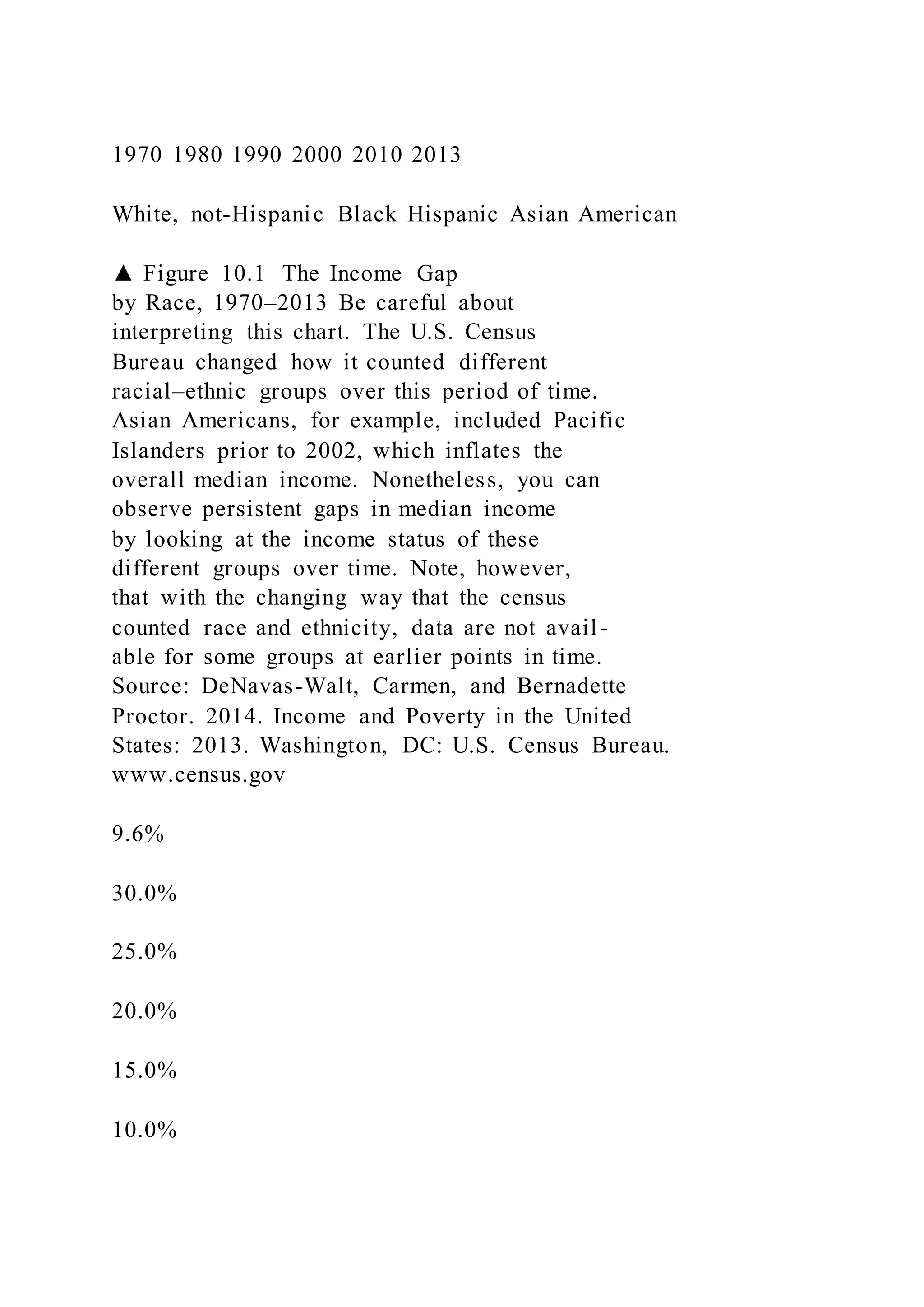
The discrimination affecting the nation’s minori-
ties takes a number of forms—for example, income dis-
crimination, as you can see in ▲ Figure 10.1. Although
the median income of Black and Hispanic families
has increased since 1970, the size of the income gap
between these two groups and Whites has remained
much the same over time.
Median income figures tell only part of the story
though. In addition to annual income, the net worth of
White families has consistently grown faster than that
of Black families (Oliver and Shapiro 2008). Net worth
may well be a better indicator of economic inequality
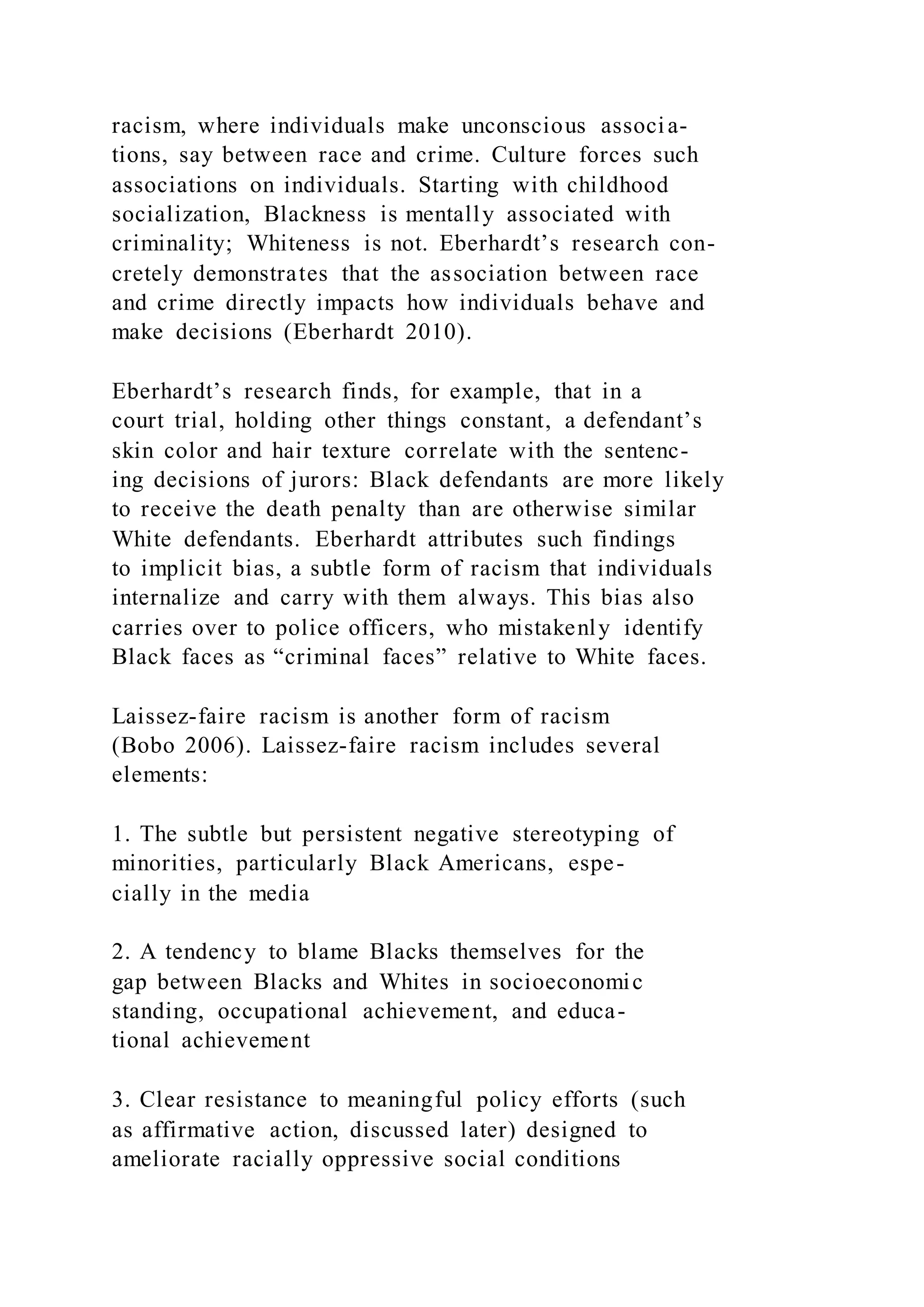
than annual income. Poverty among Blacks has also
decreased since the 1950s, but is now close to the same
level as in 1970. As ▲ Figure 10.2 shows, the current pov-
erty rate is highest for African Americans and Hispanics
compared with Whites or Asians. Note that it is greater
for Asians than for Whites. In all these racial groups,
children have the highest rate of poverty.
Discrimination is illegal under U.S. law. Nonethe-
less, for many years, various discriminatory processes
have continued. Take housing as an example. Even very
recently, banks and mortgage companies have withheld
mortgage loans from minorities based on “redlining,”
an illegal practice in which entire minority neighbor-
hoods are designated as “ineligible for loans.” Racial
segregation may also be fostered by gerrymandering,
the calculated redrawing of election districts, school
districts, and similar political boundaries to maintain
racial segregation.
Segregation is the spatial and social separation of
racial and ethnic groups. Although desegregation has
been mandated by law (thus eliminating de jure seg-
regation, or legal segregation), de facto segregation—
segregation in fact—still exists, particularly in housing
and education. Segregation has contributed to the cre-
ation of an urban underclass, a grouping of people,
largely minorities and the poor, who live at the absolute
bottom of the socioeconomic ladder in urban areas
$80,000
$67,469
$40,205
$33, 295
$57, 880
$70,000
$60,000
$50,000
$40,000
$30,000
$20,000
$10,000
$0
1970 1980 1990 2000 2010 2013
White, not-Hispanic Black Hispanic Asian American
▲ Figure 10.1 The Income Gap
by Race, 1970–2013 Be careful about
interpreting this chart. The U.S. Census
Bureau changed how it counted different
racial–ethnic groups over this period of time.
Asian Americans, for example, included Pacific
Islanders prior to 2002, which inflates the
overall median income. Nonetheless, you can
observe persistent gaps in median income
by looking at the income status of these
different groups over time. Note, however,
that with the changing way that the census
counted race and ethnicity, data are not avail-
able for some groups at earlier points in time.
Source: DeNavas-Walt, Carmen, and Bernadette
Proctor. 2014. Income and Poverty in the United
States: 2013. Washington, DC: U.S. Census Bureau.
www.census.gov
9.6%
30.0%
25.0%
20.0%
15.0%
10.0%
5.0%
0.0%
White, not-
Hispanic
Black Asian Hispanic (any
race)
27.2%
10.5%
23.5%
▲ Figure 10.2 People in Poverty by Race, 2013
This shows the overall percentage of people living below
the official poverty line in 2013. Given what you learned in
Chapter 8 about how poverty is measured, what might you
conclude from this chart?
Source: DeNavas-Walt, Carmen, and Bernadette Proctor. 2014.
Income
and Poverty in the United States: 2013. Washington, DC: U.S.
Census
Bureau. www.census.gov
Copyright 2017 Cengage Learning. All Rights Reserved. May
not be copied, scanned, or duplicated, in whole or in part. Due
to electronic rights, some third party content may be suppressed
from the eBook and/or eChapter(s).
Editorial review has deemed that any suppressed content does
not materially affect the overall learning experience. Cengage
Learning reserves the right to remove additional content at any
time if subsequent rights restrictions require it.
23 6 CHA PTER 10
formally nonsegregated places. As a consequence, in
restaurants as an example, both White and Black
patrons recognize—only semiconsciously—that certain
seating sections are “for Blacks.” As a result, such areas
tend to be avoided by White patrons and even actively
sought out by Black patrons (Anderson 2011).
Racism
Racism includes both attitudes and behaviors. A nega-
tive attitude taken toward someone simply because he
or she belongs to a racial or ethnic group is a prejudice,
as has already been discussed. Racism is the perception
and treatment of a racial or ethnic group, or member
of that group, as intellectually, socially, and culturally
inferior to one’s own group. It is more than an attitude;
it is institutionalized in society.
There are different forms of racism. Researchers
have often called obvious, overt racism, such as physical
assaults, lynchings, and overt expressions of prejudice,
The term apartheid was used to
describe the society of South Africa
prior to the election of Nelson Mandela
in 1994. It refers to the rigid separation
of the Black and White races. Socio-
logical researchers Massey and Denton
argue that the United States is now
under a system of apartheid and that it is
based on a very rigid residential segrega-
tion in the country.
Research Question: What is the current
state of residential segregation? Massey
and Denton note that the terms segre-
gation and residential segregation prac-
tically disappeared from the American
vocabulary in the late 1970s and early
1980s. These terms were spoken little
by public officials, journalists, and even
civil rights officials. This was because the
ills of race relations in the United States
were at the time attributed, though
erroneously, to other causes such as a
“culture of poverty” among minorities,
or inadequate family structure among
Blacks, or too much welfare for minority
groups. The Fair Housing Act was passed
in 1968, and the problem of segrega-
tion and discrimination in housing was
American Apartheid
declared solved. Yet nothing could be
farther from the truth.
Research Methods and Results:
Researchers Massey and Denton
amassed a large amount of survey
data demonstrating that residential
segregation not only has persisted in
American society but also that it has
actually increased since the 1960s. Most
Americans vaguely realize that urban
America is still residentially segregated,
but few appreciate the depth of Black
and Hispanic segregation or the degree
to which it is maintained by ongoing
institutional arrangements and contem-
porary individual actions. Urban society is
thus hypersegregated, or characterized
by an extreme form of residential and
educational segregation.
Conclusions and Implications: Massey
and Denton find that most people think
of racial segregation as a faded notion
from the past, one that is decreasing
over time. Today, theoretical con-
cepts such as the culture of poverty,
institutional racism, and welfare are
widely debated, yet rarely is residential
segregation considered to be a major
contributing cause of urban poverty
and the underclass. Massey and Denton
argue that their purpose is to redirect
the focus of public debate back to race
and racial segregation.
Questions to Consider
1. Think about the degree of residen-
tial segregation in the neighborhood
in which you grew up. How racially
and/or ethnically segregated was
it? If it was segregated at all, what
racial–ethnic groups were living
there?
2. Do you think the problem of racial–
ethnic residential segregation in the
United States is largely “solved”?
How so or why not?
3. What are the consequences of resi-
dential segregation—for example,
for education? For employment?
Sources: Massey, Douglas S., and Nancy
A. Denton. 1993. American Apartheid:
Segregation and the M.aking of the Under-
class. Cambridge, MA: Harvard University
Press; Massey, Douglas S. 2005. Strangers
in a Strange Land: Humans in an Urbanizing
World. New York: Norton; Rugh, Jacob
S., and Douglas S. Massey. 2010. “Racial
Segregation and the American Foreclosure
Crisis.” American Sociological Review 75 (5):
629–651.
doing sociological research
(Wilson 2009, 1987; Massey and Denton 1993). Indeed,
the level of housing segregation is so high for some
groups, especially poor African Americans and Latinos,
that it has been termed hypersegregation, referring to a
pattern of extreme segregation (Rugh and Massey 2010;
Massey 2005; Massey and Denton 1993). Currently,
the rate of segregation of Blacks and Hispanics in U.S.
cities is actually increasing, thus allowing for less and
less interaction between White and Black children and
White and Hispanic children (Schmitt 2001; Massey and
Denton 1993; see the box “Doing Sociological Research:
American Apartheid”). In education, the extraordinary
realization is that schools are also becoming more seg-
regated, a phenomenon called resegregation, because
American schools are now more segregated than they
were even in the 1980s (Frankenberg and Lee 2002).
Residential segregation and other forms of spe-
cial segregation are so pervasive that people have psy-
chologically internalized notions of “the White space”
in neighborhoods, workplaces, restaurants, and other
Copyright 2017 Cengage Learning. All Rights Reserved. May
not be copied, scanned, or duplicated, in whole or in part. Due
to electronic rights, some third party content may be suppressed
from the eBook and/or eChapter(s).
Editorial review has deemed that any suppressed content does
not materially affect the overall learning experience. Cengage
Learning reserves the right to remove additional content at any
time if subsequent rights restrictions require it.
RACE AND ETH N ICI TY 237
Jim Crow racism. This form of racism has declined
somewhat in our society since the 1950s, though it cer-
tainly has not disappeared (Bobo 2004).
Racism can also be subtle, covert, and nonobvi-
ous; this is known as aversive racism (Jones et al.
2013). Consistently avoiding interaction with someone
of another race or ethnicity is an example of aversive
racism. This form of racism is quite common and has
remained at roughly the same level for more than sixty
years, with perhaps a slight increase (Jones et al. 2013).
Even when overt forms of racism dissipate, aversive
racism tends to persist, because it is less visible than
overt racism; people can believe racism has diminished
when it has not (Gaertner and Dovidio 2005).
Another subtle nonobvious form of racism, akin to
aversive racism, is what researcher Jennifer Eberhardt
calls implicit bias. It is a largely nonconscious form of
racism, where individuals make unconscious associa-
tions, say between race and crime. Culture forces such
associations on individuals. Starting with childhood
socialization, Blackness is mentally associated with
criminality; Whiteness is not. Eberhardt’s research con-
cretely demonstrates that the association between race
and crime directly impacts how individuals behave and
make decisions (Eberhardt 2010).
Eberhardt’s research finds, for example, that in a
court trial, holding other things constant, a defendant’s
skin color and hair texture correlate with the sentenc-
ing decisions of jurors: Black defendants are more likely
to receive the death penalty than are otherwise similar
White defendants. Eberhardt attributes such findings
to implicit bias, a subtle form of racism that individuals
internalize and carry with them always. This bias also
carries over to police officers, who mistakenly identify
Black faces as “criminal faces” relative to White faces.
Laissez-faire racism is another form of racism
(Bobo 2006). Laissez-faire racism includes several
elements:
1. The subtle but persistent negative stereotyping of
minorities, particularly Black Americans, espe-
cially in the media
2. A tendency to blame Blacks themselves for the
gap between Blacks and Whites in socioeconomic
standing, occupational achievement, and educa-
tional achievement
3. Clear resistance to meaningful policy efforts (such
as affirmative action, discussed later) designed to
ameliorate racially oppressive social conditions
and practices in the United States.
A close relative of laissez-faire racism is Eduardo
Bonilla-Silva’s (2013) concept of color-blind racism—
so named because individuals affected by this type of
racism prefer to ignore legitimate racial–ethnic, cul-
tural, and other differences and insist that the race
problems in the United States will go away if only race
is ignored altogether. Accompanying this belief is the
opinion that race differences in the United States are
merely an illusion and that race is not real. Simply refus-
ing to perceive any differences at all between racial
groups (thus being color-blind) is in itself a form of rac-
ism (Bonilla-Silva 2013; Gallagher 2013; Bonilla-Silva
and Baiocchi 2001). This will come as a surprise to
many. Here is an example of color-blind racism: Have
you heard someone say, as they attempt to show that
they are “not racist”: “I don’t care if you are white, black,
yellow, or green! I am not prejudiced!”
Such people insist that they are only objective and
fair people, people who do not notice skin color. By def-
inition, this is color-blind racism—a form of racism, for
sure. This ignores the reality of race and its significance
in society.
Color-blindness hides what is called White
privilege behind a mask: It allows Whites to define
themselves as politically and racially tolerant as they
proclaim adherence to a belief system that does not see
or judge individuals by “the color of their skin.” They
think of skin color as irrelevant, but it is not “irrelevant.”
Racial domination—that is, white privilege, is struc-
tured into society. Color-blind racism gives the false
impression that racial barriers have fallen when they
have not (Gallagher 2013; Kristof 2008).
Institutional racism as a form of racism is the
negative treatment and oppression of one racial or
ethnic group by society’s existing institutions based on
the presumed inferiority of the oppressed group. Insti -
tutional racism exists at the level of social structure. In
Durkheim’s sense, it is external to individuals—thus
institutional. It is then possible to have “racism with-
out racists,” as sociologist Bonilla-Silva has shown
(Bonilla-Silva 2013). It is a purely sociological notion:
Institutional racism can exist apart from the individual
personality or personalities. Key to understanding insti-
tutional racism is seeing that dominant groups have the
economic and political power to subjugate the minor-
ity group, even if they do not have the explicit intent of
being prejudiced or discriminating against others.
Racial profiling is an example of institutional rac-
ism in the criminal justice system. African American
and Hispanic people are arrested—and serve longer
sentences—considerably more often than are Whites
and Asians. In fact, an African American or Hispanic
wrongdoer is more likely to be arrested than a White
person who commits the exact same crime, even when
the White person shares the same age, socioeconomic
environment, and prior arrest record as the Black or
Hispanic. These kinds of disparities are very promi-
nent in traffic arrests, where police officers often report
that the arrested person “fit the profile” (Doermer and
Demuth 2010; Eberhardt 2010).
As most people now know, in a heavily Black sub-
urb of St. Louis, in Ferguson, Missouri, a Black teenager,
Copyright 2017 Cengage Learning. All Rights Reserved. May
not be copied, scanned, or duplicated, in whole or in part. Due
to electronic rights, some third party content may be suppressed
from the eBook and/or eChapter(s).
Editorial review has deemed that any suppressed content does
not materially affect the overall learning experience. Cengage
Learning reserves the right to remove additional content at any
time if subsequent rights restrictions require it.
23 8 CHA PTER 10
Michael Brown, was shot and killed in the summer of
2014 by a White policeman (Darren Wilson) for alleg-
edly physically attacking Wilson. Massive public dem-
onstrations followed. Many Black observers of the
shooting reported that Brown did not attack Wilson, was
unarmed, and had his hands up. “Hands up/don’t shoot”
became a rallying cry of the public demonstrations.
The institutional racism in this incident is shown by
the data. Ferguson, Missouri, is a predominantly Black
suburb (55 percent Black), yet 90 percent of all traffic
arrests are of Black people. Second, Blacks in Fergu-
son were more likely than Whites to say that race was
definitely a factor in Wilson’s fatal shooting of Michael
Brown: Eighty percent of a total of Blacks interviewed
in a later survey thought so, whereas only 23 percent of
Whites interviewed thought so (Pew Research Center
2014). The cry of Whites that “race had nothing to do
with it” is all too familiar in such situations.
Consider this: Even if every White person in the
country lost all of his or her personal prejudices, and
even if he or she stopped engaging in individual acts of
discrimination, institutional racism would still persist
for some time. Over the years, it has become so much
a part of U.S. institutions (hence, the term institutional
racism) that discrimination can occur even when no
single person is deliberately causing it. To sum up, rac-
ism is a characteristic of the institutions and not nec-
essarily of the individuals within the institution. This is
why institutional racism can exist even without preju-
dice being the cause.
DEBUNKING Society’s Myths←
Myth: The primary cause of racial inequality in the United
States is the persistence of prejudice.
Sociological Perspective: Prejudice is one dimension
of racial problems in the United States, but institutional
racism can flourish even while prejudice is on the decline.
Prejudice is an attribute of the individual, whereas institu-
tional racism is an attribute of social structure.
Theories of Prejudice
and Racism
Why does racial inequality persist? Sociological theory
provides insight into this question.
Assimilation theory examines the process by
which a minority becomes socially, economically, and
culturally absorbed within the dominant society. This
theory assumes that to become fully fledged members
of society, minority groups must adopt as much of the
dominant society’s culture as possible, particularly its
language, mannerisms, and goals for success, and thus
give up much of its own culture. Assimilation stands
in contrast to racial cultural pluralism—the separate
maintenance and persistence of one’s culture, lan-
guage, mannerisms, practices, art, and so on.
Many Americans believe that with enough hard
work and loyalty to the dominant White culture of the
country, any minority can make it and thus “assimilate”
into American society. It is the often heard argument
that African Americans, Hispanics, and Native Ameri-
cans need only to pull themselves up “by their own
bootstraps” to become a success.
→THINKING Sociologically
Write down your own racial–ethnic background and list
one thing that people from this background have positively
contributed to U.S. society or culture. Also list one experi -
ence (current or historical) in which people from your
group have been victimized by society. Discuss how these
two things illustrate the fact that racial–ethnic groups have
both been victimized and have made positive contributions
to this society. Share your comments with others: What
does this reveal to you about the connections between
different groups of people and their experiences as racial –
ethnic groups in the United States?
Assimilationists believe that to overcome adversity
and oppression, minority people need only imitate the
dominant White culture as much as possible. In this
sense, minorities must assimilate “into” White culture
and White society. The general assumption is that with
Minorities are more likely to be arrested than Whites
for the same offense. Does this reflect institutional racism
in addition to possible individual prejudice of the arresting
police officer?
Da
ry
l L
an
g/
Sh
ut
te
rs
to
ck
.c
om
Copyright 2017 Cengage Learning. All Rights Reserved. May
not be copied, scanned, or duplicated, in whole or in part. Due
to electronic rights, some third party content may be suppressed
from the eBook and/or eChapter(s).
Editorial review has deemed that any suppressed content does
not materially affect the overall learning experience. Cengage
Learning reserves the right to remove additional content at any
time if subsequent rights restrictions require it.
RACE AND ETH N ICI TY 23 9
each new generation, assimilation becomes more and
more likely. One of the questions asked in this perspec-
tive is to what extent groups can maintain some of their
distinct cultural values and still be incorporated into
the society to which they have moved. One could argue,
for example, that the Irish have been able to assimilate
quite fully into American culture while still maintain-
ing an ethnic identity—one that is particularly salient
around Saint Patrick’s Day!
Many Asian American groups have followed this
pattern and have thus been called by some the “model
minority,” but this label ignores the fact that Asians
are still subject to considerable prejudice, discrimi -
nation, racism, and poverty (Ngai 2012; Ling 2009;
Woo 1998).
There are problems with the assimilation approach.
First, it fails to consider the time that it takes certai n
groups to assimilate. Those from rural backgrounds
(Native Americans, Hispanics, African Americans, White
Appalachians, and some White ethnic immigrants) typi-
cally take much longer to assimilate than those from
urban backgrounds.
Second, the histories of Black and White arrivals are
very different, with lasting consequences. Whites came
voluntarily; Blacks arrived in chains. Whites sought rel -
atives in the New World; Blacks were sold and separated
from close relatives. For these and other reasons, the
experiences of African Americans and Whites as new -
comers can hardly be compared, and their assimilation
is unlikely to follow the same course.
Third, although White ethnic groups did indeed
face prejudice and discrimination when they arrived
in the United States, many entered at a time when the
economy was growing rapidly and their labor was in
high demand. Thus they were able to attain education
and job skills. In contrast, by the time Blacks arrived
during the Great Migration to northern industrial
areas from the rural South, Whites had already estab-
lished firm control over labor and used this control
to exclude Blacks from better-paying jobs and higher
education.
Fourth, assimilation is more difficult for people of
color because skin color is an especially salient char-
acteristic, ascribed and relatively unchangeable. White
ethnic group members can change their names, which
many did (for example, from Levine to Lane; from Bel-
litto to Bell; many other examples exist), but people of
color cannot easily change their skin color.
The assimilation model raises the question of
whether it is possible for a society to maintain cultural
pluralism, which is defined as different groups in soci -
ety maintaining their distinctive cultures, while also
coexisting peacefully with the dominant group. Recent
theorists note that achievement of cultural pluralism
involves a degree of mutually formative two-way inter-
section of immigration and race (Kibria et al. 2013).
Some groups have explicitly practiced cultural
pluralism: The Amish people of Lancaster County in
Pennsylvania and of north-central Ohio—who travel by
horse and buggy; use no electricity; and run their own
schools, banks, and stores—constitute a good example
of a relatively complete degree of cultural pluralism. A
somewhat lesser degree of cultural pluralism, but still
present, is maintained by “Little Italy” neighborhoods
in some U.S. cities and also by certain Black Muslim
groups in the United States.
Symbolic Interaction Theory. Symbolic interac-
tion theory addresses two issues: first, the role of social
interaction in reducing racial and ethnic hostility, and
second, how race and ethnicity are socially constructed.
Symbolic interactionism asks: What happens when two
people of different racial or ethnic origins come into
contact with each other, and how can such interracial
or interethnic contact reduce hostility and conflict?
Contact theory, which originated with the psychologist
Gordon Allport (Cook 1988; Allport 1954), argues that
interaction and contact between two groups will reduce
prejudice within both groups—but only if three condi-
tions are met:
1. The contact must be between individuals of equal
status; the parties must interact on equal ground.
A Hispanic cleaning woman and a wealthier White
woman who employs her may interact, but their
interaction will not reduce prejudice. Instead, their
interaction is more likely to perpetuate stereotypes
and prejudices on the part of both.
2. The contact between equals must be sustained;
short-term contact will not decrease prejudice.
Neighborhoods such as this one in Manhattan, New York,
are indicative of residential segregation.
Je
ff
Gr
ee
nb
er
g/
Ph
ot
oE
di
t
Copyright 2017 Cengage Learning. All Rights Reserved. May
not be copied, scanned, or duplicated, in whole or in part. Due
to electronic rights, some third party content may be suppressed
from the eBook and/or eChapter(s).
Editorial review has deemed that any suppressed content does
not materially affect the overall learning experience. Cengage
Learning reserves the right to remove additional content at any
time if subsequent rights restrictions require it.
24 0 CHA PT ER 10
3. Social norms favoring equality must be agreed
upon by the participants. Having African Americans
and White skinheads interact on a TV talk show, as
once done on the Jerry Springer Show, will proba-
bly not decrease prejudice; such interaction might
well increase it for both groups.
Conflict Theory. The basic premise of conflict the-
ory is that class-based conflict is an inherent and fun-
damental part of social interaction. To the extent that
racial and ethnic conflict is tied to class conflict, conflict
theorists argue that class inequality must be reduced to
lessen racial and ethnic conflict in society.
The “class versus race” controversy in sociology
concerns the question of whether class or race is more
important in explaining racial inequality. Sociologist
William Julius Wilson (2009, 1996, 1987, 1978) argues
that class and changes in the economic structure are
sometimes more important than race in shaping the life
chances of different groups. Wilson argues that being
disadvantaged in the United States is more a matter of
class, although he sees this clearly linked to race. Oth-
ers argue that race has been and continues to be more
important than class—though class is still important—
in explaining and accounting for inequality and con-
flict in society (Bonilla-Silva 2013; Bonilla-Silva and
Baiocchi 2001; Feagin 2000; Bonilla-Silva 1997; Willie
1979; see ◆ Table 10.2). Wilson has consistently argued,
however, that group race differences are clearly causally
related to class differences, and that, in addition, race
has an effect independent of class.
Wilson (1987) attributes the causes of the urban
underclass to economic and social structural defi-
cits in society. The problems of the inner city, such as
joblessness, crime, teen pregnancy, and violence, are
seen as arising from social class inequalities, that is,
inequalities in the structure of society. These inequali -
ties have dire behavioral consequences at the indi-
vidual level, in the form of drug abuse, violence, and
lack of education (Wilson 2009, 1996, 1987; Sampson
1987). Despite these disadvantages, many minority
individuals nonetheless manage to achieve upward
occupational and economic mobility (Newman 1999).
Wilson argues that the civil rights agenda needs to
be expanded to address the problems of the under-
class, especially joblessness. This does not mean
that race is unimportant, rather that the influence of
class is increasing, even though race still continues
to remain extremely important, and may be increas-
ing in importance. In numerous studies, scholars find
that race, in and of itself, still influences such things as
income, wealth holdings, occupational prestige, place
of residence, educational attainment, and numerous
other measures of socioeconomic well-being (Pattillo
McCoy 2013; Bobo 2012; Oliver and Shapiro 2006;
Brown et al. 2005).
The “class versus race” controversy is connected
to theories of intersectionality. The intersection
perspective argues that class, race, and gender com-
bine (or “intersect”) to create a matrix of domination
(Andersen and Collins 2013; Collins 1990). Intersec-
tional theory points out that people are socially located
in positions that simultaneously involve race, class, and
gender. Looking at only one of them is incomplete. The
effects of gender and race are intertwined, and both are
intertwined with class.
Diverse Groups, Diverse
Histories
The different racial and ethnic groups in the United
States have arrived at their current social condi-
tion through histories that are similar in some ways,
yet quite different in other respects. Their histories
are related because of a common experience of
White supremacy, economic exploitation, and politi-
cal disenfranchisement.
◆ Table 10.2 Comparing Sociological Theories of Race and
Ethnicity
Functionalism Conflict Theory Symbolic Interaction
The Racial Order Has social stability when diverse
racial and ethnic groups are
assimilated into society
Is intricately intertwined with
class stratification of racial
and ethnic groups
Is based on social construction that
assigns groups of people to diverse
racial and ethnic categories
Minority Groups Are assimilated into dominant
culture as they adopt cultural
practices and beliefs of the
dominant group
Have life chances that result
from the opportunities formed
by the intersection of class,
race, and gender
Form identity as the result of socio-
historical change
Social Change Is a slow and gradual process
as groups adapt to the social
system
Is the result of organized social
movements and other forms of
resistance to oppression
Is dependent on the different
forms of social interaction that
characterize intergroup relations
©
C
en
ga
ge
L
ea
rn
in
g
Copyright 2017 Cengage Learning. All Rights Reserved. May
not be copied, scanned, or duplicated, in whole or in part. Due
to electronic rights, some third party content may be suppressed
from the eBook and/or eChapter(s).
Editorial review has deemed that any suppressed content does
not materially affect the overall learning experience. Cengage
Learning reserves the right to remove additional content at any
time if subsequent rights restrictions require it.
RACE AND E THN IC ITY 24 1
Native Americans: The First
of This Land
The exact size of the indigenous population in North
America at the time of the Europeans’ arrival with
Columbus in 1492 has been estimated at anywhere
from one million to ten million people. Native Ameri-
cans were here tens of thousands of years before they
were “discovered” by Europeans. Discovery quickly
turned to conquest, and in the course of the next three
centuries, the Europeans systematically drove the
Native Americans from their lands, destroying their
ways of life and crushing various tribal cultures. Native
Americans were subjected to an onslaught of Euro-
pean diseases. Lacking immunity to these diseases,
Native Americans suffered a population decline, con-
sidered by some to have been the steepest and most
drastic of any people in the history of the world. Native
American traditions have survived in many isolated
places, but what is left is only an echo of the original
500 nations of North America (Snipp 2007, 1989; Nagel
1996; Thornton 1987).
At the time of European contact in the 1640s, there
was great linguistic, religious, governmental, and eco-
nomic heterogeneity among Native American tribes.
Most historical accounts have underestimated the
degree of cultural and social variety, however. Between
the arrival of Columbus in the Caribbean in 1492 and
the establishment of the first thirteen colonies in North
America in the early 1600s, the ravages of disease and
the encroachment of Europeans caused a considerable
degree of social disorganization.
By 1800, the number of Native Americans had been
reduced to a mere 600,000, and wars of extermination
against the Indians were being conducted in earnest.
Fifty years later, the population had fallen by another
half. Indians were killed defending their land, or died
of hunger and disease when taking refuge in inhospi-
table country. In 1834, 4000 Cherokee died on a forced
march from their homeland in Georgia to reservations
in Arkansas and Oklahoma, a trip memorialized as the
Trail of Tears. Today, about 55 percent of all American
Indians live on or near a reservation, which is land set
aside by the U.S. government for their exclusive use. The
other 45 percent live in or near urban areas (U.S. Census
Bureau 2012a; Snipp 1989). The reservation system
has served the Indians poorly. Many Native Americans
now live in conditions of abject poverty, deprivation,
lack of educational opportunity, and alcoholism. They
suffer massive unemployment (currently more than
50 percent among males—extraordinarily high). They
are at the lowest rung of the socioeconomic ladder, with
the highest poverty rate. The first here in this land are
now last in status, a painful irony of U.S. history.
African Americans
The development of slavery in the Americas is related
to the development of world markets for sugar and
tobacco. Slaves were imported from Africa to provide
the labor for sugar and tobacco production and to
enhance the profits of slaveholders. An estimated
twelve million Africans were transported under appall -
ing conditions to the Americas, about a quarter of whom
came to the mainland United States (TransAtlantic
Slave Trade Database 2014).
Slavery evolved as a form of stratification called a
caste system (see Chapter 8). Slaveholders profited from
the labor of a caste, the slaves. Central to the operation
of slavery was the principle that human beings could
be chattel (or property). Slavery was based on the belief
that Whites are superior to other races, coupled with a
belief in a patriarchal social order. The social distinc-
tions maintained between Whites and Blacks were
caste-like, with rigid categorization and prohibitions,
rather than merely class-like, which suggests more pli-
ant social demarcations. Vestiges of this caste system
remain in the United States to this very day.
The slave system also involved the domination of
men over women—another aspect of the caste sys-
tem. In this combination of patriarchy and White
supremacy, White males presided over their “property”
of White women as well as their “property” of Black
men and women. This in turn led to gender stratifica-
tion among the slaves themselves, reflecting the White
slaveholders’ assumptions about the relative roles of
men and women. Black women performed domestic
labor for their masters and their own families. White
The opening of the National Museum of the American
Indian (part of the Smithsonian Institution in Washington,
DC) was cause for celebration among diverse groups of
Native Americans, as well as others.
Ja
so
n
Re
ed
/R
eu
te
rs
/L
an
do
v
Copyright 2017 Cengage Learning. All Rights Reserved. May
not be copied, scanned, or duplicated, in whole or in part. Due
to electronic rights, some third party content may be suppressed
from the eBook and/or eChapter(s).
Editorial review has deemed that any suppressed content does
not materially affect the overall learning experience. Cengage
Learning reserves the right to remove additional content at any
time if subsequent rights restrictions require it.
24 2 CHA PT ER 10
men further exerted their authority in demanding
sexual relations with Black women (White 1999). The
predominant attitude of Whites toward Blacks was
paternalistic. Whites saw slaves as childlike and inca-
pable of caring for themselves. The stereotypes of
African Americans as “childlike” are directly traceable
to the system of slavery.
Slaves struggled to preserve both their culture
and their sense of humanity and to resist, often by
open conflict, the dehumanizing effects of a system
that defined human beings as mere property (Myers
1998; Blassingame 1973). Slaves revolted against the
conditions of enslavement in a variety of ways, from
passive means such as work slowdowns and feigned ill-
ness to more aggressive means such as destruction of
property, escapes, and outright rebellion. To this day
the extent and frequency of slave rebellions has been
underestimated.
After slavery was ended by the Civil War
(1861–1865) and the Emancipation Proclamation
(1863), Black Americans continued to be exploited for
their labor. In the South, the system of sharecropping
emerged, an exploitative system in which Black fami-
lies tilled the fields for White landowners in exchange
for a share of the crop. With the onset of the First World
War and the intensified industrialization of society
came the Great Migration of Blacks from the South
to the urban north. This massive movement, lasting from
the late 1800s through the 1920s, significantly affect ed
the status of Blacks in society because there was now a
greater potential for collective action (Marks 1989).
In the early part of the century, the formation of
Black ghettos victimized Black Americans with grim
urban conditions at the same time that it encouraged
the development of Black resources, including volun-
teer organizations, settlement houses, social move-
ments, political action groups, and artistic and cultural
achievements. During the 1920s, Harlem in New York
City became an important intellectual and artistic oasis
for Black America, known as the Harlem Renaissance.
The Harlem Renaissance gave the nation great
literary figures, such as Langston Hughes, Jessie Fauset,
Alain Locke, Arna Bontemps, Zora Neale Hurston,
Countee Cullen, Wallace Thurman, and Nella Larsen
(Marks and Edkins 1999; Gates et al. 1997; Rampersad
1988, 1986; Bontemps 1972). At the same time, many
of America’s greatest musicians, entertainers, and art-
ists came to the fore, such as musicians Duke Elling-
ton, Count Basie, Benny Carter, Billie Holiday, Cab
Calloway, and Louis Armstrong, and painters Hale
Woodruff and Elmer Brown. The end of the 1920s and
the stock market crash of 1929 brought everyone down
a peg or two, Whites as well as Blacks, although in the
words of Harlem Renaissance writer Langston Hughes,
Black Americans at the time “had but a few pegs to fall”
(Hughes 1967).
Latinos
Latinos have recently surpassed African Americans as
the largest minority group population in the United
States; the largest increase among Mexican Americans.
Latinos include Chicanos and Chicanas, Mexican
Americans, Puerto Ricans, Cubans, and other recent
Latin and Central American immigrants to the United
States. They also include Latin Americans who have
lived for generations in the United States; many are
not immigrants but very early settlers from Spain and
Portugal in the 1400s. The terms Hispanic and Latino or
Latina mask the great structural and cultural diversity
among the various Hispanic groups.
Diverse Latino groups have been forced by institu-
tional procedures to cause the public to perceive them
“as one,” for example, by the media, by political lead-
ers, and by the U.S. Census categories (Mora 2009).
The use of such inclusive terms also ignores important
differences in their respective entries into U.S. society:
Chicanos/as through military conquest of the Mexican–
American War (1846–1848); Puerto Ricans through war
with Spain in the Spanish–American War (1898); and
Cubans as political refugees fleeing since 1959 from
the communist dictatorship of Fidel Castro, which the
U.S. government vigorously opposed (Telles et al. 2011;
Glenn 2002; Bean and Tienda 1987).
Mexican Americans. Before the Anglo (White) con-
quest, Mexican colonists had formed settlements and
missions throughout the West and Southwest. In 1834,
the U.S. government ordered the dismantling of these
missions, bringing them under tight governmental con-
trol and creating a period known as the Golden Age of
the Ranchos. Land then became concentrated into the
hands of a few wealthy Mexican ranchers, who had
been given large land grants by the Mexican govern-
ment. This created a class system within the Chicano
community, consisting of the elite ranchers, mission
farmers, and government administrators at the top;
mestizos, who were small farmers and ranchers, as the
middle class; a third class of skilled workers; and a bot-
tom class of manual laborers, who were mostly Indians
(Maldonado 1997; Mirandé 1985).
With the Mexican–American War of 1846–1848,
Chicanos lost claims to huge land areas that ultimately
became Texas, New Mexico, and parts of Colorado,
Arizona, Nevada, Utah, and California. White cattle ranch-
ers and sheep ranchers enclosed giant tracts of land,
thus cutting off many small ranchers, both Mexican and
Anglo. Thus began a process of wholesale economic and
social exclusion of Mexicans and Mexican Americans
from U.S. society, much of which continues to this day,
generation after generation (Telles and Ortiz 2008).
It was at this time that Mexicans, as well as early
U.S. settlers of Mexican descent, became defined as an
Copyright 2017 Cengage Learning. All Rights Reserved. May
not be copied, scanned, or duplicated, in whole or in part. Due
to electronic rights, some third party content may be suppressed
from the eBook and/or eChapter(s).
Editorial review has deemed that any suppressed content does
not materially affect the overall learning experience. Cengage
Learning reserves the right to remove additional content at any
time if subsequent rights restrictions require it.
RACE AND E THN IC ITY 243
inferior race that did not deserve social, educational, or
political equality. This is an example of the racial forma-
tion process, as noted earlier in this chapter (Omi and
Winant 2014). Anglos believed that Mexicans were lazy,
corrupt, and cowardly, yet violent, which launched ste-
reotypes that would further oppress Mexicans. These
stereotypes were used to justify the lower status of
Mexicans and Anglo control of the land that Mexicans
were presumed to be incapable of managing (Telles and
Ortiz 2008; Moore 1976).
During the twentieth century, advances in agricul-
tural technology changed the organization of labor in
the Southwest and West. Irrigation allowed year-round
production of crops and a new need for cheap labor to
work in the fields. Migrant workers from Mexico were
exploited as a cheap source of labor. Migrant work was
characterized by low earnings, poor housing condi-
tions, poor health, and extensive use of child labor. The
wide use of Mexican migrant workers as field workers,
domestic servants, and other kinds of poorly paid work
continues, now throughout the United States.
Puerto Ricans. The island of Puerto Rico was ceded
to the United States by Spain in 1898. In 1917, the Jones
Act extended U.S. citizenship to Puerto Ricans, although
it was not until 1948 that Puerto Ricans were allowed
to elect their own governor. In 1952, the United States
established the Commonwealth of Puerto Rico, with
its own constitution. Following the Second World War,
the first elected governor launched a program known
as Operation Bootstrap, which was designed to attract
large U.S. corporations to the island of Puerto Rico by
using tax breaks and other concessions. This program
contributed to rapid overall growth in the Puerto Rican
economy, although unemployment remained high and
wages remained low. Seeking opportunity, unemployed
farmworkers began migrating to the United States.
These migrants were interested in seasonal work, and
thus a pattern of temporary migration characterized the
Puerto Ricans’ entrance into the United States (Amott
and Matthaei 1996; Rodriguez 1989).
Unemployment in Puerto Rico became so severe
that the U.S. government even went so far as to attempt a
reduction in the population by some form of population
control. Pharmaceutical companies experimented with
Puerto Rican women in developing contraceptive pills,
and the U.S. government actually encouraged the steril-
ization of Puerto Rican women. More than 37 percent of
the women of reproductive age in Puerto Rico had been
sterilized by 1974 (Roberts 1997). More than one-third
of these women have since indicated that they regret
sterilization because they were not made aware at the
time that the procedure was irreversible.
Cubans. Cuban migration to the United States is recent
in comparison with the many other Hispanic groups.
The largest migration has occurred since the revolu tion
led by Fidel Castro in 1959. Between then and 1980, more
than 800,000 Cubans—one-tenth of the entire island
population—migrated to the United States. The U.S. gov-
ernment defined this as a political exodus, facilitating
the early entrance and acceptance of these migrants.
Many of the first migrants had been middle- and upper-
class professionals and landowners under the prior
dictatorship of Fulgencio Batista, but they had lost their
land during the Castro revolution. In exile in the United
States, some worked to overthrow Castro, often with
the support of the U.S. federal government. Many other
Cuban immigrants were of more modest means who,
like other immigrant groups, came seeking freedom
from political and social persecution and an escape
from poverty.
A second wave of Cuban immigration came in
1980, when the Cuban government, still under Castro,
opened the Port of Mariel to anyone who wanted to
leave Cuba. In the five months following this action,
125,000 Cubans came to the United States—more than
the combined total for the preceding eight years. The
arrival of people from Mariel has produced debate
and tension, particularly in Florida, a major cen-
ter of Cuban migration. The Cuban government had
previously labeled the people fleeing from Mariel as
Activities such as this Puerto Rican Day Parade in New
York City reflect pride in one’s group culture and result
in greater cohesiveness of the group.
AP
Im
ag
es
/R
ic
ha
rd
D
re
w
Copyright 2017 Cengage Learning. All Rights Reserved. May
not be copied, scanned, or duplicated, in whole or in part. Due
to electronic rights, some third party content may be suppressed
from the eBook and/or eChapter(s).
Editorial review has deemed that any suppressed content does
not materially affect the overall learning experience. Cengage
Learning reserves the right to remove additional content at any
time if subsequent rights restrictions require it.
24 4 CH A PTER 10
“undesirable”; some had been incarcerated in Cuba
before leaving. They were actually not much differ-
ent from previous refugees such as the “golden exiles,”
who were professional and high-status refugees
(Portes and Rumbaut 1996). But because the refu-
gees escaping from Mariel had been labeled (stereo-
typed) as undesirables, and because they were forced
to live in primitive camps for long periods after their
arrival, they have been unable to achieve much social
and economic mobility in the United States—thus
ironically reinforcing the initial perception that they
were “lazy” and “undesirable.” In contrast, the earlier
Cuban migrants, who were on average more educated
and much more settled, have enjoyed a fair degree of
success (Portes and Rumbaut 2001, 1996; Amott and
Matthei 1996; Pedraza 1996).
Asian Americans
Like Hispanic Americans, Asian Americans are from
many different countries and diverse cultural back-
grounds; they cannot be classified as the single
cultural rubric of Asians. Asian Americans include
migrants from China, Japan, the Philippines, Korea,
and Vietnam, as well as more recent immigrants from
Southeast Asia.
Chinese. Attracted by the U.S. demand for labor, Chi-
nese Americans began migrating to the United States
during the mid-nineteenth century. In the early stages
of this migration, the Chinese were tolerated because
they provided cheap labor. They were initially seen as
good, quiet citizens, but racial stereotypes turned hos-
tile when the Chinese came to be seen as competing
with White California gold miners for jobs. Thousands
of Chinese laborers worked for the Central Pacific Rail -
road from 1865 to 1868. They were relegated to the most
difficult and dangerous work, worked longer hours than
the White laborers, and for a long time were paid con-
siderably less than the White workers.
The Chinese were virtually expelled from rail-
road work near the turn of the twentieth century (in
1890–1900) and settled in rural areas throughout the
western states. As a consequence, anti-Chinese sen-
timent and prejudice ran high in the West. This eth-
nic antagonism was largely the result of competition
between the White and Chinese laborers for scarce jobs.
In 1882, the federal government passed the Chinese
Exclusion Act, which banned further immigration of
unskilled Chinese laborers. Like African Americans, the
Chinese and Chinese Americans were legally excluded
from intermarriage with Whites (Takaki 1989). During
this period, several Chinatowns were established by
those who had been forcibly uprooted and who found
strength and comfort within enclaves of Chinese people
and culture (Nee 1973).
Japanese. Japanese immigration to the United States
took place mainly between 1890 and 1924, after which
passage of the Japanese Immigration Act forbade fur-
ther immigration. Most of these first-generation immi-
grants, called issei, were employed in agriculture or in
small Japanese businesses. Many issei were from farm-
ing families and wished to acquire their own land, but
in 1913, the Alien Land Law of California stipulated
that Japanese aliens could lease land for only three
years and that lands already owned or leased by them
could not be bequeathed to heirs. The second genera-
tion of Japanese Americans, or nisei, were born in the
United States of Japanese-born parents. They became
better educated than their parents, lost their Japanese
accents, and in general became more “Americanized,”
that is, culturally assimilated. The third generation,
called sansei, became even better educated and assim-
ilated, yet still met with prejudice and discrimination,
particularly where Japanese Americans were present
in the highest concentrations, as on the West Coast
from Washington to southern California (Takaki 1989;
Glenn 1986).
The Japanese suffered the complete indignity of
having their loyalty questioned when the federal gov-
ernment, thinking they would side with Japan after the
Japanese attack on Pearl Harbor in December 1941,
herded them into concentration camps. By executive
order of president Franklin D. Roosevelt, much of the
West Coast Japanese American population (a great
many—perhaps most—of them loyal second- and
third-generation Americans) had their assets frozen
and their real estate confiscated by the government. A
media campaign immediately followed, labeling Japa-
nese Americans “traitors” and “enemy aliens.” Virtually
During World War II, Japanese Americans, who were full
American citizens, were forced into concentration camps. A
noon food (“mess”) line at one of these camps, Manzanar, is
shown here.
Li
br
ar
y
of
C
on
gr
es
s
Pr
in
ts
a
nd
P
ho
to
gr
ap
hs
D
iv
is
io
n
[L
C-
DI
G-
pp
pr
s-
00
36
8]
Copyright 2017 Cengage Learning. All Rights Reserved. May
not be copied, scanned, or duplicated, in whole or in part. Due
to electronic rights, some third party content may be suppressed
from the eBook and/or eChapter(s).
Editorial review has deemed that any suppressed content does
not materially affect the overall learning experience. Cengage
Learning reserves the right to remove additional content at any
time if subsequent rights restrictions require it.
RACE AND E THN IC ITY 24 5
all Japanese Americans in the United States had been
removed from their homes by August 1942, and some
were forced to stay in relocation camps until as late as
1946. Relocation destroyed numerous Japanese fami-
lies and ruined them financially (Takaki 1989; Glenn
1986; Kitano 1976).
In 1986, the U.S. Supreme Court allowed Japanese
Americans the right to file suit for monetary repara-
tions. In 1987, legislation was passed, awarding $20,000
to each person who had been relocated and offering an
official apology from the U.S. government. One is moti-
vated to contemplate how far this paltry sum and late
apology could go in righting what many have argued
was the “greatest mistake” the United States has ever
made as a government.
Filipinos. The Philippine Islands in the Pacific Ocean
fell under U.S. rule in 1899 as a result of the Spanish-
American War, and for a while Filipinos could enter
the United States freely. By 1934, the islands became a
commonwealth of the United States, and immigration
quotas were imposed on Filipinos. More than 200,000
Filipinos immigrated to the United States between 1966
and 1980, settling in major urban centers on the West
and East Coasts. More than two-thirds of those arriv-
ing were professional workers; their high average lev-
els of education and skill have eased their assimilation.
By 1985, more than one million Filipinos were in the
United States. They are now the second largest Asian
American population.
Koreans. Many Koreans entered the United States
in the late 1960s, after amendments to the immigra-
tion laws in 1965 raised the limit on immigration from
the Eastern Hemisphere. The largest concentration of
Koreans is in Los Angeles. As much as half of the adult
Korean American population is college educated, an
exceptionally high proportion. Many of the immigrants
were successful professionals in Korea; upon arrival in
the United States, though, they have been forced to take
on menial jobs, thus experiencing downward social
mobility and status inconsistency. This is especially true
of those Koreans who migrated to the East Coast. How -
ever, nearly one in eight Koreans in the United States
today owns a business; many own small greengrocer
businesses. Many of these stores are located in pre-
dominantly African American communities and have
become one among several sources of ongoing conflict
between some African Americans and Koreans. This has
fanned negative feeling and prejudice on both sides—
among Koreans against African Americans and among
African Americans against Koreans (Chen 1991).
Vietnamese. Among the more recent groups of
Asians to enter the United States have been the South
Vietnamese, who began arriving following the fall of
South Vietnam to the communist North Vietnamese at
the end of the Vietnam War in 1975. These immigrants,
many of them refugees who fled for their lives, num-
bered about 650,000 in the United States in 1975. About
one-third of the refugees settled in California. Many
faced prejudice and hostility, resulting in part from
the same perception that has dogged many immigrant
groups before them—that they were in competition
for scarce jobs. A second wave of Vietnamese immi-
grants arrived after China attacked Vietnam in 1978.
As many as 725,000 arrived in the United States, only
to face discrimination in a variety of locations. Ten-
sions became especially heated when the Vietnamese
became a substantial competitive presence in the fish-
ing and shrimping industries in the Gulf of Mexico on
the Texas shore. Since that time, however, many com-
munities have welcomed them, and many Vietnamese
heads of households have become employed full-time
(Kim 1993; Winnick 1990).
Middle Easterners
Since the mid-1970s, immigrants from the Middle East
have been arriving in the United States. They have come
from countries such as Syria, Lebanon, Egypt, and Iran,
and more recently, especially Iraq. Contrary to popular
belief, the immigrants speak no single language and fol-
low no singular religion and thus are ethnically diverse.
Some are Catholic, some are Coptic Christian, and many
are Muslim. Many are from working-class backgrounds,
but many were professionals—teachers, engineers, sci-
entists, and other such positions—in their homelands.
About 65 percent of those residing in this country were
born outside the United States; about half are college-
educated (Kohut 2007). Like immigrant populations
before them, Middle Easterners have formed their own
ethnic enclaves in the cities and suburbs of this country
as they pursue the often elusive American dream (Abra-
hamson 2006).
Since the terrorist attacks on the World Trade Cen-
ter and the Pentagon on September 11, 2001, many
male Middle Easterners of several nationalities have
become unjustly suspect in this country and are sub-
jected to severe harassment; racially motivated physi-
cal attacks; and as already noted, out-and-out racial
profiling, if only because they had dark skin and—as
with some—wore a turban of some sort on their heads.
Most of these individuals, of course, probably had no
discernible connection at all with the terrorists. A sur-
vey shows that most Muslims in this country believe
that the September 11, 2001, terrorist attacks were
indeed the cause of subsequent increased racial harass-
ment and violence against them (Kohut 2007). Finally,
the U.S. wars with Iraq and Afghanistan have not
helped in easing tensions between White Americans
Copyright 2017 Cengage Learning. All Rights Reserved. May
not be copied, scanned, or duplicated, in whole or in part. Due
to electronic rights, some third party content may be suppressed
from the eBook and/or eChapter(s).
Editorial review has deemed that any suppressed content does
not materially affect the overall learning experience. Cengage
Learning reserves the right to remove additional content at any
time if subsequent rights restrictions require it.
24 6 CH APT ER 10
and Middle Easterners, nor have the recent genuinely
terrorist attacks of ISIS against Middle Easterners and
some Anglos in Mid-East locations.
White Ethnic Groups
The story of White ethnic groups in the United States
begins during the colonial period. White Anglo Saxon
Protestants (WASPs), who were originally immigrants
from England and to some extent Scotland and Wales,
settled in the New World (what is now North America).
They were the first ethnic group to come into contact—
most often hostile contact—on a large scale with those
people already here, namely, Native American Indians.
WASPs came to dominate the newly emerging society
earlier than any other White ethnic group.
In the late 1700s, the WASPs regarded the later
immigrants from Germany and France as “foreigners”
with odd languages, accents, and customs, and applied
derogatory labels (“krauts” for Germans; “frogs”
for the French) to them. Again, this demonstrates
that virtually every immigrant group, except WASPs
themselves, was discriminated against and subject to
racist name-calling. Tension between the “old stock”
and the “foreigners” continued through the Civil War
era until around 1860, when the national origins of
U.S. immigrants began to change (Kibria et al. 2013;
Handlin 1951).
Of all racial and ethnic groups in the United States
during that time and since, only WASPs do not think
of themselves as an ethnic nationality. The WASPs
came to think of themselves as the “original” Americans
despite the prior presence of Native American Indians,
whom the WASPs in turn described and stereotyped as
savages. As immigrants from northern, western, east-
ern, and southern Europe began to arrive, particularly
during the mid- to late-nineteenth century, WASPs
began to direct prejudice and discrimination against
many of these newer groups.
There were two waves of migration of White eth-
nic groups in the mid- and late-nineteenth century.
The first stretched from about 1850 through 1880, and
included northern and western Europeans: English,
Irish, Germans, French, and Scandinavians. The second
wave of immigration occurred from 1890 to 1914, and
included eastern and southern European populations:
Italians, Greeks, Poles, Russians, and other eastern
Europeans, in addition to more Irish. The immigration
of Jews to the United States extended for well over a
century, but the majority of Jewish immigrants came to
the United States during the period from 1880 to 1920.
The Irish arrived in large numbers in the mid-
nineteenth century and after, as a consequence of
food shortages and massive starvation in Ireland. Dur-
ing the latter half of the nineteenth century and in the
early twentieth century, the Irish in the United States
were abused, attacked, and viciously stereotyped. It
is instructive to remember that the Irish, particularly
on the East Coast and especially in Boston, under-
went a period of ethnic oppression of extraordinary
magnitude. A frequently seen sign posted in Boston
saloons during that time proclaimed “no dogs or Irish
allowed.” The sign was not intended as a joke. German
immigrants were similarly stereotyped, as were the
French and the Scandinavians. It is easy to forget that
virtually all immigrant groups have gone through
times of oppression and prejudice, although these
periods were considerably longer for some groups
than for others. As a rule, where the population den-
sity of an ethnic group in a town, city, or region was
greatest, so too was the amount of prejudice, negative
stereotyping, and discrimination to which that group
was subjected.
More than 40 percent of the world’s Jewish popu-
lation lives in the United States, making it the largest
community of Jews in the world. Most of the Jews in the
United States arrived between 1880 and the First World
War, originating from the eastern European countries
of Russia, Poland, Lithuania, Hungary, and Roma-
nia. Jews from Germany arrived in two phases; the
first wave came just prior to the arrival of those from
eastern Europe, and the second came as a result of
Hitler’s ascension to power in Germany during the late
1930s. Because many German Jews were professionals
who also spoke English, they assimilated more rapidly
than those from the eastern European countries. Jews
from both parts of Europe underwent lengthy peri-
ods of anti-Jewish prejudice, anti-Semitism (defined
as the hatred of Jewish people), and discrimination,
particularly on Manhattan’s Lower East Side. Sig-
nificant anti-Semitism still exists in the United States
(Ferber 1999; Essed 1991). In 1924, the National Origins
Jewish immigrants were questioned, sometimes brutally,
at Ellis Island, the point of entry to the United States for
many early European immigrants.
Be
ttm
an
n/
Co
rb
is
Copyright 2017 Cengage Learning. All Rights Reserved. May
not be copied, scanned, or duplicated, in whole or in part. Due
to electronic rights, some third party content may be suppressed
from the eBook and/or eChapter(s).
Editorial review has deemed that any suppressed content does
not materially affect the overall learning experience. Cengage
Learning reserves the right to remove additional content at any
time if subsequent rights restrictions require it.
RACE AND E THN ICI TY 247
Quota Act was passed, one of the most discriminatory
legal actions ever taken by the United States in the
area of immigration. By this act, the first real establish-
ment of ethnic quotas in the United States, immigrants
were permitted to enter the country only in proportion
to their numbers already existing in the United
States. Thus ethnic groups who were already here in
relatively high proportions (English, Germans, French,
Scandinavians, and others—mostly White western
and northern Europeans) were allowed to immigrate
in greater numbers than were those from southern and
eastern Europe, such as Italians, Poles, Greeks, and
other eastern Europeans. Hence, the act discriminated
against southern and eastern Europeans in favor of
western and northern Europeans. It has been noted that
the European groups who were discriminated against
by the National Origins Quota Act tended to be those
with darker skins on average, even though they were
White and European.
The act barred anyone who was classified as a con-
vict, lunatic, “idiot,” or “imbecile” from immigration.
On New York City’s Ellis Island, non-English-speaking
immigrants, many of them Jews, were given the 1916
version of the Stanford Binet IQ test and literacy tests
in English (Kamin 1974). Obviously, non-English-
speaking people taking this test were unlikely to score
high. On the basis of this grossly biased test, govern-
mental psychologist H. H. Goddard classified fully
83 percent of Jews, 80 percent of Hungarians, and
79 percent of Italians as “feebleminded.” It did not dawn
on Goddard or the U.S. government that the IQ test, in
English, probably did not measure something called
“intelligence,” as intended, but instead simply mea-
sured the immigrant’s mastery of the English language
(Gould 1999; Taylor 1980; Kamin 1974).
Attaining Racial
and Ethnic Equality:
The Challenge
Race and ethnic relations in the United States have
posed a major challenge for the nation, one that is
becoming even more complex as the racial–ethnic pop-
ulation becomes more diverse (see ■ Map 10.1). Even
though the nation elected its first African American
president in 2008, racial inequalities persist.
Intergroup contact has been both negative and
positive, obvious and subtle, tragic and helpful. How
can the nation respond to its new diversity as well as
to the issues faced by racial and ethnic minorities that
have been present since the nation’s founding? This
question engages significant sociological thought and
attention to the nation’s record of social change with
regard to race and ethnic groups.
The Civil Rights Movement
A major force behind social change in race relations has
been the civil rights movement. The civil rights move-
ment is probably the single most important source for
change in race relations in the twentieth century.
The civil rights movement was initially based on the
passive resistance philosophy of Martin Luther King Jr.,
learned from the philosophy of Satyagraha (“soul firm-
ness and force”) of the East Indian Mahatma (meaning
“leader”) Mohandas Gandhi. This philosophy encour-
aged resistance to segregation through nonviolent
techniques, such as sit-ins, marches, and appealing
to human conscience in calls for brotherhood, justice,
and equality. Although African Americans had worked
for racial justice and civil rights long before this his-
toric movement, the civil rights movement has brought
greater civil rights under the law to many groups:
women, disabled people, the aged, and gays and lesbi -
ans (Andersen 2004).
The major civil rights movement in the United
States intensified shortly after the 1954 Brown v. Board
of Education decision, the famous Supreme court case
that ruled that “separate but equal” in education was
unconstitutional. In 1955, African American seam-
stress and NAACP secretary Rosa Parks made news in
Montgomery, Alabama. By prior arrangement with the
NAACP, Parks bravely refused to relinquish her seat
in the “White-only” section on a segregated bus when
asked to do so by the White bus driver. At the time,
the majority of Montgomery’s bus riders were African
American, and the action of Rosa Parks initiated the
now-famous Montgomery Bus Boycott, led by the young
Martin Luther King Jr. The boycott, which took place
in many cities beyond Montgomery, was successful in
desegregating the buses. It got more African American
bus drivers hired and catapulted Martin Luther King Jr.
to the forefront of the civil rights movement.
Impetus was given to the civil rights movement
by the murder of Emmett Till, a Black teenager from
Chicago, who was brutally killed in Mississippi in 1954,
merely for whistling at a White woman in a store. After
he did so, a group of White men rousted Till from his
bed at the home of a relative and beat him until he
was dead and unrecognizable as a human being. They
then tied a heavy cotton gin fan around his neck, and
dumped him into the nearest river. Later, his mother
in Chicago allowed a picture of his horribly misshapen
head and body in his casket to be published (in Jet mag-
azine) so that the public could contemplate the horror
vested upon her son. No one was ever prosecuted for
the Till murder.
The civil rights movement produced many epi-
sodes of both tragedy and heroism. In a landmark 1957
decision, President Dwight D. Eisenhower called out
the National Guard—after initial delay—to assist the
Copyright 2017 Cengage Learning. All Rights Reserved. May
not be copied, scanned, or duplicated, in whole or in part. Due
to electronic rights, some third party content may be suppressed
from the eBook and/or eChapter(s).
Editorial review has deemed that any suppressed content does
not materially affect the overall learning experience. Cengage
Learning reserves the right to remove additional content at any
time if subsequent rights restrictions require it.
24 8 CHA PTER 10
entrance of nine Black students into Little Rock Central
High School in Little Rock, Arkansas. Sit-ins followed
throughout the South in which White and Black stu-
dents perched at lunch counters until the Black students
were served. A number of these people, both Black and
White, were beaten bloody for merely attempting this
nonviolent protest. This was followed by the famous
“Selma to Montgomery” march across the infamous
Edmund Pettus Bridge on March 7, 1965 to protest seg-
regation. Alabama Sheriff James N. Clark and his offi-
cers mercilessly beat the protesters during this march,
beatings so severe that many marchers, both Black and
White, suffered fractures and major lacerations.
Organized bus trips from the North to the South,
“freedom rides,” forged on and promoted civil rights
despite the murders of freedom riders Viola Liuzzo,
a White Detroit housewife; Andrew Goodman and
Michael Schwerner, two White students; and James
Chaney, a Black student. The murders of civil rights
workers—especially when they were White—galvanized
public support for change.
The Black Power Movement
While the civil rights movement developed throughout
the late 1950s and 1960s, a more radical philosophy of
change also developed, as more militant leaders grew
increasingly disenchanted with the limits of the civil
rights agenda, which was perceived as moving too
slowly. The militant Black Power movement, taking its
name from the book Black Power (1967) by political
activist Stokely Carmichael, later Kwame Touré, and
Columbia University political science professor Charles
V. Hamilton, had a more radical critique of race relations
0.0–3.3
3.4–7.9
8.0–14.8
15.0–24.4
26.0–63.1
Data Classes
Percent
Percent of Total Population Foreign-Born
Mapping America’s Diversity: Foreign-Born Population
This map shows the total number
of foreign-born residents per state.
Foreign-born includes legal residents
(immigrants), temporary migrants
(such as students), refugees, and illegal
immigrants—to the extent they can
be known. Some states have a high
number of foreign-born (for example,
California, Florida, and New York), and
other states have fewer (for example,
Wyoming, South Dakota, and Vermont).
Where does your region fall in the
number of foreign-born to the total
population?
Data: U.S. Census Bureau. 2010. 2005–2009
American Community Survey. ACS Maps.
www.census.gov
map 10.1
Copyright 2017 Cengage Learning. All Rights Reserved. May
not be copied, scanned, or duplicated, in whole or in part. Due
to electronic rights, some third party content may be suppressed
from the eBook and/or eChapter(s).
Editorial review has deemed that any suppressed content does
not materially affect the overall learning experience. Cengage
Learning reserves the right to remove additional content at any
time if subsequent rights restrictions require it.
RACE AND ETHN I CI TY 24 9
in the United States. The Black Power movement saw
inequality as stemming not just from moral failures but
also from the institutional power that Whites had over
Black Americans (Carmichael and Hamilton 1967).
Before breaking with the Black Muslims (the Black
Nation of Islam in the United States) and his religious
mentor Elijah Muhammad, and prior to his assassina-
tion in 1965, Malcolm X advocated a form of plural-
ism, demanding separate business establishments,
banks, churches, and schools for Black Americans.
He echoed an earlier effort of the 1920s led by Marcus
Garvey’s Back-to-Africa movement, the Universal Negro
Improvement Association (UNIA).
The Black Power movement of the late 1960s
rejected assimilation and instead demanded pluralism
in the form of self-determination and self-regulation
of Black communities. Militant groups such as the
Black Panther Party advocated fighting oppression with
armed revolution. The U.S. government acted quickly,
imprisoning members of the Black Panther Party and
similar militant revolutionary groups, in some cases
killing them outright (Brown 1992).
The Black Power movement also influenced the
development of other groups who were affected by the
analysis of institutional racism that the Black Power
movement developed, as well as by the assertion of
strong group identity that this movement encouraged.
Groups such as La Raza Unida (“The Race United”),
a Chicano organization, encouraged “brown power,”
promoting solidarity and the use of Chicano power to
achieve racial justice.
Likewise, the American Indian Movement (AIM)
used some of the same strategies and tactics that the
Black Power movement had encouraged, as have
Puerto Rican, Asian American, and other racial pro-
test groups. Elements of Black Power strategy were also
borrowed by the developing women’s movement, and
Black feminism was developed upon the realization
that women, including women of color, shared in the
oppressed status fostered by institutions that promoted
racism (Collins 1998, 1990). Overall, the Black Power
movement dramatically altered the nature of political
struggle, and race and ethnic relations in the United
States. It, and the other movements it inspired, changed
the nation’s consciousness about race and forced even
academic scholars to develop a deeper understanding
of how fundamental racism is to U.S. social institutions
(Branch 2006; Morris 1984).
The Contemporary Challenge: Race-Specific
versus Race-Blind Policies. A continuing question
from the dialogue between a civil rights strategy and
more radical strategies for change is the debate between
race-specific versus color-blind programs for change.
Color-blind policies are those advocating that all groups
be treated alike, with no barriers to opportunity posed
by race, gender, or other group differences. Equal
opportunity is the key concept in color-blind policies.
Race-specific policies are those that recognize the
unique status of racial groups because of the long his-
tory of discrimination and the continuing influence of
institutional racism. Those advocating such policies
argue that color-blind strategies will not work because
Whites and other racial–ethnic groups do not start from
the same position.
The “Tax” on Being a Minority in America:
Give Yourself a True–False Test
(An Illustration of White Privilege)
On the following test, give yourself one point for each
statement that is true for you personally. When you are
done, total up your points. The higher your score (the more
points you have), the less “minority tax” you are paying in
your own life:
1. My parents and grandparents were able to purchase
a house in any neighborhood they could afford.
2. I can take a job in an organization with an affirmative
action policy without people thinking I got my job
because of my race.
3. My parents own their own home.
4. I can look at the mainstream media and see people who
look like me represented in a wide variety of roles.
5. I can choose from many different student organizations
on campus that reflect my interests.
6. I can go shopping most of the time pretty well assured
that I will not be followed or harassed when I am in
the store.
7. If my car breaks down on a deserted stretch of road,
I can trust that the law enforcement officer who shows
up will be helpful.
8. I have a wide choice of grooming products that
I can buy in places convenient to campus and/or
near where I live as a student.
9. I never think twice about calling the police when
trouble occurs.
10. The schools I have attended teach about my race
and heritage and present it in positive ways.
11. I can be pretty sure that if I go into a business or other
organization (such as a university or college) to speak
with the “person in charge,” I will be facing a person
of my race.
Your total points:
Your racial identity:
Your gender:
How would you describe your social class?
Now gather results from some of your classmates and see
if their total points vary according to their own race, gender,
and/or social class.
Source: Adapted from the Discussion Guide for Race: The
Power
of an Illusion. www.pbs.org
Copyright 2017 Cengage Learning. All Rights Reserved. May
not be copied, scanned, or duplicated, in whole or in part. Due
to electronic rights, some third party content may be suppressed
from the eBook and/or eChapter(s).
Editorial review has deemed that any suppressed content does
not materially affect the overall learning experience. Cengage
Learning reserves the right to remove additional content at any
time if subsequent rights restrictions require it.
25 0 CHA PT ER 10
being considered and quotas are not used. This had
been upheld in at least two U.S. Supreme Court cases:
Regents of the University of California v. Bakke (1978)
and Grutter v. Bollinger (2003). Various legal challenges
have been made to constitutional law on affirmative
action, but to date the principles articulated in the
Bakke and Grutter cases are the law of the land.
All told, the challenge of race in the United States
remains one that continues to affect the distribution
of social, economic, and political resources. No single
strategy is likely to solve this complex social issue. How
will the nation continue to address persistent racial
and ethnic inequality? Debates about racial and eth-
nic inequality and how to fix them rage on—in dinner
conversations, courtrooms, college classrooms, and the
U.S. Supreme Court.
Affirmative action is an example of a race-specific
policy for reducing job and educational inequality. Affir -
mative action means two things: First, it means recruit-
ing minorities from a wide base to ensure consideration
of groups that have been traditionally overlooked,
while not using rigid quotas based on race or ethnicity.
Second, affirmative action can mean taking race into
account as one factor among others that can be used
in such things as hiring decisions or college admis-
sions. Despite public misunderstandings about affir-
mative action, establishing specific quotas for minority
representation via affirmative action has been ruled
unconstitutional.
The practice of affirmative action had, at least until
now, been upheld as constitutional in the law—that is,
at least as long as the use of race is not the sole factor
How are race and ethnicity defined?
In virtually every walk of life, race matters. A race is a
social construction based loosely on physical criteria,
whereas an ethnic group is a culturally distinct group. A
group is minority not on the basis of their numbers in a
society but on the basis of which group occupies lower
average social status.
What are stereotypes, and how are they
important?
Stereotyping and stereotype interchangeability rein-
force racial and ethnic prejudices and thus cause them
to persist in the maintenance of inequality in society.
Racial and gender stereotypes have similar dynamics in
society, and both racial and gender stereotypes receive
ongoing support in the media. Stereotypes serve to jus-
tify and make legitimate the oppression of groups based
on race, ethnicity, class, and gender. Stereotypes, such
as “lazy,” support attributions made to minorities and
to working-class people and attempt to cast blame on
the minority in question, thus removing blame from the
social structure. Via the principle of stereotype threat,
stereotypes can affect the actual behavior of stereo-
typed individuals.
What are the differences between prejudice,
discrimination, and racism?
Prejudice is an attitude usually involving nega-
tive prejudgment on the basis of race or ethnicity.
Discrimination is overt, actual behavior involving
unequal treatment. Racism involves both attitude and
behavior.
What different forms does racism take?
Racism can take on several forms, such as overt preju-
dice, aversive (subtle) racism, implicit (unconscious)
racism, laissez-faire racism, color-blind racism (which
masks White privilege), and institutional racism. Insti-
tutional racism is unequal treatment, carrying with it
notions of cultural inferiority of a minority, which has
become firmly ingrained into the economic, politi-
cal, and educational institutional structure of society.
Institutional racism is a property of the social struc-
ture, less a property of the individual person, hence
Bonilla-Silva’s phrase “racism without racists.” Racial
profiling by the police is an example of institutional
racism.
Do all minority groups have different histories,
or are they similar?
Historical experiences show that different groups have
unique histories, although they are bound together by
some similarities in the prejudice and discrimination
they have experienced.
What are the challenges in attaining racial and
ethnic equality?
Not all immigrant groups and minority groups assimi-
late at the same rate, and some groups (U.S. Black Mus-
lims, the Amish) maintain cultural pluralism. Cultural
pluralism is tied to immigration. An urban underclass
remains entrenched in the United States, and cities
remain hypersegregated on the basis of race and eth-
nicity. All this means that, contrary to wishful thinking
Chapter Summary
Copyright 2017 Cengage Learning. All Rights Reserved. May
not be copied, scanned, or duplicated, in whole or in part. Due
to electronic rights, some third party content may be suppressed
from the eBook and/or eChapter(s).
Editorial review has deemed that any suppressed content does
not materially affect the overall learning experience. Cengage
Learning reserves the right to remove additional content at any
time if subsequent rights restrictions require it.
RACE AND ETHN I CI TY 251
of some journalists, the United States is by no means
headed toward a “postracial” society.
What are some of the approaches to attaining
racial and ethnic equality?
Approaches include Reverend Martin Luther King’s
nonviolent civil rights strategy, radical social change,
and movements such as the Black Power movement,
La Raza Unida, and the American Indian Movement
(AIM), all of which directly addressed institutional
racism. Affirmative action policies, which are race-
specific rather than race-blind programs, continue
to be changed and modified through Supreme Court
cases.
affirmative action 250
anti-Semitism 246
assimilation theory 238
aversive racism 237
color-blind racism 237
contact theory 239
discrimination 234
dominant group 232
ethnic group 228
ethnocentrism 234
hypersegregation 236
implicit bias 237
institutional racism 237
intersection
perspective 240
laissez-faire racism 237
minority group 232
pluralism 238
prejudice 234
race 228
racial formation 231
racial profiling 237
racialization 229
racism 236
residential
segregation 236
salience principle 232
segregation 235
stereotype 232
stereotype
interchangeability 233
stereotype threat 234
urban underclass 235
White privilege 237
Key Terms
Copyright 2017 Cengage Learning. All Rights Reserved. May
not be copied, scanned, or duplicated, in whole or in par t. Due
to electronic rights, some third party content may be suppressed
from the eBook and/or eChapter(s).
Editorial review has deemed that any suppressed content does
not materially affect the overall learning experience. Cengage
Learning reserves the right to remove additional content at any
time if subsequent rights restrictions require it.
Ch 10: Race and Ethnicity Race and
Ethnicity Racial Stereotypes
Prejudice and Discrimination Racism
Theories of Prejudice and Racism
Diverse Groups, Diverse Histories
Attaining Racial and Ethnic Equality: The Challenge
Chapter Summary
Film Paper #2
Instructions: Please answer the following 4 questions using the
concepts from Chapter 10:
1) Write an informative summary of the material in one to two
paragraphs.
2) Choose four of the concepts listed below to discuss what you
feel are the important themes of
the film.
a. Define each concept;
b. Relate that concept to the film; and
c. Explain why you think this concept is important in the film.
3) Did the film increase your understanding of a particular
issue? Did it change your perspective in
any way?
4) Evaluate the merit of the film: the importance of its points,
its accuracy, completeness,
organization, and so on. Include a discussion of whether or not
you would recommend the film
to others, and why.
Points of consideration in writing your reaction:
1) Proof read your paper for clarity, grammatical errors, and
coherent, error-free sentences.
2) Throughout your paper, be sure to use direct quotations to
illustrate important ideas.
3) Throughout your paper, be sure to cite the textbook. using
page numbers.
4) Support any general points you make or attitudes you express
with specific reasons and details.
Statements such as "I agree with many ideas in this film" or "I
found the film very interesting"
are meaningless without specific evidence that shows why you
feel as you do.
Concepts for The House We Live In: Race – The Power of an
Illusion
• Ethnicity and Race (this is 1 concept)
• Racialization
• Stereotypes and Salience (this is 1
concept)
• Prejudice and Discrimination (this is 1
concept)
• Institutional Racism
• Theories of Racism
• Diverse Groups, Diverse Histories (this
is 1 concept)
• Attaining Racial and Ethnic Equality
• White privilege
• Segregation
• Racial profiling

Michael B. ThomasGetty Im

  • 1.
    M ic ha el B . T ho m as /G et ty Im ag es 10 Copyright 2017Cengage Learning. All Rights Reserved. May not be copied, scanned, or duplicated, in whole or in part. Due to electronic rights, some third party content may be suppressed from the eBook and/or eChapter(s). Editorial review has deemed that any suppressed content does not materially affect the overall learning experience. Cengage Learning reserves the right to remove additional content at any
  • 2.
    time if subsequentrights restrictions require it. 227 You might expect a society based on the values of freedom and equality, such as the United States, not to be deeply afflicted by racial–ethnic conflict, but think of the following situations: ● In 2009, James von Brunn, an eighty-eight-year-old self- proclaimed White supremacist, gunned down and killed a security guard at the U.S. Holocaust Memorial Museum in Washington, DC. Federal authorities knew James von Brunn was affiliated with various hate groups. The shooter left an anti-Semitic letter in his car parked outside the museum, charging that “Obama was created by Jews.” The guard who was shot and killed, Stephen T. Johns, was a thirty-nine-year-old African American guard who worked at the museum. ● A sorority at a major East Coast university posted a photo of their group dressed in sombreros, ponchos, and fake mustaches, also carrying signs that said, “Will mow lawn for weed and beer.” Such denigrating and offensive “racial theme parties” are common on college campuses (Cabrera 2014), including the March 2015 event in which a chapter of Sigma Alpha Epsilon at the University of Oklahoma was closed after a busload of fraternity brothers chanted a highly racist tune: “There will never be a ni**** at SAE. You can hang him from a tree, but he can never sign with me. There will never be a ni**** at SAE” (cnn.com). ● A thirty-eight-year-old American man of East Indian descent and vice president of a major bank was attacked
  • 3.
    on a LakeTahoe beach as his attackers called him a “ter- rorist,” “relative of Osama bin Laden,” and “Indian garbage.” The attack broke his eye socket and he will have dizzy spells for the rest of his life. These are all ugly incidents. They all have one thing in common—racial–ethnic prejudice and overt racism. Race and ethnicity have fundamental importance in human social inter- action and are integral parts of the social institutions in the United States. Unfortunately, ethnic prejudice and racism are also integral to American society. Of course, racial and ethnic groups do not always interact as enemies, and interracial tension is not always obvious. It can be as subtle as a White person who simply does not initiate Race and Ethnicity Race and Ethnicity 228 Racial Stereotypes 232 Prejudice and Discrimination 234 Racism 236 Theories of Prejudice and Racism 238 Diverse Groups, Diverse Histories 240 Attaining Racial and Ethnic Equality: The Challenge 247 Chapter Summary 250
  • 4.
    ● Define raceas a social construction ● Define and give examples of stereotype interchangeability ● Understand the difference between prejudice and racism ● Define and distinguish the different forms of racism ● Show how sociological theory broadens our understanding of prejudice and discrimination ● Discuss at least one common thread present in the histories of Blacks, Mexican Americans, and Japanese Americans in the United States ● Compare and contrast the different social change strategies toward the attainment of racial–ethnic equality and freedom in the United States in this chapter, you will learn to: Copyright 2017 Cengage Learning. All Rights Reserved. May not be copied, scanned, or duplicated, in whole or in part. Due to electronic rights, some third party content may be suppressed from the eBook and/or eChapter(s). Editorial review has deemed that any suppressed content does
  • 5.
    not materially affectthe overall learning experience. Cengage Learning reserves the right to remove additional content at any time if subsequent rights restrictions require it. 2 2 8 CHA PT ER 10 interactions with African Americans and Latinos, or an elderly White man who almost imperceptibly leans backward at a cocktail party as a Japanese American man approaches him. In everyday human interaction, as African American philosopher Cornel West has cogently argued, race matters and still matters a lot (West 2004; 1994). What is race, and what is ethnicity? Why does society treat racial and ethnic groups differently, and why is there social inequality—stratification— between these groups? Racial and ethnic inequality is so strong and persistent in American society that sociologists reject the notion that we are a “postracial” society. As this chapter will show, race and ethnicity remain two of the most important axes of social stratification in the United States. Race and Ethnicity Within sociology, the terms ethnicity, race, minority, and dominant group have very specific meanings, dif- ferent from their meanings in common usage. These concepts are important in developing a sociological perspective on race and ethnicity. Ethnicity An ethnic group is a social category of people who share a common culture, for example, a common language
  • 6.
    or dialect, acommon nationality, a common religion, and common norms, practices, customs, and history. Ethnic groups have a consciousness of their com- mon cultural bond—a “consciousness of kind.” Italian Americans, Japanese Americans, Arab Americans, Polish Americans, Greek Americans, Mexican Americans, and Irish Americans are all examples of ethnic groups in the United States. Ethnic groups are also found in other societies, such as the Pashtuns in Afghanistan or the Shiites and Sunnis in Iraq, whose ethnicity is based on religious differences. An ethnic group does not exist only because of the common national or cultural origins of a group, however. Ethnic groups develop also because of their unique historical and social experiences. These experi - ences become the basis for the group’s ethnic identity, meaning the definition the group has of itself as sharing a common cultural bond. Prior to immigration to the United States, Italians, for example, did not necessarily think of themselves as a distinct group with common interests and experiences. Originating from different villages, cities, and regions of Italy, Italian immigrants identified themselves by their family background and community of origin. However, the process of immigra- tion and the experiences Italian Americans faced as a group in the United States, including discrimination, created a new identity for the group, who subsequently began to define themselves as “Italians” (Waters and Levitt 2002; Alba 1990; Waters 1990). The social and cultural basis of ethnicity allows ethnic groups to develop more or less intense ethnic identification at different points in time. Ethnic iden- tification may grow stronger when groups face preju-
  • 7.
    dice or hostilityfrom other groups. Perceived or real threats and perceived competition from other groups may unite an ethnic group around common politi- cal and economic interests, which as you may recall was an idea advanced by early sociological theo- rist Emile Durkheim (see Chapter 1). Ethnic unity can develop voluntarily, or it may be involuntarily imposed when more powerful groups exclude ethnic groups from certain residential areas, occupations, or social clubs. Exclusionary practices strengthen ethnic identity. Defining Race Like ethnicity, race is primarily, though not exclu- sively, a socially constructed category. A race is a group treated as distinct in society based on certain charac- teristics, some of may be biological, that have been assigned or attributed social importance. Because of presumed biologically or culturally inferior character- istics (as defined by powerful groups in society), a race is often singled out for differential and unfair treat- ment. It is not the biological characteristics per se that define racial groups but how groups have been treated and labeled historically and socially (Higginbotham and Andersen 2012). Society assigns people to racial categories, such as Black, White, and so on, not because of science, logic, or fact, but because of opinion and social experience. In other words, how groups are defined racially is a social process. This is what is meant when one says that race is “socially constructed.” Although the meaning of race begins with alleged biological/genetic differences between groups (such as differences in physical char- acteristics like skin color, lip form, and hair texture), on closer examination, the assumption that racial differ-
  • 8.
    ences are purelybiological breaks down. In fact, biolo- gists have pointed out that there is little correspondence between races as defined biologically/genetically and the actual naming of the races (Taylor 2012; Morning 2011; Ledger 2009; Lewontin 1996). Copyright 2017 Cengage Learning. All Rights Reserved. May not be copied, scanned, or duplicated, in whole or in part. Due to electronic rights, some third party content may be suppressed from the eBook and/or eChapter(s). Editorial review has deemed that any suppressed content does not materially affect the overall learning experience. Cengage Learning reserves the right to remove additional content at any time if subsequent rights restrictions require it. RACE AND ETH N ICI TY 2 2 9 DEBUNKING Society’s Myths← Myth: Racial differences are fixed, biological categories. Sociological Perspective: Race is a social construct, one in which certain physical or cultural characteris- tics take on social meanings that become the basis for racism and discrimination. The definition of race varies across cultures within a society, across different societ- ies, and at different times in the history of a given society (Graves 2004). The social categories used to divide groups into races are not fixed. They vary from society to society and at different times in the history of a given society (Morn- ing 2011, 2008; Washington 2011). Within the United States, laws defining who is Black have historically var- ied from state to state. North Carolina and Tennessee law historically defined people as Black if they have
  • 9.
    even one great-grandparentwho was Black (thus being one-eighth Black—called “octoroon” in the 1890 Cen- sus; see Table 10.1). In other southern states, having any Black ancestry at all defined one as a Black person—the so-called one-drop rule, that is, one drop of Black blood (Washington 2011; Broyard 2007; Malcomson 2000). This one-drop rule still applies to a great extent today in the United States, even though its use for defining one’s race has eroded somewhat. This is even more complex when we consider the meaning of race in other countries. In Brazil, a light- skinned Black person could well be considered White, especially if the person is of high socioeconomic sta- tus. This demonstrates that one’s race in Brazil is in part actually defined by one’s social class. Thus, in parts of Brazil, it is often said that “money lightens” (o dinheiro embranquence). In this sense, a category such as social class can become racialized. In fact, people in Brazil are considered Black only if they are clearly of African descent and have little or no discernible White ancestry at all. A large percentage of U.S. Blacks would not be considered Black in Brazil (Telles et al. 2011; Telles 2004). Although Brazil is often touted as being a utopia of race “mixing” and racial social equality, nonetheless, as sociologist Edward Telles notes, light- skinned Brazilians continue to be privileged and con- tinue to hold a disproportionate share of the wealth and power. Brazilians of darker skin color have signifi - cantly lower earnings, occupational status, and lower access to education (Telles et al. 2011; Villareal 2010; Telles 2004, 1994). Racialization is a process whereby some social category, such as a social class or nationality, takes on what society perceives to be racial characteristics
  • 10.
    (Omi and Winant2014; Harrison 2000; Malcomson 2000). The experiences of Jewish people provide a good example of what it means to say that race is a socially constructed category. Jews are more accurately called an ethnic group because of common religious and cul- tural heritage, but in Nazi Germany, Hitler defined Jews as a “race.” An ethnic group thus became racialized. Jews were presumed to be biologically inferior to the group Hitler labeled the Aryans—white-skinned, blonde, tall, blue-eyed people. On the basis of this definition— which was supported through Nazi law, taught in Nazi schools, and enforced by the Nazi military—Jewish people were brutally mistreated. They were segregated, persecuted, and systematically murdered in what has come to be called the Holocaust during the Second World War. Mixed-race people defy the biological categories that are typically used to define race. Is someone who is the child of an Asian mother and an African American father Asian or Black? Reflecting this issue, the U.S. Census’s current practice is for people to have the option of checking several racial categories rather than just one, thus defining one’s self as “biracial” or “multiracial” (Spencer 2011; Waters 1990). As ◆Table 10.1 shows, the decennial U.S. census (taken every ten years) has dramatically changed its racial and ethnic classifications since 1890, reflecting the fact that society’s thinking about racial and ethnic categoriza- tion has not remained constant through time (Spencer 2012; Saulny 2011; Washington 2011; Rodriguez 2000; Lee 1993). Opposition to the multiple categorization of races has arisen upon both scholarly and political grounds.
  • 11.
    Some (Spencer 2012)have argued that advocating simultaneous multiple categorization of races tends to downplay the rich cultural traditions in the case of Blacks in the United States, including but not limited to language (“Ebonics”), music (jazz, blues, rock, hip- hop, and so on), dance, a vast literature, and many, many others. Some people have argued that multira- cial classification will ultimately lead to a “postracial” society and thus a solution of sorts to race problems in the United States. Wiping out single-race categorization will not, and has not, however, led to less discrimina- tion against minorities of color. The “postracial dream” conflicts with the hard realities of housing discrimination, higher foreclo- sure rates during the recession, racial discrimination in education and in standardized testing, differential access to medical care, a lower life expectancy, and many other forms of discrimination (Bobo 2012; Rugh and Massey 2010). Some of these forms of racial dis- crimination actually increased even within the last decade! At least one sociological analyst concluded that “Those who proclaim that multiracial identity will destroy racial distinctions are living a lie” (Spencer 2012: 70). Copyright 2017 Cengage Learning. All Rights Reserved. May not be copied, scanned, or duplicated, in whole or in part. Due to electronic rights, some third party content may be suppressed from the eBook and/or eChapter(s). Editorial review has deemed that any suppressed content does not materially affect the overall learning experience. Cengage Learning reserves the right to remove additional content at any time if subsequent rights restrictions require it.
  • 12.
    23 0 CHAPTER 10 The Significance of Defining Race. The biologi- cal characteristics that have been used to define dif- ferent racial groups vary considerably both within and between groups. Many Asians, for example, are actu- ally lighter skinned than many Europeans and White Americans but, regardless of their skin color, have been defined in racial terms as “yellow.” Some light-skinned African Americans are also lighter in skin color than some White Americans. Developing racial categories overlooks the fact that human groups defined as races are—biologically speaking—much more alike than they are different (Graves 2004). The biological differences that are presumed to define different racial groups are somewhat arbitrary. Why, for example, do we differentiate people based on skin color and not some other characteristic such as height or hair color? You might ask yourself how a society based on the presumed racial inferiority of red-haired people would compare to other racial inequalities in the United States. The likelihood is that if a powerful group defined another group as infe- rior because of some biological characteristics and they used their power to create social institutions that treated this group unfairly, a system of racial inequal - ity would result. In fact, very few biological differences exist between racial groups. As we already noted, most of the variability in almost all biological characteristics, even blood type and various bodily chemicals, is within and not between racial groups. Different groups use different criteria to define racial groups. To American Indians, being classified
  • 13.
    as an AmericanIndian depends upon proving one’s ◆ Table 10.1 Comparison of U.S. Census Classifications, 1890–2010 Census Date White African American Native American Asian American Other Categories 1890 White Black, Mulatto, Quadroon, Octoroon Indian Chinese, Japanese 1900 White Black Indian Chinese, Japanese 1910 White Black, Mulatto Indian Chinese, Japanese Other 1990 White Black or Negro Indian (American) Eskimo Aleut Chinese, Japanese, Filipino, Korean, Asian, Indian, Vietnamese Hawaiian, Guamanian, Samoan, Asian or Pacific Islander, Other 2000 and 2010a, b White Black or African American American Indian,
  • 14.
    Alaskan Native Chinese, Japanese, Filipino,Korean, Asian, Indian, Vietnamese Native Hawaiian, Pacific Islander, Other a In 2000, for the first time ever, and again in 2010, individuals could select more than one racial category. In 2010, only 5 percent actually did so. b Hispanics were included under “Other” in 1910 and 1920. In 1930 and subsequent years, the category “Mexican” was listed in addition to the category “Other.” Sources: Lee, Sharon. 1993. “Racial Classification in the U.S. Census: 1890–1990.” Ethnic and Racial Studies 16(1): 75–94; U.S. Census Bureau. 2003. “Racial and Ethnic Classification Used in Census 2000 and Beyond.” Rodriguez, Clara E. 2000. Changing Race: Latinos, the Census, and the History of Ethnicity. New York: New York University Press; Silver, Alexandra. 2010. “Brief History of the U.S. Census.” Time (February 8): 16; Washington, Scott. 2011. “Who Isn’t Black? The History of the One-Drop Rule.” PhD dissertation, Department of Sociology, Princeton University, Princeton, NJ. This is Barack Obama, the first African American ever to be elected U.S. president, and for two terms. His father is Black African (Kenyan) and his mother is White American. Why is his race African American?
  • 15.
    Sc ot t O ls on /G et ty Im ag es N ew s/ Ge tty Im ag es Copyright 2017Cengage Learning. All Rights Reserved. May not be copied, scanned, or duplicated, in whole or in part. Due to electronic rights, some third party content may be suppressed from the eBook and/or eChapter(s). Editorial review has deemed that any suppressed content does not materially affect the overall learning experience. Cengage Learning reserves the right to remove additional content at any
  • 16.
    time if subsequentrights restrictions require it. RACE AND ETH N ICI TY 23 1 ancestry, but this proof varies considerably from nation to nation. Among some American Indians, one must be able to demonstrate at least 75 percent American Indian ancestry to be recognized as such; for other American Indians, demonstrating 50 percent American Indian ancestry is sufficient. It also matters who defines racial group member- ship. The government makes tribes prove themselves as tribes through a complex set of federal regulations (called the “federal acknowledgment process”); very few are actually given this official status, and the criteria for tribal membership as well as definition as “Indian” or “Native American” have varied considerably through- out American history. Thus, as with African Americans, it has been the state or federal government, and not so much the racial or ethnic group itself, that has defined who is a member of the group and who is not! Official recognition by the government matters. For example, only those groups officially defined as Indian tribes qualify for health, housing, and educational assistance from the Bureau of Indian Affairs (the BIA) or are allowed to manage the natural resources on Indian lands and maintain their own system of governance (Locklear 1999; Brown 1993; Snipp 1989). This definition of race emphasizes that in addition to physical and cultural differences, race is created and maintained by the most powerful in society. Again, this
  • 17.
    is what ismeant by the social construction of race. Who is defined as a race can be as much a political question as a biological or cultural one. For example, although they probably did not think of themselves as a race, Irish Americans in the early twentieth century were defined by more powerful White groups as a “race” that was inferior to White people. This was an example of the racialization of an ethnic or nationality group. At that time, Irish people were not considered by many even to be White (Ignatiev 1995)! In fact, a century ago, the Irish were called “negroes/coloreds/Blacks/niggers turned inside out,” and Negroes (Black people) were called “smoked Irish” (Malcomson 2000). The social construction of race has been elabo- rated in an insightful perspective in sociology known as racial formation theory (Omi and Winant 2014; Brodkin 2006). Racial formation is the process by which a group comes to be defined as a race. This definition is supported through official social institutions such as the law and the government. This concept empha- sizes the importance of social institutions in producing and maintaining the meaning of race; it also connects the process of racial formation to the exploitation of so-called racial groups. A good example comes from African American history. During slavery, an African American was defined as being three-fifths of a person (equivalently, as “divested two-fifths the man”) for the purposes of deciding how slaves would be counted for state representation in the new federal government and how they would be defined for purposes of taxa- tion. Defining slaves in this way served the purposes of White Americans, not slaves themselves. It linked the definition of slaves as a race to the political and eco- nomic needs of the most powerful group in society (A. L. Higginbotham 1978).
  • 18.
    “Whiteness” is alsoa social construction. This only underscores the importance of social constructionism in the definition of race in addition to biological crite- ria. A new field of “Whiteness studies” has developed, showing how racial formation works in defining who is “White” (Painter 2011). Early on, Anglo-Saxons were defined as the “true Whites” and thus superior to other White groups (Irish, Germans, Polish, and Italians, for example). Racial formation theory also explains how groups such as Asian Americans, American Indians, and Lati- nos have been defined as races, despite the different experiences and nationalities of the groups compos- ing these three categories. Race, like ethnicity, lumps groups together that may have very different histori- cal and cultural backgrounds, but once they are so labeled, the groups are perceived as a single entity. All members of any out-group are perceived to be similar Most people still think race is a strictly physical, biological category of humans. This is not correct. The notion of race is more social construction than biol- ogy. Race is, in part, perceived physical attributes such as skin color, hair texture, lip form, eye form, and so on, but it in greater part is defined by social and What Exactly Is “Race” Anyway? cultural attributes. In fact, any biologi- cal category of “race” is not a socially identifiable category at all without the social and cultural attributes that society assigns to the various “race” labels.
  • 19.
    Hence, the notionof race is strongly rooted in society and has taken on its meaning only as people were treated differently throughout time. Up until the 1950s in the United States, the races were defined as strict physical/biological categories, as follows: Negro (Black), Caucasian (White), Asian (Yellow), American Indian (Red), and finally “Australoid” (Brown). Virtually all the colors of the spectrum! There are still people to this day who define “race” in terms of this archaic color spectrum. what would a sociologist say? Copyright 2017 Cengage Learning. All Rights Reserved. May not be copied, scanned, or duplicated, in whole or in part. Due to electronic rights, some third party content may be suppressed from the eBook and/or eChapter(s). Editorial review has deemed that any suppressed content does not materially affect the overall learning experience. Cengage Learning reserves the right to remove additional content at any time if subsequent rights restrictions require it. 232 CHAPTER 10 or even identical to each other, and differences among them are perceived to be minor or nonexistent. This has recently been the case in the United States with Middle Easterners: Egyptians, Lebanese, Syrians, Saudi Arabians, Iranians, Iraqis, Jordanians, Afghans, and many others are classified as one group and called
  • 20.
    Middle Easterners, orsimply “Arabs.” Minority and Dominant Groups Minorities are racial or ethnic groups, but not all racial or ethnic groups are always considered minorities. Irish Americans, for instance, are no longer thought of as minorities, although they certainly were in the early part of the twentieth century. A minority group is any distinct group in society that shares common group characteristics and is forced to occupy low status in society because of prejudice and discrimination. The group that assigns a racial or ethnic group to subordi- nate status in society is called the dominant group. A group may be classified as a minority on the basis of ethnicity, race, sexual preference, age, class status, and even gender. A minority group is not nec- essarily a numerical minority but is a group that holds low social status in relation to other groups in society, regardless of the size of the group. In South Africa, Blacks outnumber Whites ten to one, but Blacks have been viciously oppressed and politically excluded first under the infamous apartheid (pronounced “aparthate” or “apart hite”) system of government. In general, a racial or ethnic minority group has the fol- lowing characteristics: 1. The minority group possesses characteristics (such as race, ethnicity, sexual preference, age, religion, or gender) that are regarded as different from those of the dominant group. 2. The minority group suffers prejudice and discrimi- nation by the dominant group. 3. Membership in the group is frequently ascribed
  • 21.
    rather than achieved,although either form of status can be the basis for being identified as a minority. 4. Members of a minority group feel a strong sense of group solidarity. There is a “consciousness of kind” or “we” feeling. This bond grows from com- mon cultural heritage and the shared experience of being a recipient of prejudice and discrimination. DEBUNKING Society’s Myths← Myth: Minority groups are those with the least numerical representation in society. Sociological Perspective: A minority group is any group, regardless of size, that is singled out in society for unfair treatment and that generally occupies a lower status in the society. Racial Stereotypes Racial and ethnic inequality in society produces racial stereotypes, and these stereotypes become the lens through which members of different groups perceive one another. Over time, these stereotypes may become more rigid and unchangeable. A stereotype is an over- simplified set of beliefs about members of a social group or social stratum. It is based on the tendency of humans to categorize a person based on a narrow range of perceived characteristics. Stereotypes are presumed to describe the “typical” member of some social group. They are usually, but not always, incorrect. Stereotypes and Salience In everyday social interaction, people tend to catego- rize other people. Fortunately or unfortunately, we all do this. The most common bases for such categoriza- tions are race, gender, and age. A person immediately identifies a stranger as Black, Asian, Hispanic, White,
  • 22.
    and so on;as a man or woman; and as a child, teen- ager, adult, or elderly person. Quick and ready cat- egorizations help people process the huge amounts of information they receive about people with whom they come into contact. People quickly assign others to a few categories, saving themselves the task of evaluating and remembering every little discernible detail about a per - son. People may be taught from childhood to treat each person as a unique individual, but clearly they do not, as research shows. Instead, people routinely categorize others in some way or another. We process information about others quickly, assigning certain characteristics to them with little actual knowledge of them. Stereotypes based on race or ethnicity are called racial–ethnic stereotypes. Here are some common examples of racial–ethnic stereotypes: Asian Americans have been stereotyped as overly ambitious to a fault, and academically successful; African Americans often bear the stereotype of being loud and lazy; Hispanics are stereotyped as lazy, oversexed, and for Hispanic men, macho; Jews have been perceived as overly mate- rialistic. Such stereotypes, presumed to describe the “typical” members of a group, are factually inaccurate for the vast majority of members of a group. No group in U.S. history has escaped the process of categorization and stereotyping, not even White groups. For example, Italians have been stereotyped as overly emotional and prone to crime, the Irish as heavy drinkers and political , and so on for virtually any group in U.S. history. The categorization of people into groups and the subsequent application of stereotypes is based on the salience principle, which states that we categorize people on the basis of what appears initially prominent and obvious—that is, salient—about them. Skin color is
  • 23.
    a salient characteristic;it is one of the first things that Copyright 2017 Cengage Learning. All Rights Reserved. May not be copied, scanned, or duplicated, in whole or in part. Due to electronic rights, some third party content may be suppressed from the eBook and/or eChapter(s). Editorial review has deemed that any suppressed content does not materially affect the overall learning experience. Cengage Learning reserves the right to remove additional content at any time if subsequent rights restrictions require it. RACE AN D E THN ICI TY 233 we notice about someone. Because skin color is so obvi - ous, it becomes a basis for stereotyping. Gender and age are also salient characteristics of an individual and thus serve as notable bases for group stereotyping. →THINKING Sociologically Observe several people on the street. What are the first things you notice about them (that is, what is salient)? Make a short list of these things. Do these lead you to stereotype these people? On what are your stereotypes based? The choice of salient characteristics is culturally determined. In the United States, skin color, hair tex- ture, nose form and size, and lip form and size have become salient characteristics, and these characteris- tics determine whether we perceive someone as “intel- ligent” or “stupid,” as “attractive” or “unattractive,” or even “trustworthy” or “untrustworthy.” This was shown in a clever experiment by R. Hunt, who had people rate photographs of other people for trustworthiness (Hunt
  • 24.
    2005). People withdarker skin were rated as less trust- worthy than lighter-skinned people; people with kinky hair (regardless of their skin color) were rated as less trustworthy; and people with thick lips (regardless of skin color and hair texture) were rated as less trustwor- thy than people with thin lips. Clearly, we use salient features to categorize people in our minds, including on the basis of race. In other cul - tures, religion may be far more salient than skin color. In the Middle East, whether one is Muslim or Christian is far more important than skin color. The Interplay among Race, Gender, and Class Stereotypes Alongside racial and ethnic stereotypes, gender, social class, and age are among prominent features by which people are categorized. In our society, there is a com- plex interplay among racial or ethnic, gender, and class stereotypes. Among gender stereotypes, those based on a person’s gender, the stereotypes about women are more likely to be negative than those about men. The “typical” woman has been traditionally stereotyped as subservient, overly emotional and talkative, inept at math and science, and so on. These stereotypes are conveyed and supported by the cultural media—music, TV, magazines, art, and literature—and also by one’s family. Men, too, are painted in crude strokes, although usually not as nega- tively as women. Men in the media are stereotyped as macho, insensitive, and pigheaded and are portrayed in situation comedies as inept and bumbling. Stereotypes of men vary, however, depending on their race and class. Social class stereotypes are based on assumptions
  • 25.
    about social classstatus. First of all, people use a variety of visual (salient) clues to categorize a person by social class: Speech, mannerisms, dress, and so on serve as such salient (though not always accurate) clues. Then, upper-class people are stereotyped (by middle- and working-class people) as snooty, aloof, condescend- ing, and phony. Some of the stereotypes held about the middle class (by both the upper class and the working class) are that they are overly ambitious, striving, and obsessed with “keeping up with the Joneses.” Finally, stereotypes about working-class people abound: They are perceived by the upper and middle classes as dirty, lazy, unmotivated, violent, and so on. These stereo- types are then used (by the upper and middle classes) as presumed explanations of why those perceived are “lower” in their social class, bad citizens, unsuccessful, and so on. The principle of stereotype interchangeability holds that stereotypes, especially negative ones, are often interchangeable from one social class to another, from one racial or ethnic group to another, from a racial or ethnic group to a social class, or from a social class to a gender. Stereotype interchangeabil - ity is sometimes revealed through humor. Ethnic jokes often interchange different groups as the butt of the humor, stereotyping them as dumb and inept. Take the stereotype of African Americans as inherently lazy. This stereotype has also been applied in recent history to Hispanic, Polish, Irish, Italian, and other groups (illustrating interchangeability from one racial–ethnic group to another). It has even been applied to those people perceived as lower class (showing interchange- ability from a racial–ethnic group to a social class). In fact, “laziness” is often used to explain why someone is working class or poor.
  • 26.
    The same kindsof stereotypes have historically been applied to women. Many of the stereotypes applied to women in literature and the media—they are childlike, overly emotional, unreasonable, bad at math- ematics, and so on—have also been applied to African Americans, working-class people, the poor, and Chi- nese Americans earlier in the twentieth century. This shows stereotype interchangeability among gender, racial groups, and social classes. A common theme is apparent: Whatever group occupies lower social sta- tus in society at a given time (whether racial or ethnic minorities, women, or the working class), that group is negatively stereotyped. Often the same negative ste- reotypes are used between and among these groups. The stereotype is then used as an “explanation” for the observed behavior of a stereotyped group’s members to justify their lower status in society. This in turn subjects the stereotyped group to prejudice, discrimination, and racism—topics to which we now turn, after first dis- cussing the notion of stereotype threat. Copyright 2017 Cengage Learning. All Rights Reserved. May not be copied, scanned, or duplicated, in whole or in part. Due to electronic rights, some third party content may be suppressed from the eBook and/or eChapter(s). Editorial review has deemed that any suppressed content does not materially affect the overall learning experience. Cengage Learning reserves the right to remove additional content at any time if subsequent rights restrictions require it. 23 4 CHA PT ER 10 Can stereotypes affect the actual behavior of the
  • 27.
    stereotyped individual? Canstereotypes about stereo- typed individuals become internalized by those indi- viduals and thus affect their actual behavior? An answer of sorts has been provided in the lengthy ongoing research by the social psychologist Claude Steele and colleagues on the principle of stereotype threat (Steele 2010, 1997; Steele and Aaronson 1995). Recently, stereotype threat has become one of the most studied and researched topics in the field of social psychology. In experimental settings, if African Ameri- cans are given instructions by a prestigious expert say- ing that African Americans are less intelligent than Whites, African Americans then perform less well than equally matched Whites who were told the same thing. To date, a large number of studies have confirmed this kind of effect. Other studies have also shown that ste- reotype threat can result in memory loss in African Americans as well as in women. Prejudice and Discrimination Many people use the terms prejudice, discrimination, and racism loosely, as if they were all the same thing. They are not. Typically, in common parlance, people also think of these terms as they apply to individuals, as if the major problems of race are the result of individual people’s bad will or biased ideas. This ignores the social structural and institutional levels of race in the United States. Sociologists use more refined concepts to under- stand race and ethnic relations, distinguishing carefully between prejudice, discrimination, and racism. Prejudice Prejudice is the evaluation of a social group and the individuals within it, based on conceptions about the
  • 28.
    social group thatare held despite facts that disprove them; the beliefs involve both prejudgment and mis- judgment (Jones et al. 2013; Allport 1954). Prejudices are usually defined as negative predispositions or as evaluations that are rarely positive. Thinking ill of people only because they are members of group X is prejudice. A negative prejudice against someone not in one’s own group is often accompanied by a positive prejudice in favor of someone who is in one’s own group. Thus the prejudiced person will have negative attitudes about a member of an out-group (any group other than one’s own) and positive attitudes about someone simply because he or she is in one’s in-group (any group a per- son considers to be one’s own). Most people disavow racial or ethnic prejudice, yet the vast majority of us carry around some prejudices, whether about racial–ethnic groups, women and men, old and young, upper class and lower class, or straight and gay. Virtually no one is free of prejudice—of both harboring it and being the recipient of it. Decades of research have shown definitively that people who are more prejudiced are also more likely to stereotype and categorize others by race or ethnicity or by gender than those who are less prejudiced (Taylor et al. 2013; 2014; Adorno et al. 1950). Prejudice based on race or ethnicity is called racial or ethnic prejudice. If you are Latino and dislike Anglos only because they are White, then this constitutes preju- dice: It is a negative judgment or prejudgment based on race and ethnicity and very little else. If a Latino individ- ual attempts to justify these feelings by arguing that “all
  • 29.
    Whites have thesame bad character,” then the Latino is using a stereotype as justification for the prejudice. Note that any group can hold prejudice against another group. Prejudice is also revealed in the phenomenon of ethnocentrism, which was examined in Chapter 2 on culture. Ethnocentrism is the belief that one’s group is superior to all other groups. Ethnocentric people feel that their own group is moral, just, and right, and that an out-group—and thus any member of that out-group—is immoral, unjust, wrong, distrustful, or criminal. Ethno- centric individuals use their own in-group as the stan- dard against which all other groups are compared. People are not born with stereotypes and preju- dices. Research shows that prejudiced attitudes are learned and internalized through socialization, includ- ing from family, peers, teachers, and the media, among some places. Children imitate the attitudes of their parents, peers, and teachers. If a parent complains about “Japs taking away jobs from Americans,” then the child grows up thinking negatively about the Japanese, including Japanese Americans. Attitudes about race are formed early in childhood, at about age 3 or 4 (Feagin 2000; Van Ausdale and Feagin 1996; Allport 1954). The more ethnically or racially prejudiced the parent, the more ethnically or racially prejudiced the child will be. This is even true for individuals who insist that they can think for themselves, and who think they are not influ- enced by their parents’ prejudice (Taylor et al. 2013). As we saw in Chapter 2, the media outlets are major vehicles for communicating racial–ethnic attitudes. For many decades, African Americans, Hispanics, Native Americans, and Asians were rarely represented in the media and then only in negatively stereotyped roles.
  • 30.
    Now, although imagesin the media have improved, there are still rampant stereotypical images in the media (Dirks and Mueller 2010). Discrimination Different from prejudice, which is an attitude, dis- crimination is behavior. Discrimination is overt nega- tive and unequal treatment of members of some social Copyright 2017 Cengage Learning. All Rights Reserved. May not be copied, scanned, or duplicated, in whole or in part. Due to electronic rights, some third party content may be suppressed from the eBook and/or eChapter(s). Editorial review has deemed that any suppressed content does not materially affect the overall learning experience. Cengage Learning reserves the right to remove additional content at any time if subsequent rights restrictions require it. RACE AND E THN IC ITY 235 group or stratum solely because of their membership in that group or stratum. Prejudice is an attitude; discrimi- nation is overt behavior. Racial–ethnic discrimination is unequal treatment of a person on the basis of race or ethnicity. Discrimination occurs in many sites and it can be seen in studies. Audit studies take two people identi- cal in nearly all respects (age, education, gender, social class, and other characteristics) who then present themselves as potential tenants or employees. If one is White and the other is a minority, the minority person will often be refused housing or employment by land- lords and employers. Audit studies have found that
  • 31.
    discrimination occurs farmore frequently than most people imagine (Feagin 2007). The discrimination affecting the nation’s minori- ties takes a number of forms—for example, income dis- crimination, as you can see in ▲ Figure 10.1. Although the median income of Black and Hispanic families has increased since 1970, the size of the income gap between these two groups and Whites has remained much the same over time. Median income figures tell only part of the story though. In addition to annual income, the net worth of White families has consistently grown faster than that of Black families (Oliver and Shapiro 2008). Net worth may well be a better indicator of economic inequality than annual income. Poverty among Blacks has also decreased since the 1950s, but is now close to the same level as in 1970. As ▲ Figure 10.2 shows, the current pov- erty rate is highest for African Americans and Hispanics compared with Whites or Asians. Note that it is greater for Asians than for Whites. In all these racial groups, children have the highest rate of poverty. Discrimination is illegal under U.S. law. Nonethe- less, for many years, various discriminatory processes have continued. Take housing as an example. Even very recently, banks and mortgage companies have withheld mortgage loans from minorities based on “redlining,” an illegal practice in which entire minority neighbor- hoods are designated as “ineligible for loans.” Racial segregation may also be fostered by gerrymandering, the calculated redrawing of election districts, school districts, and similar political boundaries to maintain racial segregation.
  • 32.
    Segregation is thespatial and social separation of racial and ethnic groups. Although desegregation has been mandated by law (thus eliminating de jure seg- regation, or legal segregation), de facto segregation— segregation in fact—still exists, particularly in housing and education. Segregation has contributed to the cre- ation of an urban underclass, a grouping of people, largely minorities and the poor, who live at the absolute bottom of the socioeconomic ladder in urban areas $80,000 $67,469 $40,205 $33, 295 $57, 880 $70,000 $60,000 $50,000 $40,000 $30,000 $20,000 $10,000 $0
  • 33.
    1970 1980 19902000 2010 2013 White, not-Hispanic Black Hispanic Asian American ▲ Figure 10.1 The Income Gap by Race, 1970–2013 Be careful about interpreting this chart. The U.S. Census Bureau changed how it counted different racial–ethnic groups over this period of time. Asian Americans, for example, included Pacific Islanders prior to 2002, which inflates the overall median income. Nonetheless, you can observe persistent gaps in median income by looking at the income status of these different groups over time. Note, however, that with the changing way that the census counted race and ethnicity, data are not avail- able for some groups at earlier points in time. Source: DeNavas-Walt, Carmen, and Bernadette Proctor. 2014. Income and Poverty in the United States: 2013. Washington, DC: U.S. Census Bureau. www.census.gov 9.6% 30.0% 25.0% 20.0% 15.0% 10.0%
  • 34.
    5.0% 0.0% White, not- Hispanic Black AsianHispanic (any race) 27.2% 10.5% 23.5% ▲ Figure 10.2 People in Poverty by Race, 2013 This shows the overall percentage of people living below the official poverty line in 2013. Given what you learned in Chapter 8 about how poverty is measured, what might you conclude from this chart? Source: DeNavas-Walt, Carmen, and Bernadette Proctor. 2014. Income and Poverty in the United States: 2013. Washington, DC: U.S. Census Bureau. www.census.gov Copyright 2017 Cengage Learning. All Rights Reserved. May not be copied, scanned, or duplicated, in whole or in part. Due to electronic rights, some third party content may be suppressed from the eBook and/or eChapter(s). Editorial review has deemed that any suppressed content does not materially affect the overall learning experience. Cengage Learning reserves the right to remove additional content at any time if subsequent rights restrictions require it.
  • 35.
    23 6 CHAPTER 10 formally nonsegregated places. As a consequence, in restaurants as an example, both White and Black patrons recognize—only semiconsciously—that certain seating sections are “for Blacks.” As a result, such areas tend to be avoided by White patrons and even actively sought out by Black patrons (Anderson 2011). Racism Racism includes both attitudes and behaviors. A nega- tive attitude taken toward someone simply because he or she belongs to a racial or ethnic group is a prejudice, as has already been discussed. Racism is the perception and treatment of a racial or ethnic group, or member of that group, as intellectually, socially, and culturally inferior to one’s own group. It is more than an attitude; it is institutionalized in society. There are different forms of racism. Researchers have often called obvious, overt racism, such as physical assaults, lynchings, and overt expressions of prejudice, The term apartheid was used to describe the society of South Africa prior to the election of Nelson Mandela in 1994. It refers to the rigid separation of the Black and White races. Socio- logical researchers Massey and Denton argue that the United States is now under a system of apartheid and that it is based on a very rigid residential segrega- tion in the country.
  • 36.
    Research Question: Whatis the current state of residential segregation? Massey and Denton note that the terms segre- gation and residential segregation prac- tically disappeared from the American vocabulary in the late 1970s and early 1980s. These terms were spoken little by public officials, journalists, and even civil rights officials. This was because the ills of race relations in the United States were at the time attributed, though erroneously, to other causes such as a “culture of poverty” among minorities, or inadequate family structure among Blacks, or too much welfare for minority groups. The Fair Housing Act was passed in 1968, and the problem of segrega- tion and discrimination in housing was American Apartheid declared solved. Yet nothing could be farther from the truth. Research Methods and Results: Researchers Massey and Denton amassed a large amount of survey data demonstrating that residential segregation not only has persisted in American society but also that it has actually increased since the 1960s. Most Americans vaguely realize that urban America is still residentially segregated, but few appreciate the depth of Black and Hispanic segregation or the degree to which it is maintained by ongoing institutional arrangements and contem-
  • 37.
    porary individual actions.Urban society is thus hypersegregated, or characterized by an extreme form of residential and educational segregation. Conclusions and Implications: Massey and Denton find that most people think of racial segregation as a faded notion from the past, one that is decreasing over time. Today, theoretical con- cepts such as the culture of poverty, institutional racism, and welfare are widely debated, yet rarely is residential segregation considered to be a major contributing cause of urban poverty and the underclass. Massey and Denton argue that their purpose is to redirect the focus of public debate back to race and racial segregation. Questions to Consider 1. Think about the degree of residen- tial segregation in the neighborhood in which you grew up. How racially and/or ethnically segregated was it? If it was segregated at all, what racial–ethnic groups were living there? 2. Do you think the problem of racial– ethnic residential segregation in the United States is largely “solved”? How so or why not?
  • 38.
    3. What arethe consequences of resi- dential segregation—for example, for education? For employment? Sources: Massey, Douglas S., and Nancy A. Denton. 1993. American Apartheid: Segregation and the M.aking of the Under- class. Cambridge, MA: Harvard University Press; Massey, Douglas S. 2005. Strangers in a Strange Land: Humans in an Urbanizing World. New York: Norton; Rugh, Jacob S., and Douglas S. Massey. 2010. “Racial Segregation and the American Foreclosure Crisis.” American Sociological Review 75 (5): 629–651. doing sociological research (Wilson 2009, 1987; Massey and Denton 1993). Indeed, the level of housing segregation is so high for some groups, especially poor African Americans and Latinos, that it has been termed hypersegregation, referring to a pattern of extreme segregation (Rugh and Massey 2010; Massey 2005; Massey and Denton 1993). Currently, the rate of segregation of Blacks and Hispanics in U.S. cities is actually increasing, thus allowing for less and less interaction between White and Black children and White and Hispanic children (Schmitt 2001; Massey and Denton 1993; see the box “Doing Sociological Research: American Apartheid”). In education, the extraordinary realization is that schools are also becoming more seg- regated, a phenomenon called resegregation, because American schools are now more segregated than they were even in the 1980s (Frankenberg and Lee 2002). Residential segregation and other forms of spe-
  • 39.
    cial segregation areso pervasive that people have psy- chologically internalized notions of “the White space” in neighborhoods, workplaces, restaurants, and other Copyright 2017 Cengage Learning. All Rights Reserved. May not be copied, scanned, or duplicated, in whole or in part. Due to electronic rights, some third party content may be suppressed from the eBook and/or eChapter(s). Editorial review has deemed that any suppressed content does not materially affect the overall learning experience. Cengage Learning reserves the right to remove additional content at any time if subsequent rights restrictions require it. RACE AND ETH N ICI TY 237 Jim Crow racism. This form of racism has declined somewhat in our society since the 1950s, though it cer- tainly has not disappeared (Bobo 2004). Racism can also be subtle, covert, and nonobvi- ous; this is known as aversive racism (Jones et al. 2013). Consistently avoiding interaction with someone of another race or ethnicity is an example of aversive racism. This form of racism is quite common and has remained at roughly the same level for more than sixty years, with perhaps a slight increase (Jones et al. 2013). Even when overt forms of racism dissipate, aversive racism tends to persist, because it is less visible than overt racism; people can believe racism has diminished when it has not (Gaertner and Dovidio 2005). Another subtle nonobvious form of racism, akin to aversive racism, is what researcher Jennifer Eberhardt calls implicit bias. It is a largely nonconscious form of
  • 40.
    racism, where individualsmake unconscious associa- tions, say between race and crime. Culture forces such associations on individuals. Starting with childhood socialization, Blackness is mentally associated with criminality; Whiteness is not. Eberhardt’s research con- cretely demonstrates that the association between race and crime directly impacts how individuals behave and make decisions (Eberhardt 2010). Eberhardt’s research finds, for example, that in a court trial, holding other things constant, a defendant’s skin color and hair texture correlate with the sentenc- ing decisions of jurors: Black defendants are more likely to receive the death penalty than are otherwise similar White defendants. Eberhardt attributes such findings to implicit bias, a subtle form of racism that individuals internalize and carry with them always. This bias also carries over to police officers, who mistakenly identify Black faces as “criminal faces” relative to White faces. Laissez-faire racism is another form of racism (Bobo 2006). Laissez-faire racism includes several elements: 1. The subtle but persistent negative stereotyping of minorities, particularly Black Americans, espe- cially in the media 2. A tendency to blame Blacks themselves for the gap between Blacks and Whites in socioeconomic standing, occupational achievement, and educa- tional achievement 3. Clear resistance to meaningful policy efforts (such as affirmative action, discussed later) designed to ameliorate racially oppressive social conditions
  • 41.
    and practices inthe United States. A close relative of laissez-faire racism is Eduardo Bonilla-Silva’s (2013) concept of color-blind racism— so named because individuals affected by this type of racism prefer to ignore legitimate racial–ethnic, cul- tural, and other differences and insist that the race problems in the United States will go away if only race is ignored altogether. Accompanying this belief is the opinion that race differences in the United States are merely an illusion and that race is not real. Simply refus- ing to perceive any differences at all between racial groups (thus being color-blind) is in itself a form of rac- ism (Bonilla-Silva 2013; Gallagher 2013; Bonilla-Silva and Baiocchi 2001). This will come as a surprise to many. Here is an example of color-blind racism: Have you heard someone say, as they attempt to show that they are “not racist”: “I don’t care if you are white, black, yellow, or green! I am not prejudiced!” Such people insist that they are only objective and fair people, people who do not notice skin color. By def- inition, this is color-blind racism—a form of racism, for sure. This ignores the reality of race and its significance in society. Color-blindness hides what is called White privilege behind a mask: It allows Whites to define themselves as politically and racially tolerant as they proclaim adherence to a belief system that does not see or judge individuals by “the color of their skin.” They think of skin color as irrelevant, but it is not “irrelevant.” Racial domination—that is, white privilege, is struc- tured into society. Color-blind racism gives the false impression that racial barriers have fallen when they
  • 42.
    have not (Gallagher2013; Kristof 2008). Institutional racism as a form of racism is the negative treatment and oppression of one racial or ethnic group by society’s existing institutions based on the presumed inferiority of the oppressed group. Insti - tutional racism exists at the level of social structure. In Durkheim’s sense, it is external to individuals—thus institutional. It is then possible to have “racism with- out racists,” as sociologist Bonilla-Silva has shown (Bonilla-Silva 2013). It is a purely sociological notion: Institutional racism can exist apart from the individual personality or personalities. Key to understanding insti- tutional racism is seeing that dominant groups have the economic and political power to subjugate the minor- ity group, even if they do not have the explicit intent of being prejudiced or discriminating against others. Racial profiling is an example of institutional rac- ism in the criminal justice system. African American and Hispanic people are arrested—and serve longer sentences—considerably more often than are Whites and Asians. In fact, an African American or Hispanic wrongdoer is more likely to be arrested than a White person who commits the exact same crime, even when the White person shares the same age, socioeconomic environment, and prior arrest record as the Black or Hispanic. These kinds of disparities are very promi- nent in traffic arrests, where police officers often report that the arrested person “fit the profile” (Doermer and Demuth 2010; Eberhardt 2010). As most people now know, in a heavily Black sub- urb of St. Louis, in Ferguson, Missouri, a Black teenager, Copyright 2017 Cengage Learning. All Rights Reserved. May
  • 43.
    not be copied,scanned, or duplicated, in whole or in part. Due to electronic rights, some third party content may be suppressed from the eBook and/or eChapter(s). Editorial review has deemed that any suppressed content does not materially affect the overall learning experience. Cengage Learning reserves the right to remove additional content at any time if subsequent rights restrictions require it. 23 8 CHA PTER 10 Michael Brown, was shot and killed in the summer of 2014 by a White policeman (Darren Wilson) for alleg- edly physically attacking Wilson. Massive public dem- onstrations followed. Many Black observers of the shooting reported that Brown did not attack Wilson, was unarmed, and had his hands up. “Hands up/don’t shoot” became a rallying cry of the public demonstrations. The institutional racism in this incident is shown by the data. Ferguson, Missouri, is a predominantly Black suburb (55 percent Black), yet 90 percent of all traffic arrests are of Black people. Second, Blacks in Fergu- son were more likely than Whites to say that race was definitely a factor in Wilson’s fatal shooting of Michael Brown: Eighty percent of a total of Blacks interviewed in a later survey thought so, whereas only 23 percent of Whites interviewed thought so (Pew Research Center 2014). The cry of Whites that “race had nothing to do with it” is all too familiar in such situations. Consider this: Even if every White person in the country lost all of his or her personal prejudices, and even if he or she stopped engaging in individual acts of discrimination, institutional racism would still persist
  • 44.
    for some time.Over the years, it has become so much a part of U.S. institutions (hence, the term institutional racism) that discrimination can occur even when no single person is deliberately causing it. To sum up, rac- ism is a characteristic of the institutions and not nec- essarily of the individuals within the institution. This is why institutional racism can exist even without preju- dice being the cause. DEBUNKING Society’s Myths← Myth: The primary cause of racial inequality in the United States is the persistence of prejudice. Sociological Perspective: Prejudice is one dimension of racial problems in the United States, but institutional racism can flourish even while prejudice is on the decline. Prejudice is an attribute of the individual, whereas institu- tional racism is an attribute of social structure. Theories of Prejudice and Racism Why does racial inequality persist? Sociological theory provides insight into this question. Assimilation theory examines the process by which a minority becomes socially, economically, and culturally absorbed within the dominant society. This theory assumes that to become fully fledged members of society, minority groups must adopt as much of the dominant society’s culture as possible, particularly its language, mannerisms, and goals for success, and thus give up much of its own culture. Assimilation stands in contrast to racial cultural pluralism—the separate maintenance and persistence of one’s culture, lan- guage, mannerisms, practices, art, and so on. Many Americans believe that with enough hard
  • 45.
    work and loyaltyto the dominant White culture of the country, any minority can make it and thus “assimilate” into American society. It is the often heard argument that African Americans, Hispanics, and Native Ameri- cans need only to pull themselves up “by their own bootstraps” to become a success. →THINKING Sociologically Write down your own racial–ethnic background and list one thing that people from this background have positively contributed to U.S. society or culture. Also list one experi - ence (current or historical) in which people from your group have been victimized by society. Discuss how these two things illustrate the fact that racial–ethnic groups have both been victimized and have made positive contributions to this society. Share your comments with others: What does this reveal to you about the connections between different groups of people and their experiences as racial – ethnic groups in the United States? Assimilationists believe that to overcome adversity and oppression, minority people need only imitate the dominant White culture as much as possible. In this sense, minorities must assimilate “into” White culture and White society. The general assumption is that with Minorities are more likely to be arrested than Whites for the same offense. Does this reflect institutional racism in addition to possible individual prejudice of the arresting police officer? Da ry l L an
  • 46.
    g/ Sh ut te rs to ck .c om Copyright 2017 CengageLearning. All Rights Reserved. May not be copied, scanned, or duplicated, in whole or in part. Due to electronic rights, some third party content may be suppressed from the eBook and/or eChapter(s). Editorial review has deemed that any suppressed content does not materially affect the overall learning experience. Cengage Learning reserves the right to remove additional content at any time if subsequent rights restrictions require it. RACE AND ETH N ICI TY 23 9 each new generation, assimilation becomes more and more likely. One of the questions asked in this perspec- tive is to what extent groups can maintain some of their distinct cultural values and still be incorporated into the society to which they have moved. One could argue, for example, that the Irish have been able to assimilate quite fully into American culture while still maintain- ing an ethnic identity—one that is particularly salient
  • 47.
    around Saint Patrick’sDay! Many Asian American groups have followed this pattern and have thus been called by some the “model minority,” but this label ignores the fact that Asians are still subject to considerable prejudice, discrimi - nation, racism, and poverty (Ngai 2012; Ling 2009; Woo 1998). There are problems with the assimilation approach. First, it fails to consider the time that it takes certai n groups to assimilate. Those from rural backgrounds (Native Americans, Hispanics, African Americans, White Appalachians, and some White ethnic immigrants) typi- cally take much longer to assimilate than those from urban backgrounds. Second, the histories of Black and White arrivals are very different, with lasting consequences. Whites came voluntarily; Blacks arrived in chains. Whites sought rel - atives in the New World; Blacks were sold and separated from close relatives. For these and other reasons, the experiences of African Americans and Whites as new - comers can hardly be compared, and their assimilation is unlikely to follow the same course. Third, although White ethnic groups did indeed face prejudice and discrimination when they arrived in the United States, many entered at a time when the economy was growing rapidly and their labor was in high demand. Thus they were able to attain education and job skills. In contrast, by the time Blacks arrived during the Great Migration to northern industrial areas from the rural South, Whites had already estab- lished firm control over labor and used this control
  • 48.
    to exclude Blacksfrom better-paying jobs and higher education. Fourth, assimilation is more difficult for people of color because skin color is an especially salient char- acteristic, ascribed and relatively unchangeable. White ethnic group members can change their names, which many did (for example, from Levine to Lane; from Bel- litto to Bell; many other examples exist), but people of color cannot easily change their skin color. The assimilation model raises the question of whether it is possible for a society to maintain cultural pluralism, which is defined as different groups in soci - ety maintaining their distinctive cultures, while also coexisting peacefully with the dominant group. Recent theorists note that achievement of cultural pluralism involves a degree of mutually formative two-way inter- section of immigration and race (Kibria et al. 2013). Some groups have explicitly practiced cultural pluralism: The Amish people of Lancaster County in Pennsylvania and of north-central Ohio—who travel by horse and buggy; use no electricity; and run their own schools, banks, and stores—constitute a good example of a relatively complete degree of cultural pluralism. A somewhat lesser degree of cultural pluralism, but still present, is maintained by “Little Italy” neighborhoods in some U.S. cities and also by certain Black Muslim groups in the United States. Symbolic Interaction Theory. Symbolic interac- tion theory addresses two issues: first, the role of social interaction in reducing racial and ethnic hostility, and second, how race and ethnicity are socially constructed. Symbolic interactionism asks: What happens when two
  • 49.
    people of differentracial or ethnic origins come into contact with each other, and how can such interracial or interethnic contact reduce hostility and conflict? Contact theory, which originated with the psychologist Gordon Allport (Cook 1988; Allport 1954), argues that interaction and contact between two groups will reduce prejudice within both groups—but only if three condi- tions are met: 1. The contact must be between individuals of equal status; the parties must interact on equal ground. A Hispanic cleaning woman and a wealthier White woman who employs her may interact, but their interaction will not reduce prejudice. Instead, their interaction is more likely to perpetuate stereotypes and prejudices on the part of both. 2. The contact between equals must be sustained; short-term contact will not decrease prejudice. Neighborhoods such as this one in Manhattan, New York, are indicative of residential segregation. Je ff Gr ee nb er g/ Ph ot
  • 50.
    oE di t Copyright 2017 CengageLearning. All Rights Reserved. May not be copied, scanned, or duplicated, in whole or in part. Due to electronic rights, some third party content may be suppressed from the eBook and/or eChapter(s). Editorial review has deemed that any suppressed content does not materially affect the overall learning experience. Cengage Learning reserves the right to remove additional content at any time if subsequent rights restrictions require it. 24 0 CHA PT ER 10 3. Social norms favoring equality must be agreed upon by the participants. Having African Americans and White skinheads interact on a TV talk show, as once done on the Jerry Springer Show, will proba- bly not decrease prejudice; such interaction might well increase it for both groups. Conflict Theory. The basic premise of conflict the- ory is that class-based conflict is an inherent and fun- damental part of social interaction. To the extent that racial and ethnic conflict is tied to class conflict, conflict theorists argue that class inequality must be reduced to lessen racial and ethnic conflict in society. The “class versus race” controversy in sociology concerns the question of whether class or race is more important in explaining racial inequality. Sociologist William Julius Wilson (2009, 1996, 1987, 1978) argues
  • 51.
    that class andchanges in the economic structure are sometimes more important than race in shaping the life chances of different groups. Wilson argues that being disadvantaged in the United States is more a matter of class, although he sees this clearly linked to race. Oth- ers argue that race has been and continues to be more important than class—though class is still important— in explaining and accounting for inequality and con- flict in society (Bonilla-Silva 2013; Bonilla-Silva and Baiocchi 2001; Feagin 2000; Bonilla-Silva 1997; Willie 1979; see ◆ Table 10.2). Wilson has consistently argued, however, that group race differences are clearly causally related to class differences, and that, in addition, race has an effect independent of class. Wilson (1987) attributes the causes of the urban underclass to economic and social structural defi- cits in society. The problems of the inner city, such as joblessness, crime, teen pregnancy, and violence, are seen as arising from social class inequalities, that is, inequalities in the structure of society. These inequali - ties have dire behavioral consequences at the indi- vidual level, in the form of drug abuse, violence, and lack of education (Wilson 2009, 1996, 1987; Sampson 1987). Despite these disadvantages, many minority individuals nonetheless manage to achieve upward occupational and economic mobility (Newman 1999). Wilson argues that the civil rights agenda needs to be expanded to address the problems of the under- class, especially joblessness. This does not mean that race is unimportant, rather that the influence of class is increasing, even though race still continues to remain extremely important, and may be increas- ing in importance. In numerous studies, scholars find that race, in and of itself, still influences such things as
  • 52.
    income, wealth holdings,occupational prestige, place of residence, educational attainment, and numerous other measures of socioeconomic well-being (Pattillo McCoy 2013; Bobo 2012; Oliver and Shapiro 2006; Brown et al. 2005). The “class versus race” controversy is connected to theories of intersectionality. The intersection perspective argues that class, race, and gender com- bine (or “intersect”) to create a matrix of domination (Andersen and Collins 2013; Collins 1990). Intersec- tional theory points out that people are socially located in positions that simultaneously involve race, class, and gender. Looking at only one of them is incomplete. The effects of gender and race are intertwined, and both are intertwined with class. Diverse Groups, Diverse Histories The different racial and ethnic groups in the United States have arrived at their current social condi- tion through histories that are similar in some ways, yet quite different in other respects. Their histories are related because of a common experience of White supremacy, economic exploitation, and politi- cal disenfranchisement. ◆ Table 10.2 Comparing Sociological Theories of Race and Ethnicity Functionalism Conflict Theory Symbolic Interaction The Racial Order Has social stability when diverse racial and ethnic groups are assimilated into society
  • 53.
    Is intricately intertwinedwith class stratification of racial and ethnic groups Is based on social construction that assigns groups of people to diverse racial and ethnic categories Minority Groups Are assimilated into dominant culture as they adopt cultural practices and beliefs of the dominant group Have life chances that result from the opportunities formed by the intersection of class, race, and gender Form identity as the result of socio- historical change Social Change Is a slow and gradual process as groups adapt to the social system Is the result of organized social movements and other forms of resistance to oppression Is dependent on the different forms of social interaction that characterize intergroup relations © C
  • 54.
    en ga ge L ea rn in g Copyright 2017 CengageLearning. All Rights Reserved. May not be copied, scanned, or duplicated, in whole or in part. Due to electronic rights, some third party content may be suppressed from the eBook and/or eChapter(s). Editorial review has deemed that any suppressed content does not materially affect the overall learning experience. Cengage Learning reserves the right to remove additional content at any time if subsequent rights restrictions require it. RACE AND E THN IC ITY 24 1 Native Americans: The First of This Land The exact size of the indigenous population in North America at the time of the Europeans’ arrival with Columbus in 1492 has been estimated at anywhere from one million to ten million people. Native Ameri- cans were here tens of thousands of years before they were “discovered” by Europeans. Discovery quickly turned to conquest, and in the course of the next three centuries, the Europeans systematically drove the Native Americans from their lands, destroying their
  • 55.
    ways of lifeand crushing various tribal cultures. Native Americans were subjected to an onslaught of Euro- pean diseases. Lacking immunity to these diseases, Native Americans suffered a population decline, con- sidered by some to have been the steepest and most drastic of any people in the history of the world. Native American traditions have survived in many isolated places, but what is left is only an echo of the original 500 nations of North America (Snipp 2007, 1989; Nagel 1996; Thornton 1987). At the time of European contact in the 1640s, there was great linguistic, religious, governmental, and eco- nomic heterogeneity among Native American tribes. Most historical accounts have underestimated the degree of cultural and social variety, however. Between the arrival of Columbus in the Caribbean in 1492 and the establishment of the first thirteen colonies in North America in the early 1600s, the ravages of disease and the encroachment of Europeans caused a considerable degree of social disorganization. By 1800, the number of Native Americans had been reduced to a mere 600,000, and wars of extermination against the Indians were being conducted in earnest. Fifty years later, the population had fallen by another half. Indians were killed defending their land, or died of hunger and disease when taking refuge in inhospi- table country. In 1834, 4000 Cherokee died on a forced march from their homeland in Georgia to reservations in Arkansas and Oklahoma, a trip memorialized as the Trail of Tears. Today, about 55 percent of all American Indians live on or near a reservation, which is land set aside by the U.S. government for their exclusive use. The other 45 percent live in or near urban areas (U.S. Census Bureau 2012a; Snipp 1989). The reservation system
  • 56.
    has served theIndians poorly. Many Native Americans now live in conditions of abject poverty, deprivation, lack of educational opportunity, and alcoholism. They suffer massive unemployment (currently more than 50 percent among males—extraordinarily high). They are at the lowest rung of the socioeconomic ladder, with the highest poverty rate. The first here in this land are now last in status, a painful irony of U.S. history. African Americans The development of slavery in the Americas is related to the development of world markets for sugar and tobacco. Slaves were imported from Africa to provide the labor for sugar and tobacco production and to enhance the profits of slaveholders. An estimated twelve million Africans were transported under appall - ing conditions to the Americas, about a quarter of whom came to the mainland United States (TransAtlantic Slave Trade Database 2014). Slavery evolved as a form of stratification called a caste system (see Chapter 8). Slaveholders profited from the labor of a caste, the slaves. Central to the operation of slavery was the principle that human beings could be chattel (or property). Slavery was based on the belief that Whites are superior to other races, coupled with a belief in a patriarchal social order. The social distinc- tions maintained between Whites and Blacks were caste-like, with rigid categorization and prohibitions, rather than merely class-like, which suggests more pli- ant social demarcations. Vestiges of this caste system remain in the United States to this very day. The slave system also involved the domination of men over women—another aspect of the caste sys- tem. In this combination of patriarchy and White
  • 57.
    supremacy, White malespresided over their “property” of White women as well as their “property” of Black men and women. This in turn led to gender stratifica- tion among the slaves themselves, reflecting the White slaveholders’ assumptions about the relative roles of men and women. Black women performed domestic labor for their masters and their own families. White The opening of the National Museum of the American Indian (part of the Smithsonian Institution in Washington, DC) was cause for celebration among diverse groups of Native Americans, as well as others. Ja so n Re ed /R eu te rs /L an do v Copyright 2017 Cengage Learning. All Rights Reserved. May not be copied, scanned, or duplicated, in whole or in part. Due to electronic rights, some third party content may be suppressed
  • 58.
    from the eBookand/or eChapter(s). Editorial review has deemed that any suppressed content does not materially affect the overall learning experience. Cengage Learning reserves the right to remove additional content at any time if subsequent rights restrictions require it. 24 2 CHA PT ER 10 men further exerted their authority in demanding sexual relations with Black women (White 1999). The predominant attitude of Whites toward Blacks was paternalistic. Whites saw slaves as childlike and inca- pable of caring for themselves. The stereotypes of African Americans as “childlike” are directly traceable to the system of slavery. Slaves struggled to preserve both their culture and their sense of humanity and to resist, often by open conflict, the dehumanizing effects of a system that defined human beings as mere property (Myers 1998; Blassingame 1973). Slaves revolted against the conditions of enslavement in a variety of ways, from passive means such as work slowdowns and feigned ill- ness to more aggressive means such as destruction of property, escapes, and outright rebellion. To this day the extent and frequency of slave rebellions has been underestimated. After slavery was ended by the Civil War (1861–1865) and the Emancipation Proclamation (1863), Black Americans continued to be exploited for their labor. In the South, the system of sharecropping emerged, an exploitative system in which Black fami- lies tilled the fields for White landowners in exchange
  • 59.
    for a shareof the crop. With the onset of the First World War and the intensified industrialization of society came the Great Migration of Blacks from the South to the urban north. This massive movement, lasting from the late 1800s through the 1920s, significantly affect ed the status of Blacks in society because there was now a greater potential for collective action (Marks 1989). In the early part of the century, the formation of Black ghettos victimized Black Americans with grim urban conditions at the same time that it encouraged the development of Black resources, including volun- teer organizations, settlement houses, social move- ments, political action groups, and artistic and cultural achievements. During the 1920s, Harlem in New York City became an important intellectual and artistic oasis for Black America, known as the Harlem Renaissance. The Harlem Renaissance gave the nation great literary figures, such as Langston Hughes, Jessie Fauset, Alain Locke, Arna Bontemps, Zora Neale Hurston, Countee Cullen, Wallace Thurman, and Nella Larsen (Marks and Edkins 1999; Gates et al. 1997; Rampersad 1988, 1986; Bontemps 1972). At the same time, many of America’s greatest musicians, entertainers, and art- ists came to the fore, such as musicians Duke Elling- ton, Count Basie, Benny Carter, Billie Holiday, Cab Calloway, and Louis Armstrong, and painters Hale Woodruff and Elmer Brown. The end of the 1920s and the stock market crash of 1929 brought everyone down a peg or two, Whites as well as Blacks, although in the words of Harlem Renaissance writer Langston Hughes, Black Americans at the time “had but a few pegs to fall” (Hughes 1967). Latinos
  • 60.
    Latinos have recentlysurpassed African Americans as the largest minority group population in the United States; the largest increase among Mexican Americans. Latinos include Chicanos and Chicanas, Mexican Americans, Puerto Ricans, Cubans, and other recent Latin and Central American immigrants to the United States. They also include Latin Americans who have lived for generations in the United States; many are not immigrants but very early settlers from Spain and Portugal in the 1400s. The terms Hispanic and Latino or Latina mask the great structural and cultural diversity among the various Hispanic groups. Diverse Latino groups have been forced by institu- tional procedures to cause the public to perceive them “as one,” for example, by the media, by political lead- ers, and by the U.S. Census categories (Mora 2009). The use of such inclusive terms also ignores important differences in their respective entries into U.S. society: Chicanos/as through military conquest of the Mexican– American War (1846–1848); Puerto Ricans through war with Spain in the Spanish–American War (1898); and Cubans as political refugees fleeing since 1959 from the communist dictatorship of Fidel Castro, which the U.S. government vigorously opposed (Telles et al. 2011; Glenn 2002; Bean and Tienda 1987). Mexican Americans. Before the Anglo (White) con- quest, Mexican colonists had formed settlements and missions throughout the West and Southwest. In 1834, the U.S. government ordered the dismantling of these missions, bringing them under tight governmental con- trol and creating a period known as the Golden Age of the Ranchos. Land then became concentrated into the hands of a few wealthy Mexican ranchers, who had been given large land grants by the Mexican govern-
  • 61.
    ment. This createda class system within the Chicano community, consisting of the elite ranchers, mission farmers, and government administrators at the top; mestizos, who were small farmers and ranchers, as the middle class; a third class of skilled workers; and a bot- tom class of manual laborers, who were mostly Indians (Maldonado 1997; Mirandé 1985). With the Mexican–American War of 1846–1848, Chicanos lost claims to huge land areas that ultimately became Texas, New Mexico, and parts of Colorado, Arizona, Nevada, Utah, and California. White cattle ranch- ers and sheep ranchers enclosed giant tracts of land, thus cutting off many small ranchers, both Mexican and Anglo. Thus began a process of wholesale economic and social exclusion of Mexicans and Mexican Americans from U.S. society, much of which continues to this day, generation after generation (Telles and Ortiz 2008). It was at this time that Mexicans, as well as early U.S. settlers of Mexican descent, became defined as an Copyright 2017 Cengage Learning. All Rights Reserved. May not be copied, scanned, or duplicated, in whole or in part. Due to electronic rights, some third party content may be suppressed from the eBook and/or eChapter(s). Editorial review has deemed that any suppressed content does not materially affect the overall learning experience. Cengage Learning reserves the right to remove additional content at any time if subsequent rights restrictions require it. RACE AND E THN IC ITY 243 inferior race that did not deserve social, educational, or
  • 62.
    political equality. Thisis an example of the racial forma- tion process, as noted earlier in this chapter (Omi and Winant 2014). Anglos believed that Mexicans were lazy, corrupt, and cowardly, yet violent, which launched ste- reotypes that would further oppress Mexicans. These stereotypes were used to justify the lower status of Mexicans and Anglo control of the land that Mexicans were presumed to be incapable of managing (Telles and Ortiz 2008; Moore 1976). During the twentieth century, advances in agricul- tural technology changed the organization of labor in the Southwest and West. Irrigation allowed year-round production of crops and a new need for cheap labor to work in the fields. Migrant workers from Mexico were exploited as a cheap source of labor. Migrant work was characterized by low earnings, poor housing condi- tions, poor health, and extensive use of child labor. The wide use of Mexican migrant workers as field workers, domestic servants, and other kinds of poorly paid work continues, now throughout the United States. Puerto Ricans. The island of Puerto Rico was ceded to the United States by Spain in 1898. In 1917, the Jones Act extended U.S. citizenship to Puerto Ricans, although it was not until 1948 that Puerto Ricans were allowed to elect their own governor. In 1952, the United States established the Commonwealth of Puerto Rico, with its own constitution. Following the Second World War, the first elected governor launched a program known as Operation Bootstrap, which was designed to attract large U.S. corporations to the island of Puerto Rico by using tax breaks and other concessions. This program contributed to rapid overall growth in the Puerto Rican economy, although unemployment remained high and
  • 63.
    wages remained low.Seeking opportunity, unemployed farmworkers began migrating to the United States. These migrants were interested in seasonal work, and thus a pattern of temporary migration characterized the Puerto Ricans’ entrance into the United States (Amott and Matthaei 1996; Rodriguez 1989). Unemployment in Puerto Rico became so severe that the U.S. government even went so far as to attempt a reduction in the population by some form of population control. Pharmaceutical companies experimented with Puerto Rican women in developing contraceptive pills, and the U.S. government actually encouraged the steril- ization of Puerto Rican women. More than 37 percent of the women of reproductive age in Puerto Rico had been sterilized by 1974 (Roberts 1997). More than one-third of these women have since indicated that they regret sterilization because they were not made aware at the time that the procedure was irreversible. Cubans. Cuban migration to the United States is recent in comparison with the many other Hispanic groups. The largest migration has occurred since the revolu tion led by Fidel Castro in 1959. Between then and 1980, more than 800,000 Cubans—one-tenth of the entire island population—migrated to the United States. The U.S. gov- ernment defined this as a political exodus, facilitating the early entrance and acceptance of these migrants. Many of the first migrants had been middle- and upper- class professionals and landowners under the prior dictatorship of Fulgencio Batista, but they had lost their land during the Castro revolution. In exile in the United States, some worked to overthrow Castro, often with the support of the U.S. federal government. Many other Cuban immigrants were of more modest means who, like other immigrant groups, came seeking freedom
  • 64.
    from political andsocial persecution and an escape from poverty. A second wave of Cuban immigration came in 1980, when the Cuban government, still under Castro, opened the Port of Mariel to anyone who wanted to leave Cuba. In the five months following this action, 125,000 Cubans came to the United States—more than the combined total for the preceding eight years. The arrival of people from Mariel has produced debate and tension, particularly in Florida, a major cen- ter of Cuban migration. The Cuban government had previously labeled the people fleeing from Mariel as Activities such as this Puerto Rican Day Parade in New York City reflect pride in one’s group culture and result in greater cohesiveness of the group. AP Im ag es /R ic ha rd D re w Copyright 2017 Cengage Learning. All Rights Reserved. May
  • 65.
    not be copied,scanned, or duplicated, in whole or in part. Due to electronic rights, some third party content may be suppressed from the eBook and/or eChapter(s). Editorial review has deemed that any suppressed content does not materially affect the overall learning experience. Cengage Learning reserves the right to remove additional content at any time if subsequent rights restrictions require it. 24 4 CH A PTER 10 “undesirable”; some had been incarcerated in Cuba before leaving. They were actually not much differ- ent from previous refugees such as the “golden exiles,” who were professional and high-status refugees (Portes and Rumbaut 1996). But because the refu- gees escaping from Mariel had been labeled (stereo- typed) as undesirables, and because they were forced to live in primitive camps for long periods after their arrival, they have been unable to achieve much social and economic mobility in the United States—thus ironically reinforcing the initial perception that they were “lazy” and “undesirable.” In contrast, the earlier Cuban migrants, who were on average more educated and much more settled, have enjoyed a fair degree of success (Portes and Rumbaut 2001, 1996; Amott and Matthei 1996; Pedraza 1996). Asian Americans Like Hispanic Americans, Asian Americans are from many different countries and diverse cultural back- grounds; they cannot be classified as the single cultural rubric of Asians. Asian Americans include migrants from China, Japan, the Philippines, Korea, and Vietnam, as well as more recent immigrants from
  • 66.
    Southeast Asia. Chinese. Attractedby the U.S. demand for labor, Chi- nese Americans began migrating to the United States during the mid-nineteenth century. In the early stages of this migration, the Chinese were tolerated because they provided cheap labor. They were initially seen as good, quiet citizens, but racial stereotypes turned hos- tile when the Chinese came to be seen as competing with White California gold miners for jobs. Thousands of Chinese laborers worked for the Central Pacific Rail - road from 1865 to 1868. They were relegated to the most difficult and dangerous work, worked longer hours than the White laborers, and for a long time were paid con- siderably less than the White workers. The Chinese were virtually expelled from rail- road work near the turn of the twentieth century (in 1890–1900) and settled in rural areas throughout the western states. As a consequence, anti-Chinese sen- timent and prejudice ran high in the West. This eth- nic antagonism was largely the result of competition between the White and Chinese laborers for scarce jobs. In 1882, the federal government passed the Chinese Exclusion Act, which banned further immigration of unskilled Chinese laborers. Like African Americans, the Chinese and Chinese Americans were legally excluded from intermarriage with Whites (Takaki 1989). During this period, several Chinatowns were established by those who had been forcibly uprooted and who found strength and comfort within enclaves of Chinese people and culture (Nee 1973). Japanese. Japanese immigration to the United States took place mainly between 1890 and 1924, after which passage of the Japanese Immigration Act forbade fur-
  • 67.
    ther immigration. Mostof these first-generation immi- grants, called issei, were employed in agriculture or in small Japanese businesses. Many issei were from farm- ing families and wished to acquire their own land, but in 1913, the Alien Land Law of California stipulated that Japanese aliens could lease land for only three years and that lands already owned or leased by them could not be bequeathed to heirs. The second genera- tion of Japanese Americans, or nisei, were born in the United States of Japanese-born parents. They became better educated than their parents, lost their Japanese accents, and in general became more “Americanized,” that is, culturally assimilated. The third generation, called sansei, became even better educated and assim- ilated, yet still met with prejudice and discrimination, particularly where Japanese Americans were present in the highest concentrations, as on the West Coast from Washington to southern California (Takaki 1989; Glenn 1986). The Japanese suffered the complete indignity of having their loyalty questioned when the federal gov- ernment, thinking they would side with Japan after the Japanese attack on Pearl Harbor in December 1941, herded them into concentration camps. By executive order of president Franklin D. Roosevelt, much of the West Coast Japanese American population (a great many—perhaps most—of them loyal second- and third-generation Americans) had their assets frozen and their real estate confiscated by the government. A media campaign immediately followed, labeling Japa- nese Americans “traitors” and “enemy aliens.” Virtually During World War II, Japanese Americans, who were full American citizens, were forced into concentration camps. A noon food (“mess”) line at one of these camps, Manzanar, is
  • 68.
  • 69.
    is io n [L C- DI G- pp pr s- 00 36 8] Copyright 2017 CengageLearning. All Rights Reserved. May not be copied, scanned, or duplicated, in whole or in part. Due to electronic rights, some third party content may be suppressed from the eBook and/or eChapter(s). Editorial review has deemed that any suppressed content does not materially affect the overall learning experience. Cengage Learning reserves the right to remove additional content at any time if subsequent rights restrictions require it. RACE AND E THN IC ITY 24 5 all Japanese Americans in the United States had been removed from their homes by August 1942, and some were forced to stay in relocation camps until as late as
  • 70.
    1946. Relocation destroyednumerous Japanese fami- lies and ruined them financially (Takaki 1989; Glenn 1986; Kitano 1976). In 1986, the U.S. Supreme Court allowed Japanese Americans the right to file suit for monetary repara- tions. In 1987, legislation was passed, awarding $20,000 to each person who had been relocated and offering an official apology from the U.S. government. One is moti- vated to contemplate how far this paltry sum and late apology could go in righting what many have argued was the “greatest mistake” the United States has ever made as a government. Filipinos. The Philippine Islands in the Pacific Ocean fell under U.S. rule in 1899 as a result of the Spanish- American War, and for a while Filipinos could enter the United States freely. By 1934, the islands became a commonwealth of the United States, and immigration quotas were imposed on Filipinos. More than 200,000 Filipinos immigrated to the United States between 1966 and 1980, settling in major urban centers on the West and East Coasts. More than two-thirds of those arriv- ing were professional workers; their high average lev- els of education and skill have eased their assimilation. By 1985, more than one million Filipinos were in the United States. They are now the second largest Asian American population. Koreans. Many Koreans entered the United States in the late 1960s, after amendments to the immigra- tion laws in 1965 raised the limit on immigration from the Eastern Hemisphere. The largest concentration of Koreans is in Los Angeles. As much as half of the adult Korean American population is college educated, an exceptionally high proportion. Many of the immigrants
  • 71.
    were successful professionalsin Korea; upon arrival in the United States, though, they have been forced to take on menial jobs, thus experiencing downward social mobility and status inconsistency. This is especially true of those Koreans who migrated to the East Coast. How - ever, nearly one in eight Koreans in the United States today owns a business; many own small greengrocer businesses. Many of these stores are located in pre- dominantly African American communities and have become one among several sources of ongoing conflict between some African Americans and Koreans. This has fanned negative feeling and prejudice on both sides— among Koreans against African Americans and among African Americans against Koreans (Chen 1991). Vietnamese. Among the more recent groups of Asians to enter the United States have been the South Vietnamese, who began arriving following the fall of South Vietnam to the communist North Vietnamese at the end of the Vietnam War in 1975. These immigrants, many of them refugees who fled for their lives, num- bered about 650,000 in the United States in 1975. About one-third of the refugees settled in California. Many faced prejudice and hostility, resulting in part from the same perception that has dogged many immigrant groups before them—that they were in competition for scarce jobs. A second wave of Vietnamese immi- grants arrived after China attacked Vietnam in 1978. As many as 725,000 arrived in the United States, only to face discrimination in a variety of locations. Ten- sions became especially heated when the Vietnamese became a substantial competitive presence in the fish- ing and shrimping industries in the Gulf of Mexico on the Texas shore. Since that time, however, many com- munities have welcomed them, and many Vietnamese
  • 72.
    heads of householdshave become employed full-time (Kim 1993; Winnick 1990). Middle Easterners Since the mid-1970s, immigrants from the Middle East have been arriving in the United States. They have come from countries such as Syria, Lebanon, Egypt, and Iran, and more recently, especially Iraq. Contrary to popular belief, the immigrants speak no single language and fol- low no singular religion and thus are ethnically diverse. Some are Catholic, some are Coptic Christian, and many are Muslim. Many are from working-class backgrounds, but many were professionals—teachers, engineers, sci- entists, and other such positions—in their homelands. About 65 percent of those residing in this country were born outside the United States; about half are college- educated (Kohut 2007). Like immigrant populations before them, Middle Easterners have formed their own ethnic enclaves in the cities and suburbs of this country as they pursue the often elusive American dream (Abra- hamson 2006). Since the terrorist attacks on the World Trade Cen- ter and the Pentagon on September 11, 2001, many male Middle Easterners of several nationalities have become unjustly suspect in this country and are sub- jected to severe harassment; racially motivated physi- cal attacks; and as already noted, out-and-out racial profiling, if only because they had dark skin and—as with some—wore a turban of some sort on their heads. Most of these individuals, of course, probably had no discernible connection at all with the terrorists. A sur- vey shows that most Muslims in this country believe that the September 11, 2001, terrorist attacks were indeed the cause of subsequent increased racial harass- ment and violence against them (Kohut 2007). Finally,
  • 73.
    the U.S. warswith Iraq and Afghanistan have not helped in easing tensions between White Americans Copyright 2017 Cengage Learning. All Rights Reserved. May not be copied, scanned, or duplicated, in whole or in part. Due to electronic rights, some third party content may be suppressed from the eBook and/or eChapter(s). Editorial review has deemed that any suppressed content does not materially affect the overall learning experience. Cengage Learning reserves the right to remove additional content at any time if subsequent rights restrictions require it. 24 6 CH APT ER 10 and Middle Easterners, nor have the recent genuinely terrorist attacks of ISIS against Middle Easterners and some Anglos in Mid-East locations. White Ethnic Groups The story of White ethnic groups in the United States begins during the colonial period. White Anglo Saxon Protestants (WASPs), who were originally immigrants from England and to some extent Scotland and Wales, settled in the New World (what is now North America). They were the first ethnic group to come into contact— most often hostile contact—on a large scale with those people already here, namely, Native American Indians. WASPs came to dominate the newly emerging society earlier than any other White ethnic group. In the late 1700s, the WASPs regarded the later immigrants from Germany and France as “foreigners” with odd languages, accents, and customs, and applied derogatory labels (“krauts” for Germans; “frogs”
  • 74.
    for the French)to them. Again, this demonstrates that virtually every immigrant group, except WASPs themselves, was discriminated against and subject to racist name-calling. Tension between the “old stock” and the “foreigners” continued through the Civil War era until around 1860, when the national origins of U.S. immigrants began to change (Kibria et al. 2013; Handlin 1951). Of all racial and ethnic groups in the United States during that time and since, only WASPs do not think of themselves as an ethnic nationality. The WASPs came to think of themselves as the “original” Americans despite the prior presence of Native American Indians, whom the WASPs in turn described and stereotyped as savages. As immigrants from northern, western, east- ern, and southern Europe began to arrive, particularly during the mid- to late-nineteenth century, WASPs began to direct prejudice and discrimination against many of these newer groups. There were two waves of migration of White eth- nic groups in the mid- and late-nineteenth century. The first stretched from about 1850 through 1880, and included northern and western Europeans: English, Irish, Germans, French, and Scandinavians. The second wave of immigration occurred from 1890 to 1914, and included eastern and southern European populations: Italians, Greeks, Poles, Russians, and other eastern Europeans, in addition to more Irish. The immigration of Jews to the United States extended for well over a century, but the majority of Jewish immigrants came to the United States during the period from 1880 to 1920. The Irish arrived in large numbers in the mid- nineteenth century and after, as a consequence of
  • 75.
    food shortages andmassive starvation in Ireland. Dur- ing the latter half of the nineteenth century and in the early twentieth century, the Irish in the United States were abused, attacked, and viciously stereotyped. It is instructive to remember that the Irish, particularly on the East Coast and especially in Boston, under- went a period of ethnic oppression of extraordinary magnitude. A frequently seen sign posted in Boston saloons during that time proclaimed “no dogs or Irish allowed.” The sign was not intended as a joke. German immigrants were similarly stereotyped, as were the French and the Scandinavians. It is easy to forget that virtually all immigrant groups have gone through times of oppression and prejudice, although these periods were considerably longer for some groups than for others. As a rule, where the population den- sity of an ethnic group in a town, city, or region was greatest, so too was the amount of prejudice, negative stereotyping, and discrimination to which that group was subjected. More than 40 percent of the world’s Jewish popu- lation lives in the United States, making it the largest community of Jews in the world. Most of the Jews in the United States arrived between 1880 and the First World War, originating from the eastern European countries of Russia, Poland, Lithuania, Hungary, and Roma- nia. Jews from Germany arrived in two phases; the first wave came just prior to the arrival of those from eastern Europe, and the second came as a result of Hitler’s ascension to power in Germany during the late 1930s. Because many German Jews were professionals who also spoke English, they assimilated more rapidly than those from the eastern European countries. Jews from both parts of Europe underwent lengthy peri-
  • 76.
    ods of anti-Jewishprejudice, anti-Semitism (defined as the hatred of Jewish people), and discrimination, particularly on Manhattan’s Lower East Side. Sig- nificant anti-Semitism still exists in the United States (Ferber 1999; Essed 1991). In 1924, the National Origins Jewish immigrants were questioned, sometimes brutally, at Ellis Island, the point of entry to the United States for many early European immigrants. Be ttm an n/ Co rb is Copyright 2017 Cengage Learning. All Rights Reserved. May not be copied, scanned, or duplicated, in whole or in part. Due to electronic rights, some third party content may be suppressed from the eBook and/or eChapter(s). Editorial review has deemed that any suppressed content does not materially affect the overall learning experience. Cengage Learning reserves the right to remove additional content at any time if subsequent rights restrictions require it. RACE AND E THN ICI TY 247 Quota Act was passed, one of the most discriminatory legal actions ever taken by the United States in the
  • 77.
    area of immigration.By this act, the first real establish- ment of ethnic quotas in the United States, immigrants were permitted to enter the country only in proportion to their numbers already existing in the United States. Thus ethnic groups who were already here in relatively high proportions (English, Germans, French, Scandinavians, and others—mostly White western and northern Europeans) were allowed to immigrate in greater numbers than were those from southern and eastern Europe, such as Italians, Poles, Greeks, and other eastern Europeans. Hence, the act discriminated against southern and eastern Europeans in favor of western and northern Europeans. It has been noted that the European groups who were discriminated against by the National Origins Quota Act tended to be those with darker skins on average, even though they were White and European. The act barred anyone who was classified as a con- vict, lunatic, “idiot,” or “imbecile” from immigration. On New York City’s Ellis Island, non-English-speaking immigrants, many of them Jews, were given the 1916 version of the Stanford Binet IQ test and literacy tests in English (Kamin 1974). Obviously, non-English- speaking people taking this test were unlikely to score high. On the basis of this grossly biased test, govern- mental psychologist H. H. Goddard classified fully 83 percent of Jews, 80 percent of Hungarians, and 79 percent of Italians as “feebleminded.” It did not dawn on Goddard or the U.S. government that the IQ test, in English, probably did not measure something called “intelligence,” as intended, but instead simply mea- sured the immigrant’s mastery of the English language (Gould 1999; Taylor 1980; Kamin 1974). Attaining Racial
  • 78.
    and Ethnic Equality: TheChallenge Race and ethnic relations in the United States have posed a major challenge for the nation, one that is becoming even more complex as the racial–ethnic pop- ulation becomes more diverse (see ■ Map 10.1). Even though the nation elected its first African American president in 2008, racial inequalities persist. Intergroup contact has been both negative and positive, obvious and subtle, tragic and helpful. How can the nation respond to its new diversity as well as to the issues faced by racial and ethnic minorities that have been present since the nation’s founding? This question engages significant sociological thought and attention to the nation’s record of social change with regard to race and ethnic groups. The Civil Rights Movement A major force behind social change in race relations has been the civil rights movement. The civil rights move- ment is probably the single most important source for change in race relations in the twentieth century. The civil rights movement was initially based on the passive resistance philosophy of Martin Luther King Jr., learned from the philosophy of Satyagraha (“soul firm- ness and force”) of the East Indian Mahatma (meaning “leader”) Mohandas Gandhi. This philosophy encour- aged resistance to segregation through nonviolent techniques, such as sit-ins, marches, and appealing to human conscience in calls for brotherhood, justice, and equality. Although African Americans had worked for racial justice and civil rights long before this his- toric movement, the civil rights movement has brought greater civil rights under the law to many groups:
  • 79.
    women, disabled people,the aged, and gays and lesbi - ans (Andersen 2004). The major civil rights movement in the United States intensified shortly after the 1954 Brown v. Board of Education decision, the famous Supreme court case that ruled that “separate but equal” in education was unconstitutional. In 1955, African American seam- stress and NAACP secretary Rosa Parks made news in Montgomery, Alabama. By prior arrangement with the NAACP, Parks bravely refused to relinquish her seat in the “White-only” section on a segregated bus when asked to do so by the White bus driver. At the time, the majority of Montgomery’s bus riders were African American, and the action of Rosa Parks initiated the now-famous Montgomery Bus Boycott, led by the young Martin Luther King Jr. The boycott, which took place in many cities beyond Montgomery, was successful in desegregating the buses. It got more African American bus drivers hired and catapulted Martin Luther King Jr. to the forefront of the civil rights movement. Impetus was given to the civil rights movement by the murder of Emmett Till, a Black teenager from Chicago, who was brutally killed in Mississippi in 1954, merely for whistling at a White woman in a store. After he did so, a group of White men rousted Till from his bed at the home of a relative and beat him until he was dead and unrecognizable as a human being. They then tied a heavy cotton gin fan around his neck, and dumped him into the nearest river. Later, his mother in Chicago allowed a picture of his horribly misshapen head and body in his casket to be published (in Jet mag- azine) so that the public could contemplate the horror vested upon her son. No one was ever prosecuted for the Till murder.
  • 80.
    The civil rightsmovement produced many epi- sodes of both tragedy and heroism. In a landmark 1957 decision, President Dwight D. Eisenhower called out the National Guard—after initial delay—to assist the Copyright 2017 Cengage Learning. All Rights Reserved. May not be copied, scanned, or duplicated, in whole or in part. Due to electronic rights, some third party content may be suppressed from the eBook and/or eChapter(s). Editorial review has deemed that any suppressed content does not materially affect the overall learning experience. Cengage Learning reserves the right to remove additional content at any time if subsequent rights restrictions require it. 24 8 CHA PTER 10 entrance of nine Black students into Little Rock Central High School in Little Rock, Arkansas. Sit-ins followed throughout the South in which White and Black stu- dents perched at lunch counters until the Black students were served. A number of these people, both Black and White, were beaten bloody for merely attempting this nonviolent protest. This was followed by the famous “Selma to Montgomery” march across the infamous Edmund Pettus Bridge on March 7, 1965 to protest seg- regation. Alabama Sheriff James N. Clark and his offi- cers mercilessly beat the protesters during this march, beatings so severe that many marchers, both Black and White, suffered fractures and major lacerations. Organized bus trips from the North to the South, “freedom rides,” forged on and promoted civil rights despite the murders of freedom riders Viola Liuzzo,
  • 81.
    a White Detroithousewife; Andrew Goodman and Michael Schwerner, two White students; and James Chaney, a Black student. The murders of civil rights workers—especially when they were White—galvanized public support for change. The Black Power Movement While the civil rights movement developed throughout the late 1950s and 1960s, a more radical philosophy of change also developed, as more militant leaders grew increasingly disenchanted with the limits of the civil rights agenda, which was perceived as moving too slowly. The militant Black Power movement, taking its name from the book Black Power (1967) by political activist Stokely Carmichael, later Kwame Touré, and Columbia University political science professor Charles V. Hamilton, had a more radical critique of race relations 0.0–3.3 3.4–7.9 8.0–14.8 15.0–24.4 26.0–63.1 Data Classes Percent Percent of Total Population Foreign-Born Mapping America’s Diversity: Foreign-Born Population This map shows the total number of foreign-born residents per state. Foreign-born includes legal residents (immigrants), temporary migrants (such as students), refugees, and illegal
  • 82.
    immigrants—to the extentthey can be known. Some states have a high number of foreign-born (for example, California, Florida, and New York), and other states have fewer (for example, Wyoming, South Dakota, and Vermont). Where does your region fall in the number of foreign-born to the total population? Data: U.S. Census Bureau. 2010. 2005–2009 American Community Survey. ACS Maps. www.census.gov map 10.1 Copyright 2017 Cengage Learning. All Rights Reserved. May not be copied, scanned, or duplicated, in whole or in part. Due to electronic rights, some third party content may be suppressed from the eBook and/or eChapter(s). Editorial review has deemed that any suppressed content does not materially affect the overall learning experience. Cengage Learning reserves the right to remove additional content at any time if subsequent rights restrictions require it. RACE AND ETHN I CI TY 24 9 in the United States. The Black Power movement saw inequality as stemming not just from moral failures but also from the institutional power that Whites had over Black Americans (Carmichael and Hamilton 1967). Before breaking with the Black Muslims (the Black
  • 83.
    Nation of Islamin the United States) and his religious mentor Elijah Muhammad, and prior to his assassina- tion in 1965, Malcolm X advocated a form of plural- ism, demanding separate business establishments, banks, churches, and schools for Black Americans. He echoed an earlier effort of the 1920s led by Marcus Garvey’s Back-to-Africa movement, the Universal Negro Improvement Association (UNIA). The Black Power movement of the late 1960s rejected assimilation and instead demanded pluralism in the form of self-determination and self-regulation of Black communities. Militant groups such as the Black Panther Party advocated fighting oppression with armed revolution. The U.S. government acted quickly, imprisoning members of the Black Panther Party and similar militant revolutionary groups, in some cases killing them outright (Brown 1992). The Black Power movement also influenced the development of other groups who were affected by the analysis of institutional racism that the Black Power movement developed, as well as by the assertion of strong group identity that this movement encouraged. Groups such as La Raza Unida (“The Race United”), a Chicano organization, encouraged “brown power,” promoting solidarity and the use of Chicano power to achieve racial justice. Likewise, the American Indian Movement (AIM) used some of the same strategies and tactics that the Black Power movement had encouraged, as have Puerto Rican, Asian American, and other racial pro- test groups. Elements of Black Power strategy were also borrowed by the developing women’s movement, and Black feminism was developed upon the realization
  • 84.
    that women, includingwomen of color, shared in the oppressed status fostered by institutions that promoted racism (Collins 1998, 1990). Overall, the Black Power movement dramatically altered the nature of political struggle, and race and ethnic relations in the United States. It, and the other movements it inspired, changed the nation’s consciousness about race and forced even academic scholars to develop a deeper understanding of how fundamental racism is to U.S. social institutions (Branch 2006; Morris 1984). The Contemporary Challenge: Race-Specific versus Race-Blind Policies. A continuing question from the dialogue between a civil rights strategy and more radical strategies for change is the debate between race-specific versus color-blind programs for change. Color-blind policies are those advocating that all groups be treated alike, with no barriers to opportunity posed by race, gender, or other group differences. Equal opportunity is the key concept in color-blind policies. Race-specific policies are those that recognize the unique status of racial groups because of the long his- tory of discrimination and the continuing influence of institutional racism. Those advocating such policies argue that color-blind strategies will not work because Whites and other racial–ethnic groups do not start from the same position. The “Tax” on Being a Minority in America: Give Yourself a True–False Test (An Illustration of White Privilege) On the following test, give yourself one point for each statement that is true for you personally. When you are done, total up your points. The higher your score (the more
  • 85.
    points you have),the less “minority tax” you are paying in your own life: 1. My parents and grandparents were able to purchase a house in any neighborhood they could afford. 2. I can take a job in an organization with an affirmative action policy without people thinking I got my job because of my race. 3. My parents own their own home. 4. I can look at the mainstream media and see people who look like me represented in a wide variety of roles. 5. I can choose from many different student organizations on campus that reflect my interests. 6. I can go shopping most of the time pretty well assured that I will not be followed or harassed when I am in the store. 7. If my car breaks down on a deserted stretch of road, I can trust that the law enforcement officer who shows up will be helpful. 8. I have a wide choice of grooming products that I can buy in places convenient to campus and/or near where I live as a student. 9. I never think twice about calling the police when trouble occurs. 10. The schools I have attended teach about my race and heritage and present it in positive ways.
  • 86.
    11. I canbe pretty sure that if I go into a business or other organization (such as a university or college) to speak with the “person in charge,” I will be facing a person of my race. Your total points: Your racial identity: Your gender: How would you describe your social class? Now gather results from some of your classmates and see if their total points vary according to their own race, gender, and/or social class. Source: Adapted from the Discussion Guide for Race: The Power of an Illusion. www.pbs.org Copyright 2017 Cengage Learning. All Rights Reserved. May not be copied, scanned, or duplicated, in whole or in part. Due to electronic rights, some third party content may be suppressed from the eBook and/or eChapter(s). Editorial review has deemed that any suppressed content does not materially affect the overall learning experience. Cengage Learning reserves the right to remove additional content at any time if subsequent rights restrictions require it. 25 0 CHA PT ER 10 being considered and quotas are not used. This had been upheld in at least two U.S. Supreme Court cases: Regents of the University of California v. Bakke (1978) and Grutter v. Bollinger (2003). Various legal challenges have been made to constitutional law on affirmative
  • 87.
    action, but todate the principles articulated in the Bakke and Grutter cases are the law of the land. All told, the challenge of race in the United States remains one that continues to affect the distribution of social, economic, and political resources. No single strategy is likely to solve this complex social issue. How will the nation continue to address persistent racial and ethnic inequality? Debates about racial and eth- nic inequality and how to fix them rage on—in dinner conversations, courtrooms, college classrooms, and the U.S. Supreme Court. Affirmative action is an example of a race-specific policy for reducing job and educational inequality. Affir - mative action means two things: First, it means recruit- ing minorities from a wide base to ensure consideration of groups that have been traditionally overlooked, while not using rigid quotas based on race or ethnicity. Second, affirmative action can mean taking race into account as one factor among others that can be used in such things as hiring decisions or college admis- sions. Despite public misunderstandings about affir- mative action, establishing specific quotas for minority representation via affirmative action has been ruled unconstitutional. The practice of affirmative action had, at least until now, been upheld as constitutional in the law—that is, at least as long as the use of race is not the sole factor How are race and ethnicity defined? In virtually every walk of life, race matters. A race is a social construction based loosely on physical criteria, whereas an ethnic group is a culturally distinct group. A group is minority not on the basis of their numbers in a
  • 88.
    society but onthe basis of which group occupies lower average social status. What are stereotypes, and how are they important? Stereotyping and stereotype interchangeability rein- force racial and ethnic prejudices and thus cause them to persist in the maintenance of inequality in society. Racial and gender stereotypes have similar dynamics in society, and both racial and gender stereotypes receive ongoing support in the media. Stereotypes serve to jus- tify and make legitimate the oppression of groups based on race, ethnicity, class, and gender. Stereotypes, such as “lazy,” support attributions made to minorities and to working-class people and attempt to cast blame on the minority in question, thus removing blame from the social structure. Via the principle of stereotype threat, stereotypes can affect the actual behavior of stereo- typed individuals. What are the differences between prejudice, discrimination, and racism? Prejudice is an attitude usually involving nega- tive prejudgment on the basis of race or ethnicity. Discrimination is overt, actual behavior involving unequal treatment. Racism involves both attitude and behavior. What different forms does racism take? Racism can take on several forms, such as overt preju- dice, aversive (subtle) racism, implicit (unconscious) racism, laissez-faire racism, color-blind racism (which masks White privilege), and institutional racism. Insti- tutional racism is unequal treatment, carrying with it notions of cultural inferiority of a minority, which has become firmly ingrained into the economic, politi-
  • 89.
    cal, and educationalinstitutional structure of society. Institutional racism is a property of the social struc- ture, less a property of the individual person, hence Bonilla-Silva’s phrase “racism without racists.” Racial profiling by the police is an example of institutional racism. Do all minority groups have different histories, or are they similar? Historical experiences show that different groups have unique histories, although they are bound together by some similarities in the prejudice and discrimination they have experienced. What are the challenges in attaining racial and ethnic equality? Not all immigrant groups and minority groups assimi- late at the same rate, and some groups (U.S. Black Mus- lims, the Amish) maintain cultural pluralism. Cultural pluralism is tied to immigration. An urban underclass remains entrenched in the United States, and cities remain hypersegregated on the basis of race and eth- nicity. All this means that, contrary to wishful thinking Chapter Summary Copyright 2017 Cengage Learning. All Rights Reserved. May not be copied, scanned, or duplicated, in whole or in part. Due to electronic rights, some third party content may be suppressed from the eBook and/or eChapter(s). Editorial review has deemed that any suppressed content does not materially affect the overall learning experience. Cengage Learning reserves the right to remove additional content at any time if subsequent rights restrictions require it.
  • 90.
    RACE AND ETHNI CI TY 251 of some journalists, the United States is by no means headed toward a “postracial” society. What are some of the approaches to attaining racial and ethnic equality? Approaches include Reverend Martin Luther King’s nonviolent civil rights strategy, radical social change, and movements such as the Black Power movement, La Raza Unida, and the American Indian Movement (AIM), all of which directly addressed institutional racism. Affirmative action policies, which are race- specific rather than race-blind programs, continue to be changed and modified through Supreme Court cases. affirmative action 250 anti-Semitism 246 assimilation theory 238 aversive racism 237 color-blind racism 237 contact theory 239 discrimination 234 dominant group 232 ethnic group 228 ethnocentrism 234 hypersegregation 236 implicit bias 237 institutional racism 237 intersection perspective 240
  • 91.
    laissez-faire racism 237 minoritygroup 232 pluralism 238 prejudice 234 race 228 racial formation 231 racial profiling 237 racialization 229 racism 236 residential segregation 236 salience principle 232 segregation 235 stereotype 232 stereotype interchangeability 233 stereotype threat 234 urban underclass 235 White privilege 237 Key Terms Copyright 2017 Cengage Learning. All Rights Reserved. May not be copied, scanned, or duplicated, in whole or in par t. Due to electronic rights, some third party content may be suppressed from the eBook and/or eChapter(s). Editorial review has deemed that any suppressed content does not materially affect the overall learning experience. Cengage Learning reserves the right to remove additional content at any time if subsequent rights restrictions require it. Ch 10: Race and Ethnicity Race and Ethnicity Racial Stereotypes
  • 92.
    Prejudice and DiscriminationRacism Theories of Prejudice and Racism Diverse Groups, Diverse Histories Attaining Racial and Ethnic Equality: The Challenge Chapter Summary Film Paper #2 Instructions: Please answer the following 4 questions using the concepts from Chapter 10: 1) Write an informative summary of the material in one to two paragraphs. 2) Choose four of the concepts listed below to discuss what you feel are the important themes of the film. a. Define each concept; b. Relate that concept to the film; and c. Explain why you think this concept is important in the film. 3) Did the film increase your understanding of a particular issue? Did it change your perspective in any way? 4) Evaluate the merit of the film: the importance of its points, its accuracy, completeness,
  • 93.
    organization, and soon. Include a discussion of whether or not you would recommend the film to others, and why. Points of consideration in writing your reaction: 1) Proof read your paper for clarity, grammatical errors, and coherent, error-free sentences. 2) Throughout your paper, be sure to use direct quotations to illustrate important ideas. 3) Throughout your paper, be sure to cite the textbook. using page numbers. 4) Support any general points you make or attitudes you express with specific reasons and details. Statements such as "I agree with many ideas in this film" or "I found the film very interesting" are meaningless without specific evidence that shows why you feel as you do. Concepts for The House We Live In: Race – The Power of an Illusion • Ethnicity and Race (this is 1 concept) • Racialization • Stereotypes and Salience (this is 1 concept) • Prejudice and Discrimination (this is 1 concept) • Institutional Racism • Theories of Racism • Diverse Groups, Diverse Histories (this
  • 94.
    is 1 concept) •Attaining Racial and Ethnic Equality • White privilege • Segregation • Racial profiling