Laying the Sociological Foundation
12.1 Contrast the myth and reality of race; compare race and ethnicity and minority and
dominant groups; discuss ethnic work.
• Race: Myth and Reality
• Ethnic Groups
• Minority Groups and Dominant Groups
• Ethnic Work: Constructing Our Racial-Ethnic Identity
Race: Myth and Reality (1 of 3)
• Reality of Human Variety
• The Myth of Pure Races
• The Myth of a Fixed Number of Races
• The Myth of Racial Superiority
• The Myth Continues
Race: Myth and Reality (2 of 3)
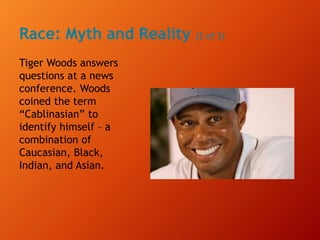
Tiger Woods answers
questions at a news
conference. Woods
coined the term
“Cablinasian” to
identify himself – a
combination of
Caucasian, Black,
Indian, and Asian.
Race: Myth and Reality (3 of 3)
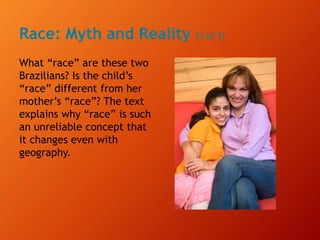
What “race” are these two
Brazilians? Is the child’s
“race” different from her
mother’s “race”? The text
explains why “race” is such
an unreliable concept that
it changes even with
geography.
Ethnic Groups (1 of 2)
• Ethnicity
• Shared cultural characteristics
• Derived from the word ethnos (Greek word meaning
“people” or “nation”)
Ethnic Groups (2 of 2)
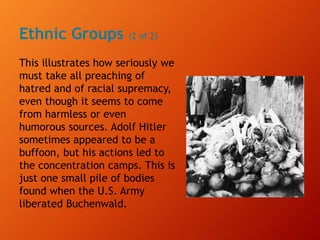
This illustrates how seriously we
must take all preaching of
hatred and of racial supremacy,
even though it seems to come
from harmless or even
humorous sources. Adolf Hitler
sometimes appeared to be a
buffoon, but his actions led to
the concentration camps. This is
just one small pile of bodies
found when the U.S. Army
liberated Buchenwald.
Minority Groups and Dominant Groups
(1 of 2)
• Dominance and discrimination versus size
• Emergence of minority groups
• Expanding political boundaries
• Migration
Minority Groups and Dominant Groups
(2 of 2)
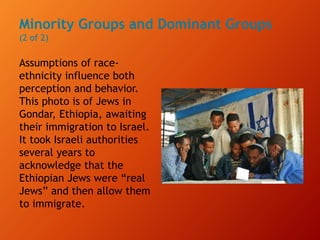
Assumptions of race-
ethnicity influence both
perception and behavior.
This photo is of Jews in
Gondar, Ethiopia, awaiting
their immigration to Israel.
It took Israeli authorities
several years to
acknowledge that the
Ethiopian Jews were “real
Jews” and then allow them
to immigrate.
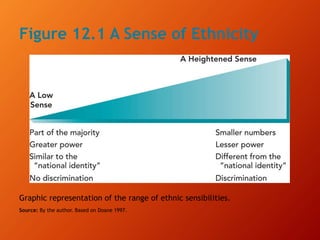
Figure 12.1 A Sense of Ethnicity
Graphic representation of the range of ethnic sensibilities.
Source: By the author. Based on Doane 1997.
Ethnic Work: Constructing Our Racial-Ethnic
Identity (1 of 3)
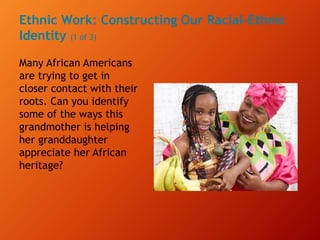
Many African Americans
are trying to get in
closer contact with their
roots. Can you identify
some of the ways this
grandmother is helping
her granddaughter
appreciate her African
heritage?
Ethnic Work: Constructing Our Racial-Ethnic
Identity (2 of 3)
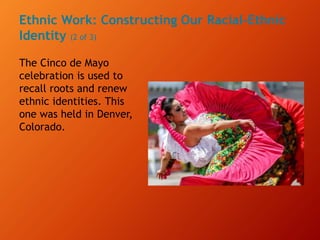
The Cinco de Mayo
celebration is used to
recall roots and renew
ethnic identities. This
one was held in Denver,
Colorado.
Ethnic Work: Constructing Our Racial-Ethnic
Identity (3 of 3)
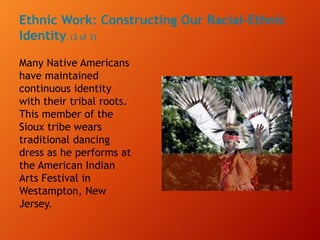
Many Native Americans
have maintained
continuous identity
with their tribal roots.
This member of the
Sioux tribe wears
traditional dancing
dress as he performs at
the American Indian
Arts Festival in
Westampton, New
Jersey.
Prejudice and Discrimination (1 of 3)
12.2 Contrast prejudice and discrimination and individual and institutional discrimination;
discuss learning prejudice, internalizing dominant norms, and institutional discrimination.
• Learning Prejudice
• Distinguishing between prejudice and discrimination
• Learning prejudice from associating with others
• Internalizing dominant norms
• Individual and Institutional Prejudice
• Home mortgages
• Health care
Prejudice and Discrimination (2 of 3)
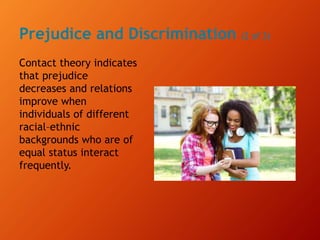
Contact theory indicates
that prejudice
decreases and relations
improve when
individuals of different
racial–ethnic
backgrounds who are of
equal status interact
frequently.
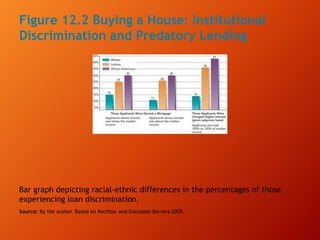
Figure 12.2 Buying a House: Institutional
Discrimination and Predatory Lending
Bar graph depicting racial-ethnic differences in the percentages of those
experiencing loan discrimination.
Source: By the author. Based on Kochbar and Gonzalez-Barrera 2009.
Prejudice and Discrimination (3 of 3)
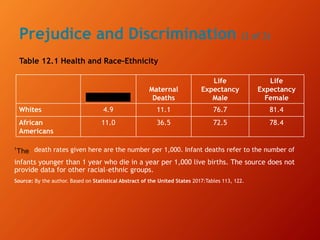
Table 12.1 Health and Race–Ethnicity
Blank
Infant deaths superscript 1
Maternal
Deaths
Life
Expectancy
Male
Life
Expectancy
Female
Whites 4.9 11.1 76.7 81.4
African
Americans
11.0 36.5 72.5 78.4
death rates given here are the number per 1,000. Infant deaths refer to the number of
infants younger than 1 year who die in a year per 1,000 live births. The source does not
provide data for other racial–ethnic groups.
Source: By the author. Based on Statistical Abstract of the United States 2017:Tables 113, 122.
1
Infant Deaths
1
The
Theories of Prejudice (1 of 2)
12.3 Contrast psychological and sociological theories of prejudice: include functionalism,
conflict, and symbolic interactionism
• Psychological Perspectives
• Frustration and scapegoats
• The authoritarian personality
• Sociological Perspectives
• Functionalism
• Conflict theory
• Symbolic interactionism
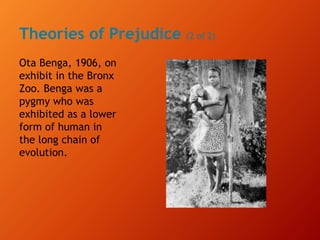
Theories of Prejudice (2 of 2)
Ota Benga, 1906, on
exhibit in the Bronx
Zoo. Benga was a
pygmy who was
exhibited as a lower
form of human in
the long chain of
evolution.
Global Patterns of Intergroup Relations (1 of 4)
12.4 Explain genocide, population transfer, internal colonialism, segregation, assimilation, and
multiculturalism.
• Genocide
• Population Transfer
• Internal Colonialism
• Segregation
• Assimilation
• Multiculturalism (Pluralism)
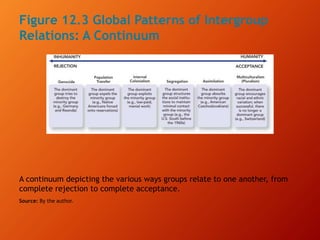
Figure 12.3 Global Patterns of Intergroup
Relations: A Continuum
A continuum depicting the various ways groups relate to one another, from
complete rejection to complete acceptance.
Source: By the author.
Global Patterns of Intergroup Relations (2 of 4)
• Genocide
• Labeling a group as inferior facilitates genocide
• Population transfer
• Indirect transfer
• Direct transfer
▪ Japanese Americans interned in “relocation
camps”
▪ Native Americans forced onto reservations
Global Patterns of Intergroup Relations (3 of 4)
• Internal colonialism
• Exploitation
• Segregation
• Separate and unequal
• Assimilation
• Forced assimilation
• Permissible assimilation
Global Patterns of Intergroup Relations (4 of 4)
• Multiculturalism (Pluralism)
• Example: Switzerland
Racial-Ethnic Relations in the U.S.
12.5 Summarize the major patterns that characterize European Americans, Latinos, African
Americans, Asian Americans, and Native Americans.
• European Americans
• Latinos (Hispanics)
• African Americans
• Asian Americans
• Native Americans
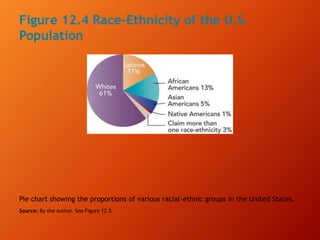
Figure 12.4 Race–Ethnicity of the U.S.
Population
Pie chart showing the proportions of various racial-ethnic groups in the United States.
Source: By the author. See Figure 12.5.
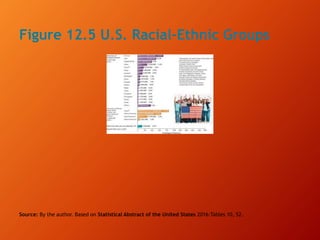
Figure 12.5 U.S. Racial–Ethnic Groups
Source: By the author. Based on Statistical Abstract of the United States 2016:Tables 10, 52.
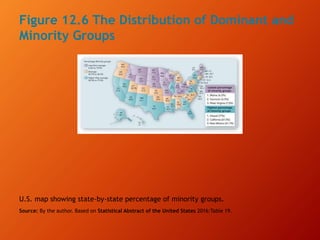
Figure 12.6 The Distribution of Dominant and
Minority Groups
U.S. map showing state-by-state percentage of minority groups.
Source: By the author. Based on Statistical Abstract of the United States 2016:Table 19.
European Americans
• WASPS
• White ethnics
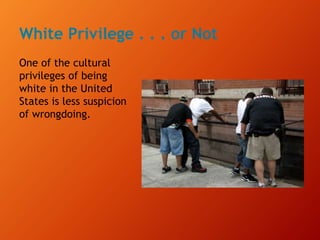
White Privilege . . . or Not
One of the cultural
privileges of being
white in the United
States is less suspicion
of wrongdoing.
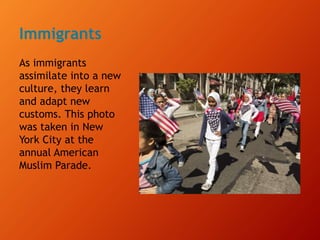
Immigrants
As immigrants
assimilate into a new
culture, they learn
and adapt new
customs. This photo
was taken in New
York City at the
annual American
Muslim Parade.
Latinos (Hispanics) (1 of 6)
• Umbrella term – Many countries of origin
• Key issues
• Unauthorized immigration
• Residence
• Language
• Economic well-being
• Politics
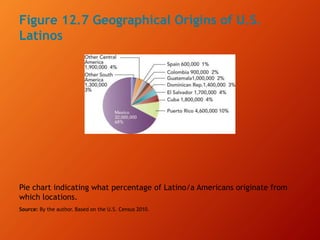
Figure 12.7 Geographical Origins of U.S.
Latinos
Pie chart indicating what percentage of Latino/a Americans originate from
which locations.
Source: By the author. Based on the U.S. Census 2010.
Latinos (Hispanics) (2 of 6)
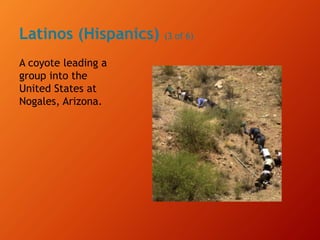
For millions of people,
the United States
represents a land of
opportunity and
freedom from
oppression. Shown here
are Cubans who
reached the United
States by transforming
their 1950s truck into a
boat.
Latinos (Hispanics) (3 of 6)
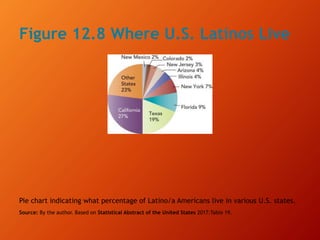
A coyote leading a
group into the
United States at
Nogales, Arizona.
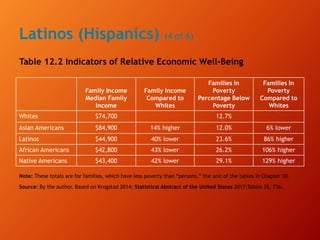
Figure 12.8 Where U.S. Latinos Live
Pie chart indicating what percentage of Latino/a Americans live in various U.S. states.
Source: By the author. Based on Statistical Abstract of the United States 2017:Table 19.
Latinos (Hispanics) (4 of 6)
Table 12.2 Indicators of Relative Economic Well-Being
Blank
Family Income
Median Family
Income
Family Income
Compared to
Whites
Families In
Poverty
Percentage Below
Poverty
Families In
Poverty
Compared to
Whites
Whites $74,700
Blank
12.7%
Blank
Asian Americans $84,900 14% higher 12.0% 6% lower
Latinos $44,900 40% lower 23.6% 86% higher
African Americans $42,800 43% lower 26.2% 106% higher
Native Americans $43,400 42% lower 29.1% 129% higher
Note: These totals are for families, which have less poverty than “persons,” the unit of the tables in Chapter 10.
Source: By the author. Based on Krogstad 2014; Statistical Abstract of the United States 2017:Tables 35, 736.
Latinos (Hispanics) (5 of 6)
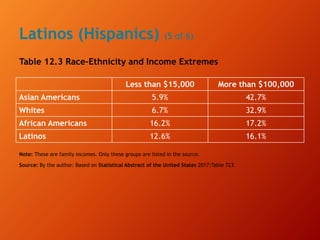
Table 12.3 Race–Ethnicity and Income Extremes
Blank
Less than $15,000 More than $100,000
Asian Americans 5.9% 42.7%
Whites 6.7% 32.9%
African Americans 16.2% 17.2%
Latinos 12.6% 16.1%
Note: These are family incomes. Only these groups are listed in the source.
Source: By the author: Based on Statistical Abstract of the United States 2017:Table 723.
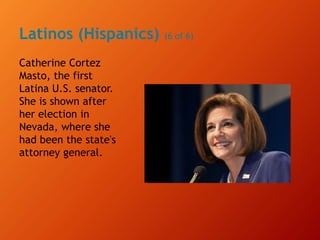
Latinos (Hispanics) (6 of 6)
Catherine Cortez
Masto, the first
Latina U.S. senator.
She is shown after
her election in
Nevada, where she
had been the state's
attorney general.
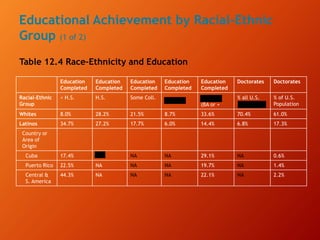
Educational Achievement by Racial-Ethnic
Group (1 of 2)
Table 12.4 Race–Ethnicity and Education
blank
Education
Completed
Education
Completed
Education
Completed
Education
Completed
Education
Completed
Doctorates Doctorates
Racial-Ethnic
Group
< H.S. H.S. Some Coll. Associate degree
College degree
(BA or +
% all U.S.
Doctorates 1
% of U.S.
Population
Whites 8.0% 28.2% 21.5% 8.7% 33.6% 70.4% 61.0%
Latinos 34.7% 27.2% 17.7% 6.0% 14.4% 6.8% 17.3%
Country or
Area of
Origin
Blank Blank Blank Blank Blank Blank Blank
Cuba 17.4% N A superscript 2
NA NA 29.1% NA 0.6%
Puerto Rico 22.5% NA NA NA 19.7% NA 1.4%
Central &
S. America
44.3% NA NA NA 22.1% NA 2.2%
2
NA
Assoc.° College°
1
Doctorates
Educational Achievement by Racial-Ethnic
Group (2 of 2)
Table 12.4 [continued]
blank
Education
Completed
Education
Completed
Education
Completed
Education
Completed
Education
Completed
Doctorates Doctorates
Racial-Ethnic
Group
< H.S. H.S. Some Coll. Associate degree
College degree
(BA or +
% all U.S.
Doctorates 1
% of U.S.
Population
Latinos
Country or
Area of Origin
Blank Blank Blank Blank Blank Blank Blank
Mexico 29.2% NA NA NA 10.5% NA 10.4%
African
Americans
15.6% 31.6% 25.1% 8.0% 19.7% 8.1% 13.2%
Asian
Americans
13.7% 15.5% 12.6% 6.7% 51.5% 12.3% 5.4%
Native
Americans
20.7% 31.9% 25.2% 8.4% 13.9% 0.6% 1.2%
after the doctorates awarded to nonresidents and those claiming two or more races are deducted from the total.
Source: By the author. Based on Statistical Abstract of the United States 2017:Tables 35, 36, 315, and Figure 12.5 of
this chapter.
Assoc.° College°
1
Doctorates
1
Percentage
2
Not Available.
African Americans (1 of 3)
• Jim Crow laws
• Rising expectations and civil strife
• Continued gains
• Current losses
• Race or social class? A sociological debate
• Racism as everyday burden
African Americans (2 of 3)
• Integrating the lunch counters
• Until the 1960s, the South’s public facilities were
segregated. Some were reserved for whites, others
for blacks. This apartheid was broken by blacks and
whites who worked together and risked their lives to
bring about a fairer society.
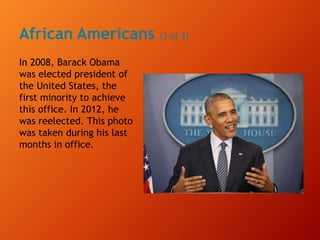
African Americans (3 of 3)
In 2008, Barack Obama
was elected president of
the United States, the
first minority to achieve
this office. In 2012, he
was reelected. This photo
was taken during his last
months in office.
Asian Americans
• Many countries of origin
• Key issues
• A background of discrimination
• Diversity
• Reasons for financial success
• Politics
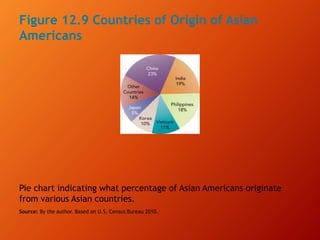
Figure 12.9 Countries of Origin of Asian
Americans
Pie chart indicating what percentage of Asian Americans originate
from various Asian countries.
Source: By the author. Based on U.S. Census Bureau 2010.
Native Americans (1 of 2)
• Much group diversity
• Key issues
• Treaties to population transfer/genocide
• Invisibility
• Self-determination
• Casinos
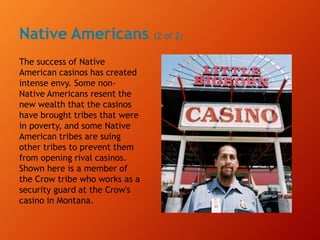
Native Americans (2 of 2)
The success of Native
American casinos has created
intense envy. Some non-
Native Americans resent the
new wealth that the casinos
have brought tribes that were
in poverty, and some Native
American tribes are suing
other tribes to prevent them
from opening rival casinos.
Shown here is a member of
the Crow tribe who works as a
security guard at the Crow's
casino in Montana.
Looking Toward the Future (1 of 2)
12.6 Discuss immigration, affirmative action, and a multicultural society
• The Immigration Debate
• Affirmative Action
• Toward a True Multicultural Society
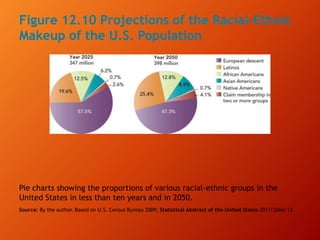
Figure 12.10 Projections of the Racial-Ethnic
Makeup of the U.S. Population
Pie charts showing the proportions of various racial-ethnic groups in the
United States in less than ten years and in 2050.
Source: By the author. Based on U.S. Census Bureau 2009; Statistical Abstract of the United States 2017:Table 13.
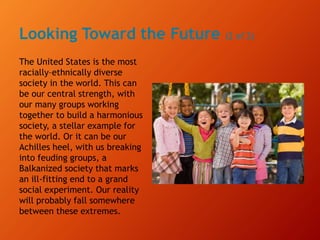
Looking Toward the Future (2 of 2)
The United States is the most
racially–ethnically diverse
society in the world. This can
be our central strength, with
our many groups working
together to build a harmonious
society, a stellar example for
the world. Or it can be our
Achilles heel, with us breaking
into feuding groups, a
Balkanized society that marks
an ill-fitting end to a grand
social experiment. Our reality
will probably fall somewhere
between these extremes.

Chapter 12 Lecture Notes.pptx

  • 1.
    Laying the SociologicalFoundation 12.1 Contrast the myth and reality of race; compare race and ethnicity and minority and dominant groups; discuss ethnic work. • Race: Myth and Reality • Ethnic Groups • Minority Groups and Dominant Groups • Ethnic Work: Constructing Our Racial-Ethnic Identity
  • 2.
    Race: Myth andReality (1 of 3) • Reality of Human Variety • The Myth of Pure Races • The Myth of a Fixed Number of Races • The Myth of Racial Superiority • The Myth Continues
  • 3.
    Race: Myth andReality (2 of 3) Tiger Woods answers questions at a news conference. Woods coined the term “Cablinasian” to identify himself – a combination of Caucasian, Black, Indian, and Asian.
  • 4.
    Race: Myth andReality (3 of 3) What “race” are these two Brazilians? Is the child’s “race” different from her mother’s “race”? The text explains why “race” is such an unreliable concept that it changes even with geography.
  • 5.
    Ethnic Groups (1of 2) • Ethnicity • Shared cultural characteristics • Derived from the word ethnos (Greek word meaning “people” or “nation”)
  • 6.
    Ethnic Groups (2of 2) This illustrates how seriously we must take all preaching of hatred and of racial supremacy, even though it seems to come from harmless or even humorous sources. Adolf Hitler sometimes appeared to be a buffoon, but his actions led to the concentration camps. This is just one small pile of bodies found when the U.S. Army liberated Buchenwald.
  • 7.
    Minority Groups andDominant Groups (1 of 2) • Dominance and discrimination versus size • Emergence of minority groups • Expanding political boundaries • Migration
  • 8.
    Minority Groups andDominant Groups (2 of 2) Assumptions of race- ethnicity influence both perception and behavior. This photo is of Jews in Gondar, Ethiopia, awaiting their immigration to Israel. It took Israeli authorities several years to acknowledge that the Ethiopian Jews were “real Jews” and then allow them to immigrate.
  • 9.
    Figure 12.1 ASense of Ethnicity Graphic representation of the range of ethnic sensibilities. Source: By the author. Based on Doane 1997.
  • 10.
    Ethnic Work: ConstructingOur Racial-Ethnic Identity (1 of 3) Many African Americans are trying to get in closer contact with their roots. Can you identify some of the ways this grandmother is helping her granddaughter appreciate her African heritage?
  • 11.
    Ethnic Work: ConstructingOur Racial-Ethnic Identity (2 of 3) The Cinco de Mayo celebration is used to recall roots and renew ethnic identities. This one was held in Denver, Colorado.
  • 12.
    Ethnic Work: ConstructingOur Racial-Ethnic Identity (3 of 3) Many Native Americans have maintained continuous identity with their tribal roots. This member of the Sioux tribe wears traditional dancing dress as he performs at the American Indian Arts Festival in Westampton, New Jersey.
  • 13.
    Prejudice and Discrimination(1 of 3) 12.2 Contrast prejudice and discrimination and individual and institutional discrimination; discuss learning prejudice, internalizing dominant norms, and institutional discrimination. • Learning Prejudice • Distinguishing between prejudice and discrimination • Learning prejudice from associating with others • Internalizing dominant norms • Individual and Institutional Prejudice • Home mortgages • Health care
  • 14.
    Prejudice and Discrimination(2 of 3) Contact theory indicates that prejudice decreases and relations improve when individuals of different racial–ethnic backgrounds who are of equal status interact frequently.
  • 15.
    Figure 12.2 Buyinga House: Institutional Discrimination and Predatory Lending Bar graph depicting racial-ethnic differences in the percentages of those experiencing loan discrimination. Source: By the author. Based on Kochbar and Gonzalez-Barrera 2009.
  • 16.
    Prejudice and Discrimination(3 of 3) Table 12.1 Health and Race–Ethnicity Blank Infant deaths superscript 1 Maternal Deaths Life Expectancy Male Life Expectancy Female Whites 4.9 11.1 76.7 81.4 African Americans 11.0 36.5 72.5 78.4 death rates given here are the number per 1,000. Infant deaths refer to the number of infants younger than 1 year who die in a year per 1,000 live births. The source does not provide data for other racial–ethnic groups. Source: By the author. Based on Statistical Abstract of the United States 2017:Tables 113, 122. 1 Infant Deaths 1 The
  • 17.
    Theories of Prejudice(1 of 2) 12.3 Contrast psychological and sociological theories of prejudice: include functionalism, conflict, and symbolic interactionism • Psychological Perspectives • Frustration and scapegoats • The authoritarian personality • Sociological Perspectives • Functionalism • Conflict theory • Symbolic interactionism
  • 18.
    Theories of Prejudice(2 of 2) Ota Benga, 1906, on exhibit in the Bronx Zoo. Benga was a pygmy who was exhibited as a lower form of human in the long chain of evolution.
  • 19.
    Global Patterns ofIntergroup Relations (1 of 4) 12.4 Explain genocide, population transfer, internal colonialism, segregation, assimilation, and multiculturalism. • Genocide • Population Transfer • Internal Colonialism • Segregation • Assimilation • Multiculturalism (Pluralism)
  • 20.
    Figure 12.3 GlobalPatterns of Intergroup Relations: A Continuum A continuum depicting the various ways groups relate to one another, from complete rejection to complete acceptance. Source: By the author.
  • 21.
    Global Patterns ofIntergroup Relations (2 of 4) • Genocide • Labeling a group as inferior facilitates genocide • Population transfer • Indirect transfer • Direct transfer ▪ Japanese Americans interned in “relocation camps” ▪ Native Americans forced onto reservations
  • 22.
    Global Patterns ofIntergroup Relations (3 of 4) • Internal colonialism • Exploitation • Segregation • Separate and unequal • Assimilation • Forced assimilation • Permissible assimilation
  • 23.
    Global Patterns ofIntergroup Relations (4 of 4) • Multiculturalism (Pluralism) • Example: Switzerland
  • 24.
    Racial-Ethnic Relations inthe U.S. 12.5 Summarize the major patterns that characterize European Americans, Latinos, African Americans, Asian Americans, and Native Americans. • European Americans • Latinos (Hispanics) • African Americans • Asian Americans • Native Americans
  • 25.
    Figure 12.4 Race–Ethnicityof the U.S. Population Pie chart showing the proportions of various racial-ethnic groups in the United States. Source: By the author. See Figure 12.5.
  • 26.
    Figure 12.5 U.S.Racial–Ethnic Groups Source: By the author. Based on Statistical Abstract of the United States 2016:Tables 10, 52.
  • 27.
    Figure 12.6 TheDistribution of Dominant and Minority Groups U.S. map showing state-by-state percentage of minority groups. Source: By the author. Based on Statistical Abstract of the United States 2016:Table 19.
  • 28.
  • 29.
    White Privilege .. . or Not One of the cultural privileges of being white in the United States is less suspicion of wrongdoing.
  • 30.
    Immigrants As immigrants assimilate intoa new culture, they learn and adapt new customs. This photo was taken in New York City at the annual American Muslim Parade.
  • 31.
    Latinos (Hispanics) (1of 6) • Umbrella term – Many countries of origin • Key issues • Unauthorized immigration • Residence • Language • Economic well-being • Politics
  • 32.
    Figure 12.7 GeographicalOrigins of U.S. Latinos Pie chart indicating what percentage of Latino/a Americans originate from which locations. Source: By the author. Based on the U.S. Census 2010.
  • 33.
    Latinos (Hispanics) (2of 6) For millions of people, the United States represents a land of opportunity and freedom from oppression. Shown here are Cubans who reached the United States by transforming their 1950s truck into a boat.
  • 34.
    Latinos (Hispanics) (3of 6) A coyote leading a group into the United States at Nogales, Arizona.
  • 35.
    Figure 12.8 WhereU.S. Latinos Live Pie chart indicating what percentage of Latino/a Americans live in various U.S. states. Source: By the author. Based on Statistical Abstract of the United States 2017:Table 19.
  • 36.
    Latinos (Hispanics) (4of 6) Table 12.2 Indicators of Relative Economic Well-Being Blank Family Income Median Family Income Family Income Compared to Whites Families In Poverty Percentage Below Poverty Families In Poverty Compared to Whites Whites $74,700 Blank 12.7% Blank Asian Americans $84,900 14% higher 12.0% 6% lower Latinos $44,900 40% lower 23.6% 86% higher African Americans $42,800 43% lower 26.2% 106% higher Native Americans $43,400 42% lower 29.1% 129% higher Note: These totals are for families, which have less poverty than “persons,” the unit of the tables in Chapter 10. Source: By the author. Based on Krogstad 2014; Statistical Abstract of the United States 2017:Tables 35, 736.
  • 37.
    Latinos (Hispanics) (5of 6) Table 12.3 Race–Ethnicity and Income Extremes Blank Less than $15,000 More than $100,000 Asian Americans 5.9% 42.7% Whites 6.7% 32.9% African Americans 16.2% 17.2% Latinos 12.6% 16.1% Note: These are family incomes. Only these groups are listed in the source. Source: By the author: Based on Statistical Abstract of the United States 2017:Table 723.
  • 38.
    Latinos (Hispanics) (6of 6) Catherine Cortez Masto, the first Latina U.S. senator. She is shown after her election in Nevada, where she had been the state's attorney general.
  • 39.
    Educational Achievement byRacial-Ethnic Group (1 of 2) Table 12.4 Race–Ethnicity and Education blank Education Completed Education Completed Education Completed Education Completed Education Completed Doctorates Doctorates Racial-Ethnic Group < H.S. H.S. Some Coll. Associate degree College degree (BA or + % all U.S. Doctorates 1 % of U.S. Population Whites 8.0% 28.2% 21.5% 8.7% 33.6% 70.4% 61.0% Latinos 34.7% 27.2% 17.7% 6.0% 14.4% 6.8% 17.3% Country or Area of Origin Blank Blank Blank Blank Blank Blank Blank Cuba 17.4% N A superscript 2 NA NA 29.1% NA 0.6% Puerto Rico 22.5% NA NA NA 19.7% NA 1.4% Central & S. America 44.3% NA NA NA 22.1% NA 2.2% 2 NA Assoc.° College° 1 Doctorates
  • 40.
    Educational Achievement byRacial-Ethnic Group (2 of 2) Table 12.4 [continued] blank Education Completed Education Completed Education Completed Education Completed Education Completed Doctorates Doctorates Racial-Ethnic Group < H.S. H.S. Some Coll. Associate degree College degree (BA or + % all U.S. Doctorates 1 % of U.S. Population Latinos Country or Area of Origin Blank Blank Blank Blank Blank Blank Blank Mexico 29.2% NA NA NA 10.5% NA 10.4% African Americans 15.6% 31.6% 25.1% 8.0% 19.7% 8.1% 13.2% Asian Americans 13.7% 15.5% 12.6% 6.7% 51.5% 12.3% 5.4% Native Americans 20.7% 31.9% 25.2% 8.4% 13.9% 0.6% 1.2% after the doctorates awarded to nonresidents and those claiming two or more races are deducted from the total. Source: By the author. Based on Statistical Abstract of the United States 2017:Tables 35, 36, 315, and Figure 12.5 of this chapter. Assoc.° College° 1 Doctorates 1 Percentage 2 Not Available.
  • 41.
    African Americans (1of 3) • Jim Crow laws • Rising expectations and civil strife • Continued gains • Current losses • Race or social class? A sociological debate • Racism as everyday burden
  • 42.
    African Americans (2of 3) • Integrating the lunch counters • Until the 1960s, the South’s public facilities were segregated. Some were reserved for whites, others for blacks. This apartheid was broken by blacks and whites who worked together and risked their lives to bring about a fairer society.
  • 43.
    African Americans (3of 3) In 2008, Barack Obama was elected president of the United States, the first minority to achieve this office. In 2012, he was reelected. This photo was taken during his last months in office.
  • 44.
    Asian Americans • Manycountries of origin • Key issues • A background of discrimination • Diversity • Reasons for financial success • Politics
  • 45.
    Figure 12.9 Countriesof Origin of Asian Americans Pie chart indicating what percentage of Asian Americans originate from various Asian countries. Source: By the author. Based on U.S. Census Bureau 2010.
  • 46.
    Native Americans (1of 2) • Much group diversity • Key issues • Treaties to population transfer/genocide • Invisibility • Self-determination • Casinos
  • 47.
    Native Americans (2of 2) The success of Native American casinos has created intense envy. Some non- Native Americans resent the new wealth that the casinos have brought tribes that were in poverty, and some Native American tribes are suing other tribes to prevent them from opening rival casinos. Shown here is a member of the Crow tribe who works as a security guard at the Crow's casino in Montana.
  • 48.
    Looking Toward theFuture (1 of 2) 12.6 Discuss immigration, affirmative action, and a multicultural society • The Immigration Debate • Affirmative Action • Toward a True Multicultural Society
  • 49.
    Figure 12.10 Projectionsof the Racial-Ethnic Makeup of the U.S. Population Pie charts showing the proportions of various racial-ethnic groups in the United States in less than ten years and in 2050. Source: By the author. Based on U.S. Census Bureau 2009; Statistical Abstract of the United States 2017:Table 13.
  • 50.
    Looking Toward theFuture (2 of 2) The United States is the most racially–ethnically diverse society in the world. This can be our central strength, with our many groups working together to build a harmonious society, a stellar example for the world. Or it can be our Achilles heel, with us breaking into feuding groups, a Balkanized society that marks an ill-fitting end to a grand social experiment. Our reality will probably fall somewhere between these extremes.

Editor's Notes

  • #10 "The figure shows a scale going from small to high. The small end shows the factors contributing to a low sense of ethnicity and the tall end shows the factors contributing a heightened sense of ethnicity. • Factors contributing to a low sense of ethnicity o Part of the majority o Greater power o Similar to the “national identity” o No discrimination • Factors contributing a heightened sense of ethnicity o Smaller numbers o Lesser power o Different from the “national identity” o Discrimination "
  • #16 "The details of the graph are as follows: The y-axis shows the percentage of people starting from 0 to 45 in increments of 5. The x-axis shows the categories of people including Whites, Latinos, and African Americans. The graph shows the following results: • Percentage of applicants that were denied mortgage o Applicants whose income was below the median income  Whites: 15 percent  Latinos: 25 percent  African Americans: 30 percent o Applicants whose income was above the median income  Whites: 11 percent  Latinos: 26 percent  African Americans: 30 percent • Applicants Were Charged Higher Interest (given subprime loans) o Applicants who had 100 percent to 120 percent of median income  Whites: 14 percent  Latinos: 36 percent  African Americans: 43 percent"
  • #21  "The details of the table are as follows: The continuum shows inhumanity and rejection at the left end and humanity and acceptance on the right end. The following list shows the aspects from left to right. • Genocide: The dominant group tries to destroy the minority group (e.g., Germany and Rwanda) • Population Transfer: The dominant group expels the minority group (e.g., Native Americans forced onto reservations) • Internal Colonialism: The dominant group exploits the minority group (e.g., low-paid, menial work) • Segregation: The dominant group structures the social institutions to maintain minimal contact with the minority group (e.g., the U.S. South before the 1960s) • Assimilation: The dominant group absorbs the minority group (e.g., American Czechoslovakians) • Multiculturalism (Pluralism): The dominant group encourages racial and ethnic variation; when successful, there is no longer a dominant group (e.g., Switzerland)"
  • #26 "The pie chart shows the following results: • Whites: 61 percent • Latinos: 17 percent • African American: 13 percent • Asian Americans: 5 percent • Native Americans: 1 percent • Claim more than one race: 3 percent"
  • #27 An image next to it shows people of different ethnicities holding the American flag. "The details of the figure are as follows: • Overall Total: 324,713,000 • Americans of European Descent: 197,871,000; 60.9 percent o German: 46,163,000; 14.2 percent o Irish: 33,348,000; 10.3 percent. Interestingly, this total is seven times higher than all the Irish who live in Ireland. o English/British: 25,785,000; 7.9 percent o Italian: 17,222,000; 5.3 percent o French: 10,329,000; 3.2 percent. Includes French-Canadian. o Polish: 9,383,000; 2.9 percent o Scottish: 8,287,000; 2.6 percent. Includes “Scotch-Irish.” o Norwegian: 4,484,000; 1.4 percent o Dutch: 4,272,000; 1.3 percent o Swedish: 3,913,000; 1.2 percent o Russian: 2,845,000; 0.9 percent o Welsh: 1,777,000; 0.5 percent o Czech: 1,441,000; 0.4 percent o Hungarian: 1,438,000; 0.4 percent o Portuguese: 1,374,000; 0.4 percent o Danish: 1,311,000; 0.4 percent o Greek: 1,265,000; 04 percent o Others: 23,234,000; 7.2 percent • Americans of African, Asian, North, Central, and South American Descent: 118,846,000; 36.6 percent o Latino: 55,388,000; 17.0 percent. Most Latinos trace at least part of their ancestry to Europe. o African American: 42,158,000; 13.0 percent o Asian Americans: 17,339,000; 5.3 percent. In descending order, the largest groups of Asian Americans are from China, India, the Philippines, Vietnam, Korea, and Japan. See Figure 12.9. Also includes those who identify themselves as Native Hawaiian or Pacific Islander. o Native American: 3,961,000; 1.2 percent. Includes Native Alaskan. • Claim more than one race-ethnicity: 7,996,000; 2.5 percent Overall Total: 324,713,000. The source comes up with various overall totals of the U.S. population."
  • #28 The details of the map are as follows: Percentage Minority groups • Less than average: 6.2 percent to 19.9 percent o MT: 13.7% o WY: 15.9% o ND: 13.4% o SD: 17.0% o NE: 19.5% o MN: 18.6% o IA: 12.9% o WI: 17.8% o IN: 19.7% o KY: 14.6% o OH: 19.9% o MO: 19.9% o WV: 7.5% o VT: 6.5% o ME: 6.2% o NH: 8.7% • Average: 20.7 percent to 36.3 percent o ID: 17.2% o CO: 31.0% o KS: 23.2% o OK: 33.0% o WA: 29.6% o OR: 23.0% o UT: 20.7% o AR: 26.6% o TN: 25.4% o AL: 33.8% o NC: 35.9% o SC: 36.1% o MI: 24.2% o PA: 22.1% o RI: 25.5% o CT: 31.2% o DE: 36.3% • Higher than average: 36.9 percent to 77.0 percent o AZ: 43.8% o NM: 61.1% o TX: 56.5% o NV: 48.5% o CA: 61.5% o LA: 40.7% o MS: 42.7% o GA: 45.7% o FL: 44.2% o IL: 37.7% o VA: 36.9% o NJ: 43.2% o NY: 43.5% o AK: 38.1% o HI: 77% Lowest percentage of minority groups 1. Maine: 6.2% 2. Vermont: 6.5% 3. West Virginia: 7.5% Highest percentage of minority groups 1. Hawaii: 77% 2. California: 61.5% 3. New Mexico: 61.1%
  • #33 "The details of the pie chart are as follows: • Mexico: 32,000,000; 68 percent • Spain: 600,000; 1 percent • Colombia: 900,000; 2 percent • Guatemala: 1,000,000; 2 percent • Dominican Rep.: 1,400,000; 3 percent • El Salvador: 1,700,000; 4 percent • Cuba: 1,800,000; 4 percent • Puerto Rico: 4,600,000; 10 percent • Other Central America: 1,900,000; 4 percent • Other South America: 1,300,000; 3 percent"
  • #36 "The details of the graph are as follows: • California: 27 percent • Texas: 19 percent • Florida: 9 percent • New York: 7 percent • Illinois: 4 percent • Arizona: 4 percent • New Jersey: 3 percent • Colorado: 2 percent • New Mexico: 2 percent • Other states: 23 percent"
  • #50 "1. Projections of the racial–ethnic makeup of the U.S. population in 2025 • European descent: 57.5 percent • Latinos: 19.6 percent • African Americans: 12.5 percent • Asian Americans: 6.2 percent • Native Americans: 0.7 percent • Claim membership in two or more groups: 2.6 percent 2. Projections of the racial–ethnic makeup of the U.S. population in 2050 • European descent: 47.3 percent • Latinos: 25.4 percent • African Americans: 12.8 percent • Asian Americans: 8.4 percent • Native Americans: 0.7 percent • Claim membership in two or more groups: 4.1 percent."