Our Perception is Our Reality

                 By
           Lisa Polydoros
            Speech 104
         Professor Marteney
There is more to life
than what we perceive
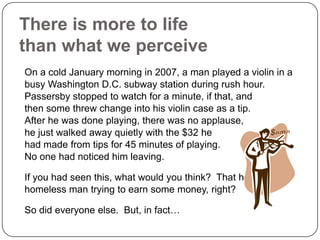
On a cold January morning in 2007, a man played a violin in a
busy Washington D.C. subway station during rush hour.
Passersby stopped to watch for a minute, if that, and
then some threw change into his violin case as a tip.
After he was done playing, there was no applause,
he just walked away quietly with the $32 he
had made from tips for 45 minutes of playing.
No one had noticed him leaving.

If you had seen this, what would you think? That he is a
homeless man trying to earn some money, right?

So did everyone else. But, in fact…
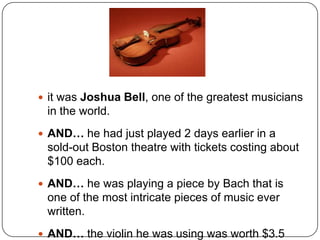
 it was Joshua Bell, one of the greatest musicians
 in the world.
 AND… he had just played 2 days earlier in a
 sold-out Boston theatre with tickets costing about
 $100 each.
 AND… he was playing a piece by Bach that is
 one of the most intricate pieces of music ever
 written.
 AND… the violin he was using was worth $3.5
Consider this…

 What else might we be missing everyday?

 My Perception, is my REALITY. Your perception
 is your REALITY.

 We either place value on things to give them
 value, or do not place value on things and then
 they have no value.
What is YOUR
Perception?

 No 2 people perceive the same situation exactly
 the same way

 We each take different meanings from different
 environmental messages everyday

 We each use the perception process to
 accomplish this
The Perception
Process

 First – we select data from the environment using
 our senses and filter out the rest

 Second – we sort the information by organizing and
 prioritizing according to our uniquely individual past
 experiences

 Third – we interpret the data by assigning meaning
 to it based on our past experience
Recognizing
Data:
We recognize data:

 Psychologically – by our mood and state of
 mind

 Physically – by our physical condition
 (senses, age, health, fatigue, hunger, etc.)
Organizing
Data:

 Language helps us organize data
   The more limited our vocabulary, the more limited
   our reality
Factors that Influence
how we interpret data
 Formal learning teaches us the socially correct
    view of our environment.
   Experiences are informal learning occurrences.
   Expectations are perceptions that we expect to
    conform to.
   Closure is making sense out of data and filling in
    missing information if necessary.
   Selective Perception is using heuristics as
    mental shortcuts to interpret the environment.
   Patterning uses new perceptions to reinforce our
    current reality to avoid cognitive dissonance.
Reality
Testing

 Reality Testing is necessary to narrow the
 differences in perceptions between people.

 It is necessary to realize that each person’s
 interpretation of a perception is not fact.
Reality
Testing
 Communication narrows the gap between
 people’s perceptions.
  comparing realities lets us know if our perceptions
   are reasonable
  examining a variety of realities might lead to the
   discovery of a more accurate reality
  reevaluate your data if your reality cannot be
   validated by others
  be sure to compare realities with a variety of
   people, not just those who are like-minded
Reality
Testing
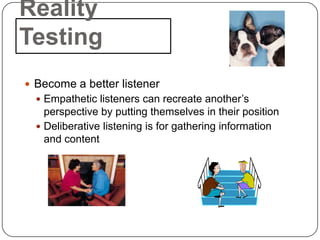
 Become a better listener
   Empathetic listeners can recreate another’s
    perspective by putting themselves in their position
   Deliberative listening is for gathering information
    and content
Stati
s
 We all want a reality we are comfortable with

 Statis is a reality on a particular subject
    it is the absence of change in one more realities for an
     extended period of time
    it is the existing state of things
    it is physical and/or emotional contentment
    it is our comfort zone

 We perceive the world according to our stasis

 We defend our reality as being the most accurate

Our perception is our reality crit thinking

  • 1.
    Our Perception isOur Reality By Lisa Polydoros Speech 104 Professor Marteney
  • 2.
    There is moreto life than what we perceive On a cold January morning in 2007, a man played a violin in a busy Washington D.C. subway station during rush hour. Passersby stopped to watch for a minute, if that, and then some threw change into his violin case as a tip. After he was done playing, there was no applause, he just walked away quietly with the $32 he had made from tips for 45 minutes of playing. No one had noticed him leaving. If you had seen this, what would you think? That he is a homeless man trying to earn some money, right? So did everyone else. But, in fact…
  • 3.
     it wasJoshua Bell, one of the greatest musicians in the world.  AND… he had just played 2 days earlier in a sold-out Boston theatre with tickets costing about $100 each.  AND… he was playing a piece by Bach that is one of the most intricate pieces of music ever written.  AND… the violin he was using was worth $3.5
  • 4.
    Consider this…  Whatelse might we be missing everyday?  My Perception, is my REALITY. Your perception is your REALITY.  We either place value on things to give them value, or do not place value on things and then they have no value.
  • 5.
    What is YOUR Perception? No 2 people perceive the same situation exactly the same way  We each take different meanings from different environmental messages everyday  We each use the perception process to accomplish this
  • 6.
    The Perception Process  First– we select data from the environment using our senses and filter out the rest  Second – we sort the information by organizing and prioritizing according to our uniquely individual past experiences  Third – we interpret the data by assigning meaning to it based on our past experience
  • 7.
    Recognizing Data: We recognize data: Psychologically – by our mood and state of mind  Physically – by our physical condition (senses, age, health, fatigue, hunger, etc.)
  • 8.
    Organizing Data:  Language helpsus organize data  The more limited our vocabulary, the more limited our reality
  • 9.
    Factors that Influence howwe interpret data  Formal learning teaches us the socially correct view of our environment.  Experiences are informal learning occurrences.  Expectations are perceptions that we expect to conform to.  Closure is making sense out of data and filling in missing information if necessary.  Selective Perception is using heuristics as mental shortcuts to interpret the environment.  Patterning uses new perceptions to reinforce our current reality to avoid cognitive dissonance.
  • 10.
    Reality Testing  Reality Testingis necessary to narrow the differences in perceptions between people.  It is necessary to realize that each person’s interpretation of a perception is not fact.
  • 11.
    Reality Testing  Communication narrowsthe gap between people’s perceptions.  comparing realities lets us know if our perceptions are reasonable  examining a variety of realities might lead to the discovery of a more accurate reality  reevaluate your data if your reality cannot be validated by others  be sure to compare realities with a variety of people, not just those who are like-minded
  • 12.
    Reality Testing  Become abetter listener  Empathetic listeners can recreate another’s perspective by putting themselves in their position  Deliberative listening is for gathering information and content
  • 13.
    Stati s  We allwant a reality we are comfortable with  Statis is a reality on a particular subject  it is the absence of change in one more realities for an extended period of time  it is the existing state of things  it is physical and/or emotional contentment  it is our comfort zone  We perceive the world according to our stasis  We defend our reality as being the most accurate