MEDIA
LANGUAGE
Media
Language
• Media
• Media Language
• Types of Media Languages
2
Introduction
to Media
The term Media, which is the plural of medium, refers to the communication channels
through which we transmit news, music, movies, education, messages, and other Datas.
It includes physical and online newspapers and magazines, television, radio, telephone
and the Internet.
3
Media
Language
Every medium has its own ‘language’ – or combination of languages that it uses to
communicate meaning. Television, for example, uses verbal and written language
as well as the languages of moving images and sound. We call these ‘languages’
because they use familiar codes and conventions that are generally understood.
Particular kinds of music or camera angles may be used to signal particular
emotions, for example; a page of a newspaper or a sequence of shots in a film will
be put together using a certain kind of ‘grammar’. By analyzing these languages,
we can come to a better understanding of how media make meaning.
4
WHAT DOES
MEDIA
LANGUAGE
INVOLVE?
 Form
 Style
 Genre
 Conventions
 Narratives
5
Messages/Meanings
Example
6
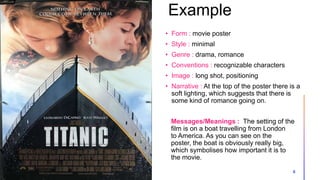
Messages/Meanings : The setting of the
film is on a boat travelling from London
to America. As you can see on the
poster, the boat is obviously really big,
which symbolises how important it is to
the movie.
• Form : movie poster
• Style : minimal
• Genre : drama, romance
• Conventions : recognizable characters
• Image : long shot, positioning
• Narrative : At the top of the poster there is a
soft lighting, which suggests that there is
some kind of romance going on.
TYPES OF
MEDIA
LANGUAGE
 Written Language
 Verbal Language
 Non – Verbal Language
 Visual Language
7
Written
Language
In print-based media, also in text such as captions for photographs.
The language chosen generates meaning. Captions allow the
publication to present a story in a particular way.
8
Verbal
Language
In media areas such as television, radio and film. How the language
is delivered and its context used are important factors in the way
meaning is generated for the audience.
9
Non Verbal
Language
Non-verbal language is communication through signs different from
those of language, but which can be received through various
senses, such as sight, smell or touch. This includes gestures,
movements, sounds that are not very intelligible but may be
understandable, etc.
10
Visual
Language
In televisions and films what is on the screen has been chosen
specifically to generate a series of effects and meanings. Specific
camera angles and movement are chosen to tell the story and
meaning of that scene.
11
THANK YOU
SAMPLE
FOOTER
TEXT
Presenter name
Email address
Website
12

Media language

  • 1.
  • 2.
    Media Language • Media • MediaLanguage • Types of Media Languages 2
  • 3.
    Introduction to Media The termMedia, which is the plural of medium, refers to the communication channels through which we transmit news, music, movies, education, messages, and other Datas. It includes physical and online newspapers and magazines, television, radio, telephone and the Internet. 3
  • 4.
    Media Language Every medium hasits own ‘language’ – or combination of languages that it uses to communicate meaning. Television, for example, uses verbal and written language as well as the languages of moving images and sound. We call these ‘languages’ because they use familiar codes and conventions that are generally understood. Particular kinds of music or camera angles may be used to signal particular emotions, for example; a page of a newspaper or a sequence of shots in a film will be put together using a certain kind of ‘grammar’. By analyzing these languages, we can come to a better understanding of how media make meaning. 4
  • 5.
    WHAT DOES MEDIA LANGUAGE INVOLVE?  Form Style  Genre  Conventions  Narratives 5 Messages/Meanings
  • 6.
    Example 6 Messages/Meanings : Thesetting of the film is on a boat travelling from London to America. As you can see on the poster, the boat is obviously really big, which symbolises how important it is to the movie. • Form : movie poster • Style : minimal • Genre : drama, romance • Conventions : recognizable characters • Image : long shot, positioning • Narrative : At the top of the poster there is a soft lighting, which suggests that there is some kind of romance going on.
  • 7.
    TYPES OF MEDIA LANGUAGE  WrittenLanguage  Verbal Language  Non – Verbal Language  Visual Language 7
  • 8.
    Written Language In print-based media,also in text such as captions for photographs. The language chosen generates meaning. Captions allow the publication to present a story in a particular way. 8
  • 9.
    Verbal Language In media areassuch as television, radio and film. How the language is delivered and its context used are important factors in the way meaning is generated for the audience. 9
  • 10.
    Non Verbal Language Non-verbal languageis communication through signs different from those of language, but which can be received through various senses, such as sight, smell or touch. This includes gestures, movements, sounds that are not very intelligible but may be understandable, etc. 10
  • 11.
    Visual Language In televisions andfilms what is on the screen has been chosen specifically to generate a series of effects and meanings. Specific camera angles and movement are chosen to tell the story and meaning of that scene. 11
  • 12.