






1
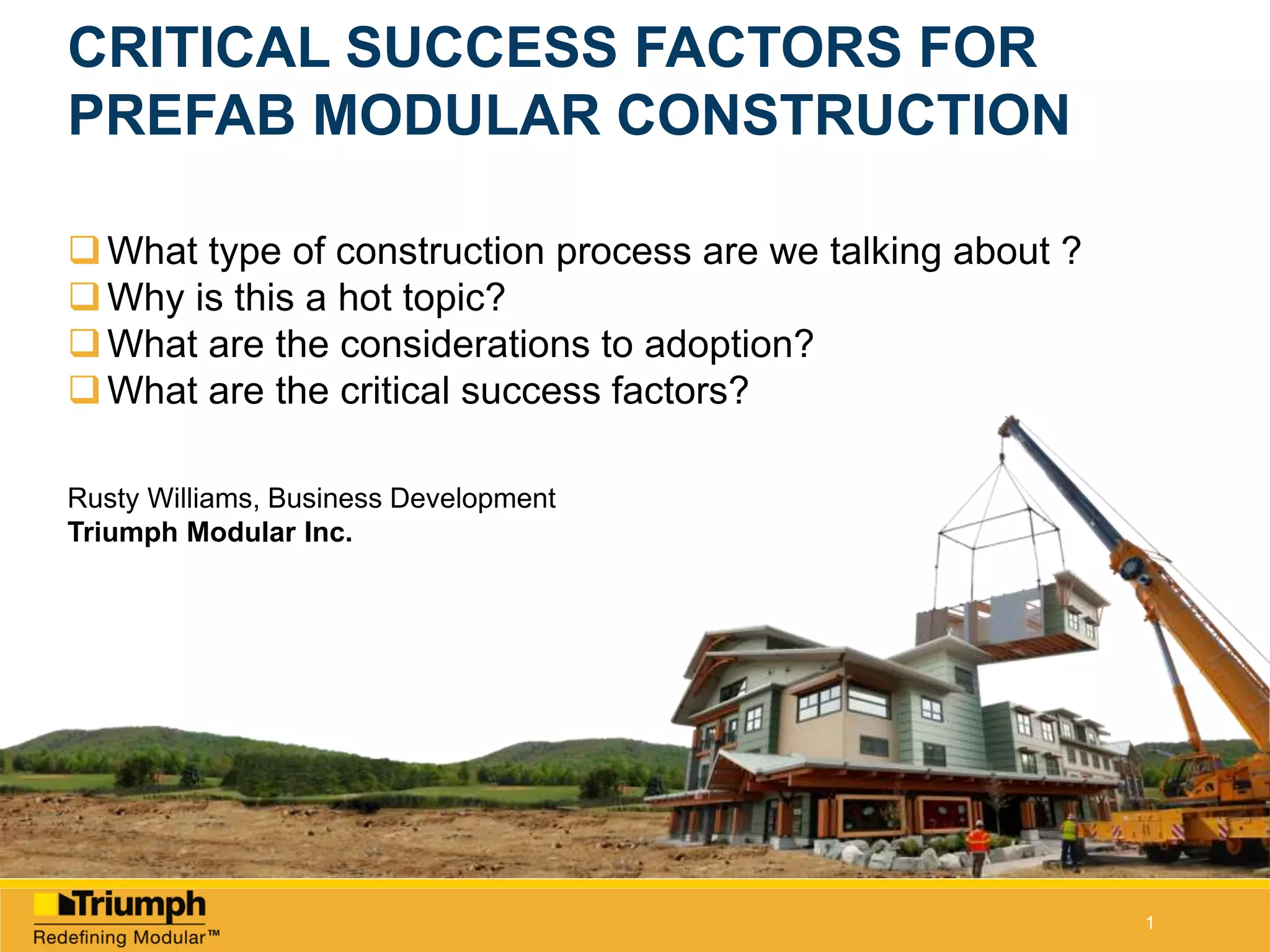
What type of construction process are we talking about ?
Why is this a hot topic?
What are the considerations to adoption?
What are the critical success factors?
Rusty Williams, Business Development
Triumph Modular Inc.
CRITICAL SUCCESS FACTORS FOR
MODULAR CONSTRUCTION
2
The Cocktail Conversation Challenge
What is it that
YOU do?
3
The Cocktail Conversation Challenge
4
Oh, Interesting…. Is that like... Uh…
5
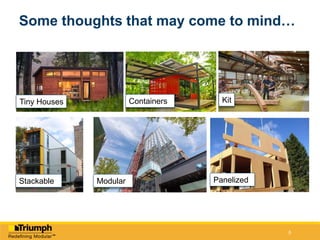
Some thoughts that may come to mind…
Tiny Houses Kit
Stackable Modular
Containers Kit
Panelized
6
Which is good….
Because they have a general idea
And bad…..
Because it’s confusing
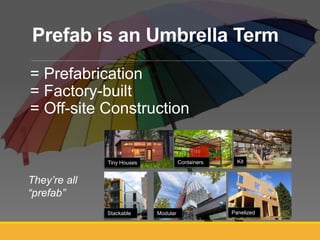
Prefab is an Umbrella Term
= Prefabrication
= Factory-built
= Off-site Construction
Tiny Houses
Stackable Modular
Containers Kit
Panelized
They’re all
“prefab”
8
9
They’re Different Styles & Techniques
Jazz
Folk
Classical Rock
10
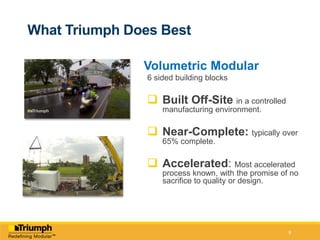
What Triumph Does Best
Volumetric Modular
6 sided building blocks
 Built Off-Site in a controlled
manufacturing environment.
 Near-Complete: typically over
65% complete.
 Accelerated: Most accelerated
process known, with the promise of no
sacrifice to quality or design.
11
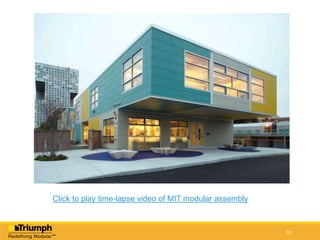
Click to play time-lapse video of MIT modular assembly
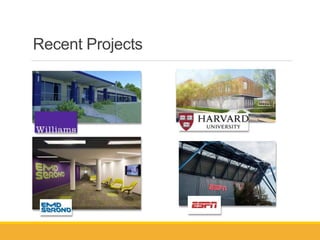
Recent Projects
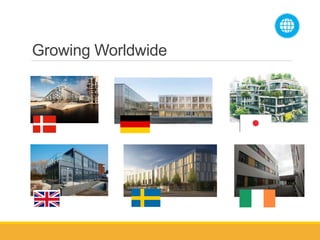
Growing Worldwide
14
Why Choose
Modular?
15
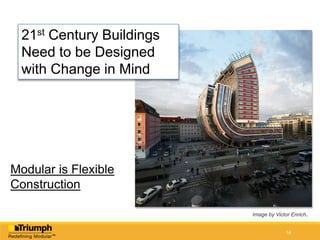
21st Century Buildings
Need to be Designed
with Change in Mind
Modular is Flexible
Construction
Image by Victor Enrich.
16
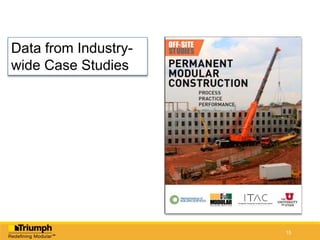
Data from Industry-
wide Case Studies
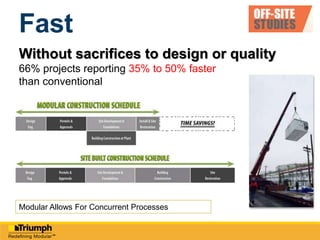
Fast
Without sacrifices to design or quality
66% projects reporting 35% to 50% faster
than conventional
Modular Allows For Concurrent Processes
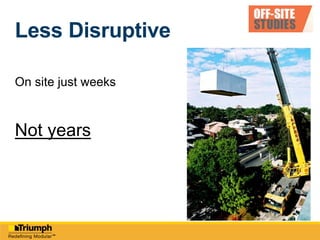
Less Disruptive
On site just weeks
Not years
Cases from the Off-Site Studies Report
demonstrate an average of 16% cost savings
compared to traditional construction.
 Greater control of cost
 Reduction in change orders
 “8% cost overruns over multiple projects over a
four year period due to Change Orders.”
Predictable Cost
19
“The reason for choosing off-site construction is not simply in cost
efficiency, but in precision of the construction and ability to control
and predict cost.” (NIBS Off Site 2014)
Safer
According to the Safety Management
in the Construction Industry
SmartMarket Report, "Firms using
prefabrication … have significantly
higher adoption levels of nearly all the
safety practices measured in the
survey.”
21
What’s Needed
To Become Mainstream?
22
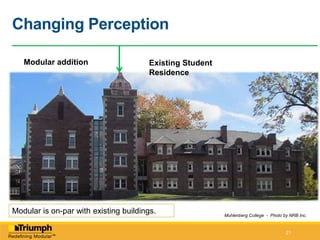
Changing Perception
Muhlenberg College - Photo by NRB Inc.
Modular addition Existing Student
Residence
Modular is on-par with existing buildings.
23
Approaching Modular as a
Specialized Technique / Style
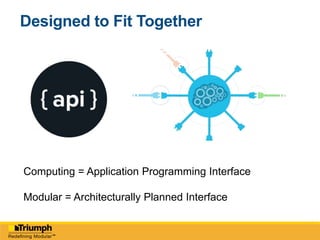
Designed to Fit Together
Computing = Application Programming Interface
Modular = Architecturally Planned Interface
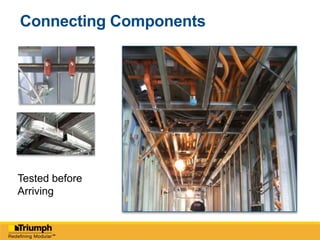
Connecting Components
Tested before
Arriving
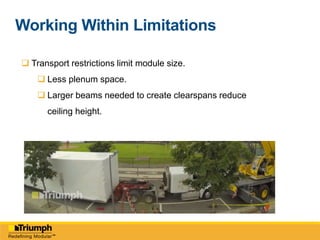
Working Within Limitations
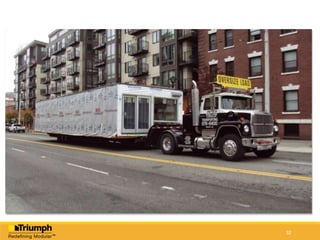
 Transport restrictions limit module size.
 Less plenum space.
 Larger beams needed to create clearspans reduce
ceiling height.
Critical Success Factors
 Commit to the concept early, owner and consults
 Speed requires intense coordination - Design build or
construction management forms of contracting
 Team member roles clearly understood, designer, factory,
engineers.
 Subcontractor Scopes of Work clear
 Architect works in close coordination with modular expert -
pull subs up into design process
27
28
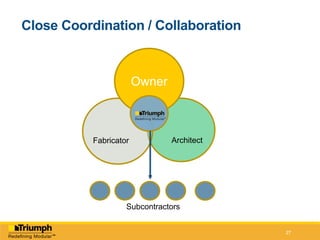
Owner
Fabricator Architect
Subcontractors
Close Coordination / Collaboration
29
 Fabricator Selection
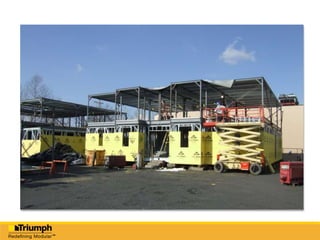
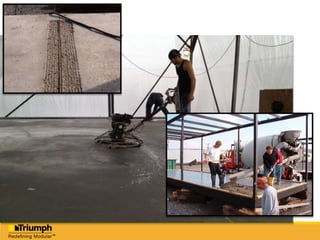
 Factory vs Field
 Transportation
 Permitting and Regulatory
Other important considerations:
30
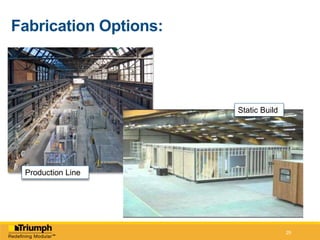
Fabrication Options:
Production Line
Static Build
33
Thank
you
for your
time
For follow up questions
please email
rwilliams@triumphmodular.com
34

Overview of Modular Construction

Editor's Notes

  • #3 Distant Cousin Challenge: What is it you do?
  • #4 Distant Cousin Challenge: What is it you do?
  • #5 Distant Cousin Challenge: What is it you do?
  • #6 Helped by trendiness and coverage in Dwell, Inhabitat and HGTV’s Tiny House show.
  • #10 While these are the same discipline – prefabricated buildings – they are very distinct styles and techniques.
  • #11 Many modular companies will use legos as a comparison. It’s appropriate because they click together to build amazing things. But for Volumetric, you need to imagine fully finished living spaces inside each lego. That’s what we do: move-in ready legos.
  • #12 Luckily with a few pictures and one video it’s easier to convey.
  • #16 We’ll get into some tangible metric in a minute, but at a higher level there’s a growing need to think of space as a flexible asset – able to adapt to changing needs. In fact Google referred to this as a “reconfigurable campus”
  • #17 60 companies interviewed. 17 Case studies All attendees of this webinar were sent the link to the “NIBS” report, National Institute of Building Sciences and the University of Utah. A year long study completed in April 2015. Over 66 companies interviewed by 8 researchers, 312 total survey respondents, 17 case studies nationwide. It was an important study the first of its kind undertaken by objective outside observers, Triumph was one of 9 sponsors of the report. The introduction on Page 5 cites : “Although conceptually strong .. The lack of research data on PMC has been identified as a barrier to its adoption” The study’s conclusions are overall favorable however there is one major theme or take away that corroborates what many of us practitioners have been experiencing as the largest limitation of permanent modular – that is, its requirement of so much collaboration up front. Procurement methods that learn toward driving the lowest cost and competion rather than collaborative methods of team formation and contracting – are a large barrier.
  • #19 Key consideration for educational institutions, tech companies, and buildings designed for relocation or “temporarily permanent” use – 5 to 15 years.
  • #23 Point to the slide Of course that is a part of what we are trying to do here today. The process is unique the process is different. Parties who are steeped in tradition of conventional ways of thinking will need to rethink – on that note let’s look at our first video.
  • #28  Design Assistance - Prior experience required. The Module Layout is factored in to the design, Module layout creates the most logical and cost effective way to achieve the desired outcome Module layout dictates design of the Foundation Controls routing based on dimensional limitations Access to and around the site – staging areas Mechanical designs – ceiling spaces Configuration to maximize construction off site. Final Design and Approvals are more time sensitive. Project schedules should establish a reasonable but finite time for final design development and decision making Decisions must be made early and modular footprint frozen Turnaround time for approvals is shorter Changes during fabrication are costly and can be avoided with more collaboration between stakeholders. Define and Delineate the Project Scope of Work During pre-bid phase establish a scope of work document that best suits the requirements of the stakeholders Clearly communicate to avoid scope creep/overlap or scope gaps
  • #29 Triumph is specialized GC with extensive experience coordinating modular projects with fabricators, architects, owners and subcontractors.