Modernisation of Curricula in HE – The SCL
approach
Dr. Evangelia (Lia) Krassadaki
Technical University of Crete, Production Engineering & Management School
TECHNICAL UNIVERSITY OF CRETE
PRODUCTION ENGINEERING & MANAGEMENT SCHOOL
Workshop of the students’ union BEST, “Local Event on Education – LEoE. Studies in the TUC:
Methods for Learning & Teaching”. Centre for Mediterranean Architecture, 18 February 2015,
Chania, Crete
Contents:
Student – Centred Learning (SCL)
Learning Outcomes (LOs)
Conclusions
Student – Centred Learning (SCL) [1]
• Student-Centred Learning represents both a mindset
and a culture within a given higher education
institution (HEI).
• It is a learning approach, which is broadly related to,
and supported by, constructuvist theories of learning.
• It is characterized by innovative methods of teaching,
which aim to promote learning.
• During SCL students are active participants for their
own learning, which support enhancement of
transferable skills such as problem-solving, critical
thinking and reflective thinking.
SCL ConclusionsLOs
Student – Centred Learning (SCL) [2]
SCL ConclusionsLOs
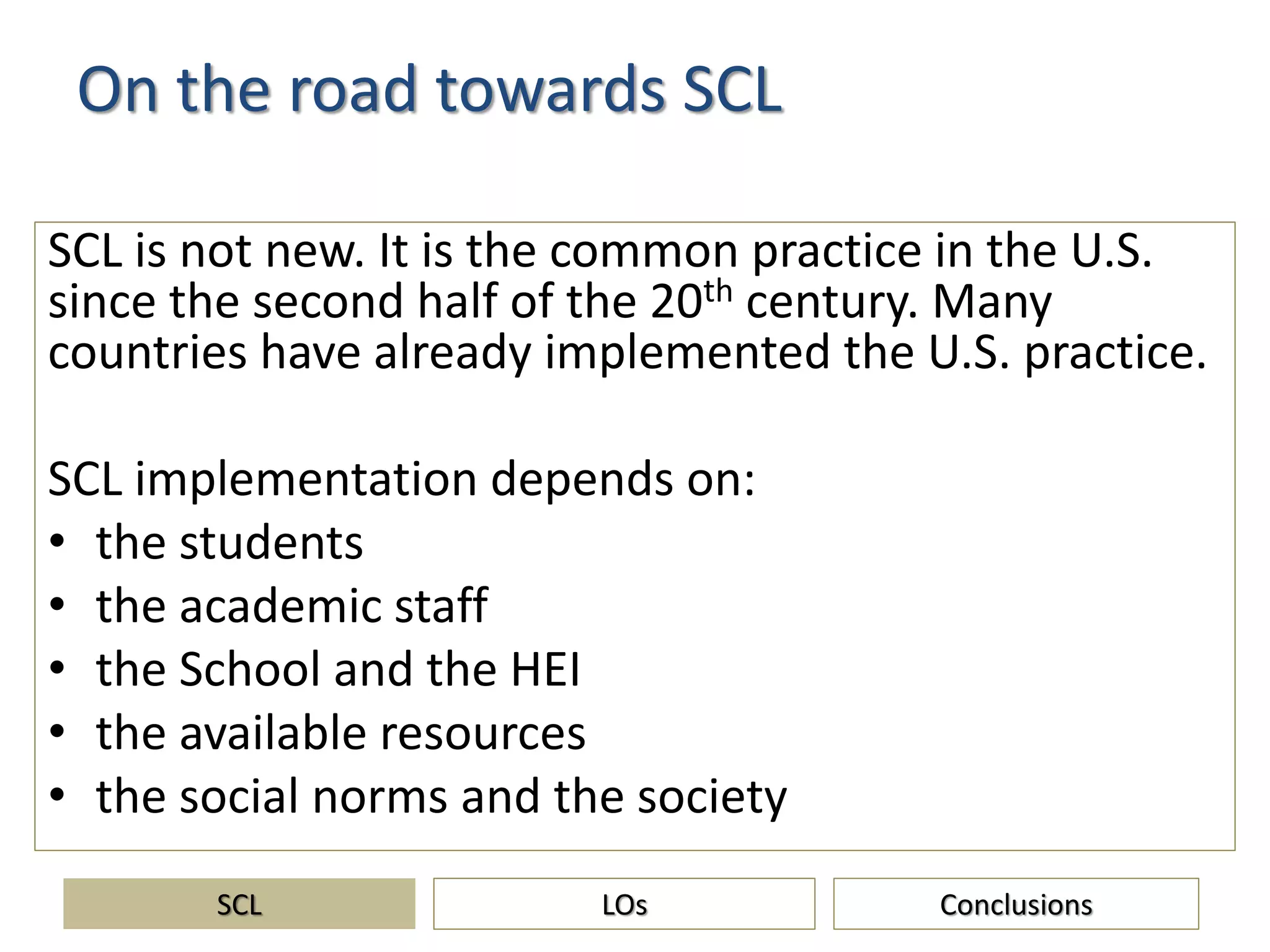
On the road towards SCL
SCL is not new. It is the common practice in the U.S.
since the second half of the 20th century. Many
countries have already implemented the U.S. practice.
SCL implementation depends on:
• the students
• the academic staff
• the School and the HEI
• the available resources
• the social norms and the society
SCL ConclusionsLOs
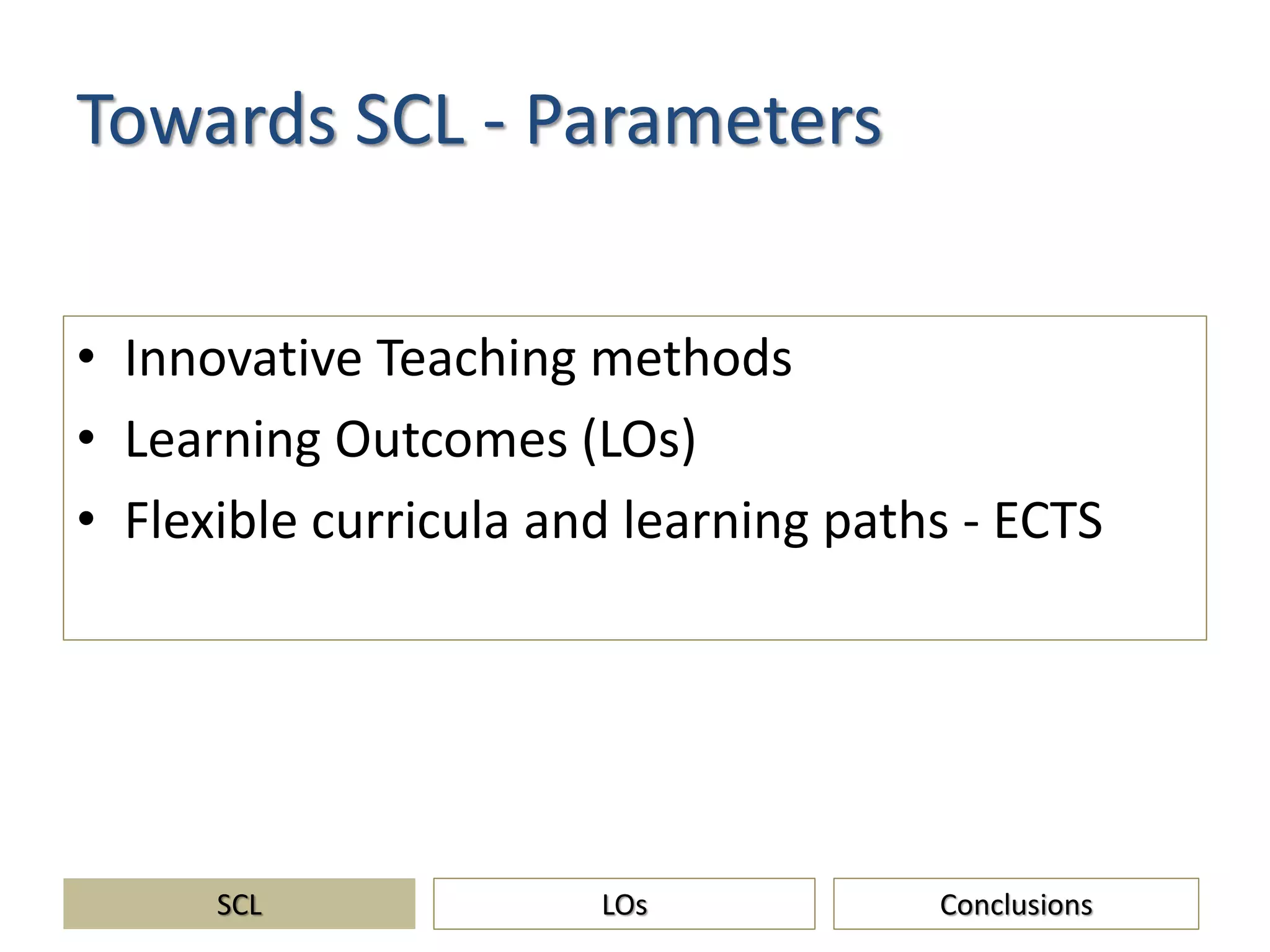
Towards SCL - Parameters
• Innovative Teaching methods
• Learning Outcomes (LOs)
• Flexible curricula and learning paths - ECTS
SCL ConclusionsLOs
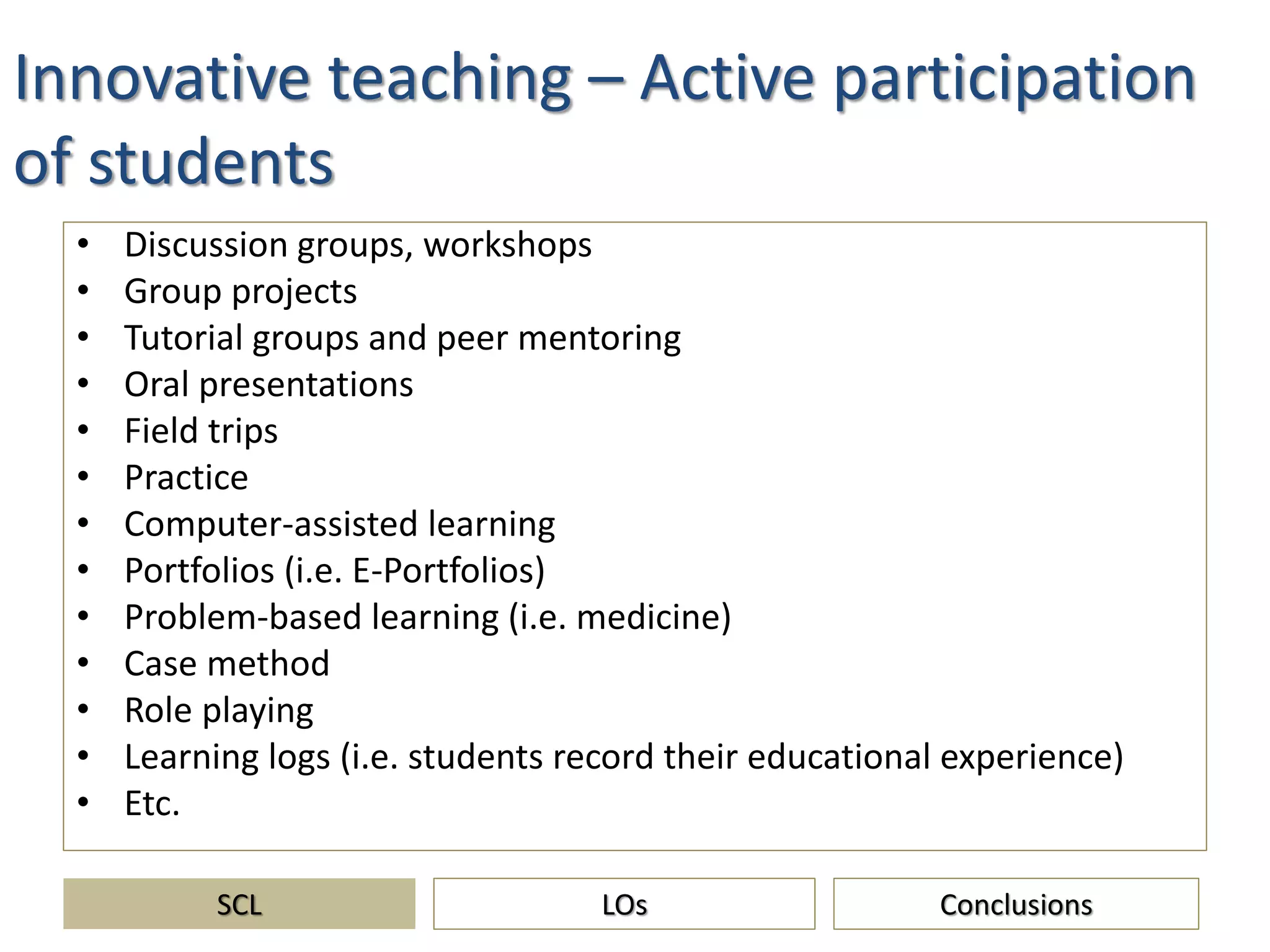
Innovative teaching – Active participation
of students
• Discussion groups, workshops
• Group projects
• Tutorial groups and peer mentoring
• Oral presentations
• Field trips
• Practice
• Computer-assisted learning
• Portfolios (i.e. E-Portfolios)
• Problem-based learning (i.e. medicine)
• Case method
• Role playing
• Learning logs (i.e. students record their educational experience)
• Etc.
SCL ConclusionsLOs
Innovative teaching – How [1]
• Minimize time spent for lecturing – enhance active
participation of ALL students.
• Offer experience – connect practice with learning.
• Make students aware of the value of what they are
doing in an applied situation.
• Create a trusting and learning environment.
• Make students aware of career paths available.
• Invite experts.
• Apply research to assess learning experience of
students (i.e. use formative assessment techniques).
SCL ConclusionsLOs
Innovative teaching – How [2]
• What to do: minimise time spent for lecturing,
insert all forms of media like graphics, sound, video,
etc., and insert classroom activities ensuring the
active participation of all students.
• Why: make learning process more attractive.
• How: active participation of students during the
lesson.
• Is it possible: yes, but it depends on the course.
• Is there a ‘norm’: no, the tutor has to choose among
various methods/techniques, either inside/outside
lectures.
SCL ConclusionsLOs
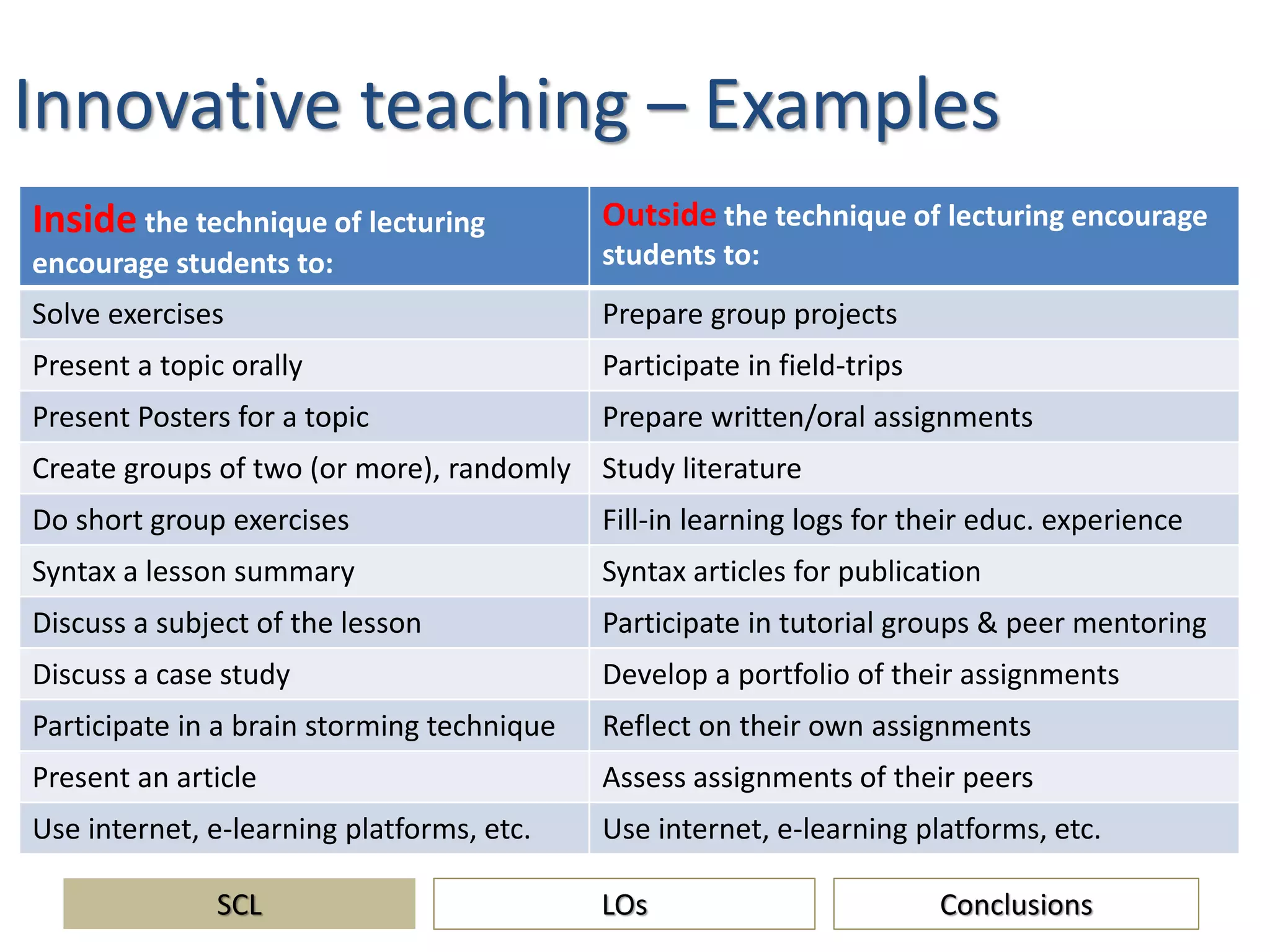
Innovative teaching – Examples
Inside the technique of lecturing
encourage students to:
Outside the technique of lecturing encourage
students to:
Solve exercises Prepare group projects
Present a topic orally Participate in field-trips
Present Posters for a topic Prepare written/oral assignments
Create groups of two (or more), randomly Study literature
Do short group exercises Fill-in learning logs for their educ. experience
Syntax a lesson summary Syntax articles for publication
Discuss a subject of the lesson Participate in tutorial groups & peer mentoring
Discuss a case study Develop a portfolio of their assignments
Participate in a brain storming technique Reflect on their own assignments
Present an article Assess assignments of their peers
Use internet, e-learning platforms, etc. Use internet, e-learning platforms, etc.
SCL ConclusionsLOs
Innovative teaching – Best practices
The case of KU Leuven, Engineering School.
• Course: Designing and Solving Engineering problems (a
project-based course), two semesters duration (1st & 2nd).
• Type of the course: mandatory for all engineering students,
multi-disciplinary course.
• Academic Staff: from all engineering faculties.
• Main Goal: (a) introduction in engineering science, (b) team-
working of students in short projects.
• Additional Goals: technical/academic writing, teamworking,
critical thinking, solving problems, creativity, use of basic ICT
tools, library skills, etc.
Heylen Ch., Vander Sloter J. (2013). A technical writing programme implemented in a first-year engineering
course at KU Leuven. European J. of Engineering Education, vol. 38 (6), pp. 595-607.
SCL ConclusionsLOs
12
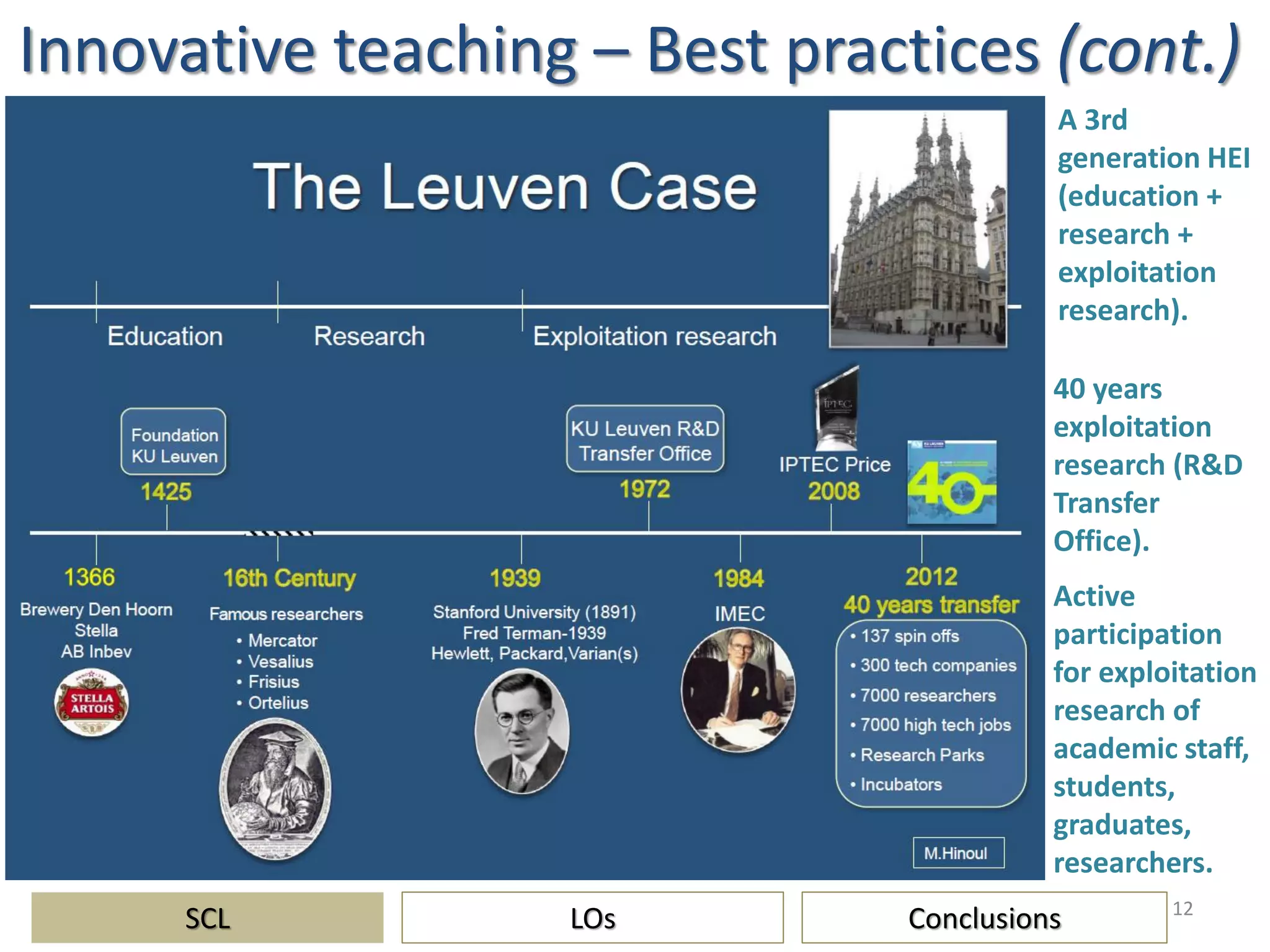
40 years
exploitation
research (R&D
Transfer
Office).
Active
participation
for exploitation
research of
academic staff,
students,
graduates,
researchers.
SCL ConclusionsLOs
Innovative teaching – Best practices (cont.)
A 3rd
generation HEI
(education +
research +
exploitation
research).
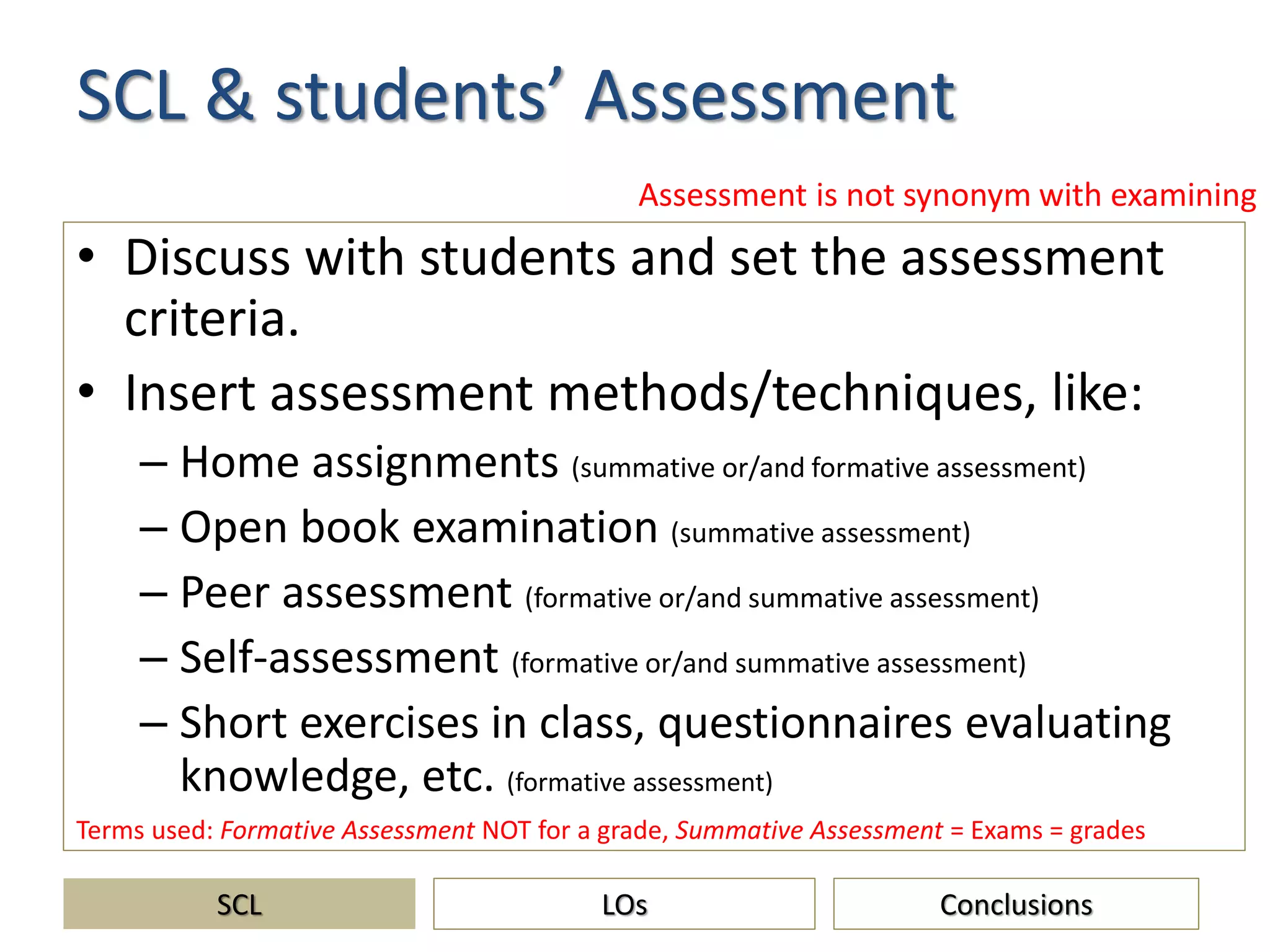
SCL & students’ Assessment
• Discuss with students and set the assessment
criteria.
• Insert assessment methods/techniques, like:
– Home assignments (summative or/and formative assessment)
– Open book examination (summative assessment)
– Peer assessment (formative or/and summative assessment)
– Self-assessment (formative or/and summative assessment)
– Short exercises in class, questionnaires evaluating
knowledge, etc. (formative assessment)
SCL ConclusionsLOs
Assessment is not synonym with examining
Terms used: Formative Assessment NOT for a grade, Summative Assessment = Exams = grades
Learning Outcomes (LOs)
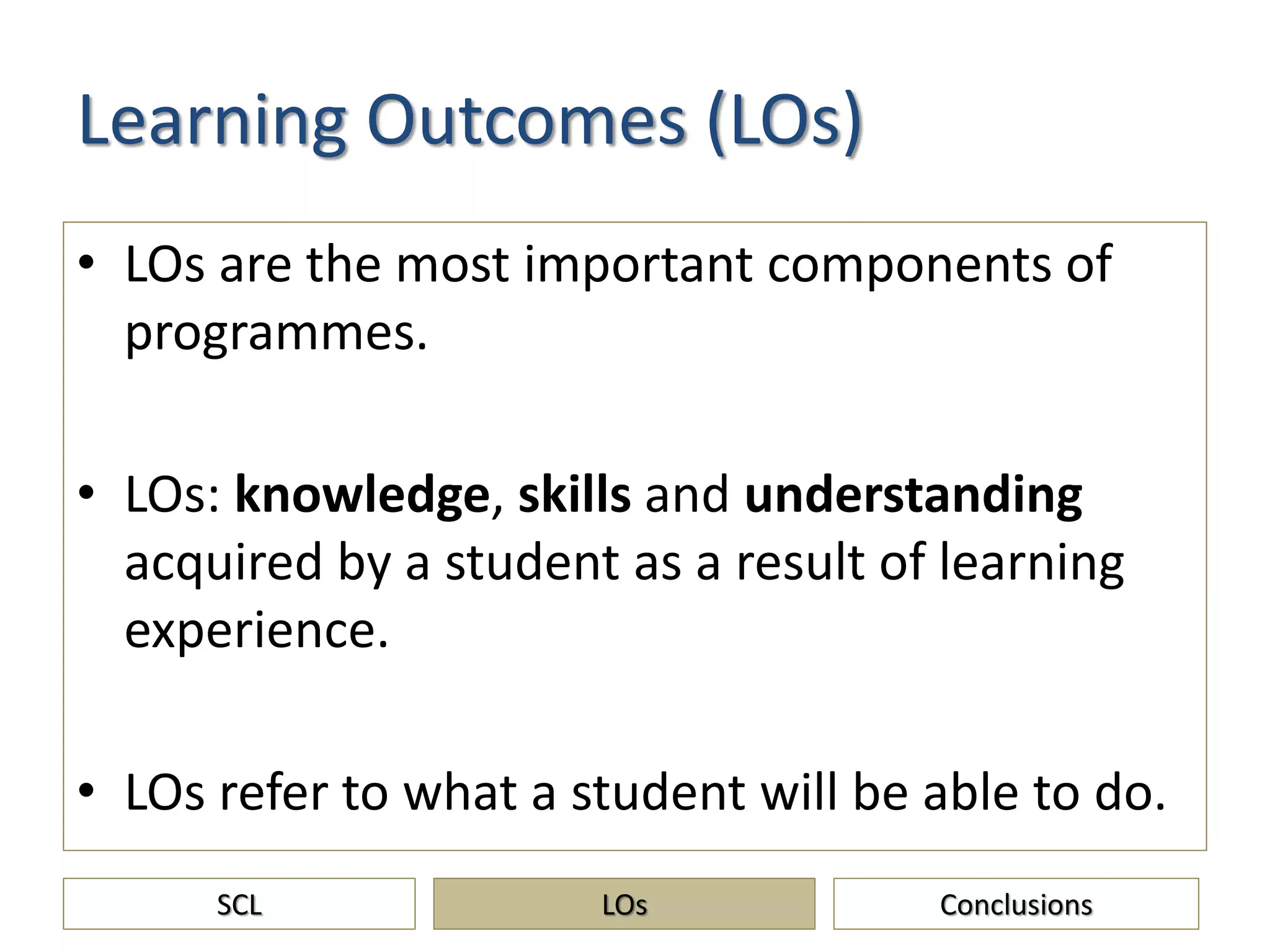
• LOs are the most important components of
programmes.
• LOs: knowledge, skills and understanding
acquired by a student as a result of learning
experience.
• LOs refer to what a student will be able to do.
SCL ConclusionsLOs
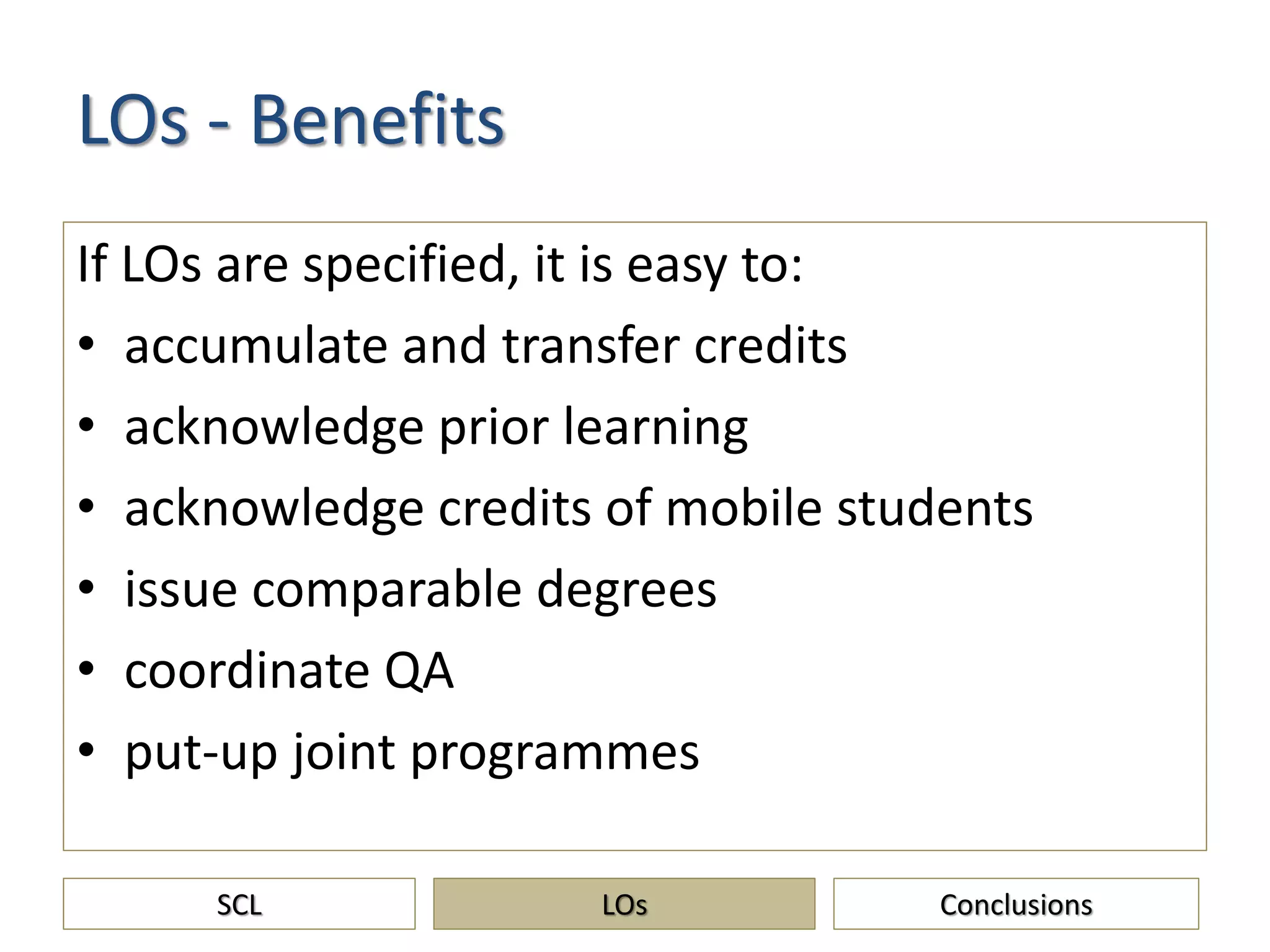
LOs - Benefits
If LOs are specified, it is easy to:
• accumulate and transfer credits
• acknowledge prior learning
• acknowledge credits of mobile students
• issue comparable degrees
• coordinate QA
• put-up joint programmes
SCL ConclusionsLOs
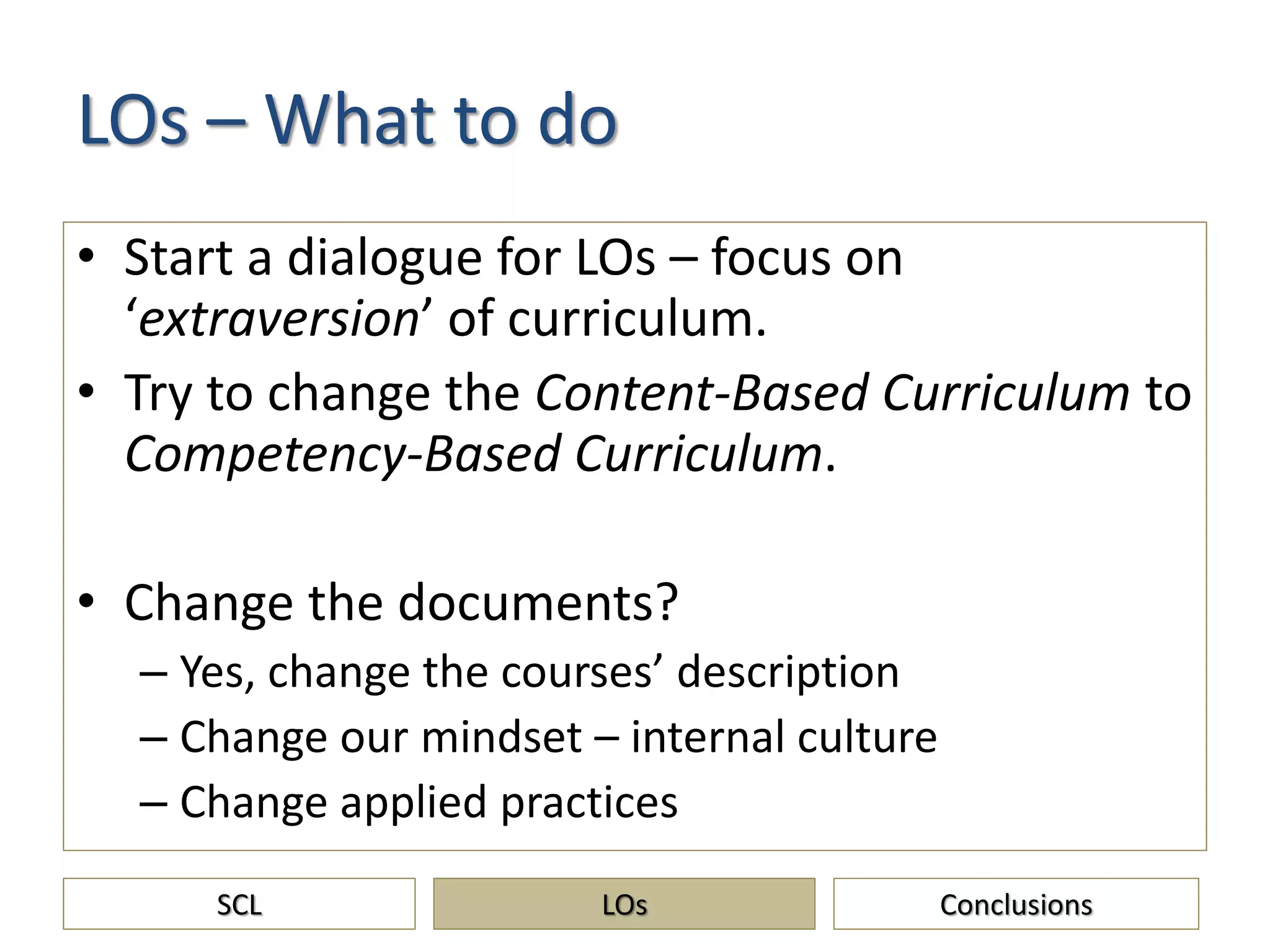
LOs – What to do
• Start a dialogue for LOs – focus on
‘extraversion’ of curriculum.
• Try to change the Content-Based Curriculum to
Competency-Based Curriculum.
• Change the documents?
– Yes, change the courses’ description
– Change our mindset – internal culture
– Change applied practices
SCL ConclusionsLOs
LOs – Best practices
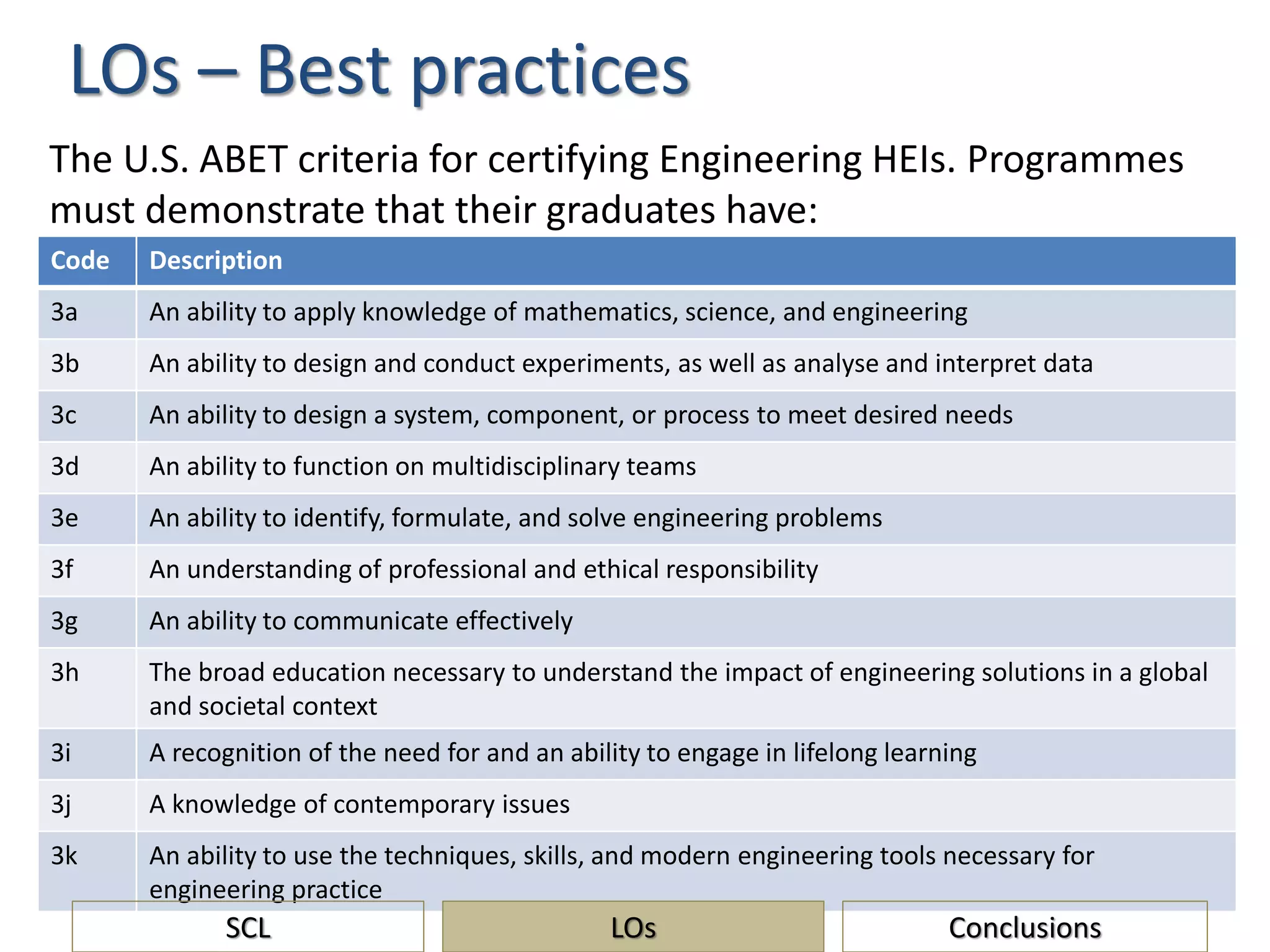
The U.S. ABET criteria for certifying Engineering HEIs. Programmes
must demonstrate that their graduates have:
Code Description
3a An ability to apply knowledge of mathematics, science, and engineering
3b An ability to design and conduct experiments, as well as analyse and interpret data
3c An ability to design a system, component, or process to meet desired needs
3d An ability to function on multidisciplinary teams
3e An ability to identify, formulate, and solve engineering problems
3f An understanding of professional and ethical responsibility
3g An ability to communicate effectively
3h The broad education necessary to understand the impact of engineering solutions in a global
and societal context
3i A recognition of the need for and an ability to engage in lifelong learning
3j A knowledge of contemporary issues
3k An ability to use the techniques, skills, and modern engineering tools necessary for
engineering practice
SCL ConclusionsLOs
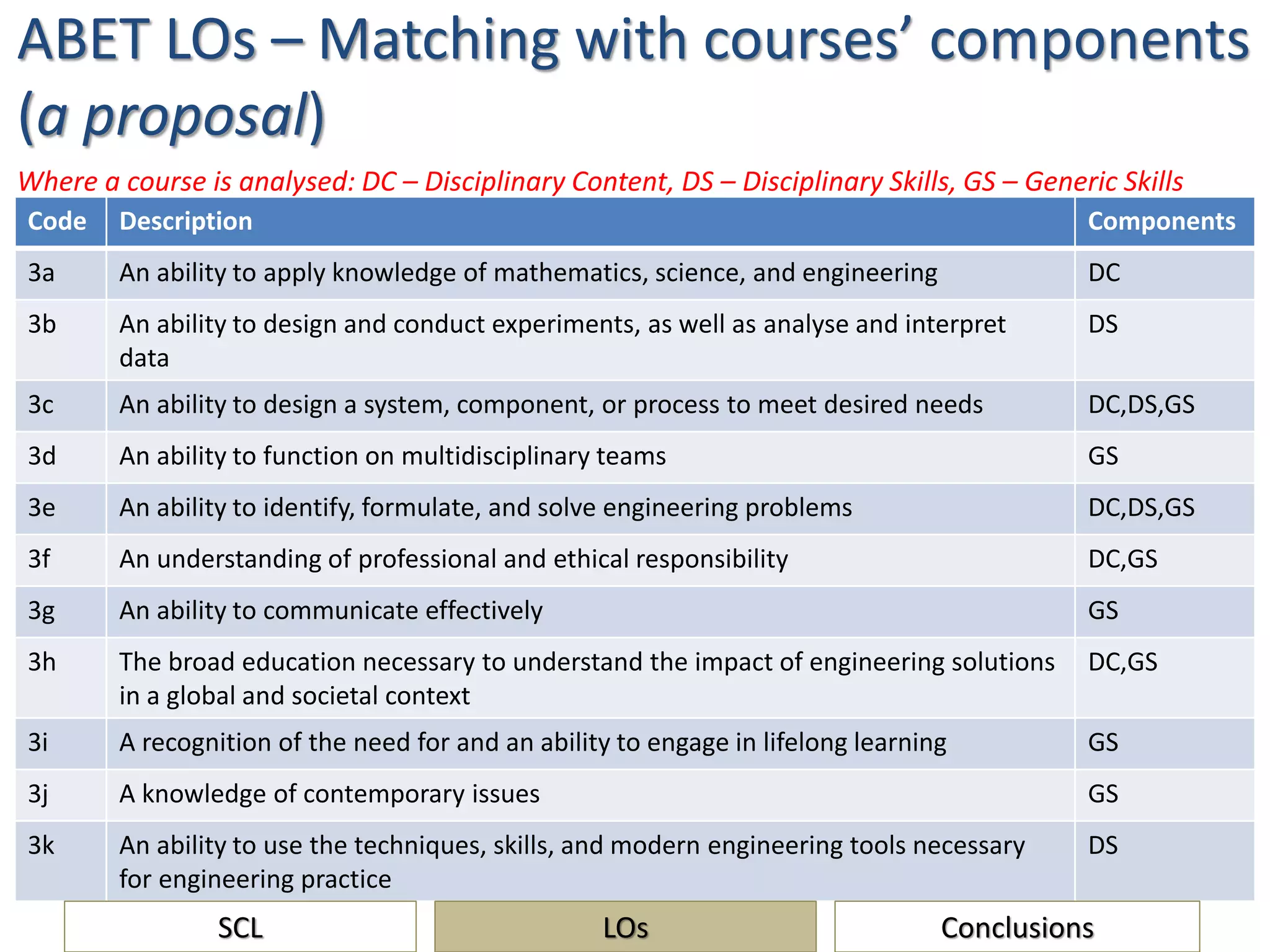
ABET LOs – Matching with courses’ components
(a proposal)
Code Description Components
3a An ability to apply knowledge of mathematics, science, and engineering DC
3b An ability to design and conduct experiments, as well as analyse and interpret
data
DS
3c An ability to design a system, component, or process to meet desired needs DC,DS,GS
3d An ability to function on multidisciplinary teams GS
3e An ability to identify, formulate, and solve engineering problems DC,DS,GS
3f An understanding of professional and ethical responsibility DC,GS
3g An ability to communicate effectively GS
3h The broad education necessary to understand the impact of engineering solutions
in a global and societal context
DC,GS
3i A recognition of the need for and an ability to engage in lifelong learning GS
3j A knowledge of contemporary issues GS
3k An ability to use the techniques, skills, and modern engineering tools necessary
for engineering practice
DS
Where a course is analysed: DC – Disciplinary Content, DS – Disciplinary Skills, GS – Generic Skills
SCL ConclusionsLOs
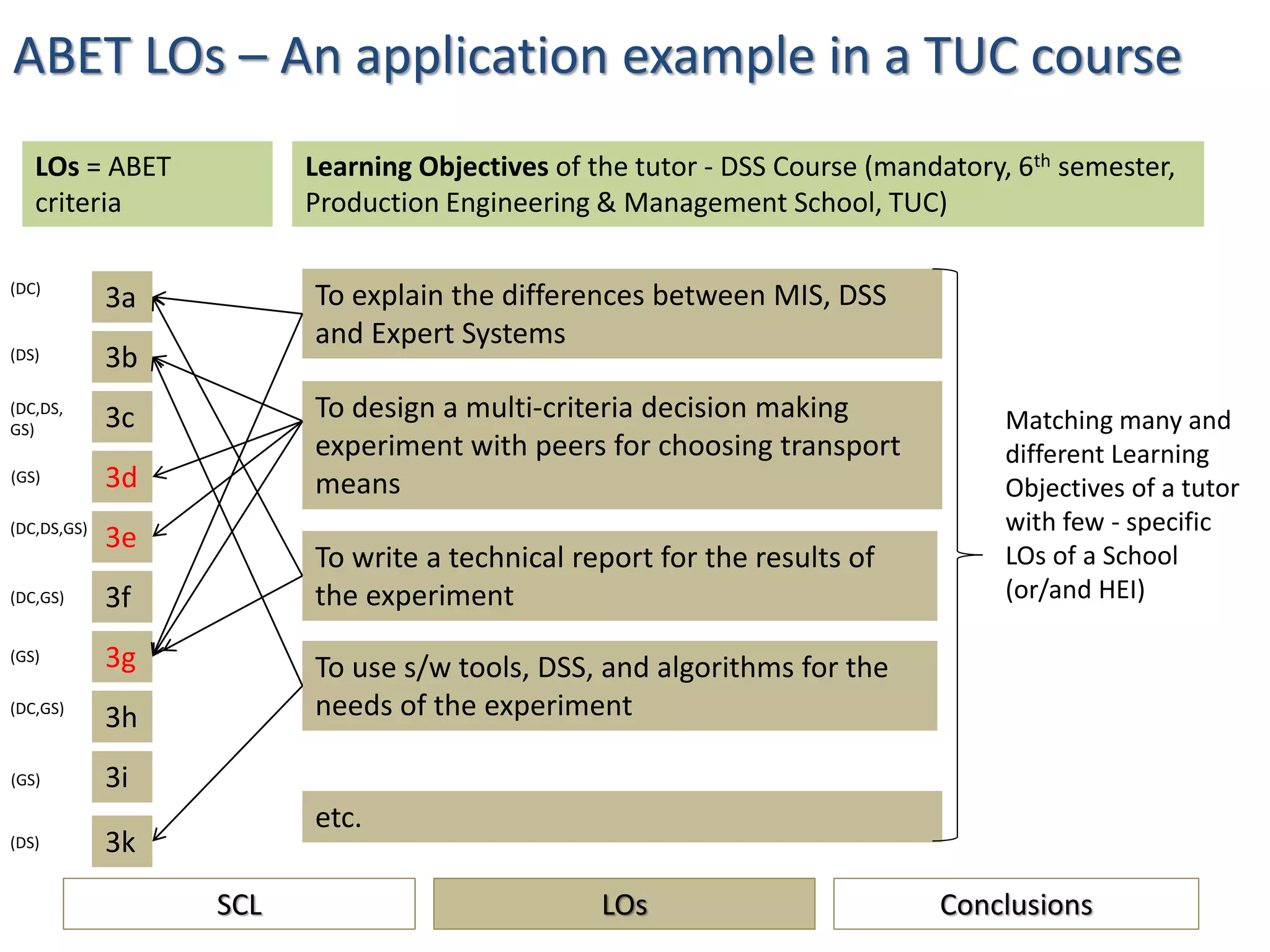
ABET LOs – An application example in a TUC course
LOs = ΑΒΕΤ
criteria
3a
3b
3c
3d
3e
3f
3g
3h
3i
To explain the differences between MIS, DSS
and Expert Systems
To design a multi-criteria decision making
experiment with peers for choosing transport
means
Learning Objectives of the tutor - DSS Course (mandatory, 6th semester,
Production Engineering & Management School, TUC)
To write a technical report for the results of
the experiment
To use s/w tools, DSS, and algorithms for the
needs of the experiment
etc.
Matching many and
different Learning
Objectives of a tutor
with few - specific
LOs of a School
(or/and HEI)
(GS)
(GS)
(DC)
(DS)
(DC,DS,
GS)
(DC,DS,GS)
(DC,GS)
(DC,GS)
(GS)
(DS) 3k
SCL ConclusionsLOs
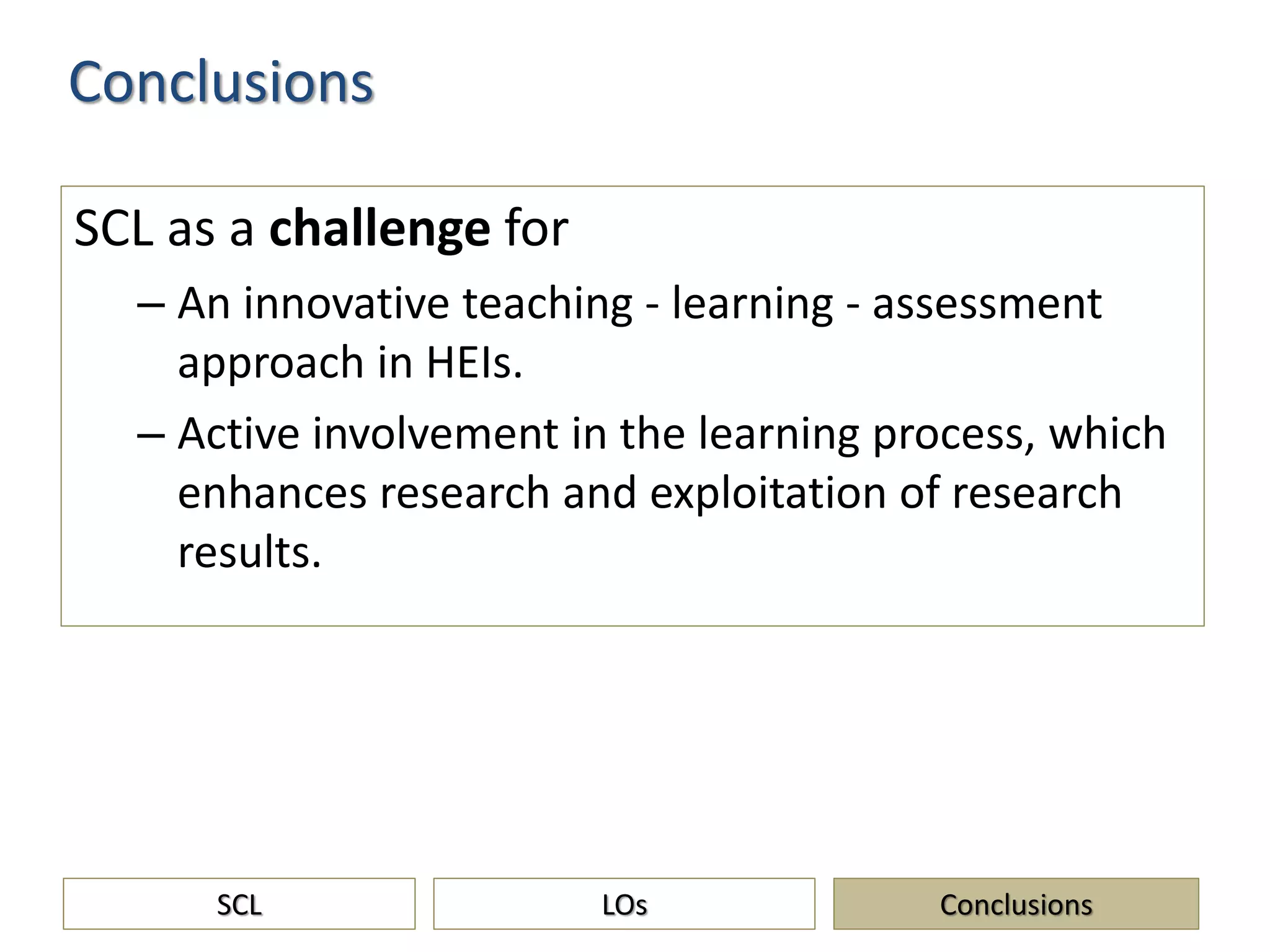
SCL as a challenge for
– An innovative teaching - learning - assessment
approach in HEIs.
– Active involvement in the learning process, which
enhances research and exploitation of research
results.
Conclusions
SCL ConclusionsLOs
THANK YOU FOR YOUR ATTENTION
Contact:
Dr. Evangelia (Lia) Krassadaki, Technical University of Crete, Production Engineering and Management
School, DSS Laboratory - ERGASYA, University Campus, Chania, 73100, Greece. Tel.: +30-28210-37350, E-
mail: lia@ergasya.tuc.gr

Modernisation of Curricula in HE - the SCL approach

  • 1.
    Modernisation of Curriculain HE – The SCL approach Dr. Evangelia (Lia) Krassadaki Technical University of Crete, Production Engineering & Management School TECHNICAL UNIVERSITY OF CRETE PRODUCTION ENGINEERING & MANAGEMENT SCHOOL Workshop of the students’ union BEST, “Local Event on Education – LEoE. Studies in the TUC: Methods for Learning & Teaching”. Centre for Mediterranean Architecture, 18 February 2015, Chania, Crete
  • 2.
    Contents: Student – CentredLearning (SCL) Learning Outcomes (LOs) Conclusions
  • 3.
    Student – CentredLearning (SCL) [1] • Student-Centred Learning represents both a mindset and a culture within a given higher education institution (HEI). • It is a learning approach, which is broadly related to, and supported by, constructuvist theories of learning. • It is characterized by innovative methods of teaching, which aim to promote learning. • During SCL students are active participants for their own learning, which support enhancement of transferable skills such as problem-solving, critical thinking and reflective thinking. SCL ConclusionsLOs
  • 4.
    Student – CentredLearning (SCL) [2] SCL ConclusionsLOs
  • 5.
    On the roadtowards SCL SCL is not new. It is the common practice in the U.S. since the second half of the 20th century. Many countries have already implemented the U.S. practice. SCL implementation depends on: • the students • the academic staff • the School and the HEI • the available resources • the social norms and the society SCL ConclusionsLOs
  • 6.
    Towards SCL -Parameters • Innovative Teaching methods • Learning Outcomes (LOs) • Flexible curricula and learning paths - ECTS SCL ConclusionsLOs
  • 7.
    Innovative teaching –Active participation of students • Discussion groups, workshops • Group projects • Tutorial groups and peer mentoring • Oral presentations • Field trips • Practice • Computer-assisted learning • Portfolios (i.e. E-Portfolios) • Problem-based learning (i.e. medicine) • Case method • Role playing • Learning logs (i.e. students record their educational experience) • Etc. SCL ConclusionsLOs
  • 8.
    Innovative teaching –How [1] • Minimize time spent for lecturing – enhance active participation of ALL students. • Offer experience – connect practice with learning. • Make students aware of the value of what they are doing in an applied situation. • Create a trusting and learning environment. • Make students aware of career paths available. • Invite experts. • Apply research to assess learning experience of students (i.e. use formative assessment techniques). SCL ConclusionsLOs
  • 9.
    Innovative teaching –How [2] • What to do: minimise time spent for lecturing, insert all forms of media like graphics, sound, video, etc., and insert classroom activities ensuring the active participation of all students. • Why: make learning process more attractive. • How: active participation of students during the lesson. • Is it possible: yes, but it depends on the course. • Is there a ‘norm’: no, the tutor has to choose among various methods/techniques, either inside/outside lectures. SCL ConclusionsLOs
  • 10.
    Innovative teaching –Examples Inside the technique of lecturing encourage students to: Outside the technique of lecturing encourage students to: Solve exercises Prepare group projects Present a topic orally Participate in field-trips Present Posters for a topic Prepare written/oral assignments Create groups of two (or more), randomly Study literature Do short group exercises Fill-in learning logs for their educ. experience Syntax a lesson summary Syntax articles for publication Discuss a subject of the lesson Participate in tutorial groups & peer mentoring Discuss a case study Develop a portfolio of their assignments Participate in a brain storming technique Reflect on their own assignments Present an article Assess assignments of their peers Use internet, e-learning platforms, etc. Use internet, e-learning platforms, etc. SCL ConclusionsLOs
  • 11.
    Innovative teaching –Best practices The case of KU Leuven, Engineering School. • Course: Designing and Solving Engineering problems (a project-based course), two semesters duration (1st & 2nd). • Type of the course: mandatory for all engineering students, multi-disciplinary course. • Academic Staff: from all engineering faculties. • Main Goal: (a) introduction in engineering science, (b) team- working of students in short projects. • Additional Goals: technical/academic writing, teamworking, critical thinking, solving problems, creativity, use of basic ICT tools, library skills, etc. Heylen Ch., Vander Sloter J. (2013). A technical writing programme implemented in a first-year engineering course at KU Leuven. European J. of Engineering Education, vol. 38 (6), pp. 595-607. SCL ConclusionsLOs
  • 12.
    12 40 years exploitation research (R&D Transfer Office). Active participation forexploitation research of academic staff, students, graduates, researchers. SCL ConclusionsLOs Innovative teaching – Best practices (cont.) A 3rd generation HEI (education + research + exploitation research).
  • 13.
    SCL & students’Assessment • Discuss with students and set the assessment criteria. • Insert assessment methods/techniques, like: – Home assignments (summative or/and formative assessment) – Open book examination (summative assessment) – Peer assessment (formative or/and summative assessment) – Self-assessment (formative or/and summative assessment) – Short exercises in class, questionnaires evaluating knowledge, etc. (formative assessment) SCL ConclusionsLOs Assessment is not synonym with examining Terms used: Formative Assessment NOT for a grade, Summative Assessment = Exams = grades
  • 14.
    Learning Outcomes (LOs) •LOs are the most important components of programmes. • LOs: knowledge, skills and understanding acquired by a student as a result of learning experience. • LOs refer to what a student will be able to do. SCL ConclusionsLOs
  • 15.
    LOs - Benefits IfLOs are specified, it is easy to: • accumulate and transfer credits • acknowledge prior learning • acknowledge credits of mobile students • issue comparable degrees • coordinate QA • put-up joint programmes SCL ConclusionsLOs
  • 16.
    LOs – Whatto do • Start a dialogue for LOs – focus on ‘extraversion’ of curriculum. • Try to change the Content-Based Curriculum to Competency-Based Curriculum. • Change the documents? – Yes, change the courses’ description – Change our mindset – internal culture – Change applied practices SCL ConclusionsLOs
  • 17.
    LOs – Bestpractices The U.S. ABET criteria for certifying Engineering HEIs. Programmes must demonstrate that their graduates have: Code Description 3a An ability to apply knowledge of mathematics, science, and engineering 3b An ability to design and conduct experiments, as well as analyse and interpret data 3c An ability to design a system, component, or process to meet desired needs 3d An ability to function on multidisciplinary teams 3e An ability to identify, formulate, and solve engineering problems 3f An understanding of professional and ethical responsibility 3g An ability to communicate effectively 3h The broad education necessary to understand the impact of engineering solutions in a global and societal context 3i A recognition of the need for and an ability to engage in lifelong learning 3j A knowledge of contemporary issues 3k An ability to use the techniques, skills, and modern engineering tools necessary for engineering practice SCL ConclusionsLOs
  • 18.
    ABET LOs –Matching with courses’ components (a proposal) Code Description Components 3a An ability to apply knowledge of mathematics, science, and engineering DC 3b An ability to design and conduct experiments, as well as analyse and interpret data DS 3c An ability to design a system, component, or process to meet desired needs DC,DS,GS 3d An ability to function on multidisciplinary teams GS 3e An ability to identify, formulate, and solve engineering problems DC,DS,GS 3f An understanding of professional and ethical responsibility DC,GS 3g An ability to communicate effectively GS 3h The broad education necessary to understand the impact of engineering solutions in a global and societal context DC,GS 3i A recognition of the need for and an ability to engage in lifelong learning GS 3j A knowledge of contemporary issues GS 3k An ability to use the techniques, skills, and modern engineering tools necessary for engineering practice DS Where a course is analysed: DC – Disciplinary Content, DS – Disciplinary Skills, GS – Generic Skills SCL ConclusionsLOs
  • 19.
    ABET LOs –An application example in a TUC course LOs = ΑΒΕΤ criteria 3a 3b 3c 3d 3e 3f 3g 3h 3i To explain the differences between MIS, DSS and Expert Systems To design a multi-criteria decision making experiment with peers for choosing transport means Learning Objectives of the tutor - DSS Course (mandatory, 6th semester, Production Engineering & Management School, TUC) To write a technical report for the results of the experiment To use s/w tools, DSS, and algorithms for the needs of the experiment etc. Matching many and different Learning Objectives of a tutor with few - specific LOs of a School (or/and HEI) (GS) (GS) (DC) (DS) (DC,DS, GS) (DC,DS,GS) (DC,GS) (DC,GS) (GS) (DS) 3k SCL ConclusionsLOs
  • 20.
    SCL as achallenge for – An innovative teaching - learning - assessment approach in HEIs. – Active involvement in the learning process, which enhances research and exploitation of research results. Conclusions SCL ConclusionsLOs
  • 21.
    THANK YOU FORYOUR ATTENTION Contact: Dr. Evangelia (Lia) Krassadaki, Technical University of Crete, Production Engineering and Management School, DSS Laboratory - ERGASYA, University Campus, Chania, 73100, Greece. Tel.: +30-28210-37350, E- mail: lia@ergasya.tuc.gr