Defining customer satisfaction
criteria categories using MCDA and Kano’s model
Evangelia Krassadaki & Evangelos Grigoroudis
TECHNICAL UNIVERSITY OF CRETE
SCHOOL OF PRODUCTION ENGINEERING & MANAGEMENT
DECISION SUPPORT SYSTEMS Laboratory ‘ERGASYA’
EEEE2018, 14-16 June 2018, Chania, Greece (eeee2018.maich.gr)
Issue of interest
Classification of satisfaction criteria & sub-criteria into
three Kano’s levels of quality
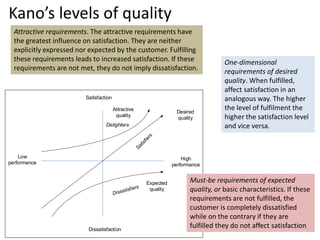
Kano’s levels of quality
High
performance
Low
performance
Satisfaction
Dissatisfaction
Desired
quality
Expected
quality
Attractive
quality
Delighters
Must-be requirements of expected
quality, or basic characteristics. If these
requirements are not fulfilled, the
customer is completely dissatisfied
while on the contrary if they are
fulfilled they do not affect satisfaction
One-dimensional
requirements of desired
quality. When fulfilled,
affect satisfaction in an
analogous way. The higher
the level of fulfilment the
higher the satisfaction level
and vice versa.
Attractive requirements. The attractive requirements have
the greatest influence on satisfaction. They are neither
explicitly expressed nor expected by the customer. Fulfilling
these requirements leads to increased satisfaction. If these
requirements are not met, they do not imply dissatisfaction.
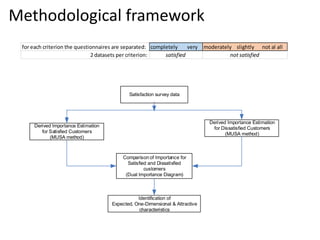
Methodological framework
for each criterion the questionnaires are separated: completely very moderately slightly not al all
2datasets per criterion: satisfied not satisfied
Satisfaction survey data
Derived Importance Estimation
for Satisfied Customers
(MUSA method)
Derived Importance Estimation
for Dissatisfied Customers
(MUSA method)
Comparison of Importance for
Satisfied and Dissatisfied
customers
(Dual Importance Diagram)
Identification of
Expected, One-Dimensional & Attractive
characteristics
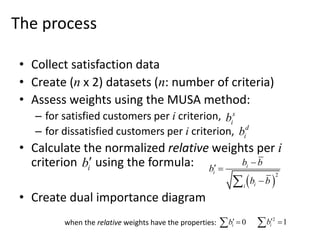
The process
• Collect satisfaction data
• Create (n x 2) datasets (n: number of criteria)
• Assess weights using the MUSA method:
– for satisfied customers per i criterion,
– for dissatisfied customers per i criterion,
• Calculate the normalized relative weights per i
criterion using the formula:
• Create dual importance diagram
s
ib
d
ib
ib
 
2
i
i
ii
b b
b
b b

 

0ib  2
1ib when the relative weights have the properties:
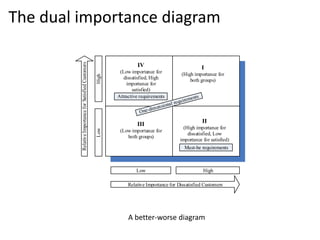
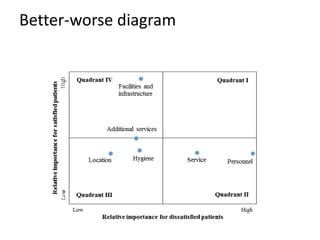
The dual importance diagram
Relative Importance for Dissatisfied Customers
RelativeImportanceforSatisfiedCustomers
I
(High importance for
both groups)
III
(Low importance for
both groups)
II
(High importance for
dissatisfied, Low
importance for satisfied)
IV
(Low importance for
dissatisfied, High
importance for
satisfied)
Low High
LowHigh
Must-be requirements
Attractive requirements
A better-worse diagram
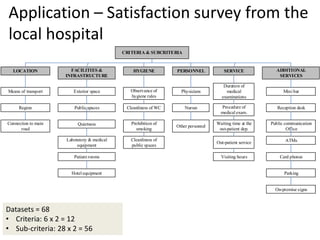
Application – Satisfaction survey from the
local hospital
Datasets = 68
• Criteria: 6 x 2 = 12
• Sub-criteria: 28 x 2 = 56
CRITERIA & SUBCRITERIA
LOCATION FACILITIES &
INFRASTRUCTURE
HYGIENE PERSONNEL
Means of transport
Region
Connection to main
road
Exterior space
Public spaces
Quietness
Laboratory & medical
equipment
Patient rooms
Observance of
hygiene rules
Cleanliness of WC
Prohibition of
smoking
Cleanliness of
public spaces
Physicians
Nurses
Other personnel
Hotel equipment
SERVICE
Duration of
medical
examinations
Procedure of
medical exam.
Waiting time at the
out-patient dep.
Out-patient service
Visiting hours
ADDITIONAL
SERVICES
Mini bar
Reception desk
Public communication
Office
ΑΤΜs
Card phones
Parking
On-premise signs
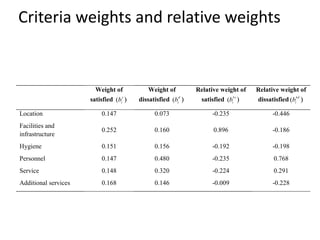
Criteria weights and relative weights
Weight of
satisfied ( )s
i
b
Weight of
dissatisfied ( )d
i
b
Relative weight of
satisfied ( )s
i
b
Relative weight of
dissatisfied ( )d
i
b
Location 0.147 0.073 -0.235 -0.446
Facilities and
infrastructure
0.252 0.160 0.896 -0.186
Hygiene 0.151 0.156 -0.192 -0.198
Personnel 0.147 0.480 -0.235 0.768
Service 0.148 0.320 -0.224 0.291
Additional services 0.168 0.146 -0.009 -0.228
Better-worse diagram
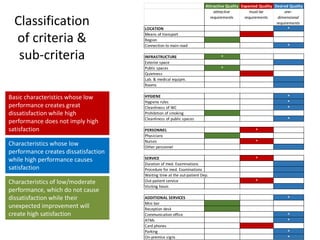
Classification
of criteria &
sub-criteria
Attractive Quality Expected Quality Desired Quality
attractive
requirements
must-be
requirements
one-
dimensional
requirements
LOCATION *
Means of transport
Region
Connection to main road *
INFRASTRUCTURE *
Exterior space
Public spaces *
Quietness
Lab. & medical equipm.
Rooms
HYGIENE *
Hygiene rules *
Cleanliness of WC *
Prohibition of smoking
Cleanliness of public spaces *
PERSONNEL *
Physicians
Nurses *
Other personnel
SERVICE *
Duration of med. Examinations
Procedure for med. Examinations
Waiting time at the out-patient Dep.
Out-patient service *
Visiting hours
ADDITIONAL SERVICES *
Mini bar
Reception desk
Communication office *
ATMs *
Card phones
Parking *
On-premise signs *
Basic characteristics whose low
performance creates great
dissatisfaction while high
performance does not imply high
satisfaction
Characteristics whose low
performance creates dissatisfaction
while high performance causes
satisfaction
Characteristics of low/moderate
performance, which do not cause
dissatisfaction while their
unexpected improvement will
create high satisfaction
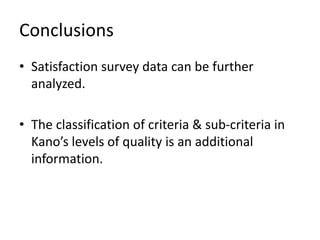
Conclusions
• Satisfaction survey data can be further
analyzed.
• The classification of criteria & sub-criteria in
Kano’s levels of quality is an additional
information.
Thank you for your attention
Contact details:
– Dr. Evangelia Krassadaki, Technical University of Crete, School of Production
Engineering & Management, DSS Laboratory, Univ. Campus, Chania, 73100,
Greece. Tel. +30-28210-37350, E-mail: lia@ergasya.tuc.gr
– Prof. Evangelos Grigoroudis, Technical University of Crete, School of Production
Engineering & Management, DSS Laboratory, Univ. Campus, Chania, 73100,
Greece. Tel. +30-28210-37346, E-mail: vangelis@ergasya.tuc.gr

Krassadaki Grigoroudis presentation eeee2018 maich chania

  • 1.
    Defining customer satisfaction criteriacategories using MCDA and Kano’s model Evangelia Krassadaki & Evangelos Grigoroudis TECHNICAL UNIVERSITY OF CRETE SCHOOL OF PRODUCTION ENGINEERING & MANAGEMENT DECISION SUPPORT SYSTEMS Laboratory ‘ERGASYA’ EEEE2018, 14-16 June 2018, Chania, Greece (eeee2018.maich.gr)
  • 2.
    Issue of interest Classificationof satisfaction criteria & sub-criteria into three Kano’s levels of quality
  • 3.
    Kano’s levels ofquality High performance Low performance Satisfaction Dissatisfaction Desired quality Expected quality Attractive quality Delighters Must-be requirements of expected quality, or basic characteristics. If these requirements are not fulfilled, the customer is completely dissatisfied while on the contrary if they are fulfilled they do not affect satisfaction One-dimensional requirements of desired quality. When fulfilled, affect satisfaction in an analogous way. The higher the level of fulfilment the higher the satisfaction level and vice versa. Attractive requirements. The attractive requirements have the greatest influence on satisfaction. They are neither explicitly expressed nor expected by the customer. Fulfilling these requirements leads to increased satisfaction. If these requirements are not met, they do not imply dissatisfaction.
  • 4.
    Methodological framework for eachcriterion the questionnaires are separated: completely very moderately slightly not al all 2datasets per criterion: satisfied not satisfied Satisfaction survey data Derived Importance Estimation for Satisfied Customers (MUSA method) Derived Importance Estimation for Dissatisfied Customers (MUSA method) Comparison of Importance for Satisfied and Dissatisfied customers (Dual Importance Diagram) Identification of Expected, One-Dimensional & Attractive characteristics
  • 5.
    The process • Collectsatisfaction data • Create (n x 2) datasets (n: number of criteria) • Assess weights using the MUSA method: – for satisfied customers per i criterion, – for dissatisfied customers per i criterion, • Calculate the normalized relative weights per i criterion using the formula: • Create dual importance diagram s ib d ib ib   2 i i ii b b b b b     0ib  2 1ib when the relative weights have the properties:
  • 6.
    The dual importancediagram Relative Importance for Dissatisfied Customers RelativeImportanceforSatisfiedCustomers I (High importance for both groups) III (Low importance for both groups) II (High importance for dissatisfied, Low importance for satisfied) IV (Low importance for dissatisfied, High importance for satisfied) Low High LowHigh Must-be requirements Attractive requirements A better-worse diagram
  • 7.
    Application – Satisfactionsurvey from the local hospital Datasets = 68 • Criteria: 6 x 2 = 12 • Sub-criteria: 28 x 2 = 56 CRITERIA & SUBCRITERIA LOCATION FACILITIES & INFRASTRUCTURE HYGIENE PERSONNEL Means of transport Region Connection to main road Exterior space Public spaces Quietness Laboratory & medical equipment Patient rooms Observance of hygiene rules Cleanliness of WC Prohibition of smoking Cleanliness of public spaces Physicians Nurses Other personnel Hotel equipment SERVICE Duration of medical examinations Procedure of medical exam. Waiting time at the out-patient dep. Out-patient service Visiting hours ADDITIONAL SERVICES Mini bar Reception desk Public communication Office ΑΤΜs Card phones Parking On-premise signs
  • 8.
    Criteria weights andrelative weights Weight of satisfied ( )s i b Weight of dissatisfied ( )d i b Relative weight of satisfied ( )s i b Relative weight of dissatisfied ( )d i b Location 0.147 0.073 -0.235 -0.446 Facilities and infrastructure 0.252 0.160 0.896 -0.186 Hygiene 0.151 0.156 -0.192 -0.198 Personnel 0.147 0.480 -0.235 0.768 Service 0.148 0.320 -0.224 0.291 Additional services 0.168 0.146 -0.009 -0.228
  • 9.
  • 10.
    Classification of criteria & sub-criteria AttractiveQuality Expected Quality Desired Quality attractive requirements must-be requirements one- dimensional requirements LOCATION * Means of transport Region Connection to main road * INFRASTRUCTURE * Exterior space Public spaces * Quietness Lab. & medical equipm. Rooms HYGIENE * Hygiene rules * Cleanliness of WC * Prohibition of smoking Cleanliness of public spaces * PERSONNEL * Physicians Nurses * Other personnel SERVICE * Duration of med. Examinations Procedure for med. Examinations Waiting time at the out-patient Dep. Out-patient service * Visiting hours ADDITIONAL SERVICES * Mini bar Reception desk Communication office * ATMs * Card phones Parking * On-premise signs * Basic characteristics whose low performance creates great dissatisfaction while high performance does not imply high satisfaction Characteristics whose low performance creates dissatisfaction while high performance causes satisfaction Characteristics of low/moderate performance, which do not cause dissatisfaction while their unexpected improvement will create high satisfaction
  • 11.
    Conclusions • Satisfaction surveydata can be further analyzed. • The classification of criteria & sub-criteria in Kano’s levels of quality is an additional information.
  • 12.
    Thank you foryour attention Contact details: – Dr. Evangelia Krassadaki, Technical University of Crete, School of Production Engineering & Management, DSS Laboratory, Univ. Campus, Chania, 73100, Greece. Tel. +30-28210-37350, E-mail: lia@ergasya.tuc.gr – Prof. Evangelos Grigoroudis, Technical University of Crete, School of Production Engineering & Management, DSS Laboratory, Univ. Campus, Chania, 73100, Greece. Tel. +30-28210-37346, E-mail: vangelis@ergasya.tuc.gr