Modern
Theater
Introduction
• This is the period of theater that we are
currently in.
• Dates back to the late 1800s
• The industrial revolution was on its way.
• There were huge advancements.
• City life grew exponentially.
• The intellectual revolution was taking
place.
• Therefore, theater paralleled what was
going on in the world.
• The chaos and confusion of the time was
directly reflected in the modern theater.
Different Movements
• Realism
• Naturalism
• Antirealism
Futurism
Dadaism
Impressionism
Expressionism
Constructivism
Surrealism
Era of
“ISMS”
Realism
• The most popular and longest standing
movement of modern theater.
• Has a “likeness to life” without any
abstractions
• Problems of real life in a realistic manner
of a play
• A reaction against romanticism
• Actors becoming the character
Realism
• Objective performance
• Exposes the nature of relationships and
society
• Gives a large amount of real life
“evidence”
• “Life is a sewer.”
• Lower and middle classes as heroes
Realism
• The protagonist rises up against the odds.
• Realism theater sets, costumes and props
were made to mirror their real-life
counterparts.
Pioneer
• Popularized
by Henrik
Ibsen, a
Norwegian
dramatist
Pioneer
• George Bernard
Shaw
• Created a comic
realism and
addressed issues
like prositution,
poverty and slum
landlordism
Pioneer
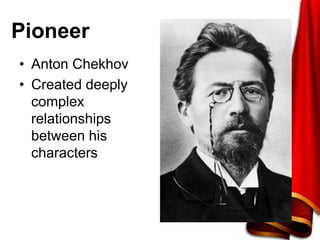
• Anton Chekhov
• Created deeply
complex
relationships
between his
characters
Naturalism
• An extreme form of realism
• Began in France in the 19th century
• Removed the dramatic elements of theater
to present “slice of life”
• The most appropriate subject matter is the
lower class
• Follows the “Three Unities Rule”
Naturalism
• Despised climaxes and characters as
heroes
• All characters as the product of their
environment
• Regularly explores sordid subject matters
• Mostly lower class as characters
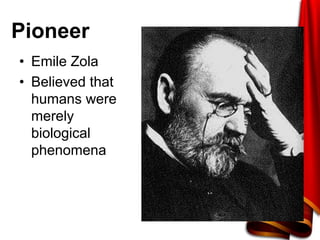
Pioneer
• Emile Zola
• Believed that
humans were
merely
biological
phenomena
Antirealism
• Against realism
• Theatrical realism seen as having some
serious limitations
• Exclusions: music, dance, symbolism,
poetry
Symbolism
• Leads the antirealistic movement
• French as major propronents
• Drama should present the mystery of
being.
• Focused on symbolic imagery
• Takes place in a dream world
• Most important goal is to evoke mood
• Focused on inner realities that can’t be
directly perceived
ERA OF “ISMS”
Expressionism
• Flourished in Germany during WWI
• The representation of reality was distorted
in order to communicate inner feelings.
• Highly subjective plays
• Christ-like character of the protagonist
• Exaggerated scenery, bright lights and
piercing sounds
Expressionism
• Tries to express the feelings of the people
• American expressionist writers addressed
the growing concerns that country’s rapid
industrial and financial growth was
crushing human freedom.
Futurism
• Futurism originated in Italy around 1909.
• Idealized war and the machine age.
• Attacked ideas of the past “museum art”
• They believed audiences should be
confronted and antagonized.
Surrealism
• Surrealism began in 1924 in France.
• They argued that the subconscious is the
highest plane of reality.
• Their plays seem to be set in a dream
world.
Theater of Cruelty
• Originated in France in the 1930’s
• A revolt against realistic theater
• The viewers’ senses should be
bombarded.
• Based on magic and ritual which would
evoke deep, violent and erotic impulses.
• Audience was the center of attention.
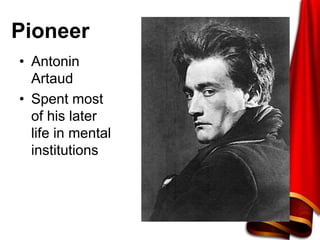
Pioneer
• Antonin
Artaud
• Spent most
of his later
life in mental
institutions
Epic Theater
• Developed by Bertolt Brecht
• Aimed at intellect rather than emotions in
order to affect social change
• Episodic in nature
• Cover a great deal of time and change
locations frequently
• Complex plots and large casts
• Audience are alienated from the action on
stage.
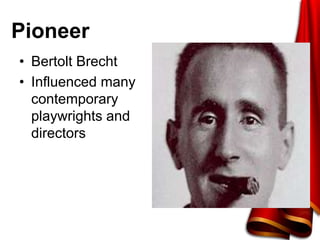
Pioneer
• Bertolt Brecht
• Influenced many
contemporary
playwrights and
directors
Existentialism
• A reaction to WWII
• Existentialist believed that:
– Existence has little meaning.
– God does not exist.
– Humanity is alone in an irrational universe.
– The only thing a person can do is accept
responsibly for his or her actions.
Pioneers
• Jean-Paul
Sartre
• Albert Camus
Theater of the Absurd
• A small unorganized movement in the 50s
and 60s
• Absurdist playwrights believe that:
– Our existence is futile and nonsensical.
– Nothing seems to happen in the play.
– The plot moves in circles.
– No climatic action or episodic plot.
– The characters are not realistic.
– Setting are sometimes unrecognizable.
– Characters fail to communicate effectively.
Pioneers
• Samuel Beckett
• Eugene Ionesco
• Edward Albee
• Harold Pinter
Impressionism
• Shows the effects of things and events on
the mind of artist
• The attempt of the artist to express his
expressions
• Seeks to suggest the impressions on the
artist rather than making an obvious
statement about the characteristics of
things
MODERN THEATER
PRODUCTION
Theater Personnel
• The Producer
the person who puts together the
financing, management staff, and the
artistic team to produce the show.
• The Director
assume responsibility for the
overall interpretation of a script, and
they have the authority to approve,
control, and coordinate all the
elements of a production.
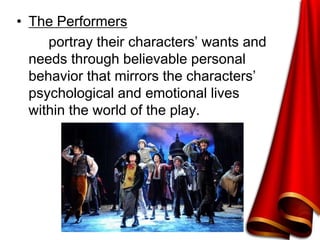
• The Performers
portray their characters’ wants and
needs through believable personal
behavior that mirrors the characters’
psychological and emotional lives
within the world of the play.
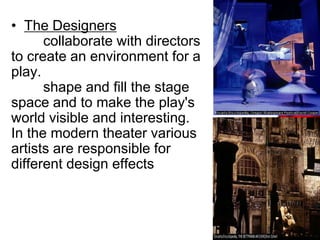
• The Designers
collaborate with directors
to create an environment for a
play.
shape and fill the stage
space and to make the play's
world visible and interesting.
In the modern theater various
artists are responsible for
different design effects
• The Lighting Designer
Modern stage lighting affects what
audiences see. Carefully planned
lighting can establish mood and color,
control the audience's focus of
attention, and enhance the meaning of
the play.
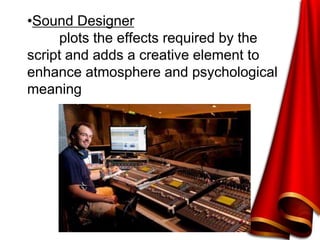
•Sound Designer
plots the effects required by the
script and adds a creative element to
enhance atmosphere and psychological
meaning
•Costume Design
Carefully chosen costumes help
convey a sense of a character’s identity,
as well as set the mood and time period
of the work being performed.
TYPES OF THEATERS
Arena
• A theatre in which the audience completely
surrounds the stage or playing area. Actor
entrances to the playing area are provided
through vomitories or gaps in the seating
arrangement.
Thrust
• A theatre in which the stage is
extended so that the audience
surrounds it on three sides. The thrust
stage may be backed by an enclosed
proscenium stage, providing a place for
background scenery, but audience
views into the proscenium opening are
usually limited.
End Stage
• A theatre in which the audience seating
and stage occupy the same
architectural space, with the stage at
one end and the audience seated in
front facing the stage.
Environmental Theater
• A found space in which the architecture
of the space is intrinsic to the
performance, or a theatre space that is
transformed into a complete
environment for the performance. The
audience space and performance
space are sometimes intermingled, and
the action may be single-focus or
multiple-focus.
Promenade Theater
• A theatre without fixed seating in the
main part of the auditorium – this allows
the standing audience to intermingle
with the performance and to follow the
focal point of the action to different
parts of the room.
Black Box Theater
• A flexible theatre usually without
character or embellishment—a “void”
space that may indeed be black, but
isn’t always. Usually, audience seating
is on the main floor, with no audience
galleries, though a technical gallery
may be provided.
Studio Theater
• A flexible theatre with one or more
audience galleries on three or four
sides of a rectangular room. The main
floor can usually be reconfigured into
arena, thrust, endstage, and flat floor
configurations. The room usually has
some architectural character.
Courtyard Theater
• The term courtyard theatre embraces a
range of theatre forms, all with the
common characteristic of at least one
raised seating gallery surrounding a
central area. Often this central area is
flexible, and can be configured into
arena, thrust, end stage, and flat floor
configurations.
Proscenium Theater
• In a proscenium theatre, the stage is
located at one end of the auditorium
and is physically separated from the
audience space. This is sometimes
called a “two-box” arrangement—the
auditorium and stage occupy two
separate “boxes” or rooms. The stage
box permits a wide variety of scenic
and lighting effects. The auditorium box
is the audience chamber.
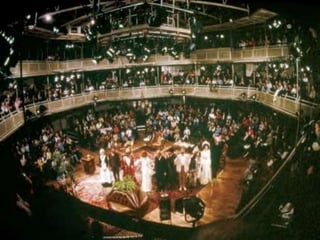
Thrust and open stage
• Some larger drama theatres take the
form of a thrust stage, with the
audience surrounding three sides of the
performance platform. The term open
stage can be used interchangeably with
thrust, but implies a more frontal
arrangement.
Recital Hall
• A space designed for soloists and small
ensembles (up to chamber orchestra
size), with a seat count typically in the
range of 150 to 800. This form is a
descendant of the court music rooms of
the Renaissance. It is often rectangular
in plan, with an open concert platform
at one end of the room and seating
galleries on the other three walls.
Shoebox Concert Hall
• The classic concert hall form is the
shoebox, named after the rectangular
shape and approximate proportions of a
tennis-shoe box. The shoebox form has
high volume, limited width, and multiple
audience levels, usually with relatively
narrow side seating ledges.
Vineyard Concert Hall
• Some modern concert halls have
audience seating in terraces
reminiscent of a vineyard. The seating
may completely or partially encircle the
concert platform. A hall with partial
encirclement may be called a modified
vineyard.
Opera House
• The auditorium is almost always
multilevel with side tiers or boxes to
enhance visual and aural intimacy. The
stage is usually large, with extensive
machinery. It sometimes has separate
auxiliary stages in a cruciform, six-
square, or other arrangement to enable
the opera company to perform in
repertory.
Dance Theater
• The design of the auditorium
emphasizes frontal sightlines and a
clear view of the stage floor.
Sometimes the seating is on telescopic
risers that can be retracted to allow the
whole space to be used for rehearsal or
instruction.
Broadway Theater
• This is a proscenium theatre designed
primarily for amplified sound. The room
acoustics are usually “dry” with little
adjustment available, making these rooms
unsuitable for un-amplified acoustic music. A
reasonable degree of intimacy can be
achieved with multiple cantilevered balconies,
bringing a large portion of the audience as
close to the stage as possible. The stage is
usually sized and equipped to receive large
scale touring musicals.
HOW DID THE THEATER
CHANGE?
Audience Location
Elizabethan Theater
• The audience surrounded
the actors horizontally
and vertically.
Everywhere he looked
there was audience.
Modern Theater
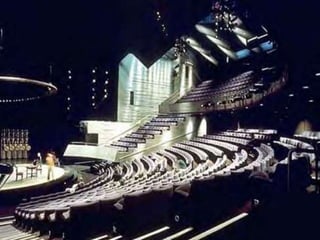
• The audience tends to be
seated in rows on one
side of the playing area.
The audience is separate
from the playing area.
They are observing.
Actor-Audience Relationship
Elizabethan Theater
• Everywhere the actor
looked, there was
audience. He couldn’t talk
to a fellow actor without
seeing an audience
member behind him. The
theater was designed for
the actor to speak with
and directly to the
audience.
Modern Theater
• The actors talk and relate
to each other exclusively.
They do not speak to or
acknowledge the
audience. They are in the
world of the play.
Status of Audience
Elizabethan Theater
• The cheap seats were in
the front. And, they were
not seats. The people
around the stage stood
through the performance.
The next more expensive
seats were in the tiers
surrounding the stage.
The expensive seats
were the Lord’s Boxes,
above and behind the
players.
Modern Theater
• The most expensive
seats are up front near
the stage. The cheap
seats are those furthest
away from the stage,
often up in the balconies.
The people with money
and status get close.
Those with less have an
altered experience due to
the distance from their
seat to the stage.
Production Design
Elizabethan Theater
• The Theater was the
scenery. It had doors,
columns and inner below
and a balcony. There was
a roof that represented
the heavens and a god or
angel could ascend to
heaven and the trap door
known as hell mouth. The
actors conjured the
setting in the
imaginations of the
audience with minimal
additions.
Modern Theater
• The scenery, costumes,
lighting and sound are
designed by artists and
constructed by craftsman
to create the environment
of the play. It is designed
to represent the place
and time.
Production Design (cont.)
Elizabethan Theater
• The costumes were of the
current time, even when
playing ancient Romans.
There were no lights
since the plays were
played during the day
time, except when they
brought on torches or
lanterns to act like it was
dark. There was a lot of
music, played live by
musicians, usually
contemporary tunes.
Modern Theater
• The degree of naturalism
to expressionism or
abstract is carefully
calculated to tell the story
of the play.
Rehearsal and Performance
Elizabethan Theater
• The core company of
actors played together for
years. They supplemented
their ranks with
apprentices to play the
boys and females and
hired men to play the small
roles. They were cast by
type though often played
roles outside their type.
They regularly played
multiple roles in a play.
New plays were premiered
every two weeks.
Modern Theater
• The play is written then
rehearsed for several
weeks by the actors.
There is a director who
guided the actors to play
out his vision of the play.
Each night the actors
repeat the same lines,
movements, motivations
and responses as
developed during the
rehearsal process.
Rehearsal and Performance (cont.)
Elizabethan Theater
• To revive and play an old
play every day would leave
very little time to rehearse
the new play.
Modern Theater
• They play the same show
eight times a week. The
actors are usually cast to
play these specific roles
and this group of actors is
assembled to only play
this play. Each actor often
plays one role so as not
to confuse the audience
or if they do have to play
more than one role, they
try to disguise the fact
they are doubling.
Language and Rhetoric
Elizabethan Theater
• The play was designed as
an argument with the
characters fighting for the
support of the audience. It
debated points of view. Most
of the play was in verse
rather than prose. Verse
carries thought and feeling
more descriptively on its
meter. The audience feels
the heartbeat of meter and
breaths with the actors. The
language is heightened.
Modern Theater
• The text is almost fully in
prose. The lines are
made to be like life. The
idiom, style and prosaic is
intended to produce the
sound of real life even if it
slightly elevated or
funnier. The story and
text is intended to be a
slice of life.
Art/Entertainment
Elizabethan Theater
• There was no division
between art and
entertainment. Theatricals
were required to amuse
the drunk and engage the
scholar. This created
more balance between
the two and made for a
more full experience.
Modern Theater
• There is a division between
high art and popular
entertainment. One
interesting comparison in
between outdoor and indoor
Shakespeare production
today: If you see a
Shakespeare play indoors, it
is usually intended to be art;
if you see a Shakespeare
play outdoors, it is usually
intended to be
entertainment.

Modern theater

  • 1.
  • 2.
    Introduction • This isthe period of theater that we are currently in. • Dates back to the late 1800s • The industrial revolution was on its way. • There were huge advancements. • City life grew exponentially. • The intellectual revolution was taking place.
  • 3.
    • Therefore, theaterparalleled what was going on in the world. • The chaos and confusion of the time was directly reflected in the modern theater.
  • 4.
    Different Movements • Realism •Naturalism • Antirealism Futurism Dadaism Impressionism Expressionism Constructivism Surrealism Era of “ISMS”
  • 5.
    Realism • The mostpopular and longest standing movement of modern theater. • Has a “likeness to life” without any abstractions • Problems of real life in a realistic manner of a play • A reaction against romanticism • Actors becoming the character
  • 6.
    Realism • Objective performance •Exposes the nature of relationships and society • Gives a large amount of real life “evidence” • “Life is a sewer.” • Lower and middle classes as heroes
  • 7.
    Realism • The protagonistrises up against the odds. • Realism theater sets, costumes and props were made to mirror their real-life counterparts.
  • 8.
  • 9.
    Pioneer • George Bernard Shaw •Created a comic realism and addressed issues like prositution, poverty and slum landlordism
  • 10.
    Pioneer • Anton Chekhov •Created deeply complex relationships between his characters
  • 11.
    Naturalism • An extremeform of realism • Began in France in the 19th century • Removed the dramatic elements of theater to present “slice of life” • The most appropriate subject matter is the lower class • Follows the “Three Unities Rule”
  • 12.
    Naturalism • Despised climaxesand characters as heroes • All characters as the product of their environment • Regularly explores sordid subject matters • Mostly lower class as characters
  • 13.
    Pioneer • Emile Zola •Believed that humans were merely biological phenomena
  • 14.
    Antirealism • Against realism •Theatrical realism seen as having some serious limitations • Exclusions: music, dance, symbolism, poetry
  • 15.
    Symbolism • Leads theantirealistic movement • French as major propronents • Drama should present the mystery of being. • Focused on symbolic imagery • Takes place in a dream world • Most important goal is to evoke mood • Focused on inner realities that can’t be directly perceived
  • 16.
  • 17.
    Expressionism • Flourished inGermany during WWI • The representation of reality was distorted in order to communicate inner feelings. • Highly subjective plays • Christ-like character of the protagonist • Exaggerated scenery, bright lights and piercing sounds
  • 18.
    Expressionism • Tries toexpress the feelings of the people • American expressionist writers addressed the growing concerns that country’s rapid industrial and financial growth was crushing human freedom.
  • 19.
    Futurism • Futurism originatedin Italy around 1909. • Idealized war and the machine age. • Attacked ideas of the past “museum art” • They believed audiences should be confronted and antagonized.
  • 20.
    Surrealism • Surrealism beganin 1924 in France. • They argued that the subconscious is the highest plane of reality. • Their plays seem to be set in a dream world.
  • 21.
    Theater of Cruelty •Originated in France in the 1930’s • A revolt against realistic theater • The viewers’ senses should be bombarded. • Based on magic and ritual which would evoke deep, violent and erotic impulses. • Audience was the center of attention.
  • 22.
    Pioneer • Antonin Artaud • Spentmost of his later life in mental institutions
  • 23.
    Epic Theater • Developedby Bertolt Brecht • Aimed at intellect rather than emotions in order to affect social change • Episodic in nature • Cover a great deal of time and change locations frequently • Complex plots and large casts • Audience are alienated from the action on stage.
  • 24.
    Pioneer • Bertolt Brecht •Influenced many contemporary playwrights and directors
  • 25.
    Existentialism • A reactionto WWII • Existentialist believed that: – Existence has little meaning. – God does not exist. – Humanity is alone in an irrational universe. – The only thing a person can do is accept responsibly for his or her actions.
  • 26.
  • 27.
    Theater of theAbsurd • A small unorganized movement in the 50s and 60s • Absurdist playwrights believe that: – Our existence is futile and nonsensical. – Nothing seems to happen in the play. – The plot moves in circles. – No climatic action or episodic plot. – The characters are not realistic. – Setting are sometimes unrecognizable. – Characters fail to communicate effectively.
  • 28.
    Pioneers • Samuel Beckett •Eugene Ionesco • Edward Albee • Harold Pinter
  • 29.
    Impressionism • Shows theeffects of things and events on the mind of artist • The attempt of the artist to express his expressions • Seeks to suggest the impressions on the artist rather than making an obvious statement about the characteristics of things
  • 30.
  • 31.
    Theater Personnel • TheProducer the person who puts together the financing, management staff, and the artistic team to produce the show.
  • 32.
    • The Director assumeresponsibility for the overall interpretation of a script, and they have the authority to approve, control, and coordinate all the elements of a production.
  • 33.
    • The Performers portraytheir characters’ wants and needs through believable personal behavior that mirrors the characters’ psychological and emotional lives within the world of the play.
  • 34.
    • The Designers collaboratewith directors to create an environment for a play. shape and fill the stage space and to make the play's world visible and interesting. In the modern theater various artists are responsible for different design effects
  • 35.
    • The LightingDesigner Modern stage lighting affects what audiences see. Carefully planned lighting can establish mood and color, control the audience's focus of attention, and enhance the meaning of the play.
  • 36.
    •Sound Designer plots theeffects required by the script and adds a creative element to enhance atmosphere and psychological meaning
  • 37.
    •Costume Design Carefully chosencostumes help convey a sense of a character’s identity, as well as set the mood and time period of the work being performed.
  • 38.
  • 40.
    Arena • A theatrein which the audience completely surrounds the stage or playing area. Actor entrances to the playing area are provided through vomitories or gaps in the seating arrangement.
  • 42.
    Thrust • A theatrein which the stage is extended so that the audience surrounds it on three sides. The thrust stage may be backed by an enclosed proscenium stage, providing a place for background scenery, but audience views into the proscenium opening are usually limited.
  • 44.
    End Stage • Atheatre in which the audience seating and stage occupy the same architectural space, with the stage at one end and the audience seated in front facing the stage.
  • 46.
    Environmental Theater • Afound space in which the architecture of the space is intrinsic to the performance, or a theatre space that is transformed into a complete environment for the performance. The audience space and performance space are sometimes intermingled, and the action may be single-focus or multiple-focus.
  • 48.
    Promenade Theater • Atheatre without fixed seating in the main part of the auditorium – this allows the standing audience to intermingle with the performance and to follow the focal point of the action to different parts of the room.
  • 50.
    Black Box Theater •A flexible theatre usually without character or embellishment—a “void” space that may indeed be black, but isn’t always. Usually, audience seating is on the main floor, with no audience galleries, though a technical gallery may be provided.
  • 52.
    Studio Theater • Aflexible theatre with one or more audience galleries on three or four sides of a rectangular room. The main floor can usually be reconfigured into arena, thrust, endstage, and flat floor configurations. The room usually has some architectural character.
  • 54.
    Courtyard Theater • Theterm courtyard theatre embraces a range of theatre forms, all with the common characteristic of at least one raised seating gallery surrounding a central area. Often this central area is flexible, and can be configured into arena, thrust, end stage, and flat floor configurations.
  • 56.
    Proscenium Theater • Ina proscenium theatre, the stage is located at one end of the auditorium and is physically separated from the audience space. This is sometimes called a “two-box” arrangement—the auditorium and stage occupy two separate “boxes” or rooms. The stage box permits a wide variety of scenic and lighting effects. The auditorium box is the audience chamber.
  • 58.
    Thrust and openstage • Some larger drama theatres take the form of a thrust stage, with the audience surrounding three sides of the performance platform. The term open stage can be used interchangeably with thrust, but implies a more frontal arrangement.
  • 60.
    Recital Hall • Aspace designed for soloists and small ensembles (up to chamber orchestra size), with a seat count typically in the range of 150 to 800. This form is a descendant of the court music rooms of the Renaissance. It is often rectangular in plan, with an open concert platform at one end of the room and seating galleries on the other three walls.
  • 62.
    Shoebox Concert Hall •The classic concert hall form is the shoebox, named after the rectangular shape and approximate proportions of a tennis-shoe box. The shoebox form has high volume, limited width, and multiple audience levels, usually with relatively narrow side seating ledges.
  • 64.
    Vineyard Concert Hall •Some modern concert halls have audience seating in terraces reminiscent of a vineyard. The seating may completely or partially encircle the concert platform. A hall with partial encirclement may be called a modified vineyard.
  • 66.
    Opera House • Theauditorium is almost always multilevel with side tiers or boxes to enhance visual and aural intimacy. The stage is usually large, with extensive machinery. It sometimes has separate auxiliary stages in a cruciform, six- square, or other arrangement to enable the opera company to perform in repertory.
  • 68.
    Dance Theater • Thedesign of the auditorium emphasizes frontal sightlines and a clear view of the stage floor. Sometimes the seating is on telescopic risers that can be retracted to allow the whole space to be used for rehearsal or instruction.
  • 70.
    Broadway Theater • Thisis a proscenium theatre designed primarily for amplified sound. The room acoustics are usually “dry” with little adjustment available, making these rooms unsuitable for un-amplified acoustic music. A reasonable degree of intimacy can be achieved with multiple cantilevered balconies, bringing a large portion of the audience as close to the stage as possible. The stage is usually sized and equipped to receive large scale touring musicals.
  • 71.
    HOW DID THETHEATER CHANGE?
  • 72.
    Audience Location Elizabethan Theater •The audience surrounded the actors horizontally and vertically. Everywhere he looked there was audience. Modern Theater • The audience tends to be seated in rows on one side of the playing area. The audience is separate from the playing area. They are observing.
  • 73.
    Actor-Audience Relationship Elizabethan Theater •Everywhere the actor looked, there was audience. He couldn’t talk to a fellow actor without seeing an audience member behind him. The theater was designed for the actor to speak with and directly to the audience. Modern Theater • The actors talk and relate to each other exclusively. They do not speak to or acknowledge the audience. They are in the world of the play.
  • 74.
    Status of Audience ElizabethanTheater • The cheap seats were in the front. And, they were not seats. The people around the stage stood through the performance. The next more expensive seats were in the tiers surrounding the stage. The expensive seats were the Lord’s Boxes, above and behind the players. Modern Theater • The most expensive seats are up front near the stage. The cheap seats are those furthest away from the stage, often up in the balconies. The people with money and status get close. Those with less have an altered experience due to the distance from their seat to the stage.
  • 75.
    Production Design Elizabethan Theater •The Theater was the scenery. It had doors, columns and inner below and a balcony. There was a roof that represented the heavens and a god or angel could ascend to heaven and the trap door known as hell mouth. The actors conjured the setting in the imaginations of the audience with minimal additions. Modern Theater • The scenery, costumes, lighting and sound are designed by artists and constructed by craftsman to create the environment of the play. It is designed to represent the place and time.
  • 76.
    Production Design (cont.) ElizabethanTheater • The costumes were of the current time, even when playing ancient Romans. There were no lights since the plays were played during the day time, except when they brought on torches or lanterns to act like it was dark. There was a lot of music, played live by musicians, usually contemporary tunes. Modern Theater • The degree of naturalism to expressionism or abstract is carefully calculated to tell the story of the play.
  • 77.
    Rehearsal and Performance ElizabethanTheater • The core company of actors played together for years. They supplemented their ranks with apprentices to play the boys and females and hired men to play the small roles. They were cast by type though often played roles outside their type. They regularly played multiple roles in a play. New plays were premiered every two weeks. Modern Theater • The play is written then rehearsed for several weeks by the actors. There is a director who guided the actors to play out his vision of the play. Each night the actors repeat the same lines, movements, motivations and responses as developed during the rehearsal process.
  • 78.
    Rehearsal and Performance(cont.) Elizabethan Theater • To revive and play an old play every day would leave very little time to rehearse the new play. Modern Theater • They play the same show eight times a week. The actors are usually cast to play these specific roles and this group of actors is assembled to only play this play. Each actor often plays one role so as not to confuse the audience or if they do have to play more than one role, they try to disguise the fact they are doubling.
  • 79.
    Language and Rhetoric ElizabethanTheater • The play was designed as an argument with the characters fighting for the support of the audience. It debated points of view. Most of the play was in verse rather than prose. Verse carries thought and feeling more descriptively on its meter. The audience feels the heartbeat of meter and breaths with the actors. The language is heightened. Modern Theater • The text is almost fully in prose. The lines are made to be like life. The idiom, style and prosaic is intended to produce the sound of real life even if it slightly elevated or funnier. The story and text is intended to be a slice of life.
  • 80.
    Art/Entertainment Elizabethan Theater • Therewas no division between art and entertainment. Theatricals were required to amuse the drunk and engage the scholar. This created more balance between the two and made for a more full experience. Modern Theater • There is a division between high art and popular entertainment. One interesting comparison in between outdoor and indoor Shakespeare production today: If you see a Shakespeare play indoors, it is usually intended to be art; if you see a Shakespeare play outdoors, it is usually intended to be entertainment.