Chapter 3Chapter 3
Theatre and Cultural DiversityTheatre and Cultural Diversity
Critical Mirror:Critical Mirror:
Art and Entertainment Reflect CultureArt and Entertainment Reflect Culture
Culture – the values, standards, andCulture – the values, standards, and
patterns of behavior of a particular grouppatterns of behavior of a particular group
of peopleof people
Enculturation – the process by which weEnculturation – the process by which we
learn our culturelearn our culture
Theatre Outside the DominantTheatre Outside the Dominant
CultureCulture
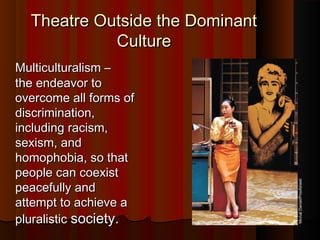
Multiculturalism –Multiculturalism –
the endeavor tothe endeavor to
overcome all forms ofovercome all forms of
discrimination,discrimination,
including racism,including racism,
sexism, andsexism, and
homophobia, so thathomophobia, so that
people can coexistpeople can coexist
peacefully andpeacefully and
attempt to achieve aattempt to achieve a
pluralisticpluralistic society.society.
MichalDaniel/Proofsheet
Basic TypesBasic Types
ofof
Theatre of the PeopleTheatre of the People
Theatre of IdentityTheatre of Identity
Theatre of ProtestTheatre of Protest
Cross-cultural TheatreCross-cultural Theatre
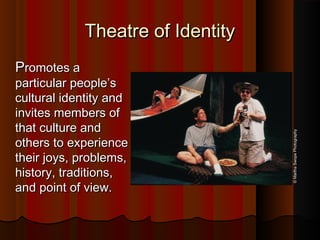
Theatre of IdentityTheatre of Identity
PPromotes aromotes a
particular people’sparticular people’s
cultural identity andcultural identity and
invites members ofinvites members of
that culture andthat culture and
others to experienceothers to experience
their joys, problems,their joys, problems,
history, traditions,history, traditions,
and point of view.and point of view.
©MarthaSwopePhotography
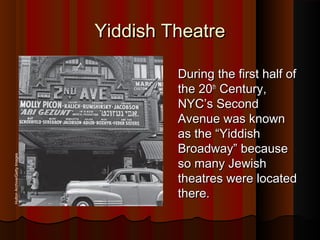
Yiddish TheatreYiddish Theatre
During the first half ofDuring the first half of
the 20the 20thth
Century,Century,
NYC’s SecondNYC’s Second
Avenue was knownAvenue was known
as the “Yiddishas the “Yiddish
Broadway” becauseBroadway” because
so many Jewishso many Jewish
theatres were locatedtheatres were located
there.there.
HultonArchive/GettyImages
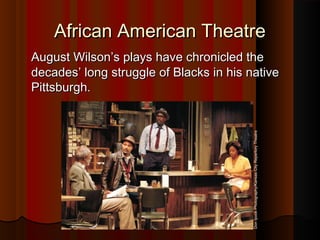
African American TheatreAfrican American Theatre
August Wilson’s plays have chronicled theAugust Wilson’s plays have chronicled the
decades’ long struggle of Blacks in his nativedecades’ long struggle of Blacks in his native
Pittsburgh.Pittsburgh.
DonIpockPhotography/KansasCityRepertoryTheatre
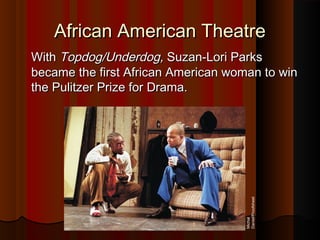
African American TheatreAfrican American Theatre
WithWith Topdog/Underdog,Topdog/Underdog, Suzan-Lori ParksSuzan-Lori Parks
became the first African American woman to winbecame the first African American woman to win
the Pulitzer Prize for Drama.the Pulitzer Prize for Drama.
Michal
Daniel/Proofsheet
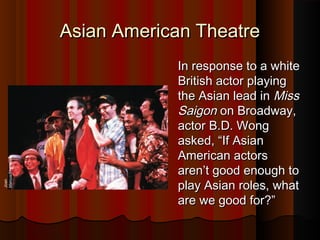
Asian American TheatreAsian American Theatre
In response to a whiteIn response to a white
British actor playingBritish actor playing
the Asian lead inthe Asian lead in MissMiss
SaigonSaigon on Broadway,on Broadway,
actor B.D. Wongactor B.D. Wong
asked, “If Asianasked, “If Asian
American actorsAmerican actors
aren’t good enough toaren’t good enough to
play Asian roles, whatplay Asian roles, what
are we good for?”are we good for?”
Joan
Marcus/Photofest
Theatre of ProtestTheatre of Protest
Objects to the dominant culture’s control andObjects to the dominant culture’s control and
demands that a minority culture’s voice anddemands that a minority culture’s voice and
political agenda be heard.political agenda be heard.
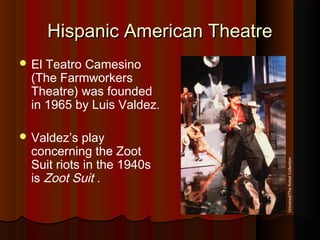
Hispanic American TheatreHispanic American Theatre
 El Teatro Camesino
(The Farmworkers
Theatre) was founded
in 1965 by Luis Valdez.
 Valdez’s play
concerning the Zoot
Suit riots in the 1940s
is Zoot Suit .
Universal/TheKobalCollection
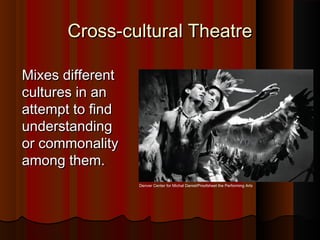
Cross-cultural TheatreCross-cultural Theatre
Mixes differentMixes different
cultures in ancultures in an
attempt to findattempt to find
understandingunderstanding
or commonalityor commonality
among them.among them.
Denver Center for Michal Daniel/Proofsheet the Performing Arts
Cross-cultural TheatreCross-cultural Theatre
The playThe play Black Elk Speaks ,Black Elk Speaks , which was adaptedwhich was adapted
from an oral biography of a Sioux holy man, tellsfrom an oral biography of a Sioux holy man, tells
the story of white America’s westward expansionthe story of white America’s westward expansion
from the Native American perspective.from the Native American perspective.
Japanese director Shozo Sato stages WesternJapanese director Shozo Sato stages Western
classics such asclassics such as Medea, FaustMedea, Faust, and, and MacbethMacbeth inin
Japanese Kabuki style.Japanese Kabuki style.
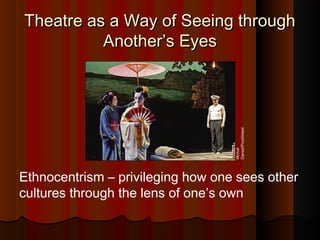
Theatre as a Way of Seeing throughTheatre as a Way of Seeing through
Another’s EyesAnother’s Eyes
Ethnocentrism – privileging how one sees other
cultures through the lens of one’s own
Michal
Daniel/Proofsheet
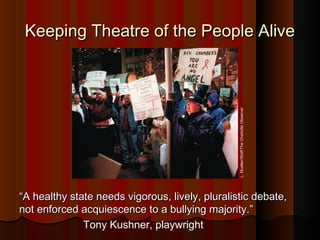
Keeping Theatre of the People AliveKeeping Theatre of the People Alive
““A healthy state needs vigorous, lively, pluralistic debate,A healthy state needs vigorous, lively, pluralistic debate,
not enforced acquiescence to a bullying majority.”not enforced acquiescence to a bullying majority.”
Tony Kushner, playwright
L.Mueller/Staff/TheCharlotteObserver
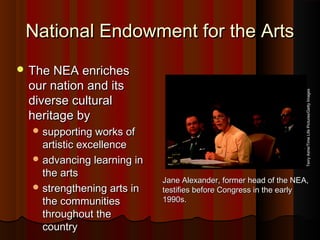
National Endowment for the ArtsNational Endowment for the Arts
 The NEA enrichesThe NEA enriches
our nation and itsour nation and its
diverse culturaldiverse cultural
heritage byheritage by
 supporting works ofsupporting works of
artistic excellenceartistic excellence
 advancing learning inadvancing learning in
the artsthe arts
 strengthening arts instrengthening arts in
the communitiesthe communities
throughout thethroughout the
countrycountry
Jane Alexander, former head of the NEA,Jane Alexander, former head of the NEA,
testifies before Congress in the earlytestifies before Congress in the early
1990s.1990s.
TerryAshe/TimeLifePictures/GettyImages
Curtain CallCurtain Call
““Cultural diversity is as necessary forCultural diversity is as necessary for
humankind as biodiversity is for nature.”humankind as biodiversity is for nature.”
UNESCO’sUNESCO’s Universal DeclarationUniversal Declaration
on Cultural Diversityon Cultural Diversity

Chapter 3: Theatre and Cultural Diversity

  • 1.
    Chapter 3Chapter 3 Theatreand Cultural DiversityTheatre and Cultural Diversity
  • 2.
    Critical Mirror:Critical Mirror: Artand Entertainment Reflect CultureArt and Entertainment Reflect Culture Culture – the values, standards, andCulture – the values, standards, and patterns of behavior of a particular grouppatterns of behavior of a particular group of peopleof people Enculturation – the process by which weEnculturation – the process by which we learn our culturelearn our culture
  • 3.
    Theatre Outside theDominantTheatre Outside the Dominant CultureCulture Multiculturalism –Multiculturalism – the endeavor tothe endeavor to overcome all forms ofovercome all forms of discrimination,discrimination, including racism,including racism, sexism, andsexism, and homophobia, so thathomophobia, so that people can coexistpeople can coexist peacefully andpeacefully and attempt to achieve aattempt to achieve a pluralisticpluralistic society.society. MichalDaniel/Proofsheet
  • 4.
    Basic TypesBasic Types ofof Theatreof the PeopleTheatre of the People Theatre of IdentityTheatre of Identity Theatre of ProtestTheatre of Protest Cross-cultural TheatreCross-cultural Theatre
  • 5.
    Theatre of IdentityTheatreof Identity PPromotes aromotes a particular people’sparticular people’s cultural identity andcultural identity and invites members ofinvites members of that culture andthat culture and others to experienceothers to experience their joys, problems,their joys, problems, history, traditions,history, traditions, and point of view.and point of view. ©MarthaSwopePhotography
  • 6.
    Yiddish TheatreYiddish Theatre Duringthe first half ofDuring the first half of the 20the 20thth Century,Century, NYC’s SecondNYC’s Second Avenue was knownAvenue was known as the “Yiddishas the “Yiddish Broadway” becauseBroadway” because so many Jewishso many Jewish theatres were locatedtheatres were located there.there. HultonArchive/GettyImages
  • 7.
    African American TheatreAfricanAmerican Theatre August Wilson’s plays have chronicled theAugust Wilson’s plays have chronicled the decades’ long struggle of Blacks in his nativedecades’ long struggle of Blacks in his native Pittsburgh.Pittsburgh. DonIpockPhotography/KansasCityRepertoryTheatre
  • 8.
    African American TheatreAfricanAmerican Theatre WithWith Topdog/Underdog,Topdog/Underdog, Suzan-Lori ParksSuzan-Lori Parks became the first African American woman to winbecame the first African American woman to win the Pulitzer Prize for Drama.the Pulitzer Prize for Drama. Michal Daniel/Proofsheet
  • 9.
    Asian American TheatreAsianAmerican Theatre In response to a whiteIn response to a white British actor playingBritish actor playing the Asian lead inthe Asian lead in MissMiss SaigonSaigon on Broadway,on Broadway, actor B.D. Wongactor B.D. Wong asked, “If Asianasked, “If Asian American actorsAmerican actors aren’t good enough toaren’t good enough to play Asian roles, whatplay Asian roles, what are we good for?”are we good for?” Joan Marcus/Photofest
  • 10.
    Theatre of ProtestTheatreof Protest Objects to the dominant culture’s control andObjects to the dominant culture’s control and demands that a minority culture’s voice anddemands that a minority culture’s voice and political agenda be heard.political agenda be heard.
  • 11.
    Hispanic American TheatreHispanicAmerican Theatre  El Teatro Camesino (The Farmworkers Theatre) was founded in 1965 by Luis Valdez.  Valdez’s play concerning the Zoot Suit riots in the 1940s is Zoot Suit . Universal/TheKobalCollection
  • 12.
    Cross-cultural TheatreCross-cultural Theatre MixesdifferentMixes different cultures in ancultures in an attempt to findattempt to find understandingunderstanding or commonalityor commonality among them.among them. Denver Center for Michal Daniel/Proofsheet the Performing Arts
  • 13.
    Cross-cultural TheatreCross-cultural Theatre TheplayThe play Black Elk Speaks ,Black Elk Speaks , which was adaptedwhich was adapted from an oral biography of a Sioux holy man, tellsfrom an oral biography of a Sioux holy man, tells the story of white America’s westward expansionthe story of white America’s westward expansion from the Native American perspective.from the Native American perspective. Japanese director Shozo Sato stages WesternJapanese director Shozo Sato stages Western classics such asclassics such as Medea, FaustMedea, Faust, and, and MacbethMacbeth inin Japanese Kabuki style.Japanese Kabuki style.
  • 14.
    Theatre as aWay of Seeing throughTheatre as a Way of Seeing through Another’s EyesAnother’s Eyes Ethnocentrism – privileging how one sees other cultures through the lens of one’s own Michal Daniel/Proofsheet
  • 15.
    Keeping Theatre ofthe People AliveKeeping Theatre of the People Alive ““A healthy state needs vigorous, lively, pluralistic debate,A healthy state needs vigorous, lively, pluralistic debate, not enforced acquiescence to a bullying majority.”not enforced acquiescence to a bullying majority.” Tony Kushner, playwright L.Mueller/Staff/TheCharlotteObserver
  • 16.
    National Endowment forthe ArtsNational Endowment for the Arts  The NEA enrichesThe NEA enriches our nation and itsour nation and its diverse culturaldiverse cultural heritage byheritage by  supporting works ofsupporting works of artistic excellenceartistic excellence  advancing learning inadvancing learning in the artsthe arts  strengthening arts instrengthening arts in the communitiesthe communities throughout thethroughout the countrycountry Jane Alexander, former head of the NEA,Jane Alexander, former head of the NEA, testifies before Congress in the earlytestifies before Congress in the early 1990s.1990s. TerryAshe/TimeLifePictures/GettyImages
  • 17.
    Curtain CallCurtain Call ““Culturaldiversity is as necessary forCultural diversity is as necessary for humankind as biodiversity is for nature.”humankind as biodiversity is for nature.” UNESCO’sUNESCO’s Universal DeclarationUniversal Declaration on Cultural Diversityon Cultural Diversity