Where can we Perform?

   A place for everything…
Do we need a theatre
   in order to do
      theatre?
Stage Directions
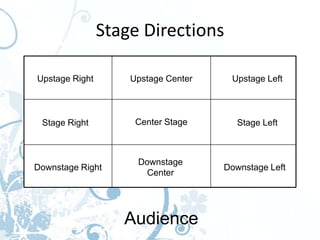
• We talk about the locations on stage from the actor’s
  point of view when they’re standing on the stage facing
  the audience. The actor’s right hand is stage right, etc.
  If the actor turns around and faces away from the
  audience, we don’t change the terminology.
• The part of the stage that is farthest from the audience
  is referred to as upstage, while the closest is
  downstage. This comes from a time when the stages
  were “raked,” which means they were built like a giant
  ramp that slanted uphill away from the audience. So if
  they walked away from the audience, they were
  literally going UP stage.
Stage Directions

Upstage Right       Upstage Center    Upstage Left


 Stage Right         Center Stage       Stage Left


                     Downstage
Downstage Right                      Downstage Left
                      Center


                   Audience
Stage Directions
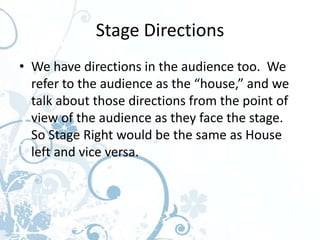
• We have directions in the audience too. We
  refer to the audience as the “house,” and we
  talk about those directions from the point of
  view of the audience as they face the stage.
  So Stage Right would be the same as House
  left and vice versa.
St-st-st-st-stages…


There is more than one kind of stage, and each
stage affects the performance, the staging, the
           acting and the audience.
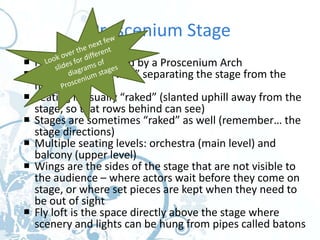
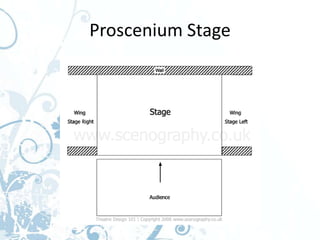
Proscenium Stage
 Formal stage framed by a Proscenium Arch
 Invisible “fourth wall” separating the stage from the
  house
 Seating is usually “raked” (slanted uphill away from the
  stage, so that rows behind can see)
 Stages are sometimes “raked” as well (remember… the
  stage directions)
 Multiple seating levels: orchestra (main level) and
  balcony (upper level)
 Wings are the sides of the stage that are not visible to
  the audience – where actors wait before they come on
  stage, or where set pieces are kept when they need to
  be out of sight
 Fly loft is the space directly above the stage where
  scenery and lights can be hung from pipes called batons
Proscenium Stage
Proscenium Stage


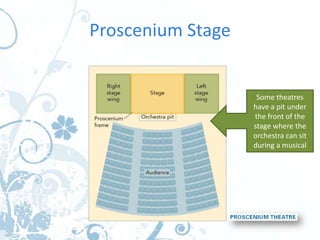
                    Some theatres
                   have a pit under
                   the front of the
                   stage where the
                   orchestra can sit
                   during a musical
Proscenium Stage with Apron


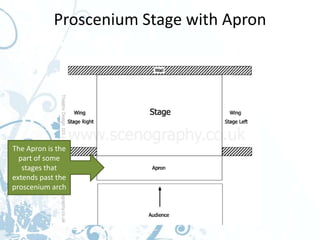
The Apron is the
  part of some
   stages that
extends past the
proscenium arch
Proscenium Stage


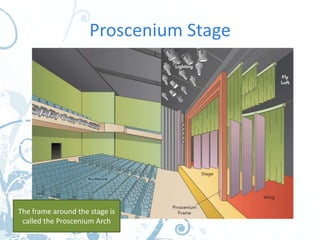
The frame around the stage is
 called the Proscenium Arch
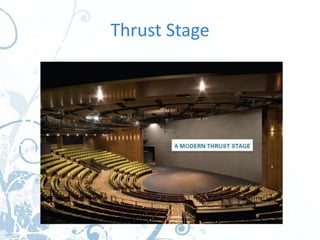
Thrust Stage
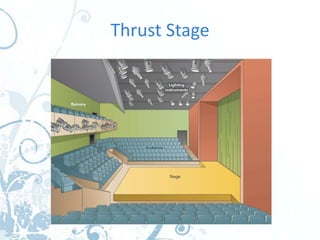
Thrust Stage
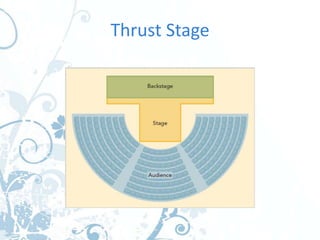
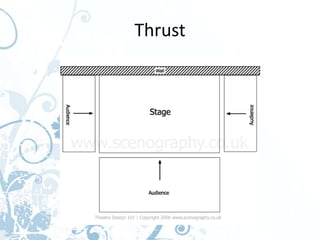
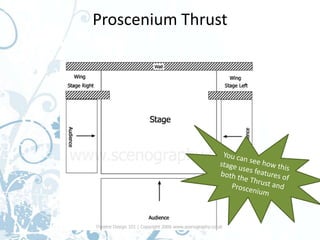
• The audience sits on three sides, or in a
  semicircle around a stage that thrusts out into
  the audience
• The kind of theatre the Greeks used
• Offers a sense of intimacy
• Limitations due to sightlines – since the
  audience is sitting on three sides, their view
  can be easily blocked by set pieces or even by
  actors
Thrust Stage
Thrust
Proscenium Thrust
Thrust Stage
Arena Stage
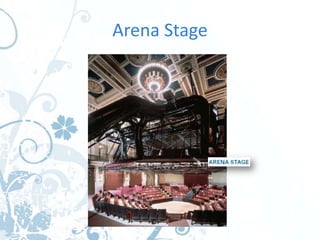
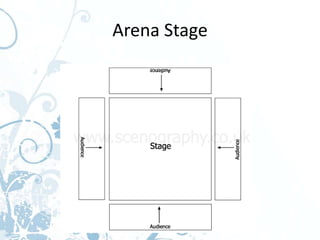
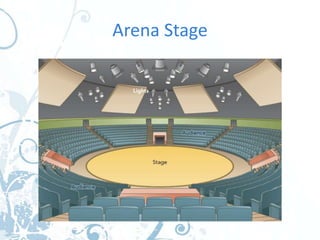
 Also called theatre-in-the-round
 Stage in the middle with the audience on all
  sides
 Even more intimate – audience can see each
  other
 Even more limitations on sightlines – there
  really can’t be any large set pieces or they’ll
  block everyone’s view of something
Arena Stage
Arena Stage
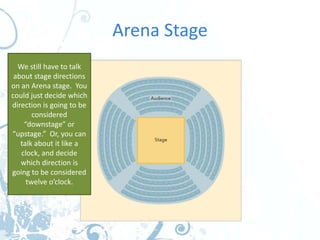
  We still have to talk
 about stage directions
on an Arena stage. You
could just decide which
direction is going to be
       considered
    “downstage” or
“upstage.” Or, you can
   talk about it like a
   clock, and decide
   which direction is
going to be considered
     twelve o’clock.
Arena Stage
Arena Stage
Flexible Spaces
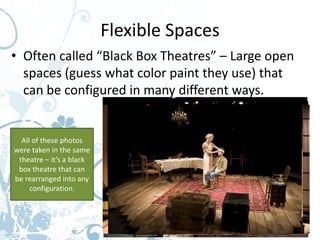
• Often called “Black Box Theatres” – Large open
  spaces (guess what color paint they use) that
  can be configured in many different ways.


  All of these photos
were taken in the same
 theatre – it’s a black
 box theatre that can
be rearranged into any
     configuration.
REALLY Flexible Theatre
Watch these videos about a very high tech space
that was build in Dallas a few years ago.
Imagine the possibilities of a theatre this
flexible...
• Dallas Theatre Center
• Time Lapsed Video of the DTC
Found Spaces
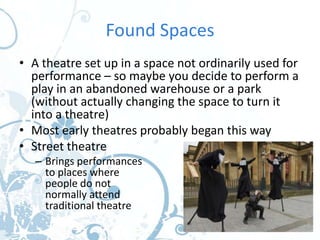
• A theatre set up in a space not ordinarily used for
  performance – so maybe you decide to perform a
  play in an abandoned warehouse or a park
  (without actually changing the space to turn it
  into a theatre)
• Most early theatres probably began this way
• Street theatre
   – Brings performances
     to places where
     people do not
     normally attend
     traditional theatre
Improv Everywhere
• Link 1                  Speaking of found spaces,
                        Theatre can happen any time,
• Link 2             anywhere. Sometimes it’s totally
                         scripted, and sometimes it’s
                     improvised on the spot – though
                        improv will still have a plan of
                      some sort. Check out these two
                      links from a group called Improv
                     Everywhere. You might call what
                         they do a flashmob… does a
                     flashmob count as theatre? Look
                     back at our criteria and see if you
                      think what they’re doing counts.
                     Plus… just enjoy! These guys are
                                 a lot of fun!
Site Specific
• Theatre performed in a place that is specific to
  the show itself
  – performing Marat/Sade or One Flew Over the
    Cuckoo’s
    Nest in an
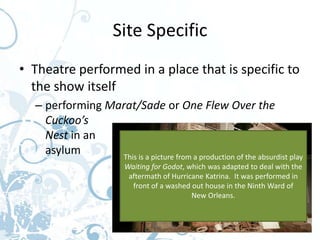
    asylum       This is a picture from a production of the absurdist play
                         Waiting for Godot, which was adapted to deal with the
                          aftermath of Hurricane Katrina. It was performed in
                           front of a washed out house in the Ninth Ward of
                                             New Orleans.
Commercial Theatre
• Broadway
  – Located in the Theatre District of Manhattan
  – 500+ seats
  – They spend big money and they charge big money for
    tickets
• Off-Broadway
  – Located in or near the Theatre District of Manhattan
  – 100-499 seats
  – More variety in terms of price, meaning they can be a
    little more accessible
• Tours
  – Large productions – usually originally from Broadway –
    that travel from city to city
Not-for-Profit Theatre
• Off-Off Broadway
  – Located in or near the Theatre District of Manhattan
  – <100 seats
  – More experimental, lower budget, opportunities for
    more artists to do more kinds of theatre
• Regional Theatre
  – In the 1940s, theatres began to sprout up outside of
    New York, all over the country
  – These are high-quality professional theaters, generally
    on par with the Off-Broadway theatres, but they are
    usually not-for-profit
Amateur Theatre
• Educational theatre
  – Associated with schools from kindergarten to
    university
  – In the university setting, these theatres set out to
    train theatre artists
• Community Theatre
  – Local entertainment and performance
    opportunities for community populations
  – The actors are not professional actors, they are
    just normal people from the community – this is
    more of a hobby

Online06 chapter4

  • 1.
    Where can wePerform? A place for everything…
  • 2.
    Do we needa theatre in order to do theatre?
  • 3.
    Stage Directions • Wetalk about the locations on stage from the actor’s point of view when they’re standing on the stage facing the audience. The actor’s right hand is stage right, etc. If the actor turns around and faces away from the audience, we don’t change the terminology. • The part of the stage that is farthest from the audience is referred to as upstage, while the closest is downstage. This comes from a time when the stages were “raked,” which means they were built like a giant ramp that slanted uphill away from the audience. So if they walked away from the audience, they were literally going UP stage.
  • 4.
    Stage Directions Upstage Right Upstage Center Upstage Left Stage Right Center Stage Stage Left Downstage Downstage Right Downstage Left Center Audience
  • 5.
    Stage Directions • Wehave directions in the audience too. We refer to the audience as the “house,” and we talk about those directions from the point of view of the audience as they face the stage. So Stage Right would be the same as House left and vice versa.
  • 6.
    St-st-st-st-stages… There is morethan one kind of stage, and each stage affects the performance, the staging, the acting and the audience.
  • 7.
    Proscenium Stage  Formalstage framed by a Proscenium Arch  Invisible “fourth wall” separating the stage from the house  Seating is usually “raked” (slanted uphill away from the stage, so that rows behind can see)  Stages are sometimes “raked” as well (remember… the stage directions)  Multiple seating levels: orchestra (main level) and balcony (upper level)  Wings are the sides of the stage that are not visible to the audience – where actors wait before they come on stage, or where set pieces are kept when they need to be out of sight  Fly loft is the space directly above the stage where scenery and lights can be hung from pipes called batons
  • 8.
  • 9.
    Proscenium Stage Some theatres have a pit under the front of the stage where the orchestra can sit during a musical
  • 10.
    Proscenium Stage withApron The Apron is the part of some stages that extends past the proscenium arch
  • 11.
    Proscenium Stage The framearound the stage is called the Proscenium Arch
  • 12.
  • 13.
    Thrust Stage • Theaudience sits on three sides, or in a semicircle around a stage that thrusts out into the audience • The kind of theatre the Greeks used • Offers a sense of intimacy • Limitations due to sightlines – since the audience is sitting on three sides, their view can be easily blocked by set pieces or even by actors
  • 14.
  • 15.
  • 16.
  • 17.
  • 18.
    Arena Stage  Alsocalled theatre-in-the-round  Stage in the middle with the audience on all sides  Even more intimate – audience can see each other  Even more limitations on sightlines – there really can’t be any large set pieces or they’ll block everyone’s view of something
  • 19.
  • 20.
    Arena Stage We still have to talk about stage directions on an Arena stage. You could just decide which direction is going to be considered “downstage” or “upstage.” Or, you can talk about it like a clock, and decide which direction is going to be considered twelve o’clock.
  • 21.
  • 22.
  • 23.
    Flexible Spaces • Oftencalled “Black Box Theatres” – Large open spaces (guess what color paint they use) that can be configured in many different ways. All of these photos were taken in the same theatre – it’s a black box theatre that can be rearranged into any configuration.
  • 24.
    REALLY Flexible Theatre Watchthese videos about a very high tech space that was build in Dallas a few years ago. Imagine the possibilities of a theatre this flexible... • Dallas Theatre Center • Time Lapsed Video of the DTC
  • 25.
    Found Spaces • Atheatre set up in a space not ordinarily used for performance – so maybe you decide to perform a play in an abandoned warehouse or a park (without actually changing the space to turn it into a theatre) • Most early theatres probably began this way • Street theatre – Brings performances to places where people do not normally attend traditional theatre
  • 26.
    Improv Everywhere • Link1 Speaking of found spaces, Theatre can happen any time, • Link 2 anywhere. Sometimes it’s totally scripted, and sometimes it’s improvised on the spot – though improv will still have a plan of some sort. Check out these two links from a group called Improv Everywhere. You might call what they do a flashmob… does a flashmob count as theatre? Look back at our criteria and see if you think what they’re doing counts. Plus… just enjoy! These guys are a lot of fun!
  • 27.
    Site Specific • Theatreperformed in a place that is specific to the show itself – performing Marat/Sade or One Flew Over the Cuckoo’s Nest in an asylum This is a picture from a production of the absurdist play Waiting for Godot, which was adapted to deal with the aftermath of Hurricane Katrina. It was performed in front of a washed out house in the Ninth Ward of New Orleans.
  • 28.
    Commercial Theatre • Broadway – Located in the Theatre District of Manhattan – 500+ seats – They spend big money and they charge big money for tickets • Off-Broadway – Located in or near the Theatre District of Manhattan – 100-499 seats – More variety in terms of price, meaning they can be a little more accessible • Tours – Large productions – usually originally from Broadway – that travel from city to city
  • 29.
    Not-for-Profit Theatre • Off-OffBroadway – Located in or near the Theatre District of Manhattan – <100 seats – More experimental, lower budget, opportunities for more artists to do more kinds of theatre • Regional Theatre – In the 1940s, theatres began to sprout up outside of New York, all over the country – These are high-quality professional theaters, generally on par with the Off-Broadway theatres, but they are usually not-for-profit
  • 30.
    Amateur Theatre • Educationaltheatre – Associated with schools from kindergarten to university – In the university setting, these theatres set out to train theatre artists • Community Theatre – Local entertainment and performance opportunities for community populations – The actors are not professional actors, they are just normal people from the community – this is more of a hobby