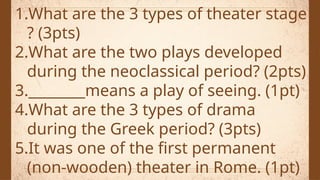
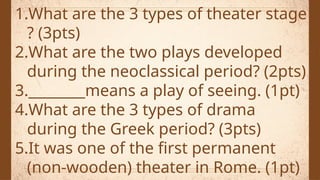
1.What are the3 types of theater stage
? (3pts)
2.What are the two plays developed
during the neoclassical period? (2pts)
3.________means a play of seeing. (1pt)
4.What are the 3 types of drama
during the Greek period? (3pts)
5.It was one of the first permanent
(non-wooden) theater in Rome. (1pt)
Identifies
selected
theatrical forms
from different
artperiods.
Design the
visual elements
and components
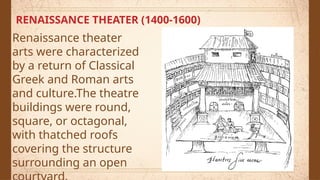
of a selected
Western
Classical theater
play and opera;
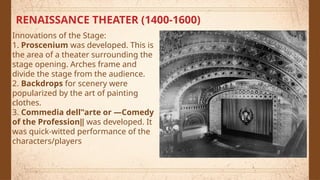
shows the influences
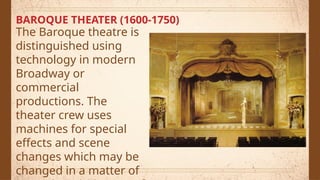
of the selected
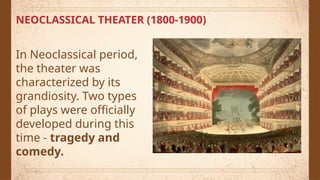
Western Classical play
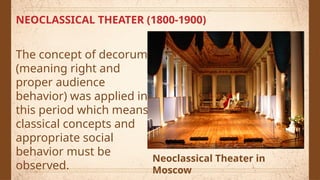
or opera on Philippine
theatrical
performance in terms
of form and content
of story.
01 02 03
LEARNING OBJECTIVES
6.
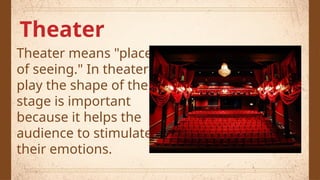
Theater
Theater means "place
ofseeing." In theater
play the shape of the
stage is important
because it helps the
audience to stimulate
their emotions.
7.
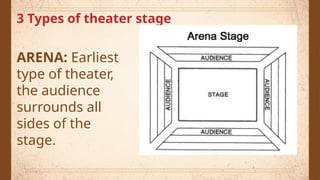
3 Types oftheater stage
ARENA: Earliest
type of theater,
the audience
surrounds all
sides of the
stage.
8.
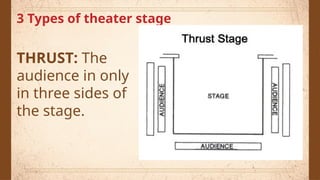
3 Types oftheater stage
THRUST: The
audience in only
in three sides of
the stage.
9.
3 Types oftheater stage
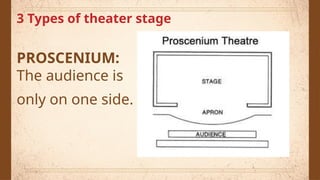
PROSCENIUM:
The audience is
only on one side.
10.
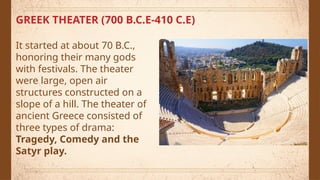
GREEK THEATER (700B.C.E-410 C.E)
It started at about 70 B.C.,
honoring their many gods
with festivals. The theater
were large, open air
structures constructed on a
slope of a hill. The theater of
ancient Greece consisted of
three types of drama:
Tragedy, Comedy and the
Satyr play.
11.
GREEK THEATER (700B.C.E-410 C.E)
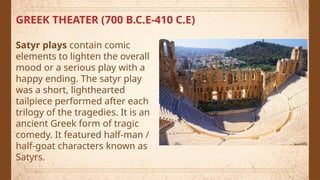
Satyr plays contain comic
elements to lighten the overall
mood or a serious play with a
happy ending. The satyr play
was a short, lighthearted
tailpiece performed after each
trilogy of the tragedies. It is an
ancient Greek form of tragic
comedy. It featured half-man /
half-goat characters known as
Satyrs.
12.
GREEK THEATER (700B.C.E-410 C.E)
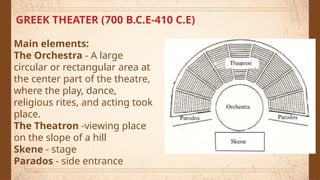
Main elements:
The Orchestra - A large
circular or rectangular area at
the center part of the theatre,
where the play, dance,
religious rites, and acting took
place.
The Theatron -viewing place
on the slope of a hill
Skene - stage
Parados - side entrance
13.
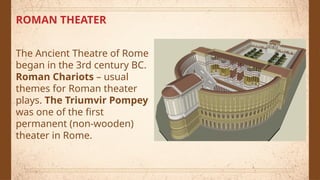
ROMAN THEATER
The AncientTheatre of Rome
began in the 3rd century BC.
Roman Chariots – usual
themes for Roman theater
plays. The Triumvir Pompey
was one of the first
permanent (non-wooden)
theater in Rome.
14.
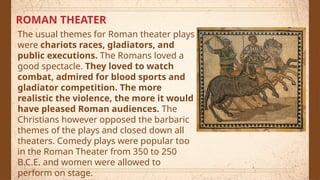
ROMAN THEATER
The usualthemes for Roman theater plays
were chariots races, gladiators, and
public executions. The Romans loved a
good spectacle. They loved to watch
combat, admired for blood sports and
gladiator competition. The more
realistic the violence, the more it would
have pleased Roman audiences. The
Christians however opposed the barbaric
themes of the plays and closed down all
theaters. Comedy plays were popular too
in the Roman Theater from 350 to 250
B.C.E. and women were allowed to
perform on stage.
15.
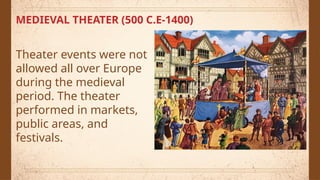
MEDIEVAL THEATER (500C.E-1400)
Theater events were not
allowed all over Europe
during the medieval
period. The theater
performed in markets,
public areas, and
festivals.
16.
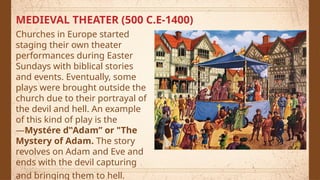
MEDIEVAL THEATER (500C.E-1400)
Churches in Europe started
staging their own theater
performances during Easter
Sundays with biblical stories
and events. Eventually, some
plays were brought outside the
church due to their portrayal of
the devil and hell. An example
of this kind of play is the
―Mystére d‟Adam” or "The
Mystery of Adam. The story
revolves on Adam and Eve and
ends with the devil capturing
and bringing them to hell.
17.
RENAISSANCE THEATER (1400-1600)
Renaissancetheater
arts were characterized
by a return of Classical
Greek and Roman arts
and culture.The theatre
buildings were round,
square, or octagonal,
with thatched roofs
covering the structure
surrounding an open
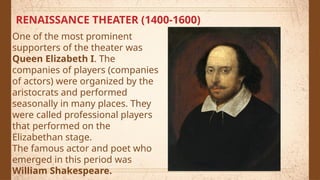
RENAISSANCE THEATER (1400-1600)
Oneof the most prominent
supporters of the theater was
Queen Elizabeth I. The
companies of players (companies
of actors) were organized by the
aristocrats and performed
seasonally in many places. They
were called professional players
that performed on the
Elizabethan stage.
The famous actor and poet who
emerged in this period was
William Shakespeare.
20.
RENAISSANCE THEATER (1400-1600)
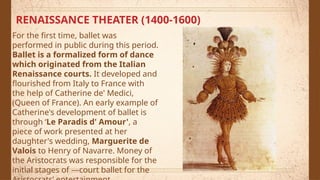
Forthe first time, ballet was
performed in public during this period.
Ballet is a formalized form of dance
which originated from the Italian
Renaissance courts. It developed and
flourished from Italy to France with
the help of Catherine de' Medici,
(Queen of France). An early example of
Catherine's development of ballet is
through ‘Le Paradis d' Amour', a
piece of work presented at her
daughter's wedding, Marguerite de
Valois to Henry of Navarre. Money of
the Aristocrats was responsible for the
initial stages of ―court ballet for the
21.
RENAISSANCE THEATER (1400-1600)
Innovationsof the Stage:
1. Proscenium was developed. This is
the area of a theater surrounding the
stage opening. Arches frame and
divide the stage from the audience.
2. Backdrops for scenery were
popularized by the art of painting
clothes.
3. Commedia dell‟arte or ―Comedy
of the Profession‖ was developed. It
was quick-witted performance of the
characters/players
22.
BAROQUE THEATER (1600-1750)
TheBaroque theatre is
distinguished using
technology in modern
Broadway or
commercial
productions. The
theater crew uses
machines for special
effects and scene
changes which may be
changed in a matter of
23.
NEOCLASSICAL THEATER (1800-1900)
InNeoclassical period,
the theater was
characterized by its
grandiosity. Two types
of plays were officially
developed during this
time - tragedy and
comedy.
24.
NEOCLASSICAL THEATER (1800-1900)
Theconcept of decorum
(meaning right and
proper audience
behavior) was applied in
this period which means
classical concepts and
appropriate social
behavior must be
observed.
Neoclassical Theater in
Moscow
25.
NEOCLASSICAL THEATER (1800-1900)
Threeplaywrights achieved a significant amount of
success. Pierre Cornielle (1606 – 1684) was often
called the father of the French tragedy, writing
scripts for more than four decades. One of these was
“The Cid. Jean Baptiste Poquelin, better known as
Molière (1622 – 1673) was known for his comedies,
“Tartuffe and The Missanthrope was one of his works.
Jean Racine (1639 – 1699) was a tragedian beloved
for his simple approach to action and the linguistic
rhythms and effects he achieved. ―Andromache and
26.
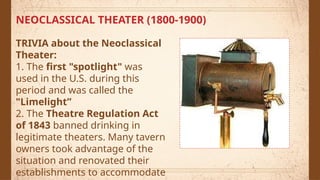
NEOCLASSICAL THEATER (1800-1900)
TRIVIAabout the Neoclassical
Theater:
1. The first "spotlight" was
used in the U.S. during this
period and was called the
"Limelight”
2. The Theatre Regulation Act
of 1843 banned drinking in
legitimate theaters. Many tavern
owners took advantage of the
situation and renovated their
establishments to accommodate
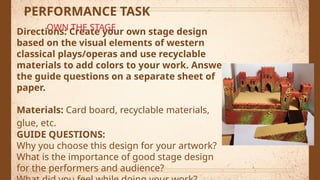
Directions: Create yourown stage design
based on the visual elements of western
classical plays/operas and use recyclable
materials to add colors to your work. Answer
the guide questions on a separate sheet of
paper.
Materials: Card board, recyclable materials,
glue, etc.
GUIDE QUESTIONS:
Why you choose this design for your artwork?
What is the importance of good stage design
for the performers and audience?
PERFORMANCE TASK
OWN THE STAGE
29.
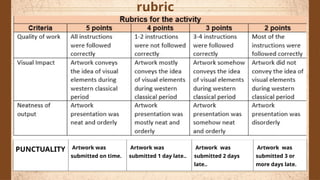
rubric
PUNCTUALITY Artwork was
submittedon time.
Artwork was
submitted 1 day late..
Artwork was
submitted 2 days
late..
Artwork was
submitted 3 or
more days late.
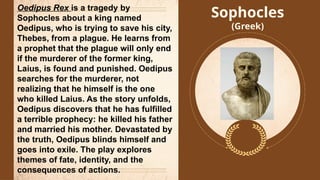
Sophocles
(Greek)
Oedipus Rex isa tragedy by
Sophocles about a king named
Oedipus, who is trying to save his city,
Thebes, from a plague. He learns from
a prophet that the plague will only end
if the murderer of the former king,
Laius, is found and punished. Oedipus
searches for the murderer, not
realizing that he himself is the one
who killed Laius. As the story unfolds,
Oedipus discovers that he has fulfilled
a terrible prophecy: he killed his father
and married his mother. Devastated by
the truth, Oedipus blinds himself and
goes into exile. The play explores
themes of fate, identity, and the
consequences of actions.
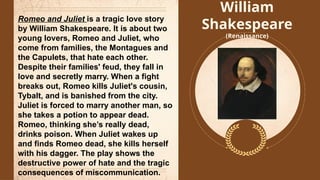
32.
William
Shakespeare
(Renaissance)
Romeo and Julietis a tragic love story
by William Shakespeare. It is about two
young lovers, Romeo and Juliet, who
come from families, the Montagues and
the Capulets, that hate each other.
Despite their families' feud, they fall in
love and secretly marry. When a fight
breaks out, Romeo kills Juliet's cousin,
Tybalt, and is banished from the city.
Juliet is forced to marry another man, so
she takes a potion to appear dead.
Romeo, thinking she’s really dead,
drinks poison. When Juliet wakes up
and finds Romeo dead, she kills herself
with his dagger. The play shows the
destructive power of hate and the tragic
consequences of miscommunication.
33.
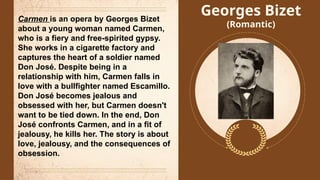
Georges Bizet
(Romantic)
Carmen isan opera by Georges Bizet
about a young woman named Carmen,
who is a fiery and free-spirited gypsy.
She works in a cigarette factory and
captures the heart of a soldier named
Don José. Despite being in a
relationship with him, Carmen falls in
love with a bullfighter named Escamillo.
Don José becomes jealous and
obsessed with her, but Carmen doesn't
want to be tied down. In the end, Don
José confronts Carmen, and in a fit of
jealousy, he kills her. The story is about
love, jealousy, and the consequences of
obsession.
1.What are the3 types of theater stage
? (3pts)
2.What are the two plays developed
during the neoclassical period? (2pts)
3.________means a play of seeing. (1pt)
4.What are the 3 types of drama
during the Greek period? (3pts)
5.It was one of the first permanent
(non-wooden) theater in Rome. (1pt)
41.
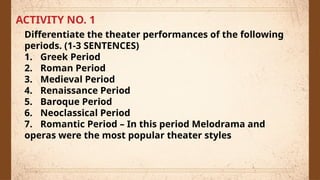
ACTIVITY NO. 1
Differentiatethe theater performances of the following
periods. (1-3 SENTENCES)
1. Greek Period
2. Roman Period
3. Medieval Period
4. Renaissance Period
5. Baroque Period
6. Neoclassical Period
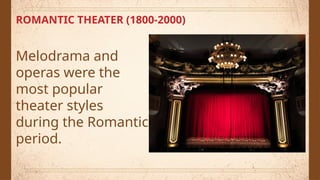
7. Romantic Period – In this period Melodrama and
operas were the most popular theater styles
#11 A Satyr play was a type of ancient Greek comedy performed after three serious tragic plays. It was lighthearted and funny, meant to give the audience a break from all the sadness and drama. The characters in these plays were often Satyrs, which were mythological creatures that looked like half-man, half-goat. They were wild, playful, and sometimes mischievous. These plays had lots of silly, funny, and sometimes rude humor, poking fun at gods, heroes, and the serious themes of the tragedies.
In short, Satyr plays were funny and entertaining, with a bit of wild, goofy fun!
#14 Roman chariots were two-wheeled vehicles pulled by horses, used mainly in races and battles. In chariot races, the Romans would compete in large arenas called circuses (the most famous being the Circus Maximus). The chariots were small, lightweight, and fast, designed for speed and maneuverability. Chariot racing was a popular sport in ancient Rome and often very dangerous.
In battles, Roman chariots were used for quick attacks and scouting, but they weren't as important in warfare as they were in earlier times, like in ancient Egypt or Greece.
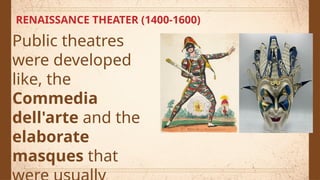
#18 Commedia dell'arte (Italian comedy and a humorous theatrical presentation performed by professional players who traveled in troupes)
elaborate masques (a dramatic entertainment consisting of pantomime, dancing, dialogue, and song and sometimes players wore masks)
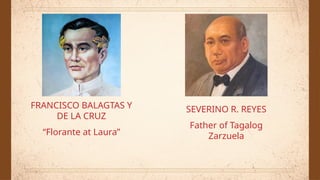
#35 Balagtas learned to write poetry from José de la Cruz (Huseng Sisiw), one of the most famous poets of Tondo. It was de la Cruz himself who personally challenged Balagtas to improve his writing.
Balagtas published Florante at Laura upon his release in 1838. He moved to Balanga, Bataan in 1840 where he served as the assistant to the Justice of the peace and later, in 1856, as the Major Lieutenant.
Balagtas is so greatly revered in the Philippines that the term for Filipino debate in extemporaneous verse is named after him: Balagtasan and one of the greatest literary awards in the Philippines is also named after him.
Florante at Laura is a Filipino epic written by Francisco Balagtas. It tells the story of Florante, a brave prince, and his love for Princess Laura. Florante is betrayed by his best friend, Aladin, and locked in a dark forest. Meanwhile, Laura is trapped in her kingdom by an evil ruler named Sultan Ali-Adab. Despite their struggles and enemies, Florante and Laura's love remains strong. With the help of friends and bravery, they fight to reunite. The story highlights love, loyalty, betrayal, and courage.
On June 14, 1902, the company staged his play Walang Sugat (No Wounds), a drama set against the historical events in Bulacan during the Philippine revolution.
In 1923, Reyes co-founded the Liwayway, a Tagalog literary weekly which published a series of fairy tales titled ― Mga Kuwento ni Lola Basyang, written by Reyes. The storyteller, Lola Basyang was based by the author on a neighbor named Gervacia de Guzman.
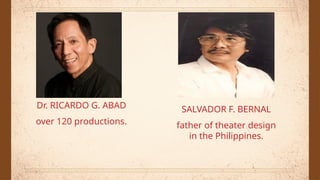
#36 Has been involved as actor and director in over 120 productions while at the same time doing sociological work as teacher, researcher, and editor. He has also directed and acted for professional companies like Teatro Pilipino and Tanghalang Pilipino of the Cultural Center of the Philippines, and the Metropolitan Theater.