Modern Portfolio Theory
EFFICIENT PORTFOLIO
• An efficient portfolio is a portfolio maximize the expected return with
a certain level of risk that is willing underwritten, or portfolio that
offers the lowest risk with a certain rate of return.
• Smallest portfolio risk for a given level of expected return
• Largest expected return for a given level of portfolio risk
• From the set of all possible portfolios
• Only locate and analyze the subset known as the efficient set
• Lowest risk for given level of return
• All other portfolios in attainable set are dominated by efficient set
• Global minimum variance portfolio
• Smallest risk of the efficient set of portfolios
• Efficient set
• Part of the efficient frontier with greater risk than the global minimum
variance portfolio
7-4
x
B
A
C
y
Risk = 
E(R)
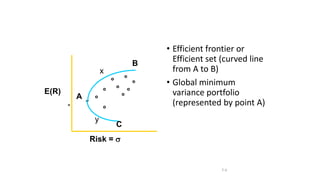
• Efficient frontier or
Efficient set (curved line
from A to B)
• Global minimum
variance portfolio
(represented by point A)
OPTIMUM PORTFOLIO
• The optimal portfolio is a portfolio chosen by investors from many the
choices that are in the collection efficient portfolio.
• The portfolio chosen by investors is portfolio according to preference
the investor is concerned with return and against willing risks bear.
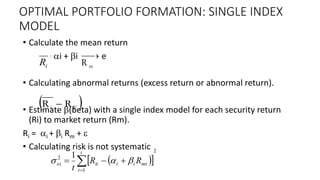
OPTIMAL PORTFOLIO FORMATION: SINGLE INDEX
MODEL
• Calculate the mean return
= i + i + e
• Calculating abnormal returns (excess return or abnormal return).
• Estimate (beta) with a single index model for each security return
(Ri) to market return (Rm).
Ri = i + i Rm + 
• Calculating risk is not systematic
iR mR
 Fi RR 
  
2
1
2 1


t
t
mtiiitei RR
t

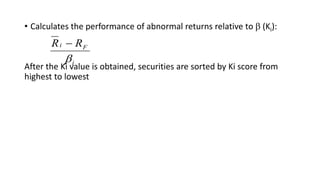
• Calculates the performance of abnormal returns relative to  (Ki):
After the Ki value is obtained, securities are sorted by Ki score from
highest to lowest
i
Fi RR


MARKOWITZ PORTFOLIO MODEL
• Portfolio theory with the Markowitz model based on three
assumptions, namely:
• Single investment period, for example 1 year.
• There are no transaction fees.
• Investor preferences are just based on expected returns and risks.
• Markowitz Diversification
• Non-random diversification
• Active measurement and management of portfolio risk
• Investigate relationships between portfolio securities before making a decision to invest
• Takes advantage of expected return and risk for individual securities and how security
returns move together
• Simplifying Markowitz Calculations
• Markowitz full-covariance model
• Requires a covariance between the returns of all securities in order to calculate portfolio
variance
• n(n-1)/2 set of covariances for n securities
• Markowitz suggests using an index to which all securities are related to
simplify
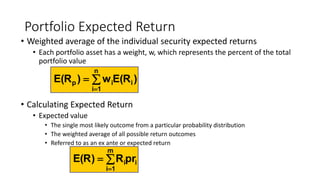
Portfolio Expected Return
• Weighted average of the individual security expected returns
• Each portfolio asset has a weight, w, which represents the percent of the total
portfolio value
• Calculating Expected Return
• Expected value
• The single most likely outcome from a particular probability distribution
• The weighted average of all possible return outcomes
• Referred to as an ex ante or expected return



n
1i
iip )R(Ew)R(E
i
m
1i
iprR)R(E 


Portfolio Risk
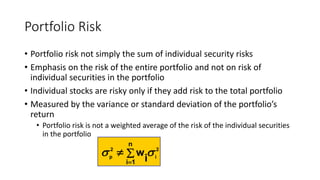
• Portfolio risk not simply the sum of individual security risks
• Emphasis on the risk of the entire portfolio and not on risk of
individual securities in the portfolio
• Individual stocks are risky only if they add risk to the total portfolio
• Measured by the variance or standard deviation of the portfolio’s
return
• Portfolio risk is not a weighted average of the risk of the individual securities
in the portfolio
2
i
2
p
n
1i i
w  


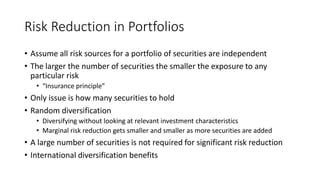
Risk Reduction in Portfolios
• Assume all risk sources for a portfolio of securities are independent
• The larger the number of securities the smaller the exposure to any
particular risk
• “Insurance principle”
• Only issue is how many securities to hold
• Random diversification
• Diversifying without looking at relevant investment characteristics
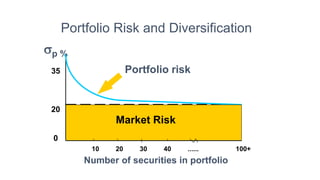
• Marginal risk reduction gets smaller and smaller as more securities are added
• A large number of securities is not required for significant risk reduction
• International diversification benefits
Portfolio Risk and Diversification
p %
35
20
0
Number of securities in portfolio
10 20 30 40 ...... 100+
Portfolio risk
Market Risk
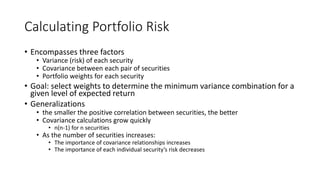
Calculating Portfolio Risk
• Encompasses three factors
• Variance (risk) of each security
• Covariance between each pair of securities
• Portfolio weights for each security
• Goal: select weights to determine the minimum variance combination for a
given level of expected return
• Generalizations
• the smaller the positive correlation between securities, the better
• Covariance calculations grow quickly
• n(n-1) for n securities
• As the number of securities increases:
• The importance of covariance relationships increases
• The importance of each individual security’s risk decreases
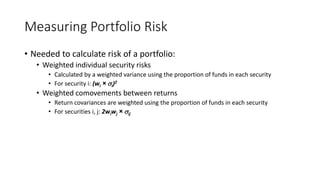
Measuring Portfolio Risk
• Needed to calculate risk of a portfolio:
• Weighted individual security risks
• Calculated by a weighted variance using the proportion of funds in each security
• For security i: (wi × i)2
• Weighted comovements between returns
• Return covariances are weighted using the proportion of funds in each security
• For securities i, j: 2wiwj × ij

Modern portfolio theory

  • 1.
  • 2.
    EFFICIENT PORTFOLIO • Anefficient portfolio is a portfolio maximize the expected return with a certain level of risk that is willing underwritten, or portfolio that offers the lowest risk with a certain rate of return. • Smallest portfolio risk for a given level of expected return • Largest expected return for a given level of portfolio risk • From the set of all possible portfolios • Only locate and analyze the subset known as the efficient set • Lowest risk for given level of return
  • 3.
    • All otherportfolios in attainable set are dominated by efficient set • Global minimum variance portfolio • Smallest risk of the efficient set of portfolios • Efficient set • Part of the efficient frontier with greater risk than the global minimum variance portfolio
  • 4.
    7-4 x B A C y Risk =  E(R) •Efficient frontier or Efficient set (curved line from A to B) • Global minimum variance portfolio (represented by point A)
  • 5.
    OPTIMUM PORTFOLIO • Theoptimal portfolio is a portfolio chosen by investors from many the choices that are in the collection efficient portfolio. • The portfolio chosen by investors is portfolio according to preference the investor is concerned with return and against willing risks bear.
  • 6.
    OPTIMAL PORTFOLIO FORMATION:SINGLE INDEX MODEL • Calculate the mean return = i + i + e • Calculating abnormal returns (excess return or abnormal return). • Estimate (beta) with a single index model for each security return (Ri) to market return (Rm). Ri = i + i Rm +  • Calculating risk is not systematic iR mR  Fi RR     2 1 2 1   t t mtiiitei RR t 
  • 7.
    • Calculates theperformance of abnormal returns relative to  (Ki): After the Ki value is obtained, securities are sorted by Ki score from highest to lowest i Fi RR  
  • 8.
    MARKOWITZ PORTFOLIO MODEL •Portfolio theory with the Markowitz model based on three assumptions, namely: • Single investment period, for example 1 year. • There are no transaction fees. • Investor preferences are just based on expected returns and risks. • Markowitz Diversification • Non-random diversification • Active measurement and management of portfolio risk • Investigate relationships between portfolio securities before making a decision to invest • Takes advantage of expected return and risk for individual securities and how security returns move together
  • 9.
    • Simplifying MarkowitzCalculations • Markowitz full-covariance model • Requires a covariance between the returns of all securities in order to calculate portfolio variance • n(n-1)/2 set of covariances for n securities • Markowitz suggests using an index to which all securities are related to simplify
  • 10.
    Portfolio Expected Return •Weighted average of the individual security expected returns • Each portfolio asset has a weight, w, which represents the percent of the total portfolio value • Calculating Expected Return • Expected value • The single most likely outcome from a particular probability distribution • The weighted average of all possible return outcomes • Referred to as an ex ante or expected return    n 1i iip )R(Ew)R(E i m 1i iprR)R(E   
  • 11.
    Portfolio Risk • Portfoliorisk not simply the sum of individual security risks • Emphasis on the risk of the entire portfolio and not on risk of individual securities in the portfolio • Individual stocks are risky only if they add risk to the total portfolio • Measured by the variance or standard deviation of the portfolio’s return • Portfolio risk is not a weighted average of the risk of the individual securities in the portfolio 2 i 2 p n 1i i w    
  • 12.
    Risk Reduction inPortfolios • Assume all risk sources for a portfolio of securities are independent • The larger the number of securities the smaller the exposure to any particular risk • “Insurance principle” • Only issue is how many securities to hold • Random diversification • Diversifying without looking at relevant investment characteristics • Marginal risk reduction gets smaller and smaller as more securities are added • A large number of securities is not required for significant risk reduction • International diversification benefits
  • 13.
    Portfolio Risk andDiversification p % 35 20 0 Number of securities in portfolio 10 20 30 40 ...... 100+ Portfolio risk Market Risk
  • 14.
    Calculating Portfolio Risk •Encompasses three factors • Variance (risk) of each security • Covariance between each pair of securities • Portfolio weights for each security • Goal: select weights to determine the minimum variance combination for a given level of expected return • Generalizations • the smaller the positive correlation between securities, the better • Covariance calculations grow quickly • n(n-1) for n securities • As the number of securities increases: • The importance of covariance relationships increases • The importance of each individual security’s risk decreases
  • 15.
    Measuring Portfolio Risk •Needed to calculate risk of a portfolio: • Weighted individual security risks • Calculated by a weighted variance using the proportion of funds in each security • For security i: (wi × i)2 • Weighted comovements between returns • Return covariances are weighted using the proportion of funds in each security • For securities i, j: 2wiwj × ij